engine MERCEDES-BENZ SPRINTER 2012 MY12 Operator’s Manual
[x] Cancel search | Manufacturer: MERCEDES-BENZ, Model Year: 2012, Model line: SPRINTER, Model: MERCEDES-BENZ SPRINTER 2012Pages: 292, PDF Size: 6.75 MB
Page 222 of 292
Always have maintenance work carried out at a qualified specialist workshop. The qualified
specialist workshop must have the necessary specialist knowledge and tools to carry out the
work required.
We
recommend visiting an authorized Sprinter Dealer. In particular, work relevant
to safety or on safety-related systems must be carried out at a qualified specialist workshop. Problem Possible causes/consequences and
0050 SolutionsThe windshield wipers
are jammed. The wiper movement is obstructed, e.g. by leaves or snow. The
wiper motor has been deactivated.
X
Stop the
vehicle as soon as possible. For safety reasons, remove
the key from the ignition lock.
X Remove the cause of the obstruction.
X Switch on the windshield wipers again. The windshield wipers
have stopped working
completely. There is a malfunction in the windshield wiper drive.
X
Select another wiper speed on the combination switch.
X Have the windshield wipers checked at a qualified specialist
workshop. Fuel and fuel tank
G
Warning
The operating safety of your vehicle could be jeopardized if maintenance work is carried out
incorrectly. As a
result, you could lose control of the vehicle and cause an accident. In addition,
the safety systems may no longer be able to protect you or others as they are designed to do.
Always have maintenance work carried out at a qualified specialist workshop. The qualified
specialist workshop must have the necessary specialist knowledge and tools to carry out the
work required. We recommend visiting an authorized Sprinter Dealer. In particular, work relevant
to safety or on safety-related systems must be carried out at a qualified specialist workshop. Problem Possible causes/consequences and
0050 SolutionsThe fuel tank has run
completely dry. There is air in the fuel system.
X
Bleed the fuel system . Fuel is
leaking from the
vehicle. G
Warning!
The fuel line or the fuel tank is damaged.
Leaking fuel creates a risk of fire or explosion.
X Switch off the ignition immediately.
X Remove the key from the ignition lock.
X Do not restart the engine under any circumstances.
X Consult a qualified specialist workshop.220
Troubleshooting
Practical advice
Page 223 of 292
Engine
Draining the fuel filter
If the 00BA
indicator lamp lights up, you must
drain the fuel filter.
! When the 00BA indicator lamp lights up,
drain the fuel filter with water separator
immediately. Otherwise, the engine may be
damaged.
0040Environmental note
When handling, storing and disposing of
diesel and diesel mixtures, please observe
the relevant regulations.
To this end, have the fuel filter with water
separator drained at a qualified specialist
workshop which
has
the necessary specialist
knowledge and tools to carry out the work
required, e.g. an authorized Sprinter Dealer.
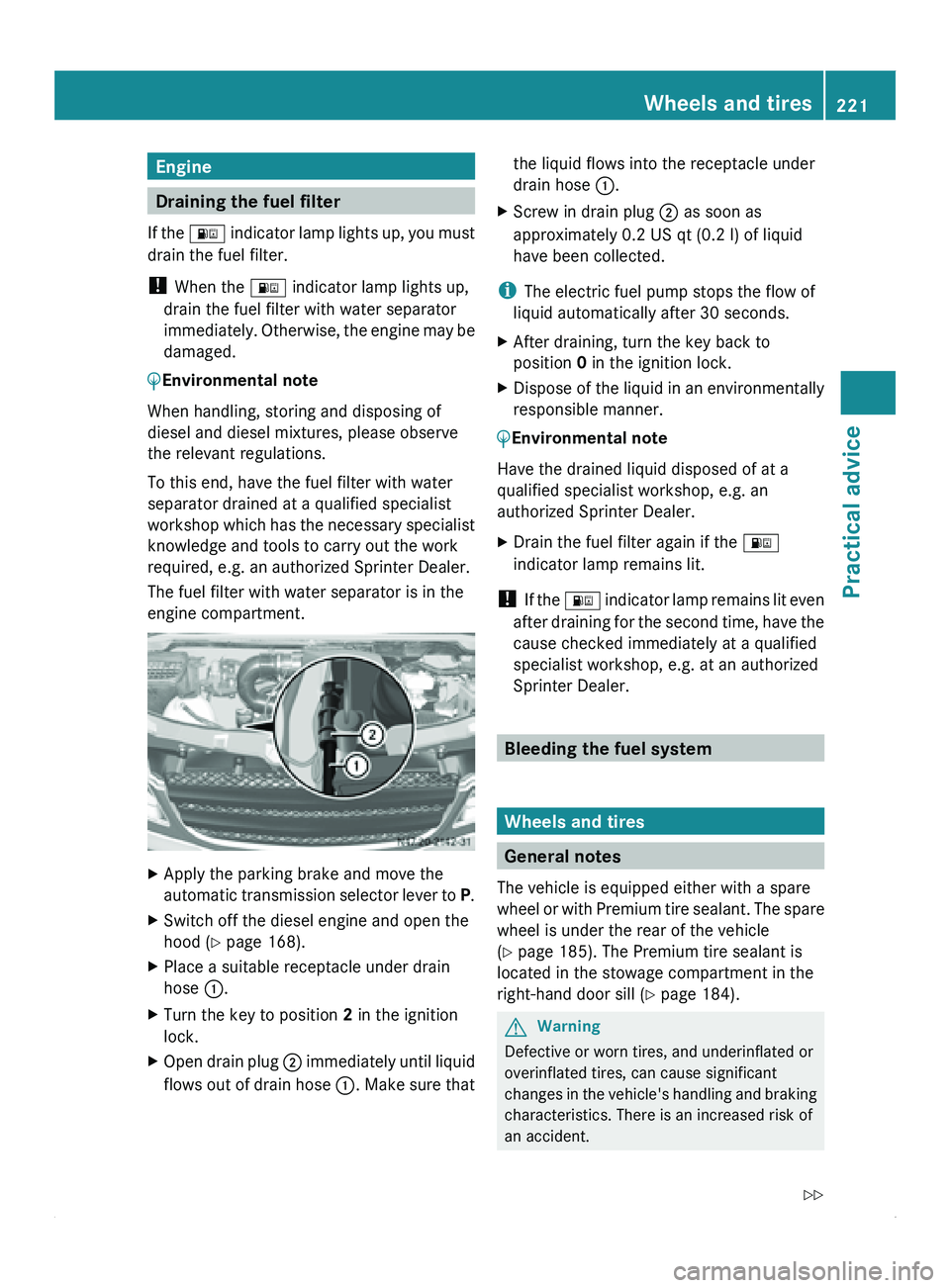
The fuel filter with water separator is in the
engine compartment. X
Apply the parking brake and move the
automatic
transmission selector
lever to P.
X Switch off the diesel engine and open the
hood ( Y page 168).
X Place a suitable receptacle under drain
hose 0046.
X Turn the key to position 2 in the ignition
lock.
X Open drain plug 0047
immediately until
liquid
flows out of drain hose 0046. Make sure that the liquid flows into the receptacle under
drain hose
0046.
X Screw in drain plug 0047 as soon as
approximately 0.2 US qt (0.2 l) of liquid have been collected.
i The electric fuel pump stops the flow of
liquid automatically after 30 seconds.
X After draining, turn the key back to
position
0 in the ignition lock.
X Dispose of the liquid in an environmentally
responsible manner.
0040Environmental note
Have the drained liquid disposed of at a
qualified specialist workshop, e.g. an
authorized Sprinter Dealer.
X Drain the fuel filter again if the 00BA
indicator lamp remains lit.
! If the
00BA
indicator lamp remains lit even
after draining for the second time, have the
cause checked immediately at a qualified
specialist workshop, e.g. at an authorized
Sprinter Dealer. Bleeding the fuel system
Wheels and tires
General notes
The vehicle is equipped either with a spare
wheel or with
Premium tire sealant. The spare
wheel is under the rear of the vehicle
(Y page 185). The Premium tire sealant is
located in the stowage compartment in the
right-hand door sill ( Y page 184). G
Warning
Defective or worn tires, and underinflated or
overinflated tires, can cause significant
changes in the
vehicle's handling and braking
characteristics. There is an increased risk of
an accident. Wheels and tires
221
Practical advice
Z
Page 226 of 292
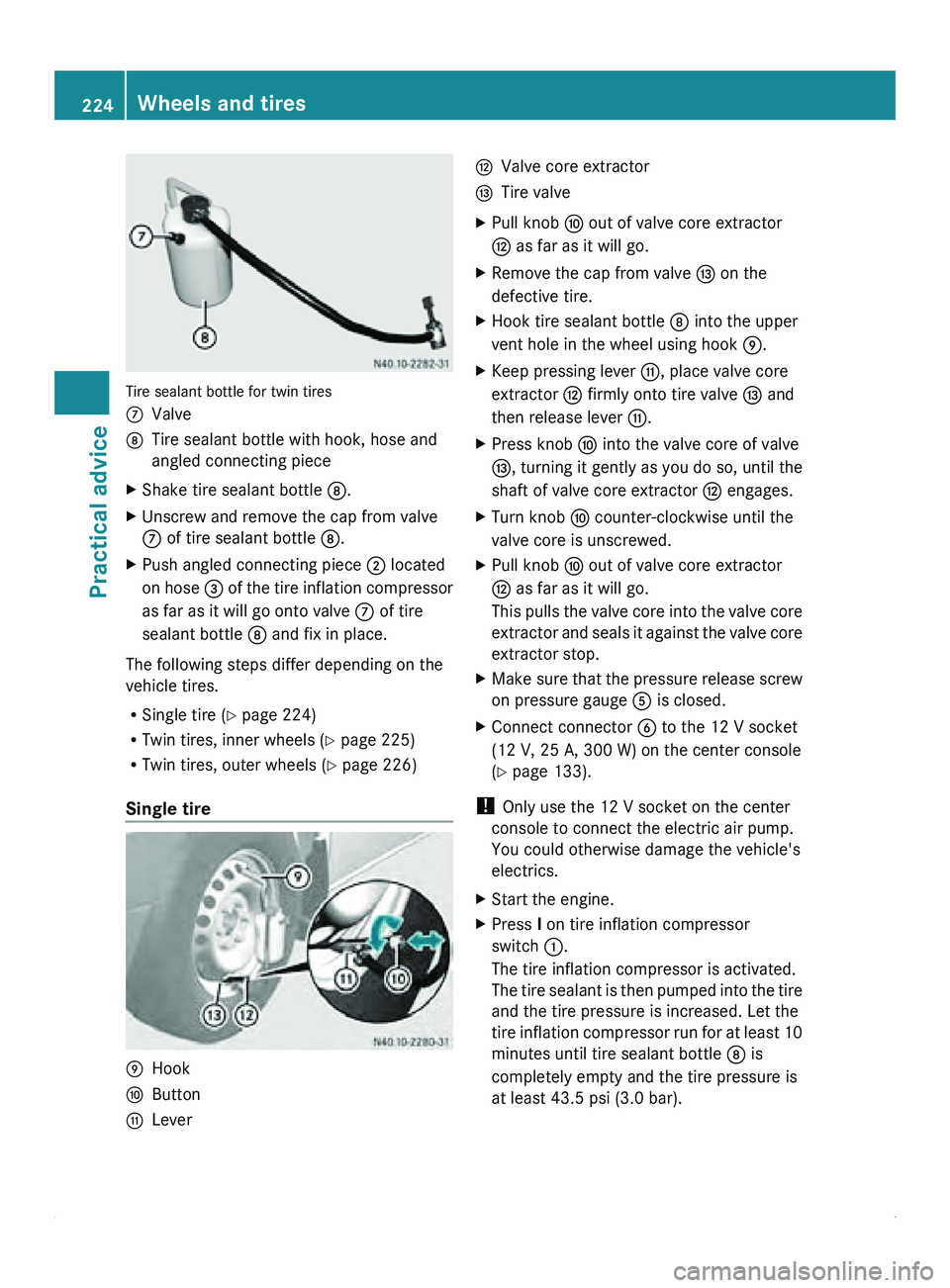
Tire sealant bottle for twin tires
006E
Valve
006F Tire sealant bottle with hook, hose and
angled connecting piece
X Shake tire sealant bottle 006F.
X Unscrew and remove the cap from valve
006E of tire sealant bottle 006F.
X Push angled connecting piece 0047 located
on hose 008A
of the tire inflation compressor
as far as it will go onto valve 006E of tire
sealant bottle 006F and fix in place.
The following steps differ depending on the
vehicle tires.
R Single tire (Y page 224)
R Twin tires, inner wheels ( Y page 225)
R Twin tires, outer wheels (
Y page 226)
Single tire 0070
Hook
0071 Button
0072 Lever 0073
Valve core extractor
0074 Tire valve
X Pull knob 0071 out of valve core extractor
0073 as far as it will go.
X Remove the cap from valve 0074 on the
defective tire.
X Hook tire sealant bottle 006F into the upper
vent hole in the wheel using hook 0070.
X Keep pressing lever 0072, place valve core
extractor 0073 firmly onto tire valve 0074 and
then release lever 0072.
X Press knob 0071 into the valve core of valve
0074, turning it gently as you do so, until the
shaft of valve core extractor 0073 engages.
X Turn knob 0071 counter-clockwise until the
valve core is unscrewed.
X Pull knob 0071 out of valve core extractor
0073 as far as it will go.
This pulls
the
valve core into the valve core
extractor and seals it against the valve core
extractor stop.
X Make sure that the pressure release screw
on pressure gauge 0086 is closed.
X Connect connector 0087 to the 12 V socket
(12 V, 25 A, 300 W) on the center console
(Y page 133).
! Only use the 12 V socket on the center
console to connect the electric air pump.
You could otherwise damage the vehicle's
electrics.
X Start the engine.
X Press I on tire inflation compressor
switch 0046.
The tire inflation compressor is activated.
The tire sealant
is then pumped into the tire
and the tire pressure is increased. Let the
tire inflation compressor run for at least 10
minutes until tire sealant bottle 006F is
completely empty and the tire pressure is
at least 43.5 psi (3.0 bar). 224
Wheels and tires
Practical advice
Page 228 of 292
X
Hook tire sealant bottle 006F into the upper
vent hole in the wheel using hook 0072.
X Push angled connecting piece 0074 located
on the hose of tire sealant filler bottle 006F
as far
as
it will go on to valve core extractor
0071 and fix it in place.
X Make sure that the pressure release screw
on pressure gauge 0086 is closed.
X Connect connector 0087 to the 12 V socket
(12 V, 25 A, 300 W) on the center console
(Y page 133).
! Only use the 12 V socket on the center
console to connect the electric air pump.
You could otherwise damage the vehicle's
electrics.
X Start the engine.
X Press I on tire inflation compressor
switch 0046.
The tire inflation compressor is activated.
The tire
sealant
is then pumped into the tire
and the tire pressure is increased. Let the
tire inflation compressor run for at least 10
minutes until tire sealant bottle 006F is
completely empty and the tire pressure is
at least 43.5 psi (3.0 bar).
! Do not
run
the electric air pump for longer
than 20 minutes without a break; otherwise
it may overheat.
The air pump can be used again once it has
cooled down.
X Inflate the tire using the tire inflation
compressor until the recommended tire
pressure ( Y page 281) is reached.
X Then, press 0 on tire inflation compressor
switch 0046.
The tire inflation compressor is
deactivated.
X Slide knob 0073 quickly to the stop in valve
core extractor 0071.
X Turn knob 0073 clockwise
until
the valve core
is firmly screwed into tire valve 0075.i
Do not pull the valve core extractor from
the tire valve while the valve core is
unscrewed from the
tire valve. Tire sealant
could otherwise escape and make you
dirty.
The tire sealant is water-soluble. If tire
sealant escapes, you can wash it away with
water.
X Pull knob 0073 out of valve core extractor
0071 as far as it will go.
X Unscrew valve core extractor 0071 counter-
clockwise from tire valve 0075.
X Screw valve extension 0070 onto tire valve
0075 and tighten it.
X Screw the valve cap onto valve extension
0070.
After filling with tire sealant, ( Y page 228).
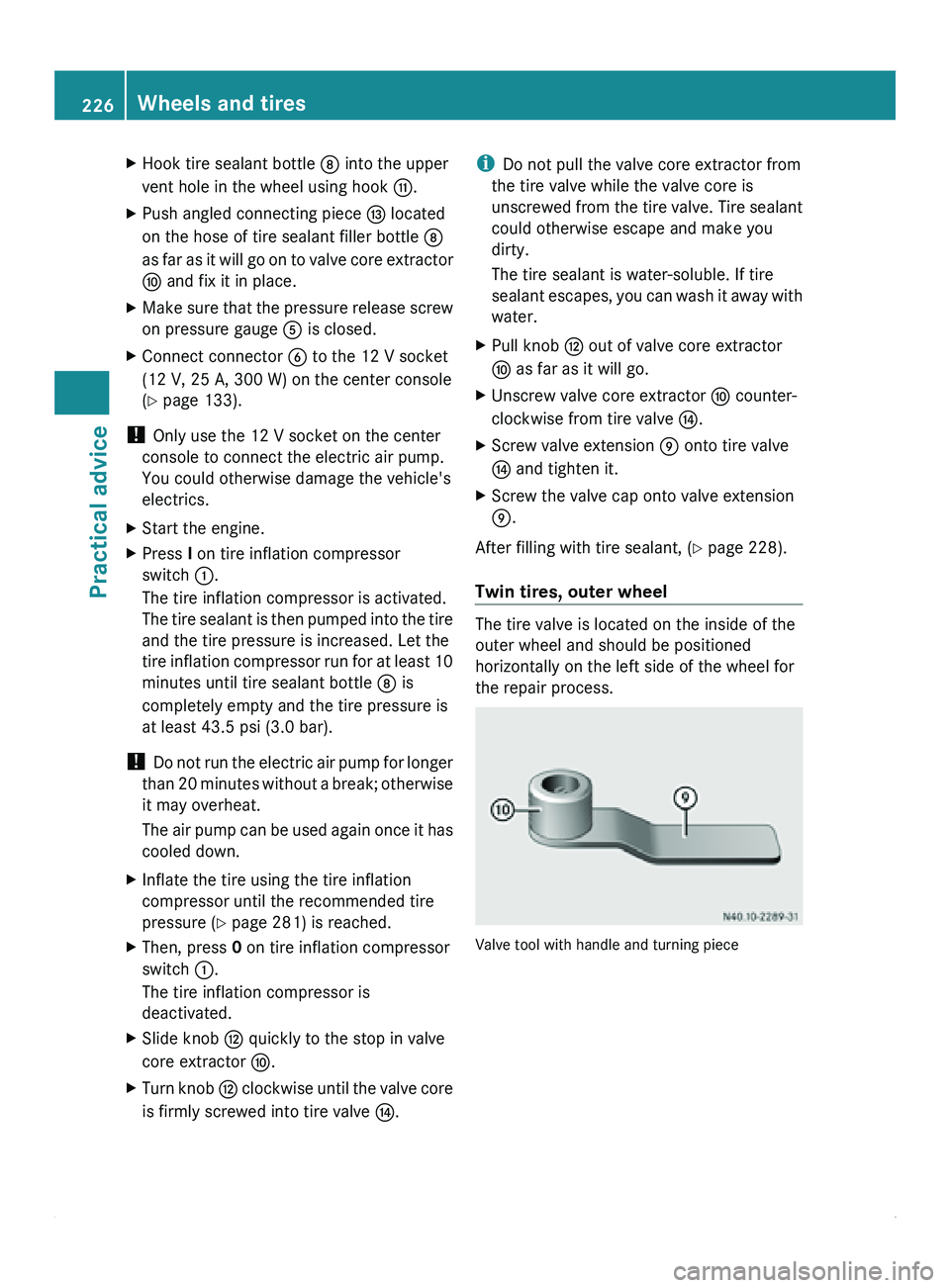
Twin tires, outer wheel The tire valve is located on the inside of the
outer wheel and should be positioned
horizontally on the left side of the wheel for
the repair process.
Valve tool with handle and turning piece226
Wheels and tires
Practical advice
Page 229 of 292
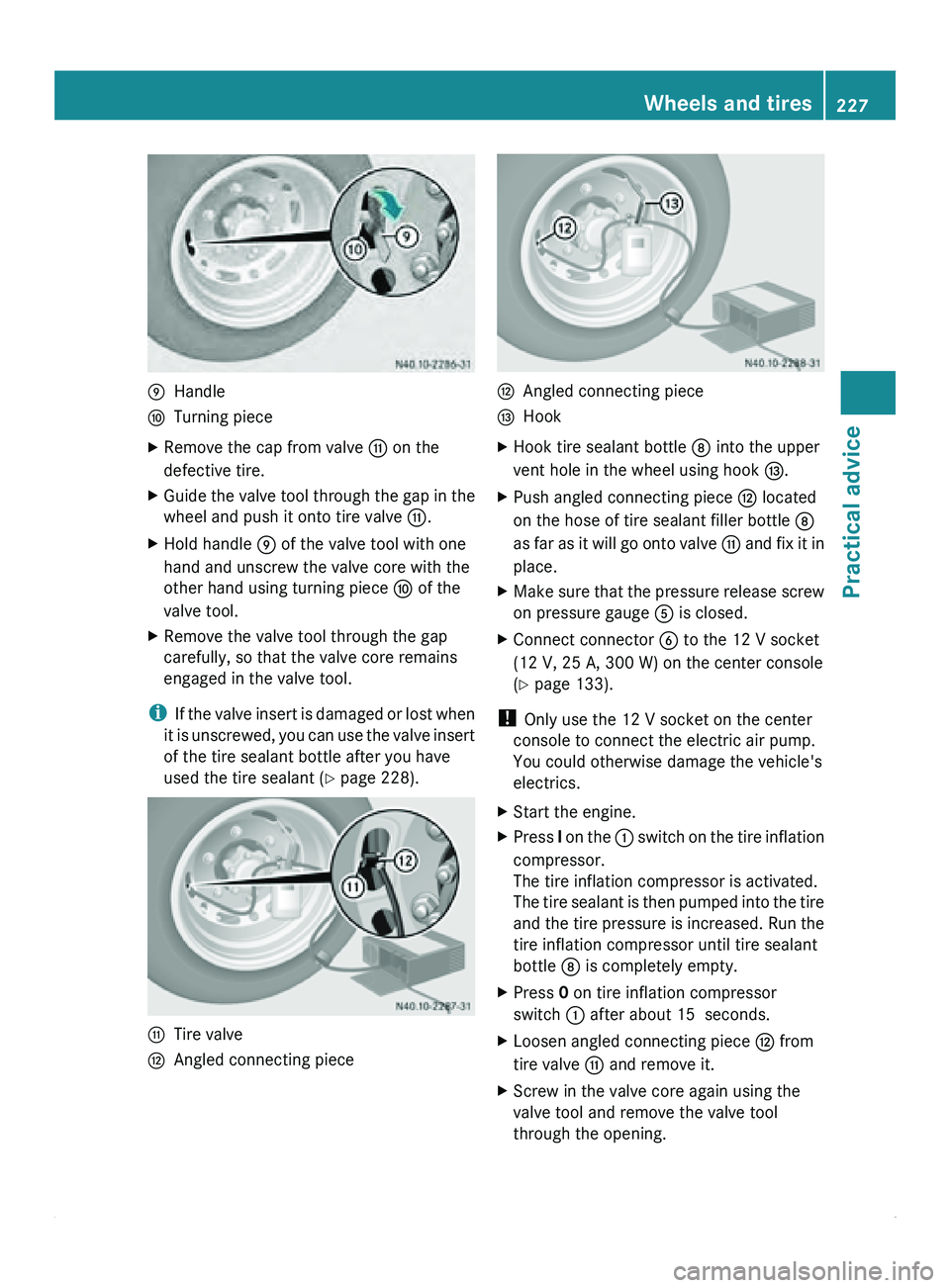
0070
Handle
0071 Turning piece
X Remove the cap from valve 0072 on the
defective tire.
X Guide the valve tool through the gap in the
wheel and push it onto tire valve 0072.
X Hold handle 0070 of the valve tool with one
hand and unscrew the valve core with the
other hand using turning piece 0071 of the
valve tool.
X Remove the valve tool through the gap
carefully, so that the valve core remains
engaged in the valve tool.
i If the
valve
insert is damaged or lost when
it is unscrewed, you can use the valve insert
of the tire sealant bottle after you have
used the tire sealant ( Y page 228).0072
Tire valve
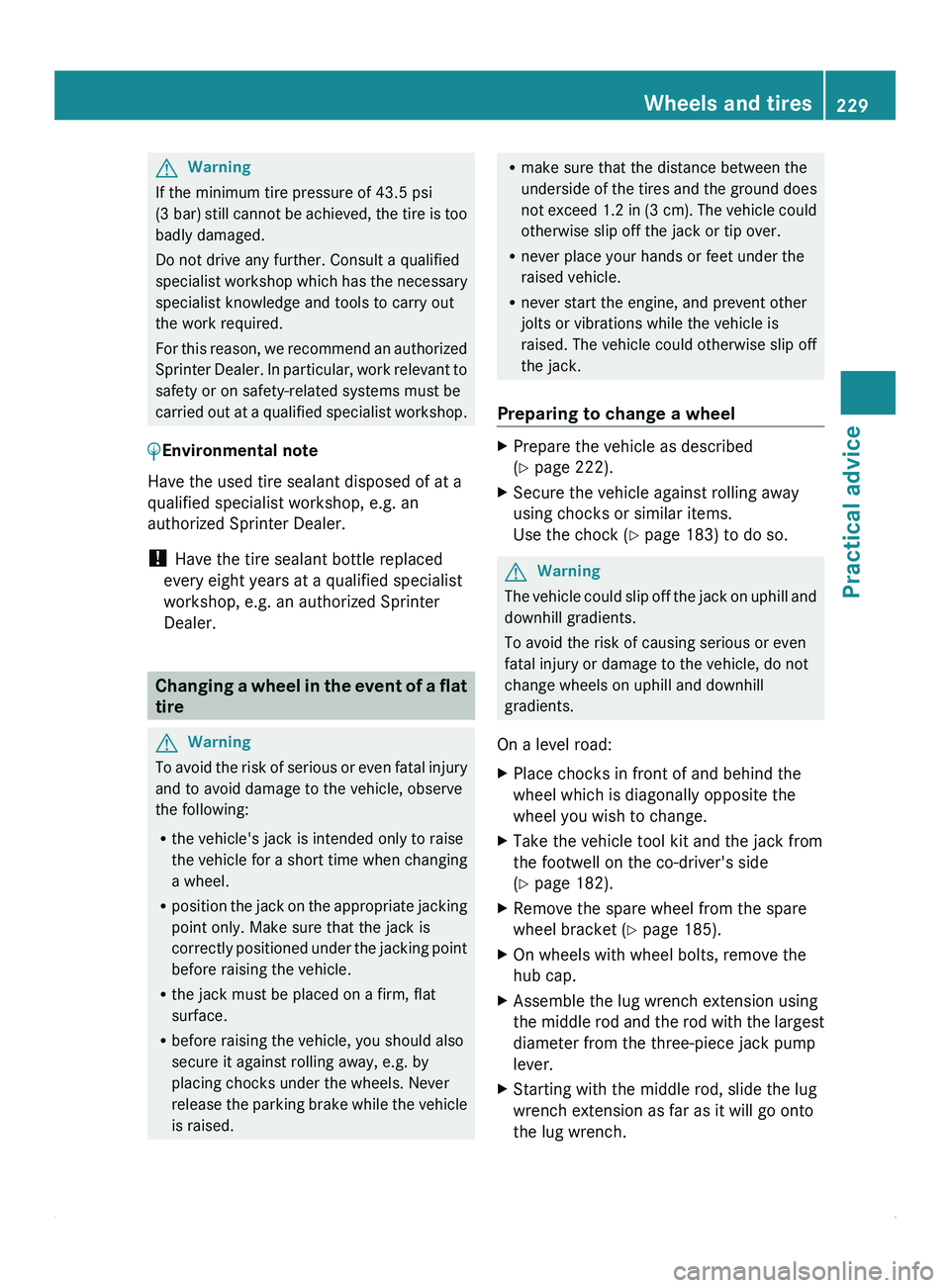
0073 Angled connecting piece 0073
Angled connecting piece
0074 Hook
X Hook tire sealant bottle 006F into the upper
vent hole in the wheel using hook 0074.
X Push angled connecting piece 0073 located
on the hose of tire sealant filler bottle 006F
as far
as
it will go onto valve 0072 and fix it in
place.
X Make sure that the pressure release screw
on pressure gauge 0086 is closed.
X Connect connector 0087 to the 12 V socket
(12 V, 25 A, 300 W) on the center console
(Y page 133).
! Only use the 12 V socket on the center
console to connect the electric air pump.
You could otherwise damage the vehicle's
electrics.
X Start the engine.
X Press I on the 0046
switch on the tire inflation
compressor.
The tire inflation compressor is activated.
The tire sealant is then pumped into the tire
and the tire pressure is increased. Run the
tire inflation compressor until tire sealant
bottle 006F is completely empty.
X Press 0 on tire inflation compressor
switch 0046 after about 15 seconds.
X Loosen angled connecting piece 0073 from
tire valve 0072 and remove it.
X Screw in the valve core again using the
valve tool and remove the valve tool
through the opening. Wheels and tires
227
Practical advice Z
Page 231 of 292
G
Warning
If the minimum tire pressure of 43.5 psi
(3 bar) still cannot
be achieved, the tire is too
badly damaged.
Do not drive any further. Consult a qualified
specialist workshop which has the necessary
specialist knowledge and tools to carry out
the work required.
For this reason, we recommend an authorized
Sprinter Dealer. In particular, work relevant to
safety or on safety-related systems must be
carried out at a qualified specialist workshop.
0040Environmental note
Have the used tire sealant disposed of at a
qualified specialist workshop, e.g. an
authorized Sprinter Dealer.
! Have the tire sealant bottle replaced
every eight years at a qualified specialist
workshop, e.g. an authorized Sprinter
Dealer. Changing a
wheel in the event of a flat
tire G
Warning
To avoid the risk of serious or even fatal injury
and to avoid damage to the vehicle, observe
the following:
R the vehicle's jack is intended only to raise
the vehicle for
a short time when changing
a wheel.
R position the jack on the appropriate jacking
point only. Make sure that the jack is
correctly positioned under the jacking point
before raising the vehicle.
R the jack must be placed on a firm, flat
surface.
R before raising the vehicle, you should also
secure it against rolling away, e.g. by
placing chocks under the wheels. Never
release the parking brake while the vehicle
is raised. R
make sure that the distance between the
underside
of the
tires and the ground does
not exceed 1.2 in (3 cm). The vehicle could
otherwise slip off the jack or tip over.
R never place your hands or feet under the
raised vehicle.
R never start the engine, and prevent other
jolts or vibrations while the vehicle is
raised. The vehicle could otherwise slip off
the jack.
Preparing to change a wheel X
Prepare the vehicle as described
(Y
page 222).
X Secure the vehicle against rolling away
using chocks or similar items.
Use the chock ( Y
page 183) to do so. G
Warning
The vehicle
could slip off the jack on uphill and
downhill gradients.
To avoid the risk of causing serious or even
fatal injury or damage to the vehicle, do not
change wheels on uphill and downhill
gradients.
On a level road:
X Place chocks in front of and behind the
wheel which is diagonally opposite the
wheel you wish to change.
X Take the vehicle tool kit and the jack from
the footwell on the co-driver's side
(Y page 182).
X Remove the spare wheel from the spare
wheel bracket ( Y page 185).
X On wheels with wheel bolts, remove the
hub cap.
X Assemble the lug wrench extension using
the middle rod
and the rod with the largest
diameter from the three-piece jack pump
lever.
X Starting with the middle rod, slide the lug
wrench extension as far as it will go onto
the lug wrench. Wheels and tires
229
Practical advice Z
Page 243 of 292
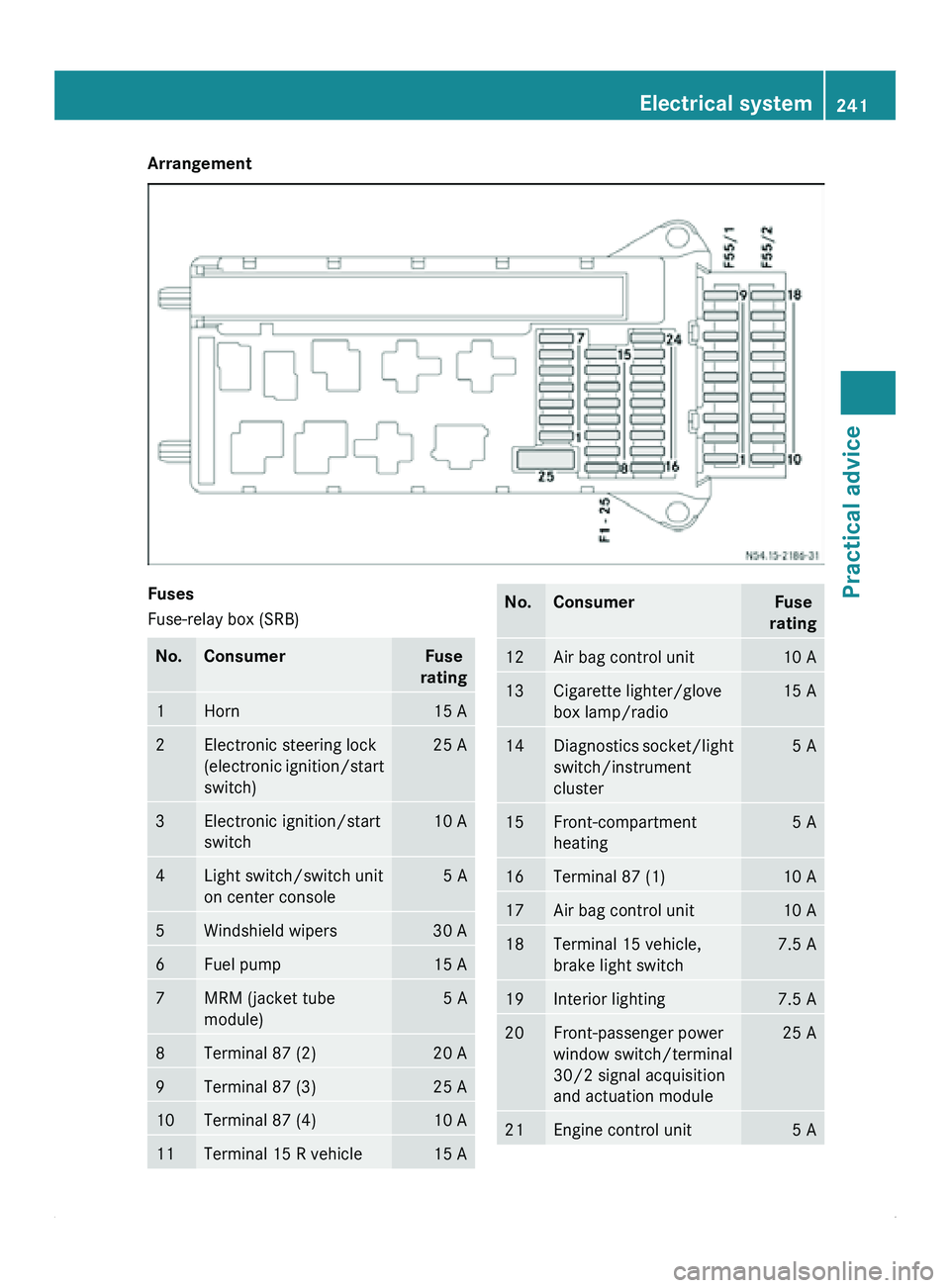
Arrangement
Fuses
Fuse-relay box (SRB)
No. Consumer Fuse
rating 1 Horn 15 A
2 Electronic steering lock
(electronic ignition/start
switch) 25 A
3 Electronic ignition/start
switch 10 A
4 Light switch/switch unit
on center console 5 A
5 Windshield wipers 30 A
6 Fuel pump 15 A
7 MRM (jacket tube
module) 5 A
8 Terminal 87 (2) 20 A
9 Terminal 87 (3) 25 A
10 Terminal 87 (4) 10 A
11 Terminal 15 R vehicle 15 A No. Consumer Fuse
rating 12 Air bag control unit 10 A
13 Cigarette lighter/glove
box lamp/radio 15 A
14 Diagnostics socket/light
switch/instrument
cluster 5 A
15 Front-compartment
heating 5 A
16 Terminal 87 (1) 10 A
17 Air bag control unit 10 A
18 Terminal 15 vehicle,
brake light switch 7.5 A
19 Interior lighting 7.5 A
20 Front-passenger power
window switch/terminal
30/2 signal acquisition
and actuation module 25 A
21 Engine control unit 5 AElectrical system
241Practical advice Z
Page 244 of 292
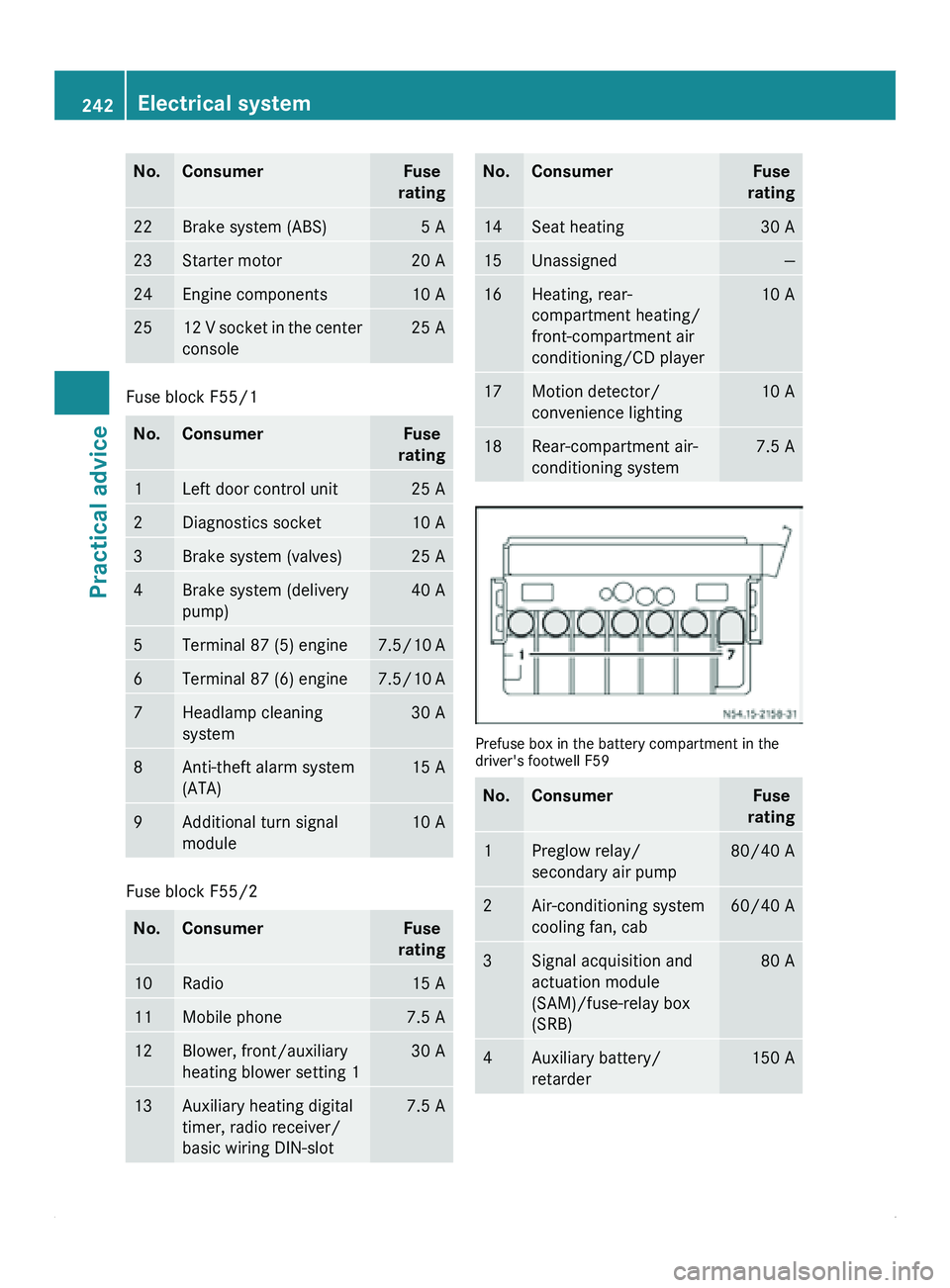
No. Consumer Fuse
rating 22 Brake system (ABS) 5 A
23 Starter motor 20 A
24 Engine components 10 A
25 12 V socket in the center
console 25 A
Fuse block F55/1
No. Consumer Fuse
rating 1 Left door control unit 25 A
2 Diagnostics socket 10 A
3 Brake system (valves) 25 A
4 Brake system (delivery
pump) 40 A
5 Terminal 87 (5) engine 7.5/10 A
6 Terminal 87 (6) engine 7.5/10 A
7 Headlamp cleaning
system 30 A
8 Anti-theft alarm system
(ATA) 15 A
9 Additional turn signal
module 10 A
Fuse block F55/2
No. Consumer Fuse
rating 10 Radio 15 A
11 Mobile phone 7.5 A
12 Blower, front/auxiliary
heating blower setting 1 30 A
13 Auxiliary heating digital
timer, radio receiver/
basic wiring DIN-
slot 7.5 A No. Consumer Fuse
rating 14 Seat heating 30 A
15 Unassigned —
16 Heating, rear-
compartment heating/
front-compartment air
conditioning/CD player 10 A
17 Motion detector/
convenience lighting 10 A
18 Rear-compartment air-
conditioning system 7.5 A
Prefuse box in the battery compartment in the
driver's footwell F59
No. Consumer Fuse
rating 1 Preglow relay/
secondary air pump 80/40 A
2 Air-conditioning system
cooling fan, cab 60/40 A
3 Signal acquisition and
actuation module
(SAM)/fuse-relay box
(SRB) 80 A
4 Auxiliary battery/
retarder 150 A242
Electrical systemPractical advice
Page 249 of 292
X
Remove implement 0047.
X Refit cover 0046. Jump starting, tow-starting and
towing away
Jump-starting
General notes If the vehicle battery is flat, the engine can be
started from another vehicle using jumper
cables. For this purpose, the vehicle has a
jump-starting connection point in the engine
compartment.
The additional battery in the engine
compartment is
not
suitable for jump-starting
operations. If your vehicle requires jump-
starting, or if you use it to jump-start another
vehicle, use the jump-starting connection
point in the engine compartment. G
Warning
Explosive oxyhydrogen is produced when
batteries are being
charged. When working on
batteries, always make sure that the work
area is well ventilated.
Keep flames and naked lights away from the
battery, and do not smoke.
Prevent the creation of sparks (e.g. when
disconnecting the batteries). Sparks can
ignite the oxyhydrogen gas and cause the
batteries to explode. You and others could be
seriously injured. G
Warning
Due to the gases which escape from batteries,
there is a risk of acid burns when jump-
starting a vehicle.
Do not lean over the battery
while the engine is being jump-started.
! Avoid repeated and lengthy starting
attempts.
Do not use a rapid-charging device to start
the engine. When jump-starting, observe the following
points:
R
jump-starting must only be performed
when the engine and catalytic converter
are cold.
R do not start the engine if the battery is
frozen. Let the battery thaw first.
R when jump-starting, use
only batteries with
the same nominal voltage and a similar
capacity.
R only use jump leads protected against
polarity reversal, with adequate cross-
section and with insulated battery terminal
clamps.
X Make sure that the two vehicles do not
touch.
X Apply the parking brake.
X Move the selector lever of the automatic
transmission to position P.
X Switch off all electrical consumers.
X Switch on the battery isolating switch
(Y page 87).
X Remove the key from the ignition lock.
X Open the hood (Y page 168).
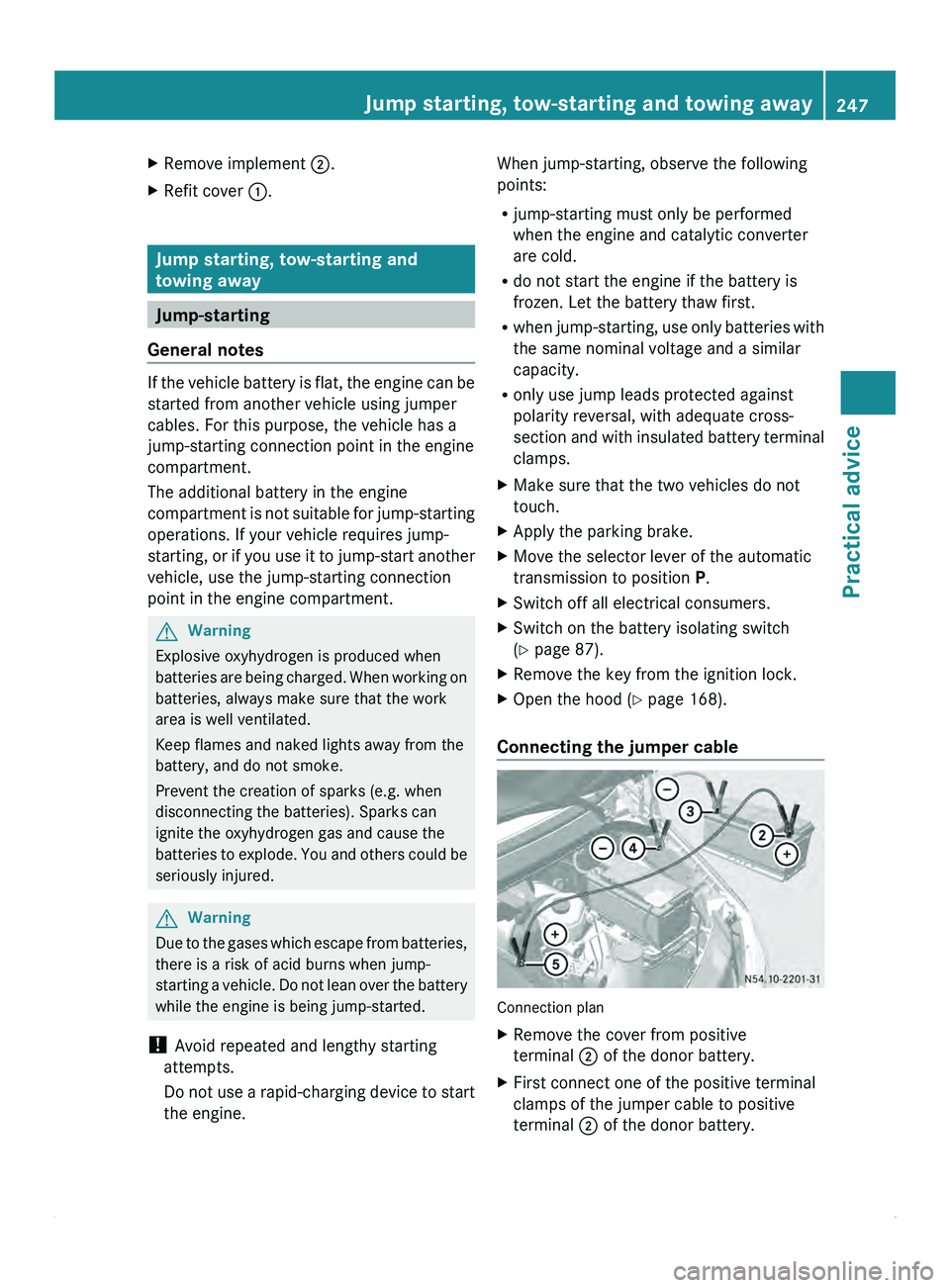
Connecting the jumper cable Connection plan
X
Remove the cover from positive
terminal 0047 of the donor battery.
X First connect one of the positive terminal
clamps of the jumper cable to positive
terminal 0047 of the donor battery. Jump starting, tow-starting and towing away
247
Practical advice Z
Page 250 of 292
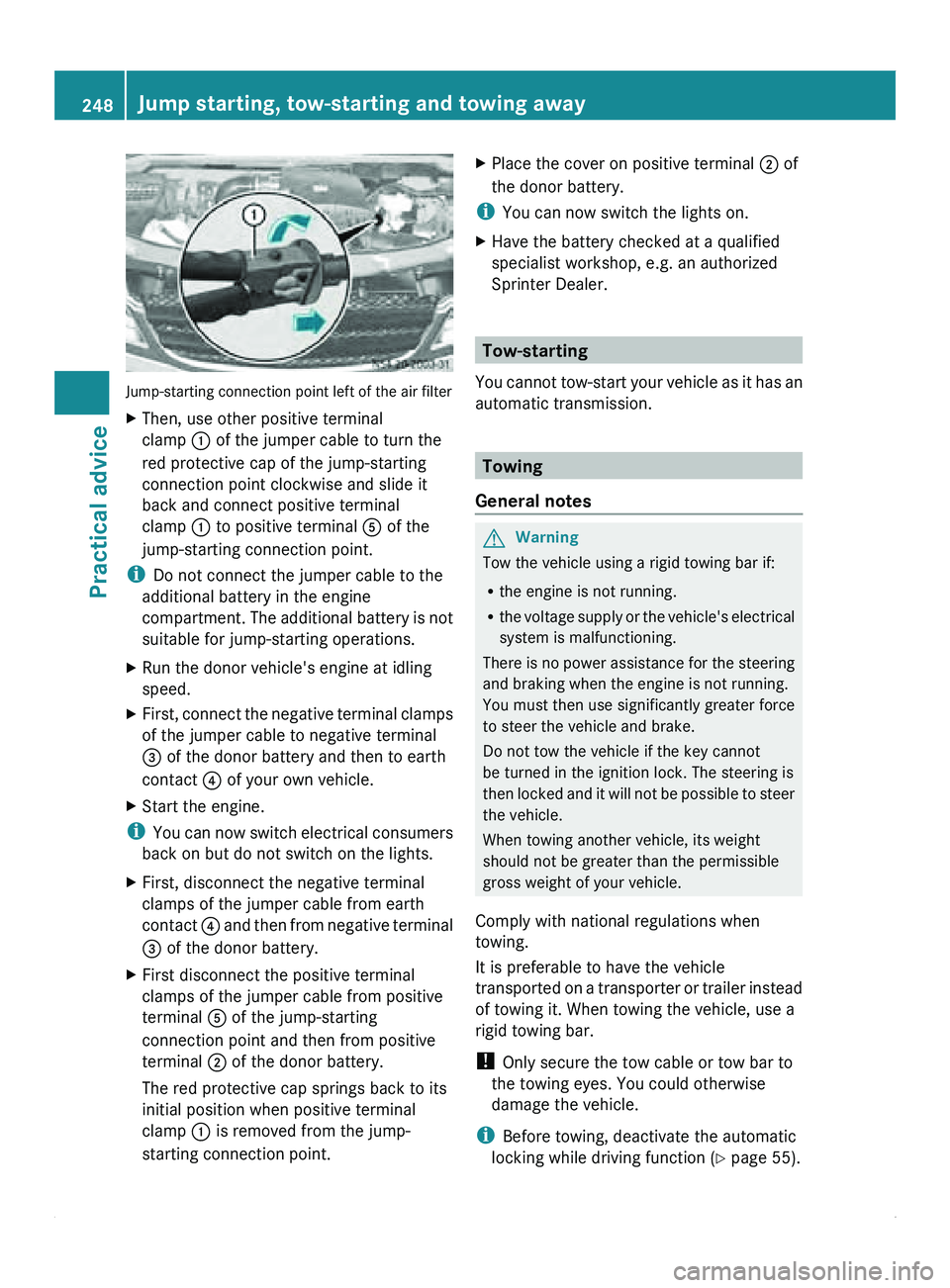
Jump-starting connection point left of the air filter
X
Then, use other positive terminal
clamp 0046 of the jumper cable to turn the
red protective cap of the jump-starting
connection point clockwise and slide it
back and connect positive terminal
clamp 0046 to positive terminal 0086 of the
jump-starting connection point.
i Do not connect the jumper cable to the
additional battery in the engine
compartment. The
additional
battery is not
suitable for jump-starting operations.
X Run the donor vehicle's engine at idling
speed.
X First, connect the negative terminal clamps
of the jumper cable to negative terminal
008A of the donor battery and then to earth
contact 0088 of your own vehicle.
X Start the engine.
i You can
now
switch electrical consumers
back on but do not switch on the lights.
X First, disconnect the negative terminal
clamps of the jumper cable from earth
contact 0088 and then
from negative terminal
008A of the donor battery.
X First disconnect the positive terminal
clamps of the jumper cable from positive
terminal 0086 of the jump-starting
connection point and then from positive
terminal 0047 of the donor battery.
The red protective cap springs back to its
initial position when positive terminal
clamp 0046 is removed from the jump-
starting connection point. X
Place the cover on positive terminal 0047 of
the donor battery.
i You can now switch the lights on.
X Have the battery checked at a qualified
specialist workshop, e.g. an authorized
Sprinter Dealer. Tow-starting
You cannot tow-start
your vehicle as it has an
automatic transmission. Towing
General notes G
Warning
Tow the vehicle using a rigid towing bar if:
R the engine is not running.
R the voltage supply
or the vehicle's electrical
system is malfunctioning.
There is no power assistance for the steering
and braking when the engine is not running.
You must then use significantly greater force
to steer the vehicle and brake.
Do not tow the vehicle if the key cannot
be turned in the ignition lock. The steering is
then locked and it will not be possible to steer
the vehicle.
When towing another vehicle, its weight
should not be greater than the permissible
gross weight of your vehicle.
Comply with national regulations when
towing.
It is preferable to have the vehicle
transported on a transporter or trailer instead
of towing it. When towing the vehicle, use a
rigid towing bar.
! Only secure the tow cable or tow bar to
the towing eyes. You could otherwise
damage the vehicle.
i Before towing, deactivate the automatic
locking while driving function (Y page 55). 248
Jump starting, tow-starting and towing away
Practical advice