brake MERCEDES-BENZ SPRINTER 2012 MY12 Operator’s Manual
[x] Cancel search | Manufacturer: MERCEDES-BENZ, Model Year: 2012, Model line: SPRINTER, Model: MERCEDES-BENZ SPRINTER 2012Pages: 292, PDF Size: 6.75 MB
Page 27 of 292
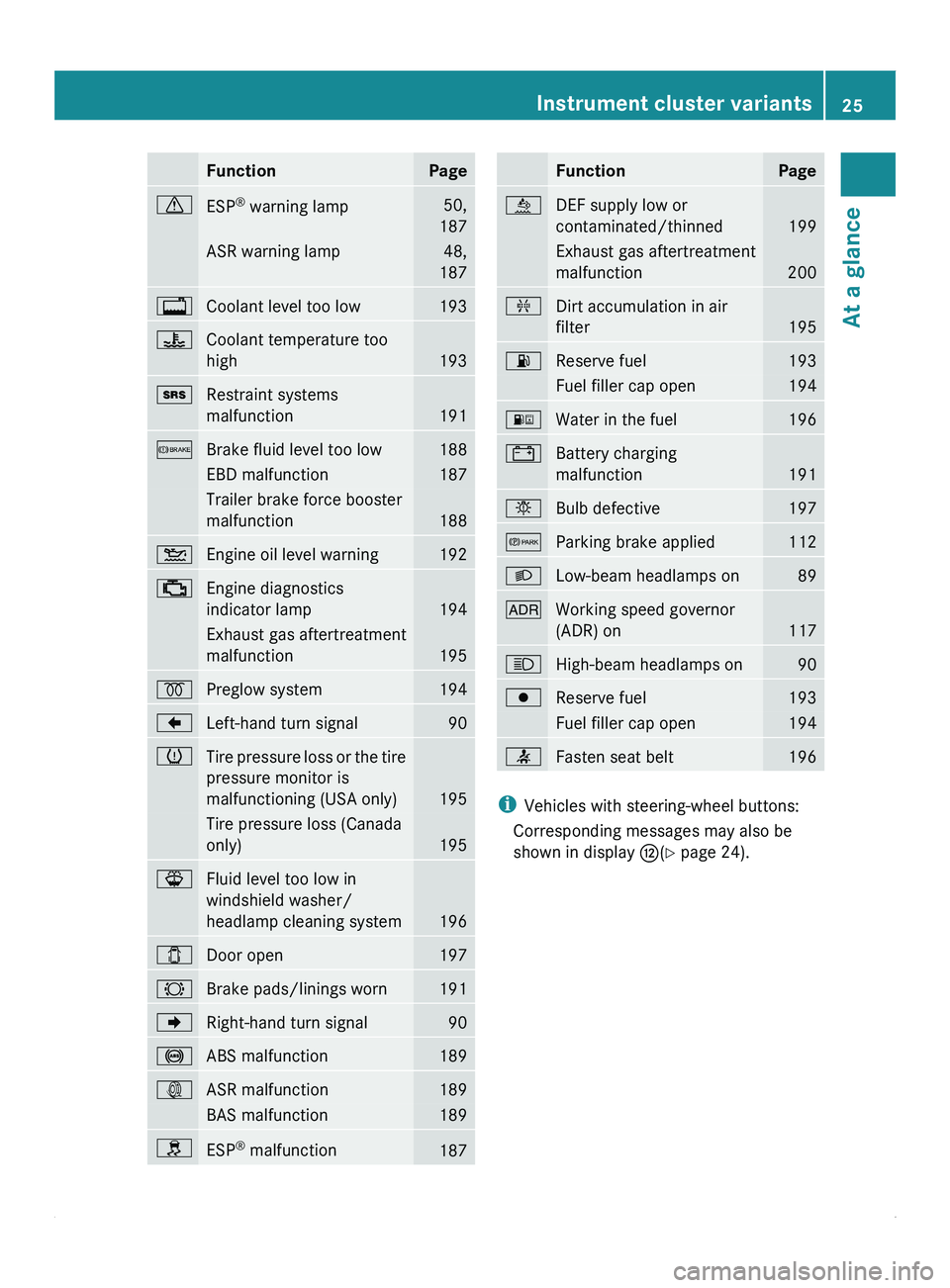
Function Page
0067
ESP
®
warning lamp 50,
187 ASR warning lamp 48,
187 0041
Coolant level too low 193
00AE
Coolant temperature too
high
193
008A
Restraint systems
malfunction
191
0065
Brake fluid level too low 188
EBD malfunction 187
Trailer brake force booster
malfunction
188
00B4
Engine oil level warning 192
00BB
Engine diagnostics
indicator lamp
194
Exhaust gas aftertreatment
malfunction
195
0028
Preglow system 194
004A
Left-hand turn signal 90
0077
Tire pressure loss or the tire
pressure monitor is
malfunctioning (USA only)
195
Tire pressure loss (Canada
only)
195
00BD
Fluid level too low in
windshield washer/
headlamp cleaning system
196
003E
Door open 197
0026
Brake pads/linings worn 191
004D
Right-hand turn signal 90
0031
ABS malfunction 189
003D
ASR malfunction 189
BAS malfunction 189
009E
ESP
®
malfunction 187 Function Page
00E4
DEF supply low or
contaminated/thinned
199
Exhaust gas aftertreatment
malfunction
200
00AB
Dirt accumulation in air
filter
195
00B6
Reserve fuel 193
Fuel filler cap open 194
00BA
Water in the fuel 196
003F
Battery charging
malfunction
191
0055
Bulb defective 197
0066
Parking brake applied 112
0064
Low-beam headlamps on 89
004E
Working speed governor
(ADR) on
117
0063
High-beam headlamps on 90
0080
Reserve fuel 193
Fuel filler cap open 194
0082
Fasten seat belt 196
i
Vehicles with steering-wheel buttons:
Corresponding messages may also be
shown in display 0073(Y page 24). Instrument cluster variants
25At a glance
Page 49 of 292
X
Turn both handles 0046 to a horizontal
position. Make sure that locks 008A are in
front of the window frame on the inside.
The window is locked.
X Replace locking pins 0047 before
beginning a
new journey at the latest.
You may obtain information about this from
any authorized Sprinter Dealer. Driving safety systems
Important safety notes
G
Warning
The following factors increase the risk of
accidents:
R Excessive speed, especially in turns
R Wet and slippery road surfaces
R Following another vehicle too closely
The driving safety systems described in this
section cannot reduce these risks or prevent
the natural laws
of physics from acting on the
vehicle. They cannot increase braking or
steering efficiency beyond that afforded by
the condition of the vehicle brakes and tires
or the traction afforded.
Only a safe, attentive, and skillful driver can
prevent accidents.
The capabilities of a vehicle equipped with the
driving safety systems described in this
section must never be exploited in a reckless
or dangerous manner which could jeopardize
the user's safety or the safety of others.
Always adjust your driving style to the
prevailing road and weather conditions and
keep a safe distance to other road users and
objects on the street.
If a driving system malfunctions, other driving
safety systems may also switch off. Observe
indicator and warning lamps that may come
on as well as messages in the multifunction
display that may appear.
i In wintry driving conditions, always use
winter tires (M+S tires) and if necessary, snow chains. Only in this way will the
driving safety systems described in this
section work as effectively as possible.
Overview
In this section,
you will find information about
the following driving safety systems:
R ABS ( Anti-lock Braking System)
R BAS ( Brake Assist System)
R ESP ®
(Electronic Stability Program)
R ASR (Acceleration Skid Control)
R EBD ( Electronic Brake force Distribution) ABS (Anti-lock Braking System)
Important safety notes G
Warning
Observe "Important safety notes"
(Y page 47). G
Warning!
Do not pump the brake pedal. Use firm, steady
brake pedal pressure instead. Pumping the
brake pedal reduces the braking effect.
ABS regulates brake pressure in such a way
that the wheels do not lock during braking.
This allows you
to maintain the ability to steer
your vehicle.
ABS works from a speed of about 3 mph
(5 km/h) upwards, regardless of road-surface
conditions. ABS works on slippery surfaces,
even when you only brake gently.
The 0031 warning lamp in the instrument
cluster lights up when the ignition is switched
on. It goes out when the engine is running.
Braking If ABS intervenes when braking, you will feel
a pulsating in the brake pedal.
If the
0067 warning lamp flashes, this may
indicate dangerous road conditions and Driving safety systems
47
Safety Z
Page 50 of 292
serves as a reminder to take extra care while
driving.
X
If ABS intervenes: continue to depress the
brake pedal with force until the braking
situation is over.
X To make a full brake application:
depress the brake pedal with full force. G
Warning
If the ABS malfunctions, other driving systems
such as the
BAS or the ESP ®
are also switched
off. Observe indicator and warning lamps that
may come on as well as messages in the
multifunction display that may appear.
If the ABS malfunctions, the wheels may lock
during hard braking, reducing the steering
capability and extending the braking distance. BAS (Brake Assist System)
G
Warning
Observe "Important safety notes"
(Y page 47).
BAS operates in emergency braking
situations. If you depress the brake pedal
quickly, BAS automatically
boosts the braking
force, potentially reducing the stopping
distance.
X Keep the brake pedal firmly depressed until
the emergency braking situation is over.
ABS prevents the wheels from locking.
The brakes will function as usual once you
release the brake pedal. BAS is deactivated. G
Warning
If the BAS malfunctions, the brake system still
functions, but without the additional brake
boost available that the BAS would normally
provide in an emergency braking maneuver.
Therefore, the braking
distance may increase. EBD (Electronic Brake force
Distribution)
G
Warning
Observe "Important safety notes"
(Y page 47).
EBD monitors and controls the brake
pressure on the rear wheels to improve
driving stability while braking. G
Warning
If the 009E, 003D, 0031 and 0065 indicator
lamps light up while the vehicle is in motion,
EBD may be defective.
If EBD malfunctions,
the brake system will still
function with full brake boost. However, the
rear wheels could lock up during emergency
braking situations, for example. You could
lose control of the vehicle and cause an
accident.
Adapt your driving style to the changed
driving characteristics. ASR (acceleration skid control)
Important safety notes G
Warning
Observe "Important safety notes"
(Y page 47).
ASR can significantly improve traction, i.e.
the transmission of power from the tires to
the road surface, and thus may increase the
vehicle's driving stability. ASR assists in
pulling away and
accelerating, particularly on
smooth and slippery surfaces.
ASR can brake individual wheels and limits
the engine torque to help prevent the drive
wheels from spinning.
If ASR intervenes, the 0067 warning lamp
flashes in the instrument cluster. 48
Driving safety systems
Safety
Page 51 of 292
G
Warning
Never switch off ASR when you see the
0067 warning lamp
flashing in the instrument
cluster. In this case proceed as follows:
R when driving off, apply as little throttle as
possible.
R while driving, ease off the accelerator
pedal.
R adapt your speed and driving style to the
prevailing road conditions.
Failure to observe these guidelines could
cause the vehicle to skid. ESP ®
cannot
prevent accidents resulting from excessive
speed.
If, taking tires, cargo load and gradient into
consideration, the surface driven on still
provides insufficient traction, you may
experience difficulties in pulling away despite
ASR.
Vehicles without steering-wheel buttons:
the 003D indicator lamp in the instrument
cluster lights up when you switch on the
ignition. It goes out when the engine is
running.
Activating/deactivating ASR G
Warning
ASR should
not be switched off during normal
driving other than in the circumstances
described below. Deactivating
the system will
reduce vehicle stability in driving maneuvers.
Do not switch off ASR when a spare wheel is
mounted.
ASR is activated automatically when the
engine is running.
It may be best to deactivate ASR briefly in the
following situations:
R when using snow chains
R in deep snow
R on sand or gravel If you deactivate ASR:
R
the engine's torque
is no longer limited and
the drive wheels can spin. The spinning of
the wheels results in a cutting action, which
provides better grip.
R brake intervention will continue to improve
traction where a drive wheel begins to spin,
e.g. if only the side of the road is slippery.
The wheel will be braked to increase
traction under such circumstances.
R active brake intervention by ESP ®
to
increase driving stability remains active. G
Warning
Even with ASR deactivated, ESP ®
remains
active and continues to perform brake
interventions where this is necessary to
improve driving stability. The 0067 warning
lamp flashes.
With ASR deactivated, there is an increased
risk of your vehicle's brake system
overheating and suffering damage due to
prolonged application. A
hot brake system will
also result in increased stopping distance.
Therefore, only deactivate ASR when
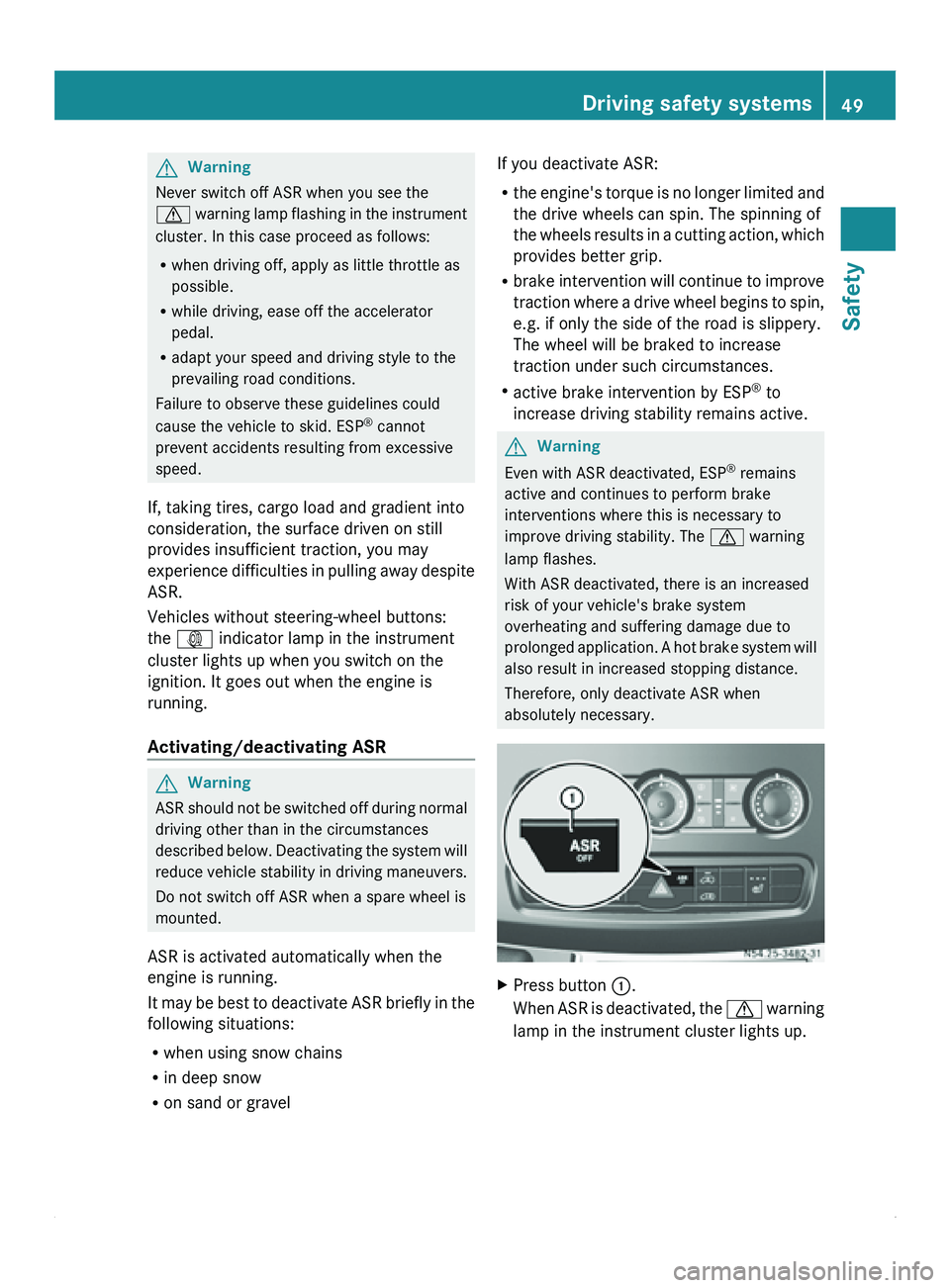
absolutely necessary. X
Press button 0046
.
When ASR is
deactivated, the 0067 warning
lamp in the instrument cluster lights up. Driving safety systems
49
Safety Z
Page 52 of 292
ESP
®
(Electronic Stability Program) G
Warning
Observe "Important safety notes"
(Y page 47).
If ESP ®
detects that the vehicle is deviating
from the direction desired by the driver, one
or more wheels are braked to help stabilize
the vehicle. If
necessary, the engine output is
also modified to help keep the vehicle on the
desired course within physical limits. ESP ®
assists the driver when pulling away on wet
or slippery roads. ESP ®
can also help stabilize
the vehicle during braking.
If ESP ®
intervenes, the 0067 warning lamp
flashes in the instrument cluster. G
Warning
If the 009E
indicator lamp remains lit, ESP ®
is
not available due to a malfunction. Vehicle
stability in standard driving maneuvers is
reduced.
Adapt your speed and driving style to the
prevailing road conditions and to the non-
operating status of ESP ®
.
If ESP ®
is malfunctioning, the engine output
may be reduced.
! Only operate the vehicle for a maximum
of ten seconds on a brake test
dynamometer. Switch off the ignition.
Application of the brakes by ESP ®
may
otherwise destroy the brake system.
! Do not operate the vehicle on a
dynamometer
(e.g. for a performance test).
If you would like to operate the vehicle on
a dynamometer, consult an authorized
Sprinter Dealer beforehand. The drive train
or brake system could otherwise be
damaged.
i Only use wheels with the recommended
tire sizes. Only then will ESP ®
function
properly. 50
Driving safety systems
Safety
Page 53 of 292
Vehicle equipment ..............................
52
Opening and closing ...........................52
Anti-theft systems .............................. 61
Seats .................................................... 63
Steering wheel .................................... 69
Mirrors ................................................. 69
Instrument cluster ..............................70
On-board computer without steer-
ing wheel buttons ............................... 72
On-board computer with steering
wheel buttons ..................................... 74
Power supply ....................................... 87
Lighting ................................................ 88
Good visibility ...................................... 94
Climate control .................................... 97
Driving and parking .......................... 108
Brakes ................................................ 112
Automatic transmission ................... 113
Driving the vehicle ............................116
Driving systems ................................ 117
Features ............................................. 128
Communications ............................... 133 51Controls
Page 65 of 292
mirror or on the grab handles on the
headliner. This will prevent a false alarm.
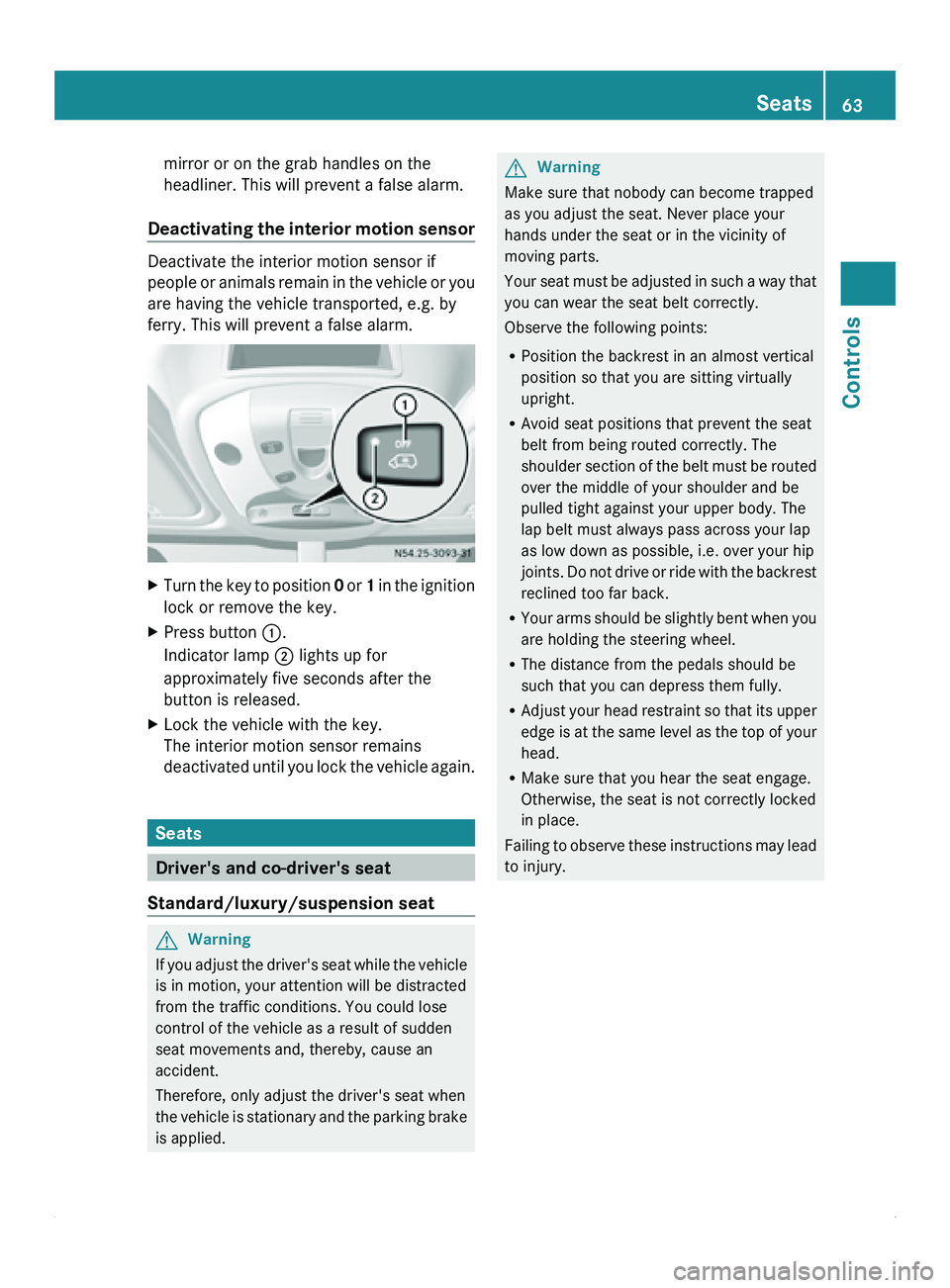
Deactivating the interior
motion sensorDeactivate the interior motion sensor if
people or
animals
remain in the vehicle or you
are having the vehicle transported, e.g. by
ferry. This will prevent a false alarm. X
Turn the key to position 0 or 1
in the ignition
lock or remove the key.
X Press button 0046.
Indicator lamp 0047 lights up for
approximately five seconds after the
button is released.
X Lock the vehicle with the key.
The interior motion sensor remains
deactivated until
you
lock the vehicle again.Seats
Driver's and co-driver's seat
Standard/luxury/suspension seat G
Warning
If you adjust the driver's seat while the vehicle
is in motion, your attention will be distracted
from the traffic conditions. You could lose
control of the vehicle as a result of sudden
seat movements and, thereby, cause an
accident.
Therefore, only adjust the driver's seat when
the vehicle is
stationary and the parking brake
is applied. G
Warning
Make sure that nobody can become trapped
as you adjust the seat. Never place your
hands under the seat or in the vicinity of
moving parts.
Your seat must
be adjusted in such a way that
you can wear the seat belt correctly.
Observe the following points:
R Position the backrest in an almost vertical
position so that you are sitting virtually
upright.
R Avoid seat positions that prevent the seat
belt from being routed correctly. The
shoulder section of the belt must be routed
over the middle of your shoulder and be
pulled tight against your upper body. The
lap belt must always pass across your lap
as low down as possible, i.e. over your hip
joints. Do not drive or ride with the backrest
reclined too far back.
R Your arms should be slightly bent when you
are holding the steering wheel.
R The distance from the pedals should be
such that you can depress them fully.
R Adjust your head restraint so that its upper
edge is at the same level as the top of your
head.
R Make sure that you hear the seat engage.
Otherwise, the seat is not correctly locked
in place.
Failing to observe these instructions may lead
to injury. Seats
63
Controls Z
Page 67 of 292
Swiveling front seats
G
Warning
Do not start the engine unless the driver's and
co-driver's seats are facing in the direction of
travel and are locked in position. Only adjust
the seats when the vehicle is stationary and
the parking brake is applied. You could
otherwise lose control of the vehicle as a
result of sudden seat movements and thereby
cause an accident.
The safety systems only work when the
driver's and co-driver's seats are facing in the
direction of travel.
The driver's seat and co-driver's seat can be
rotated through 180°.
The seats engage when facing in the direction
of travel as well as when facing in the opposite
direction and also engage at an angle of 50°
to the door.
! When rotating the seats, make sure that
there is sufficient space to do so.
Move the seat forward or back first. This
will help to avoid contact with other parts
of the interior.
Push the handbrake lever down to the stop.
The parking brake or handbrake lever could
otherwise be damaged.
i Always slide the co-driver's seat forwards
before rotating it (Y page 64).
X Make sure that the parking brake has been
engaged and that the handbrake lever has
been pushed down to the stop
(Y page 112).
X Adjust the steering wheel to provide the
necessary space to rotate and adjust the
driver's seat ( Y
page 69). G
Warning
When releasing and rotating the seats, make
sure that you do not trap yourself or others.
Never place your hands under the seat or in
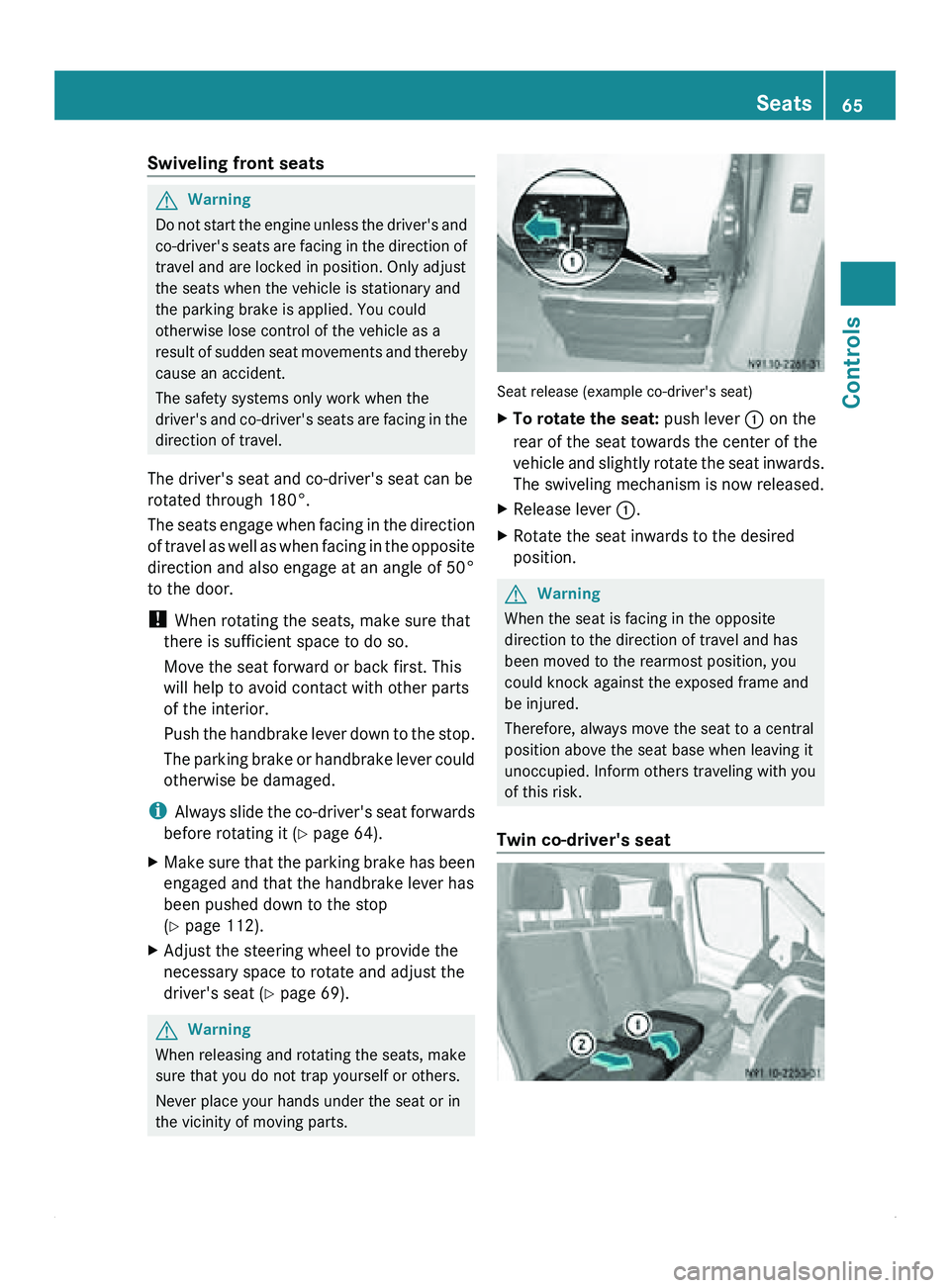
the vicinity of moving parts. Seat release (example co-driver's seat)
X
To rotate the seat: push lever 0046 on the
rear of the seat towards the center of the
vehicle and
slightly rotate the seat inwards.
The swiveling mechanism is now released.
X Release lever 0046.
X Rotate the seat inwards to the desired
position. G
Warning
When the seat is facing in the opposite
direction to the direction of travel and has
been moved to the rearmost position, you
could knock against the exposed frame and
be injured.
Therefore, always move the seat to a central
position above the seat base when leaving it
unoccupied. Inform others traveling with you
of this risk.
Twin co-driver's seat Seats
65Controls Z
Page 93 of 292
X
To indicate: press the combination switch
in desired direction 0046 or 0047, until it
engages.
The combination switch automatically
returns to its original position after large
steering movements.
X To indicate briefly: press the
combination
switch briefly in desired direction 0046
or 0047.
The corresponding turn signal flashes three
times. Cornering light function (vehicles
with Bi-Xenon headlamps)
When the low-beam
headlamps are switched
on, the cornering light function improves the
illumination of the road in the direction you
are turning.
The cornering light function switches on
automatically, if:
R you are traveling at a speed of less than
25 mph (40 km/h) and you switch on the
indicator lamp or turn the steering wheel.
R you are traveling at a speed of between
25 mph (40 km/h) and 43 mph
(70 km/h) and you turn the steering wheel.
The cornering light may continue to be lit for
a short time, but is deactivated automatically
after a maximum of three minutes. Hazard warning lamps
The hazard warning lamps work even when
the ignition is
switched off. They are activated
automatically when an air bag is deployed or
after heavy brake application from a speed of
more than 43 mph (70 km/h) that brings the
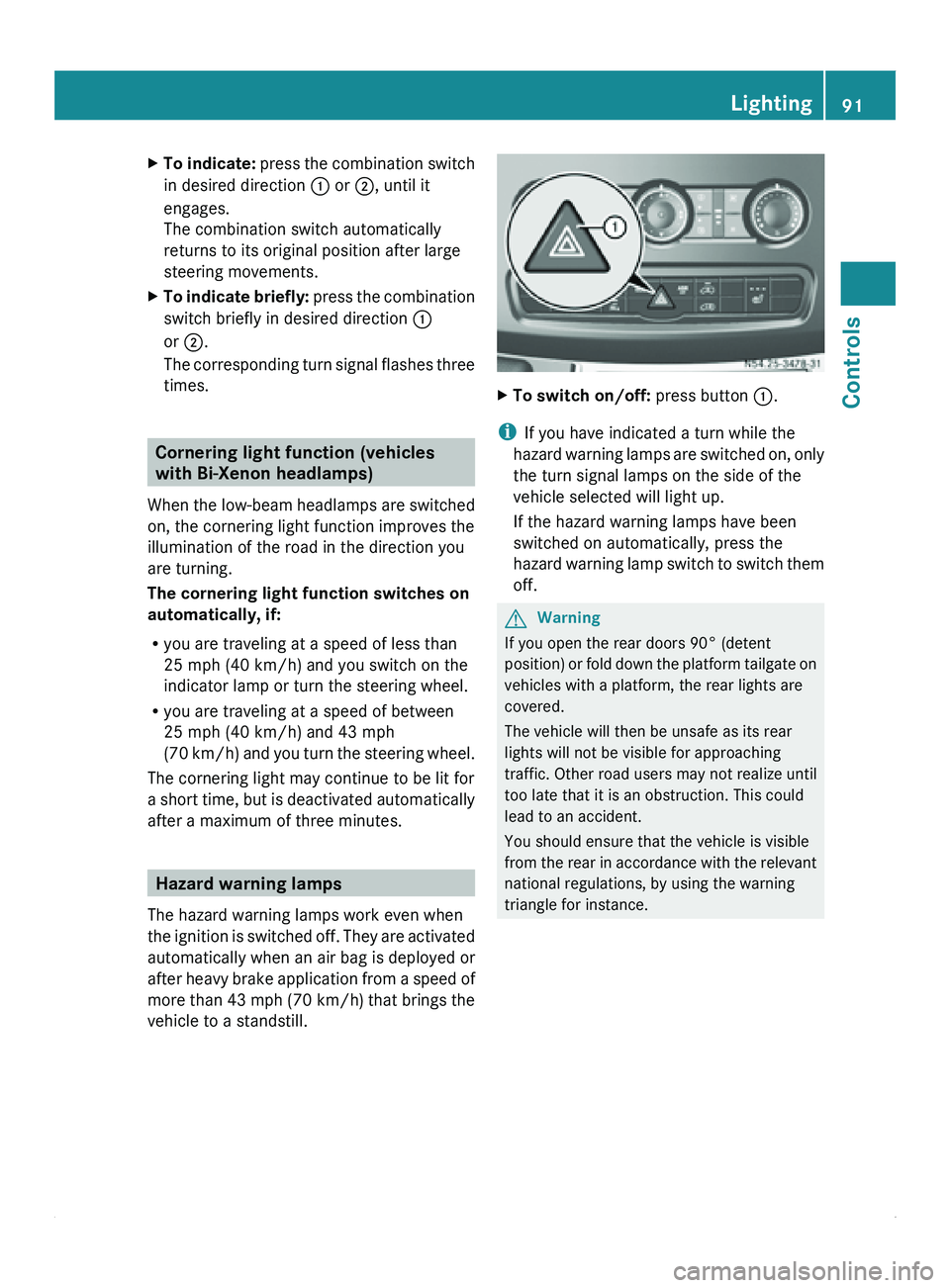
vehicle to a standstill. X
To switch on/off: press button 0046.
i If you have indicated a turn while the
hazard warning lamps
are switched on, only
the turn signal lamps on the side of the
vehicle selected will light up.
If the hazard warning lamps have been
switched on automatically, press the
hazard warning lamp switch to switch them
off. G
Warning
If you open the rear doors 90° (detent
position) or fold
down the platform tailgate on
vehicles with a platform, the rear lights are
covered.
The vehicle will then be unsafe as its rear
lights will not be visible for approaching
traffic. Other road users may not realize until
too late that it is an obstruction. This could
lead to an accident.
You should ensure that the vehicle is visible
from the rear in accordance with the relevant
national regulations, by using the warning
triangle for instance. Lighting
91
Controls Z
Page 95 of 292
lights on/off separately, depending on the
position of the central control switch.
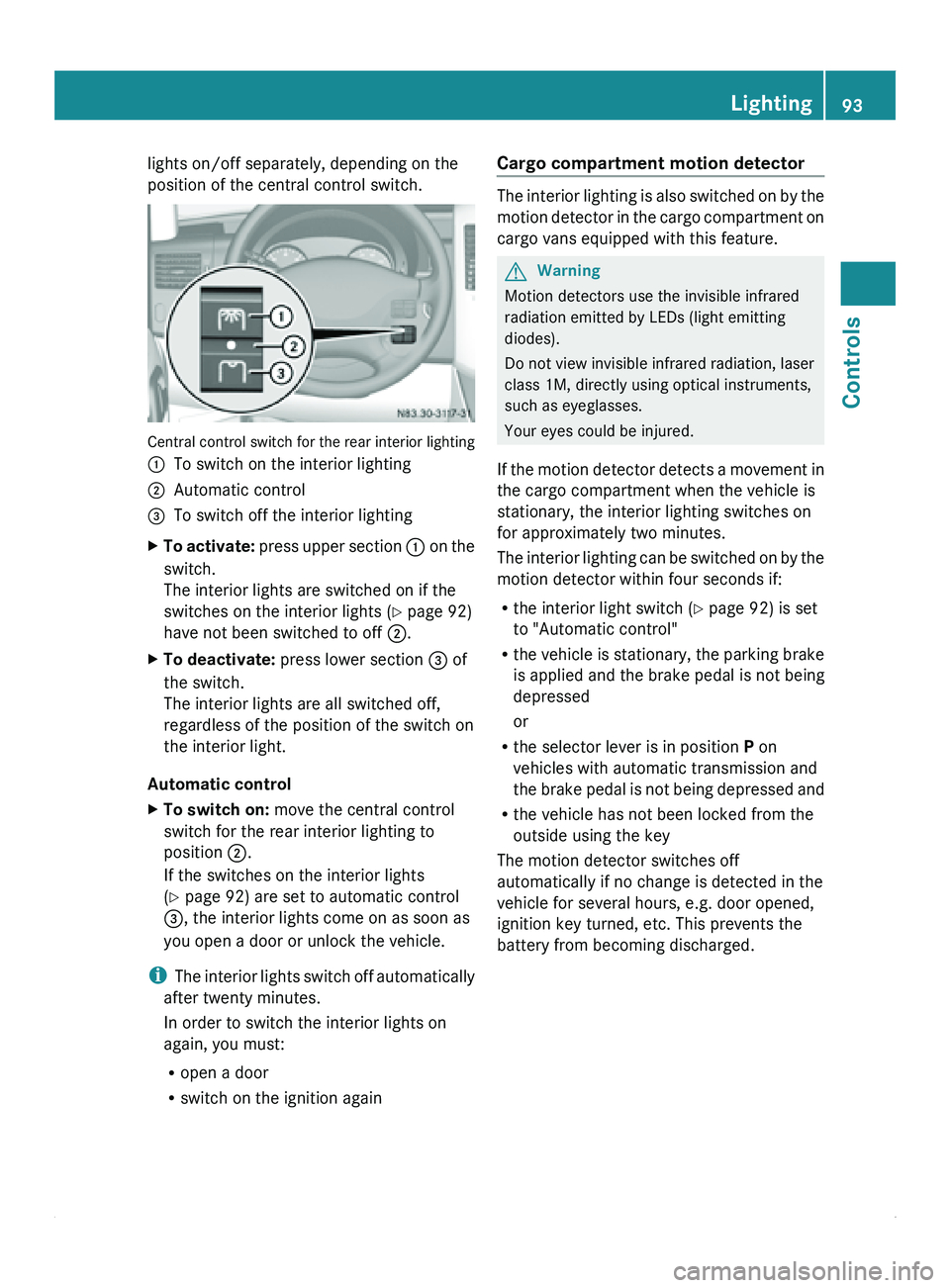
Central control switch for the rear interior lighting
0046
To switch on the interior lighting
0047 Automatic control
008A To switch off the interior lighting
X To activate: press
upper section 0046 on the
switch.
The interior lights are switched on if the
switches on the interior lights (Y page 92)
have not been switched to off 0047.
X To deactivate: press lower section 008A of
the switch.
The interior lights are all switched off,
regardless of the position of the switch on
the interior light.
Automatic control
X To switch on: move the central control
switch for the rear interior lighting to
position 0047.
If the switches on the interior lights
(Y page 92) are set to automatic control
008A, the interior lights come on as soon as
you open a door or unlock the vehicle.
i The interior
lights
switch off automatically
after twenty minutes.
In order to switch the interior lights on
again, you must:
R open a door
R switch on the ignition again Cargo compartment motion detector The interior lighting is also switched on by the
motion detector
in
the cargo compartment on
cargo vans equipped with this feature. G
Warning
Motion detectors use the invisible infrared
radiation emitted by LEDs (light emitting
diodes).
Do not view invisible infrared radiation, laser
class 1M, directly using optical instruments,
such as eyeglasses.
Your eyes could be injured.
If
the motion detector detects a movement in
the cargo compartment when the vehicle is
stationary, the interior lighting switches on
for approximately two minutes.
The interior lighting can be switched on by the
motion detector within four seconds if:
R the interior light switch (Y page 92) is set
to "Automatic control"
R the vehicle is stationary, the parking brake
is applied and the brake pedal is not being
depressed
or
R the selector lever is in position P on
vehicles with automatic transmission and
the brake pedal is not being depressed and
R the vehicle has not been locked from the
outside using the key
The motion detector switches off
automatically if no change is detected in the
vehicle for several hours, e.g. door opened,
ignition key turned, etc. This prevents the
battery from becoming discharged. Lighting
93
Controls Z