fuel cap MERCEDES-BENZ SPRINTER 2012 MY12 Operator’s Manual
[x] Cancel search | Manufacturer: MERCEDES-BENZ, Model Year: 2012, Model line: SPRINTER, Model: MERCEDES-BENZ SPRINTER 2012Pages: 292, PDF Size: 6.75 MB
Page 157 of 292
!
Do not use fuel additives (with the
exception of flow improvers), since this
could lead to malfunctions or engine
damage. Damage caused by the use of
such additives is not covered by the New
Vehicle Limited Warranty.
! Do not add
gasoline or kerosene to diesel
fuel to improve its flow characteristics.
Gasoline or kerosene impairs the
lubricating properties of the diesel fuel.
This may cause damage to the injection
system, for example.
At outside temperatures below
14 ‡(–10 †) and with less cold-resistant
winter diesel fuel, add the amount of flow
improver appropriate to the outside
temperature.
Add this additive to the diesel in time, i.e.
before the flow properties of the diesel are
affected by paraffin separation. Malfunctions
caused by paraffin separation can only be
rectified by heating the entire fuel system,
e.g. by parking the vehicle in a heated garage. G
Warning
If you heat up the fuel system with a heat gun,
for example, you
may damage parts of the fuel
system. Fuel could escape, be ignited, and
cause a fire.
Never heat the fuel system with a heat gun or
with a naked flame. Diesel Exhaust Fluid (DEF)
DEF is the
reducing agent for the exhaust gas
aftertreatment. DEF is a nonflammable,
nontoxic, colorless, odorless and water-
soluble liquid.
! Only use DEF in accordance with
ISO 22241. The exhaust gas aftertreatment
may otherwise be damaged.
Observe the MB Specifications for Service
Products, Sheet No. 352.0.
Damage caused by the use of other
reducing agents will result in the loss of your New Vehicle Limited Warranty
entitlements.
! If DEF comes into contact with a painted
or aluminum surface, wash the surface off
immediately with plenty of water.
High ambient temperatures If DEF in the DEF reservoir heats up to
temperatures over 122 ‡(50 †) for a long
period of time (e.g. due to direct sunlight),
ammonia vapors form.
G
Warning
If you open the DEF reservoir cap at high
temperatures, ammonia vapors could be
released.
Ammonia vapors have
a pungent odor and are
particularly irritating for your skin, respiratory
organs and eyes. This may result in burning
eyes, nose and throat, as well as coughing and
watering eyes.
Do not inhale ammonia vapors.
Low ambient temperatures DEF freezes at a temperature of
approximately
12 ‡(–11 †
). The vehicle is
equipped
with a DEF preheating system at the
factory. This ensures that the vehicle can be
operated in winter, even at temperatures
below 12 ‡(–11 †).
Additives and tap water !
Do not mix
DEF with any additives and do
not dilute DEF with tap water. Otherwise,
the exhaust gas aftertreatment may be
damaged.
Observe the MB Specifications for Service
Products, Sheet No. 352.0.
Damage caused by the use of additives or
tap water is not covered by the New Vehicle
Limited Warranty. Service products
155
Operation Z
Page 172 of 292
Only open the coolant expansion tank when
the coolant temperature is below 122 ‡
(50 †).
G
Warning
Coolant contains glycol and is therefore toxic.
Do not swallow the coolant. See a doctor
immediately if you swallow coolant.
Make sure that coolant does not come into
contact with skin,
eyes or clothing. In case of
contact with eyes, rinse immediately with
plenty of clean water. Clean affected areas of
skin and clothing with soap and water
immediately. Change any affected clothing
immediately.
X Slowly turn cap 0046 counter-clockwise and
allow the excess pressure to escape.
X Turn cap 0046 further and remove it.
X Add coolant until it is at the MAX mark.
Observe the correct coolant mixture ratio
and the required water quality
(Y page 160).
X Replace cap 0046 and tighten
it until the stop.
! Check the cooling and heating system
regularly for leaks.
If a large quantity of coolant is lost, have
the cause traced
and rectified at a qualified
specialist workshop, e.g. an authorized
Sprinter Dealer. Clutch mechanism and brake system
G
Warning
Brake fluid is hazardous to health. Do not
swallow brake fluid.
See a doctor immediately
if you swallow brake fluid.
Make sure that brake fluid does not come into
contact with skin, clothing or eyes. Rinse
affected areas with plenty of clean water and
consult a doctor if necessary.
Always wear gloves and eye protection when
topping up brake fluid. Store brake fluid only in the original closed
container and keep it out of the reach of
children. Comply with safety regulations
when handling brake fluid.
G
Warning
If the
boiling point of the brake fluid is too low,
vapor pockets may form in the brake system
when the brakes
are subjected to a heavy load
(e.g. on long downhill stretches). This would
impair braking efficiency. The vehicle's
stopping distance may then be longer. This
increases the risk of an accident.
Have the brake fluid renewed every two years.
The brake fluid reservoir is located in the
engine compartment.
Check the brake fluid level:
R regularly, e.g. weekly or when refueling
R only with the vehicle standing on a level
surface and with the engine switched off
! Brake fluid corrodes paint, plastic and
rubber. If paint, plastic or rubber has come
into contact with brake fluid, rinse with
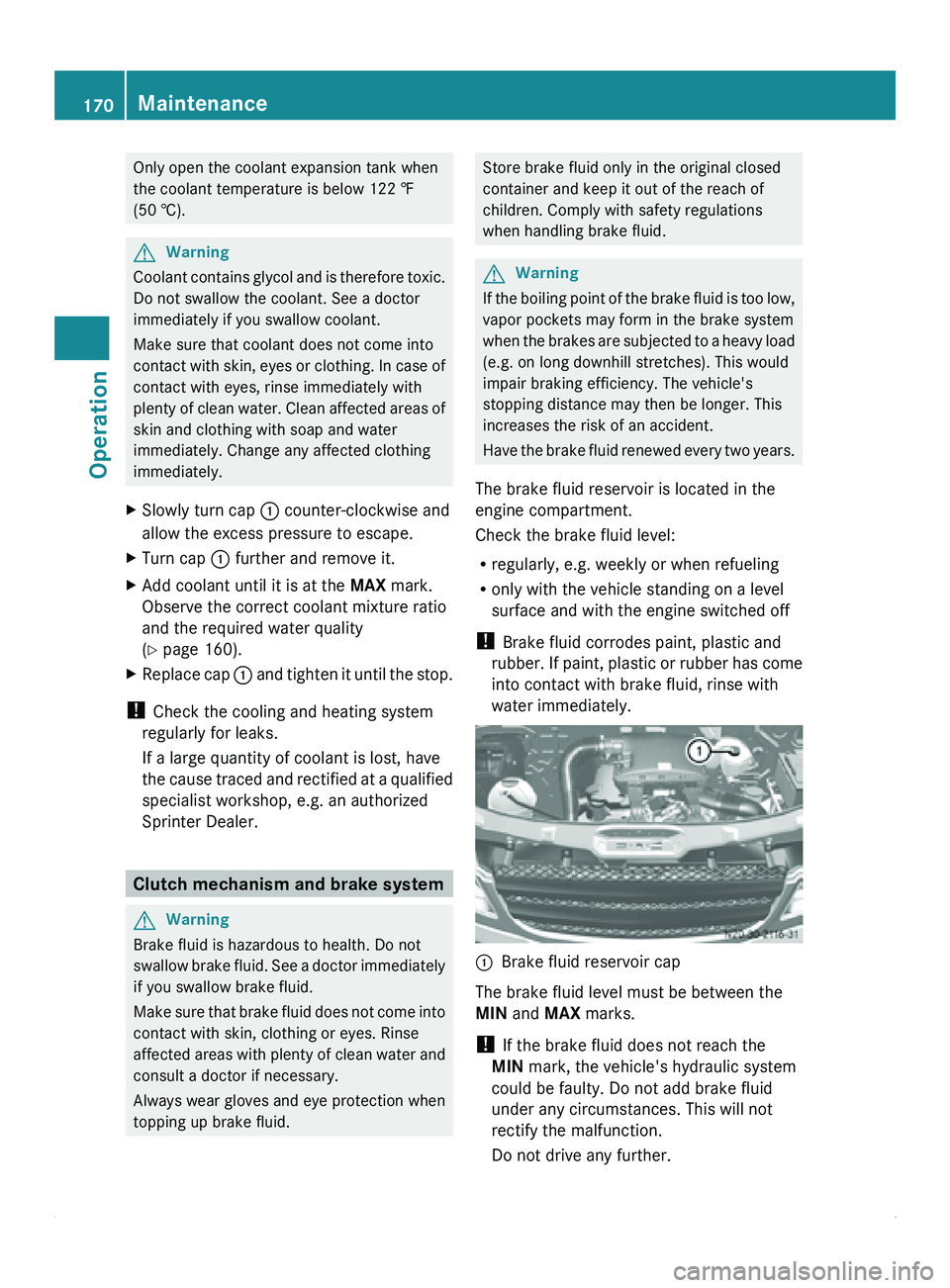
water immediately. 0046
Brake fluid reservoir cap
The brake fluid level must be between the
MIN and
MAX marks.
! If the brake fluid does not reach the
MIN mark, the vehicle's hydraulic system
could be faulty. Do not add brake fluid
under any circumstances. This will not
rectify the malfunction.
Do not drive any further. 170
Maintenance
Operation
Page 173 of 292
Have the system checked immediately at a
qualified specialist workshop, e.g. at an
authorized Sprinter Dealer.
i There is usually a notice in the engine
compartment to remind
you when the next
brake fluid change is due. Windshield washer system/
headlamp cleaning system
Add windshield washer concentrate to the
washer fluid all year round. G
Warning
Windshield washer concentrate is highly
flammable.
Fire, naked flames
and smoking are therefore
prohibited when you are handling windshield
washer concentrate.
! Only use washer fluid concentrate which
is suitable for plastic lenses. Unsuitable
washer fluid concentrate could damage the
plastic lenses of the headlamps.
Adapt the mixing ratio to the ambient
temperature. If the temperature is above
freezing, use Summerwash to prevent
smearing. If there is a risk of frost, use
Winterwash to prevent the water from
freezing on the windshield.
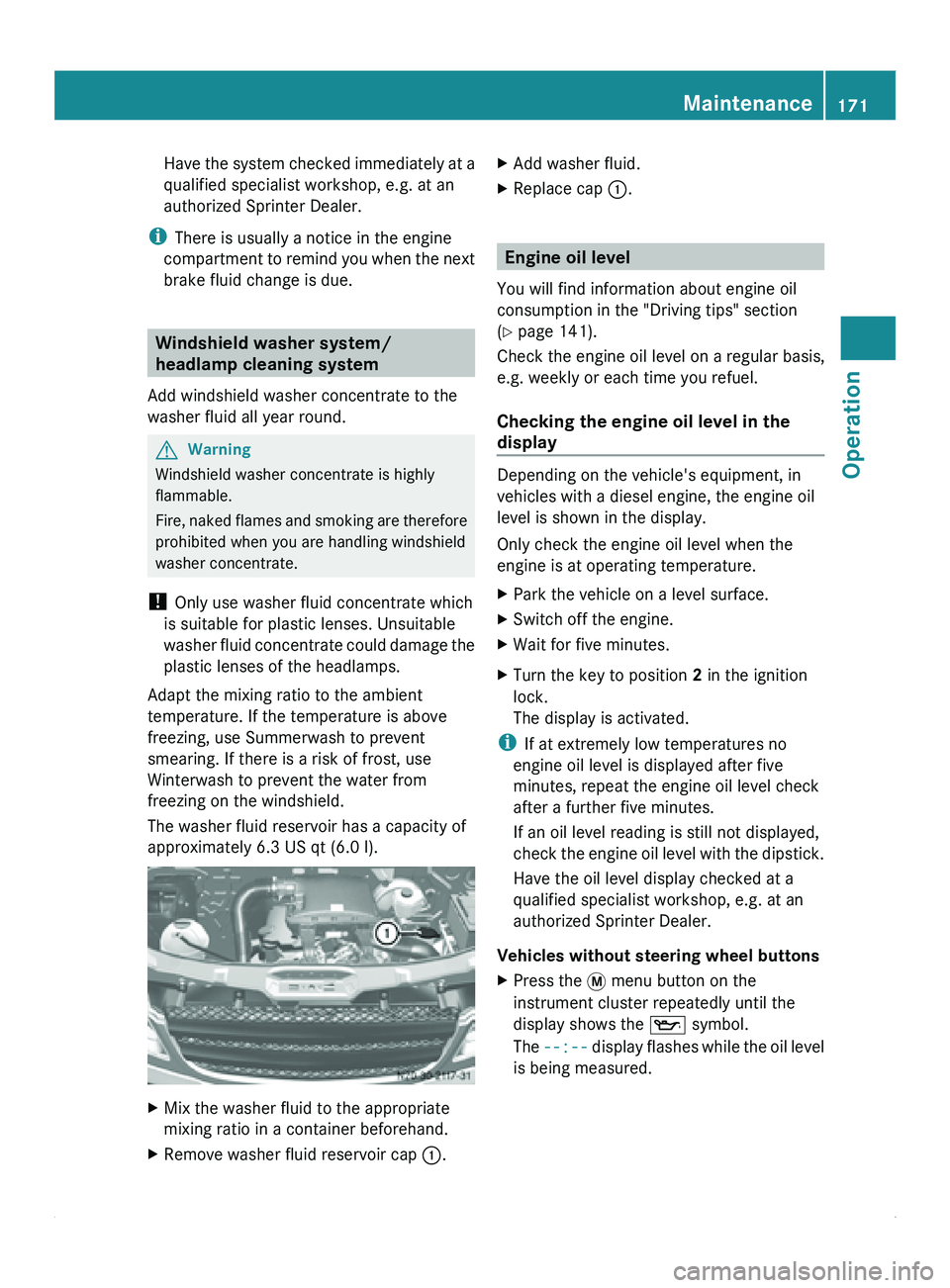
The washer fluid reservoir has a capacity of
approximately 6.3 US qt (6.0 l). X
Mix the washer fluid to the appropriate
mixing ratio in a container beforehand.
X Remove washer fluid reservoir cap 0046.X
Add washer fluid.
X Replace cap 0046. Engine oil level
You will find information about engine oil
consumption in the "Driving tips" section
(Y page 141).
Check the engine oil level on a regular basis,
e.g. weekly or each time you refuel.
Checking the engine oil level in the
display Depending on the vehicle's equipment, in
vehicles with a diesel engine, the engine oil
level is shown in the display.
Only check the engine oil level when the
engine is at operating temperature.
X
Park the vehicle on a level surface.
X Switch off the engine.
X Wait for five minutes.
X Turn the key to position 2 in the ignition
lock.
The display is activated.
i If at extremely low temperatures no
engine oil level is displayed after five
minutes, repeat the engine oil level check
after a further five minutes.
If an oil level reading is still not displayed,
check the engine
oil level with the dipstick.
Have the oil level display checked at a
qualified specialist workshop, e.g. at an
authorized Sprinter Dealer.
Vehicles without steering wheel buttons
X Press the 007B menu button on the
instrument cluster repeatedly until the
display shows the 00B1 symbol.
The --:-- display flashes
while the oil level
is being measured. Maintenance
171
Operation Z
Page 181 of 292
Battery care
!
Please always observe the following
notes:
R dirty battery clamps
and battery surfaces
cause leak currents, which lead to the
batteries discharging. Always keep the
battery terminals and battery surfaces
clean and dry. Grease the battery
terminals, particularly the terminal
undersides, with a light coating of acid-
resistant grease.
R cleaning agents containing fuel corrode
the battery housing. Only clean the
battery housing with commercially
available cleaning agents.
R only clean the batteries when the caps
are screwed on. Dirt may otherwise enter
the battery cells and damage the battery.
R the breathers in the caps and the cell
ventilation tubes must be open.
Otherwise, gas cannot escape. Unscrew
blocked breathers and clean them with a
suitable tool such as a piece of wire. If
you do not unscrew the caps for cleaning,
there is a risk of short circuit.
R regularly check the battery terminals and
the fastening of the negative cable to the
chassis to ensure that they are firmly
seated.
R if batteries are not being used, you
should charge them once a month. Maintenance
179
Operation Z
Page 184 of 292
Vehicle equipment
i Diese Betriebsanleitung beschreibt alle
Modelle, Serien- und
Sonderausstattungen
Ihres Fahrzeugs, die zum Zeitpunkt des
Redaktionsschlusses dieser
Betriebsanleitung erhältlich waren.
Länderspezifische Abweichungen sind
möglich. Beachten Sie, dass Ihr Fahrzeug
nicht mit allen beschriebenen Funktionen
ausgestattet sein könnte. Dies betrifft auch
sicherheitsrelevante Systeme und
Funktionen. Where will I find...?
Vehicle tool kit and emergency
equipment
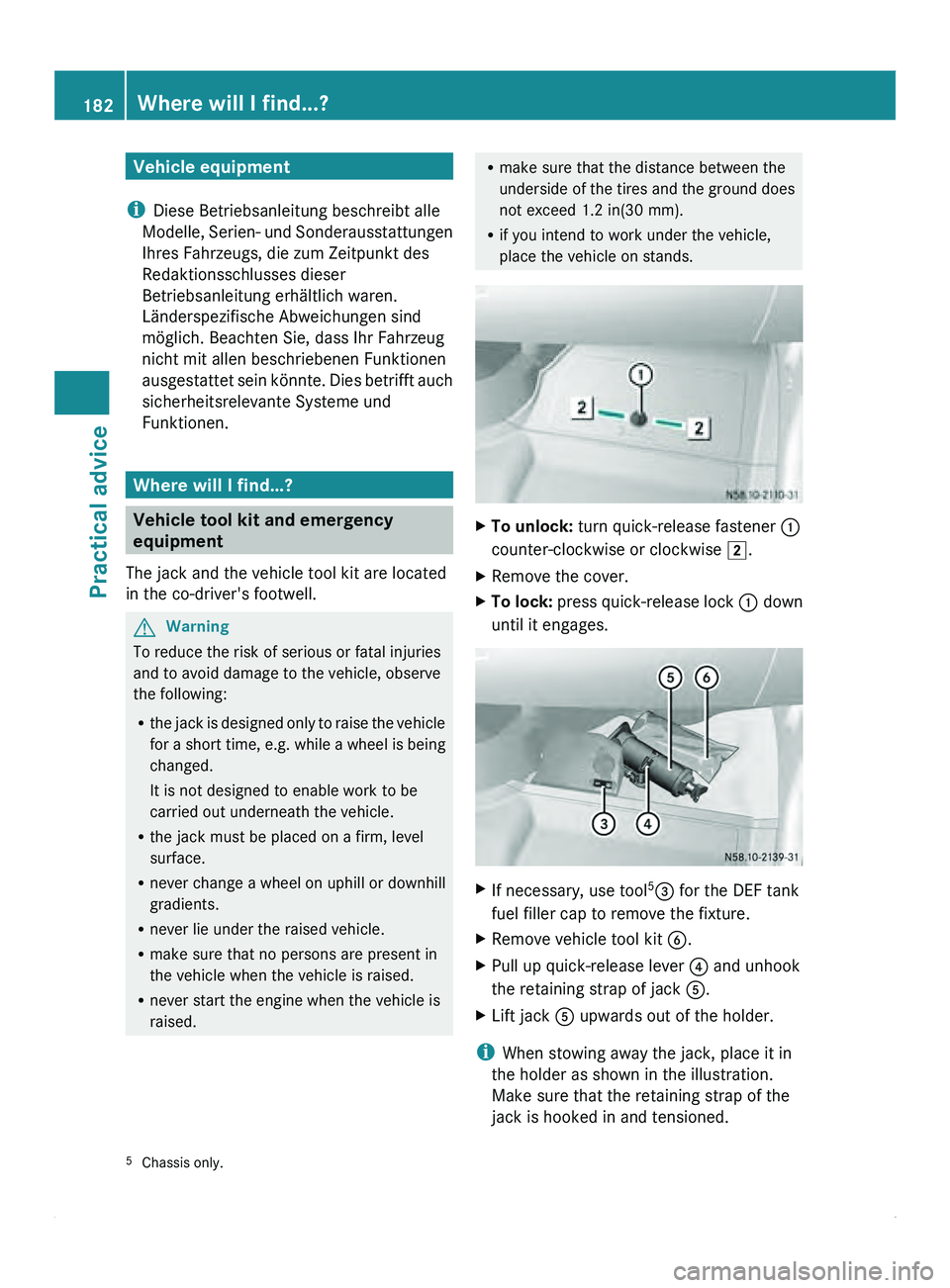
The jack and the vehicle tool kit are located
in the co-driver's footwell. G
Warning
To reduce the risk of serious or fatal injuries
and to avoid damage to the vehicle, observe
the following:
R the jack is
designed only to raise the vehicle
for a short time, e.g. while a wheel is being
changed.
It is not designed to enable work to be
carried out underneath the vehicle.
R the jack must be placed on a firm, level
surface.
R never change a wheel on uphill or downhill
gradients.
R never lie under the raised vehicle.
R make sure that no persons are present in
the vehicle when the vehicle is raised.
R never start the engine when the vehicle is
raised. R
make sure that the distance between the
underside
of the
tires and the ground does
not exceed 1.2 in(30 mm).
R if you intend to work under the vehicle,
place the vehicle on stands. X
To unlock: turn quick-release fastener
0046
counter-clockwise or clockwise 004B.
X Remove the cover.
X To lock: press quick-release lock
0046 down
until it engages. X
If necessary, use tool 5
008A for the DEF tank
fuel filler cap to remove the fixture.
X Remove vehicle tool kit 0087.
X Pull up quick-release lever 0088 and unhook
the retaining strap of jack 0086.
X Lift jack 0086 upwards out of the holder.
i When stowing away the jack, place it in
the holder as shown in the illustration.
Make sure that the retaining strap of the
jack is hooked in and tensioned.
5 Chassis only.182
Where will I find...?
Practical advice
Page 196 of 292
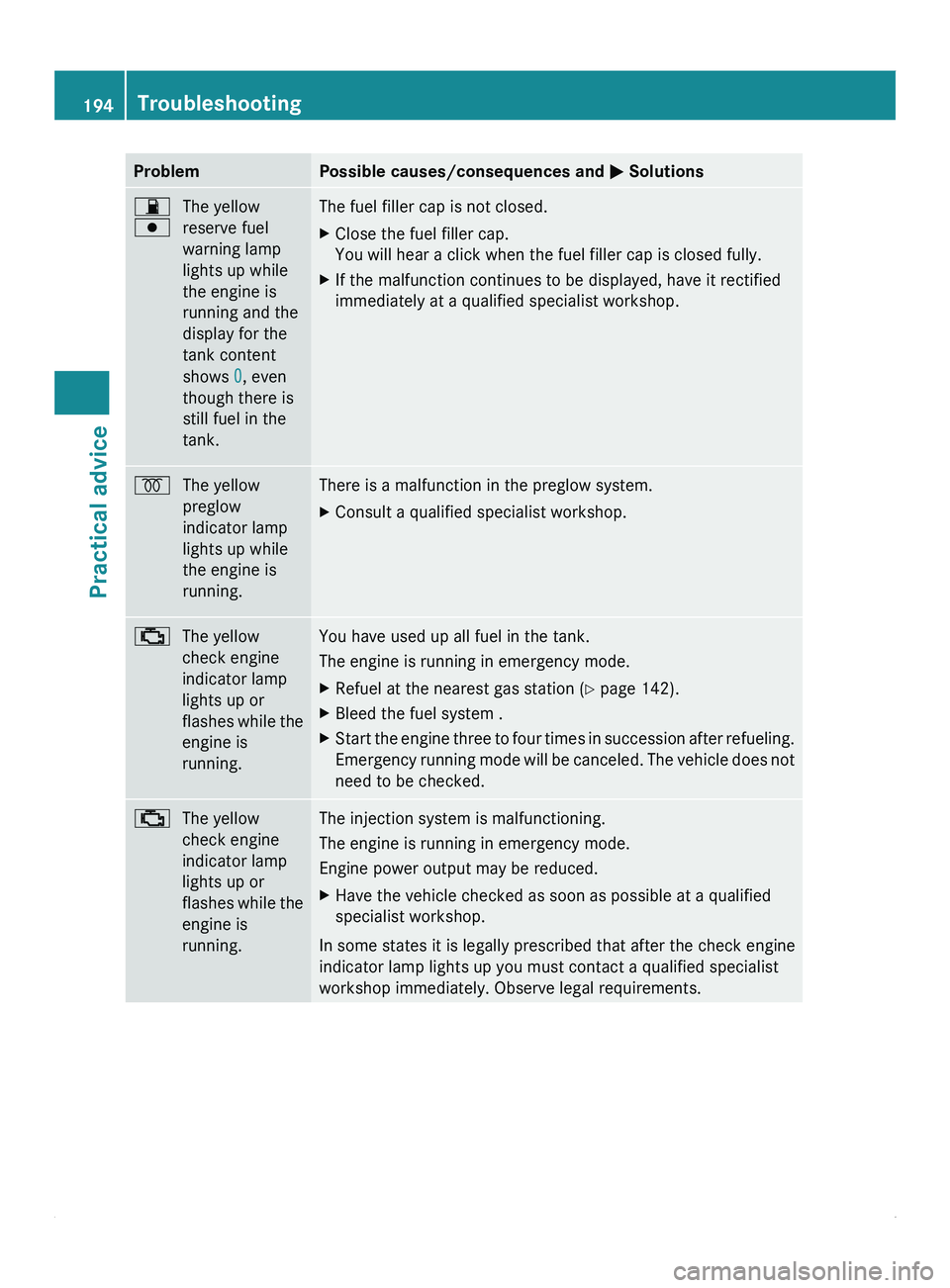
Problem Possible causes/consequences and
0050 Solutions00B7
0080
The yellow
reserve fuel
warning lamp
lights up while
the engine is
running and the
display for the
tank content
shows 0, even
though there is
still fuel in the
tank. The fuel filler cap is not closed.
X
Close the fuel filler cap.
You will hear a click when the fuel filler cap is closed fully.
X If the malfunction continues to be displayed, have it rectified
immediately at a qualified specialist workshop. 0028
The yellow
preglow
indicator lamp
lights up while
the engine is
running. There is a malfunction in the preglow system.
X
Consult a qualified specialist workshop. 00BB
The yellow
check engine
indicator lamp
lights up or
flashes while the
engine is
running. You have used up all fuel in the tank.
The engine is running in emergency mode.
X
Refuel at the nearest gas station ( Y page 142).
X Bleed the fuel system .
X Start the engine three to four times in succession after refueling.
Emergency running mode
will be canceled. The vehicle does not
need to be checked. 00BB
The yellow
check engine
indicator lamp
lights up or
flashes while the
engine is
running. The injection system is malfunctioning.
The engine is running in emergency mode.
Engine power output may be reduced.
X
Have the vehicle checked as soon as possible at a qualified
specialist workshop.
In some states it is legally prescribed that after the check engine
indicator lamp lights up you must contact a qualified specialist
workshop immediately. Observe legal requirements. 194
Troubleshooting
Practical advice
Page 210 of 292
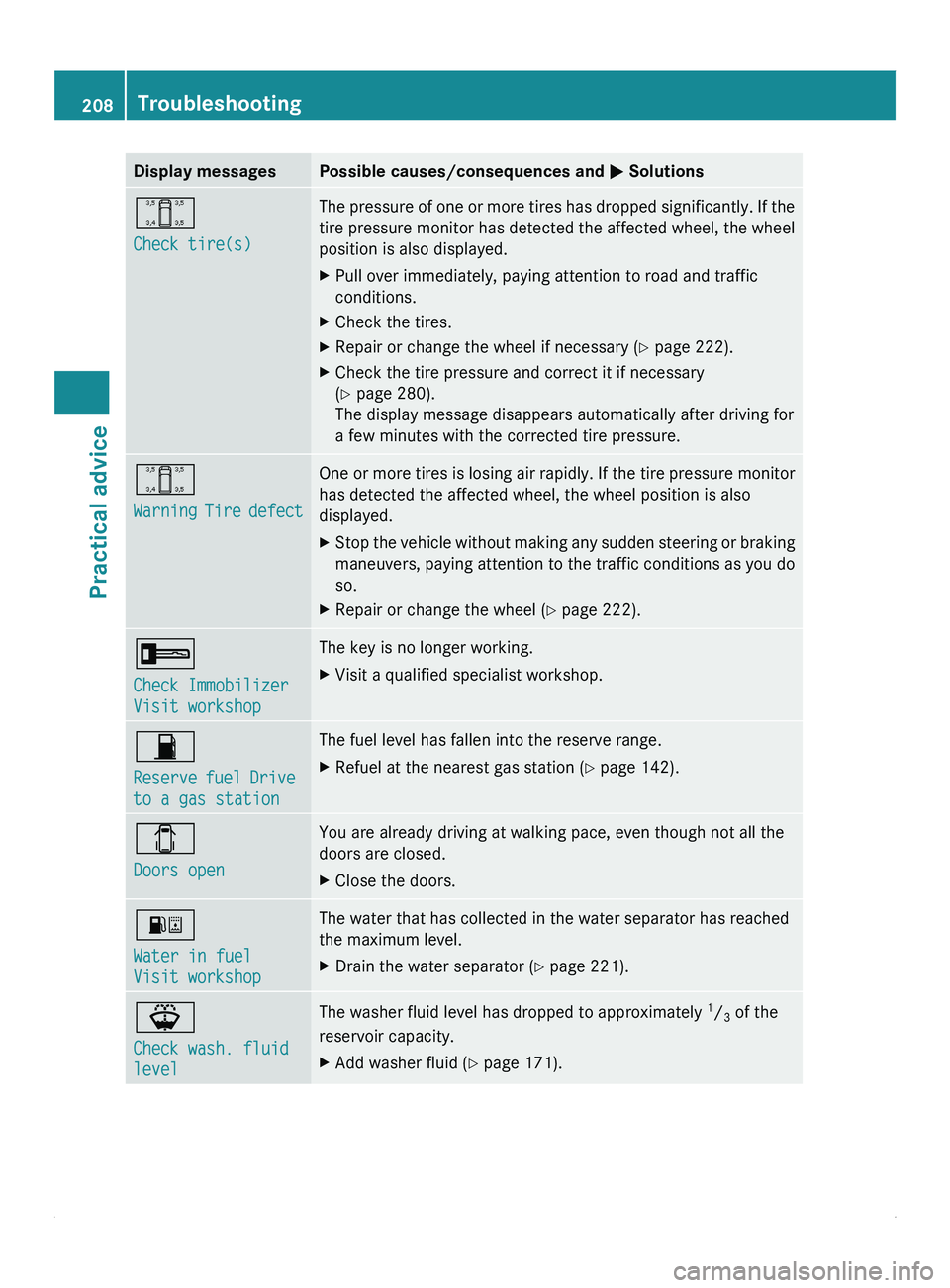
Display messages Possible causes/consequences and
0050 Solutions0063
Check tire(s) The pressure of one or more tires has dropped significantly. If the
tire pressure monitor
has detected the affected wheel, the wheel
position is also displayed.
X Pull over immediately, paying attention to road and traffic
conditions.
X Check the tires.
X Repair or change the wheel if necessary ( Y page 222).
X Check the tire pressure and correct it if necessary
(Y page 280).
The display message disappears automatically after driving for
a few minutes with the corrected tire pressure. 0063
Warning Tire
defect One or more tires is losing air rapidly. If the tire pressure monitor
has detected the affected wheel, the wheel position is also
displayed.
X
Stop the vehicle without making any sudden steering or braking
maneuvers, paying attention
to the traffic conditions as you do
so.
X Repair or change the wheel (Y page 222). 0039
Check Immobilizer
Visit workshop The key is no longer working.
X
Visit a qualified specialist workshop. 00B7
Reserve fuel
Drive
to a gas station The fuel level has fallen into the reserve range.
X
Refuel at the nearest gas station ( Y page 142).003E
Doors open You are already driving at walking pace, even though not all the
doors are closed.
X
Close the doors. 00BA
Water in fuel
Visit workshop The water that has collected in the water separator has reached
the maximum level.
X
Drain the water separator ( Y page 221).00BD
Check wash. fluid
level The washer fluid level has dropped to approximately
1
/ 3 of the
reservoir capacity.
X Add washer fluid ( Y page 171).208
Troubleshooting
Practical advice
Page 260 of 292
Do not overload the tires by exceeding the
specified load limit as indicated on the Tire
and Loading Information placard on the
driver's door B-pillar. Overloading the tires
can overheat them, possibly causing a
blowout. Overloading
the tires can also result
in handling or steering problems, or brake
failure.
Check the tire pressure at least once a month.
Only check and correct tire pressures when
the tires are cold. Checking the tire pressure manually
In order to determine and adjust the tire
pressures, proceed as follows:
X Remove the valve cap of the tire you wish
to check.
X Press the
tire pressure gauge securely onto
the valve.
X Read the tire pressure and compare it with
the recommended value on the Tire and
Loading Information placard12
or on the tire
pressure plate on the B-pillar on the driver's
side of the vehicle.
X If necessary, increase the tire pressure to
the recommended value.
X If the tire pressure is too high, release air
by pressing down
the metal pin in the valve
using the tip of a pen, for example. Then,
check the tire pressure again using the tire
pressure gauge.
X Screw the valve cap onto the valve.
X Repeat the steps for the other tires. Tire pressure monitor
Important safety notes If a tire pressure monitor is installed, the
vehicle's wheels have sensors installed that
monitor the
tire
pressures in all four tires. The
tire pressure monitor warns you when the pressure drops in one or more of the tires. The
tire pressure monitor only functions if the
correct wheel electronics units are installed
in all wheels.
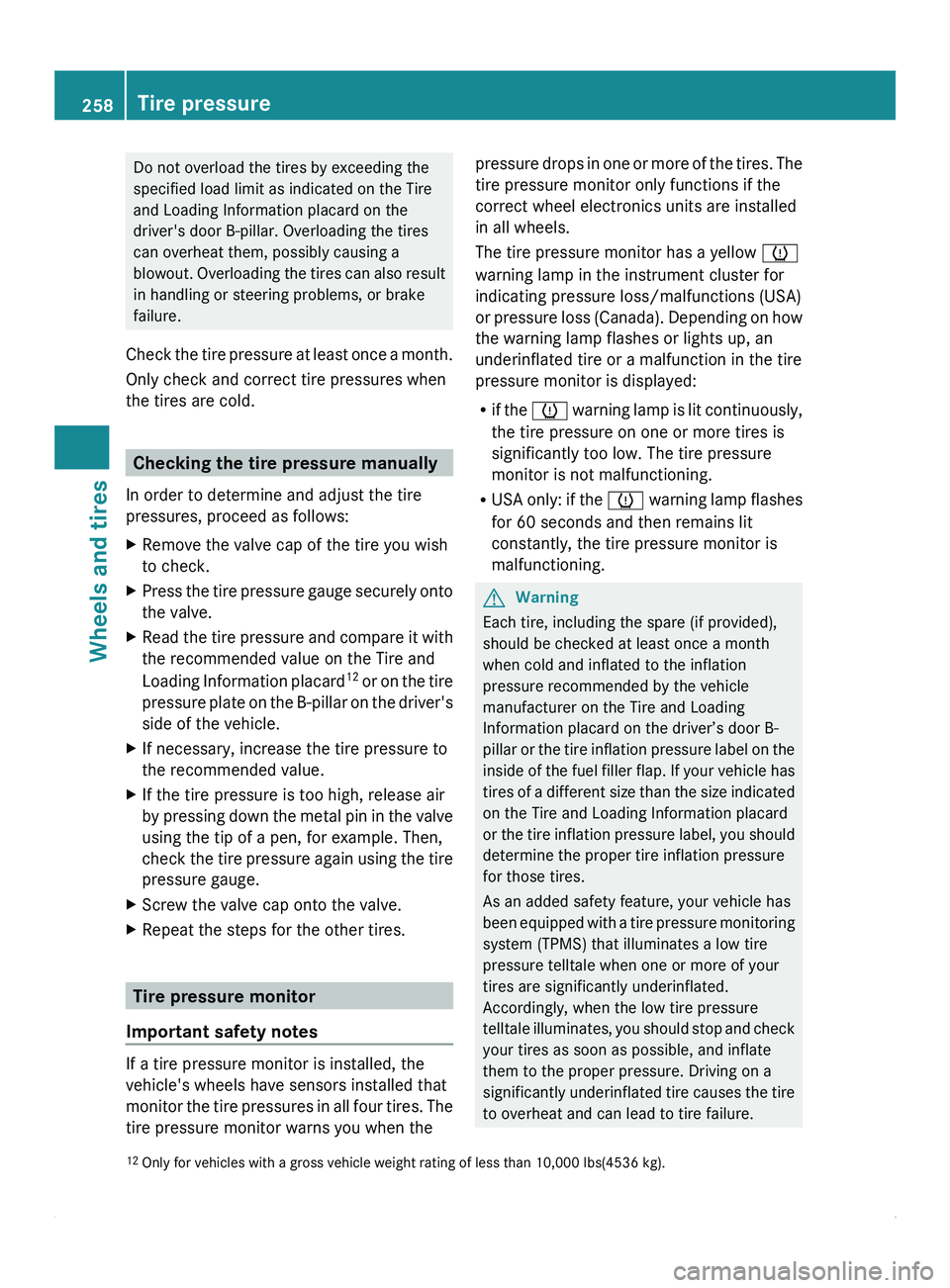
The tire pressure monitor has a yellow
0077
warning lamp in the instrument cluster for
indicating pressure loss/malfunctions (USA)
or pressure loss
(Canada). Depending on how
the warning lamp flashes or lights up, an
underinflated tire or a malfunction in the tire
pressure monitor is displayed:
R if the 0077 warning lamp is lit continuously,
the tire pressure on one or more tires is
significantly too low. The tire pressure
monitor is not malfunctioning.
R USA only: if the 0077 warning lamp flashes
for 60 seconds and then remains lit
constantly, the tire pressure monitor is
malfunctioning. G
Warning
Each tire, including the spare (if provided),
should be checked at least once a month
when cold and inflated to the inflation
pressure recommended by the vehicle
manufacturer on the Tire and Loading
Information placard on the driver’s door B-
pillar or the
tire inflation pressure label on the
inside of the fuel filler flap. If your vehicle has
tires of a different size than the size indicated
on the Tire and Loading Information placard
or the tire inflation pressure label, you should
determine the proper tire inflation pressure
for those tires.
As an added safety feature, your vehicle has
been equipped with a tire pressure monitoring
system (TPMS) that illuminates a low tire
pressure telltale when one or more of your
tires are significantly underinflated.
Accordingly, when the low tire pressure
telltale illuminates, you should stop and check
your tires as soon as possible, and inflate
them to the proper pressure. Driving on a
significantly underinflated tire causes the tire
to overheat and can lead to tire failure.
12 Only for vehicles with a gross vehicle weight rating of less than 10,000 lbs(4536 kg).258
Tire pressure
Wheels and tires
Page 272 of 292
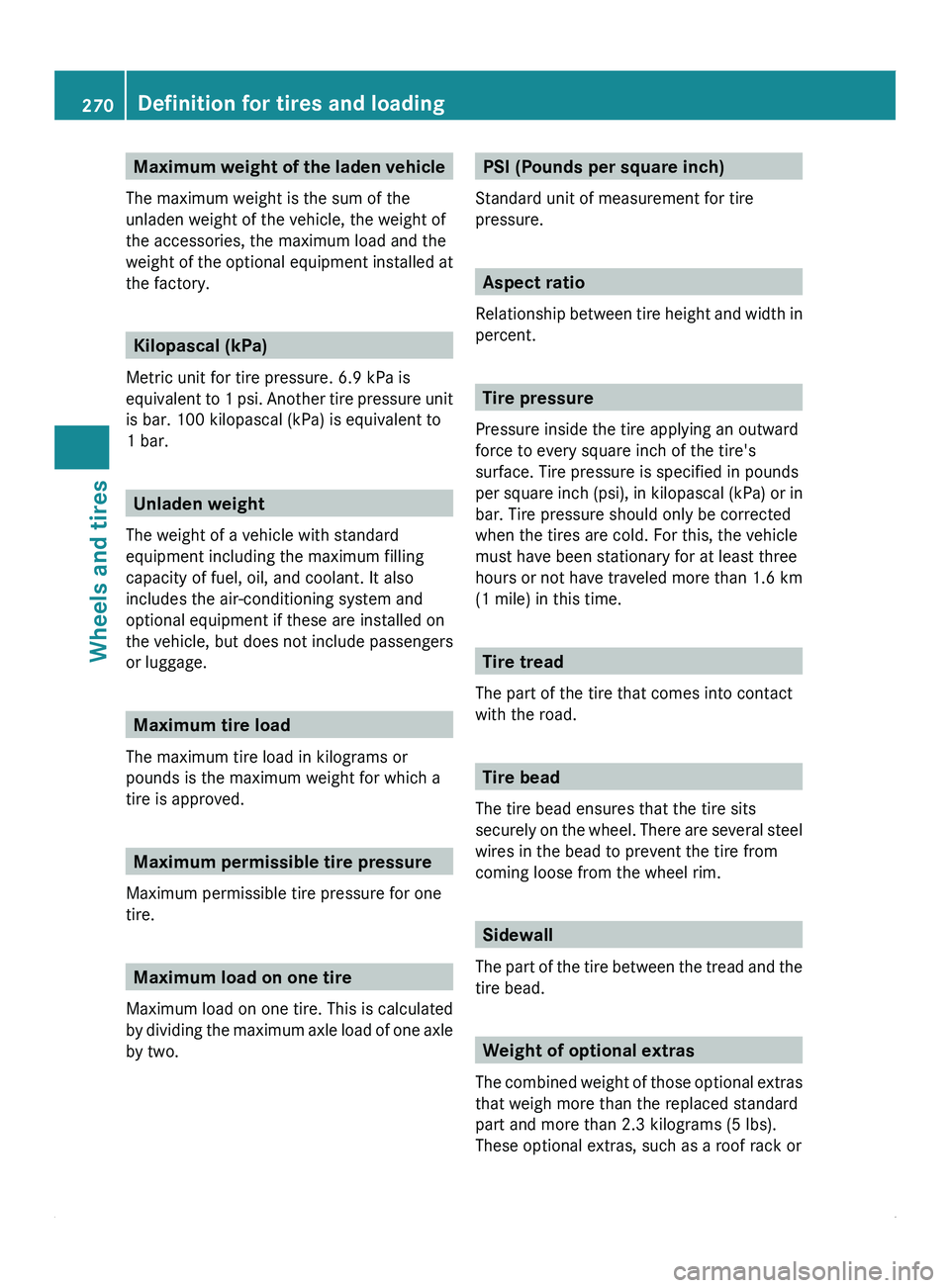
Maximum weight of the laden vehicle
The maximum weight is the sum of the
unladen weight of the vehicle, the weight of
the accessories, the maximum load and the
weight of the
optional equipment installed at
the factory. Kilopascal (kPa)
Metric unit for tire pressure. 6.9 kPa is
equivalent to
1 psi. Another tire pressure unit
is bar. 100 kilopascal (kPa) is equivalent to
1 bar. Unladen weight
The weight of a vehicle with standard
equipment including the maximum filling
capacity of fuel, oil, and coolant. It also
includes the air-conditioning system and
optional equipment if these are installed on
the vehicle, but does not include passengers
or luggage. Maximum tire load
The maximum tire load in kilograms or
pounds is the maximum weight for which a
tire is approved. Maximum permissible tire pressure
Maximum permissible tire pressure for one
tire. Maximum load on one tire
Maximum load on one tire. This is calculated
by dividing the
maximum axle load of one axle
by two. PSI (Pounds per square inch)
Standard unit of measurement for tire
pressure. Aspect ratio
Relationship between tire
height and width in
percent. Tire pressure
Pressure inside the tire applying an outward
force to every square inch of the tire's
surface. Tire pressure is specified in pounds
per square inch
(psi), in kilopascal (kPa) or in
bar. Tire pressure should only be corrected
when the tires are cold. For this, the vehicle
must have been stationary for at least three
hours or not have traveled more than 1.6 km
(1 mile) in this time. Tire tread
The part of the tire that comes into contact
with the road. Tire bead
The tire bead ensures that the tire sits
securely on the
wheel. There are several steel
wires in the bead to prevent the tire from
coming loose from the wheel rim. Sidewall
The part of
the tire between the tread and the
tire bead. Weight of optional extras
The combined weight
of those optional extras
that weigh more than the replaced standard
part and more than 2.3 kilograms (5 lbs).
These optional extras, such as a roof rack or 270
Definition for tires and loading
Wheels and tires
Page 289 of 292
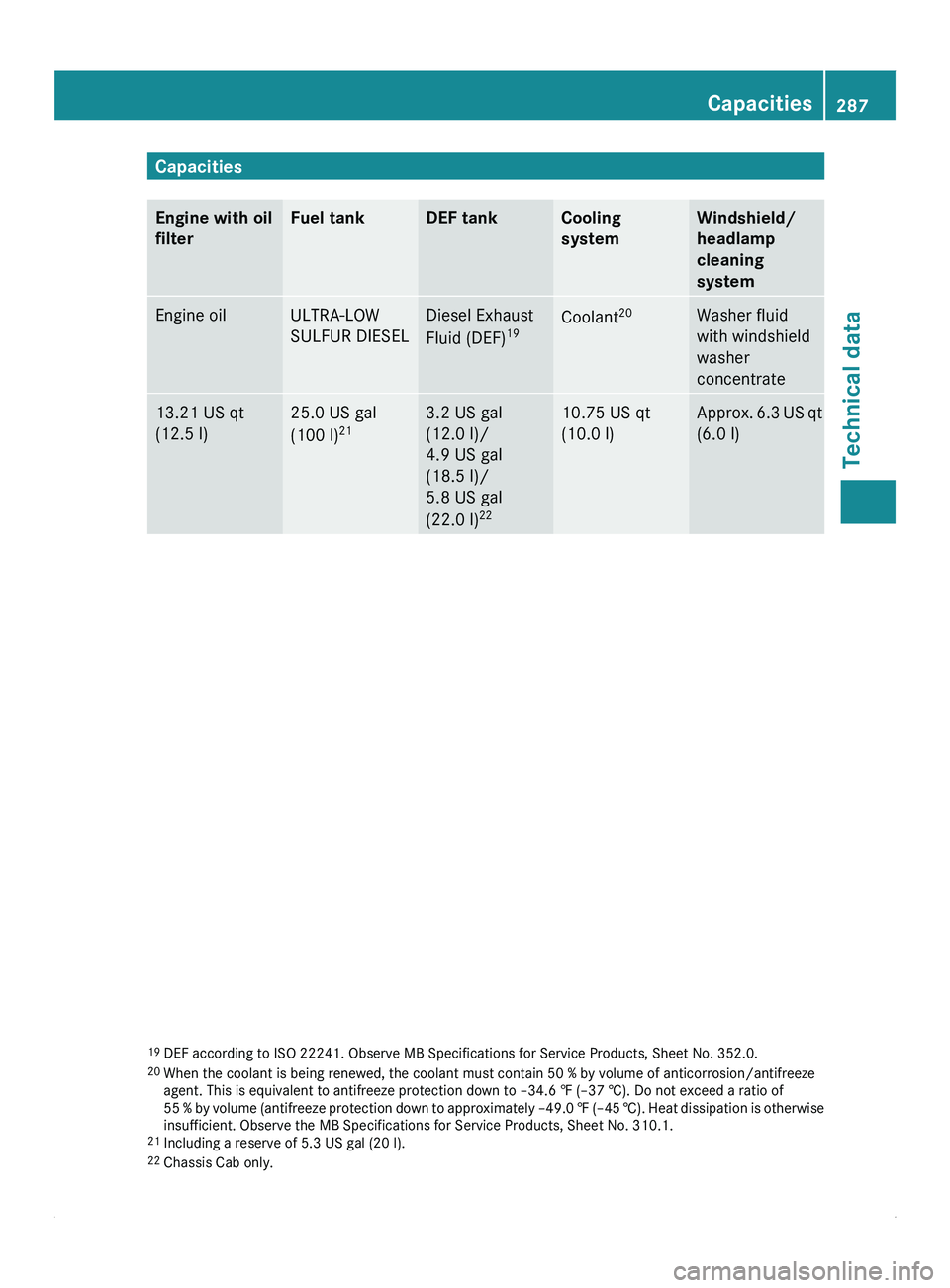
Capacities
Engine with oil
filter Fuel tank DEF tank Cooling
system Windshield/
headlamp
cleaning
system
Engine oil ULTRA-LOW
SULFUR DIESEL Diesel Exhaust
Fluid (DEF)
19 Coolant
20 Washer fluid
with windshield
washer
concentrate
13.21 US qt
(12.5 l) 25.0 US gal
(100 l)
21 3.2 US gal
(12.0 l)/
4.9 US gal
(18.5 l)/
5.8 US gal
(22.0 l)
22 10.75 US qt
(10.0 l) Approx. 6.3 US qt
(6.0 l) 19
DEF according to ISO 22241 . Observe MB Specifications for Service Products,
Sheet No. 352.0.
20 When the coolant is being renewed, the coolant must contain 50 % by volume of anticorrosion/antifreeze
agent. This is equivalent to antifreeze protection down to –34.6 ‡ (–37 †). Do not exceed a ratio of
55 % by volume (antifreeze protection down to approximately –49.0 ‡ (–45 †). Heat dissipation is otherwise
insufficient. Observe the MB Specifications for Service Products, Sheet No. 310.1.
21 Including a reserve of 5.3 US gal (20 l).
22 Chassis Cab only. Capacities
287
Technical data Z