radio MERCEDES-BENZ SPRINTER 2012 MY12 Operator’s Manual
[x] Cancel search | Manufacturer: MERCEDES-BENZ, Model Year: 2012, Model line: SPRINTER, Model: MERCEDES-BENZ SPRINTER 2012Pages: 292, PDF Size: 6.75 MB
Page 164 of 292
G
Warning
Never use openings in the bodywork as steps.
You may otherwise
damage the vehicle or lose
your footing and injure yourself or others.
If you have to clean the upper areas of the
vehicle, always use suitable ladders or other
secure climbing aids. G
Warning
Dirty or
iced-up steps and entrances create a
risk of slipping or falling.
Keep steps, entrances
and footwear free from
dirt (e.g. mud, clay, snow and ice). Cleaning the interior of the vehicle
Seat belts !
Observe the following notes on cleaning
the seat belts:
R Remove any stains or dirt immediately.
This will avoid residue or damage.
R Do not bleach
or dye the seat belts. This
could impair the function of the seat
belts.
R Do not dry the seat belts in direct
sunlight or at temperatures above
176 ‡ (80 †).
Steering wheel boss and cockpit G
Warning!
When cleaning the steering wheel boss and
dashboard, do not use cockpit sprays or
cleaning agents containing
solvents. Cleaning
agents containing solvents cause the surface
to become porous, and as a result, plastic
parts may break away and be thrown around
the interior when an air bag is deployed, which
may result in severe injuries.
Use a damp, clean and lint-free cloth to clean
the plastic components and the cockpit. If
particularly dirty, use a mild detergent. !
Do not use
dry, coarse or hard cloths and
do not scrub. You could otherwise scratch
or damage the surfaces.
Radio and monitor display X
Switch off the radio or rear-view camera
monitor and let it cool.
X Clean the display surface with a
commercially available microfiber cloth
and cleaner for TFT/LCD displays.
X After drying,
polish the display surface with
a dry microfiber cloth, applying only light
pressure.
! Do not use dry, rough or hard cloths or
abrasive products, solvents or cleaning
agents containing solvents. Do not scrub.
Only apply light pressure when cleaning.
Otherwise, you will damage the display
surface, as it is sensitive to pressure and
susceptible to scratches.
Windows !
Do not use
dry cloths, abrasive products,
solvents or cleaning agents containing
solvents to clean the inside of the windows.
Clean the inside of the windows with a
damp cloth or a commercially available
glass cleaner.
Do not touch the inside of the rear and side
windows with hard objects, e.g. an ice
scraper or ring. You could otherwise
damage the windows or the rear window
defroster. Cleaning the exterior of the vehicle
General notes Scratches, corrosive
deposits, areas affected
by corrosion and damage caused by neglect
or inadequate care cannot always be
completely remedied. In this case, visit a
qualified specialist workshop, e.g. the
nearest authorized Sprinter Dealer. 162
Cleaning and care
Operation
Page 167 of 292
from the windshield and the wiper blades to
prevent smearing.
Smears
impair the driver's
view, and their effect is made worse in
conditions where visibility is poor (e.g. glare,
mist, darkness, snow). You may therefore fail
to recognize dangers, or not recognize them
in time, and thereby cause an accident.
! Make sure that the automatic car wash is
suitable for the size of the vehicle.
Before washing the vehicle in an automatic
car wash, fold in the exterior mirrors and
remove the radio/telephone antenna.
Otherwise, the exterior mirror, antenna or
the vehicle itself could be damaged.
Make sure that the antenna is installed and
that the exterior mirrors are fully folded out
again when you leave the automatic car
wash.
! Make sure that the side windows are
completely closed, that the ventilation/
heating is switched off and that the
windshield wiper switch is set to 0.
Otherwise, the rain/light sensor could be
activated, triggering unintended wiper
movements. This can cause damage to the
vehicle.
After putting the vehicle through an
automatic car wash, wipe off wax from:
R the rear-view camera lens ( Y page 163)
R the windshield and the wiper blades. This
prevents smears and reduces wiping noise
which can be caused by residue on the
windshield. Cleaning the engine
! Water must not
enter intake or ventilation
openings. When cleaning with high
pressure water or steam cleaners, the
spray must not be aimed directly at
electrical components or the terminals of
electrical lines. Preserve the engine after the engine has
been cleaned.
Protect
the belt drive system
from exposure to the preservative agent. Alloy wheels
Clean the alloy wheels regularly.
! Do not use
any acidic or alkaline cleaning
agents. They can cause corrosion on the
wheel bolts (wheel nuts) or the retainer
springs for the wheel-balancing weights. After driving off-road or on
construction sites
G
Warning
Dirt on the vehicle can affect road and
operating safety.
It can specifically result in the following
dangers:
Stone impact. Stones trapped between the
tires can be thrown out while driving. This
could injure other
road users or damage other
vehicles (especially windscreens).
Risk of skidding. Dirt and mud on the tires/
on the road reduce the grip of the tires on the
road. This especially applies when the surface
is wet. The vehicle could then start to skid.
Risk of injury. Dirt and mud on the steps and
entrance can make the steps unsafe. This
could cause you to slip off the steps and be
injured.
For this reason, you should always clean your
vehicle carefully after driving off-road or on
construction sites before driving on public
roads. Observe the corresponding safety
notices in this chapter if you use a power
washer or an automatic car wash to clean your
vehicle.
X Clean the vehicle, paying special attention
to the following:
R
Lighting system
R Windows and exterior mirrors
R Access steps and entrances Cleaning and care
165
Operation Z
Page 205 of 292
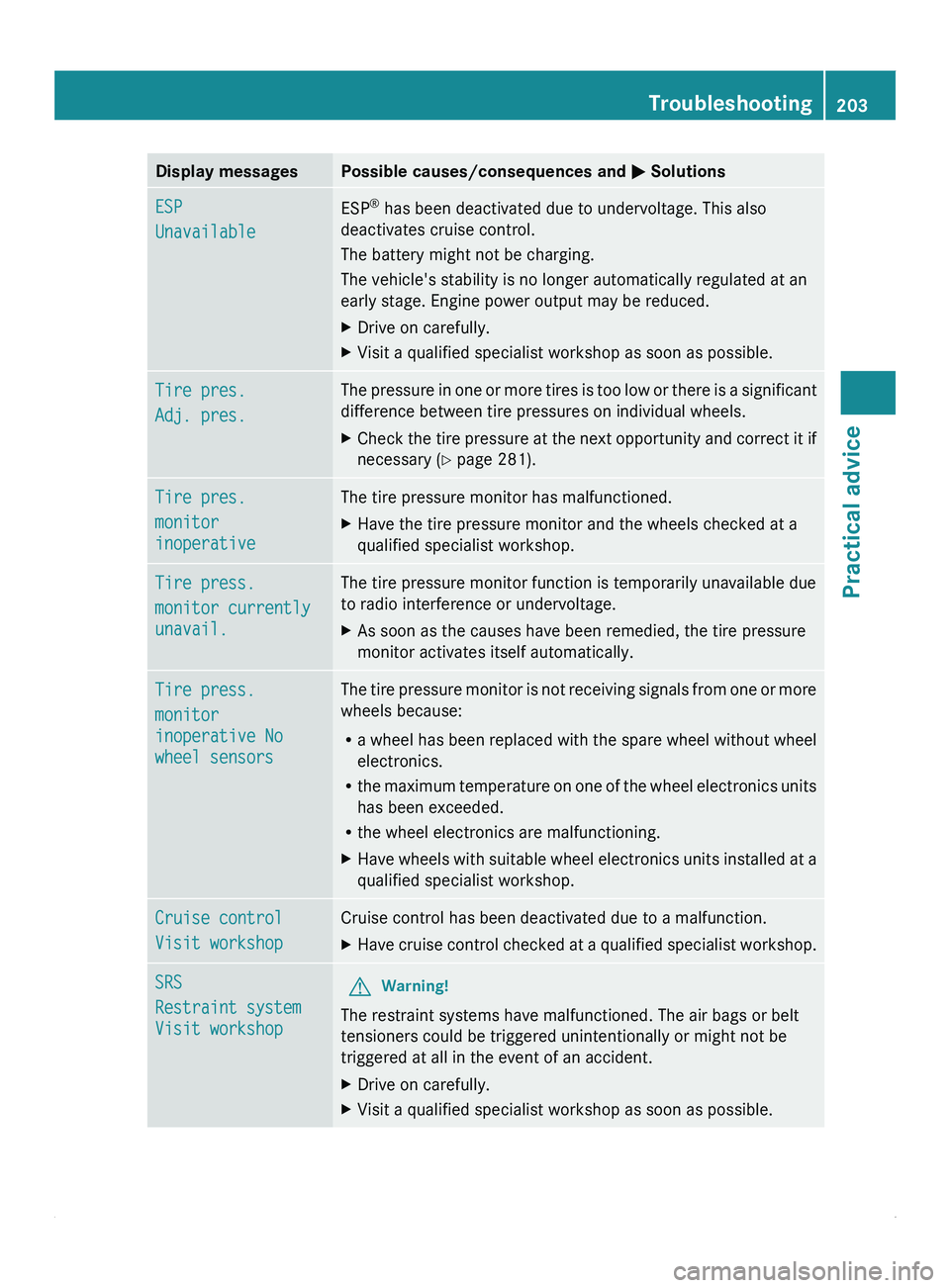
Display messages Possible causes/consequences and
0050 SolutionsESP
Unavailable
ESP
®
has been deactivated due to undervoltage. This also
deactivates cruise control.
The battery might not be charging.
The vehicle's stability is no longer automatically regulated at an
early stage. Engine power output may be reduced.
X Drive on carefully.
X Visit a qualified specialist workshop as soon as possible. Tire pres.
Adj. pres. The pressure in one or more tires is too low or there is a significant
difference between tire pressures on individual wheels.
X
Check the tire pressure at the next opportunity and correct it if
necessary ( Y page 281). Tire pres.
monitor
inoperative The tire pressure monitor has malfunctioned.
X
Have the tire pressure monitor and the wheels checked at a
qualified specialist workshop. Tire press.
monitor currently
unavail. The tire pressure monitor function is temporarily unavailable due
to radio interference or undervoltage.
X
As soon as the causes have been remedied, the tire pressure
monitor activates itself automatically. Tire press.
monitor
inoperative No
wheel sensors The tire pressure monitor is not receiving signals from one or more
wheels because:
R
a wheel has
been replaced with the spare wheel without wheel
electronics.
R the maximum temperature on one of the wheel electronics units
has been exceeded.
R the wheel electronics are malfunctioning.
X Have wheels with suitable wheel electronics units installed at a
qualified specialist workshop. Cruise control
Visit workshop Cruise control has been deactivated due to a malfunction.
X
Have cruise control checked at a qualified specialist workshop. SRS
Restraint system
Visit workshop
G
Warning!
The restraint systems have malfunctioned. The air bags or belt
tensioners could be triggered unintentionally or might not be
triggered at all in the event of an accident.
X Drive on carefully.
X Visit a qualified specialist workshop as soon as possible. Troubleshooting
203
Practical advice Z
Page 217 of 292
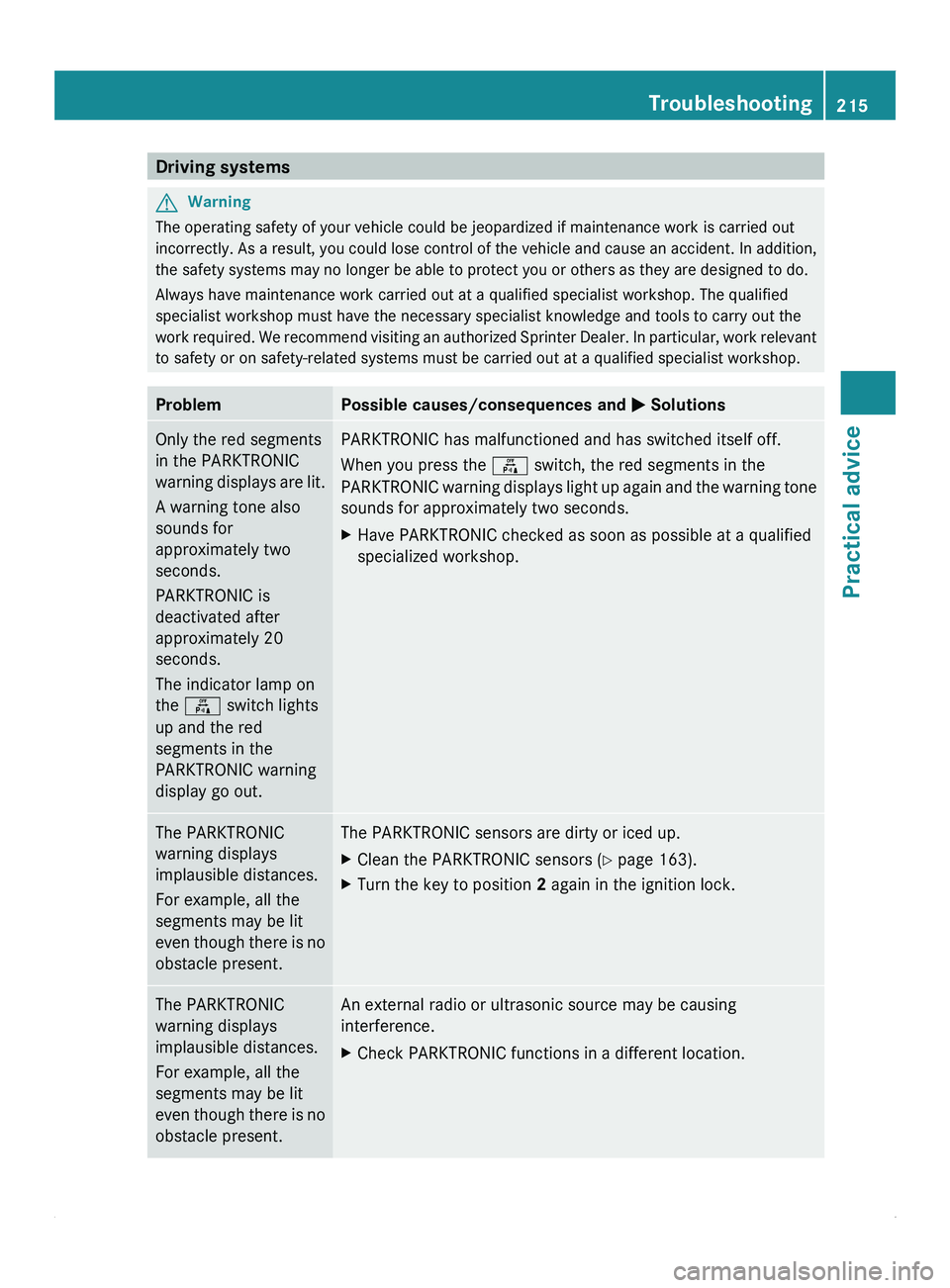
Driving systems
G
Warning
The operating safety of your vehicle could be jeopardized if maintenance work is carried out
incorrectly. As a
result, you could lose control of the vehicle and cause an accident. In addition,
the safety systems may no longer be able to protect you or others as they are designed to do.
Always have maintenance work carried out at a qualified specialist workshop. The qualified
specialist workshop must have the necessary specialist knowledge and tools to carry out the
work required. We recommend visiting an authorized Sprinter Dealer. In particular, work relevant
to safety or on safety-related systems must be carried out at a qualified specialist workshop. Problem Possible causes/consequences and
0050 SolutionsOnly the red segments
in the PARKTRONIC
warning
displays are
lit.
A warning tone also
sounds for
approximately two
seconds.
PARKTRONIC is
deactivated after
approximately 20
seconds.
The indicator lamp on
the 0069 switch lights
up and the red
segments in the
PARKTRONIC warning
display go out. PARKTRONIC has malfunctioned and has switched itself off.
When you press the
0069 switch, the red segments in the
PARKTRONIC
warning displays
light up again and the warning tone
sounds for approximately two seconds.
X Have PARKTRONIC checked as soon as possible at a qualified
specialized workshop. The PARKTRONIC
warning displays
implausible distances.
For example, all the
segments may be lit
even though
there
is no
obstacle present. The PARKTRONIC sensors are dirty or iced up.
X
Clean the PARKTRONIC sensors ( Y
page 163).
X Turn the key to position 2 again in the ignition lock. The PARKTRONIC
warning displays
implausible distances.
For example, all the
segments may be lit
even though
there
is no
obstacle present. An external radio or ultrasonic source may be causing
interference.
X
Check PARKTRONIC functions in a different location. Troubleshooting
215
Practical advice Z
Page 243 of 292
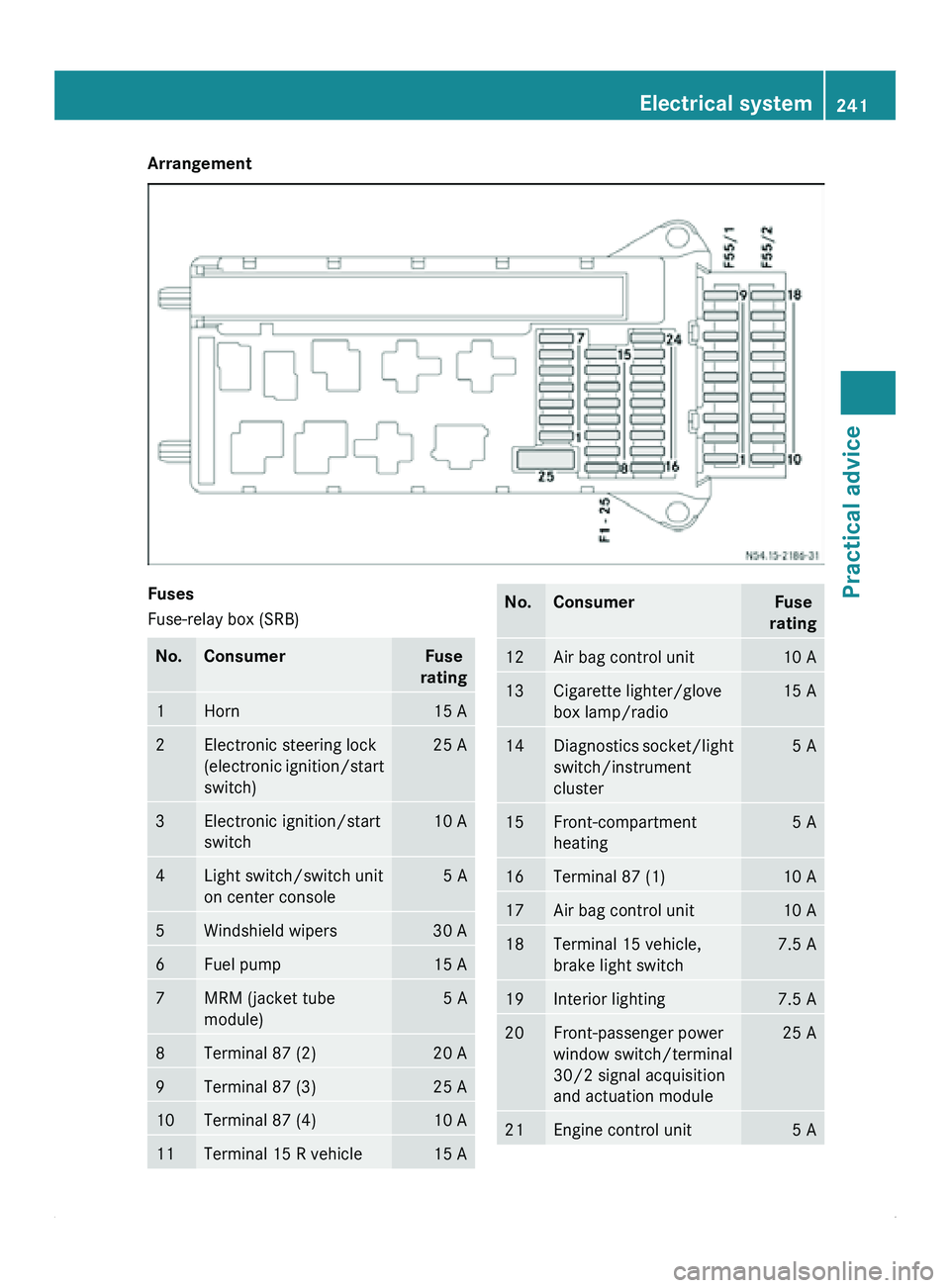
Arrangement
Fuses
Fuse-relay box (SRB)
No. Consumer Fuse
rating 1 Horn 15 A
2 Electronic steering lock
(electronic ignition/start
switch) 25 A
3 Electronic ignition/start
switch 10 A
4 Light switch/switch unit
on center console 5 A
5 Windshield wipers 30 A
6 Fuel pump 15 A
7 MRM (jacket tube
module) 5 A
8 Terminal 87 (2) 20 A
9 Terminal 87 (3) 25 A
10 Terminal 87 (4) 10 A
11 Terminal 15 R vehicle 15 A No. Consumer Fuse
rating 12 Air bag control unit 10 A
13 Cigarette lighter/glove
box lamp/radio 15 A
14 Diagnostics socket/light
switch/instrument
cluster 5 A
15 Front-compartment
heating 5 A
16 Terminal 87 (1) 10 A
17 Air bag control unit 10 A
18 Terminal 15 vehicle,
brake light switch 7.5 A
19 Interior lighting 7.5 A
20 Front-passenger power
window switch/terminal
30/2 signal acquisition
and actuation module 25 A
21 Engine control unit 5 AElectrical system
241Practical advice Z
Page 244 of 292
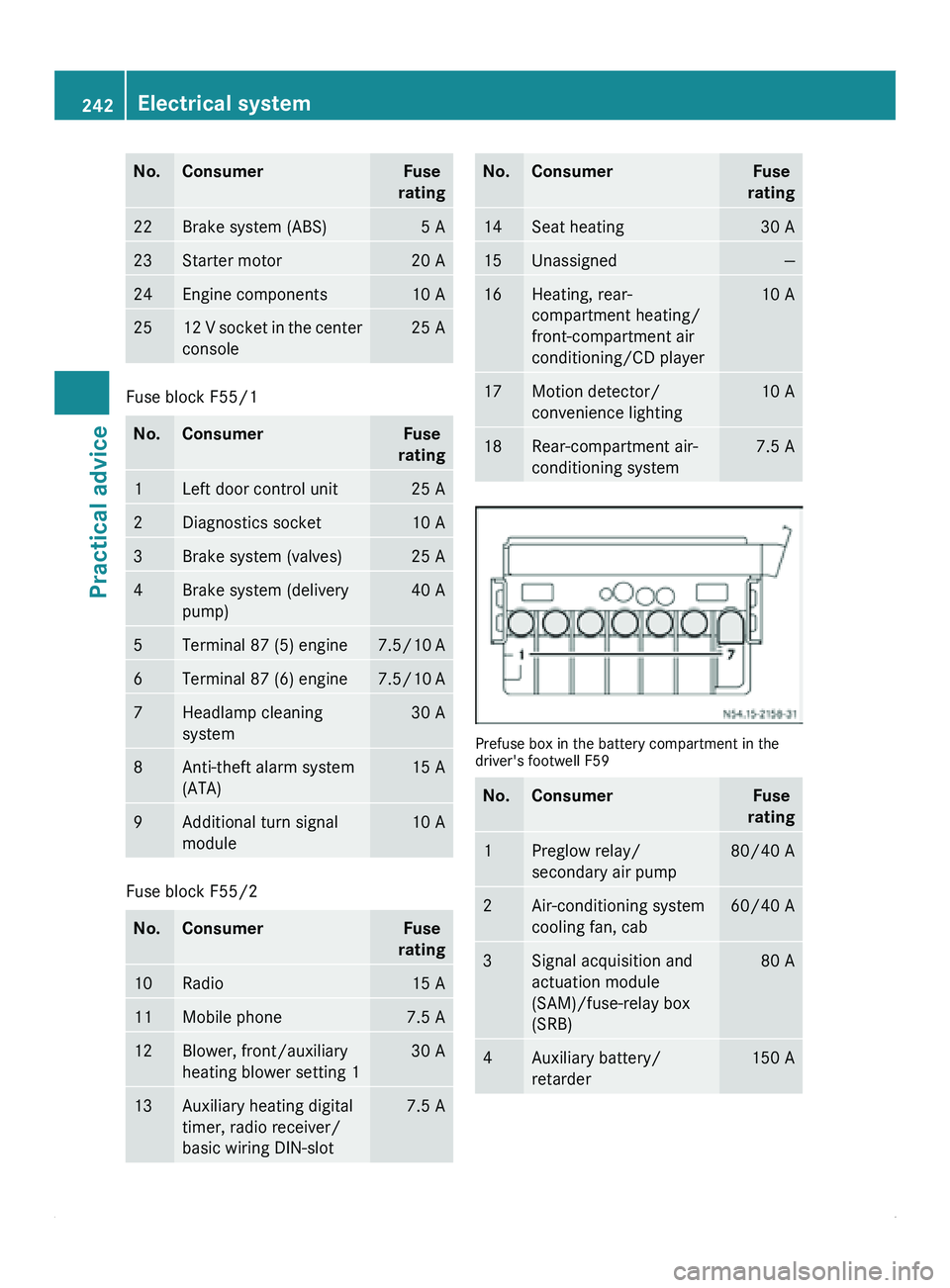
No. Consumer Fuse
rating 22 Brake system (ABS) 5 A
23 Starter motor 20 A
24 Engine components 10 A
25 12 V socket in the center
console 25 A
Fuse block F55/1
No. Consumer Fuse
rating 1 Left door control unit 25 A
2 Diagnostics socket 10 A
3 Brake system (valves) 25 A
4 Brake system (delivery
pump) 40 A
5 Terminal 87 (5) engine 7.5/10 A
6 Terminal 87 (6) engine 7.5/10 A
7 Headlamp cleaning
system 30 A
8 Anti-theft alarm system
(ATA) 15 A
9 Additional turn signal
module 10 A
Fuse block F55/2
No. Consumer Fuse
rating 10 Radio 15 A
11 Mobile phone 7.5 A
12 Blower, front/auxiliary
heating blower setting 1 30 A
13 Auxiliary heating digital
timer, radio receiver/
basic wiring DIN-
slot 7.5 A No. Consumer Fuse
rating 14 Seat heating 30 A
15 Unassigned —
16 Heating, rear-
compartment heating/
front-compartment air
conditioning/CD player 10 A
17 Motion detector/
convenience lighting 10 A
18 Rear-compartment air-
conditioning system 7.5 A
Prefuse box in the battery compartment in the
driver's footwell F59
No. Consumer Fuse
rating 1 Preglow relay/
secondary air pump 80/40 A
2 Air-conditioning system
cooling fan, cab 60/40 A
3 Signal acquisition and
actuation module
(SAM)/fuse-relay box
(SRB) 80 A
4 Auxiliary battery/
retarder 150 A242
Electrical systemPractical advice
Page 261 of 292
Underinflation also reduces fuel efficiency
and tire
tread
life, and may affect the vehicle's
handling and stopping ability. Please note that
the TPMS is not a substitute for proper tire
maintenance, and it is the driver's
responsibility to maintain correct tire
pressure, even if underinflation has not
reached the level to trigger illumination of the
TPMS low tire pressure telltale.
USA only:
Your vehicle has also been equipped with a
TPMS malfunction indicator to indicate when
the tire pressure monitoring system is not
operating properly. The TPMS malfunction
indicator is combined with the low tire
pressure telltale. When the system detects a
malfunction, the telltale will flash for
approximately one minute and then remain
continuously illuminated. This sequence will
continue upon subsequent vehicle start-ups
as long as the malfunction exists. When the
malfunction indicator is lit, the system may
not be able to detect or signal low tire
pressure as intended.
TPMS malfunctions may occur for a variety of
reasons, including the installation of
incompatible replacement or alternate tires
or wheels on the vehicle that prevent the
TPMS from functioning properly. Always
check the TPMS malfunction telltale after
replacing one or more tires or wheels on your
vehicle to ensure that the replacement or
alternate tires and wheels allow the TPMS to
continue to function properly.
i USA only:
If the tire pressure monitor is
malfunctioning, it may take more than
10 minutes for the 0077 tire pressure
warning lamp to inform you of the
malfunction by flashing for 60 seconds and
then remaining lit.
When the malfunction has been rectified,
the tire pressure warning lamp goes out
after driving for a few minutes. Information on tire pressures is displayed in
the on-board computer. After a few minutes
of driving, the current tire pressure of each
tire is shown in the on-board computer
i
The tire pressure values indicated by the
on-board computer may differ from those
measured at a gas station with a pressure
gauge. The tire
pressures shown by the on-
board computer refer to those measured at
sea level. At high altitudes, the tire pressure
values indicated by a pressure gauge are
higher than those shown by the on-board
computer. In this case, do not reduce the
tire pressures.
i If radio transmitting equipment (e.g.
wireless headphones, two-way radios) is
operated inside the vehicle or in the vicinity
of the vehicle, this can interfere with the
operation of the tire pressure monitor.
i USA only:
This device complies with Part 15 of the
FCC Rules. Operation is subject to the
following two conditions:
1. This device may not cause harmful
interference, and
2. This device must withstand any
interference received, including
interference that may cause undesired
operation.
Unauthorized modifications to the device
could void the user’s authority to operate
the equipment.
i Canada only:
This device complies with the RSS-210
Rules from Industry Canada. Operation is
subject to the following two conditions:
1. This device may not cause harmful
interference, and
2. This device must accept any interference
received, including interference that may
cause undesired operation.
Unauthorized modifications to the device
could void the user’s authority to operate
the equipment. Tire pressure
259
Wheels and tires Z
Page 279 of 292
for example an authorized Sprinter Dealer.
Otherwise, the vehicle parts may wear out
more quickly. This can invalidate the
general operating
permit
and the insurance
cover, and lead to the loss of the New
Vehicle Limited Warranty. Retrofitting electrical or electronic
equipment
Electrical and electronic equipment can
jeopardize the operational safety of the
vehicle. If equipment
of this kind is retrofitted,
it must be type-approved and bear the e
mark. The e mark may be obtained from the
equipment manufacturer or an authorized
testing center.
! Damage or consequential damage arising
from installing equipment that is not
approved for Sprinters is not covered by
the New Vehicle Limited Warranty.
If you wish to install telephones or two-way
radios in the vehicle, you must obtain formal
approval.
For operation of mobile phones and two-way
radios, We recommend connection to an
approved exterior antenna. This is the only
way to ensure optimum reception quality
inside the vehicle and to minimize mutual
interference between the vehicle electronics,
mobile phones and two-way radios. G
Warning
Excessive electromagnetic radiation may
constitute a health hazard to yourself and
others. Use of an exterior antenna gives
consideration to scientific discussion
surrounding the possible
health risk posed by
electromagnetic fields.
The exterior antenna should only be installed
at a qualified specialist workshop which has
the necessary specialist knowledge and tools
to carry out the work required. We
recommend that you use an authorized
Sprinter Dealer for this purpose. In particular,
work relevant to safety or on safety-related systems must be carried out at a qualified
specialist workshop.
The transmission output
of the mobile phone
or two-way radio must not exceed the
maximum transmission outputs listed. Frequency range Maximum
transmission
output (PEAK)
Short wave
(f < 50 MHz) 100 W
4 m waveband 30 W
2 m waveband 50 W
Trunked radio/Tetra 35 W
70 cm waveband 35 W
GSM 900/AMPS 10 W
GSM 1800 10 W
UMTS 10 W
!
If electrical or electronic equipment
which does not fulfill these conditions is
used in the vehicle, the vehicle's general
operating permit may be invalidated. Vehicle identification plates
Vehicle identification plates
The vehicle identification plate with the
vehicle identification number
(VIN), the paint
code, and the specifications for the
permissible weights is located on the base of
the driver's seat. Vehicle identification plates
277
Technical data Z