seats MERCEDES-BENZ SPRINTER 2012 MY12 Operator’s Manual
[x] Cancel search | Manufacturer: MERCEDES-BENZ, Model Year: 2012, Model line: SPRINTER, Model: MERCEDES-BENZ SPRINTER 2012Pages: 292, PDF Size: 6.75 MB
Page 68 of 292
X
To fold the seat cushions forwards: lift
the seat cushion out of front
anchorage 0046.
X Pull the seat cushion forwards slightly and
out of rear anchorage 0047.
X Fold the rear edge of the seat cushion up.
i You can stow
various articles in the space
under the twin co-driver's seat.
X To fold the seat cushion back: fold down
the seat cushion by the rear edge.
X Slide the seat cushion under the seat
backrest into rear anchorage 0047
.
X Push down on the seat cushion at the front
until it engages in front anchorage 0046. Rear bench seat
G
Warning!
The unlocking levers at the foot of the rear
bench seat must lie parallel to the vehicle
floor. You may only install a rear bench seat
with two seats on the driver's side.
Information about this can be found at any
authorized Sprinter dealer.
The integral seat
belts can only protect you as
intended if you correctly install the prescribed
rear bench seats. For this reason, have a rear
bench seat with four seats installed only at a
qualified specialist workshop, e.g. an
authorized Sprinter dealer.
Keep the mounting shells of the bench seats
on the floor free from dirt and other objects.
The secure engaging of the locks is
guaranteed only in this way.
For safety reasons, have bench seat mounting
shells retrofitted only at an authorized
Sprinter dealer.
i Do not exceed the maximum permissible
number of seats for models registered as
passenger vehicles.
! For safety reasons, the rear bench seat
with four seats must be installed or
removed only at a qualified specialist workshop, e.g. an authorized Sprinter
dealer.
Removing two-seat or three-seat rear
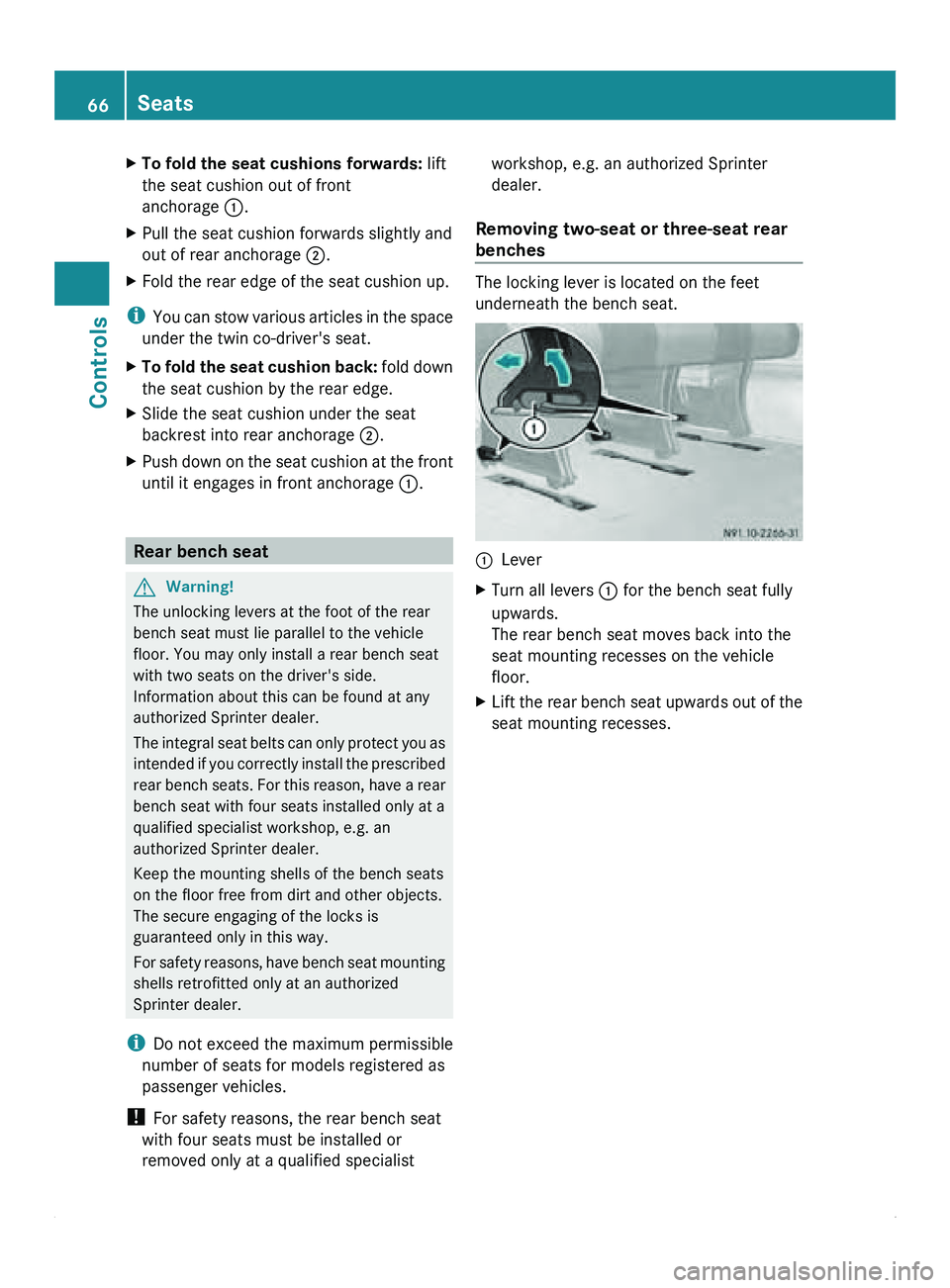
benches The locking lever is located on the feet
underneath the bench seat.
0046
Lever
X Turn all levers 0046 for the bench seat fully
upwards.
The rear bench seat moves back into the
seat mounting recesses on the vehicle
floor.
X Lift the rear bench seat upwards out of the
seat mounting recesses.66
Seats
Controls
Page 69 of 292
Installing two-seat or three-seat rear
benches
X
Observe the prescribed installation
position of the bench seat.
Install the two-seat rear bench only on the
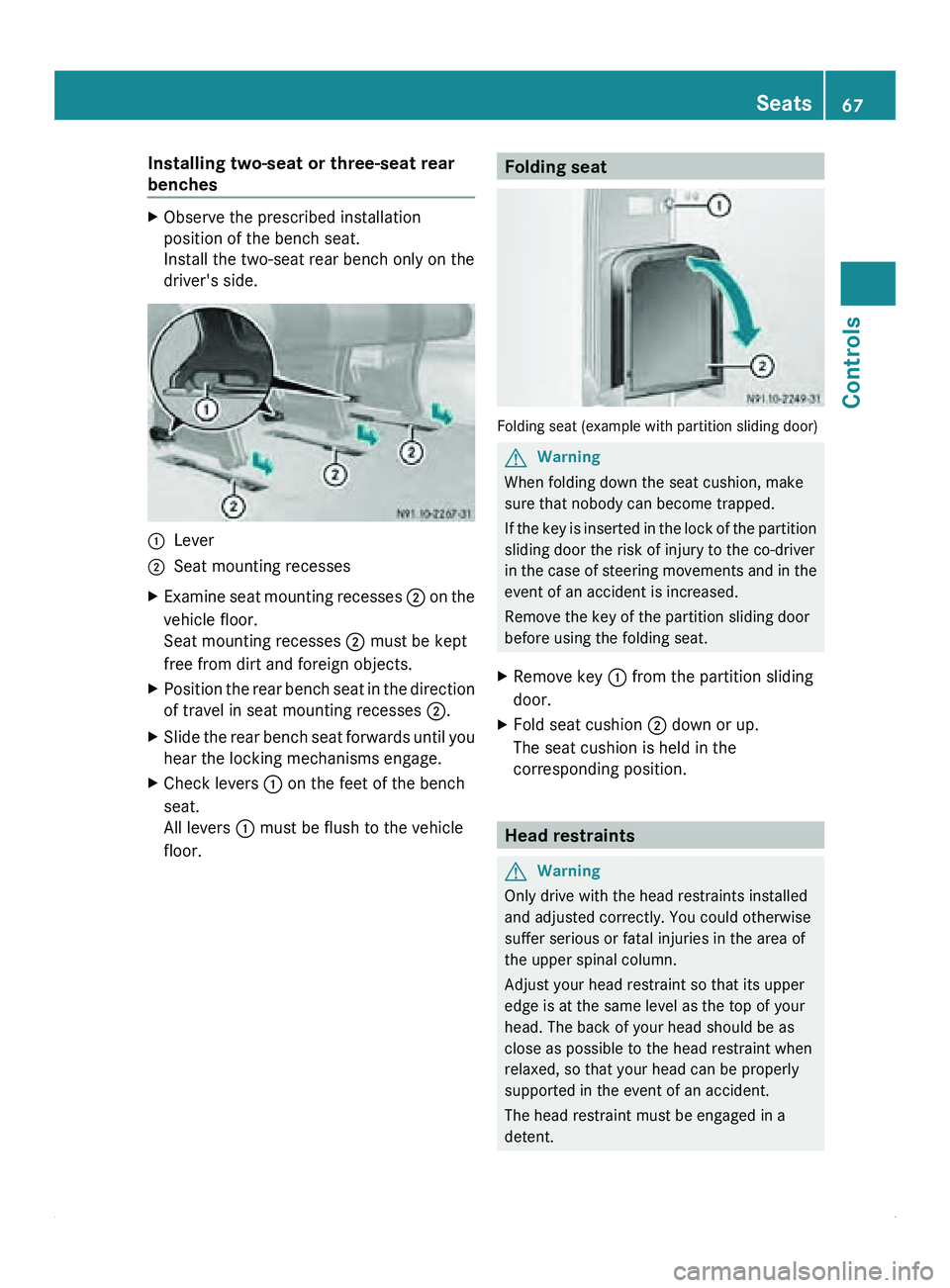
driver's side. 0046
Lever
0047 Seat mounting recesses
X Examine seat mounting recesses 0047 on
the
vehicle floor.
Seat mounting recesses 0047
must be kept
free from dirt and foreign objects.
X Position the rear bench seat in the direction
of travel in seat mounting recesses 0047.
X Slide the rear bench seat forwards until you
hear the locking mechanisms engage.
X Check levers 0046 on the feet of the bench
seat.
All levers 0046 must be flush to the vehicle
floor. Folding seat
Folding seat (example with partition sliding door)
G
Warning
When folding down the seat cushion, make
sure that nobody can become trapped.
If the key
is inserted in the lock of the partition
sliding door the risk of injury to the co-driver
in the case of steering movements and in the
event of an accident is increased.
Remove the key of the partition sliding door
before using the folding seat.
X Remove key 0046 from the partition sliding
door.
X Fold seat cushion 0047 down or up.
The seat cushion is held in the
corresponding position. Head restraints
G
Warning
Only drive with the head restraints installed
and adjusted correctly. You could otherwise
suffer serious or fatal injuries in the area of
the upper spinal column.
Adjust your head restraint so that its upper
edge is at the same level as the top of your
head. The back of your head should be as
close as possible to the head restraint when
relaxed, so that your head can be properly
supported in the event of an accident.
The head restraint must be engaged in a
detent. Seats
67
Controls Z
Page 70 of 292
Adjusting the head restraints
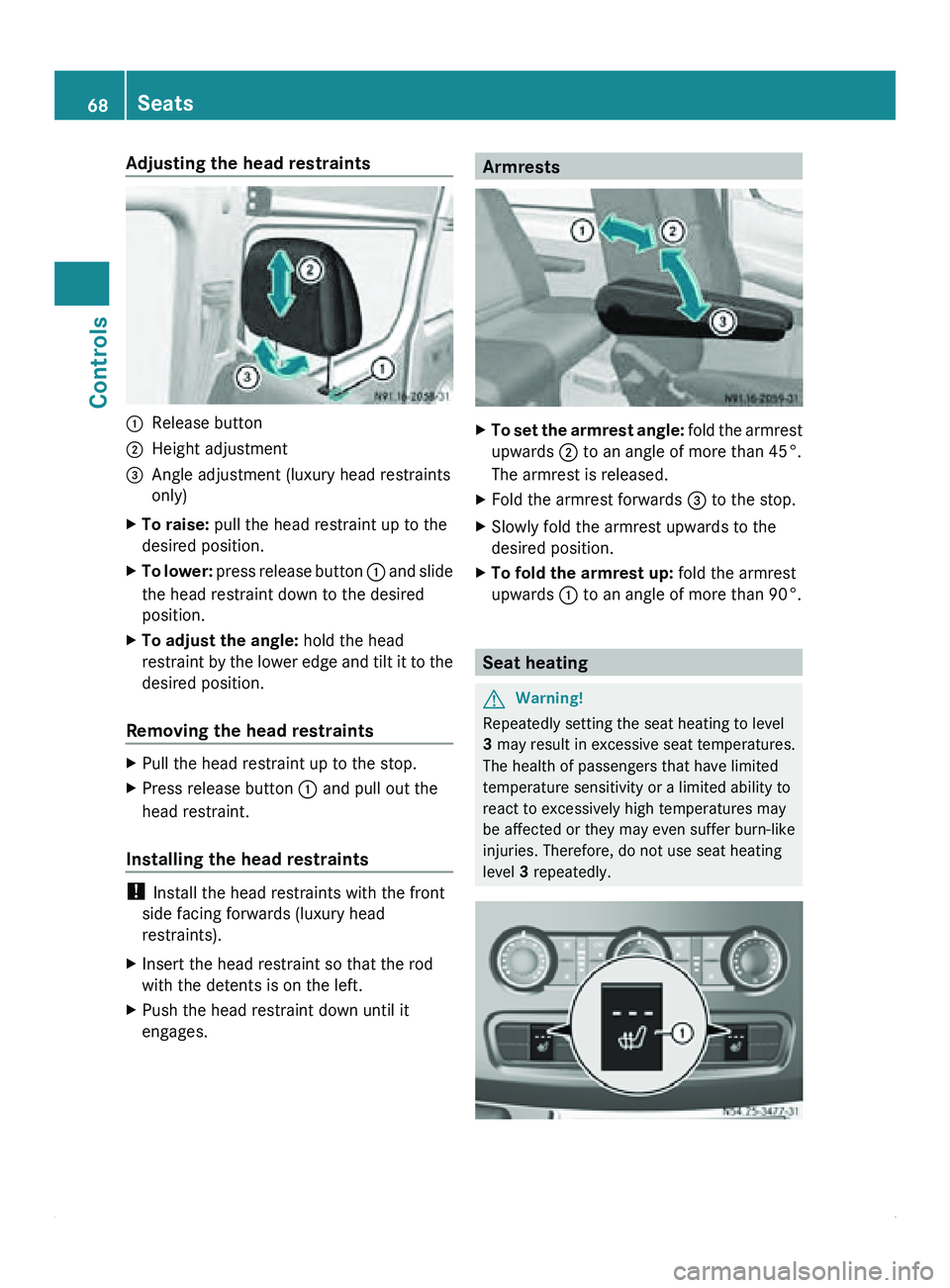
0046
Release button
0047 Height adjustment
008A Angle adjustment (luxury head restraints
only)
X To raise: pull the head restraint up to the
desired position.
X To lower: press release button
0046 and slide
the head restraint down to the desired
position.
X To adjust the angle: hold the head
restraint by the
lower edge and tilt it to the
desired position.
Removing the head restraints X
Pull the head restraint up to the stop.
X Press release button 0046 and pull out the
head restraint.
Installing the head restraints !
Install the head restraints with the front
side facing forwards (luxury head
restraints).
X Insert the head restraint so that the rod
with the detents is on the left.
X Push the head restraint down until it
engages. Armrests
X
To set the armrest angle: fold the
armrest
upwards 0047 to an angle of more than 45°.
The armrest is released.
X Fold the armrest forwards 008A to the stop.
X Slowly fold the armrest upwards to the
desired position.
X To fold the armrest up: fold the armrest
upwards 0046 to an angle of more than 90°. Seat heating
G
Warning!
Repeatedly setting the seat heating to level
3 may result in excessive seat temperatures.
The health of passengers that have limited
temperature sensitivity or a limited ability to
react to excessively high temperatures may
be affected or they may even suffer burn-like
injuries. Therefore, do not use seat heating
level 3 repeatedly.68
Seats
Controls
Page 135 of 292
X
Place the beverage container in cup
holder 0086.
X Push clamping arm 0087 against the
container.
Cup holders in the rear X
Pull out cup holder 0046.G
Warning
Slide the cup holders back under the seats
before leaving the vehicle. You and others
could otherwise injure yourselves on the
protruding cup holders. Socket
The 12 V sockets for accessories are
R at the bottom of the center console
(12 V, 25 A)
R on the inside of the driver's seat frame
(12 V, 15 A)
R in the corner lining next to the rear doors
in the passenger compartment
(12 V, 15 A)
R in the cargo compartment next to the left
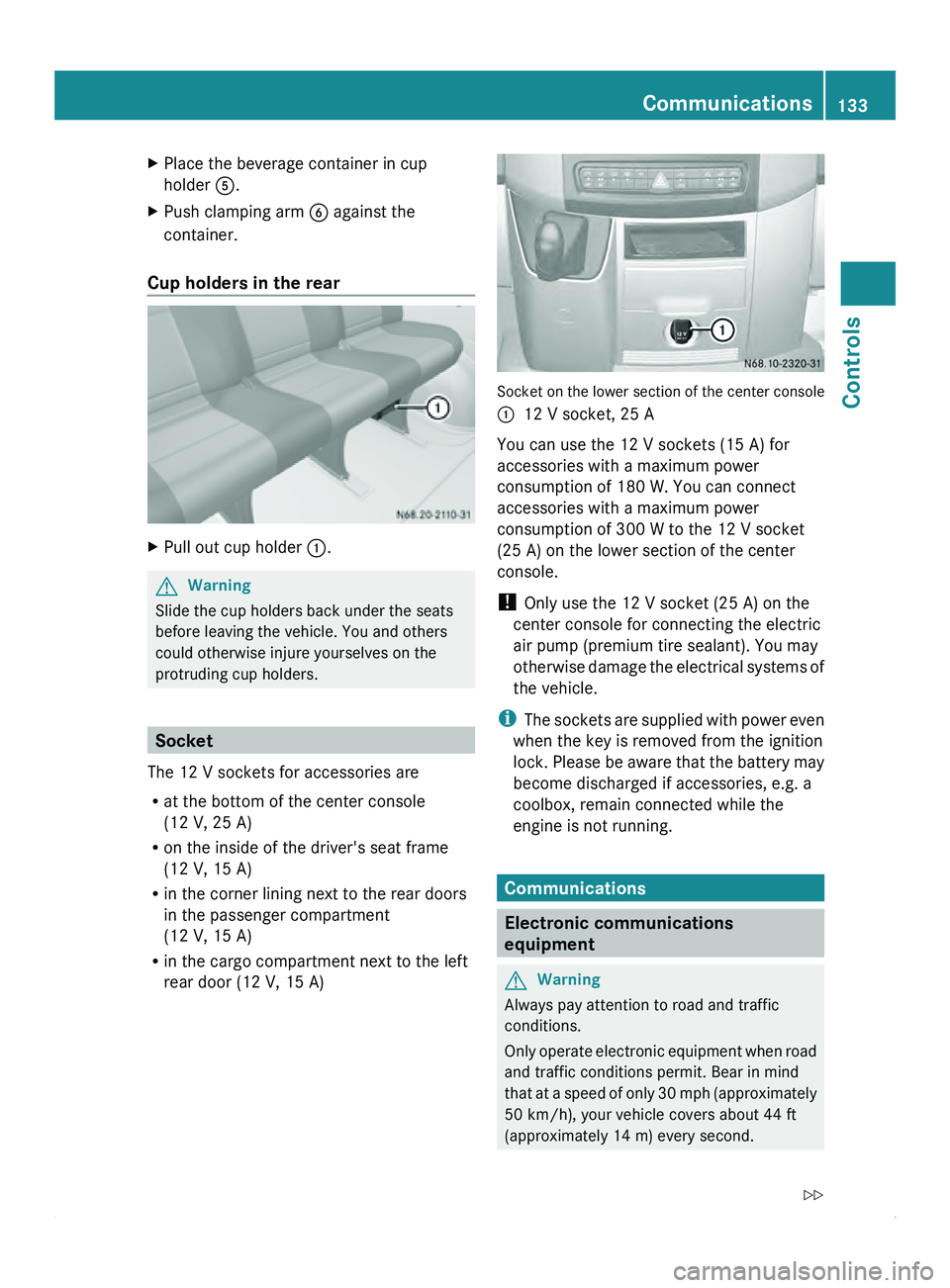
rear door (12 V, 15 A) Socket on the lower section of the center console
0046
12 V socket, 25 A
You can use the 12 V sockets (15 A) for
accessories with a maximum power
consumption of 180 W. You can connect
accessories with a maximum power
consumption of 300 W to the 12 V socket
(25 A) on the lower section of the center
console.
! Only use the 12 V socket (25 A) on the
center console for connecting the electric
air pump (premium tire sealant). You may
otherwise
damage the electrical systems of
the vehicle.
i The sockets are supplied with power even
when the key is removed from the ignition
lock. Please be aware that the battery may
become discharged if accessories, e.g. a
coolbox, remain connected while the
engine is not running. Communications
Electronic communications
equipment
G
Warning
Always pay attention to road and traffic
conditions.
Only operate electronic
equipment when road
and traffic conditions permit. Bear in mind
that at a speed of only 30 mph (approximately
50 km/h), your vehicle covers about 44 ft
(approximately 14 m) every second. Communications
133
Controls
Z
Page 146 of 292
i
Do not inhale
any ammonia vapors which
may escape when you unscrew the tank
filler cap. Ammonia vapors have a pungent
odor. However, they are neither toxic nor
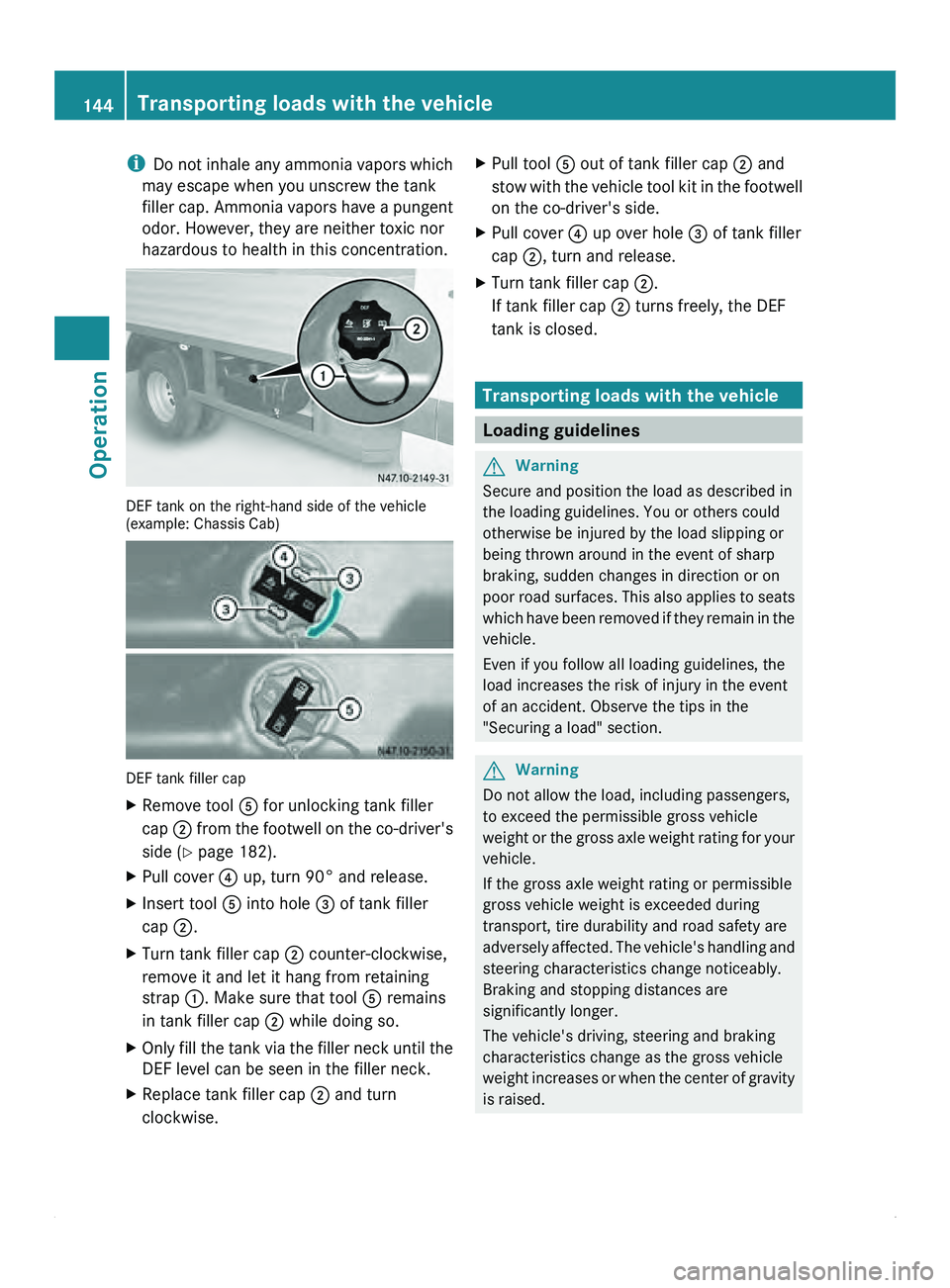
hazardous to health in this concentration. DEF tank on the right-hand side of the vehicle
(example: Chassis Cab)
DEF tank filler cap
X
Remove tool 0086 for unlocking tank filler
cap 0047 from the
footwell on the co-driver's
side ( Y page 182).
X Pull cover 0088 up, turn 90° and release.
X Insert tool 0086 into hole 008A of tank filler
cap 0047.
X Turn tank filler cap 0047 counter-clockwise,
remove it and let it hang from retaining
strap 0046. Make sure that tool 0086 remains
in tank filler cap 0047 while doing so.
X Only fill the tank via the filler neck until the
DEF level can be seen in the filler neck.
X Replace tank filler cap 0047 and turn
clockwise. X
Pull tool 0086 out of tank filler cap 0047 and
stow with
the
vehicle tool kit in the footwell
on the co-driver's side.
X Pull cover 0088 up over hole 008A of tank filler
cap 0047, turn and release.
X Turn tank filler cap 0047.
If tank filler cap 0047 turns freely, the DEF
tank is closed. Transporting loads with the vehicle
Loading guidelines
G
Warning
Secure and position the load as described in
the loading guidelines. You or others could
otherwise be injured by the load slipping or
being thrown around in the event of sharp
braking, sudden changes in direction or on
poor road surfaces.
This also applies to seats
which have been removed if they remain in the
vehicle.
Even if you follow all loading guidelines, the
load increases the risk of injury in the event
of an accident. Observe the tips in the
"Securing a load" section. G
Warning
Do not allow the load, including passengers,
to exceed the permissible gross vehicle
weight or the
gross axle weight rating for your
vehicle.
If the gross axle weight rating or permissible
gross vehicle weight is exceeded during
transport, tire durability and road safety are
adversely affected. The vehicle's handling and
steering characteristics change noticeably.
Braking and stopping distances are
significantly longer.
The vehicle's driving, steering and braking
characteristics change as the gross vehicle
weight increases or when the center of gravity
is raised. 144
Transporting loads with the vehicle
Operation
Page 148 of 292
During loading
X
Observe the gross axle weight rating and
permissible gross vehicle weight for your
vehicle.
! On passenger van versions with
maximum seating layout, the permissible
rear axle load
would be exceeded if the full
payload were to be loaded in the cargo
compartment.
i Bear in mind that the curb weight of the
vehicle is increased by installing optional
equipment and accessories.
X Observe the information about load
distribution ( Y page 146).
X Secure the load ( Y page 146). Always
observe the relevant national regulations.
Checks after loading X
Securing loads: check that the load is
secure before every
journey and at regular
intervals during a long journey, and correct
if necessary.
X Doors: close the sliding doors and rear
doors. G
Warning
Make sure that the sliding doors and rear
doors are always closed when the engine is
running.
Exhaust fumes could otherwise enter the
vehicle interior and poison you.
X Tire pressure: adjust the tire pressures
according to the vehicle load
(Y page 281).
X Driving style: adapt your driving style
according to the vehicle load. Load distribution
The overall center
of gravity of the load should
always be as low as possible, centered and
between the axles near the rear axle. !
Excessive loads on
individual points of the
cargo floor or on the load surface impair
vehicle handling characteristics and could
cause damage to the floor covering.
On crewbuses:
X Always transport loads in the cargo
compartment.
X Always place the load against the backrests
of the rear bench seat.
X Move large and heavy loads as far towards
the front of the vehicle as possible against
the rear bench seat. Stow the load flush
with the rear bench seat.
X Always additionally secure the load with
suitable load securing aids or tie down.
i Observe the following notes:
R Do not stack
loads higher than the upper
edge of the backrests.
R Transport loads behind seats that are not
occupied.
R If the rear bench seat is not occupied,
insert the seat belts crosswise into the
buckle of the opposite seat belt. Securing loads
General notes As the driver, you are responsible for ensuring
that the cargo is secured against sliding,
tipping, rolling or falling. This applies to
general traffic situations as well as evasive
maneuvers or full brake application and on
poor stretches of road.
If your load
is not secured in accordance with
applicable requirements and guidelines
regarding the securing of loads, you may be
liable to prosecution, depending on the local
legislation and the consequences of
inadequately secured loads.
You should therefore observe the respective
legal requirements for the relevant country.
Check that the load is secure before every
journey and at regular intervals during a long 146
Transporting loads with the vehicle
Operation
Page 264 of 292
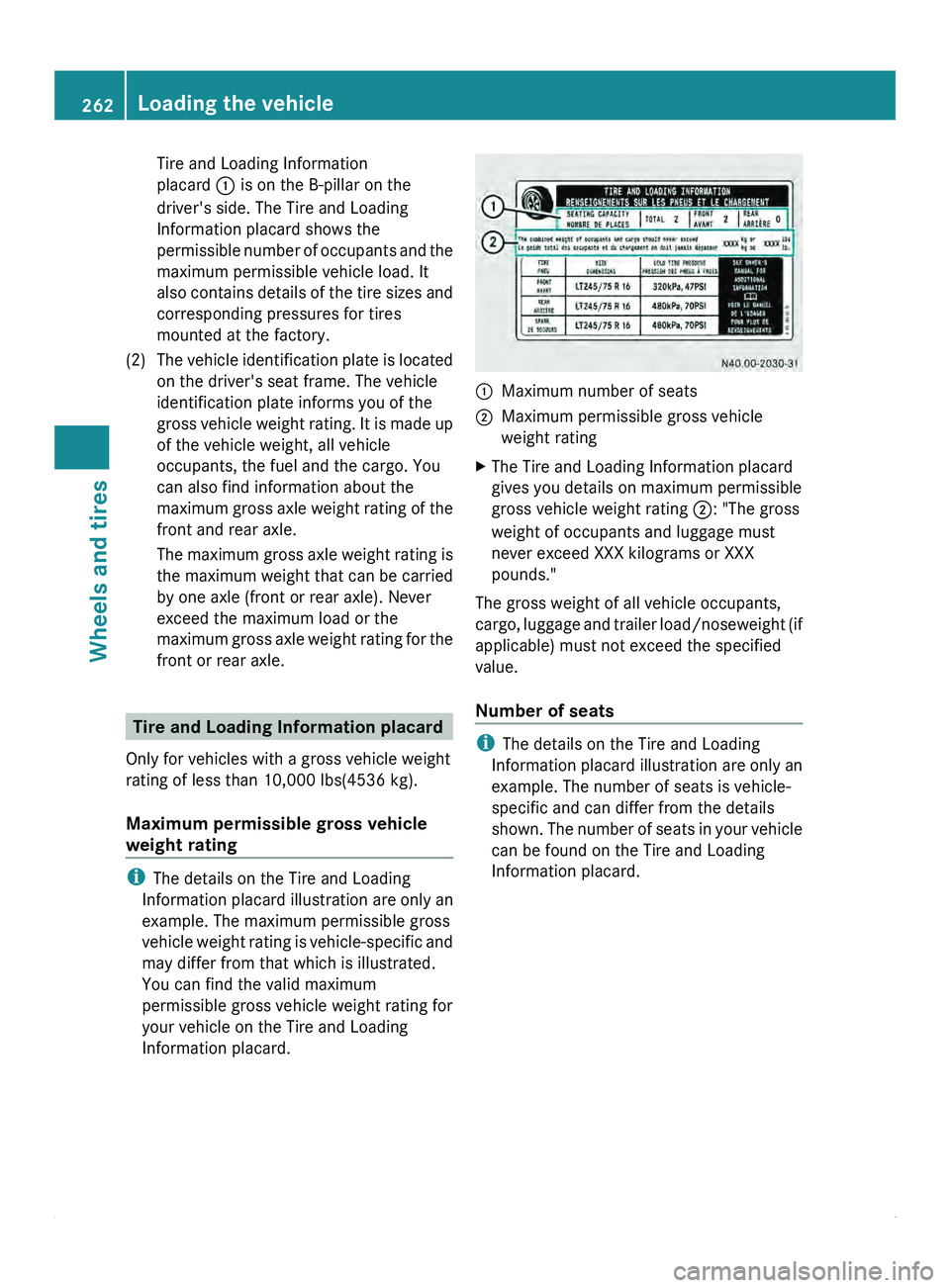
Tire and Loading Information
placard
0046 is on the B-pillar on the
driver's side. The Tire and Loading
Information placard shows the
permissible number of
occupants and the
maximum permissible vehicle load. It
also contains details of the tire sizes and
corresponding pressures for tires
mounted at the factory.
(2) The vehicle identification plate is located on the driver's seat frame. The vehicle
identification plate informs you of the
gross vehicle weight
rating. It is made up
of the vehicle weight, all vehicle
occupants, the fuel and the cargo. You
can also find information about the
maximum gross axle weight rating of the
front and rear axle.
The maximum gross axle weight rating is
the maximum weight that can be carried
by one axle (front or rear axle). Never
exceed the maximum load or the
maximum gross axle weight rating for the
front or rear axle. Tire and Loading Information placard
Only for vehicles with a gross vehicle weight
rating of less than 10,000 lbs(4536 kg).
Maximum permissible gross vehicle
weight rating i
The details on the Tire and Loading
Information placard illustration
are only an
example. The maximum permissible gross
vehicle weight rating is vehicle-specific and
may differ from that which is illustrated.
You can find the valid maximum
permissible gross vehicle weight rating for
your vehicle on the Tire and Loading
Information placard. 0046
Maximum number of seats
0047 Maximum permissible gross vehicle
weight rating
X The Tire and Loading Information placard
gives you details on maximum permissible
gross vehicle weight rating 0047: "The gross
weight of occupants and luggage must
never exceed XXX kilograms or XXX
pounds."
The gross weight of all vehicle occupants,
cargo, luggage
and
trailer load/noseweight (if
applicable) must not exceed the specified
value.
Number of seats i
The details on the Tire and Loading
Information placard illustration
are only an
example. The number of seats is vehicle-
specific and can differ from the details
shown. The number of seats in your vehicle
can be found on the Tire and Loading
Information placard. 262
Loading the vehicle
Wheels and tires
Page 265 of 292
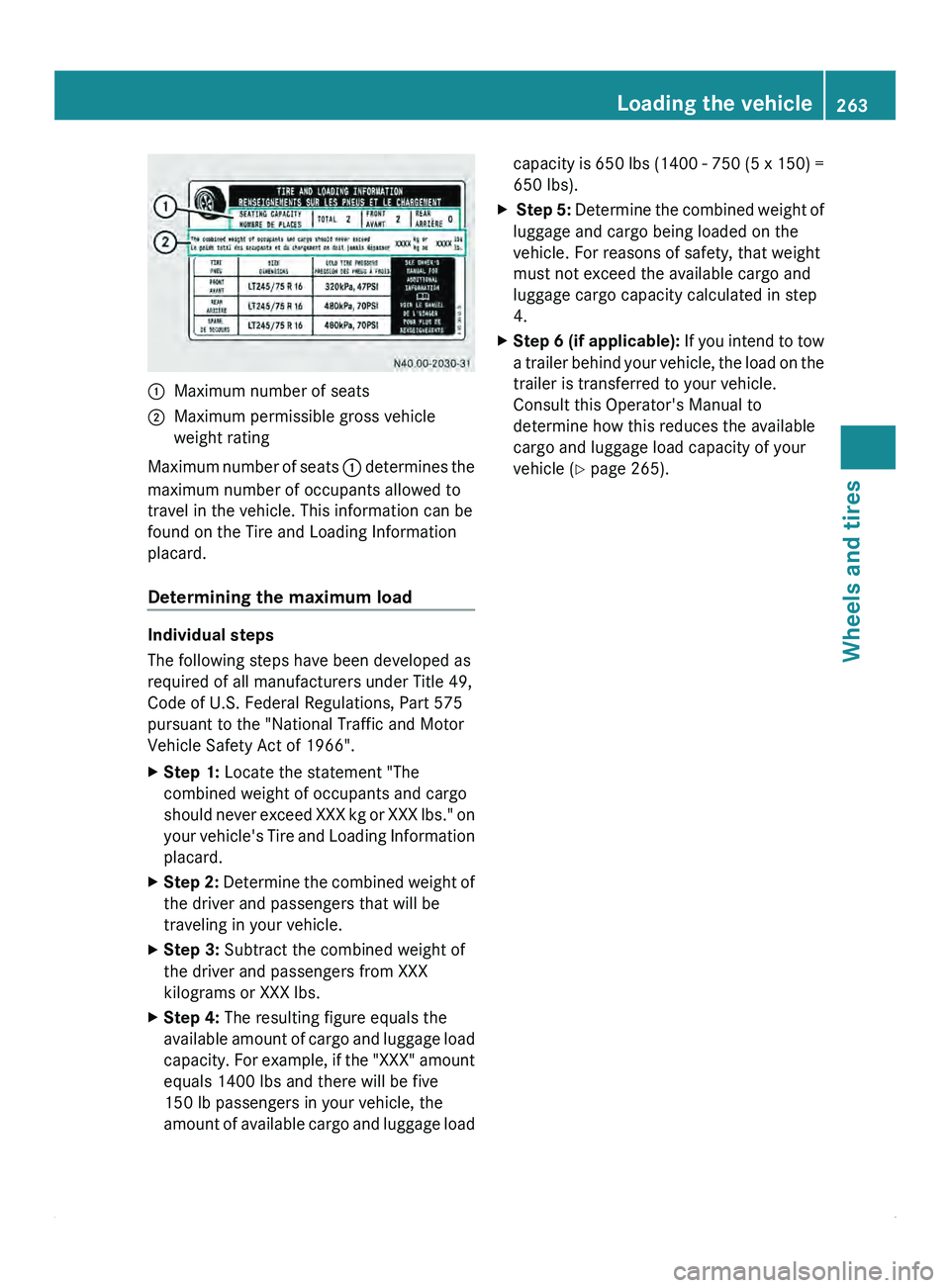
0046
Maximum number of seats
0047 Maximum permissible gross vehicle
weight rating
Maximum number of seats 0046 determines the
maximum number of occupants allowed to
travel in the vehicle. This information can be
found on the Tire and Loading Information
placard.
Determining the maximum load Individual steps
The following steps have been developed as
required of all manufacturers under Title 49,
Code of U.S. Federal Regulations, Part 575
pursuant to the "National Traffic and Motor
Vehicle Safety Act of 1966".
X
Step 1: Locate the statement "The
combined weight of occupants and cargo
should never exceed
XXX kg or XXX lbs." on
your vehicle's Tire and Loading Information
placard.
X Step 2: Determine the combined weight of
the driver and passengers that will be
traveling in your vehicle.
X Step 3: Subtract the combined weight of
the driver and passengers from XXX
kilograms or XXX lbs.
X Step 4: The resulting figure equals the
available amount of
cargo and luggage load
capacity. For example, if the "XXX" amount
equals 1400 lbs and there will be five
150 lb passengers in your vehicle, the
amount of available cargo and luggage load capacity is 650 lbs (1400 - 750 (5 x 150) =
650 lbs).
X Step 5: Determine the combined weight of
luggage and cargo being loaded on the
vehicle. For reasons of safety, that weight
must not exceed the available cargo and
luggage cargo capacity calculated in step
4.
X Step 6
(if applicable): If you
intend to tow
a trailer behind your vehicle, the load on the
trailer is transferred to your vehicle.
Consult this Operator's Manual to
determine how this reduces the available
cargo and luggage load capacity of your
vehicle ( Y page 265). Loading the vehicle
263
Wheels and tires Z
Page 273 of 292
a high-capacity battery, are not included in
the unladen weight and the weight of the
accessories.
TIN (Tire Identification Number)
A unique identification number which can be
used by a tire manufacturer to identify tires,
for example for a product recall, and thus
identify the purchasers.
The TIN is composed
of the manufacturer identification code, tire
size, tire model code and manufacturing date. Load bearing index
The load bearing index (also load index) is a
code that contains
the maximum load bearing
capacity of a tire. Traction
Traction is the result of friction between the
tires and the road surface. Wear indicator
Narrow bars (tread wear bars) that are
distributed over the
tire tread. If the tire tread
is level with the bars, the wear limit of 1
/ 16 in
(1.6 mm) has been reached. Distribution of the vehicle occupants
The distribution of vehicle occupants over
designated seat positions in a vehicle. Maximum permissible payload
weight
Nominal load and cargo/luggage load plus
68 kilograms (150 lb) multiplied by the
number of seats in the vehicle. Changing wheels
Flat tire
The "Flat tire"
section in the "Practical advice"
chapter (Y page 221) contains information
and notes on how to deal with a flat tire. It
also provides instructions on changing a
wheel or mounting the spare wheel. Replacing wheels
G
Warning
Rotate front and rear wheels only if the tires
are of the same dimension.
If your vehicle is equipped with mixed-size
tires (different tire
dimensions front vs. rear),
tire rotation is not possible. G
Warning
After changing a wheel, for safety reasons you
must:
R have the tightening torque checked. For
wheel bolts, the tightening torque is
177 lb-ft (240 Nm) (steel wheel)/ 133 lb-ft
(180
Nm) (alloy wheel). For wheel nuts, the
tightening torque is 133 lb-ft (180 Nm). The
wheels could otherwise work loose.
R check the tire pressure and correct it if
necessary.
R have the wheel bolts/wheel nuts
retightened after driving a distance of 30
miles (50 km). The tightening torque for
wheel bolts is 177 lb-ft (240 Nm)(steel
wheel)/133 lb-ft (180 Nm) (alloy wheel).
The tightening torque for wheel nuts is
133 lb-ft (180 Nm).
R if using new or painted rims, have the wheel
bolts and wheel nuts retightened at the
specified tightening torque after the vehicle
has been driven for approximately 600 to
3000 miles (1000 to 5000 km).
R have the direction of rotation corrected, if
reversed, as soon as possible at a qualified
specialist workshop, e.g. an authorized
Sprinter Dealer. The vehicle handling Changing wheels
271
Wheels and tires
Z
Page 281 of 292
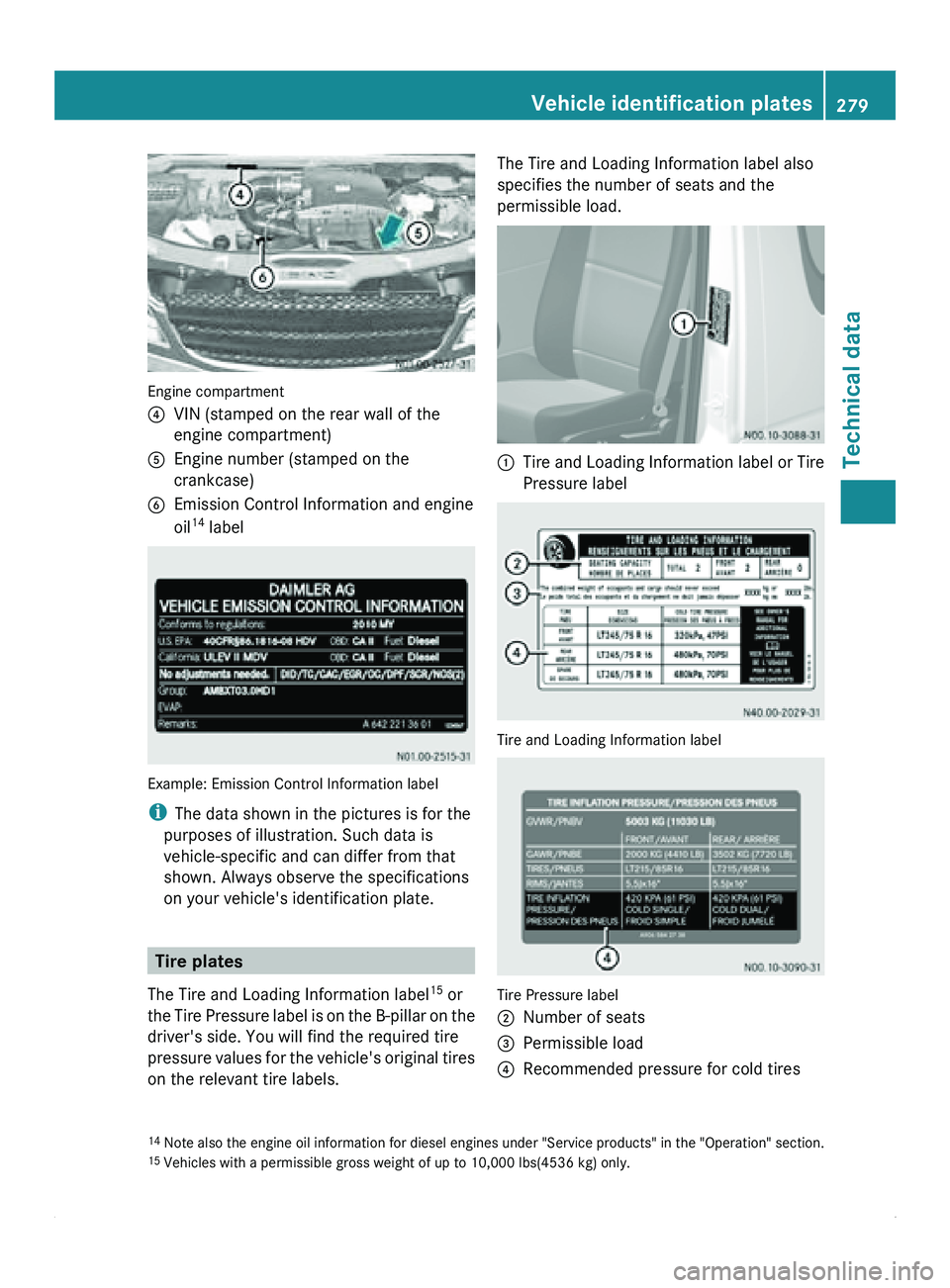
Engine compartment
0088
VIN (stamped on the rear wall of the
engine compartment)
0086 Engine number (stamped on the
crankcase)
0087 Emission Control Information and engine
oil14
label Example: Emission Control Information label
i
The data shown in the pictures is for the
purposes of illustration. Such data is
vehicle-specific and can differ from that
shown. Always observe the specifications
on your vehicle's identification plate. Tire plates
The Tire and Loading Information label 15
or
the Tire Pressure
label is on the B-pillar on the
driver's side. You will find the required tire
pressure values for the vehicle's original tires
on the relevant tire labels. The Tire and Loading Information label also
specifies the number of seats and the
permissible load.
0046
Tire and Loading Information label or Tire
Pressure label Tire and Loading Information label
Tire Pressure label
0047
Number of seats
008A Permissible load
0088 Recommended pressure for cold tires
14 Note also the
engine oil information for diesel engines under "Service products" in the "Operation" section.
15 Vehicles with a permissible gross weight of up to 10,000 lbs(4536 kg) only. Vehicle identification plates
279
Technical data Z