warning MERCEDES-BENZ SPRINTER 2014 MY14 Operator’s Manual
[x] Cancel search | Manufacturer: MERCEDES-BENZ, Model Year: 2014, Model line: SPRINTER, Model: MERCEDES-BENZ SPRINTER 2014Pages: 338, PDF Size: 6.78 MB
Page 322 of 338
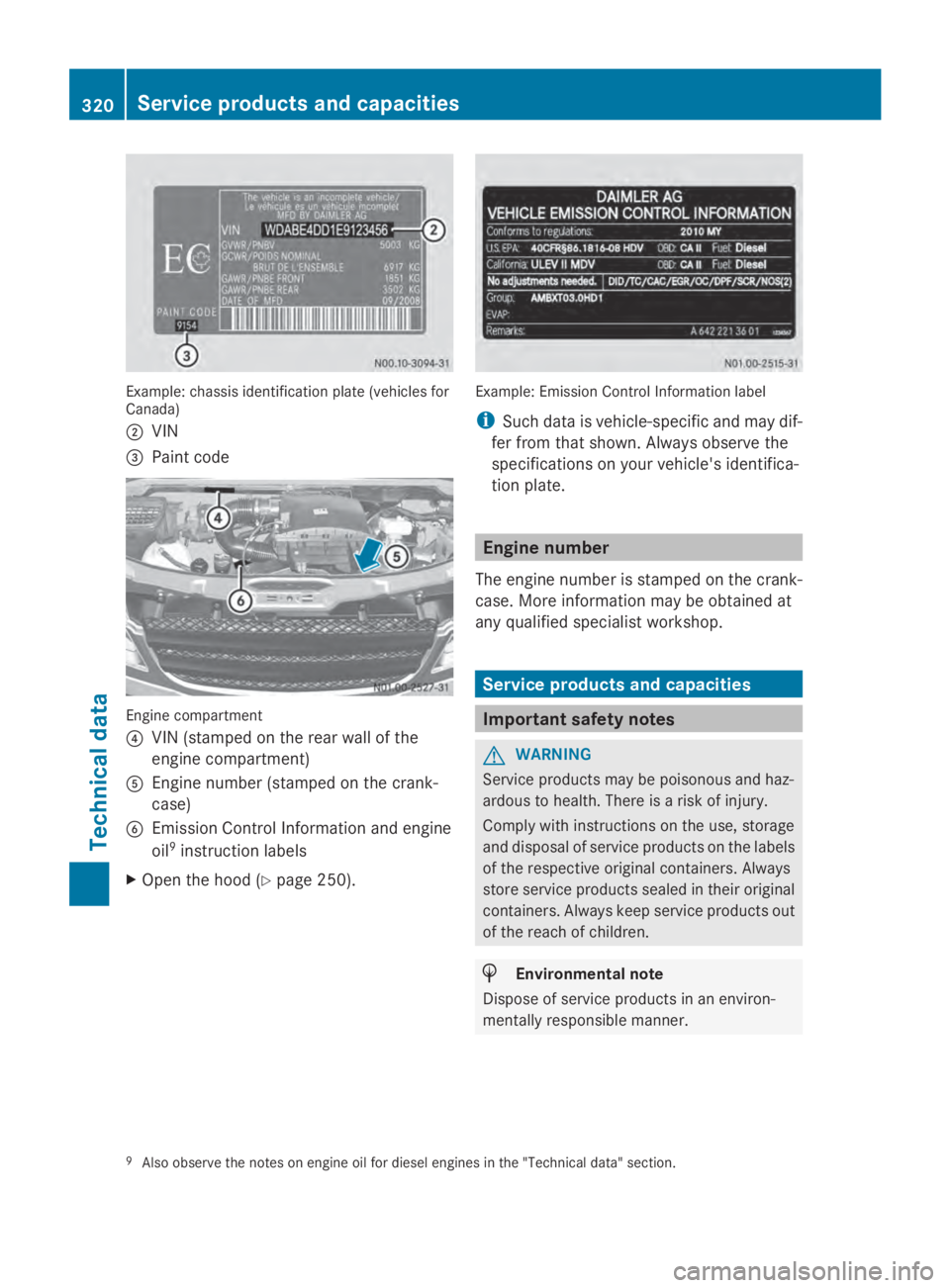
Example: chassis identification plate (vehicles for
Canada)
0044 VIN
0087 Paint code Engine compartment
0085
VIN (stamped on the rear wall of the
engine compartment)
0083 Engine number (stamped on the crank-
case)
0084 Emission Control Information and engine
oil 9
instruction labels
X Open the hood (Y page 250). Example: Emission Control Information label
i
Such data is vehicle-specific and may dif-
fer from that shown. Always observe the
specifications on your vehicle's identifica-
tion plate. Engine number
The engine number is stamped on the crank-
case. More information may be obtained at
any qualified specialist workshop. Service products and capacities
Important safety notes
G
WARNING
Service products may be poisonous and haz-
ardous to health. There is a risk of injury.
Comply with instructions on the use, storage
and disposal of service products on the labels
of the respective original containers. Always
store service products sealed in their original
containers. Always keep service products out
of the reach of children. H
Environmental note
Dispose of service products in an environ-
mentally responsible manner.
9 Also observe the notes on engine oil for diesel engines in the "Technical data" section. 320
Service products and capacitiesTechnical data
Page 323 of 338
Service products include the following:
R Fuels, e.g. diesel
R Additives for the exhaust gas aftertreat-
ment, e.g. Diesel Exhaust Fluid (DEF)
R Lubricants, e.g. engine oil, transmission oil
R Coolant
R Brake fluid
R Washer fluid
R Climate control system refrigerants
Approved service products comply with the
highest quality standards and are listed in the
MB Specifications for Service Products. Only
use service products approved for the vehi-
cle. This is an important condition for the war-
ranty.
You will recognize the approved service prod-
ucts by the inscription on the container: MB
Approval (e.g. MB Approval 228.5)
Other identifications and recommendations
refer to quality level or a specification accord-
ing to an MB Sheet Number (e.g. MB 228.5).
They are therefore not necessarily approved.
Further information can be obtained at any
qualified specialist workshop.
Additives for approved service products are
neither required nor permitted. Approved fuel
additives are the exception. Additives can
cause engine damage and must therefore not
be added to the service products.
The use of additives is always the responsi-
bility of the vehicle operator. The use of addi-
tives may result in the restriction or loss of
your Limited Warranty entitlements. Fuel
Important safety notes G
WARNING
Fuel is highly flammable. Improper handling
of fuel creates a risk of fire and explosion. Avoid fire, open flames, smoking and creating
sparks under all circumstances. Switch off the
engine and, if applicable, the auxiliary heating
before refueling.
G
WARNING
Fuel is poisonous and hazardous to health.
There is a risk of injury.
You must make sure that fuel does not come
into contact with your skin, eyes or clothing
and that it is not swallowed. Do not inhale fuel
vapors. Keep fuel away from children.
If you or others come into contact with fuel,
observe the following:
R Wash away fuel from skin immediately
using soap and water.
R If fuel comes into contact with your eyes,
immediately rinse them thoroughly with
clean water. Seek medical assistance with-
out delay.
R If fuel is swallowed, seek medical assis-
tance without delay. Do not induce vomit-
ing.
R Immediately change out of clothing which
has come into contact with fuel.
When handling, storing and disposing of fuels,
please observe the relevant regulations. Service products and capacities
321Technical data Z
Page 324 of 338
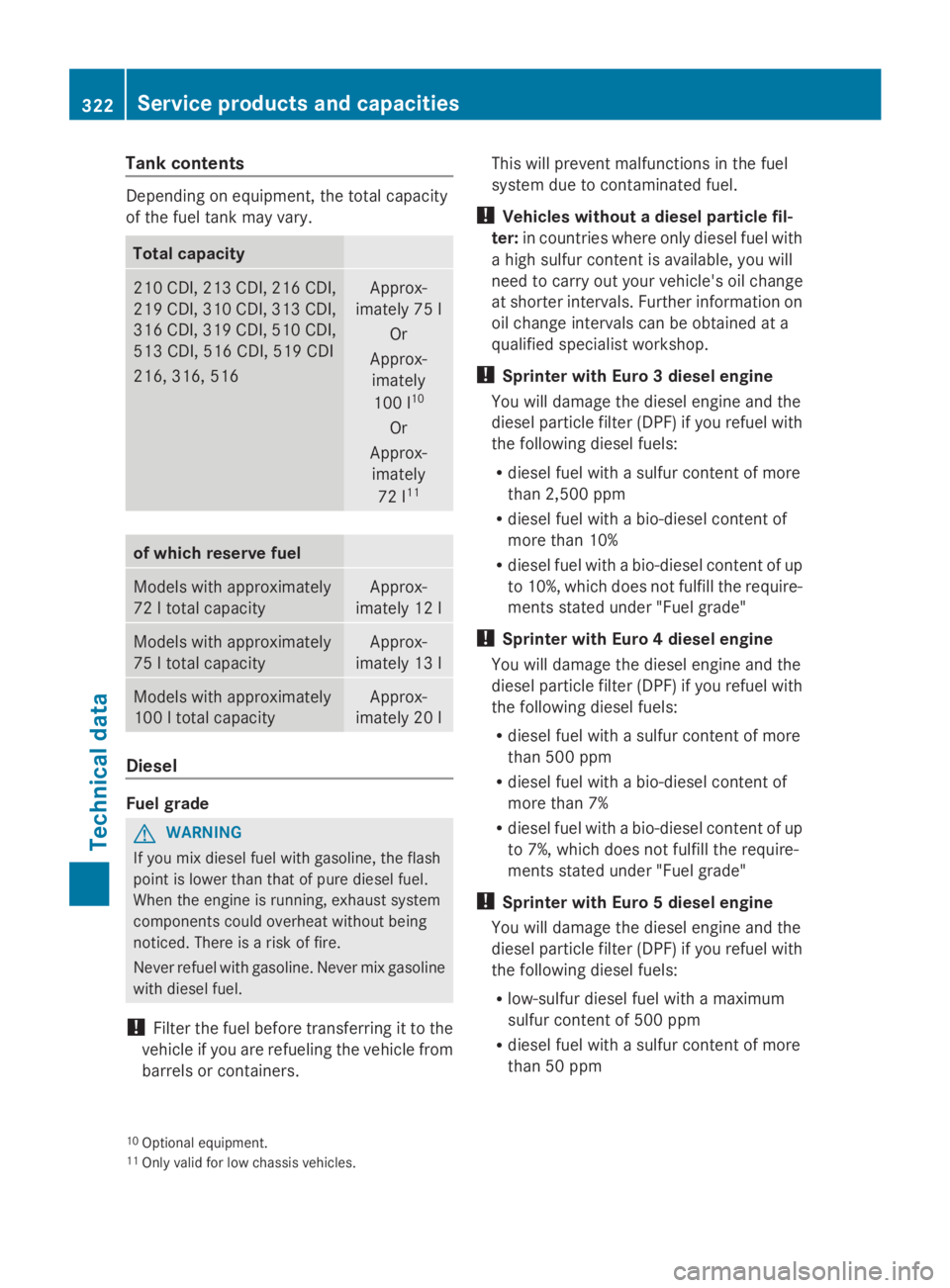
Tank contents
Depending on equipment, the total capacity
of the fuel tank may vary. Total capacity
210 CDI, 213 CDI, 216 CDI,
219 CDI, 310 CDI, 313 CDI,
316 CDI, 319 CDI, 510 CDI,
513 CDI, 516 CDI, 519 CDI
216, 316, 516 Approx-
imately 75 l
Or
Approx- imately
100 l 10
Or
Approx- imately
72 l 11 of which reserve fuel
Models with approximately
72 l total capacity Approx-
imately 12 l Models with approximately
75 l total capacity Approx-
imately 13 l Models with approximately
100 l total capacity Approx-
imately 20 l Diesel
Fuel grade
G
WARNING
If you mix diesel fuel with gasoline, the flash
point is lower than that of pure diesel fuel.
When the engine is running, exhaust system
components could overheat without being
noticed. There is a risk of fire.
Never refuel with gasoline. Never mix gasoline
with diesel fuel.
! Filter the fuel before transferring it to the
vehicle if you are refueling the vehicle from
barrels or containers. This will prevent malfunctions in the fuel
system due to contaminated fuel.
! Vehicles without a diesel particle fil-
ter: in countries where only diesel fuel with
a high sulfur content is available, you will
need to carry out your vehicle's oil change
at shorter intervals. Further information on
oil change intervals can be obtained at a
qualified specialist workshop.
! Sprinter with Euro 3 diesel engine
You will damage the diesel engine and the
diesel particle filter (DPF) if you refuel with
the following diesel fuels:
R diesel fuel with a sulfur content of more
than 2,500 ppm
R diesel fuel with a bio-diesel content of
more than 10%
R diesel fuel with a bio-diesel content of up
to 10%, which does not fulfill the require-
ments stated under "Fuel grade"
! Sprinter with Euro 4 diesel engine
You will damage the diesel engine and the
diesel particle filter (DPF) if you refuel with
the following diesel fuels:
R diesel fuel with a sulfur content of more
than 500 ppm
R diesel fuel with a bio-diesel content of
more than 7%
R diesel fuel with a bio-diesel content of up
to 7%, which does not fulfill the require-
ments stated under "Fuel grade"
! Sprinter with Euro 5 diesel engine
You will damage the diesel engine and the
diesel particle filter (DPF) if you refuel with
the following diesel fuels:
R low-sulfur diesel fuel with a maximum
sulfur content of 500 ppm
R diesel fuel with a sulfur content of more
than 50 ppm
10 Optional equipment.
11 Only valid for low chassis vehicles. 322
Service products and capacitiesTechnical data
Page 325 of 338
R
diesel fuel with a bio-diesel content of
more than 7%
R diesel fuel with a bio-diesel content of up
to 7%, which does not fulfill the require-
ments stated under "Fuel grade"
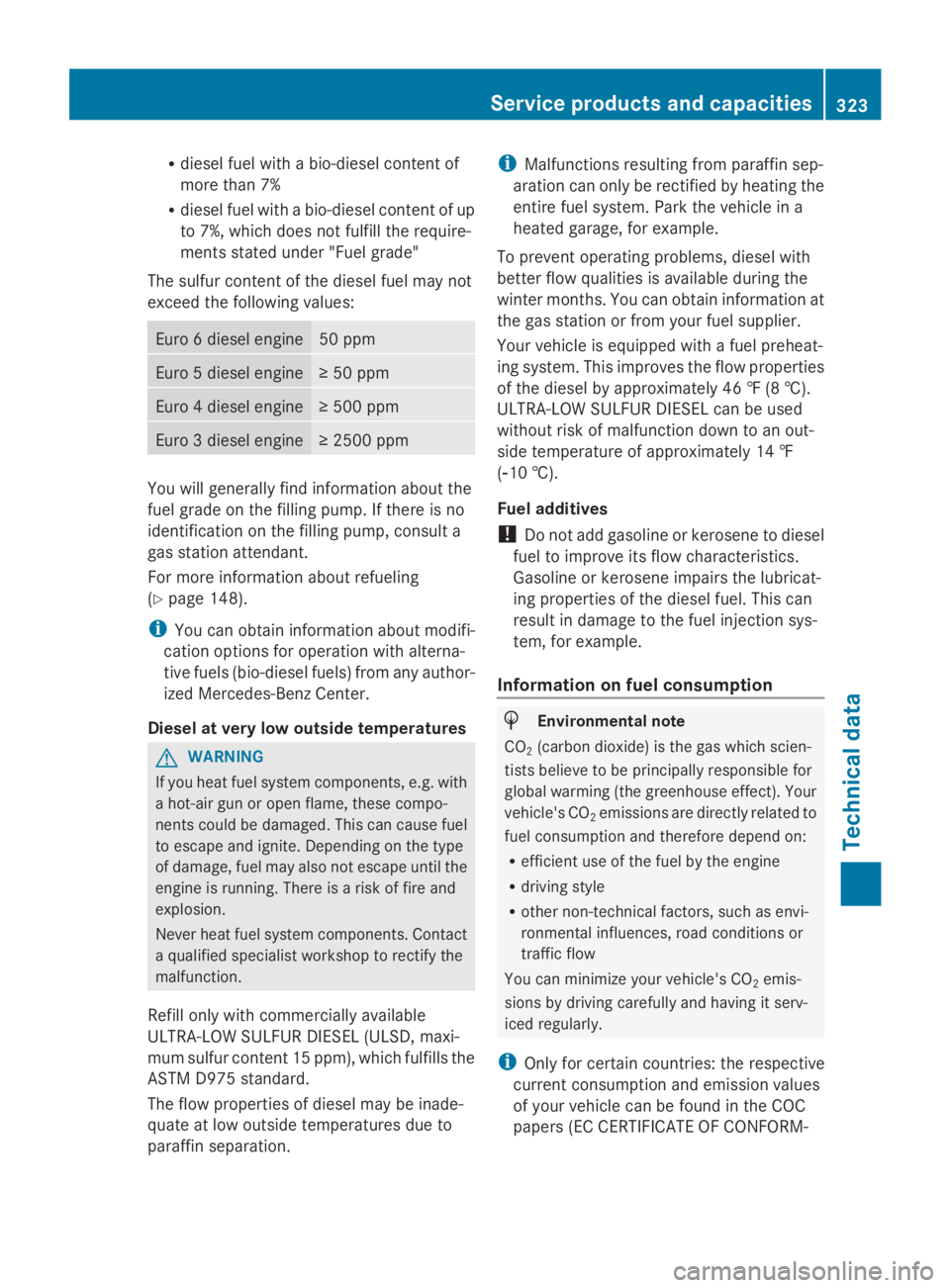
The sulfur content of the diesel fuel may not
exceed the following values: Euro 6 diesel engine 50 ppm
Euro 5 diesel engine ≥ 50 ppm
Euro 4 diesel engine ≥ 500 ppm
Euro 3 diesel engine ≥ 2500 ppm
You will generally find information about the
fuel grade on the filling pump. If there is no
identification on the filling pump, consult a
gas station attendant.
For more information about refueling
(Y
page 148).
i You can obtain information about modifi-
cation options for operation with alterna-
tive fuels (bio-diesel fuels) from any author-
ized Mercedes-Benz Center.
Diesel at very low outside temperatures G
WARNING
If you heat fuel system components, e.g. with
a hot-air gun or open flame, these compo-
nents could be damaged. This can cause fuel
to escape and ignite. Depending on the type
of damage, fuel may also not escape until the
engine is running. There is a risk of fire and
explosion.
Never heat fuel system components. Contact
a qualified specialist workshop to rectify the
malfunction.
Refill only with commercially available
ULTRA-LOW SULFUR DIESEL (ULSD, maxi-
mum sulfur content 15 ppm), which fulfills the
ASTM D975 standard.
The flow properties of diesel may be inade-
quate at low outside temperatures due to
paraffin separation. i
Malfunctions resulting from paraffin sep-
aration can only be rectified by heating the
entire fuel system. Park the vehicle in a
heated garage, for example.
To prevent operating problems, diesel with
better flow qualities is available during the
winter months. You can obtain information at
the gas station or from your fuel supplier.
Your vehicle is equipped with a fuel preheat-
ing system. This improves the flow properties
of the diesel by approximately 46 ‡ (8 †).
ULTRA-LOW SULFUR DIESEL can be used
without risk of malfunction down to an out-
side temperature of approximately 14 ‡
(00F810 †).
Fuel additives
! Do not add gasoline or kerosene to diesel
fuel to improve its flow characteristics.
Gasoline or kerosene impairs the lubricat-
ing properties of the diesel fuel. This can
result in damage to the fuel injection sys-
tem, for example.
Information on fuel consumption H
Environmental note
CO 2(carbon dioxide) is the gas which scien-
tists believe to be principally responsible for
global warming (the greenhouse effect). Your
vehicle's CO 2emissions are directly related to
fuel consumption and therefore depend on:
R efficient use of the fuel by the engine
R driving style
R other non-technical factors, such as envi-
ronmental influences, road conditions or
traffic flow
You can minimize your vehicle's CO 2emis-
sions by driving carefully and having it serv-
iced regularly.
i Only for certain countries: the respective
current consumption and emission values
of your vehicle can be found in the COC
papers (EC CERTIFICATE OF CONFORM- Service products and capacities
323Technical data Z
Page 330 of 338
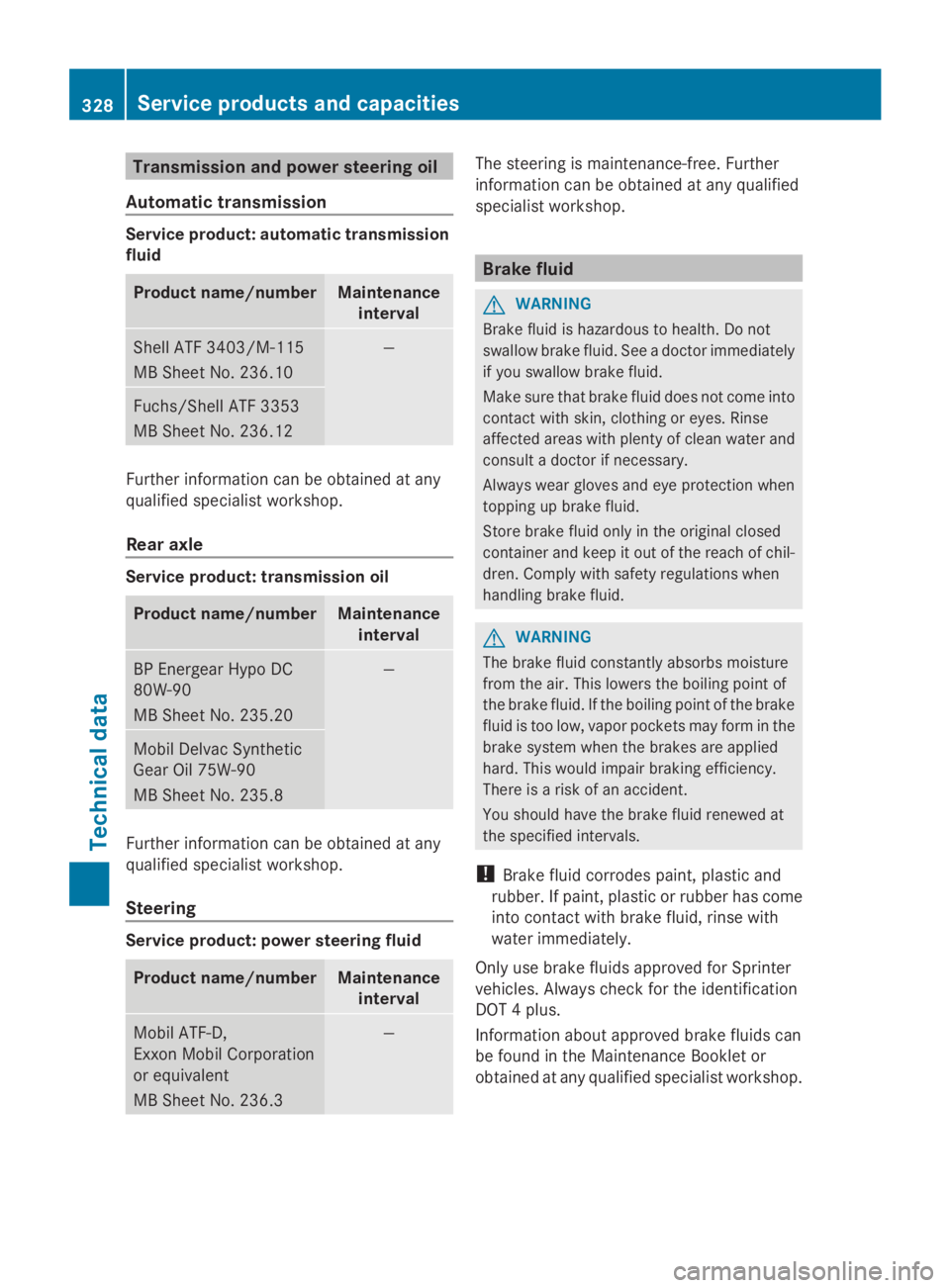
Transmission and power steering oil
Automatic transmission Service product: automatic transmission
fluid Product name/number Maintenance
interval Shell ATF 3403/M-115
MB Sheet No. 236.10 —
Fuchs/Shell ATF 3353
MB Sheet No. 236.12
Further information can be obtained at any
qualified specialist workshop.
Rear axle Service product: transmission oil
Product name/number Maintenance
interval BP Energear Hypo DC
80W-90
MB Sheet No. 235.20 —
Mobil Delvac Synthetic
Gear Oil 75W-90
MB Sheet No. 235.8
Further information can be obtained at any
qualified specialist workshop.
Steering Service product: power steering fluid
Product name/number Maintenance
interval Mobil ATF-D,
Exxon Mobil Corporation
or equivalent
MB Sheet No. 236.3 — The steering is maintenance-free. Further
information can be obtained at any qualified
specialist workshop. Brake fluid
G
WARNING
Brake fluid is hazardous to health. Do not
swallow brake fluid. See a doctor immediately
if you swallow brake fluid.
Make sure that brake fluid does not come into
contact with skin, clothing or eyes. Rinse
affected areas with plenty of clean water and
consult a doctor if necessary.
Always wear gloves and eye protection when
topping up brake fluid.
Store brake fluid only in the original closed
container and keep it out of the reach of chil-
dren. Comply with safety regulations when
handling brake fluid. G
WARNING
The brake fluid constantly absorbs moisture
from the air. This lowers the boiling point of
the brake fluid. If the boiling point of the brake
fluid is too low, vapor pockets may form in the
brake system when the brakes are applied
hard. This would impair braking efficiency.
There is a risk of an accident.
You should have the brake fluid renewed at
the specified intervals.
! Brake fluid corrodes paint, plastic and
rubber. If paint, plastic or rubber has come
into contact with brake fluid, rinse with
water immediately.
Only use brake fluids approved for Sprinter
vehicles. Always check for the identification
DOT 4 plus.
Information about approved brake fluids can
be found in the Maintenance Booklet or
obtained at any qualified specialist workshop. 328
Service products and capacitiesTechnical data
Page 331 of 338
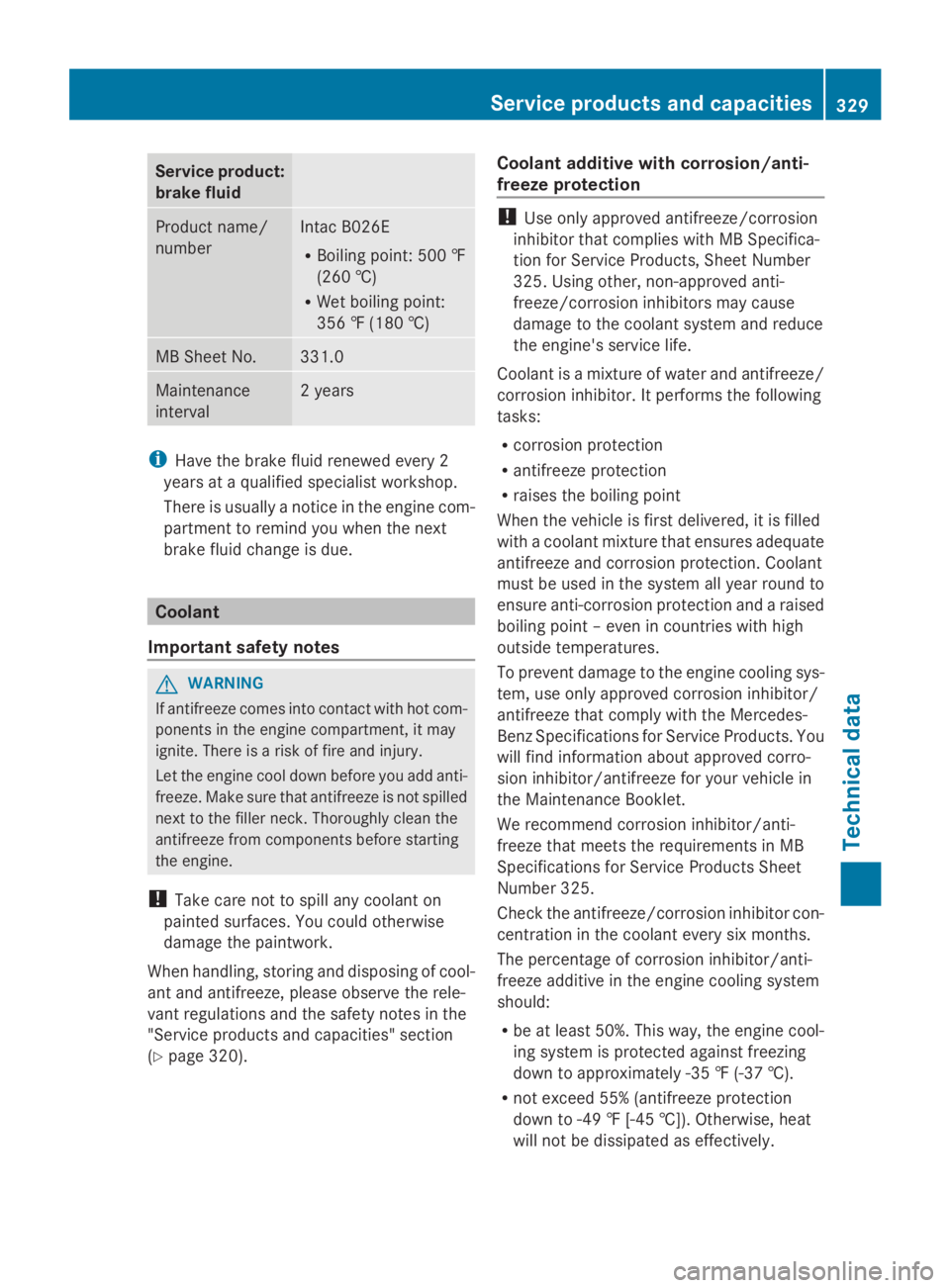
Service product:
brake fluid
Product name/
number Intac B026E
R Boiling point: 500 ‡
(260 †)
R Wet boiling point:
356 ‡ (180 †) MB Sheet No. 331.0
Maintenance
interval 2 years
i
Have the brake fluid renewed every 2
years at a qualified specialist workshop.
There is usually a notice in the engine com-
partment to remind you when the next
brake fluid change is due. Coolant
Important safety notes G
WARNING
If antifreeze comes into contact with hot com-
ponents in the engine compartment, it may
ignite. There is a risk of fire and injury.
Let the engine cool down before you add anti-
freeze. Make sure that antifreeze is not spilled
next to the filler neck. Thoroughly clean the
antifreeze from components before starting
the engine.
! Take care not to spill any coolant on
painted surfaces. You could otherwise
damage the paintwork.
When handling, storing and disposing of cool-
ant and antifreeze, please observe the rele-
vant regulations and the safety notes in the
"Service products and capacities" section
(Y page 320). Coolant additive with corrosion/anti-
freeze protection !
Use only approved antifreeze/corrosion
inhibitor that complies with MB Specifica-
tion for Service Products, Sheet Number
325. Using other, non-approved anti-
freeze/corrosion inhibitors may cause
damage to the coolant system and reduce
the engine's service life.
Coolant is a mixture of water and antifreeze/
corrosion inhibitor. It performs the following
tasks:
R corrosion protection
R antifreeze protection
R raises the boiling point
When the vehicle is first delivered, it is filled
with a coolant mixture that ensures adequate
antifreeze and corrosion protection. Coolant
must be used in the system all year round to
ensure anti-corrosion protection and a raised
boiling point – even in countries with high
outside temperatures.
To prevent damage to the engine cooling sys-
tem, use only approved corrosion inhibitor/
antifreeze that comply with the Mercedes-
Benz Specifications for Service Products. You
will find information about approved corro-
sion inhibitor/antifreeze for your vehicle in
the Maintenance Booklet.
We recommend corrosion inhibitor/anti-
freeze that meets the requirements in MB
Specifications for Service Products Sheet
Number 325.
Check the antifreeze/corrosion inhibitor con-
centration in the coolant every six months.
The percentage of corrosion inhibitor/anti-
freeze additive in the engine cooling system
should:
R be at least 50%. This way, the engine cool-
ing system is protected against freezing
down to approximately -35 ‡ (-37 †).
R not exceed 55% (antifreeze protection
down to -49 ‡ [-45 †]). Otherwise, heat
will not be dissipated as effectively. Service products and capacities
329Technical data Z
Page 332 of 338
If there has been coolant loss, do not refill
only with water. If the vehicle has lost coolant,
add equal parts water and corrosion inhibi-
tor/antifreeze additive. The water used as
part of the coolant mixture must fulfill certain
requirements; these are usually fulfilled by
drinking water. If the water quality is not suf-
ficient, you must treat the water.
Further information can be obtained at any
qualified specialist workshop.
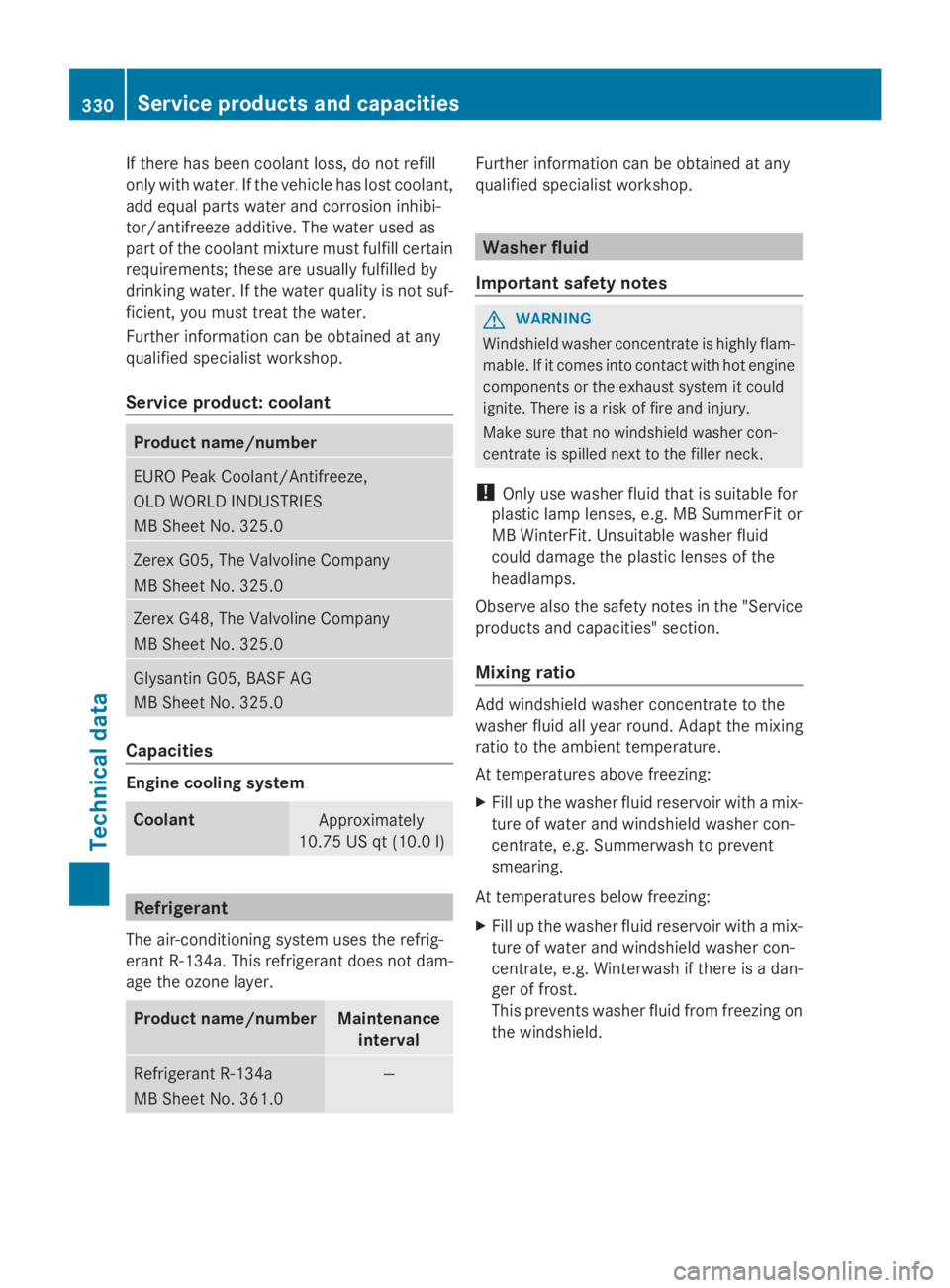
Service product: coolant Product name/number
EURO Peak Coolant/Antifreeze,
OLD WORLD INDUSTRIES
MB Sheet No. 325.0
Zerex G05, The Valvoline Company
MB Sheet No. 325.0
Zerex G48, The Valvoline Company
MB Sheet No. 325.0
Glysantin G05, BASF AG
MB Sheet No. 325.0
Capacities
Engine cooling system
Coolant
Approximately
10.75 US qt (10.0 l) Refrigerant
The air-conditioning system uses the refrig-
erant R-134a. This refrigerant does not dam-
age the ozone layer. Product name/number Maintenance
interval Refrigerant R-134a
MB Sheet No. 361.0 — Further information can be obtained at any
qualified specialist workshop.
Washer fluid
Important safety notes G
WARNING
Windshield washer concentrate is highly flam-
mable. If it comes into contact with hot engine
components or the exhaust system it could
ignite. There is a risk of fire and injury.
Make sure that no windshield washer con-
centrate is spilled next to the filler neck.
! Only use washer fluid that is suitable for
plastic lamp lenses, e.g. MB SummerFit or
MB WinterFit. Unsuitable washer fluid
could damage the plastic lenses of the
headlamps.
Observe also the safety notes in the "Service
products and capacities" section.
Mixing ratio Add windshield washer concentrate to the
washer fluid all year round. Adapt the mixing
ratio to the ambient temperature.
At temperatures above freezing:
X Fill up the washer fluid reservoir with a mix-
ture of water and windshield washer con-
centrate, e.g. Summerwash to prevent
smearing.
At temperatures below freezing:
X Fill up the washer fluid reservoir with a mix-
ture of water and windshield washer con-
centrate, e.g. Winterwash if there is a dan-
ger of frost.
This prevents washer fluid from freezing on
the windshield. 330
Service products and capacitiesTechnical data
Page 333 of 338
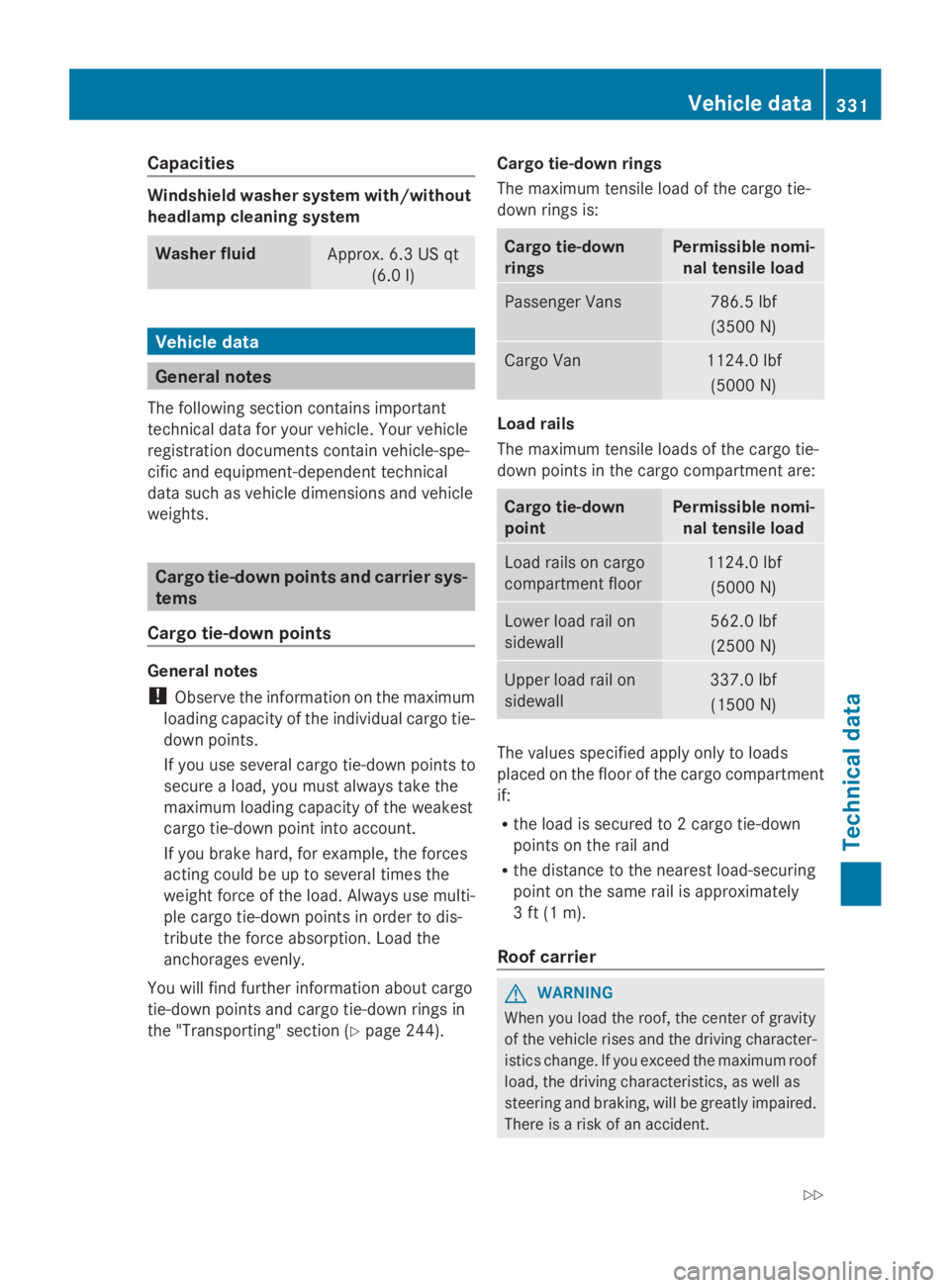
Capacities
Windshield washer system with/without
headlamp cleaning system Washer fluid
Approx. 6.3 US qt
(6.0 l) Vehicle data
General notes
The following section contains important
technical data for your vehicle. Your vehicle
registration documents contain vehicle-spe-
cific and equipment-dependent technical
data such as vehicle dimensions and vehicle
weights. Cargo tie-down points and carrier sys-
tems
Cargo tie-down points General notes
!
Observe the information on the maximum
loading capacity of the individual cargo tie-
down points.
If you use several cargo tie-down points to
secure a load, you must always take the
maximum loading capacity of the weakest
cargo tie-down point into account.
If you brake hard, for example, the forces
acting could be up to several times the
weight force of the load. Always use multi-
ple cargo tie-down points in order to dis-
tribute the force absorption. Load the
anchorages evenly.
You will find further information about cargo
tie-down points and cargo tie-down rings in
the "Transporting" section (Y page 244).Cargo tie-down rings
The maximum tensile load of the cargo tie-
down rings is: Cargo tie-down
rings Permissible nomi-
nal tensile load Passenger Vans 786.5 lbf
(3500 N) Cargo Van 1124.0 lbf
(5000 N) Load rails
The maximum tensile loads of the cargo tie-
down points in the cargo compartment are:
Cargo tie-down
point Permissible nomi-
nal tensile load Load rails on cargo
compartment floor 1124.0 lbf
(5000 N) Lower load rail on
sidewall 562.0 lbf
(2500 N) Upper load rail on
sidewall 337.0 lbf
(1500 N) The values specified apply only to loads
placed on the floor of the cargo compartment
if:
R
the load is secured to 2 cargo tie-down
points on the rail and
R the distance to the nearest load-securing
point on the same rail is approximately
3 ft (1 m).
Roof carrier G
WARNING
When you load the roof, the center of gravity
of the vehicle rises and the driving character-
istics change. If you exceed the maximum roof
load, the driving characteristics, as well as
steering and braking, will be greatly impaired.
There is a risk of an accident. Vehicle data
331Technical data
Z
Page 334 of 338
Never exceed the maximum roof load and
adjust your driving style. G
WARNING
If you distribute the load unevenly in the vehi-
cle, the handling as well as the steering and
braking characteristics are severely affected.
There is a risk of an accident.
Distribute the load evenly in the vehicle.
Secure the load to prevent it from slipping.
! The weight of any load carried on the roof,
including the roof carrier, must not exceed
the maximum permissible roof load.
The roof carrier supports must be mounted
at equal distances.
We recommend that you have a stabilizer
installed on the front axle.
! For safety reasons, we recommend that
you only use roof carrier systems that have
been tested and approved for the Sprinter.
This will help to avoid damage.
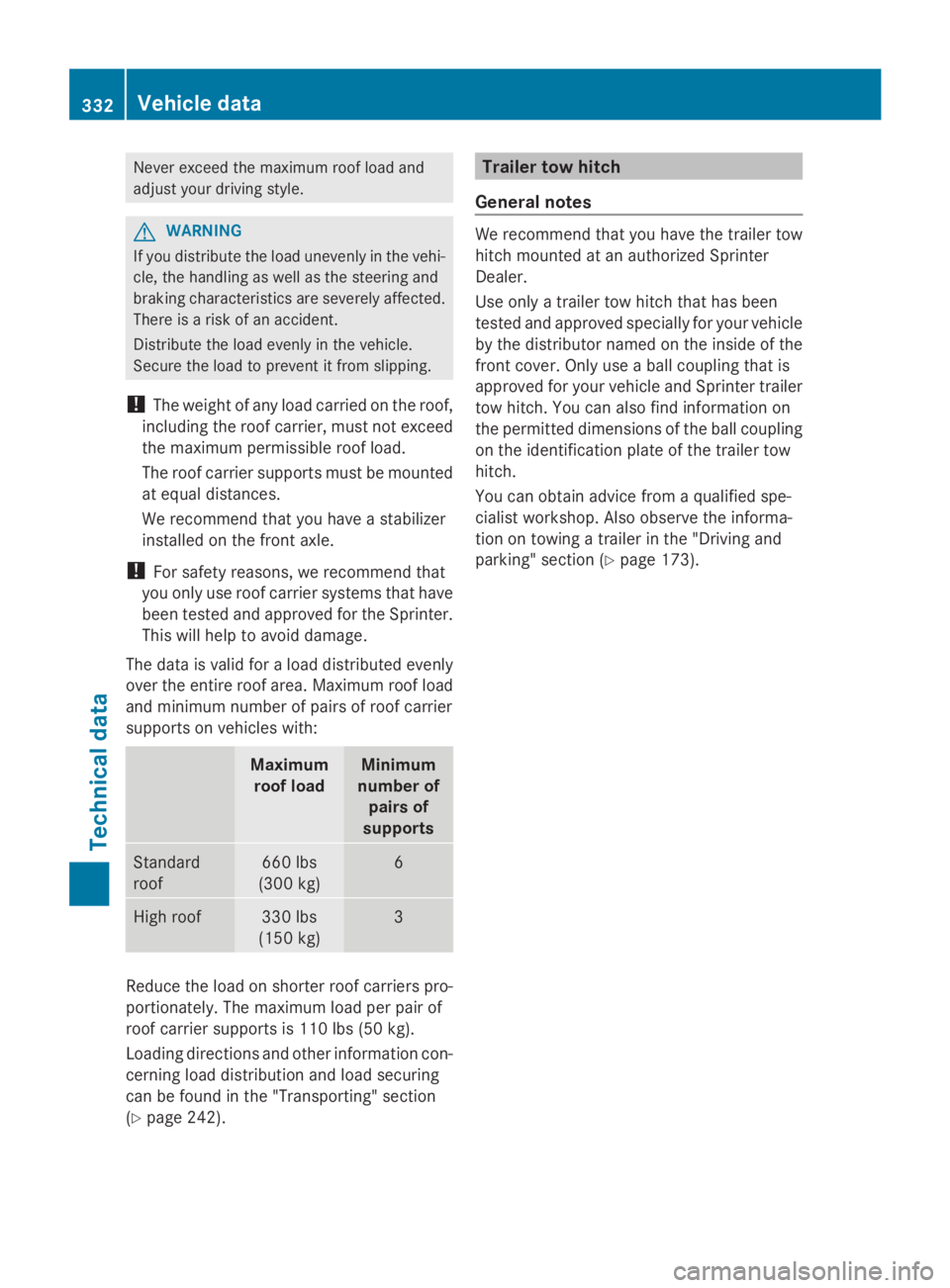
The data is valid for a load distributed evenly
over the entire roof area. Maximum roof load
and minimum number of pairs of roof carrier
supports on vehicles with: Maximum
roof load Minimum
number of pairs of
supports Standard
roof 660 lbs
(300 kg) 6
High roof 330 lbs
(150 kg) 3
Reduce the load on shorter roof carriers pro-
portionately. The maximum load per pair of
roof carrier supports is 110 lbs (50 kg).
Loading directions and other information con-
cerning load distribution and load securing
can be found in the "Transporting" section
(Y
page 242). Trailer tow hitch
General notes We recommend that you have the trailer tow
hitch mounted at an authorized Sprinter
Dealer.
Use only a trailer tow hitch that has been
tested and approved specially for your vehicle
by the distributor named on the inside of the
front cover. Only use a ball coupling that is
approved for your vehicle and Sprinter trailer
tow hitch. You can also find information on
the permitted dimensions of the ball coupling
on the identification plate of the trailer tow
hitch.
You can obtain advice from a qualified spe-
cialist workshop. Also observe the informa-
tion on towing a trailer in the "Driving and
parking" section (Y page 173).332
Vehicle dataTechnical data