air conditioning MERCEDES-BENZ SPRINTER 2014 MY14 Operator’s Manual
[x] Cancel search | Manufacturer: MERCEDES-BENZ, Model Year: 2014, Model line: SPRINTER, Model: MERCEDES-BENZ SPRINTER 2014Pages: 338, PDF Size: 6.78 MB
Page 179 of 338
Observe the following when towing a trailer:
R Practice driving around bends, stopping
and backing up at a place where there is no
traffic. This enables you to gain experience
and get used to the new handling charac-
teristics.
R Before driving, check:
-that the trailer tow hitch and ball cou-
pling are secure
- that the safety switch for a braked trailer
is functioning properly
- that the safety chains are secure and not
damaged
- that the electrical connections are
secure
- that the lights are working
- that the wheels are in good order and the
tire pressure is correct
R Adjust the exterior mirrors to provide an
unobstructed view of the rear section of the
trailer.
R If the trailer has electronically controlled
brakes, pull the vehicle/trailer combina-
tion away carefully. Brake manually using
the brake controller and check that the
brakes are working.
R Secure the load on the trailer according to
the applicable specifications and current
standards on securing loads
(Y page 244).
R When driving with a trailer, check at regular
intervals that the load is secured and that
the brakes and lights are working.
R Bear in mind that the handling will be less
stable when towing a trailer than when driv-
ing without one. Avoid sudden steering
movements.
R The vehicle/trailer combination is heavier,
accelerates more slowly and has a
decreased gradient climbing capability and
a longer braking distance.
It is more susceptible to crosswinds and
requires cautious steering.
R If possible, do not brake suddenly, but
rather moderately at first so that the trailer can activate its brakes. Then increase the
force on the brake pedal.
R If the automatic transmission repeatedly
shifts between gears when driving on
inclines, restrict the shift range. Select shift
range 4,3,2or 1.
Driving in a low gear and at a low speed
reduces the risk of damaging the engine.
R When driving on a downhill gradient, shift
to a low gear and take advantage of the
engine's braking effect.
Avoid continuous brake application as this
may overheat the vehicle brakes and, if
installed, the trailer brakes.
R If the coolant temperature increases dra-
matically while the air-conditioning system
is switched on, switch off the air-condition-
ing system.
Coolant heat can also be dissipated by
switching the airflow and the temperature
of the heater/air conditioning to the maxi-
mum level. Open the windows if necessary.
R When overtaking, pay particular attention
to the extended length of your vehicle/
trailer combination.
Due to the length of your vehicle/trailer
combination you need an additional dis-
tance before you can return to your original
lane. Uncoupling a trailer
G
WARNING
If you uncouple a trailer with the overrun
brake engaged, you could trap your hand
between the vehicle and the trailer drawbar.
There is a risk of injury.
Do not uncouple a trailer if the overrun brake
is engaged.
! Do not disconnect a trailer with an
engaged overrun brake. Otherwise, your
vehicle could be damaged by the rebound-
ing of the overrun brake. Towing a trailer
177Driving and parking Z
Page 260 of 338
X
Turn the key to position 2in the ignition
lock.
X Open drain plug 0044immediately until the
water/fuel mixture flows out of drain
hose 0043.
X Screw in drain plug 0044as soon as approx-
imately 0.2 US qt (0.2 l) of the water/fuel
mixture have been collected.
i The electrical fuel pump halts the flow of
the water/fuel mixture after 30 seconds.
X After draining, turn the key back to posi-
tion 0in the ignition lock.
X Dispose of the collected water/fuel mix-
ture in an environmentally responsible
manner, e.g. at a qualified specialist work-
shop.
X Check drain plug 0044. The drain plug must
be closed.
When the engine is running and drain
hose 0044is open, fuel is lost through drain
hose 0043.
X Close the hood.
If the 00B8 indicator lamp does not go out
after draining:
X Drain the fuel filter again.
X If the 00B8 indicator lamp does not go out
after draining for the second time, have the
cause checked immediately at a qualified
specialist workshop. Vehicle interior
Air filter for the rear-compartment air
conditioning
! Regularly check the air filters for visible
dirt. Clean or replace a dirty filter mat. The
dirt may otherwise lead to damage to the
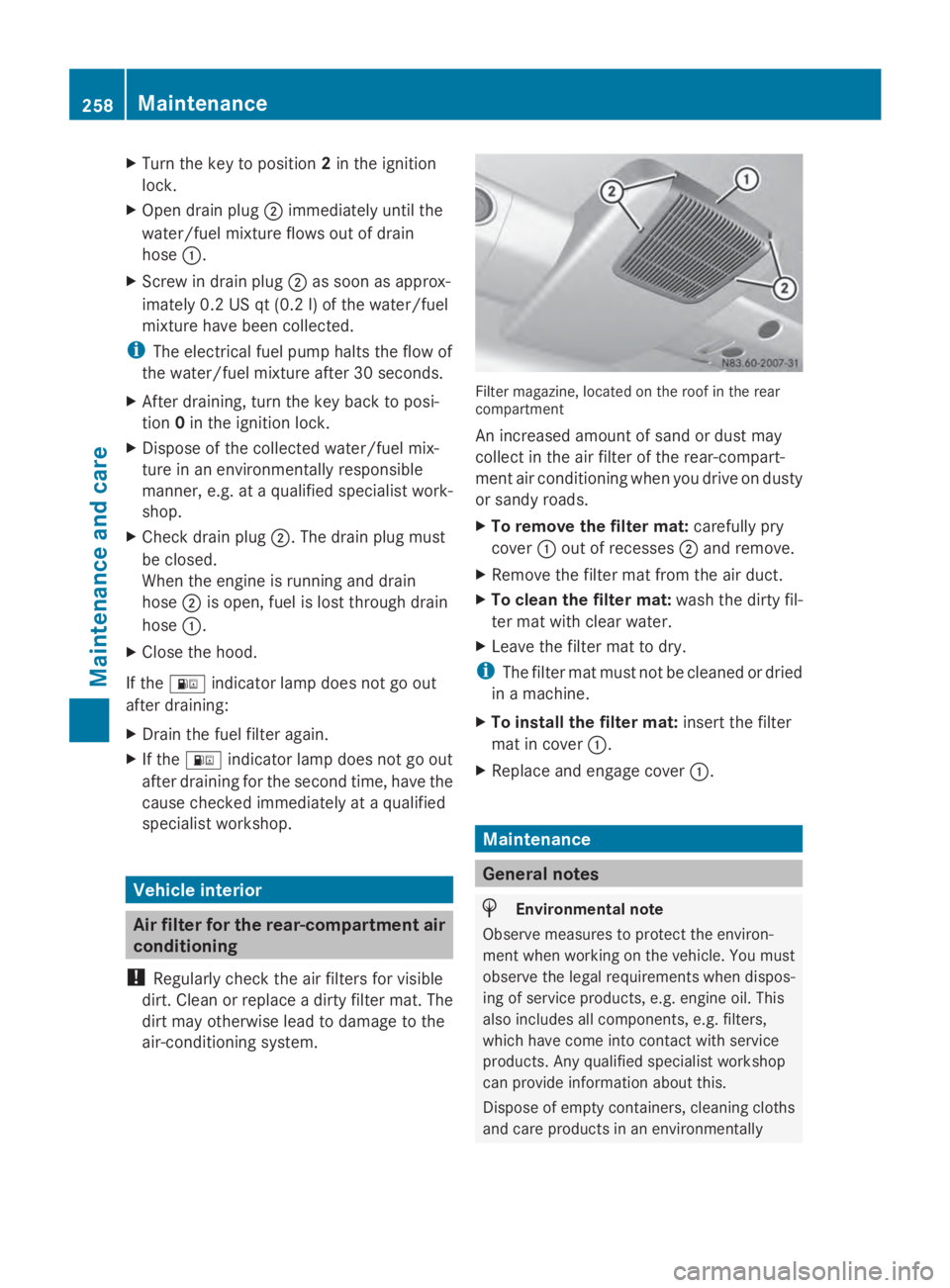
air-conditioning system. Filter magazine, located on the roof in the rear
compartment
An increased amount of sand or dust may
collect in the air filter of the rear-compart-
ment air conditioning when you drive on dusty
or sandy roads.
X
To remove the filter mat: carefully pry
cover 0043out of recesses 0044and remove.
X Remove the filter mat from the air duct.
X To clean the filter mat: wash the dirty fil-
ter mat with clear water.
X Leave the filter mat to dry.
i The filter mat must not be cleaned or dried
in a machine.
X To install the filter mat: insert the filter
mat in cover 0043.
X Replace and engage cover 0043. Maintenance
General notes
H
Environmental note
Observe measures to protect the environ-
ment when working on the vehicle. You must
observe the legal requirements when dispos-
ing of service products, e.g. engine oil. This
also includes all components, e.g. filters,
which have come into contact with service
products. Any qualified specialist workshop
can provide information about this.
Dispose of empty containers, cleaning cloths
and care products in an environmentally 258
MaintenanceMaintenance and care
Page 308 of 338
is bar. 100 kilopascals (kPa) are the equiva-
lent of 1 bar.
Load index
In addition to the load bearing index, a load
index can be stamped onto the sidewall of the
tire. It specifies the load-bearing capacity of
the tire more precisely.
Curb weight
The weight of a vehicle with standard equip-
ment including the maximum filling capacity
of fuel, oil, and coolant. It also includes the
air-conditioning system and optional equip-
ment if these are installed on the vehicle, but
does not include passengers or luggage.
Maximum tire load
The maximum tire load in kilograms or
pounds is the maximum weight for which a
tire is approved.
Maximum permissible tire pressure
Maximum permissible tire pressure for one
tire.
Maximum load on one tire
Maximum load on one tire. This is calculated
by dividing the maximum axle load of one axle
by two.
PSI (Pounds per square inch)
Standard unit of measurement for tire pres-
sure.
Aspect ratio
Relationship between tire height and width in
percent.
Tire pressure
Pressure inside the tire applying an outward
force to every square inch of the tire's sur-
face. Tire pressure is specified in pounds per
square inch (psi), in kilopascal (kPa) or in bar.
Tire pressure should only be corrected when
the tires are cold. Cold tire pressure
The tires are cold:
R
if the vehicle has been parked for at least
three hours without direct sunlight on the
tires, and
R if the vehicle has not been driven further
than 1 mile (1.6 km)
Tire tread
The part of the tire that comes into contact
with the road.
Tire bead
The tire bead ensures that the tire sits
securely on the wheel. There are several steel
wires in the bead to prevent the tire from
coming loose from the wheel rim.
Sidewall
The part of the tire between the tread and the
tire bead.
Weight of optional extras
The combined weight of those optional extras
that weigh more than the replaced standard
parts and more than 2.3 kg (5 lbs). These
optional extras, such as high-performance
brakes, level control, a roof rack or a high-
performance battery, are not included in the
curb weight and the weight of the accesso-
ries.
TIN (Tire Identification Number)
A unique identification number which can be
used by a tire manufacturer to identify tires,
for example for a product recall, and thus
identify the purchasers. The TIN is composed
of the manufacturer identification code, tire
size, tire model code and manufacturing date.
Load bearing index
The load bearing index (also load index) is a
code that contains the maximum load bearing
capacity of a tire. 306
What you should know about wheels and tiresWheels and tires
Page 326 of 338
ITY). These documents are supplied when
the vehicle is delivered.
Consumption figures were found in the cur-
rently valid respective version:
R for vehicles from the Euro 5 standard
according to regulation (EC) no.
715/2007
R for vehicles from the Euro 6 standard
according to regulation (EC) no.
595/2009
Fuel consumption depends on:
R the vehicle version
R the style of driving
R the operating conditions
R the type or quality of the fuel used
The vehicle will use more fuel than usual in
the following situations:
R at very low outside temperatures
R in city traffic
R during short journeys
R on mountainous terrain
R when towing a trailer
To keep fuel consumption low, observe the
advice in the "Protection of the environment"
section (Y page 22).
The following components of the different
vehicle versions influence fuel consumption:
R tire sizes, tire tread, tire pressure, tire con-
dition
R body
R transmission ratios for the drive assem-
blies
R additional equipment (e.g. air-conditioning
system, auxiliary heating system).
For these reasons, the actual consumption
figures for your vehicle may deviate from the
consumption figures determined according
to EU Directive 80/1268/EEC.
Data concerning fuel consumption are
recorded in the on-board computer; use the
steering wheel buttons to call up the Trip
computer menu (Ypage 197). Diesel Exhaust Fluid (DEF) General notes
!
Only use DEF in accordance with
ISO 22241. The exhaust gas aftertreatment
system may otherwise be damaged.
Observe the MB Specifications for Service
Products, Sheet No. 352.0.
Damage caused by the use of other reduc-
ing agents will invalidate the New Vehicle
Limited Warranty.
! If DEF comes into contact with a painted
or aluminum surface, wash the surface off
immediately with plenty of water.
High ambient temperatures
When opening the DEF tank filler cap at high
outside temperatures, ammonia vapors may
escape. Ammonia vapors have a pungent
odor and are particularly irritating for your
skin, respiratory organs and eyes. This may
result in burning eyes, nose and throat, as
well as coughing and watering eyes. Do not
inhale ammonia vapors.
If DEF heats up, e.g. in direct sunlight, in the
DEF supply reservoir for some time to over
122 ‡ (50 †), ammonia vapor will develop.
Low ambient temperatures
DEF freezes at a temperature of approx-
imately 12 ‡(00F811 †). The vehicle is equipped
with a DEF preheating system at the factory.
Winter operation is therefore also guaranteed
at temperatures under 12 ‡ (00F811 †).
Additives and tap water
! Do not mix DEF with any additives and do
not dilute DEF with tap water. Otherwise,
the exhaust gas aftertreatment may be
damaged.
Observe the MB Specifications for Service
Products, Sheet No. 352.0.
Damage that arises through the use of addi-
tives or tap water will invalidate the New
Vehicle Limited Warranty. 324
Service products and capacitiesTechnical data
Page 332 of 338
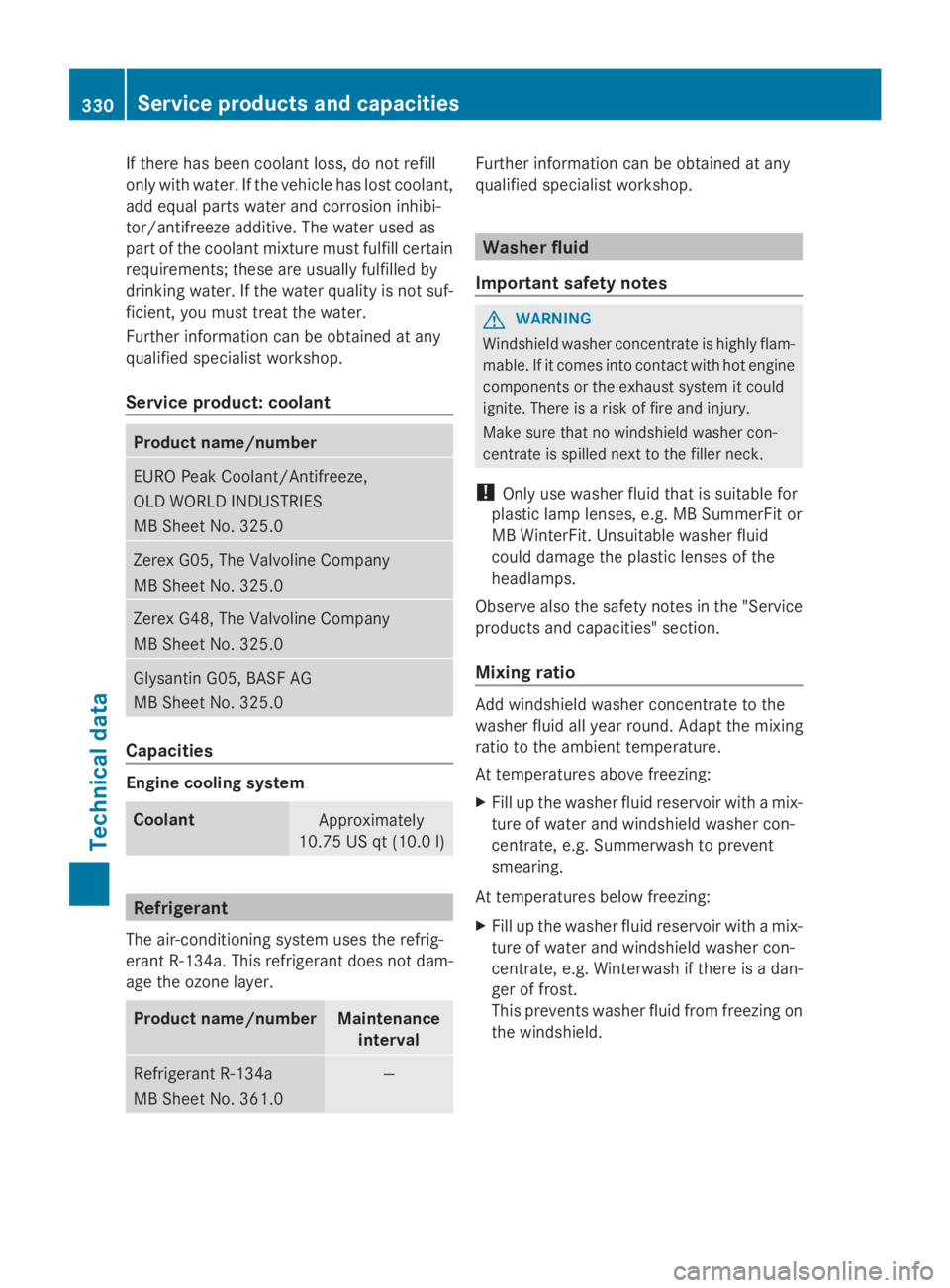
If there has been coolant loss, do not refill
only with water. If the vehicle has lost coolant,
add equal parts water and corrosion inhibi-
tor/antifreeze additive. The water used as
part of the coolant mixture must fulfill certain
requirements; these are usually fulfilled by
drinking water. If the water quality is not suf-
ficient, you must treat the water.
Further information can be obtained at any
qualified specialist workshop.
Service product: coolant Product name/number
EURO Peak Coolant/Antifreeze,
OLD WORLD INDUSTRIES
MB Sheet No. 325.0
Zerex G05, The Valvoline Company
MB Sheet No. 325.0
Zerex G48, The Valvoline Company
MB Sheet No. 325.0
Glysantin G05, BASF AG
MB Sheet No. 325.0
Capacities
Engine cooling system
Coolant
Approximately
10.75 US qt (10.0 l) Refrigerant
The air-conditioning system uses the refrig-
erant R-134a. This refrigerant does not dam-
age the ozone layer. Product name/number Maintenance
interval Refrigerant R-134a
MB Sheet No. 361.0 — Further information can be obtained at any
qualified specialist workshop.
Washer fluid
Important safety notes G
WARNING
Windshield washer concentrate is highly flam-
mable. If it comes into contact with hot engine
components or the exhaust system it could
ignite. There is a risk of fire and injury.
Make sure that no windshield washer con-
centrate is spilled next to the filler neck.
! Only use washer fluid that is suitable for
plastic lamp lenses, e.g. MB SummerFit or
MB WinterFit. Unsuitable washer fluid
could damage the plastic lenses of the
headlamps.
Observe also the safety notes in the "Service
products and capacities" section.
Mixing ratio Add windshield washer concentrate to the
washer fluid all year round. Adapt the mixing
ratio to the ambient temperature.
At temperatures above freezing:
X Fill up the washer fluid reservoir with a mix-
ture of water and windshield washer con-
centrate, e.g. Summerwash to prevent
smearing.
At temperatures below freezing:
X Fill up the washer fluid reservoir with a mix-
ture of water and windshield washer con-
centrate, e.g. Winterwash if there is a dan-
ger of frost.
This prevents washer fluid from freezing on
the windshield. 330
Service products and capacitiesTechnical data