child seat MERCEDES-BENZ SPRINTER 2014 MY14 Operator’s Manual
[x] Cancel search | Manufacturer: MERCEDES-BENZ, Model Year: 2014, Model line: SPRINTER, Model: MERCEDES-BENZ SPRINTER 2014Pages: 338, PDF Size: 6.78 MB
Page 9 of 338
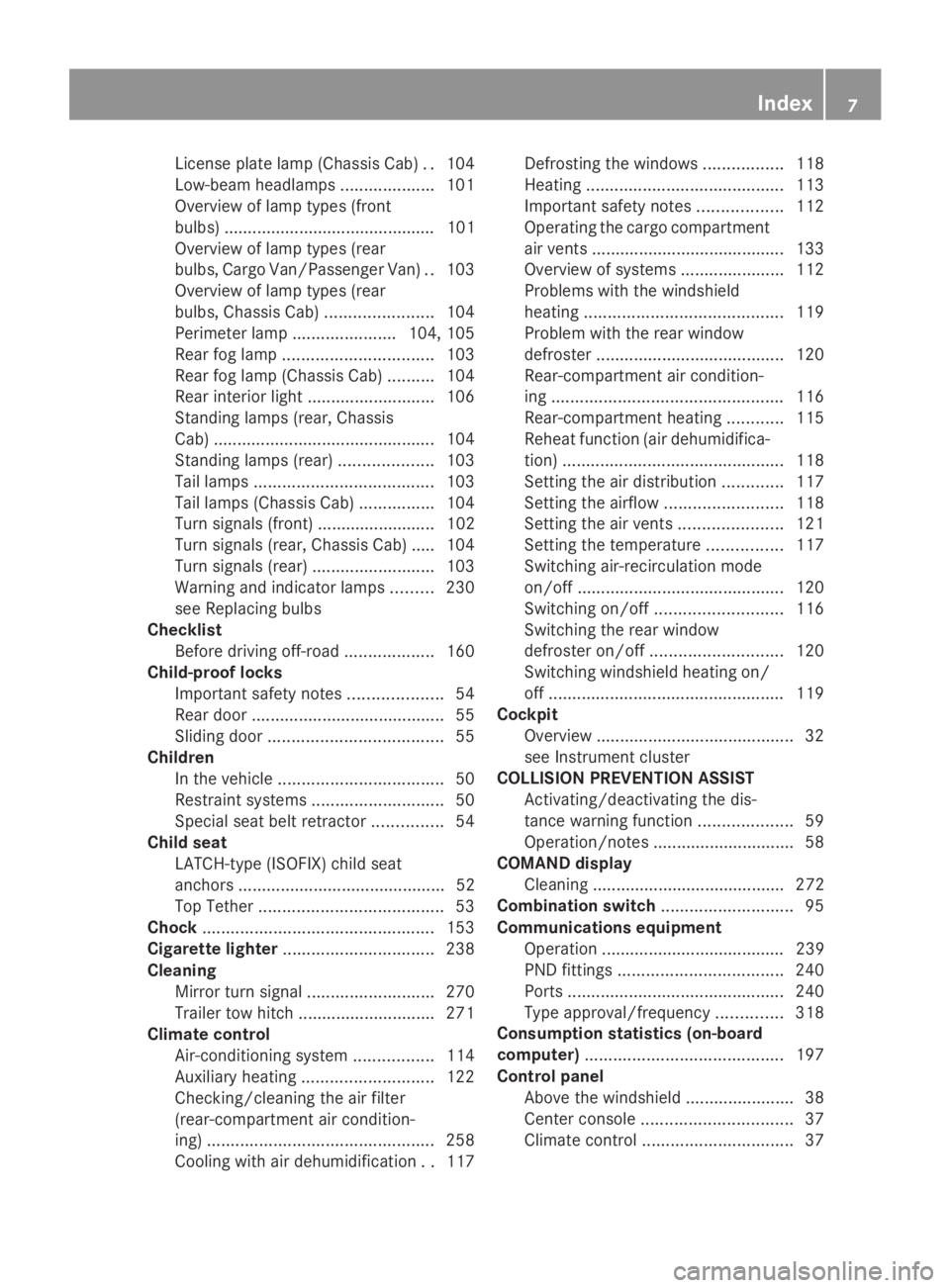
License plate lamp (Chassis Cab).
.104
Low-beam headlamps ....................101
Overview of lamp types (front
bulbs) ............................................. 101
Overview of lamp types (rear
bulbs, Cargo Van/Passenger Van) ..103
Overview of lamp types (rear
bulbs, Chassis Cab) .......................104
Perimeter lamp ......................104, 105
Rear fog lamp ................................ 103
Rear fog lamp (Chassis Cab) ..........104
Rear interior light ........................... 106
Standing lamps (rear, Chassis
Cab) ............................................... 104
Standing lamps (rear) ....................103
Tail lamps ...................................... 103
Tail lamps (Chassis Cab) ................104
Turn signals (front) ......................... 102
Turn signals (rear, Chassis Cab) ..... 104
Turn signals (rear) ..........................103
Warning and indicator lamps .........230
see Replacing bulbs
Checklist
Before driving off-road ...................160
Child-proof locks
Important safety notes ....................54
Rear door ......................................... 55
Sliding door ..................................... 55
Children
In the vehicle ................................... 50
Restraint systems ............................ 50
Special seat belt retractor ...............54
Child seat
LATCH-type (ISOFIX) child seat
anchors ............................................ 52
Top Tether ....................................... 53
Chock ................................................. 153
Cigarette lighter ................................ 238
Cleaning Mirror turn signal ........................... 270
Trailer tow hitch ............................. 271
Climate control
Air-conditioning system .................114
Auxiliary heating ............................ 122
Checking/cleaning the air filter
(rear-compartment air condition-
ing) ................................................ 258
Cooling with air dehumidification ..117 Defrosting the windows
.................118
Heating .......................................... 113
Important safety notes ..................112
Operating the cargo compartment
air vents ......................................... 133
Overview of systems ......................112
Problems with the windshield
heating .......................................... 119
Problem with the rear window
defroster ........................................ 120
Rear-compartment air condition-
ing ................................................. 116
Rear-compartment heating ............115
Reheat function (air dehumidifica-
tion) ............................................... 118
Setting the air distribution .............117
Setting the airflow .........................118
Setting the air vents ......................121
Setting the temperature ................117
Switching air-recirculation mode
on/off ............................................ 120
Switching on/off ........................... 116
Switching the rear window
defroster on/off ............................ 120
Switching windshield heating on/
off .................................................. 119
Cockpit
Overview .......................................... 32
see Instrument cluster
COLLISION PREVENTION ASSIST
Activating/deactivating the dis-
tance warning function ....................59
Operation/notes .............................. 58
COMAND display
Cleaning ......................................... 272
Combination switch ............................95
Communications equipment Operation ....................................... 239
PND fittings ................................... 240
Ports .............................................. 240
Type approval/frequency ..............318
Consumption statistics (on-board
computer) .......................................... 197
Control panel Above the windshield .......................38
Center console ................................ 37
Climate control ................................ 37 Index
7
Page 14 of 338
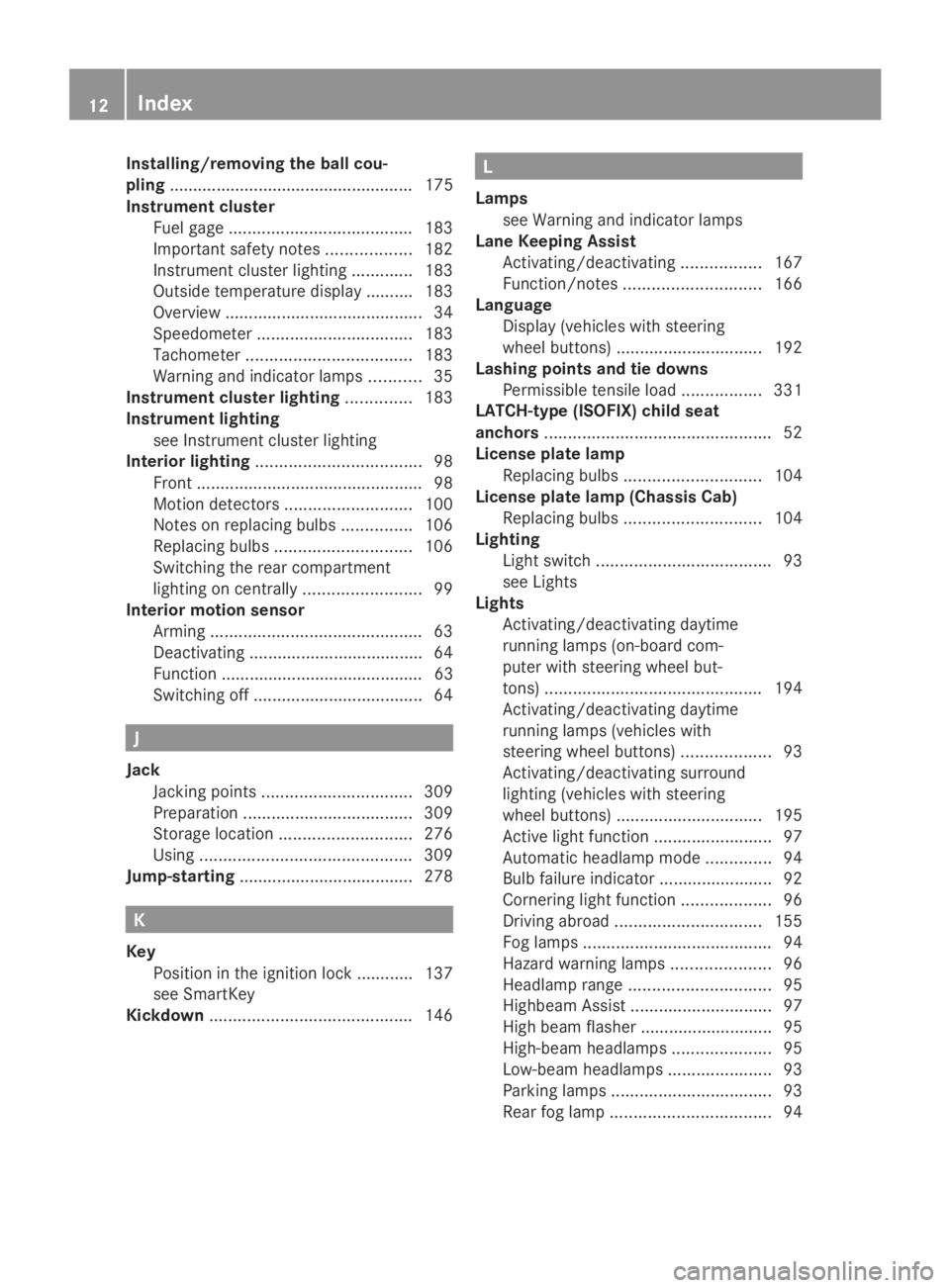
Installing/removing the ball cou-
pling
.................................................... 175
Instrument cluster Fuel gage ....................................... 183
Important safety notes ..................182
Instrument cluster lighting .............183
Outside temperature displa y.......... 183
Overview .......................................... 34
Speedometer ................................. 183
Tachometer ................................... 183
Warning and indicator lamps ...........35
Instrument cluster lighting ..............183
Instrument lighting see Instrument cluster lighting
Interior lighting ................................... 98
Front ................................................ 98
Motion detectors ........................... 100
Notes on replacing bulbs ...............106
Replacing bulbs ............................. 106
Switching the rear compartment
lighting on centrally .........................99
Interior motion sensor
Arming ............................................. 63
Deactivating .................................... .64
Function ........................................... 63
Switching off .................................... 64J
Jack Jacking points ................................ 309
Preparation .................................... 309
Storage location ............................ 276
Using ............................................. 309
Jump-starting ..................................... 278K
Key Position in the ignition lock ............ 137
see SmartKey
Kickdown ........................................... 146 L
Lamps see Warning and indicator lamps
Lane Keeping Assist
Activating/deactivating .................167
Function/notes ............................. 166
Language
Display (vehicles with steering
wheel buttons) ............................... 192
Lashing points and tie downs
Permissible tensile loa d................. 331
LATCH-type (ISOFIX) child seat
anchors ................................................ 52
License plate lamp Replacing bulbs ............................. 104
License plate lamp (Chassis Cab)
Replacing bulbs ............................. 104
Lighting
Light switch ..................................... 93
see Lights
Lights
Activating/deactivating daytime
running lamps (on-board com-
puter with steering wheel but-
tons) .............................................. 194
Activating/deactivating daytime
running lamps (vehicles with
steering wheel buttons) ...................93
Activating/deactivating surround
lighting (vehicles with steering
wheel buttons) ............................... 195
Active light function .........................97
Automatic headlamp mode ..............94
Bulb failure indicator ........................92
Cornering light function ...................96
Driving abroad ............................... 155
Fog lamps ........................................ 94
Hazard warning lamps .....................96
Headlamp range .............................. 95
Highbeam Assist .............................. 97
High beam flasher ............................ 95
High-beam headlamps .....................95
Low-beam headlamps ......................93
Parking lamps .................................. 93
Rear fog lamp .................................. 9412
Index
Page 17 of 338
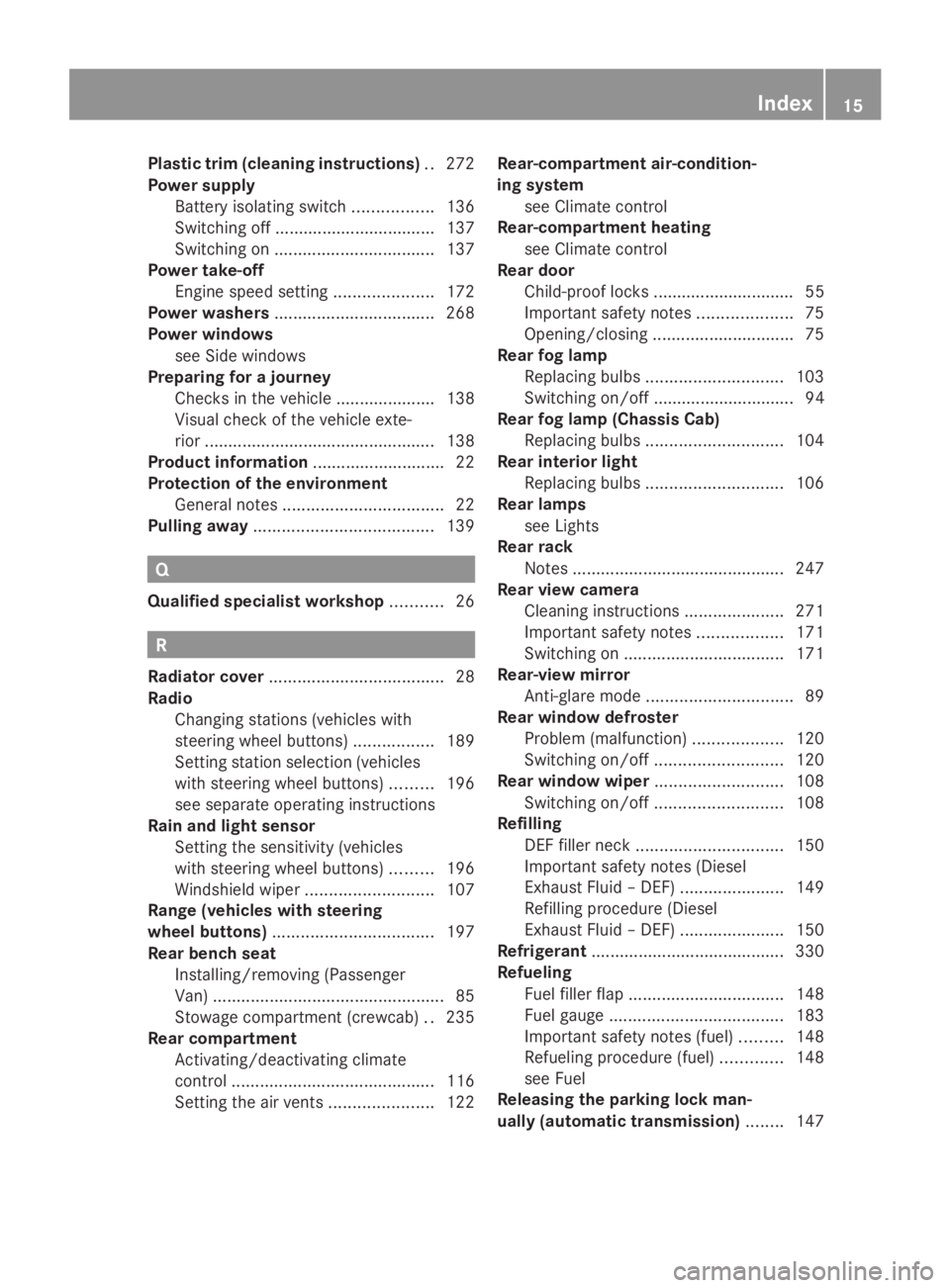
Plastic trim (cleaning instructions)
..272
Power supply Battery isolating switch .................136
Switching off .................................. 137
Switching on .................................. 137
Power take-off
Engine speed setting .....................172
Power washers .................................. 268
Power windows see Side windows
Preparing for a journey
Checks in the vehicle .....................138
Visual check of the vehicle exte-
rior ................................................. 138
Product information ............................22
Protection of the environment General notes .................................. 22
Pulling away ...................................... 139Q
Qualified specialist workshop ...........26 R
Radiator cover ..................................... 28
Radio Changing stations (vehicles with
steering wheel buttons) .................189
Setting station selection (vehicles
with steering wheel buttons) .........196
see separate operating instructions
Rain and light sensor
Setting the sensitivity (vehicles
with steering wheel buttons) .........196
Windshield wiper ........................... 107
Range (vehicles with steering
wheel buttons) .................................. 197
Rear bench seat Installing/removing (Passenger
Van) ................................................. 85
Stowage compartment (crewcab) ..235
Rear compartment
Activating/deactivating climate
control ........................................... 116
Setting the air vents ......................122Rear-compartment air-condition-
ing system
see Climate control
Rear-compartment heating
see Climate control
Rear door
Child-proof locks .............................. 55
Important safety notes ....................75
Opening/closing .............................. 75
Rear fog lamp
Replacing bulbs ............................. 103
Switching on/off .............................. 94
Rear fog lamp (Chassis Cab)
Replacing bulbs ............................. 104
Rear interior light
Replacing bulbs ............................. 106
Rear lamps
see Lights
Rear rack
Notes ............................................. 247
Rear view camera
Cleaning instructions .....................271
Important safety notes ..................171
Switching on .................................. 171
Rear-view mirror
Anti-glare mode ............................... 89
Rear window defroster
Problem (malfunction) ...................120
Switching on/off ........................... 120
Rear window wiper ...........................108
Switching on/off ........................... 108
Refilling
DEF filler neck ............................... 150
Important safety notes (Diesel
Exhaust Fluid – DEF) ......................149
Refilling procedure (Diesel
Exhaust Fluid – DEF) ......................150
Refrigerant ......................................... 330
Refueling Fuel filler fla p................................. 148
Fuel gauge ..................................... 183
Important safety notes (fuel) .........148
Refueling procedure (fuel) .............148
see Fuel
Releasing the parking lock man-
ually (automatic transmission) ........147 Index
15
Page 18 of 338
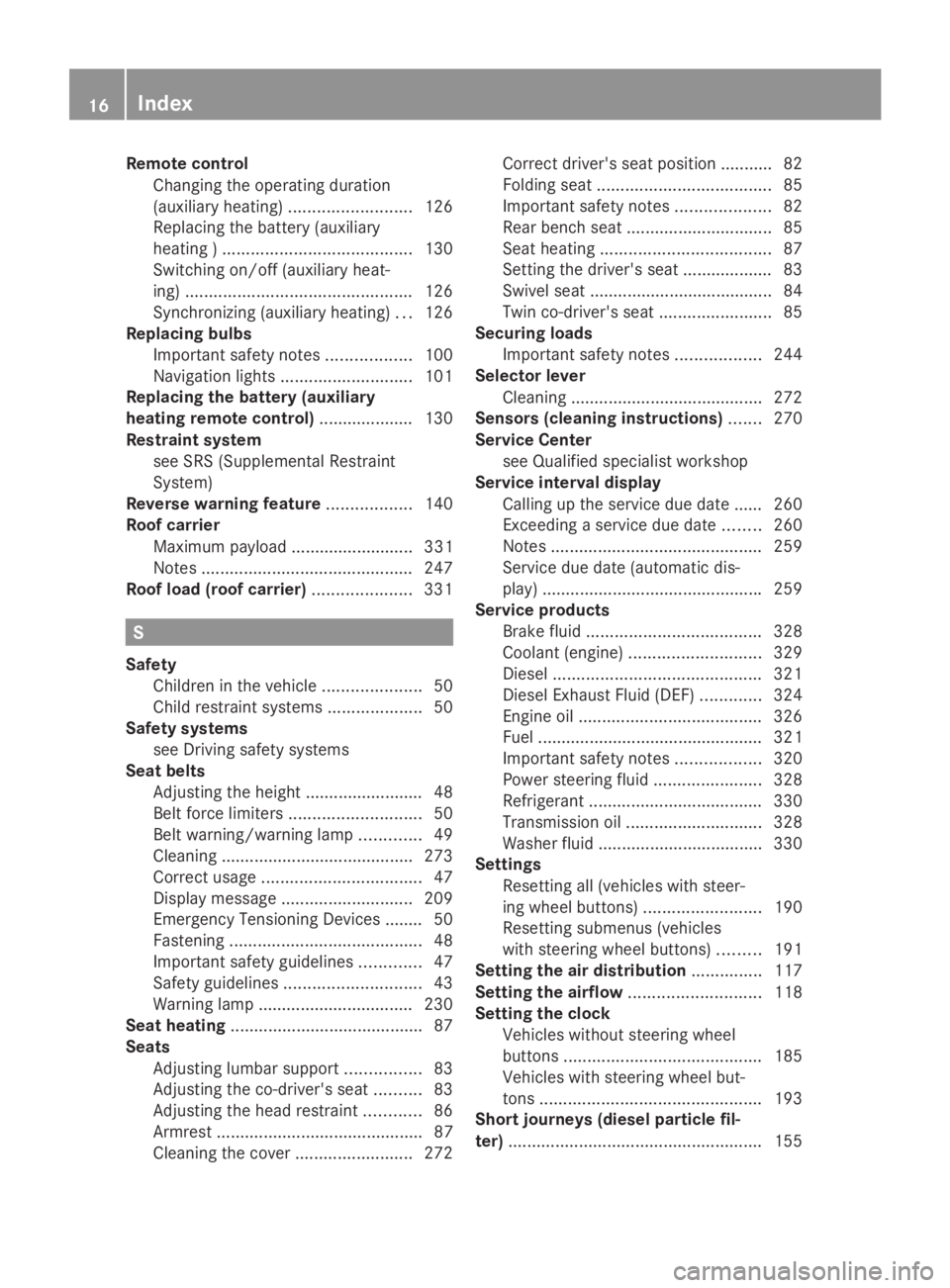
Remote control
Changing the operating duration
(auxiliary heating) .......................... 126
Replacing the battery (auxiliary
heating ) ........................................ 130
Switching on/off (auxiliary heat-
ing) ................................................ 126
Synchronizing (auxiliary heating) ...126
Replacing bulbs
Important safety notes ..................100
Navigation lights ............................ 101
Replacing the battery (auxiliary
heating remote control) .................... 130
Restraint system see SRS (Supplemental Restraint
System)
Reverse warning feature ..................140
Roof carrier Maximum payloa d.......................... 331
Notes ............................................. 247
Roof load (roof carrier) .....................331 S
Safety Children in the vehicle .....................50
Child restraint systems ....................50
Safety systems
see Driving safety systems
Seat belts
Adjusting the height ......................... 48
Belt force limiters ............................ 50
Belt warning/warning lamp .............49
Cleaning ......................................... 273
Correct usage .................................. 47
Display message ............................ 209
Emergency Tensioning Devices ....... .50
Fastening ......................................... 48
Important safety guidelines .............47
Safety guidelines ............................. 43
Warning lamp ................................. 230
Seat heating ........................................ .87
Seats Adjusting lumbar support ................83
Adjusting the co-driver's sea t.......... 83
Adjusting the head restraint ............86
Armrest ............................................ 87
Cleaning the cover .........................272Correct driver's seat position ........... 82
Folding seat
..................................... 85
Important safety notes ....................82
Rear bench seat ............................... 85
Seat heating .................................... 87
Setting the driver's seat ................... 83
Swivel seat ....................................... 84
Twin co-driver's seat ........................85
Securing loads
Important safety notes ..................244
Selector lever
Cleaning ......................................... 272
Sensors (cleaning instructions) .......270
Service Center see Qualified specialist workshop
Service interval display
Calling up the service due date ...... 260
Exceeding a service due date ........260
Notes ............................................. 259
Service due date (automatic dis-
play) .............................................. .259
Service products
Brake fluid ..................................... 328
Coolant (engine) ............................ 329
Diesel ............................................ 321
Diesel Exhaust Fluid (DEF) .............324
Engine oil ....................................... 326
Fuel ................................................ 321
Important safety notes ..................320
Power steering fluid .......................328
Refrigerant ..................................... 330
Transmission oil ............................. 328
Washer fluid .................................. .330
Settings
Resetting all (vehicles with steer-
ing wheel buttons) .........................190
Resetting submenus (vehicles
with steering wheel buttons) .........191
Setting the air distribution ...............117
Setting the airflow ............................118
Setting the clock Vehicles without steering wheel
buttons .......................................... 185
Vehicles with steering wheel but-
tons ............................................... 193
Short journeys (diesel particle fil-
ter) ...................................................... 15516
Index
Page 19 of 338
Side windows
Cleaning ......................................... 269
Hinged side windows .......................78
Important safety information ...........78
Opening/closing .............................. 78
Overview .......................................... 78
Problem (malfunction) .....................79
Resetting ......................................... 79
Sliding door
Child-proof locks .............................. 55
Cleaning ......................................... 271
Closing assist ................................... 73
Important safety notes ....................72
Opening/closing .............................. 72
SmartKey
Changing the battery .......................69
Changing the locking system set-
tings ............................................... 196
Checking the battery .......................68
Display message ............................ 220
Door central locking/unlocking .......66
Important safety notes ....................66
Loss ................................................. 70
Problem (malfunction) .....................70
SmartKey positions (ignition lock) ..137
Snow chains ...................................... 289
Sockets .............................................. 238
Spare wheel General notes ................................ 314
Important safety notes ..................313
Removing/mounting ..................... .314
Specialist workshop ............................ 26
Special seat belt retractor .................. 54
Speed, controlling see Cruise control
Speedometer
Digital (vehicles without steering
wheel buttons) ............................... 184
Digital (vehicles with steering
wheel buttons) ............................... 193
Selecting display unit (vehicles
with steering- wheel buttons) ........192
see Instrument cluster
Sprinter Dealer
see Qualified specialist workshop SRS (Supplemental Restraint Sys-
tem)
Introduction ..................................... 42
Warning lamp (function) ..........42, 225
Standing lamps
Replacing bulbs (rear) ....................103
Standing lamps (Chassis Cab)
Replacing bulbs (rear) ....................104
Starting (engine) ................................ 138
Start-off assist Display message ............................ 207
Steering wheel
Adjusting ......................................... 88
Button overview ............................... 37
Cleaning ......................................... 272
Step
see Electrical step
Sticker
Warning notes .................................. 26
Stowage spaces
see Stowage spaces and stowage
compartments
Stowage spaces and stowage com-
partments Eyeglasses compartment ...............233
Glove box ...................................... .232
Important safety notes ..................232
Paper holder .................................. 236
Stowage compartment above the
windshield ..................................... 234
Stowage compartment in the
center console ............................... 234
Stowage compartment in the
dashboard ...................................... 233
Stowage space above the head-
liner ............................................... 234
Stowage space under the rear
bench seat ..................................... 235
Stowage space under the twin co-
driver's seat ................................... 235
Summer tires ..................................... 288
Supplemental Restraint System see SRS (Supplemental Restraint
System)
Switching off the alarm (ATA) ............62
Switching the heater booster func-
tion on/off ......................................... 130 Index
17
Page 44 of 338
Useful information
This Operator's Manual describes all models
as well as standard and optional equipment
of your vehicle that were available at the time
of going to print. Country-specific variations
are possible. Note that your vehicle may not
be equipped with all of the described func-
tions. This also applies to systems and func-
tions relevant to safety.
Read the information on qualified specialist
workshops (Y page 26). Occupant safety
Important safety notes
G
WARNING
Modifications to the restraint systems could
result in them not functioning properly any
more. The restraint systems could then no
longer protect vehicle occupants as they are
designed to do and could fail in the event of
an accident or activate unexpectedly, for
example. There is an increased risk of injury.
Never modify parts of the restraint systems.
Do not attempt to modify the wiring as well as
electronic components or their software.
If it is necessary to modify an air bag system
to accommodate a person with disabilities,
contact an authorized Mercedes-Benz center.
USA only: for further information contact our
Customer Assistance Center at
1-800-FOR-MERCedes (1800-367-6372).
In this section you will learn the most impor-
tant facts about the restraint system compo-
nents of the vehicle.
The restraint system consists of:
R Seat belts
R Child restraint systems
R LATCH-type (ISOFIX) child seat securing
system
SRS (Supplemental Restraint System) and
the air bag system offer additional protection
potential. Although the systems are independent, their
protective functions work in conjunction with
one another.
i
For information on infants and children
traveling with you in the vehicle as well as
restraint systems for infants and children,
see the "Children in the vehicle" section
(Y page 50). SRS (Supplemental Restraint System)
Introduction SRS consists of:
R
007E warning lamp
R Air bags
R Air bag control unit with crash sensors
R ETDs for the driver's and co-driver's seat
R Seat belt force limiters
R Seat belt force limiters for the driver's and
co-driver seats
SRS reduces the risk of occupants hitting
parts of the vehicle interior in the event of an
accident. In addition, it can reduce the forces
the occupants are subjected to during an
accident.
SRS warning lamp G
WARNING
If SRS is malfunctioning, child restraint sys-
tem components may be triggered uninten-
tionally or might not be triggered at all in the
event of an accident with a high rate of vehicle
deceleration. There is an increased risk of
injury, possibly even fatal.
Have SRS checked and repaired immediately
at a qualified specialist workshop.
SRS functions are checked regularly when
you switch on the ignition and when the
engine is running. This allows malfunctions to
be detected in good time. 42
Occupant safetySafety
Page 46 of 338
Air bags
Important safety notes G
WARNING
To reduce the risk of injury when the front air
bags inflate, it is very important for the driver
and co-driver to always be in a properly seated
position and to wear their respective seat
belt.
For maximum protection in the event of a col-
lision always be in normal seated position with
your back against the seat backrest. Fasten
your seat belt and make sure it is properly
positioned on your body.
Since the air bag inflates with considerable
speed and force, a proper seating position
and correct positioning of the hands on the
steering wheel will help to keep you at a safe
distance from the air bag. Occupants who are
not wearing their seat belt, are not seated
properly or are too close to the air bag can be
seriously injured or killed by an air bag as it
inflates with great force instantaneously:
R Sit with the seat belt properly fastened in a
position that is as upright as possible with
your back against the seat backrest.
R Move the driver's seat as far back as pos-
sible, still permitting proper operation of
vehicle controls. The distance from the
center of the driver's chest to the center of
the air bag cover on the steering wheel
must be at least 10 inches (25 cm) or more.
You should be able to accomplish this by
adjusting the seat and steering wheel. If
you have any difficulties, please contact a
qualified specialist workshop.
R Do not lean your head or chest close to the
steering wheel or instrument panel.
R Keep hands on the outside of the steering
wheel rim. Placing hands and arms inside
the rim can increase the risk and potential
severity of hand/arm injury when the driver
front air bag inflates. R
Move the co-driver's seat as far as possible
away from the instrument panel when the
seat is occupied.
R Occupants, especially children, should
never place their bodies or lean their heads
in the area of the door where the side
impact air bag inflates. This could result in
serious injuries or death should the side
impact air bag be deployed. Always sit as
upright as possible, wear the seat belt prop-
erly and use an appropriately sized infant
restraint, toddler restraint, or booster seat
recommended for the size and weight of the
child.
R Children twelve years old and under must
never travel on the co-driver's seat. They
will otherwise be struck by the co-driver's
front air bag when it inflates in a crash. This
could result in serious or fatal injury.
Failure to follow these instructions can result
in severe injuries to you or other occupants.
If you sell your vehicle, it is important that you
make the buyer aware of this safety informa-
tion. Be sure to give the buyer this Operator's
Manual. G
WARNING
The air bag parts are hot after the airbag has
been deployed. There is a risk of injury.
Do not touch the air bag parts. Have the
deployed air bags replaced at a qualified spe-
cialist workshop as soon as possible.
i If the vehicle is still in running condition,
have it towed to a qualified specialist work-
shop. G
WARNING
If you modify the air bag covers or affix objects
such as stickers to them, the air bags may not
function correctly. There is an increased risk
of injury.
Never modify the air bag covers or affix
objects to them. 44
Occupant safetySafety
Page 49 of 338
Seat belts
Important safety notes G
WARNING
The seat belt does not offer the intended level
of protection if the backrest is not in the
upright position. When braking or in the event
of an accident, you could slide underneath the
seat belt and sustain abdomen or neck inju-
ries, for example. This poses an increased risk
of injury or even fatal injury.
Adjust the seat properly before beginning
your journey. Always make sure that the seat
is in the upright position.
Use only seat belts approved for your vehicle
by the dealer mentioned on the inside cover
page. G
WARNING
Always fasten your seat belt before driving off.
Always make sure all of your passengers are
properly restrained. You and your passengers
should always wear seat belts.
Failure to wear and properly fasten and posi-
tion your seat belt greatly increases your risk
of injuries and their likely severity in an acci-
dent.
If you are ever in an accident, your injuries can
be considerably more severe without your
seat belt properly buckled. Without your seat
belt buckled, you are much more likely to hit
the interior of the vehicle or be ejected from
it. You can be seriously injured or killed.
In the same crash, the possibility of injury or
death is lessened if you are properly wearing
your seat belt. The air bags can only protect
as intended if the occupants are properly
wearing their seat belts. G
WARNING
Never let more people ride in the vehicle than
there are seat belts available. Make sure
everyone riding in the vehicle is correctly
restrained with a separate seat belt. Never use a seat belt for more than one person at a
time.
G
WARNING
Damaged seat belts or seat belts that have
been subjected to stress in an accident must
be replaced. Their anchoring points must also
be checked.
Only use seat belts which have been approved
by the distributor named on the inside of the
front cover.
Do not make any modifications to the seat
belts. This can lead to unintended activation
of the ETDs or to their failure to activate when
necessary.
Do not bleach or dye seat belts as this may
severely weaken them. In a crash they may
not be able to provide adequate protection.
Have all work carried out only by qualified
technicians. Please contact a qualified spe-
cialist workshop.
The use of seat belts and infant and child
restraint systems is required by law in:
R all 50 states
R the U.S. territories
R the District of Columbia
R all Canadian provinces
Even where this is not required by law, all
vehicle occupants should correctly fasten
their seat belts before starting the journey.
i For information on infants and children
traveling with you in the vehicle as well as
restraint systems for infants and children,
see the "Children in the vehicle" section
(Y page 50).
Proper use of the seat belts G
WARNING
CORRECT USE OF SEAT BELTS
R Seat belts only work properly if they are
fastened correctly. Never wear seat belts in
any other way than as described in this sec- Occupant safety
47Safety
Z
Page 50 of 338
tion, as that could result in serious injuries
in the event of an accident.
R All occupants should wear their seat belt at
all times, because seat belts help reduce
the likelihood of and potential severity of
injuries in accidents, even if the vehicle
rolls over. The integrated restraint system
is equipped with SRS (driver's air bag, front-
passenger air bag, thorax side impact air
bags, window curtain air bags for side win-
dows), Emergency Tensioning Devices and
seat belt force limiters.
The system is designed to enhance the pro-
tection offered to occupants who are prop-
erly secured during certain frontal impacts
(front air bags and Emergency Tensioning
Devices) and side impacts (thorax side
impact air bags, window curtain air bags
and Emergency Tensioning Device) that
exceed preset deployment thresholds, as
well as in certain situations where the vehi-
cle rolls over (window curtain air bags and
Emergency Tensioning Device).
R Never route the shoulder section of the
seat belt under your arm, across your neck
or anywhere other than across your
shoulder. In the event of a frontal impact,
your body would be moved too far forward.
This would increase the risk of head and
neck injuries. The seat belt would then
apply excessive force to the ribs or abdo-
men, which could cause severe internal
injuries to organs such as the liver or
spleen.
Adjust the seat belt so that the upper part
of the belt is as close as possible to the
center of the shoulder. It should not touch
the neck. Never route the belt under the
shoulder. The height of the belt outlet can
be altered to ensure correct usage.
R The lap belt should be routed as low as pos-
sible across the hips, not across the abdo-
men. If the lap belt is routed across the
abdomen, it could cause serious injuries in
the event of an impact. R
Never route the seat belt over rigid or frag-
ile objects in or on your clothing, such as
eyeglasses, pens, keys etc., as this could
cause injuries.
R Always ensure that the seat belt is routed
correctly. This is particularly important if
you are wearing loose clothing.
R Never use a seat belt for more than one
person at a time. Never route a seat belt
around more than one person or additional
objects.
R Never wear seat belts if they are twisted.
Otherwise, in the event of an impact, the
full width of the seat belt is unavailable to
distribute the force of the impact. The
twisted seat belt routed across your body
could cause injuries.
R Pregnant women should also always use a
three-point seat belt. The lap belt must
always pass across your lap as low down as
possible, i.e. across your hips; not across
your abdomen.
R The backrest should be set as close to ver-
tical as possible.
R Check the seat belt during the journey in
order to make sure that it is correctly posi-
tioned.
R Never place your feet on the instrument
panel or on the seat. Always keep both feet
on the floor in front of the seat.
R When using a seat belt to secure an infant
restraint system, child restraint system or
a child on a booster seat, always follow the
child restraint system manufacturer's
instructions.
Fastening/unfastening the seat belts G
WARNING
According to accident statistics, children are
safer when properly restrained on the rear
seats than on the front-passenger seat. Thus,
we strongly recommend that children be
placed in the rear seat whenever possible.
Regardless of seating position, children 12
years old and under must be seated and prop- 48
Occupant safetySafety
Page 51 of 338
erly secured in an appropriately sized child
restraint system or booster seat recom-
mended for the size and weight of the child.
For additional information, see the "Children
in the vehicle" section.
A child's risk of serious or fatal injuries is sig-
nificantly increased if the child restraints are
not properly secured in the vehicle and/or the
child is not properly secured in the child
restraint.
! Make sure that the seat belt retracts fully.
The seat belt or belt buckle may otherwise
become trapped in the door or the seat
adjustment mechanism. This could dam-
age the door, door trim panels and the seat
belt. Damaged seat belts can no longer ful-
fill their protective function and must be
replaced at a qualified specialist workshop. X
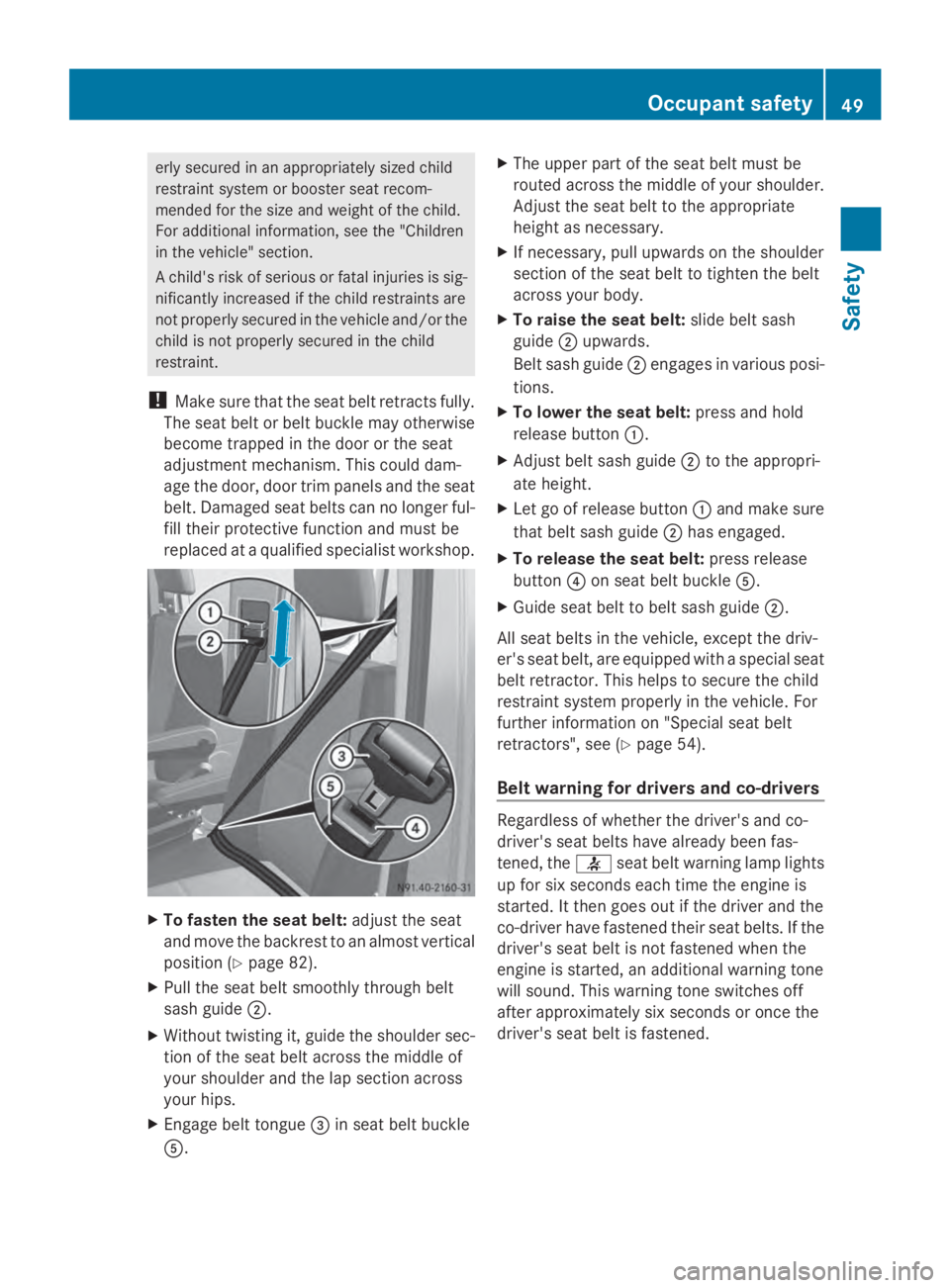
To fasten the seat belt: adjust the seat
and move the backrest to an almost vertical
position (Y page 82).
X Pull the seat belt smoothly through belt
sash guide 0044.
X Without twisting it, guide the shoulder sec-
tion of the seat belt across the middle of
your shoulder and the lap section across
your hips.
X Engage belt tongue 0087in seat belt buckle
0083. X
The upper part of the seat belt must be
routed across the middle of your shoulder.
Adjust the seat belt to the appropriate
height as necessary.
X If necessary, pull upwards on the shoulder
section of the seat belt to tighten the belt
across your body.
X To raise the seat belt: slide belt sash
guide 0044upwards.
Belt sash guide 0044engages in various posi-
tions.
X To lower the seat belt: press and hold
release button 0043.
X Adjust belt sash guide 0044to the appropri-
ate height.
X Let go of release button 0043and make sure
that belt sash guide 0044has engaged.
X To release the seat belt: press release
button 0085on seat belt buckle 0083.
X Guide seat belt to belt sash guide 0044.
All seat belts in the vehicle, except the driv-
er's seat belt, are equipped with a special seat
belt retractor. This helps to secure the child
restraint system properly in the vehicle. For
further information on "Special seat belt
retractors", see (Y page 54).
Belt warning for drivers and co-drivers Regardless of whether the driver's and co-
driver's seat belts have already been fas-
tened, the
0076seat belt warning lamp lights
up for six seconds each time the engine is
started. It then goes out if the driver and the
co-driver have fastened their seat belts. If the
driver's seat belt is not fastened when the
engine is started, an additional warning tone
will sound. This warning tone switches off
after approximately six seconds or once the
driver's seat belt is fastened. Occupant safety
49Safety Z