child seat MERCEDES-BENZ SPRINTER 2014 MY14 Operator’s Manual
[x] Cancel search | Manufacturer: MERCEDES-BENZ, Model Year: 2014, Model line: SPRINTER, Model: MERCEDES-BENZ SPRINTER 2014Pages: 338, PDF Size: 6.78 MB
Page 52 of 338
Emergency Tensioning Devices, seat
belt force limiters G
WARNING
Pyrotechnic ETDs that were activated must be
replaced.
For your safety, when disposing of the pyro-
technic ETDs always follow our safety instruc-
tions. These instructions are available from
any authorized Sprinter Dealer.
! If the front-passenger seat is not occu-
pied, do not engage the seat belt tongue in
the buckle on the front-passenger seat.
Otherwise, the Emergency Tensioning
Device could be triggered in the event of an
accident.
X In order to ensure that the pyrotechnic
Emergency Tensioning Devices have not
been triggered, always have the seat belts
checked after an accident.
If the Emergency Tensioning Devices have
been triggered, they must be replaced.
If the vehicle is equipped with a driver's air
bag, the seat belts on the driver's and co-
driver's seats have Emergency Tensioning
Devices and seat belt force limiters.
ETDs tighten the seat belts in an accident,
pulling them close against the seat occu-
pant's body.
ETDs do not correct incorrect seat positions
or incorrectly fastened seat belts.
ETDs do not pull vehicle occupants back
towards the backrest.
When activated, the seat belt force limiters
reduce the force exerted by the seat belt on
the driver or co-driver.
The seat belt force limiters are synchronized
with the front air bags, which absorb part of
the deceleration force, resulting in the force
exerted on the occupant being distributed
over a greater area.
The ETDs can only be triggered if the ignition
is switched on and the restraint systems are
operational, see " 007Ewarning lamp"
(Y page 42). The Emergency Tensioning Devices are trig-
gered depending on the type and severity of
an accident:
R
in the event of a head-on or rear-end colli-
sion if the vehicle decelerates or acceler-
ates rapidly in a longitudinal direction dur-
ing the initial stages of the impact
R in the event of a side impact if the vehicle
decelerates or accelerates rapidly in a lat-
eral direction and the vehicle is equipped
with thorax side impact air bags and/or
window curtain air bags
If the ETDs are triggered, you will hear a bang
and powder may also be released. Only in rare
cases will the bang affect your hearing. The
powder emitted is not generally hazardous to
health. The 007Ewarning lamp lights up. Child restraint systems
Important safety notes
G
WARNING
If the child restraint system is not installed
correctly to a suitable seat, the child may not
be secured in the event of an accident or sud-
den braking and may be seriously or even
fatally injured. Therefore, when installing a
child restraint system, you must observe the
manufacturer's installation instructions as
well as the notes on using the child restraint
system.
Child restraint systems should preferably be
installed to the rear seats. Children are gen-
erally better protected there.
Never place objects, e.g. cushions, under the
child restraint system. The entire base of the
child restraint system must always rest on the
seat cushion.
A child restraint system must not be used
without the genuine cover designed for it.
Only replace damaged covers with genuine
covers.
On the rear seats, use only child restraint sys-
tems that have been recommended for use in
the Sprinter. 50
Child restraint systemsSafety
Page 53 of 338
G
WARNING
Accident statistics show that children
secured in the rear seats are safer than chil-
dren secured in the co-driver's seat. For this
reason, we strongly advise that you always
secure children in the rear seats. Regardless
of the seat position, children under 12 years
must be secured correctly in a suitable infant
or child restraint system or booster seat suit-
able for the size and weight of the child.
Never place anything between the seat cush-
ion and child seat (e.g. pillow). The bottom of
the child seat must make full contact with the
vehicle seat cushion. An incorrectly mounted
child seat could cause injuries to the child in
the event of an accident, instead of protecting
the child.
The infant or child restraint must be properly
secured with the vehicle's seat belt, the seat
belt and Top Tether strap, or lower anchors
and Top Tether strap, fully in accordance with
the child seat manufacturer's instructions.
Always observe the manufacturer's instruc-
tions when installing special child restraint
systems.
Occupants, in particular children, must sit as
upright as possible, fasten the seat belt cor-
rectly and use a suitable infant restraint sys-
tem, child restraint system or booster seat
suitable for the size and weight of the child.
Children can be seriously or even fatally
injured by an air bag deploying. Observe the
following important information if it is abso-
lutely necessary to carry a child on the co-
driver's seat:
R The co-driver's front air bag is not deacti-
vated.
R Never secure your child in a rearward-
facing child restraint system on the co-driv-
er's seat. A child in a rearward-facing child
restraint system on the co-driver's seat can
be seriously injured or even killed if the co-
driver's front air bag deploys. Only install a rearward-facing child restraint system on a
suitable rear seat.
R Where permitted by state law, if you secure
your child in a forward-facing child restraint
system on the co-driver's seat, move the
co-driver's seat as far back to the rear as
possible. You must then use an appropri-
ately sized child restraint system recom-
mended for the age, size and weight of the
child and secure it with the vehicle seat belt
in accordance with the child seat manufac-
turer's instructions. G
WARNING
Infants and small children should never share
a seat belt with another occupant. In the event
of an accident, they could be crushed
between the occupant and seat belt.
A child's risk of serious or fatal injuries is sig-
nificantly increased if the child restraints are
not properly secured in the vehicle and/or the
child is not properly secured in the child
restraint.
Children that are too large for a child restraint
must travel in seats using normal seat belts.
Position the shoulder belt across the chest
and shoulder, not the face or neck. A booster
seat may be necessary to achieve proper seat
belt positioning for children over 41 lbs
(18 kg) until they reach a height where a lap/
shoulder belt fits properly without a booster
seat.
When the child restraint is not in use, remove
it from the vehicle or secure it with the seat
belt to prevent the child restraint from becom-
ing a projectile in the event of an accident. G
WARNING
When extending or retracting, parts of the
body could become trapped within the sweep
of the roller sunblind. There is a risk of injury.
When extending or retracting, make sure that
no one has any parts of the body within the
sweep of the roller sunblind. If someone
becomes trapped, briefly press the button Child restraint systems
51Safety
Z
Page 54 of 338
again. The opening or closing procedure will
be stopped. G
WARNING
If the child restraint system is installed incor-
rectly or is not secured, it can come loose in
the event of an accident, heavy braking or a
sudden change in direction. The child
restraint system could be thrown about, strik-
ing vehicle occupants. There is an increased
risk of injury, possibly even fatal.
Always install child restraint systems prop-
erly, even if they are not being used. Make
sure that you observe the child restraint sys-
tem manufacturer's installation instructions.
Further information on secure stowage of
loads can be found under "Loading guide-
lines".
If an infant or child is traveling in the vehicle:
R secure the child with a child or infant seat
restraint system appropriate to the age and
weight of the child
R make sure that the infant or child is prop-
erly secured at all times while the vehicle
is in motion.
We recommend that you always properly
secure all infants and children in an infant or
child restraint system for the journey.
The use of seat belts and infant and child
restraint systems is required by law in:
R all 50 states
R the U.S. territories
R the District of Columbia
R all Canadian provinces
Infants and children must always be seated in
an appropriate infant or child restraint system
recommended for the size and weight of the
child. This must be properly secured in
accordance with the manufacturer's installa-
tion instructions for the infant or child seat
restraint system. All infant or child restraint systems must meet
the following standards:
R
U.S. Federal Motor Vehicle Safety Stand-
ards 213 and 225
R Canadian Motor Vehicle Safety Standards
213 and 210.2
A statement by the child restraint manufac-
turer of compliance with these standards can
be found on the instruction label on the child
restraint system. You will also find the state-
ment in the instruction manual provided with
the child restraint system.
When using any infant restraint, child
restraint or booster seat, make sure to care-
fully read and follow all manufacturer's
instructions for installation and use.
Observe the warning labels in the vehicle
interior or on the infant or child restraint. LATCH-type (ISOFIX) child seat secur-
ing system
G
WARNING
Children that are too large for a child restraint
must travel in seats using normal seat belts.
Position shoulder belt across the chest and
shoulder, not face or neck.
A booster seat may be necessary to achieve
proper seat belt positioning for children over
41 lb (18 kg) until they reach a height where
a lap/shoulder belt fits properly without a
booster.
Install the child restraint system in accord-
ance with the manufacturer's instructions.
Attach the child restraint system to both
securing rings.
An incorrectly installed child restraint system
could come loose during an accident and ser-
iously or even fatally injure the child.
Child restraint systems or child seat securing
rings that are malfunctioning or damaged as
the result of a collision must be replaced. 52
Child restraint systemsSafety
Page 55 of 338
These include, for example:
R
Top Tether belt
R Seat belts
R LATCH-type (ISOFIX) child seat securing
system
! When installing the child restraint system,
make sure that the seat belt for the middle
seat does not get trapped. 0043
Securing rings
X Install the LATCH-type (ISOFIX) child
restraint system. Comply with the manu-
facturer's instructions when installing the
LATCH-type (ISOFIX) child restraint sys-
tem.
ISOFIX is a standardized securing system for
special child restraint systems on the rear
seats. Securing rings 0043for the LATCH-type
(ISOFIX) child restraint systems are located
between the seat cushion and the seat back-
rest:
R on the outer left and right-hand sides on a
narrow rear bench seat with three seats
R on the outer left side on a rear bench seat
with two seats
Secure child restraint systems without a
LATCH-type (ISOFIX) child seat securing sys-
tem using the seat belts in the vehicle. When
installing child restraint systems, you must
observe the manufacturer's installation
instructions. Top Tether
Top Tether anchorage points
Top Tether belt
Top Tether provides an additional connection
between the LATCH-type (ISOFIX) child
restraint system and the rear seat. This helps
reduce the risk of injury even further.
The Top Tether anchorage points
0044are
located on the rear side at the bases of the
rear bench seats.
X Slide head restraint 0043upwards.
X Install the LATCH-type (ISOFIX) child
restraint system with Top Tether. Comply
with the manufacturer's installation
instructions when doing so.
X Route the Top Tether belt 0085under head
restraint 0043between the two head restraint
bars.
X Hook Top Tether hook 0087into Top Tether
anchorage 0044. Child restraint systems
53Safety Z
Page 56 of 338
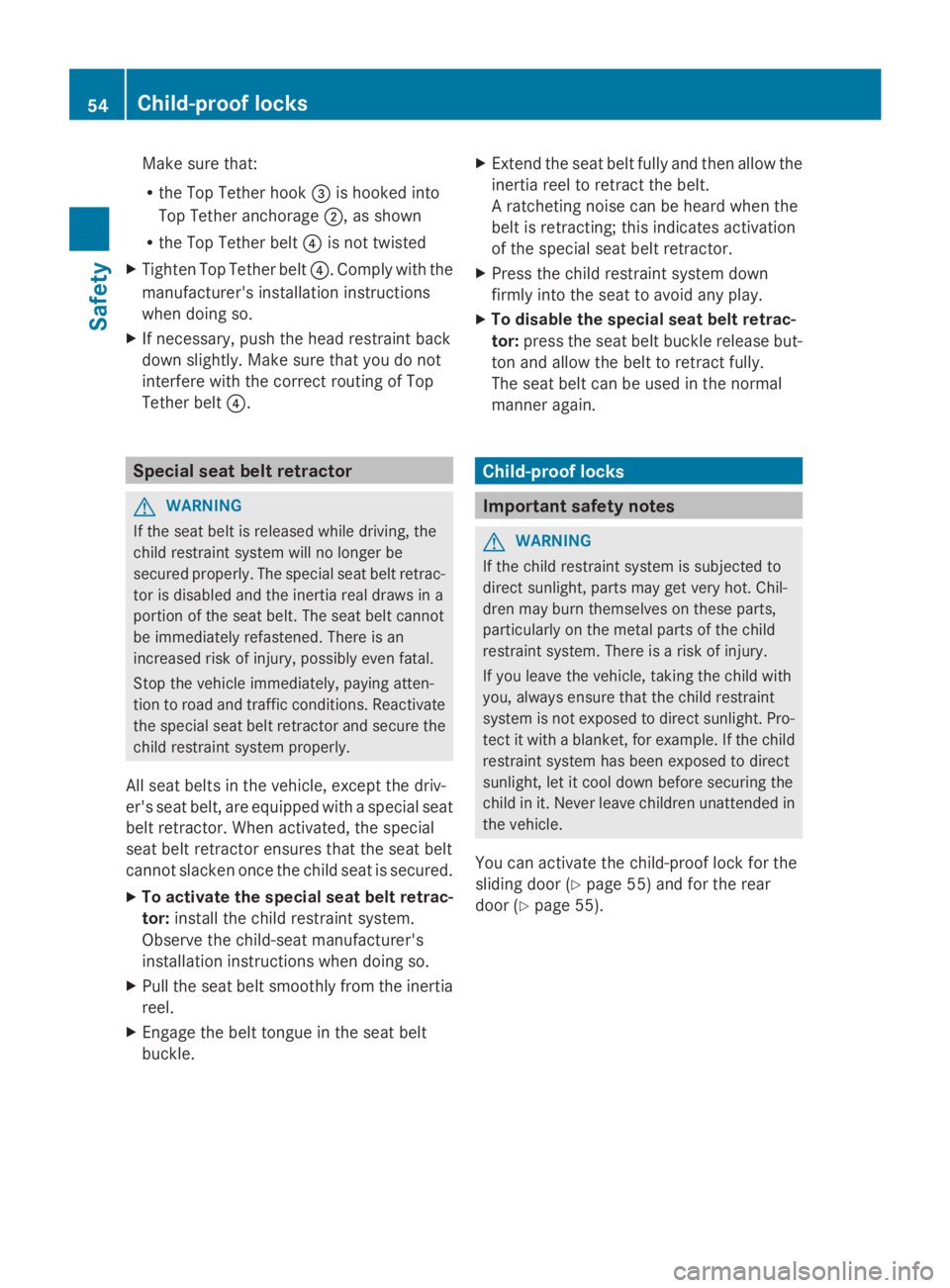
Make sure that:
R
the Top Tether hook 0087is hooked into
Top Tether anchorage 0044, as shown
R the Top Tether belt 0085is not twisted
X Tighten Top Tether belt 0085. Comply with the
manufacturer's installation instructions
when doing so.
X If necessary, push the head restraint back
down slightly. Make sure that you do not
interfere with the correct routing of Top
Tether belt 0085. Special seat belt retractor
G
WARNING
If the seat belt is released while driving, the
child restraint system will no longer be
secured properly. The special seat belt retrac-
tor is disabled and the inertia real draws in a
portion of the seat belt. The seat belt cannot
be immediately refastened. There is an
increased risk of injury, possibly even fatal.
Stop the vehicle immediately, paying atten-
tion to road and traffic conditions. Reactivate
the special seat belt retractor and secure the
child restraint system properly.
All seat belts in the vehicle, except the driv-
er's seat belt, are equipped with a special seat
belt retractor. When activated, the special
seat belt retractor ensures that the seat belt
cannot slacken once the child seat is secured.
X To activate the special seat belt retrac-
tor: install the child restraint system.
Observe the child-seat manufacturer's
installation instructions when doing so.
X Pull the seat belt smoothly from the inertia
reel.
X Engage the belt tongue in the seat belt
buckle. X
Extend the seat belt fully and then allow the
inertia reel to retract the belt.
A ratcheting noise can be heard when the
belt is retracting; this indicates activation
of the special seat belt retractor.
X Press the child restraint system down
firmly into the seat to avoid any play.
X To disable the special seat belt retrac-
tor: press the seat belt buckle release but-
ton and allow the belt to retract fully.
The seat belt can be used in the normal
manner again. Child-proof locks
Important safety notes
G
WARNING
If the child restraint system is subjected to
direct sunlight, parts may get very hot. Chil-
dren may burn themselves on these parts,
particularly on the metal parts of the child
restraint system. There is a risk of injury.
If you leave the vehicle, taking the child with
you, always ensure that the child restraint
system is not exposed to direct sunlight. Pro-
tect it with a blanket, for example. If the child
restraint system has been exposed to direct
sunlight, let it cool down before securing the
child in it. Never leave children unattended in
the vehicle.
You can activate the child-proof lock for the
sliding door (Y page 55) and for the rear
door (Y page 55). 54
Child-proof locksSafety
Page 64 of 338
X
To open: position both handles 0043verti-
cally. This will break locking pins 0044.
The window is unlocked.
X Swing the window outward by the handles
and hold it in this position. Make sure there
is sufficient clearance when doing so.
X To close: close the window.
X Position both handles 0043horizontally.
Make sure that the locks 0087are inside in
front of the window frame.
The window is locked.
X Replace locking pins 0044at the latest before
starting on a new journey.
You can obtain information on this at any
qualified specialist workshop.
In an emergency, or after an accident, the
vehicle occupants can exit the vehicle
through the emergency exit window.
Observe the following notes to make sure that
the emergency exit window can be used
safely in the event of an emergency:
R Before beginning a journey, inform the vehi-
cle occupants of the emergency exit win-
dow and explain how to use it. Make sure
to explicitly point out the risks described
here.
R Only vehicle occupants who know how to
use the emergency exit window are permit-
ted to sit next to it.
R Access to the emergency exit window must
remain unobstructed. Do not place any
large or heavy objects on or in front of the
seats next to the emergency exit window.
R The window handles must not be used as
hooks, e.g. to hang up light objects, bags
or items of clothing.
R When exiting the vehicle through the emer-
gency exit window, pay attention to the
vehicle height and the local conditions. Par-
ticularly children and smaller adults may
require assistance when exiting the vehi-
cle. Theft deterrent locking system
Immobilizer
X To activate: remove the key from the igni-
tion lock.
X To deactivate: turn the key to position 2
in the ignition lock.
The immobilizer prevents your vehicle from
being started without the correct key.
Always take the key with you and lock the
vehicle when leaving the vehicle. If you leave
the key in the vehicle, anyone can start the
engine.
i The immobilizer is always deactivated
when you start the engine.
In the event that the engine cannot be
started when the starter battery is fully
charged, the immobilizer may be faulty.
Contact an authorized Sprinter dealer or
call 1-877-762-826 7(in USA) or
1-800-387-010 0(in Canada). ATA (Anti-Theft Alarm system)
X To arm: close all doors.
X Lock the vehicle with the key.
The indicator lamp in the central locking
button (Y page 71) flashes.
X To deactivate: unlock the vehicle with the
key.
The indicator lamp in the central locking
button (Y page 71) goes out.
i Cargo Van and Crew Van only:
Unless you open a door or the tailgate
within 40 seconds after unlocking the vehi-
cle:
R the vehicle will be locked again
R the anti-theft alarm system will be armed
again 62
Theft deterrent locking systemSafety
Page 84 of 338
Useful information
This Operator's Manual describes all models
as well as standard and optional equipment
of your vehicle that were available at the time
of going to print. Country-specific variations
are possible. Note that your vehicle may not
be equipped with all of the described func-
tions. This also applies to systems and func-
tions relevant to safety.
Read the information on qualified specialist
workshops (Y page 26). Seats
Important safety notes
G
WARNING
If the driver's seat is not engaged, it could
move unexpectedly while the vehicle is in
motion. This could cause you to lose control
of the vehicle. There is a risk of an accident.
Always make sure that the driver's seat is
engaged before starting the engine. G
WARNING
When you adjust a seat, you or other vehicle
occupants could become trapped, e.g. on the
seat guide rail. There is a risk of injury.
Make sure when adjusting a seat that no one
has any body parts in the sweep of the seat. G
WARNING
If head restraints are not installed and
adjusted correctly, they cannot provide pro-
tection as intended. There is an increased risk
of injury in the head and neck area, e.g. in the
event of an accident or when braking.
Always drive with the head restraints instal-
led. Before driving off, make sure for every
vehicle occupant that the center of the head
restraint supports the back of the head at
about eye level.
Your seat must be adjusted in such a way that
you can wear the seat belt correctly. Observe the following points:
R
Position the backrest in an almost vertical
position so that you are sitting virtually
upright. Do not drive with the backrest
reclined too far back.
R Your arms should be slightly bent when you
are holding the steering wheel.
R Avoid seat positions that prevent the seat
belt from being routed correctly. The
shoulder section of the belt must be routed
over the middle of your shoulder and be
pulled tight against your upper body. The
lap belt must always pass across your lap
as low down as possible, i.e. over your hip
joints.
R Adjust the head restraint so that it supports
the back of the head at eye level.
R The distance from the pedals should be
such that you can depress them fully.
Observe also the safety notes in the section
on "Air bags" (Y page 44) and "Children in the
vehicle" ( Ypage 50).
If you swap over the head restraints for the
front and rear seats, you will not be able to
adjust the height and angle of the head
restraints to the correct position.
Use the head restraint pad to adjust the head
restraint so that it is as close as possible to
the back of your head.
Before the journey, make sure the head
restraints have been correctly set for each of
the vehicle's passengers (Y page 86).82
SeatsSeats, steering wheel and mirrors
Page 90 of 338
X
Make sure that the key is in position 1or
2 in the ignition lock.
X To switch on: press the0072button
repeatedly until the desired heating level
has been set.
X To switch off: press the0072button
repeatedly until all indicator lamps go out.
If the indicator lamps of the current heating
level in the 0072button flash, the seat heat-
ing has switched off automatically. In this
case, too many electrical consumers are
switched on or the battery charge is not suf-
ficient. The seat heating will automatically
switch back to the current heating level when
enough on-board voltage is available again. Steering wheel
G
WARNING
You could lose control of your vehicle if you
do the following while driving:
R adjust the driver's seat, head restraint,
steering wheel or mirrors
R fasten the seat belt
There is a risk of an accident.
Adjust the driver's seat, head restraint, steer-
ing wheel and mirror and fasten your seat belt
before starting the engine. G
WARNING
If the steering wheel is unlocked while the
vehicle is in motion, it could change position
unexpectedly. This could cause you to lose
control of the vehicle. There is a risk of an
accident.
Before starting off, make sure the steering
wheel is locked. Never unlock the steering
wheel while the vehicle is in motion. G
WARNING
Children could injure themselves if they
adjust the steering wheel. There is a risk of
injury. When leaving the vehicle, always take the
SmartKey with you and lock the vehicle. Never
leave children unsupervised in the vehicle.
The steering wheel can still be adjusted if the
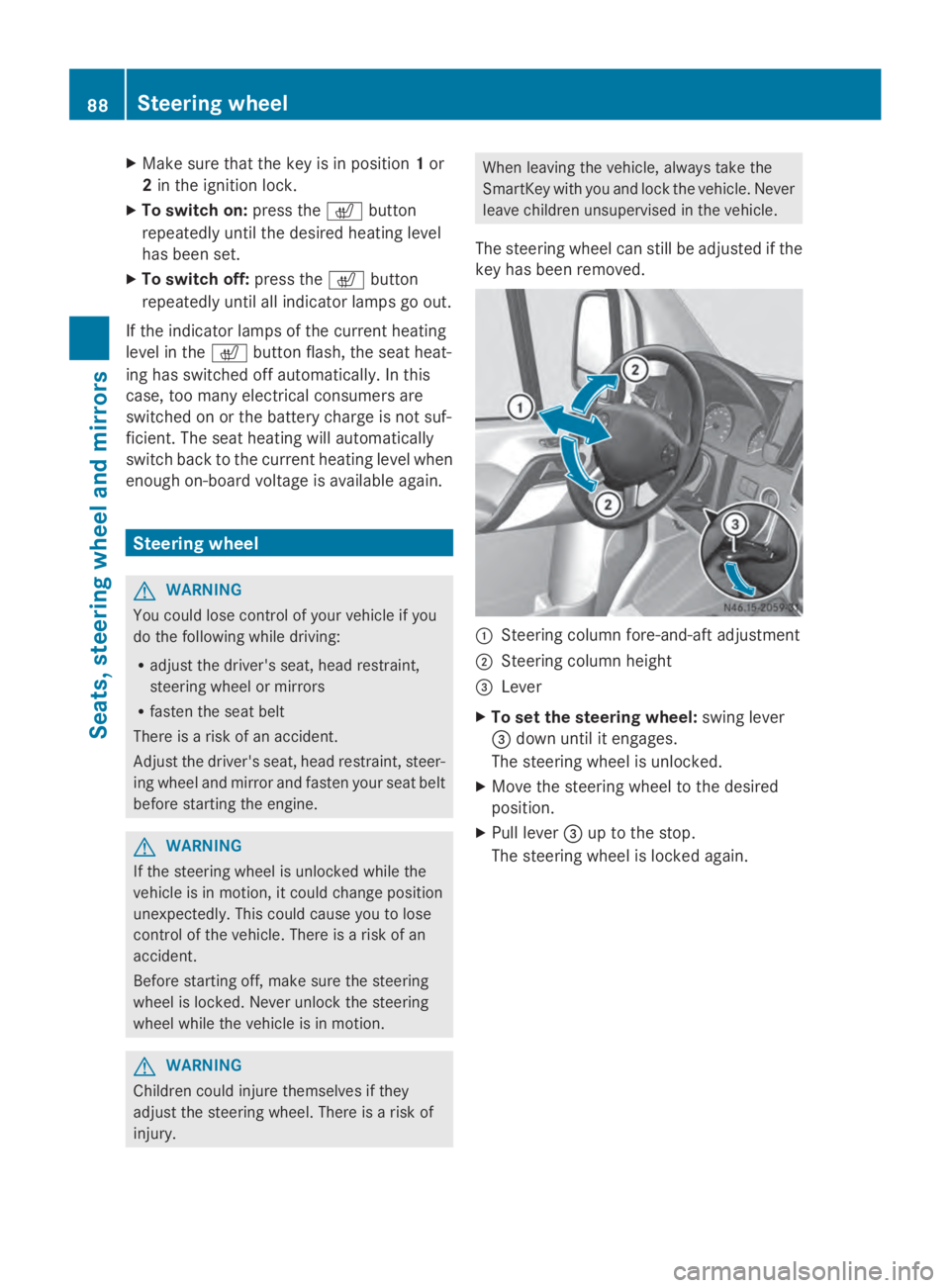
key has been removed. 0043
Steering column fore-and-aft adjustment
0044 Steering column height
0087 Lever
X To set the steering wheel: swing lever
0087 down until it engages.
The steering wheel is unlocked.
X Move the steering wheel to the desired
position.
X Pull lever 0087up to the stop.
The steering wheel is locked again. 88
Steering wheelSeats, steering wheel and mirrors
Page 240 of 338
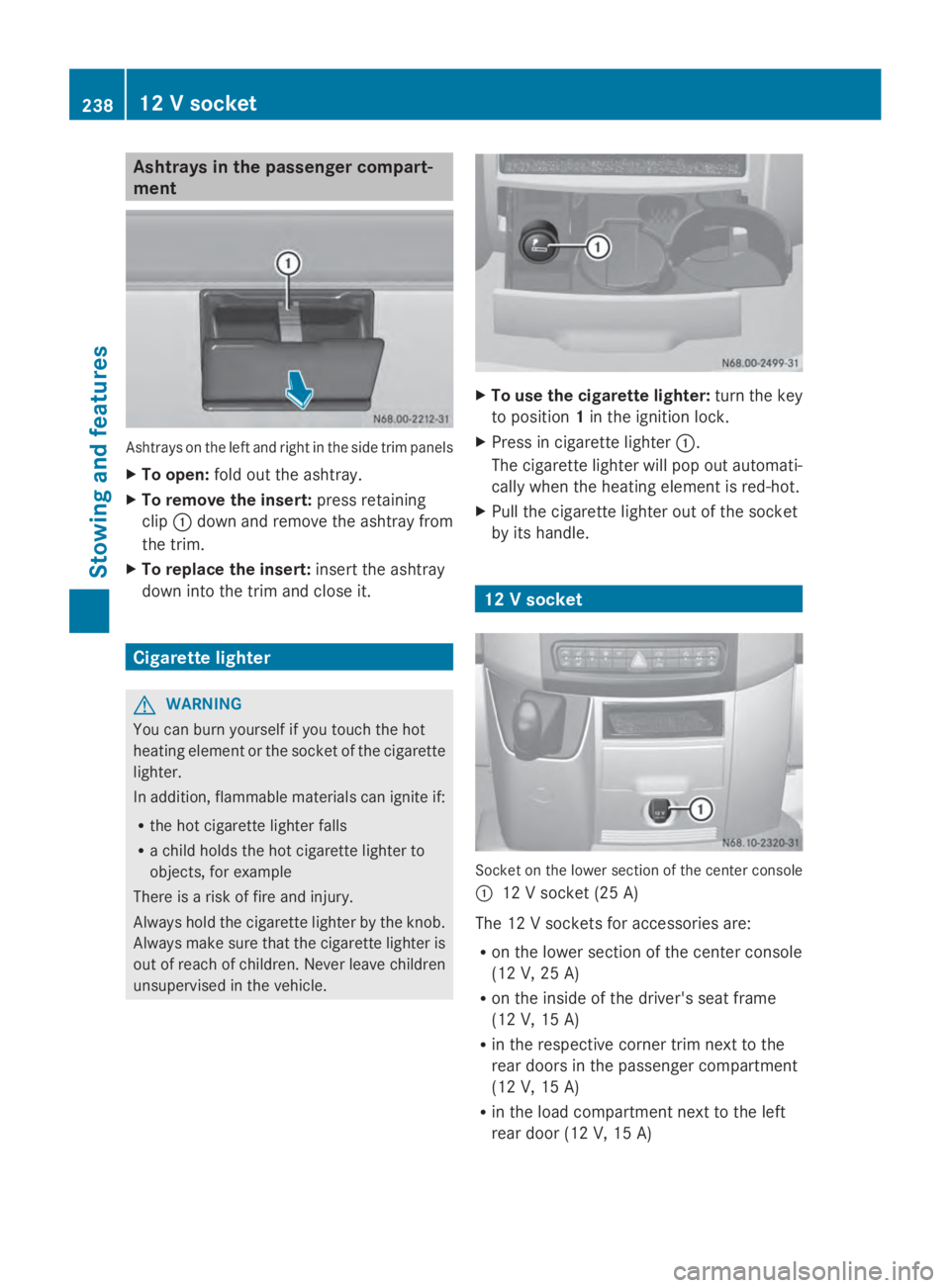
Ashtrays in the passenger compart-
ment Ashtrays on the left and right in the side trim panels
X To open: fold out the ashtray.
X To remove the insert: press retaining
clip 0043down and remove the ashtray from
the trim.
X To replace the insert: insert the ashtray
down into the trim and close it. Cigarette lighter
G
WARNING
You can burn yourself if you touch the hot
heating element or the socket of the cigarette
lighter.
In addition, flammable materials can ignite if:
R the hot cigarette lighter falls
R a child holds the hot cigarette lighter to
objects, for example
There is a risk of fire and injury.
Always hold the cigarette lighter by the knob.
Always make sure that the cigarette lighter is
out of reach of children. Never leave children
unsupervised in the vehicle. X
To use the cigarette lighter: turn the key
to position 1in the ignition lock.
X Press in cigarette lighter 0043.
The cigarette lighter will pop out automati-
cally when the heating element is red-hot.
X Pull the cigarette lighter out of the socket
by its handle. 12 V socket
Socket on the lower section of the center console
0043 12 V socket (25 A)
The 12 V sockets for accessories are:
R on the lower section of the center console
(12 V, 25 A)
R on the inside of the driver's seat frame
(12 V, 15 A)
R in the respective corner trim next to the
rear doors in the passenger compartment
(12 V, 15 A)
R in the load compartment next to the left
rear door (12 V, 15 A) 238
12 V socketStowing and featu
res
Page 268 of 338
Installing and removing the auxiliary
battery (base of the driver's seat)
Removing the auxiliary battery X
Disconnect the battery (Y page 265).
X Loosen the bolts holding the retainer that
prevents the battery from moving around in
the base of the driver's seat.
X Remove the battery holder and take out the
battery.
Installing the auxiliary battery X
Insert the battery into the battery case.
X Insert the battery holder.
X Tighten the bolts holding the retainer that
prevents the battery from moving around in
the base of the driver's seat.
X Connect the battery (Y page 265).Charging
G
WARNING
During charging and jump-starting, explosive
gases can escape from the battery. There is a
risk of an explosion.
Particularly avoid fire, open flames, creating
sparks and smoking. Ensure there is sufficient
ventilation while charging and jump-starting.
Do not lean over a battery. G
WARNING
Battery acid is caustic. There is a risk of injury.
Avoid contact with the skin, eyes or clothing.
Do not inhale any battery gases. Do not lean
over the battery. Keep children away from
batteries. Wash battery acid immediately with
water and seek medical attention.
! Only charge the installed battery with a
battery charger that has been tested and
approved by the distributor named on the
inside of the front cover. This device allows
the battery to be charged when it is instal- led in the vehicle. The vehicle's electronics
may otherwise be damaged.
X Recharge the removed battery. Observe
the notes in the operating instructions for
your battery charger.
X Install the battery. Observe the notes on
reconnecting the battery.
i If batteries are not being used, you should
charge them once a month.
It is also possible to charge the starter bat-
tery using the jump-starting connection
point in the engine compartment
(Y page 278). Care
! Dirty battery clamps and battery surfaces
cause leak currents which lead to the bat-
teries discharging.
! Do not use cleaning agents containing
fuel. Cleaning agents containing fuel cor-
rode the battery housing.
! If dirt gets into the battery cell, battery
self-discharge will increase and the battery
may be damaged.
The following points on battery care must be
observed:
X Regularly check the battery terminals and
the fastening of the negative cable to the
chassis to ensure that they are firmly
seated.
X Always keep the battery terminals and bat-
tery surfaces clean and dry.
X Lightly grease the undersides of the battery
terminals with acid-resistant grease.
X Only clean the batteries when the caps are
screwed on.
Otherwise, dirt could get into the battery
cells.
X Unscrew the caps and clean blocked
breathers with a suitable tool such as a
piece of wire. 266
BatteryMaintenance and care