clock MERCEDES-BENZ SPRINTER 2014 MY14 Operator’s Manual
[x] Cancel search | Manufacturer: MERCEDES-BENZ, Model Year: 2014, Model line: SPRINTER, Model: MERCEDES-BENZ SPRINTER 2014Pages: 338, PDF Size: 6.78 MB
Page 257 of 338
X
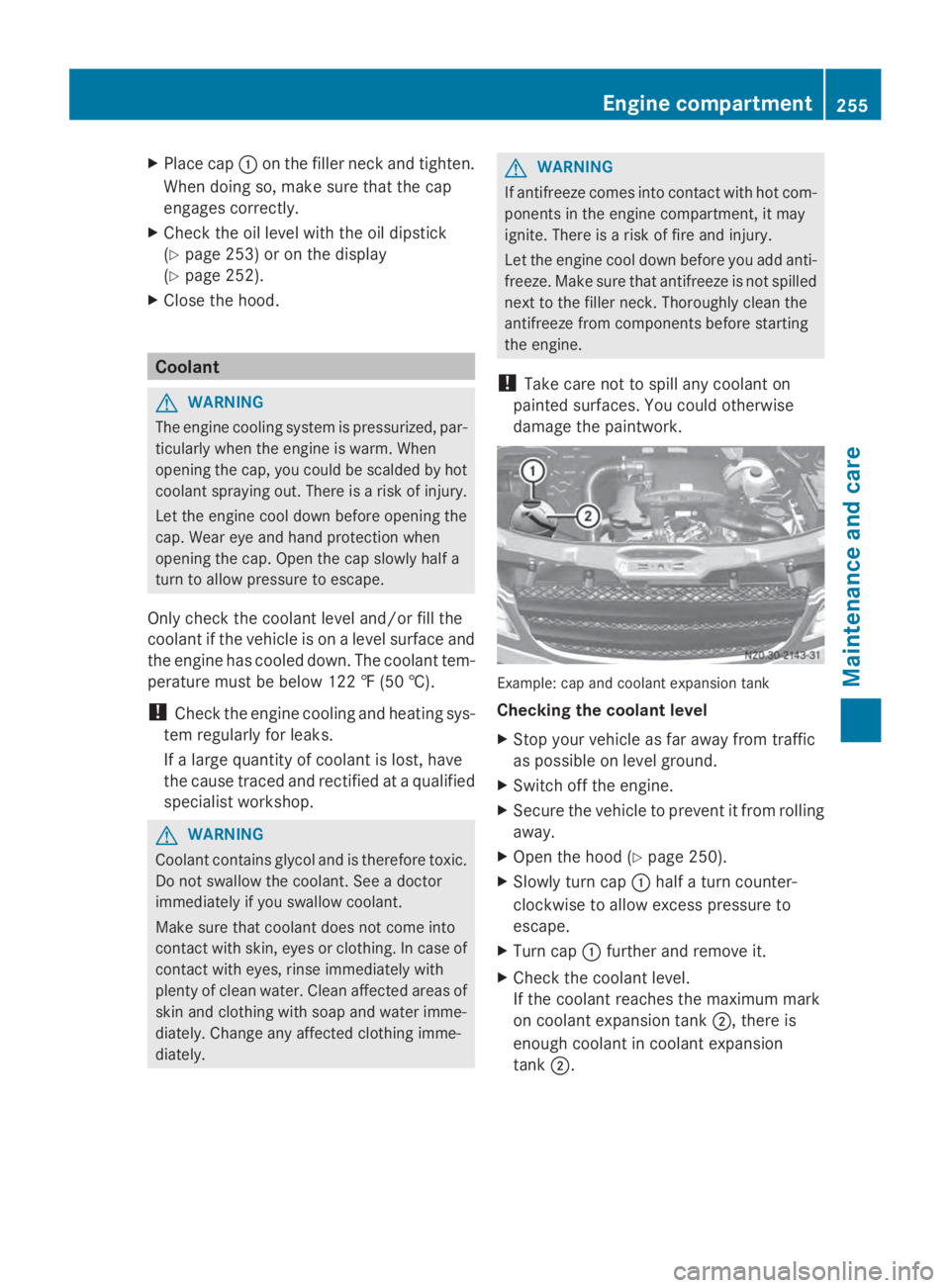
Place cap 0043on the filler neck and tighten.
When doing so, make sure that the cap
engages correctly.
X Check the oil level with the oil dipstick
(Y page 253) or on the display
(Y page 252).
X Close the hood. Coolant
G
WARNING
The engine cooling system is pressurized, par-
ticularly when the engine is warm. When
opening the cap, you could be scalded by hot
coolant spraying out. There is a risk of injury.
Let the engine cool down before opening the
cap. Wear eye and hand protection when
opening the cap. Open the cap slowly half a
turn to allow pressure to escape.
Only check the coolant level and/or fill the
coolant if the vehicle is on a level surface and
the engine has cooled down. The coolant tem-
perature must be below 122 ‡ (50 †).
! Check the engine cooling and heating sys-
tem regularly for leaks.
If a large quantity of coolant is lost, have
the cause traced and rectified at a qualified
specialist workshop. G
WARNING
Coolant contains glycol and is therefore toxic.
Do not swallow the coolant. See a doctor
immediately if you swallow coolant.
Make sure that coolant does not come into
contact with skin, eyes or clothing. In case of
contact with eyes, rinse immediately with
plenty of clean water. Clean affected areas of
skin and clothing with soap and water imme-
diately. Change any affected clothing imme-
diately. G
WARNING
If antifreeze comes into contact with hot com-
ponents in the engine compartment, it may
ignite. There is a risk of fire and injury.
Let the engine cool down before you add anti-
freeze. Make sure that antifreeze is not spilled
next to the filler neck. Thoroughly clean the
antifreeze from components before starting
the engine.
! Take care not to spill any coolant on
painted surfaces. You could otherwise
damage the paintwork. Example: cap and coolant expansion tank
Checking the coolant level
X
Stop your vehicle as far away from traffic
as possible on level ground.
X Switch off the engine.
X Secure the vehicle to prevent it from rolling
away.
X Open the hood (Y page 250).
X Slowly turn cap 0043half a turn counter-
clockwise to allow excess pressure to
escape.
X Turn cap 0043further and remove it.
X Check the coolant level.
If the coolant reaches the maximum mark
on coolant expansion tank 0044, there is
enough coolant in coolant expansion
tank 0044. Engine compartment
255Maintenance and care Z
Page 258 of 338
Adding coolant
X
If the coolant drops under the minimum
mark on coolant expansion tank 0044, add
coolant to the maximum mark.
Observe the information on coolant mix-
ture ratio and water quality in the "Techni-
cal data" section ( Ypage 329). To prevent
damage to the engine cooling system, use
only approved corrosion inhibitor/anti-
freeze that comply with the Mercedes-Benz
Specifications for Service Products.
X Replace cap 0043and turn it clockwise to
tighten.
X Start the engine.
X After approximately 5 minutes, switch off
the engine and allow it to cool down.
X Check the coolant level again and add cool-
ant if necessary.
X Close the hood. Brake fluid
G
WARNING
Service products may be poisonous and haz-
ardous to health. There is a risk of injury.
Comply with instructions on the use, storage
and disposal of service products on the labels
of the respective original containers. Always
store service products sealed in their original
containers. Always keep service products out
of the reach of children.
Brake fluid is hazardous to health. Also
observe the safety notes in the "Service prod-
ucts and capacities" section (Y page 320).G
WARNING
The brake fluid constantly absorbs moisture
from the air. This lowers the boiling point of
the brake fluid. If the boiling point of the brake
fluid is too low, vapor pockets may form in the
brake system when the brakes are applied
hard. This would impair braking efficiency.
There is a risk of an accident. You should have the brake fluid renewed at
the specified intervals.
! Brake fluid corrodes paint, plastic and
rubber. If paint, plastic or rubber has come
into contact with brake fluid, rinse with
water immediately.
Have the brake fluid renewed every 2 years
at a qualified specialist workshop. Observe
the information on brake fluid in the "Techni-
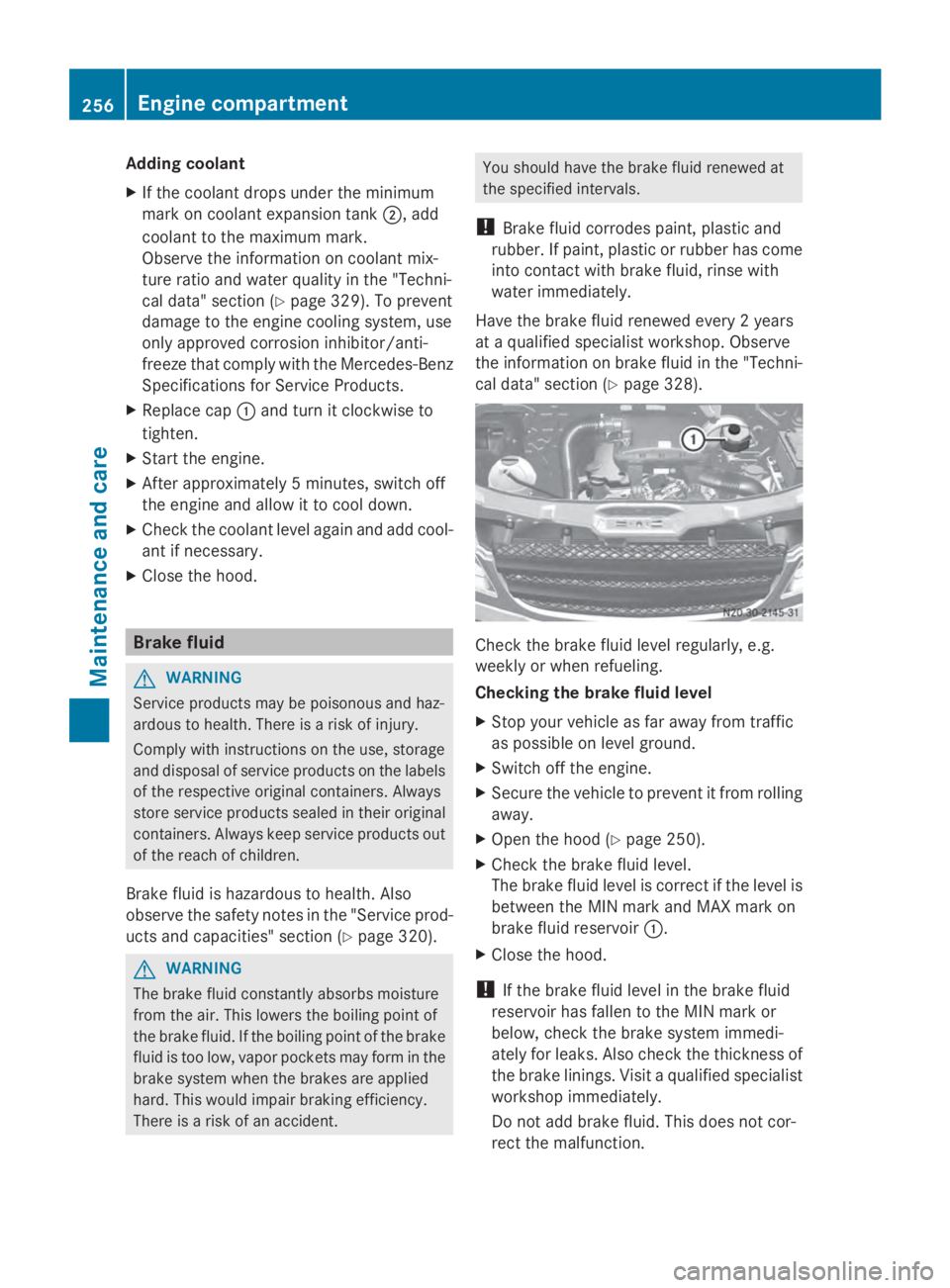
cal data" section ( Ypage 328). Check the brake fluid level regularly, e.g.
weekly or when refueling.
Checking the brake fluid level
X
Stop your vehicle as far away from traffic
as possible on level ground.
X Switch off the engine.
X Secure the vehicle to prevent it from rolling
away.
X Open the hood (Y page 250).
X Check the brake fluid level.
The brake fluid level is correct if the level is
between the MIN mark and MAX mark on
brake fluid reservoir 0043.
X Close the hood.
! If the brake fluid level in the brake fluid
reservoir has fallen to the MIN mark or
below, check the brake system immedi-
ately for leaks. Also check the thickness of
the brake linings. Visit a qualified specialist
workshop immediately.
Do not add brake fluid. This does not cor-
rect the malfunction. 256
Engine compartmentMaintenance and care
Page 278 of 338
Useful information
This Operator's Manual describes all models
as well as standard and optional equipment
of your vehicle that were available at the time
of going to print. Country-specific variations
are possible. Note that your vehicle may not
be equipped with all of the described func-
tions. This also applies to systems and func-
tions relevant to safety.
Read the information on qualified specialist
workshops (Y page 26). Where will I find...?
Vehicle tool kit
General notes The vehicle tool kit is in the stowage com-
partment in the footwell on the co-driver's
side.
The vehicle tool kit consists of:
R a towing eye
R a screwdriver with Torx, Phillips and slotted
bits
If your vehicle is equipped with a spare wheel
bracket and a jack, the vehicle tool kit addi-
tionally contains:
R a wheel wrench
R a spanner
R a pump lever rod
Stowage compartment in the co-driv-
er's footwell Unlocking and removing the cover
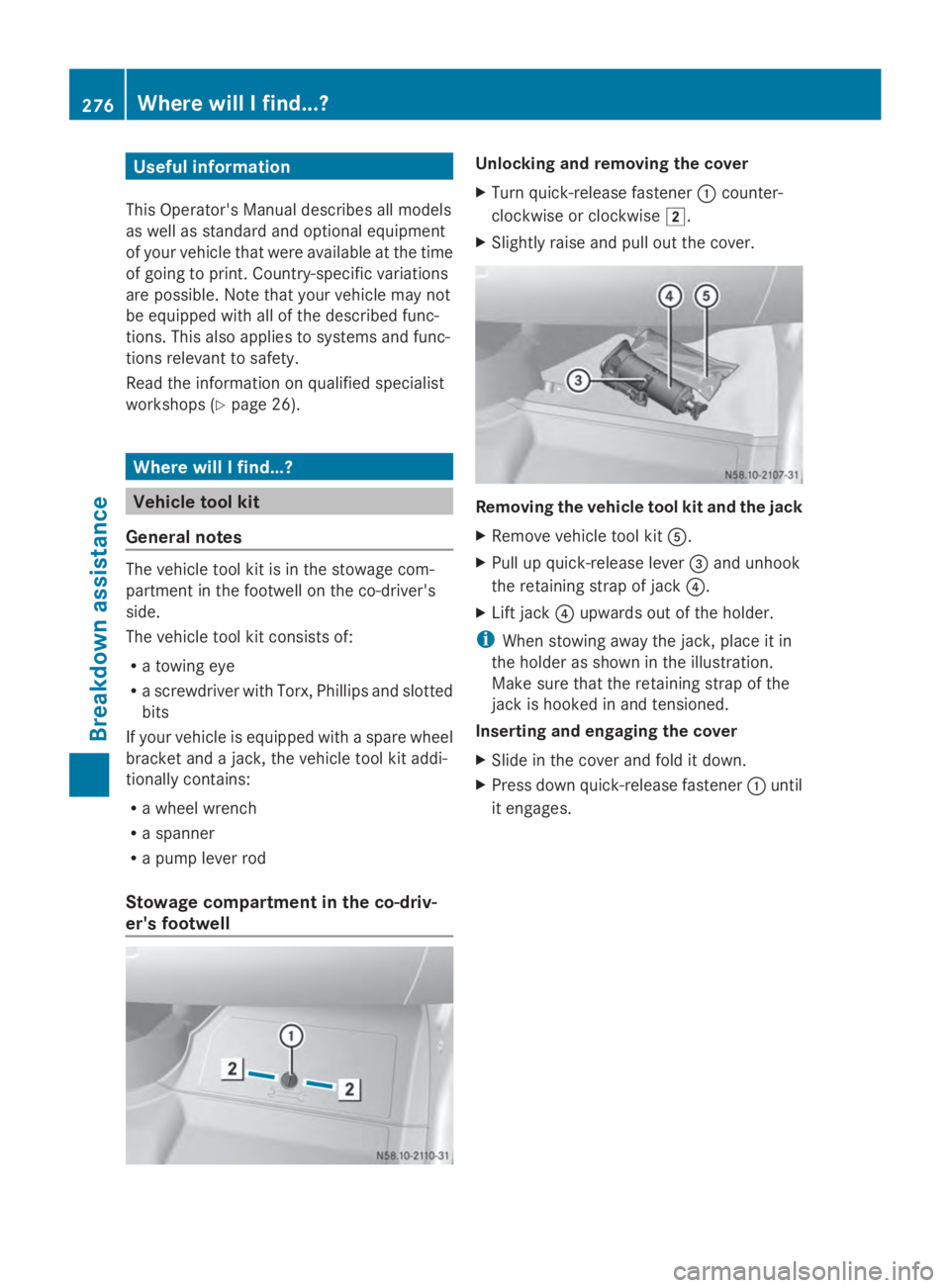
X
Turn quick-release fastener 0043counter-
clockwise or clockwise 0048.
X Slightly raise and pull out the cover. Removing the vehicle tool kit and the jack
X
Remove vehicle tool kit 0083.
X Pull up quick-release lever 0087and unhook
the retaining strap of jack 0085.
X Lift jack 0085upwards out of the holder.
i When stowing away the jack, place it in
the holder as shown in the illustration.
Make sure that the retaining strap of the
jack is hooked in and tensioned.
Inserting and engaging the cover
X Slide in the cover and fold it down.
X Press down quick-release fastener 0043until
it engages. 276
Where will I find...?Breakdown assistance
Page 282 of 338
!
Observe the following points when towing
with a tow rope:
R Secure the tow rope on the same side on
both vehicles.
R Ensure that the tow cable is not longer
than legally permitted. Mark the tow
cable in the middle, e.g. with a white
cloth (30 x 30 cm). This will make other
road users aware that the vehicle is being
towed.
R Only secure the tow cable to the towing
eye.
R Observe the brake lamps of the towing
vehicle while driving. Always maintain a
distance so that the tow rope does not
sag.
R Do not use steel cables or chains to tow
your vehicle. You could otherwise dam-
age the vehicle.
! Do not use the towing eye for recovery,
this could damage the vehicle. If in doubt,
recover the vehicle with a crane.
! When towing, pull away slowly and
smoothly. If the tractive power is too high,
the vehicles could be damaged.
Observe the legal requirements for the rele-
vant country when towing.
It is preferable to have the vehicle trans-
ported on a transporter or trailer instead of
towing it.
The automatic transmission selector lever
must be in the Nposition when towing the
vehicle.
The battery must be connected and charged.
Otherwise, you:
R cannot turn the key in the ignition lock to
position 2
R cannot move the selector lever to position
N on vehicles with automatic transmission.
i Switch off the automatic locking feature
before the vehicle is towed (Y page 71). You
could otherwise lock yourself out of the
vehicle when pushing or towing away the
vehicle. Installing/removing the towing eye
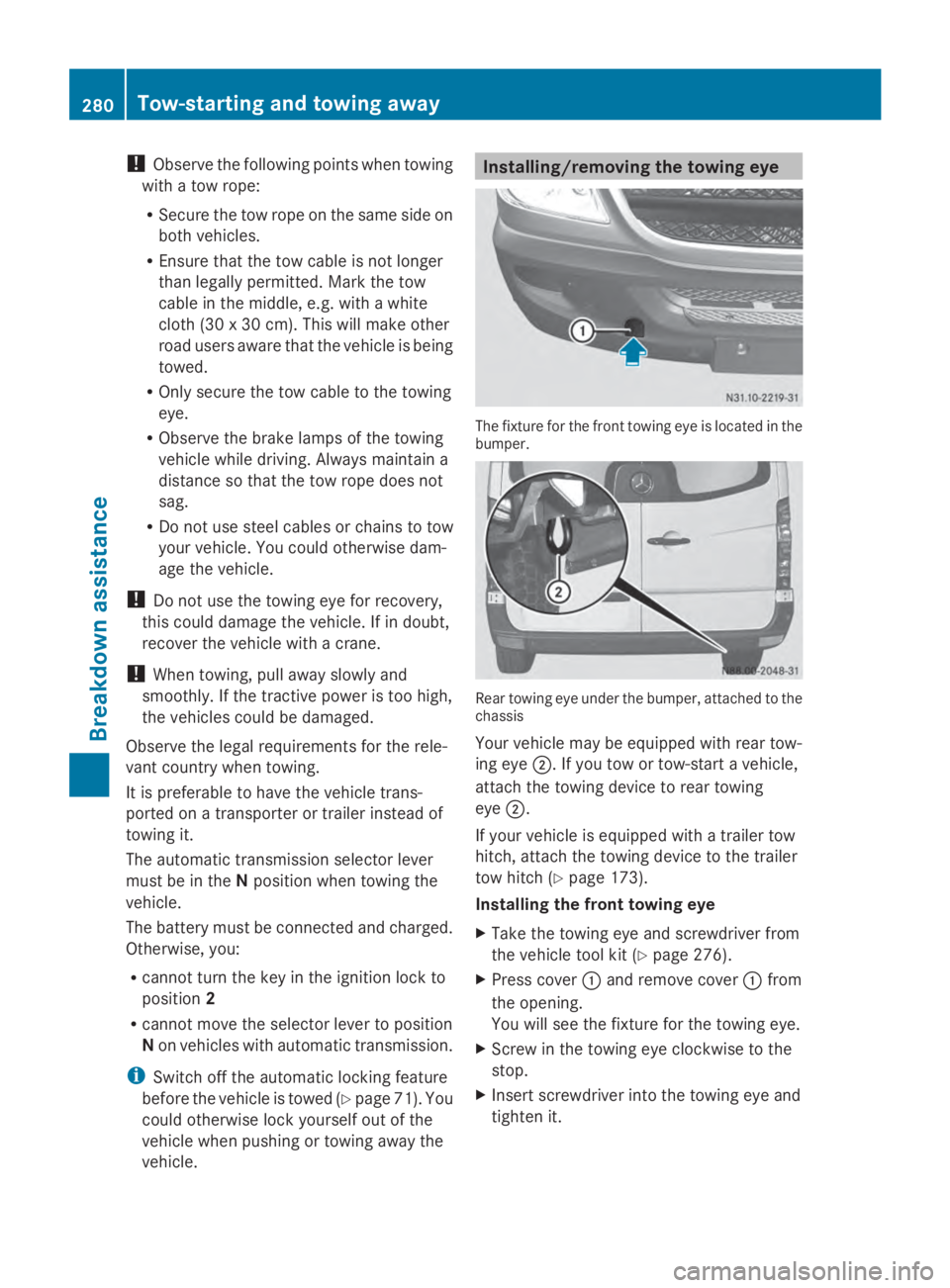
The fixture for the front towing eye is located in the
bumper.
Rear towing eye under the bumper, attached to the
chassis
Your vehicle may be equipped with rear tow-
ing eye 0044. If you tow or tow-start a vehicle,
attach the towing device to rear towing
eye 0044.
If your vehicle is equipped with a trailer tow
hitch, attach the towing device to the trailer
tow hitch (Y page 173).
Installing the front towing eye
X Take the towing eye and screwdriver from
the vehicle tool kit (Y page 276).
X Press cover 0043and remove cover 0043from
the opening.
You will see the fixture for the towing eye.
X Screw in the towing eye clockwise to the
stop.
X Insert screwdriver into the towing eye and
tighten it. 280
Tow-starting and towing awayBreakdown assistance
Page 283 of 338
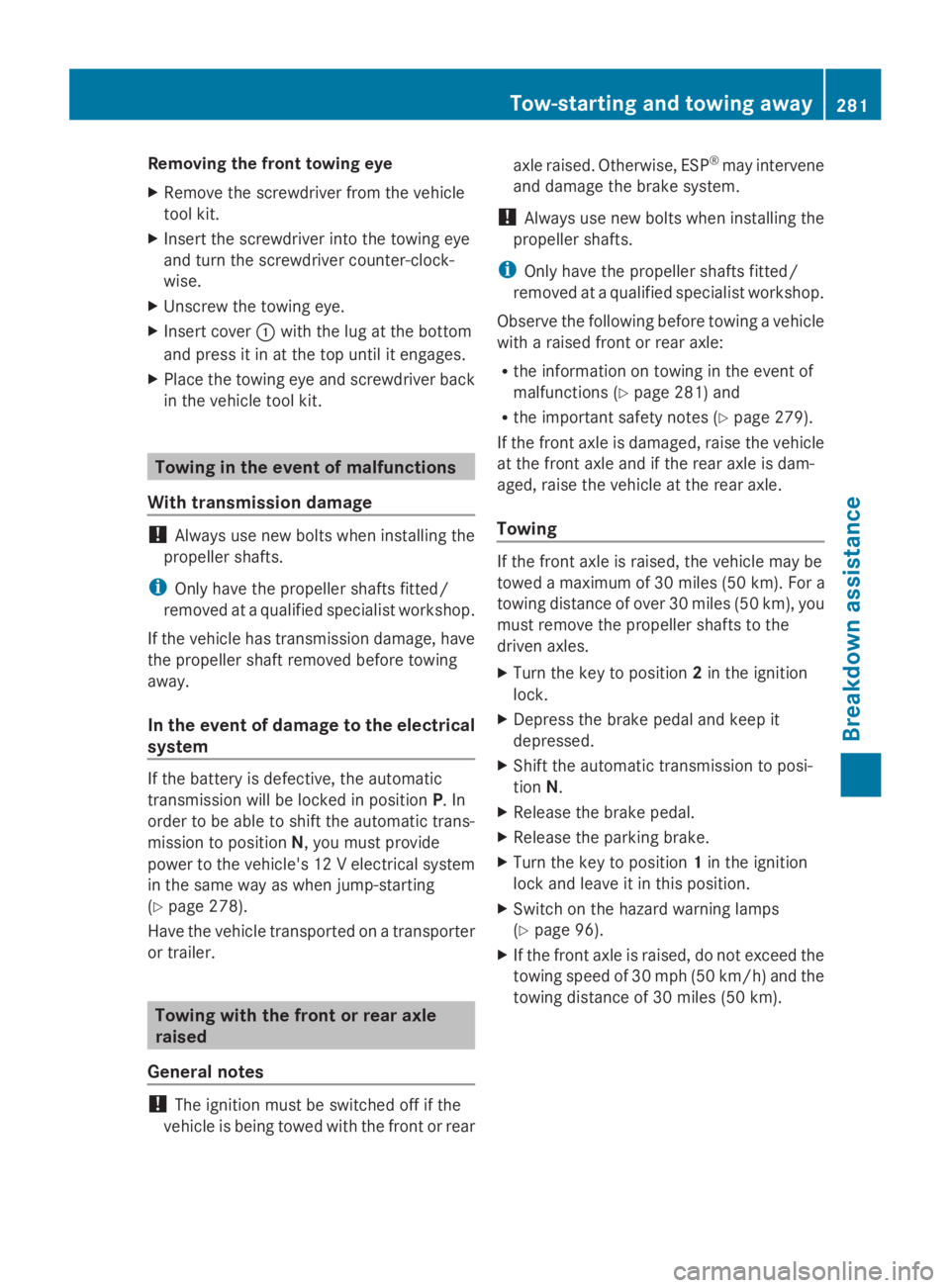
Removing the front towing eye
X
Remove the screwdriver from the vehicle
tool kit.
X Insert the screwdriver into the towing eye
and turn the screwdriver counter-clock-
wise.
X Unscrew the towing eye.
X Insert cover 0043with the lug at the bottom
and press it in at the top until it engages.
X Place the towing eye and screwdriver back
in the vehicle tool kit. Towing in the event of malfunctions
With transmission damage !
Always use new bolts when installing the
propeller shafts.
i Only have the propeller shafts fitted/
removed at a qualified specialist workshop.
If the vehicle has transmission damage, have
the propeller shaft removed before towing
away.
In the event of damage to the electrical
system If the battery is defective, the automatic
transmission will be locked in position P. In
order to be able to shift the automatic trans-
mission to position N, you must provide
power to the vehicle's 12 V electrical system
in the same way as when jump-starting
(Y page 278).
Have the vehicle transported on a transporter
or trailer. Towing with the front or rear axle
raised
General notes !
The ignition must be switched off if the
vehicle is being towed with the front or rear axle raised. Otherwise, ESP
®
may intervene
and damage the brake system.
! Always use new bolts when installing the
propeller shafts.
i Only have the propeller shafts fitted/
removed at a qualified specialist workshop.
Observe the following before towing a vehicle
with a raised front or rear axle:
R the information on towing in the event of
malfunctions (Y page 281) and
R the important safety notes (Y page 279).
If the front axle is damaged, raise the vehicle
at the front axle and if the rear axle is dam-
aged, raise the vehicle at the rear axle.
Towing If the front axle is raised, the vehicle may be
towed a maximum of 30 miles
(50 km). For a
towing distance of over 30 miles (50 km), you
must remove the propeller shafts to the
driven axles.
X Turn the key to position 2in the ignition
lock.
X Depress the brake pedal and keep it
depressed.
X Shift the automatic transmission to posi-
tion N.
X Release the brake pedal.
X Release the parking brake.
X Turn the key to position 1in the ignition
lock and leave it in this position.
X Switch on the hazard warning lamps
(Y page 96).
X If the front axle is raised, do not exceed the
towing speed of 30 mph (50 km/h) and the
towing distance of 30 miles (50 km). Tow-starting and towing away
281Breakdown assistance Z
Page 312 of 338
!
Only use the jack pump lever middle rod
and the rod with the largest diameter as a
lug wrench extension. Only slide the middle
rod as far as it will go onto the lug wrench.
The rods may otherwise bend and be dis-
torted to such an extent that they can no
longer be used as a pump lever for the jack.
! Do not place the jack on the leaf spring or
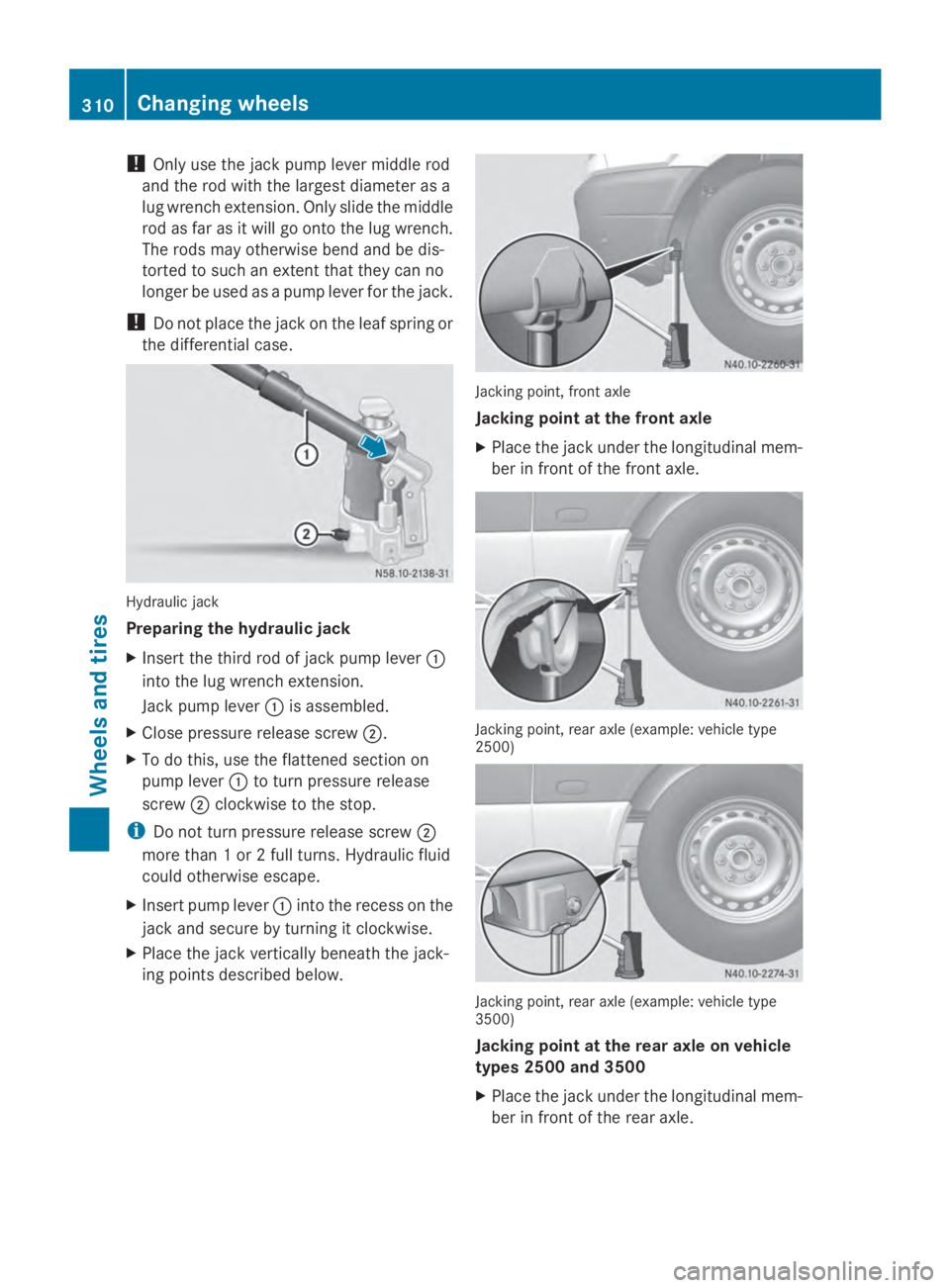
the differential case. Hydraulic jack
Preparing the hydraulic jack
X
Insert the third rod of jack pump lever 0043
into the lug wrench extension.
Jack pump lever 0043is assembled.
X Close pressure release screw 0044.
X To do this, use the flattened section on
pump lever 0043to turn pressure release
screw 0044clockwise to the stop.
i Do not turn pressure release screw 0044
more than 1 or 2 full turns. Hydraulic fluid
could otherwise escape.
X Insert pump lever 0043into the recess on the
jack and secure by turning it clockwise.
X Place the jack vertically beneath the jack-
ing points described below. Jacking point, front axle
Jacking point at the front axle
X
Place the jack under the longitudinal mem-
ber in front of the front axle. Jacking point, rear axle (example: vehicle type
2500)
Jacking point, rear axle (example: vehicle type
3500)
Jacking point at the rear axle on vehicle
types 2500 and 3500
X Place the jack under the longitudinal mem-
ber in front of the rear axle. 310
Changing wheelsWheels and tires
Page 316 of 338
R
only use a spare wheel that differs from the
wheel to be replaced for a short time.
R do not deactivate ESP ®
.
R have a spare wheel that differs from the
wheel that has been changed replaced at
the nearest qualified specialist workshop.
You must observe the correct wheel and
tire dimensions as well as the wheel type.
When using a spare wheel of a different size,
do not exceed the maximum speed of
80 km/h. General notes
! Check the spare wheel regularly to see
that it is secure and has the prescribed tire
pressure.
The procedure for mounting the spare wheel
is described in "Mounting a wheel"
(Y page 308).
The following should be checked regularly,
particularly prior to long journeys:
R the tire pressure of the spare wheel, which
should then be corrected if necessary
(Y page 290).
R the fastenings of the spare wheel bracket.
The spare wheel is located in a spare wheel
bracket under the rear of the vehicle.
Replace the tires after 6 years at the latest,
regardless of wear. This also applies to the
spare wheel.
i If you have mounted a spare wheel, the
tire pressure monitor (Y page 293) will not
function for this wheel. The spare wheel is
not equipped with a sensor for monitoring
tire pressure. Removing and installing the spare
wheel
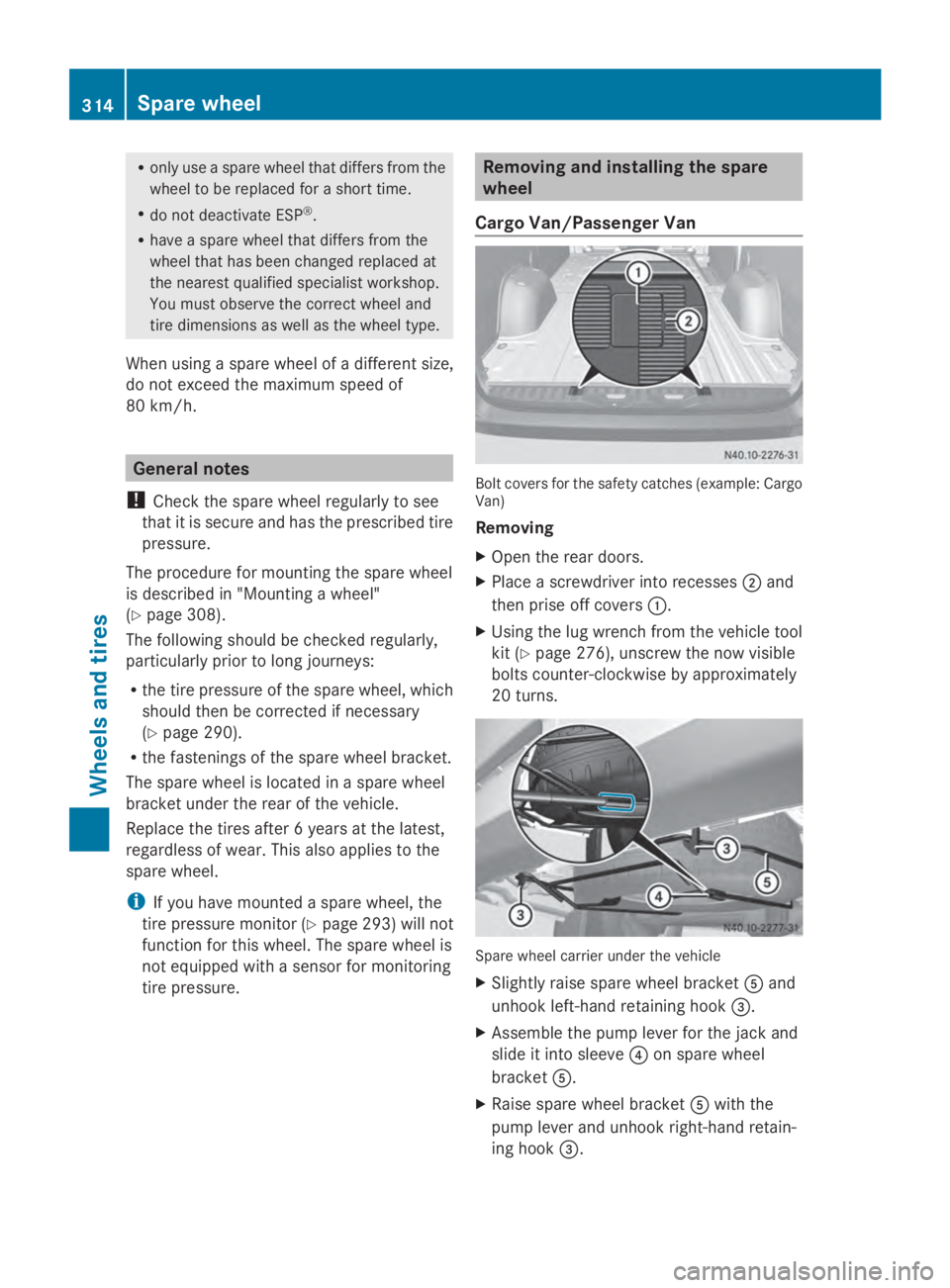
Cargo Van/Passenger Van Bolt covers for the safety catches (example: Cargo
Van)
Removing
X
Open the rear doors.
X Place a screwdriver into recesses 0044and
then prise off covers 0043.
X Using the lug wrench from the vehicle tool
kit (Y page 276), unscrew the now visible
bolts counter-clockwise by approximately
20 turns. Spare wheel carrier under the vehicle
X Slightly raise spare wheel bracket 0083and
unhook left-hand retaining hook 0087.
X Assemble the pump lever for the jack and
slide it into sleeve 0085on spare wheel
bracket 0083.
X Raise spare wheel bracket 0083with the
pump lever and unhook right-hand retain-
ing hook 0087. 314
Spare wheelWheels and tires
Page 317 of 338
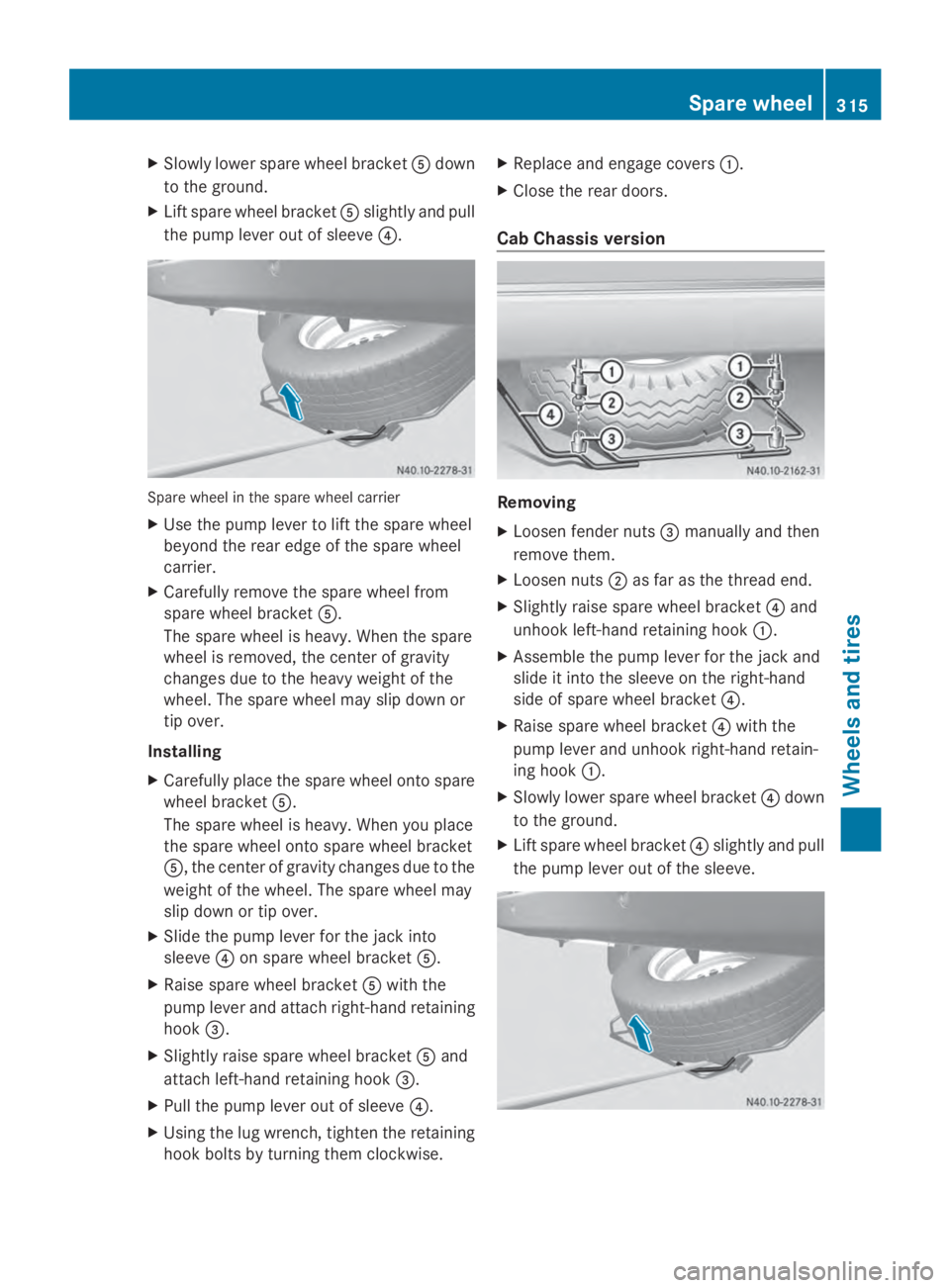
X
Slowly lower spare wheel bracket 0083down
to the ground.
X Lift spare wheel bracket 0083slightly and pull
the pump lever out of sleeve 0085.Spare wheel in the spare wheel carrier
X Use the pump lever to lift the spare wheel
beyond the rear edge of the spare wheel
carrier.
X Carefully remove the spare wheel from
spare wheel bracket 0083.
The spare wheel is heavy. When the spare
wheel is removed, the center of gravity
changes due to the heavy weight of the
wheel. The spare wheel may slip down or
tip over.
Installing
X Carefully place the spare wheel onto spare
wheel bracket 0083.
The spare wheel is heavy. When you place
the spare wheel onto spare wheel bracket
0083, the center of gravity changes due to the
weight of the wheel. The spare wheel may
slip down or tip over.
X Slide the pump lever for the jack into
sleeve 0085on spare wheel bracket 0083.
X Raise spare wheel bracket 0083with the
pump lever and attach right-hand retaining
hook 0087.
X Slightly raise spare wheel bracket 0083and
attach left-hand retaining hook 0087.
X Pull the pump lever out of sleeve 0085.
X Using the lug wrench, tighten the retaining
hook bolts by turning them clockwise. X
Replace and engage covers 0043.
X Close the rear doors.
Cab Chassis version Removing
X
Loosen fender nuts 0087manually and then
remove them.
X Loosen nuts 0044as far as the thread end.
X Slightly raise spare wheel bracket 0085and
unhook left-hand retaining hook 0043.
X Assemble the pump lever for the jack and
slide it into the sleeve on the right-hand
side of spare wheel bracket 0085.
X Raise spare wheel bracket 0085with the
pump lever and unhook right-hand retain-
ing hook 0043.
X Slowly lower spare wheel bracket 0085down
to the ground.
X Lift spare wheel bracket 0085slightly and pull
the pump lever out of the sleeve. Spare wheel
315Wheels and tires Z