wheel MERCEDES-BENZ SPRINTER 2015 MY15 Operator’s Manual
[x] Cancel search | Manufacturer: MERCEDES-BENZ, Model Year: 2015, Model line: SPRINTER, Model: MERCEDES-BENZ SPRINTER 2015Pages: 334, PDF Size: 5.94 MB
Page 312 of 334
been approved for Sprinter vehicles and the
respective wheel.
! For a steel wheel, only use the short wheel
bolts to mount the steel spare wheel. Using other wheel bolts to mount the steel spare wheel could damage the brake system.
! On vehicles equipped with a tire pressure
monitor, electronic components are loca-
ted in the wheel.
Tire-mounting tools should not be used
near the valve. This could damage the elec-
tronic components.
Only have tires changed at a qualified spe- cialist workshop. 0043
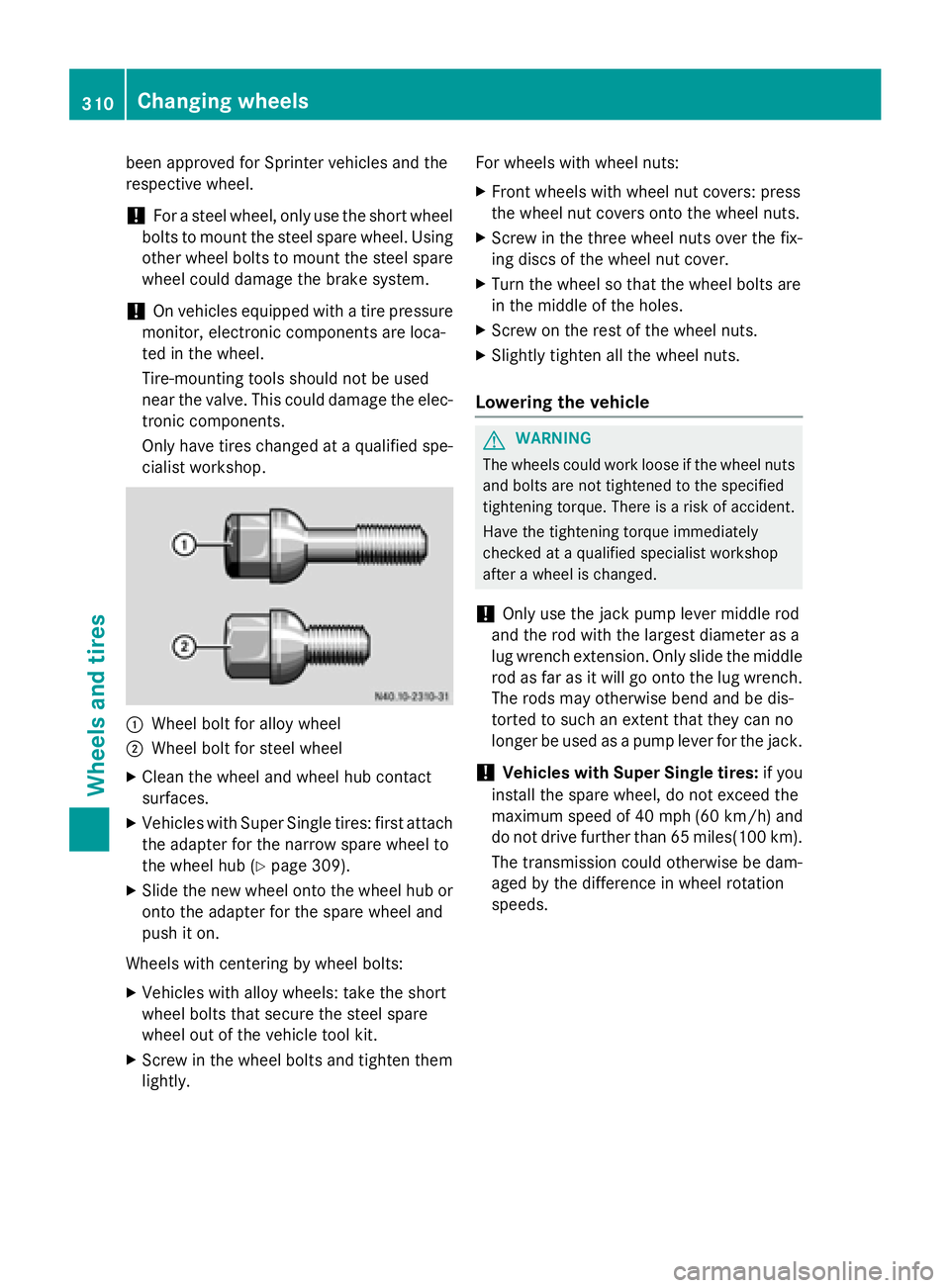
Wheel bolt for alloy wheel
0044 Wheel bolt for steel wheel
X Clean the wheel and wheel hub contact
surfaces.
X Vehicles with Super Single tires: first attach
the adapter for the narrow spare wheel to
the wheel hub (Y page 309).
X Slide the new wheel onto the wheel hub or
onto the adapter for the spare wheel and
push it on.
Wheels with centering by wheel bolts:
X Vehicles with alloy wheels: take the short
wheel bolts that secure the steel spare
wheel out of the vehicle tool kit.
X Screw in the wheel bolts and tighten them
lightly. For wheels with wheel nuts:
X Front wheels with wheel nut covers: press
the wheel nut covers onto the wheel nuts.
X Screw in the three wheel nuts over the fix-
ing discs of the wheel nut cover.
X Turn the wheel so that the wheel bolts are
in the middle of the holes.
X Screw on the rest of the wheel nuts.
X Slightly tighten all the wheel nuts.
Lowering the vehicle G
WARNING
The wheels could work loose if the wheel nuts and bolts are not tightened to the specified
tightening torque. There is a risk of accident.
Have the tightening torque immediately
checked at a qualified specialist workshop
after a wheel is changed.
! Only use the jack pump lever middle rod
and the rod with the largest diameter as a
lug wrench extension. Only slide the middle rod as far as it will go onto the lug wrench. The rods may otherwise bend and be dis-
torted to such an extent that they can no
longer be used as a pump lever for the jack.
! Vehicles with Super Single tires:
if you
install the spare wheel, do not exceed the
maximum speed of 40 mph (60 km/ h)and
do not drive further than 65 miles(100 km ).
The transmission could otherwise be dam-
aged by the difference in wheel rotation
speeds. 310
Changing wheelsWheels and tires
Page 313 of 334
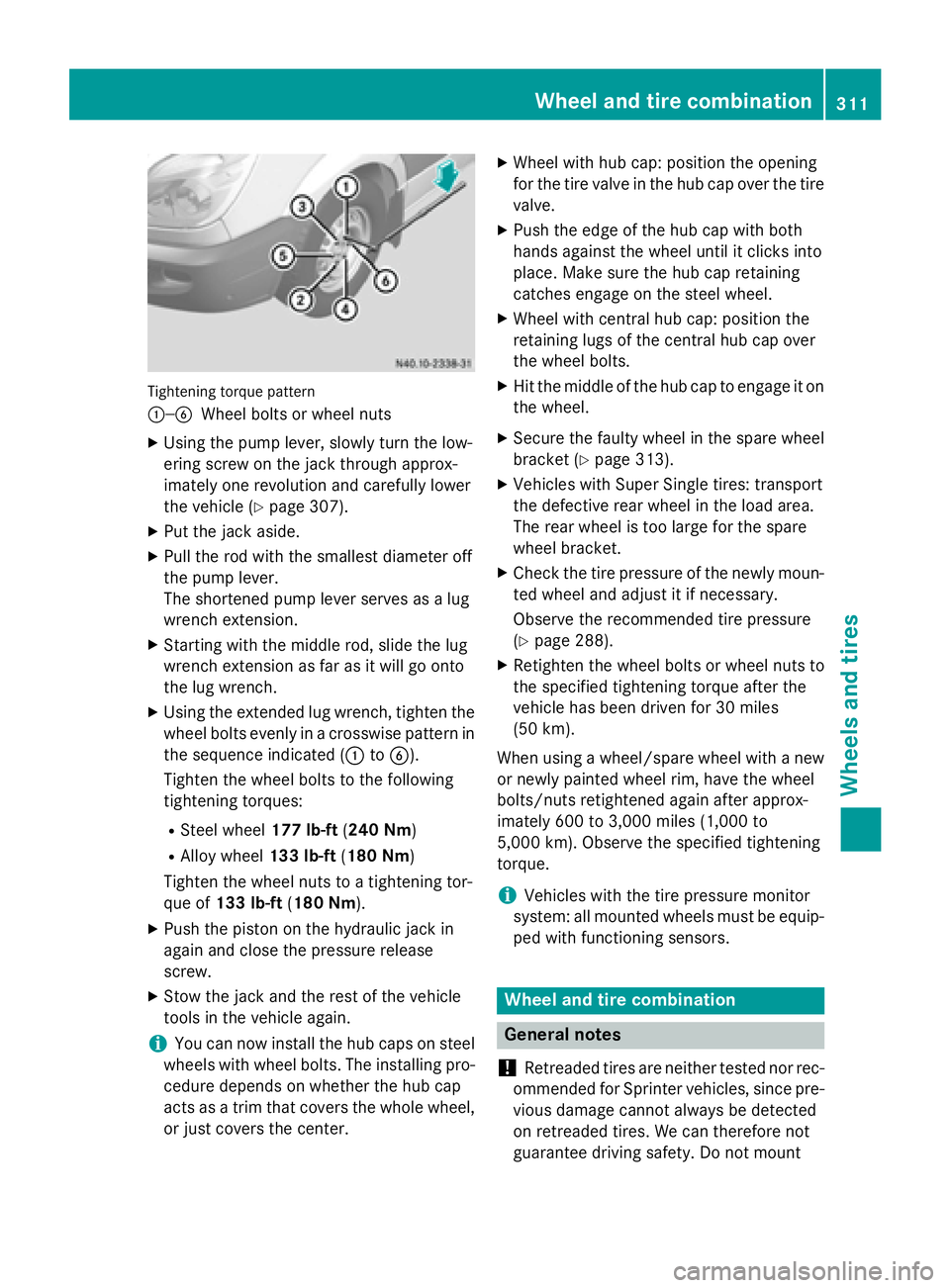
Tightening torque pattern
0043—0084
Wheel bolts or wheel nuts
X Using the pump lever, slowly turn the low-
ering screw on the jack through approx-
imately one revolution and carefully lower
the vehicle (Y page 307).
X Put the jack aside.
X Pull the rod with the smallest diameter off
the pump lever.
The shortened pump lever serves as a lug
wrench extension.
X Starting with the middle rod, slide the lug
wrench extension as far as it will go onto
the lug wrench.
X Using the extended lug wrench, tighten the
wheel bolts evenly in a crosswise pattern in the sequence indicated (0043 to0084).
Tighten the wheel bolts to the following
tightening torques:
R Steel wheel 177 lb-ft(240 Nm)
R Alloy wheel 133 lb-ft(180 Nm)
Tighten the wheel nuts to a tightening tor-
que of 133 lb-ft (180 Nm).
X Push the piston on the hydraulic jack in
again and close the pressure release
screw.
X Stow the jack and the rest of the vehicle
tools in the vehicle again.
i You can now install the hub caps on steel
wheels with wheel bolts. The installing pro-
cedure depends on whether the hub cap
acts as a trim that covers the whole wheel,
or just covers the center. X
Wheel with hub cap: position the opening
for the tire valve in the hub cap over the tire
valve.
X Push the edge of the hub cap with both
hands against the wheel until it clicks into
place. Make sure the hub cap retaining
catches engage on the steel wheel.
X Wheel with central hub cap: position the
retaining lugs of the central hub cap over
the wheel bolts.
X Hit the middle of the hub cap to engage it on
the wheel.
X Secure the faulty wheel in the spare wheel
bracket (Y page 313).
X Vehicles with Super Single tires: transport
the defective rear wheel in the load area.
The rear wheel is too large for the spare
wheel bracket.
X Check the tire pressure of the newly moun-
ted wheel and adjust it if necessary.
Observe the recommended tire pressure
(Y page 288).
X Retighten the wheel bolts or wheel nuts to
the specified tightening torque after the
vehicle has been driven for 30 miles
(50 km).
When using a wheel/spare wheel with a new
or newly painted wheel rim, have the wheel
bolts/nuts retightened again after approx-
imately 600 to 3,000 miles (1,000 to
5,000 km). Observe the specified tightening
torque.
i Vehicles with the tire pressure monitor
system: all mounted wheels must be equip- ped with functioning sensors. Wheel and tire combination
General notes
! Retreaded tires are neither tested nor rec-
ommended for Sprinter vehicles, since pre-
vious damage cannot always be detected
on retreaded tires. We can therefore not
guarantee driving safety. Do not mount Wheel and tire combination
311Wheels and tires Z
Page 314 of 334
used tires if you have no information about
their previous usage.
The recommended tire pressures can be
found:
R on the Tire and Loading Information plac-
ard 10
on the B-pillar on the driver's side
R on the tire pressure table on the B-pillar on
the driver's side
The recommended tire pressure can also be
found in the "Tire pressure table" section in
this Operator's Manual (Y page 294). The
wheel/tire combination for your vehicle can
be found on the tire pressure table. Further
information on wheel/tire combination can
be obtained at any qualified specialist work-
shop.
Check tire pressures regularly and only when
the tires are cold. Observe the notes on the
recommended tire pressure (Y page 288).
Follow the maintenance recommendations in the tire manufacturer's warranty book in your
vehicle documents.
Notes on the vehicle equipment – always
equip the vehicle:
R with tires of the same size across an axle
(left/right)
R with the same type of tires on all wheels at
a given time (summer tires, winter tires)
Tires that have been specially designed and
approved for your vehicle are marked with
MO or MO1 (Mercedes-Benz Original). You
can find this identification on the tires them-
selves and in the following table.
i Not all wheel/tire combinations can be
installed at the factory in all countries. Spare wheel
Important safety notes
G
WARNING
Wheel and tire dimensions as well as the type of tire can vary between the spare wheel and the wheel to be replaced. When the spare
wheel is mounted, driving characteristics may be severely affected. There is a risk of an acci-
dent.
In order to reduce risks:
R you should therefore adapt your driving
style and drive carefully.
R never mount more than one spare wheel
that differs from the wheel to be replaced.
R only use a spare wheel that differs from the
wheel to be replaced for a short time.
R do not deactivate ESP ®
.
R have a spare wheel that differs from the
wheel that has been changed replaced at
the nearest qualified specialist workshop.
You must observe the correct wheel and
tire dimensions as well as the wheel type.
When using a spare wheel of a different size,
do not exceed the maximum speed of
80 km/h. General notes
! Check the spare wheel regularly to see
that it is secure and has the prescribed tire
pressure.
The procedure for mounting the spare wheel
is described in "Mounting a wheel"
(Y page 306).
The following should be checked regularly,
particularly prior to long journeys:
R the tire pressure of the spare wheel, which
should then be corrected if necessary
(Y page 288).
R the fastenings of the spare wheel bracket.
The spare wheel is located in a spare wheel
bracket under the rear of the vehicle.
Replace the tires after 6 years at the latest,
regardless of wear. This also applies to the
spare wheel.
10 Only for vehicles with a gross weight of less than 10,000 lbs (4,536 kg). 312
Spare wheelWheels and ti
res
Page 315 of 334
i
If you have mounted a spare wheel, the
tire pressure monitor (Y page 291) will not
function for this wheel. The spare wheel is
not equipped with a sensor for monitoring
tire pressure. Removing and installing the spare
wheel
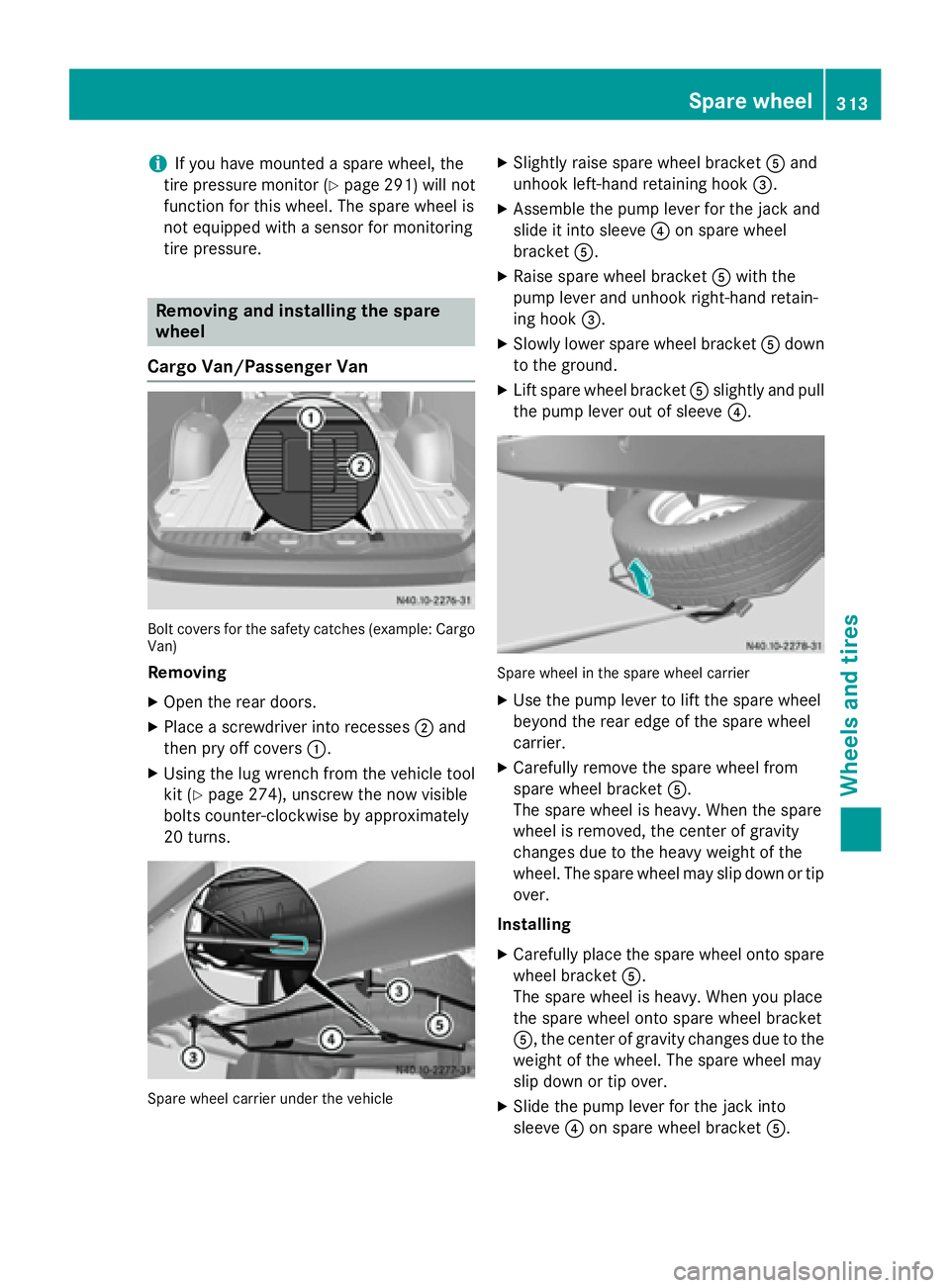
Cargo Van/Passenger Van Bolt covers for the safety catches (example: Cargo
Van)
Removing
X Open the rear doors.
X Place a screwdriver into recesses 0044and
then pry off covers 0043.
X Using the lug wrench from the vehicle tool
kit (Y page 274), unscrew the now visible
bolts counter-clockwise by approximately
20 turns. Spare wheel carrier under the vehicle X
Slightly raise spare wheel bracket 0083and
unhook left-hand retaining hook 0087.
X Assemble the pump lever for the jack and
slide it into sleeve 0085on spare wheel
bracket 0083.
X Raise spare wheel bracket 0083with the
pump lever and unhook right-hand retain-
ing hook 0087.
X Slowly lower spare wheel bracket 0083down
to the ground.
X Lift spare wheel bracket 0083slightly and pull
the pump lever out of sleeve 0085. Spare wheel in the spare wheel carrier
X Use the pump lever to lift the spare wheel
beyond the rear edge of the spare wheel
carrier.
X Carefully remove the spare wheel from
spare wheel bracket 0083.
The spare wheel is heavy. When the spare
wheel is removed, the center of gravity
changes due to the heavy weight of the
wheel. The spare wheel may slip down or tip over.
Installing X Carefully place the spare wheel onto spare
wheel bracket 0083.
The spare wheel is heavy. When you place
the spare wheel onto spare wheel bracket
0083, the center of gravity changes due to the
weight of the wheel. The spare wheel may
slip down or tip over.
X Slide the pump lever for the jack into
sleeve 0085on spare wheel bracket 0083. Spare wheel
313Wheels and tires Z
Page 316 of 334
X
Raise spare wheel bracket 0083with the
pump lever and attach right-hand retaining hook 0087.
X Slightly raise spare wheel bracket 0083and
attach left-hand retaining hook 0087.
X Pull the pump lever out of sleeve 0085.
X Using the lug wrench, tighten the retaining
hook bolts by turning them clockwise.
X Replace and engage covers 0043.
X Close the rear doors.
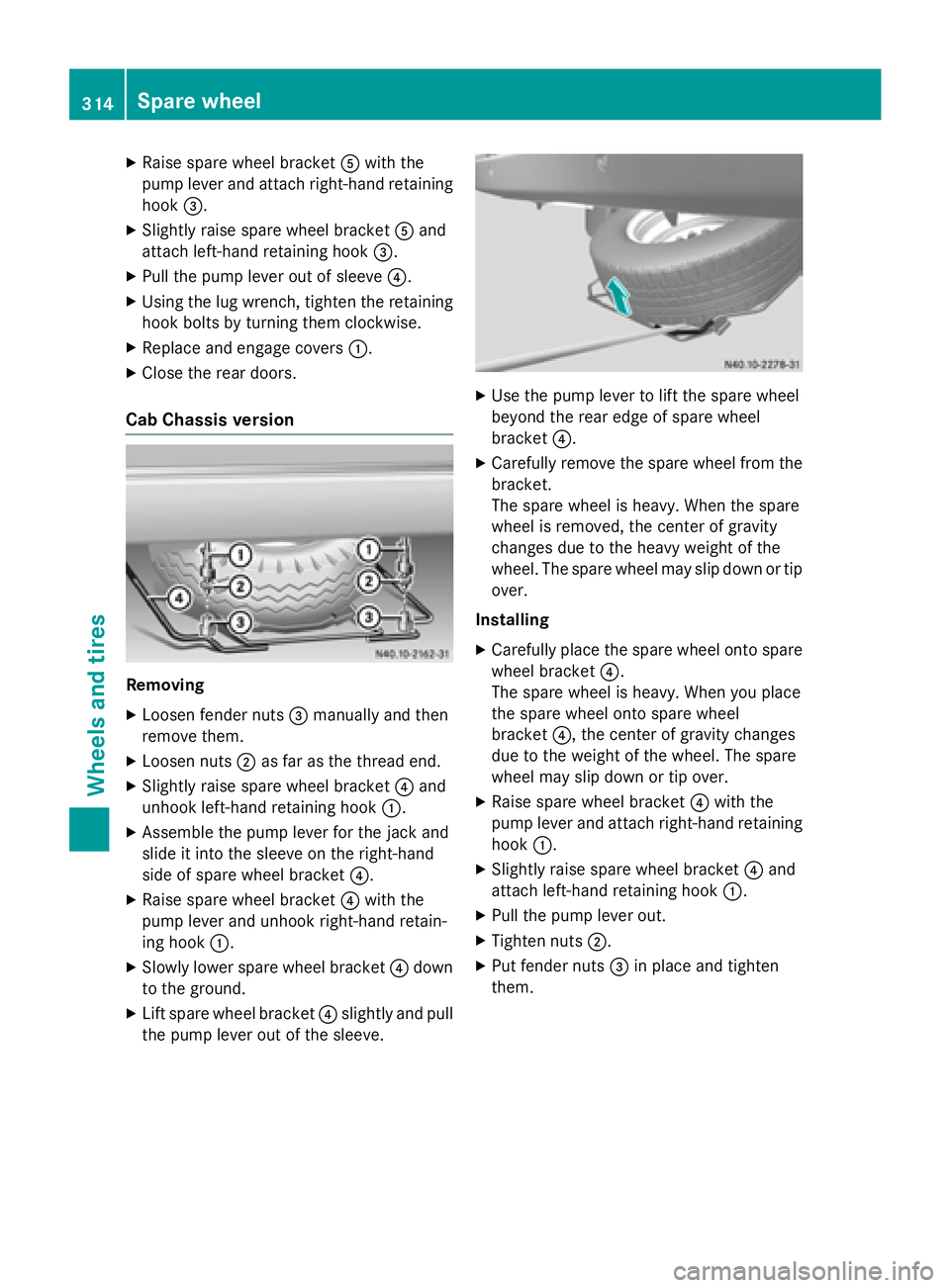
Cab Chassis version Removing
X Loosen fender nuts 0087manually and then
remove them.
X Loosen nuts 0044as far as the thread end.
X Slightly raise spare wheel bracket 0085and
unhook left-hand retaining hook 0043.
X Assemble the pump lever for the jack and
slide it into the sleeve on the right-hand
side of spare wheel bracket 0085.
X Raise spare wheel bracket 0085with the
pump lever and unhook right-hand retain-
ing hook 0043.
X Slowly lower spare wheel bracket 0085down
to the ground.
X Lift spare wheel bracket 0085slightly and pull
the pump lever out of the sleeve. X
Use the pump lever to lift the spare wheel
beyond the rear edge of spare wheel
bracket 0085.
X Carefully remove the spare wheel from the
bracket.
The spare wheel is heavy. When the spare
wheel is removed, the center of gravity
changes due to the heavy weight of the
wheel. The spare wheel may slip down or tip over.
Installing X Carefully place the spare wheel onto spare
wheel bracket 0085.
The spare wheel is heavy. When you place
the spare wheel onto spare wheel
bracket 0085, the center of gravity changes
due to the weight of the wheel. The spare
wheel may slip down or tip over.
X Raise spare wheel bracket 0085with the
pump lever and attach right-hand retaining hook 0043.
X Slightly raise spare wheel bracket 0085and
attach left-hand retaining hook 0043.
X Pull the pump lever out.
X Tighten nuts 0044.
X Put fender nuts 0087in place and tighten
them. 314
Spare wheelWheels and
tires
Page 322 of 334
i
Malfunctions resulting from paraffin sep-
aration can only be rectified by heating the
entire fuel system. Park the vehicle in a
heated garage, for example.
To prevent operating problems, diesel with
better flow qualities is available during the
winter months. You can obtain information at the gas station or from your fuel supplier.
Your vehicle is equipped with a fuel preheat-
ing system. This improves the flow properties
of the diesel by approximately 46 ‡ (8 †).
ULTRA-LOW SULFUR DIESEL can be used
without risk of malfunction down to an out-
side temperature of approximately 14 ‡
(00F810 †).
Fuel additives
! Do not add gasoline or kerosene to diesel
fuel to improve its flow characteristics.
Gasoline or kerosene impairs the lubricat-
ing properties of the diesel fuel. This can
result in damage to the fuel injection sys-
tem, for example.
Information on fuel consumption H
Environmental note
CO 2(carbon dioxide) is the gas which scien-
tists believe to be principally responsible for
global warming (the greenhouse effect). Your
vehicle's CO 2emissions are directly related to
fuel consumption and therefore depend on:
R efficient use of the fuel by the engine
R driving style
R other non-technical factors, such as envi-
ronmental influences, road conditions or
traffic flow
You can minimize your vehicle's CO 2emis-
sions by driving carefully and having it serv-
iced regularly.
Fuel consumption depends on: R the vehicle version
R the style of driving R
the operating conditions
R the type or quality of the fuel used
The vehicle will use more fuel than usual in the following situations:
R at very low outside temperatures
R in city traffic
R during short journeys
R on mountainous terrain
R when towing a trailer
To keep fuel consumption low, observe the
advice in the "Protection of the environment" section (Y page 23).
The following components of the different
vehicle versions influence fuel consumption:
R tire sizes, tire tread, tire pressure, tire con-
dition
R body
R transmission ratios for the drive assem-
blies
R additional equipment (e.g. air-conditioning
system, auxiliary heating system)
For these reasons, the actual consumption
figures for your vehicle may deviate from the
consumption figures determined according
to EU Directive 80/1268/EEC.
Data concerning fuel consumption are recor- ded in the on-board computer; use the steer-
ing wheel buttons to call up the Trip com-
puter menu (Y page 195).
Diesel Exhaust Fluid (DEF) General notes
! Only use DEF in accordance with
ISO 22241. The exhaust gas aftertreatment system may otherwise be damaged.
Observe the MB Specifications for Service
Products, Sheet No. 352.0.
Damage caused by the use of other reduc-
ing agents will invalidate the New Vehicle
Limited Warranty. 320
Service products and capacitiesTechnical data