lock MERCEDES-BENZ SPRINTER 2015 MY15 Operator’s Manual
[x] Cancel search | Manufacturer: MERCEDES-BENZ, Model Year: 2015, Model line: SPRINTER, Model: MERCEDES-BENZ SPRINTER 2015Pages: 334, PDF Size: 5.94 MB
Page 22 of 334
Trailer
Brake force booster malfunction ... 219
Trailer coupling
see Towing a trailer
Trailer loads and drawbar nose-
weights .............................................. .177
Trailer towing
Blind Spot Assist ............................ 165
PARKTRONIC ................................. 170
Permissible trailer loads and
drawbar noseweights ..................... 177
Transmission
see Automatic transmission
Transmission oil ................................ 324
Transport
Loading guidelines ......................... 240
Vehicle .......................................... .280
Transport by rail ................................ 154
Transportation
Rail ................................................ 154
Transporting
Load distribution ............................ 242
Securing a load .............................. 242
Trim pieces (cleaning instruc-
tions) ................................................. .270
Trip computer (on-board com-
puter) ................................................. .195
Trip meter
see Trip odometer
Trip odometer
Display (vehicles with steering
wheel buttons) ............................... 187
Display (vehicles without steeringwheel buttons) ............................... 182
Resetting ....................................... 181
see Trip computer (on-board computer)
Turn signals
Replacing bulbs (front) ................... 102
Replacing bulbs (rear) .................... 103
Switching on/off .............................. 94
Turn signals (Chassis Cab)
Replacing bulbs (rear) .................... 104
Twin co-driver's seat
Folding table .................................. 234
Stowage compartment .................. 232
Two-way radios
Type approval/frequency .............. 316 TWR (Tongue Weight Rating) (defi-
nition)
................................................. 305 U
Unlocking From inside the vehicle (central
unlocking button) ............................ .71
USB port .............................................2 38 V
Vehicle Data acquisition ............................... 29
Display message ............................ 216
Electronics ..................................... 316
Equipment ....................................... 22
Individual settings (vehicles with
steering wheel buttons) ................. 188
Limited Warranty ............................ .22
Loading .......................................... 295
Locking (SmartKey) .......................... 66
Lowering ........................................ 310
Maintenance .................................... 28
Parking for a long period ................ 151
Pulling away ................................... 140
Raising ........................................... 307
Registration ............................... 25, 28
Reporting problems ......................... 28
Securing from rolling away ............ 149
Towing away .................................. 277
Transporting .................................. 280
Unlocking (SmartKey )...................... 66
Vehicle battery
see Battery (vehicle)
Vehicle bodies
Body/equipment mounting direc-
tives for trucks ................................. 26
Vehicle data ....................................... 327
Vehicle identification number .......... 316
Vehicle identification plate .............. 316
Vehicle tool kit .................................. 274
Vents
see Air vents
Voltage supply
Fuses ............................................. 280 20
Index
Page 34 of 334
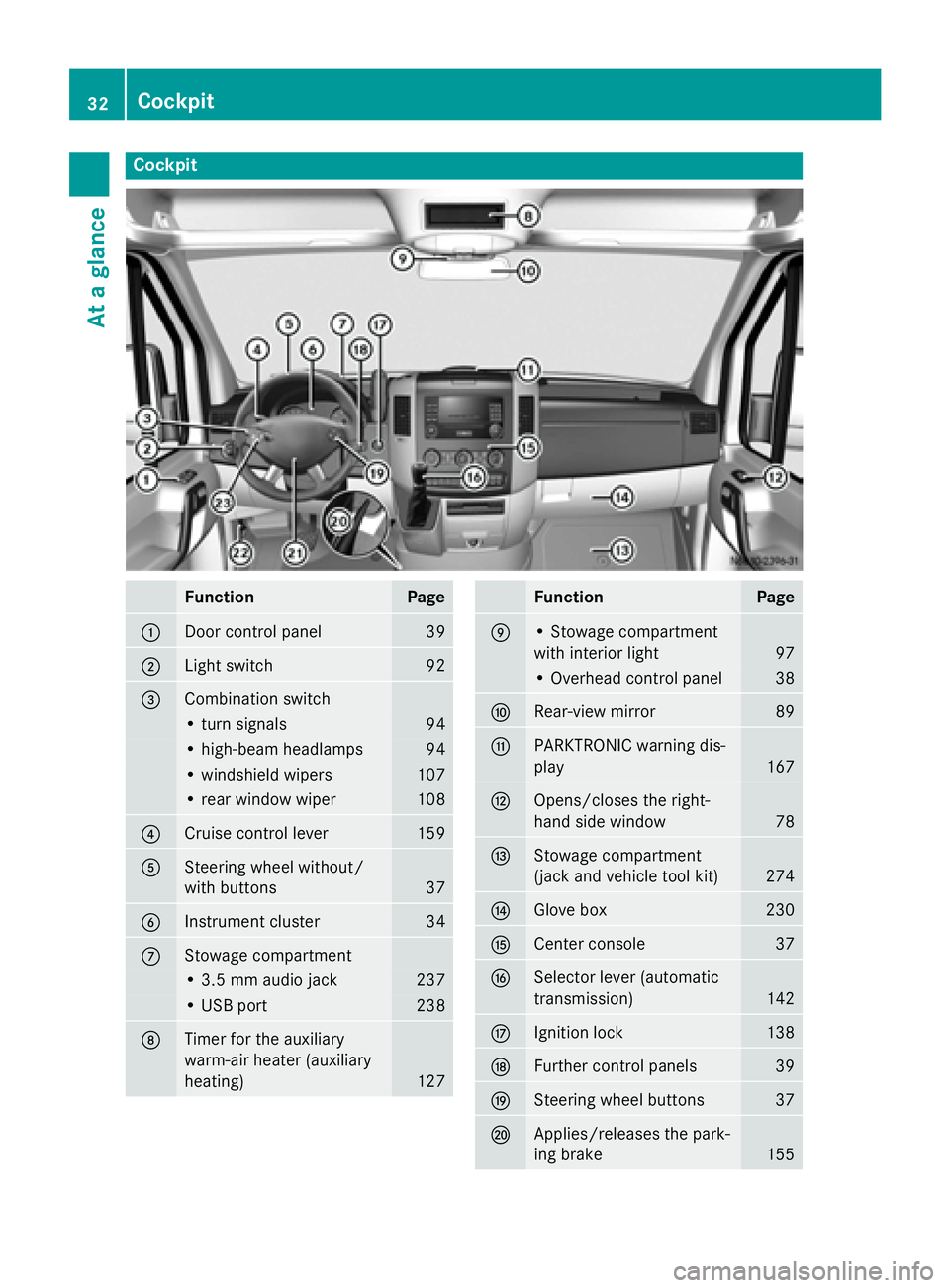
Cockpit
Function Page
0043
Door control panel 39
0044
Light switch 92
0087
Combination switch
• turn signals 94
• high-beam headlamps 94
• windshield wipers 107
• rear window wiper 108
0085
Cruise control lever 159
0083
Steering wheel without/
with buttons
37
0084
Instrument cluster 34
006B
Stowage compartment
• 3.5 mm audio jack 237
• USB port 238
006C
Timer for the auxiliary
warm-air heater (auxiliary
heating)
127 Function Page
006D
• Stowage compartment
with interior light
97
• Overhead control panel 38
006E
Rear-view mirror 89
006F
PARKTRONIC warning dis-
play
167
0070
Opens/closes the right-
hand side window
78
0071
Stowage compartment
(jack and vehicle tool kit)
274
0072
Glove box 230
0073
Center console 37
0074
Selector lever (automatic
transmission)
142
0075
Ignition lock 138
0076
Further control panels 39
0077
Steering wheel buttons 37
0078
Applies/releases the park-
ing brake
15532
CockpitAt a glance
Page 40 of 334
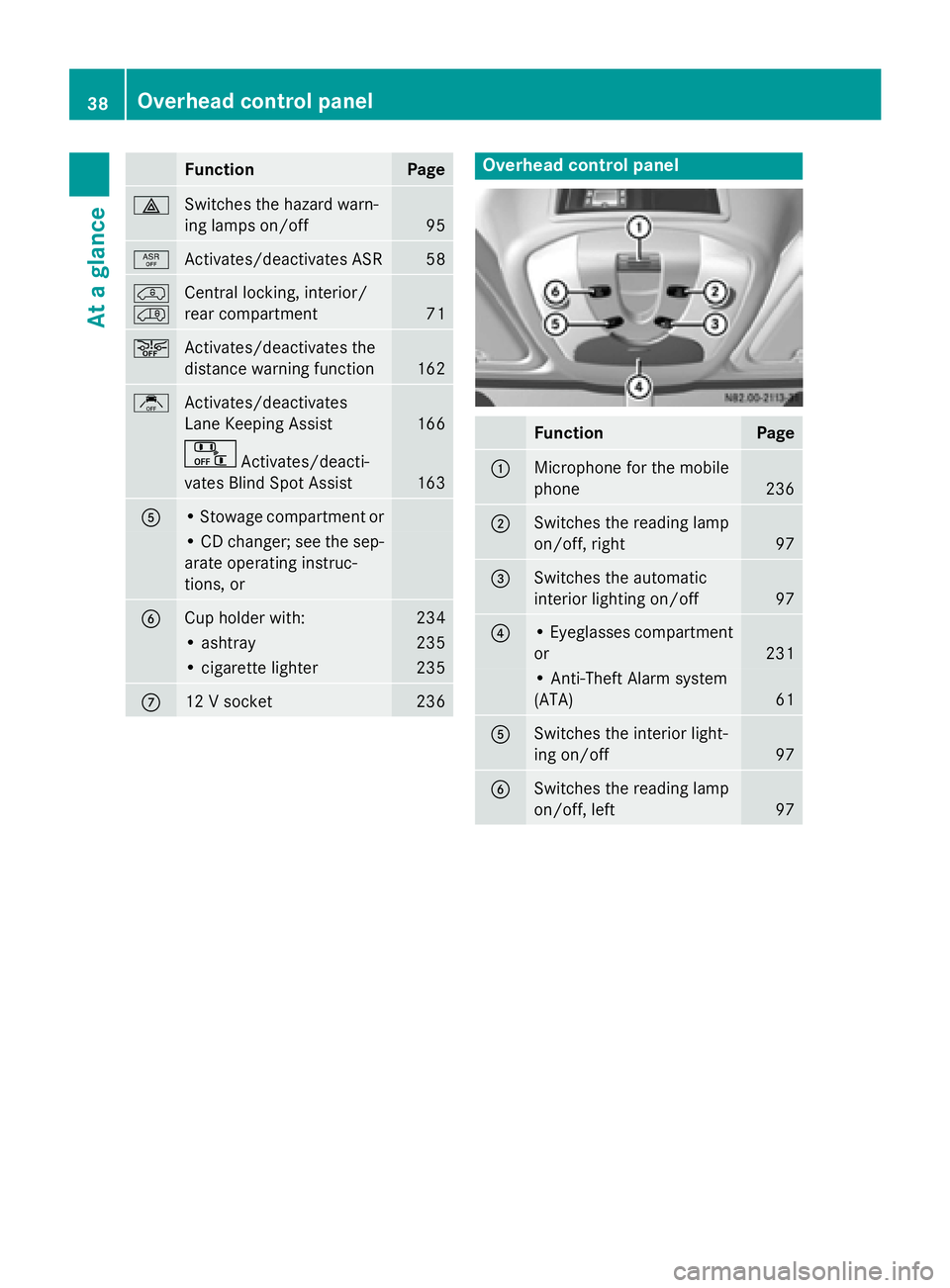
Function Page
002F
Switches the hazard warn-
ing lamps on/off
95
00E3
Activates/deactivates ASR 58
00BF
00C0
Central locking, interior/
rear compartment
71
00D4
Activates/deactivates the
distance warning function
162
j
Activates/deactivates
Lane Keeping Assist
166
Activates/deacti-
vates Blind Spot Assist 163
0083
• Stowage compartment or
• CD changer; see the sep-
arate operating instruc-
tions, or 0084
Cup holder with: 234
• ashtray 235
• cigarette lighter 235
006B
12 V socket 236 Overhead control panel
Function Page
0043
Microphone for the mobile
phone 236
0044
Switches the reading lamp
on/off, right 97
0087
Switches the automatic
interior lighting on/off 97
0085
• Eyeglasses compartment
or 231
• Anti-Theft Alarm system
(ATA)
61
0083
Switches the interior light-
ing on/off 97
0084
Switches the reading lamp
on/off, left 9738
Overhead control panelAt a glance
Page 42 of 334
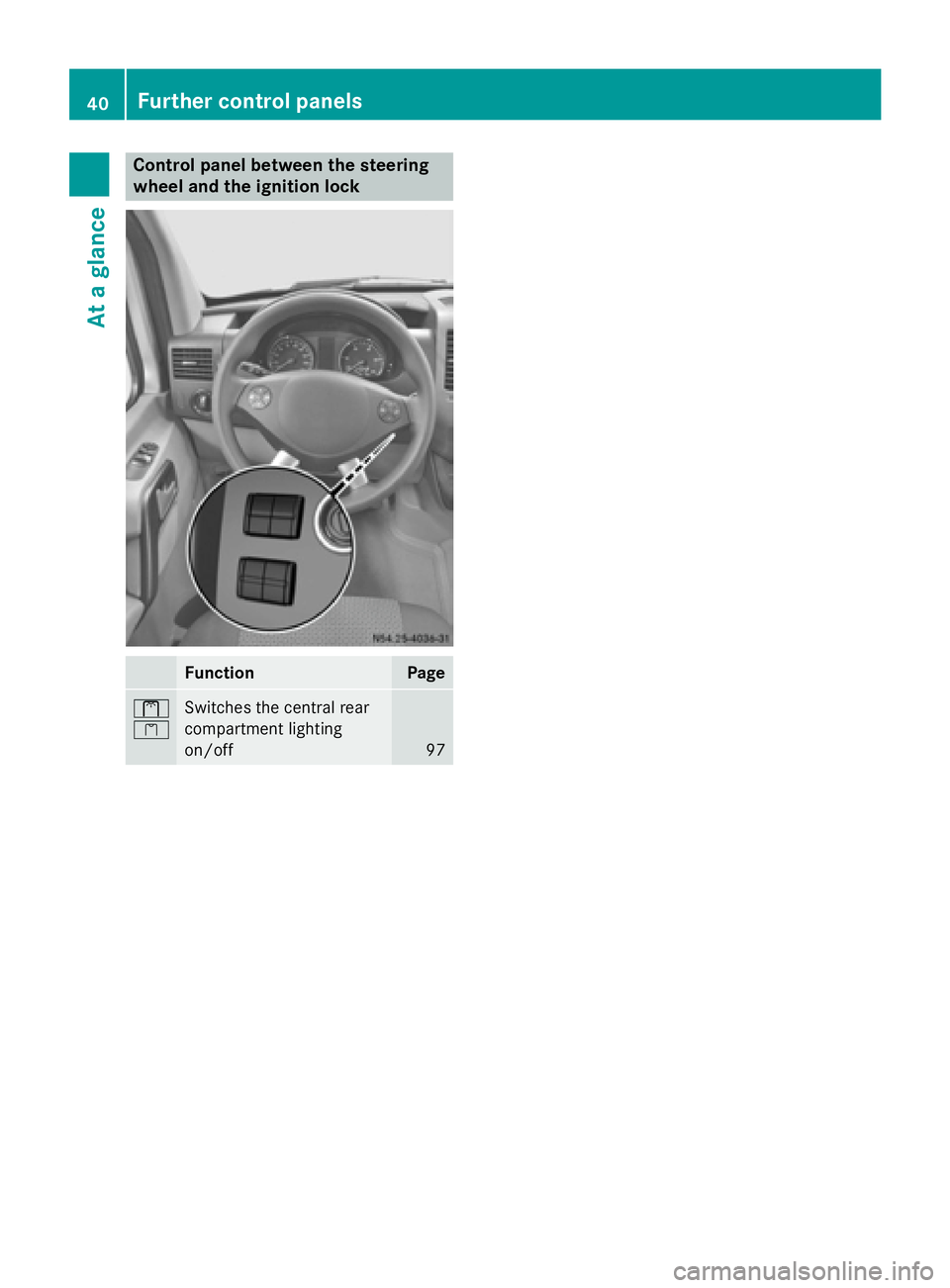
Control panel between the steering
wheel and the ignition lock Function Page
0039
0038
Switches the central rear
compartment lighting
on/off
9740
Further control panelsAt a glance
Page 43 of 334
Useful information
..............................42
Occupant safety .................................. 42
Children in the vehicle ........................51
Pets in the vehicle ............................... 56
Driving safety systems .......................57
Emergency exit .................................... 60
Theft deterrent locking system .........61 41Safety
Page 45 of 334
allows malfunctions to be detected in good
time.
When the ignition is switched on, the 0075
restraint system warning lamp in the instru-
ment cluster lights up. It goes out no later
than a few seconds after the vehicle is star-
ted. The components of the restraint system
are on standby.
A malfunction has occurred if the 0075
restraint system warning lamp:
R does not light up after the ignition is
switched on.
R does not switch off after a few seconds.
R goes out, but then lights up again, e.g. when
the engine is running. G
WARNING
If restraint system is malfunctioning, restraint system components may be triggered unin-
tentionally or might not be triggered at all in
the event of an accident with a high rate of
vehicle deceleration. This can affect the Emer- gency Tensioning Device or air bag, for exam-
ple. This poses an increased risk of injury or
even fatal injury.
Have the restraint system checked and
repaired in a qualified specialist workshop as
soon as possible. Seat belts
Introduction Seat belts are the most effective means of
restricting the movement of vehicle occu-
pants in the event of an accident or the vehi-
cle rolling over. This reduces the risk of vehi- cle occupants coming into contact with parts
of the vehicle interior or being ejected from
the vehicle. Furthermore, the seat belt helps
to keep the vehicle occupant in the best posi- tion in relation to the air bag. The seat belt system comprises:
R Seat belts
R Emergency Tensioning Devices and seat
belt force limiters for the driver's and front-
passenger seat belts
On vehicles with two seats on the front-
passenger side, both seat belts on the
front-passenger side have an Emergency
Tensioning Device. Only the seat belt on the
outer front-passenger seat has a seat belt
force limiter.
The seat belt system only includes Emer-
gency Tensioning Devices and seat belt force
limiters for the driver and front passenger if
the vehicle is equipped with a driver's air bag.
If the seat belt is pulled out of the belt outlet quickly or with a jerky movement, the belt
retractor locks. The belt strap cannot be
extracted any further.
The Emergency Tensioning Device tightens
the seat belt in an accident, pulling the belt
close against the body. However it does not
pull the vehicle occupant back in the direction
of the backrest.
The Emergency Tensioning Device does not
correct an incorrect seat position or the rout- ing of an incorrectly fastened seat belt.
When triggered, seat belt force limiters help
to reduce the force exerted by the seat belt on
the vehicle occupant.
The seat belt force limiters are synchronized
with the front air bags, which absorb part of
the deceleration force. This can reduce the
force exerted on the vehicle occupants during an accident.
! If the front-passenger seat is unoccupied,
do not insert the belt tongue into the buckle of the front-passenger seat. This may oth-
erwise lead to the triggering of the Emer-
gency Tensioning Device in the event of anaccident, which will then need to be
replaced.
Vehicles with two seats on the front-
passenger side: the Emergency Tensioning
Device of the inner front-passenger seat is Occupant safety
43Safety Z
Page 46 of 334
triggered independently of the lock status of
the seat belt.
Important safety notes The use of seat belts and child restraint sys-
tems is required by law in:
R all 50 states
R the U.S. territories
R the District of Columbia
R all Canadian provinces
Even where this is not required by law, all
vehicle occupants should correctly fasten
their seat belts before starting the journey. G
WARNING
If the seat belt is incorrectly fastened, it can-
not protect as intended. Furthermore, an
incorrectly fastened seat belt can cause addi- tional injury, for example, in an accident, dur-
ing braking or when abruptly changing direc-
tion. This poses an increased risk of injury or
even fatal injury.
Make sure that all vehicle occupants are
seated properly with a correctly fastened seat belt. G
WARNING
The seat belt does not offer the intended level of protection if you have not moved the back-
rest to an almost vertical position. When brak-
ing or in the event of an accident, you could
slide underneath the seat belt and sustain
abdomen or neck injuries, for example. This
poses an increased risk of injury or even fatal injury.
Adjust the seat properly before beginning
your journey. Always ensure that the backrest
is in an almost vertical position and that the
shoulder section of your seat belt is routed
across the center of your shoulder. G
WARNING
Persons under 5 ft (1.50 m) in heightcannot
fasten the seat belt correctly without an addi- tional suitable restraint system. If the seat belt is incorrectly fastened, it cannot protect
as intended. Furthermore, an incorrectly fas-
tened seat belt can cause additional injury, for example, in an accident, during braking or an
abrupt change of direction. This poses an
increased risk of injury or even fatal injury.
For this reason, always secure persons under
5 ft (1.50 m) in height in suitable restraint
systems.
If a child younger than 12 years and under 5 ft
(1.50 m) in height is traveling in the vehicle:
R always secure the child in a child restraint
system suitable for this vehicle. The child
restraint system must be appropriate to the
age, weight and size of the child
R always observe the instructions and safety
notes in the "Children in the vehicle" sec-
tion of this Operator's Manual
(Y page 51) in addition to the child
restraint system manufacturer's installa-
tion instructions G
WARNING
The seat belts may not perform their intended protective function if:
R they are damaged, modified, extremely
dirty, bleach or dyed
R the seat belt buckle is damaged or
extremely dirty
R the Emergency Tensioning Devices, belt
anchorages or inertia reels have been modi-
fied
Seat belts may sustain non-visible damage in an accident, e.g. due to glass splinters. Modi-
fied or damaged seat belts may tear or fail,
e.g. in an accident. Modified Emergency Ten-
sioning Devices could accidentally trigger or
fail to deploy when necessary. This poses an
increased risk of injury or even fatal injury.
Never modify the seat belts, Emergency Ten-
sioning Devices, belt anchorages or inertia
reels. Make sure that the seat belts are
undamaged, not worn out and clean. Follow-
ing an accident, have the seat belts checked 44
Occupant safetySafety
Page 52 of 334
may cause short-term breathing difficulties in
people with asthma or other respiratory prob-
lems. To avoid this, you may wish to get out of
the vehicle or open the windows as soon as it is safe to do so.
Air bags and pyrotechnic Emergency Tension-
ing Devices (ETDs) contain perchlorate mate- rial, which may require special handling and
regard for the environment. National guide-
lines must be observed during disposal. In
California, see www.dtsc.ca.gov/
HazardousWaste/Perchlorate/
index.cfm.
Method of operation During the first stage of a collision, the
restraint system control unit evaluates impor-
tant physical data relating to vehicle deceler- ation or acceleration, such as:
R duration
R direction
R intensity
Based on the evaluation of this data, the
restraint system control unit triggers the
Emergency Tensioning Devices during a fron- tal or rear collision.
An Emergency Tensioning Device can only be
triggered, if:
R the ignition is switched on.
R the components of the restraint system are
operational; see "Restraint system warning
lamp" (Y page 42)
R the belt tongue is engaged in the buckle on
the respective front-passenger seat
Vehicles with two seats on the front-
passenger side: the Emergency Tensioning
Device on the inner front-passenger seat is
triggered independently of the lock status of
the seat belt. If the restraint system control unit detects a
more severe accident, further components of
the restraint system are activated independ-
ently of each other in certain frontal collision
situations:
R Front air bags
R Window curtain air bag on the side of
impact
The activation threshold of the Emergency
Tensioning Devices and the air bag are deter- mined by evaluating the rate of vehicle decel-
eration or acceleration which occurs at vari-
ous points in the vehicle. This process is pre-
emptive in nature. Deployment should take
place in good time at the start of the collision.
The rate of vehicle deceleration or accelera-
tion and the direction of the force are essen- tially determined by:
R the distribution of forces during the colli-
sion
R the collision angle
R the deformation characteristics of the vehi-
cle
R the characteristics of the object with which
the vehicle has collided
Factors which can only be seen and measured after a collision has occurred do not play a
decisive role in the deployment of an air bag.
Nor do they provide an indication of air bag
deployment.
The vehicle can be deformed considerably,
without an air bag being deployed. This is the
case if only parts which are relatively easily
deformed are affected and the rate of decel-
eration is not high. Conversely, air bags may
be deployed even though the vehicle suffers
only minor deformation. This is the case if, for
example, very rigid vehicle parts such as lon- gitudinal body members are hit, and sufficient
deceleration occurs as a result. 50
Occupant safetySafety
Page 53 of 334
If the restraint system control unit detects a
side impact or that the vehicle is rolling over, the relevant restraint system components areactivated independently of one another
depending on the apparent type of accident.
If the system determines a need for additional
protection for the vehicle occupants, the
Emergency Tensioning Devices are triggered.
R Thorax bag on the side of impact, inde-
pendently of the Emergency Tensioning
Device and the use of the seat belt
R Window curtain air bag on the side of
impact, independently of the use of the
seat belt and independently of whether the
front-passenger seat is occupied
i Not all air bags are deployed in an acci-
dent. The different air bag systems work
independently of each other.
How the air bag system works is deter-
mined by the severity of the accident detec- ted, especially the vehicle deceleration or
acceleration and the apparent type of acci-
dent:
R frontal collision
R side impact Children in the vehicle
Important safety notes
Accident statistics show that children
secured in the rear seats are safer than chil-
dren secured in the front-passenger seat. For this reason, we strongly advise that you install
a child restraint system on a rear seat. Chil-
dren are generally better protected there.
If a child younger than 12 years and under 5 ft
(1.50 m) in height is traveling in the vehicle:
R always secure the child in a child restraint
system suitable for this vehicle. The child
restraint system must be appropriate to the
age, weight and size of the child
R be sure to observe the instructions and
safety notes in this section in addition to the child restraint system manufacturer's
installation instructions G
WARNING
If you leave children unsupervised in the vehi- cle, they could set it in motion by, for example:
R release the parking brake.
R shift the automatic transmission out of the
parking position P.
R start the engine.
In addition, they may operate vehicle equip-
ment and become trapped. There is a risk of
an accident and injury.
When leaving the vehicle, always take the
SmartKey with you and lock the vehicle. Never
leave children unsupervised in the vehicle. G
WARNING
If persons, particularly children are subjected to prolonged exposure to extreme heat or
cold, there is a risk of injury, possibly even
fatal. Never leave children unattended in the
vehicle. G
WARNING
If the child restraint system is subjected to
direct sunlight, parts may get very hot. Chil-
dren may burn themselves on these parts,
particularly on the metal parts of the child
restraint system. There is a risk of injury.
If you leave the vehicle, taking the child with
you, always ensure that the child restraint
system is not exposed to direct sunlight. Pro- tect it with a blanket, for example. If the child
restraint system has been exposed to direct
sunlight, let it cool down before securing the
child in it. Never leave children unattended in the vehicle.
Always ensure that all vehicle occupants have
their seat belts fastened correctly and are sit- ting properly. Particular attention must be
paid to children.
Observe the safety notes on the seat belt
(Y page 44) and the notes on correct use of
seat belts (Y page 45). Children in the vehicle
51Safety Z
Page 57 of 334
X
Route Top Tether belt 0085under head
restraint 0043between the two head restraint
bars.
X Hook Top Tether hook 0087into Top Tether
anchorage 0044.
Make sure that:
R Top Tether hook 0087is hooked into Top
Tether anchorage 0044as shown.
R Top Tether belt 0085is not twisted.
X Tension Top Tether belt 0085. Always comply
with the child restraint system manufactur- er's installation instructions when doing so.
X If necessary, move the head restraint back
down again slightly (Y page 86). Make
sure that you do not interfere with the cor-
rect routing of Top Tether belt 0085.Child restraint system on the co-driv-
er's seat
General notes Accident statistics show that children
secured in the rear seats are safer than chil-
dren secured in the front-passenger seat. For this reason, Mercedes-Benz strongly advises
that you install the child restraint system on a
rear seat.
Rearward-facing child restraint system The front-passenger front air bag cannot be
deactivated. Always install a rearward-facing
child restraint system on a suitable rear seat.
Always observe the child restraint system
manufacturer's installation and operating
instructions.
Forward-facing child restraint system If it is absolutely necessary to install a
forward-facing child restraint system on the
front-passenger seat, always move the front- passenger seat as far back as possible. The
entire base of the child restraint system must
always rest on the seat cushion of the front-
passenger seat. The backrest of the child restraint system must lie as flat as possible
against the backrest of the front-passenger
seat. The child restraint system must not be
subjected to a load by the head restraint.
Adjust the head restraint position accord-
ingly. Always make sure that the shoulder belt strap is correctly routed from the vehicle belt
outlet to the shoulder belt guide on the child
restraint system. The shoulder belt strap
must be routed forwards and downwards
from the vehicle belt outlet. If necessary,
adjust the vehicle belt outlet and the front-
passenger seat accordingly.
Always observe the child restraint system
manufacturer's installation and operating
instructions. Child-proof locks
Important safety notes G
WARNING
If children are traveling in the vehicle, they
could:
R open doors, thus endangering other people
or road users
R exit the vehicle and be caught by oncoming
traffic
R operate vehicle equipment and become
trapped
There is a risk of an accident and injury.
Always activate the child-proof locks and
override feature if children are traveling in the vehicle. When leaving the vehicle, always take
the key with you and lock the vehicle. Never
leave children unattended in the vehicle.
Child-proof lock/override feature for: R Sliding door (Y page 56)
R Rear door (Y page 56) Child
ren in the vehi cle
55Safety Z