steering wheel MERCEDES-BENZ SPRINTER 2015 MY15 Operator’s Manual
[x] Cancel search | Manufacturer: MERCEDES-BENZ, Model Year: 2015, Model line: SPRINTER, Model: MERCEDES-BENZ SPRINTER 2015Pages: 334, PDF Size: 5.94 MB
Page 38 of 334
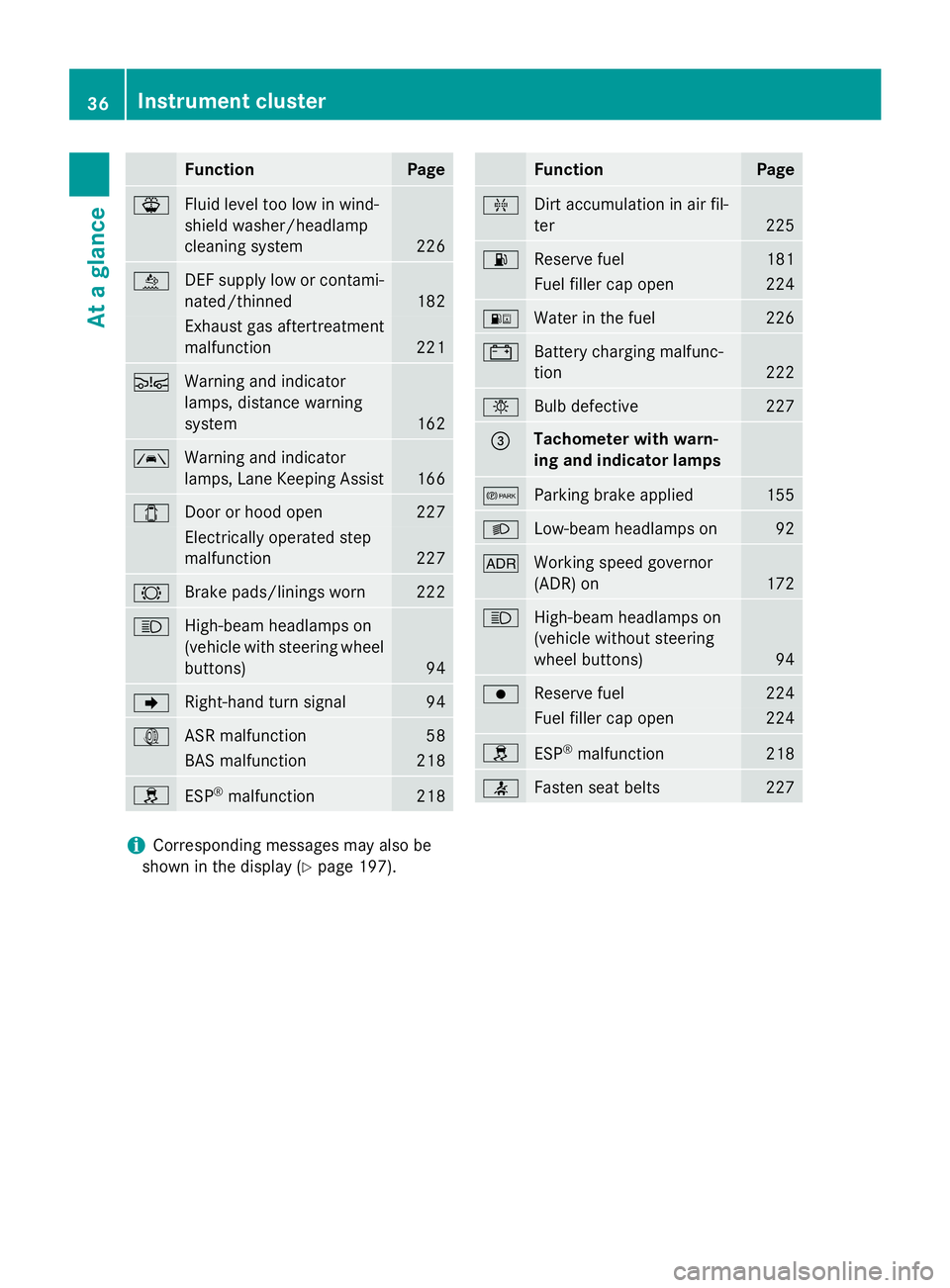
Function Page
00B1
Fluid level too low in wind-
shield washer/headlamp
cleaning system
226
00E2
DEF supply low or contami-
nated/thinned 182
Exhaust gas aftertreatment
malfunction 221
00C7
Warning and indicator
lamps, distance warning
system
162
00B0
Warning and indicator
lamps, Lane Keeping Assist
166
003E
Door or hood open 227
Electrically operated step
malfunction 227
0026
Brake pads/linings worn 222
0057
High-beam headlamps on
(vehicle with steering wheel
buttons) 94
004D
Right-hand turn signal 94
003D
ASR malfunction 58
BAS malfunction 218
0089
ESP
®
malfunction 218 Function Page
009F
Dirt accumulation in air fil-
ter
225
00B4
Reserve fuel 181
Fuel filler cap open 224
00B8
Water in the fuel 226
003D
Battery charging malfunc-
tion
222
0049
Bulb defective 227
0087 Tachometer with warn-
ing and indicator lamps 0066
Parking brake applied 155
0058
Low-beam headlamps on 92
004E
Working speed governor
(ADR) on
172
0057
High-beam headlamps on
(vehicle without steering
wheel buttons) 94
0077
Reserve fuel 224
Fuel filler cap open 224
0089
ESP
®
malfunction 218
0076
Fasten seat belts 227
i
Corresponding messages may also be
shown in the display (Y page 197).36
Instrument clusterAt a glance
Page 39 of 334
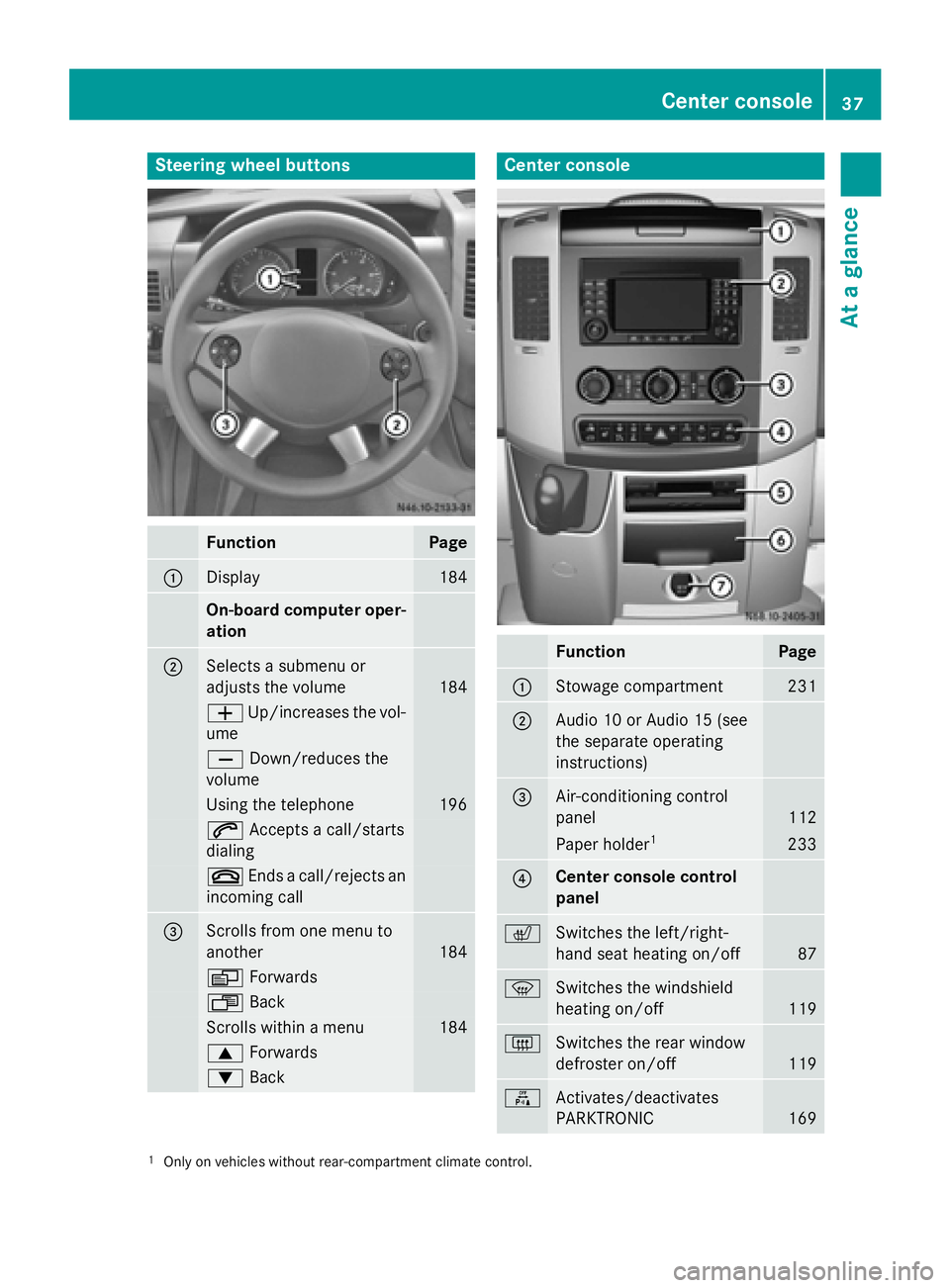
Steering wheel buttons
Function Page
0043
Display 184
On-board computer oper-
ation 0044
Selects a submenu or
adjusts the volume
184
0081
Up/increases the vol-
ume 0082
Down/reduces the
volume Using the telephone 196
0061
Accepts a call/starts
dialing 0076
Ends a call/rejects an
incoming call 0087
Scrolls from one menu to
another
184
0080
Forwards 007F
Back Scrolls within a menu 184
0063
Forwards 0064
Back Center console
Function Page
0043
Stowage compartment 231
0044
Audio 10 or Audio 15 (see
the separate operating
instructions)
0087
Air-conditioning control
panel
112
Paper holder
1 233
0085 Center console control
panel
0072
Switches the left/right-
hand seat heating on/off
87
0085
Switches the windshield
heating on/off
119
0071
Switches the rear window
defroster on/off
119
0069
Activates/deactivates
PARKTRONIC
169
1
Only on vehicles without rear-compartment climate control. Center console
37At a glance
Page 41 of 334
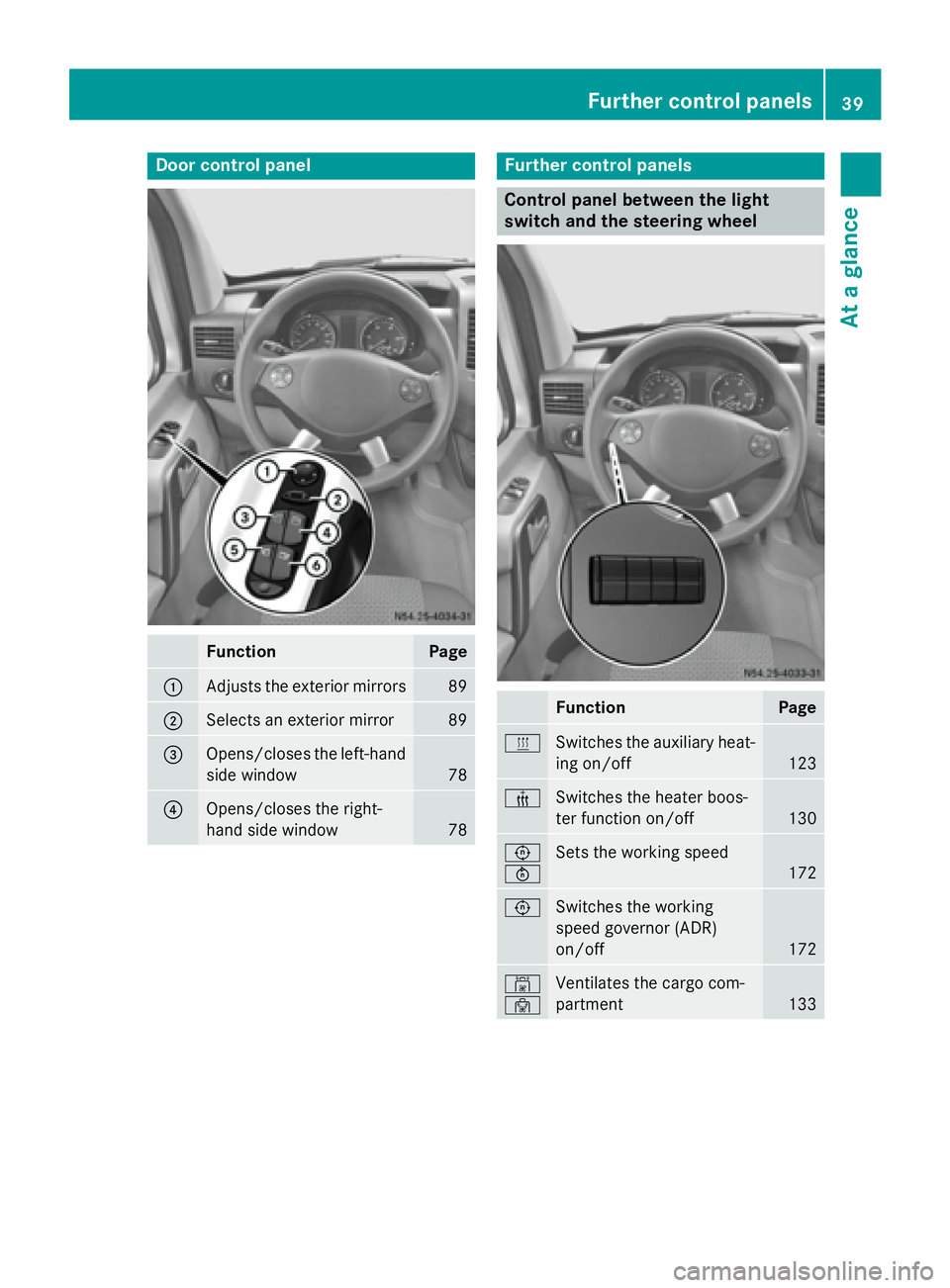
Door control panel
Function Page
0043
Adjusts the exterior mirrors 89
0044
Selects an exterior mirror 89
0087
Opens/closes the left-hand
side window 78
0085
Opens/closes the right-
hand side window 78 Further control panels
Control panel between the light
switch and the steering wheel
Function Page
0084
Switches the auxiliary heat-
ing on/off 123
00AB
Switches the heater boos-
ter function on/off
130
0091
0092
Sets the working speed
172
0091
Switches the working
speed governor (ADR)
on/off
172
00A8
00A7
Ventilates the cargo com-
partment
133Further cont
rol panels
39At a glance
Page 42 of 334
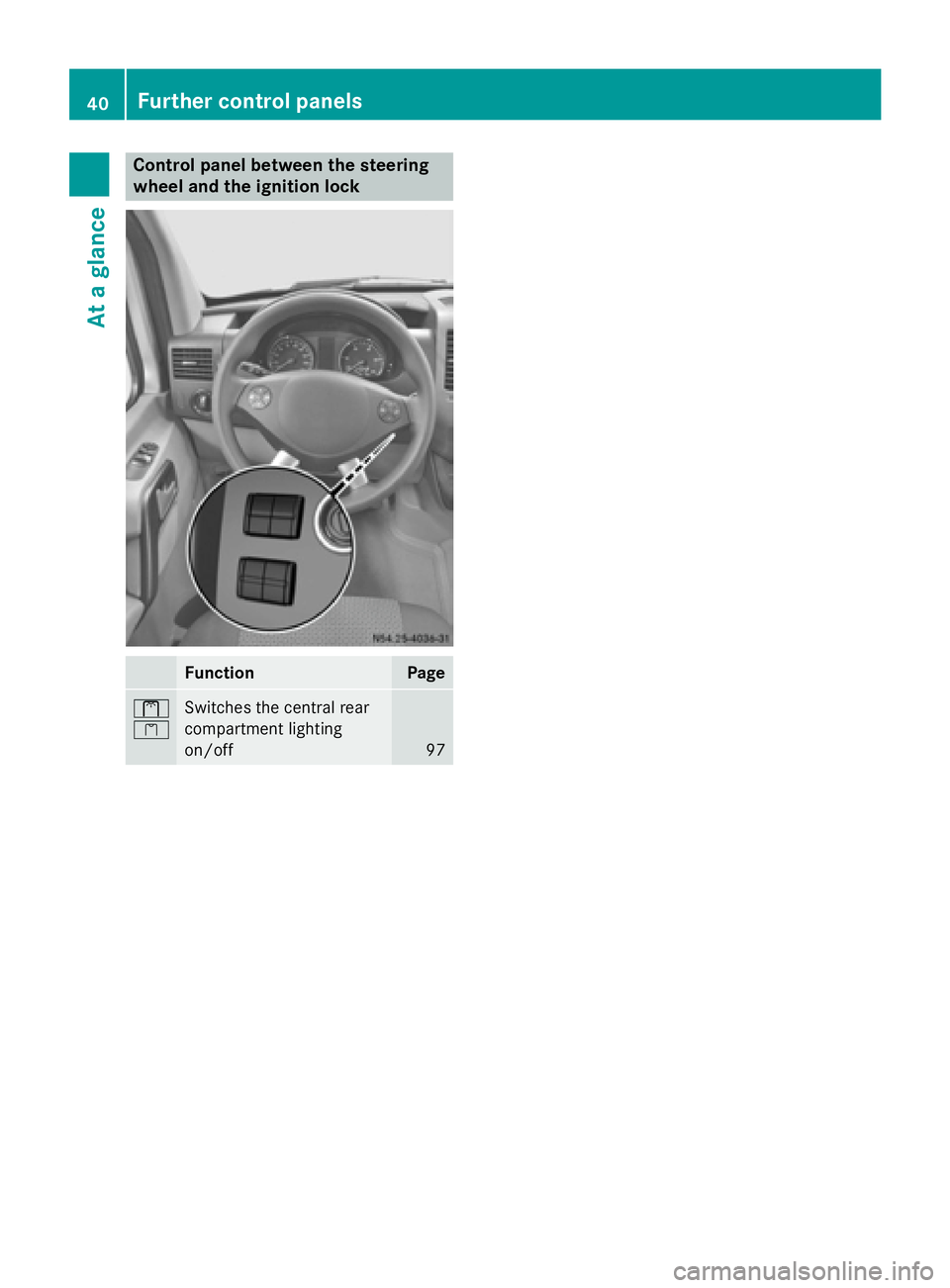
Control panel between the steering
wheel and the ignition lock Function Page
0039
0038
Switches the central rear
compartment lighting
on/off
9740
Further control panelsAt a glance
Page 44 of 334
Useful information
This Operator's Manual describes all models
as well as standard and optional equipment of your vehicle that were available at the time of going to print. Country-specific variations are
possible. Note that your vehicle may not be
equipped with all of the described functions.
This also applies to systems and functions
relevant to safety.
Read the information on qualified specialist
workshops (Y page 25). Occupant safety
Restraint system introduction
The restraint system reduces the risk of vehi- cle occupants coming into contact with parts of the vehicle's interior in the event of an
accident. The restraint system can also
reduce the forces to which vehicle occupants
are subjected during an accident.
The restraint system comprises:
R Seat belt system
R Air bags
R Child restraint system
R Child seat securing systems
The components of the restraint system work
in conjunction with each other. They can only
deploy their protective function if, at all times,
all vehicle occupants:
R have fastened their seat belts correctly
(Y page 45)
R have adjusted their seat and head restraint
properly (Y page 82).
As the driver, you also have to make sure that
the steering wheel is adjusted correctly.
Observe the information relating to the cor-
rect driver's seat position (Y page 82).
You also have to make sure that an air bag can inflate properly if deployed (Y page 47).
An air bag supplements a correctly worn seat
belt. As an additional safety device, the air
bag increases the level of protection for vehi- cle occupants in the event of an accident. For
example, if, in the event of an accident, the
protection offered by the seat belt is suffi-
cient, the air bags are not deployed. When an
accident occurs, only the air bags that
increase protection in that particular accident
situation are deployed. However, seat belts
and air bags generally do not protect against objects penetrating the vehicle from the out-
side.
Information on restraint system operation
can be found under "Deployment of Emer-
gency Tensioning Devices and air bags"
(Y page 49).
For more information about children traveling with you in the vehicle and on child restraint
systems, see "Children in the vehicle"
(Y page 51). Important safety notes
G
WARNING
Modifications to the restraint system, may
cause it to no longer work as intended. The
restraint system may then not perform its
intended protective function and may fail in an accident or trigger unexpectedly, for example.
This poses an increased risk of injury or even fatal injury.
Never modify parts of the restraint system.
Never tamper with the wiring, the electronic
components or their software.
If it is necessary to modify an airbag system to
accommodate a person with disabilities, con- tact an authorized Sprinter dealership for
details. USA only: contact our Customer
Assistance Center at 1‑877‑762 ‑8267 for
details. Restraint system warning lamp
The restraint systems functions are checked
after the ignition is switched on and at regular
intervals when the engine is running. This 42
Occupant safetySafety
Page 49 of 334
If the driver unfastens their seat belt during
the journey, the belt warning is automatically activated again.
i For more information on the
0076seat
belt warning lamp, see "Warning and indi-
cator lamps in the instrument cluster"
(Y page 227). Air bags
Introduction The installation point of an air bag can be rec-
ognized by the SRS/AIR BAG or AIR BAG sym-
bol.
An air bag complements the correctly fas-
tened seat belt. It is no substitute for the seat belt. The air bag provides additional protec-
tion in applicable accident situations.
Not all air bags are deployed in an accident.
The different air bag systems function inde-
pendently from one another (Y page 49).
However, no system available today can com- pletely eliminate injuries and fatalities.
It is also not possible to rule out a risk of injury
caused by an air bag due to the high speed at which the air bag must be deployed.
Important safety notes G
WARNING
If you do not sit in the correct seat position,
the air bag cannot protect as intended and
could even cause additional injury when
deployed. This poses an increased risk of
injury or even fatal injury.
To avoid hazardous situations, always make
sure that all of the vehicle's occupants:
R have fastened their seat belts correctly,
including pregnant women
R are sitting correctly and maintain the great-
est possible distance to the air bags
R follow the following instructions Always make sure that there are no objects
between the air bag and the vehicle's occu-
pants.
R Adjust the seats properly before beginning
your journey. Always make sure that the
seat is in an almost upright position. The
center of the head restraint must support
the head at about eye level.
R Move the driver's and front-passenger
seats as far back as possible. The driver's
seat position must allow the vehicle to be
driven safely.
R Only hold the steering wheel on the out-
side. This allows the air bag to be fully
deployed.
R Always lean against the backrest while driv-
ing. Do not lean forwards or lean against
the door or side window. You may other-
wise be in the deployment area of the air
bags.
R Always keep your feet in the footwell in
front of the seat. Do not put your feet on the
dashboard, for example. Your feet may oth-
erwise be in the deployment area of the air bag.
R For this reason, always secure persons less
than 5 ft (1.50 m) tall in suitable restraint
systems. Up to this height, the seat belt
cannot be worn correctly.
If a child is traveling in your vehicle, also
observe the following notes:
R Always secure children under 12 years of
age and less than 5 ft (1.50 m)in height in
suitable child restraint systems.
R Child restraint systems should be installed
on the rear seats.
R Always secure a child in a rearward-facing
child restraint system on a suitable rear
seat. The front-passenger front air bag can-
not be deactivated.
R Always observe the instructions and safety
notes on "Children in the vehicle"
(Y page 51) and on the "Child restraint
system on the front-passenger seat"
(Y page 55) in addition to the child Occupant safety
47Safety Z
Page 50 of 334
restraint system manufacturer's installa-
tion instructions.
Objects in the vehicle interior may pre-
vent an air bag from functioning correctly.
Before starting your journey and to avoid risks
resulting from the speed of the air bag as it
deploys, make sure that:
R there are no people, animals or objects
between the vehicle occupants and an air
bag.
R there are no objects between the seat, door
and B-pillar.
R no hard objects, e.g. coat hangers, hang on
the grab handles or coat hooks.
R no accessories, such as cup holders, are
attached to the vehicle within the deploy-
ment area of an air bag, e.g. to doors or side
windows.
R no heavy, sharp-edged or fragile objects
are in the pockets of your clothing. Store
such objects in a suitable place. G
WARNING
If you modify the air bag cover or affix objects
such as stickers to it, the air bag can no longer function correctly. There is an increased risk
of injury.
Never modify an air bag cover or affix objectsto it. G
WARNING
Sensors to control the air bags are located in the doors. Modifications or work not per-
formed correctly to the doors or door panel-
ing, as well as damaged doors, can lead to the
function of the sensors being impaired. The air bags might therefore not function properly
any more. Consequently, the air bags cannot
protect vehicle occupants as they are
designed to do. There is an increased risk of
injury.
Never modify the doors or parts of the doors.
Always have work on the doors or door pan-
eling carried out at a qualified specialist work- shop. Front air bags
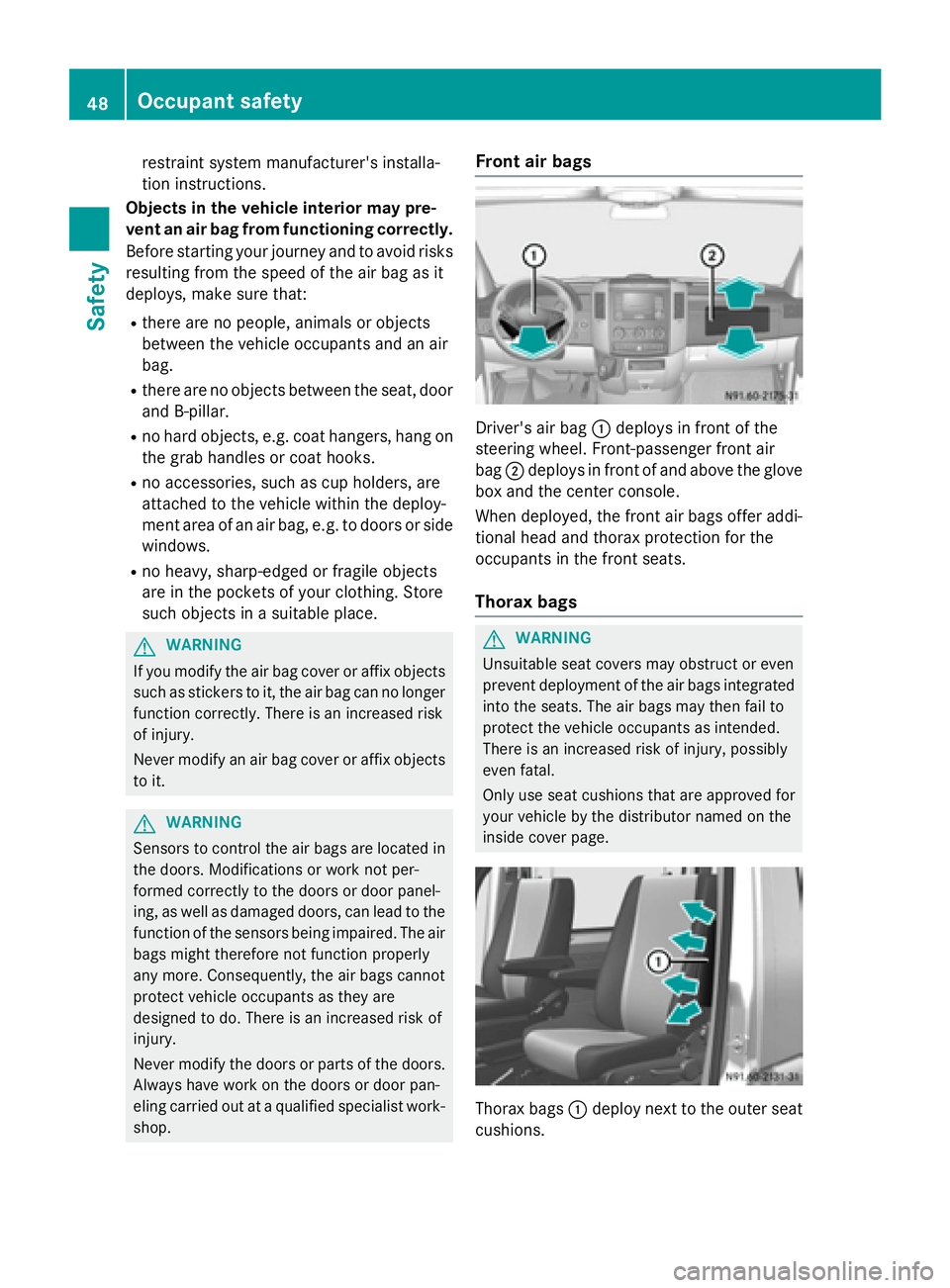
Driver's air bag
0043deploys in front of the
steering wheel. Front-passenger front air
bag 0044deploys in front of and above the glove
box and the center console.
When deployed, the front air bags offer addi- tional head and thorax protection for the
occupants in the front seats.
Thorax bags G
WARNING
Unsuitable seat covers may obstruct or even
prevent deployment of the air bags integrated into the seats. The air bags may then fail to
protect the vehicle occupants as intended.
There is an increased risk of injury, possibly
even fatal.
Only use seat cushions that are approved for
your vehicle by the distributor named on the
inside cover page. Thorax bags
0043deploy next to the outer seat
cushions. 48
Occupant safetySafety
Page 59 of 334
As a result, they could:
R activate vehicle equipment and become
trapped, for example
R activate or deactivate systems, thereby
endangering other road users
Unsecured animals could also be flung around the vehicle in the event of an accident or sud-
den steering or braking, thereby injuring vehi- cle occupants. There is a risk of an accident
and injury.
Never leave animals unattended in the vehi-
cle. Always secure animals properly during
the journey, e.g. use a suitable animal trans-
port box. Driving safety systems
Overview
In this section, you will find information about the following driving safety systems:
R ABS ( Anti-lock BrakingSystem)
R ASR (A cceleration SkidControl)
R BAS (B rakeAssist System)
R EBD ( Electronic Brake Force Distribution)
R ESP ®
(E lectronic StabilityProgram) Important safety notes
If you fail to adapt your driving style or if you
are inattentive, the driving safety systems can
neither reduce the risk of accident nor over-
ride the laws of physics. Driving safety sys-
tems are merely aids designed to assist driv- ing. You are responsible for the distance to
the vehicle in front, for vehicle speed, braking in good time and for staying in your lane.
Always adapt your driving style to the prevail-
ing road and weather conditions and maintain a sufficient, safe distance from other road
users. Drive carefully.
The driving safety systems described can only
attain their maximum effectiveness when
there is optimum contact between the tires and the road can. Pay particular attention to
the information regarding tires, recommen-
ded minimum tire tread depth etc. under
"Wheels and tires" (Y page 284).
In wintry driving conditions, always use winter
tires (M+S tires) and if necessary, snow
chains. This is the only way to get the full
benefit from the driving safety systems
described. ABS (Anti-lock Braking System)
Important safety notes Observe the important safety guidelines for
the driving safety system (Y
page 57). G
WARNING
If ABS is faulty, the wheels could lock when
braking. The steerability and braking charac-
teristics may be severely impaired. Addition-
ally, further driving safety systems are deac-
tivated. There is an increased danger of skid- ding and accidents.
Drive on carefully. Have ABS checked imme-
diately at a qualified specialist workshop.
If ABS is malfunctioning, other systems will
also fail, including driving safety systems.
Observe the information relating to the 0025
warning lamp (Y page 218).
ABS regulates brake pressure in such a way
that the wheels do not lock when you brake.
This allows you to continue steering the vehi-
cle when braking.
ABS works from a speed of about 5 mph
(8 km/h), regardless of road-surface condi-
tions. ABS works on slippery surfaces, even
when you only brake gently.
The yellow 0025warning lamp in the instru-
ment cluster lights up when the ignition is
switched on. The lamp goes out when the
engine starts running. Driving safety systems
57Safety Z
Page 60 of 334
Braking
If ABS intervenes when braking, you will feel a
pulsating in the brake pedal.
The pulsating brake pedal can be an indica-
tion of hazardous road conditions and func-
tions as a reminder to take extra care while
driving.
X If ABS intervenes: continue to depress the
brake pedal with force until the braking sit-
uation is over.
X To make a full brake application:
depress the brake pedal with full force. ASR (acceleration skid control)
General notes Important safety notes
Observe the important safety guidelines for
the driving safety system (Y
page 57).
ASR can neither reduce the risk of an accident nor suspend the laws of physics if the driver
does not pay attention when pulling away or
accelerating. ASR is only an aid. Always adapt
your driving style to suit the prevailing road
and weather conditions.
Vehicles without steering wheel buttons: if
ASR is malfunctioning, the 003Dindicator
lamp lights up while the engine is running and the engine power may be reduced
(Y page 218).
ASR significantly improves traction, i.e. the
transmission of power from the tires to the
road surface, and thus increases the vehicle's driving stability. If the driving wheels start to
spin, ASR brakes individual drive wheels and
limits the engine torque. ASR thus signifi-
cantly assists you when pulling away and
accelerating, especially on wet or slippery
roads.
If traction on the road surface is not sufficient,
even ASR will not allow you to pull away with- out difficulty. The type of tires and total
weight of the vehicle as well as the gradient of
the road also play a crucial role. If ASR intervenes, the
0072warning lamp in
the instrument cluster flashes.
Activating/deactivating ASR G
WARNING
If deactivated, ASR will not attempt to stabi-
lize the vehicle during pulling away and accel- eration. There is an increased risk of skiddingand of an accident.
Only deactivate ASR in the situations descri-
bed in the following.
! If you deactivate ASR, ESP ®
will still inter-
vene to stabilize the vehicle. Frequent brak-
ing automatically triggered by ESP ®
can
damage the brake system.
For this reason, deactivate ASR only briefly and when absolutely necessary. When ESP
®
is intervening and the 0072warn-
ing lamp in the instrument cluster is flashing,
leave ASR on. In this case, only depress the
accelerator pedal as far as required when
pulling away.
X Press the 00E3button.
If ASR is deactivated, the 0072warning
lamp in the instrument cluster lights up.
ASR is automatically activated when the
engine is started.
It may be best to deactivate ASR briefly in the
following situations:
R when using snow chains
R in deep snow
R on sand or gravel 58
Driving safety systemsSafety
Page 61 of 334
If you deactivate ASR:
R engine torque is not limited and the drive
wheels are able to spin. The spinning
wheels will then achieve a cutting effect for
better traction.
R traction control remains active through
brake intervention. If a drive wheel attains
its tire traction limit because one side of the
road is slippery, for example, that wheel is
braked. The traction is then increased in
this situation.
R active brake intervention by ESP ®
to
increase driving stability remains active.
The 0072 warning lamp in the instrument
cluster flashes when ESP ®
is intervening. BAS (Brake Assist System)
G
WARNING
If BAS is malfunctioning, the braking distance
in an emergency braking situation is
increased. There is a risk of an accident.
In an emergency braking situation, depress
the brake pedal with full force. ABS prevents
the wheels from locking.
Vehicles without steering wheel buttons: if
the BAS driving safety system is malfunction-
ing, the 003Dwarning lamp lights up while the
engine is running (Y page 218).
BAS operates in emergency braking situa-
tions. If you depress the brake quickly, BAS
automatically increases the brake pressure,
thereby reducing the stopping distance.
The brakes will function as usual once you
release the brake pedal. BAS is deactivated. EBD (electronic brake force distribu-
tion) G
WARNING
If EBD is malfunctioning, the rear wheels can
lock, e.g. under full braking. This increases the risk of skidding and an accident. You should therefore adapt your driving style
to the different handling characteristics. Have
the brake system checked at a qualified spe-
cialist workshop.
EBD monitors and controls the brake pres-
sure to the rear wheels. This enables EBD to
improve handling during braking.
Observe the information on warning and indi- cator lamps (Y page 218). ESP
®
(Electronic Stability Program)
Important safety notes Observe the important safety guidelines for
the driving safety system (Y
page 57). G
WARNING
If ESP ®
is malfunctioning it will not provide
any vehicle stabilization. There is an increased
risk of skidding or of an accident.
Exercise caution when continuing to drive.
Have ESP ®
checked at a qualified specialist
workshop.
! Do not run the vehicle on a roller dyna-
mometer (e.g. for performance tests). If
you must operate the vehicle on a roller
dynamometer, please consult a qualified
specialist workshop in advance. You could
otherwise damage the drive train or the
brake system.
If ESP ®
is malfunctioning, the 0089warning
lamp lights up while the engine is running and
the engine power may be reduced
(Y page 218).
Only use wheels with the recommended tire
sizes. Only then will ESP ®
function properly.
Crosswind Assist Crosswind Assist does not work if ESP
®
is
deactivated or disabled because of a mal-
function. Driving safety systems
59Safety Z