catalytic converter MERCEDES-BENZ SPRINTER 2015 MY15 Operator’s Manual
[x] Cancel search | Manufacturer: MERCEDES-BENZ, Model Year: 2015, Model line: SPRINTER, Model: MERCEDES-BENZ SPRINTER 2015Pages: 334, PDF Size: 5.94 MB
Page 215 of 334
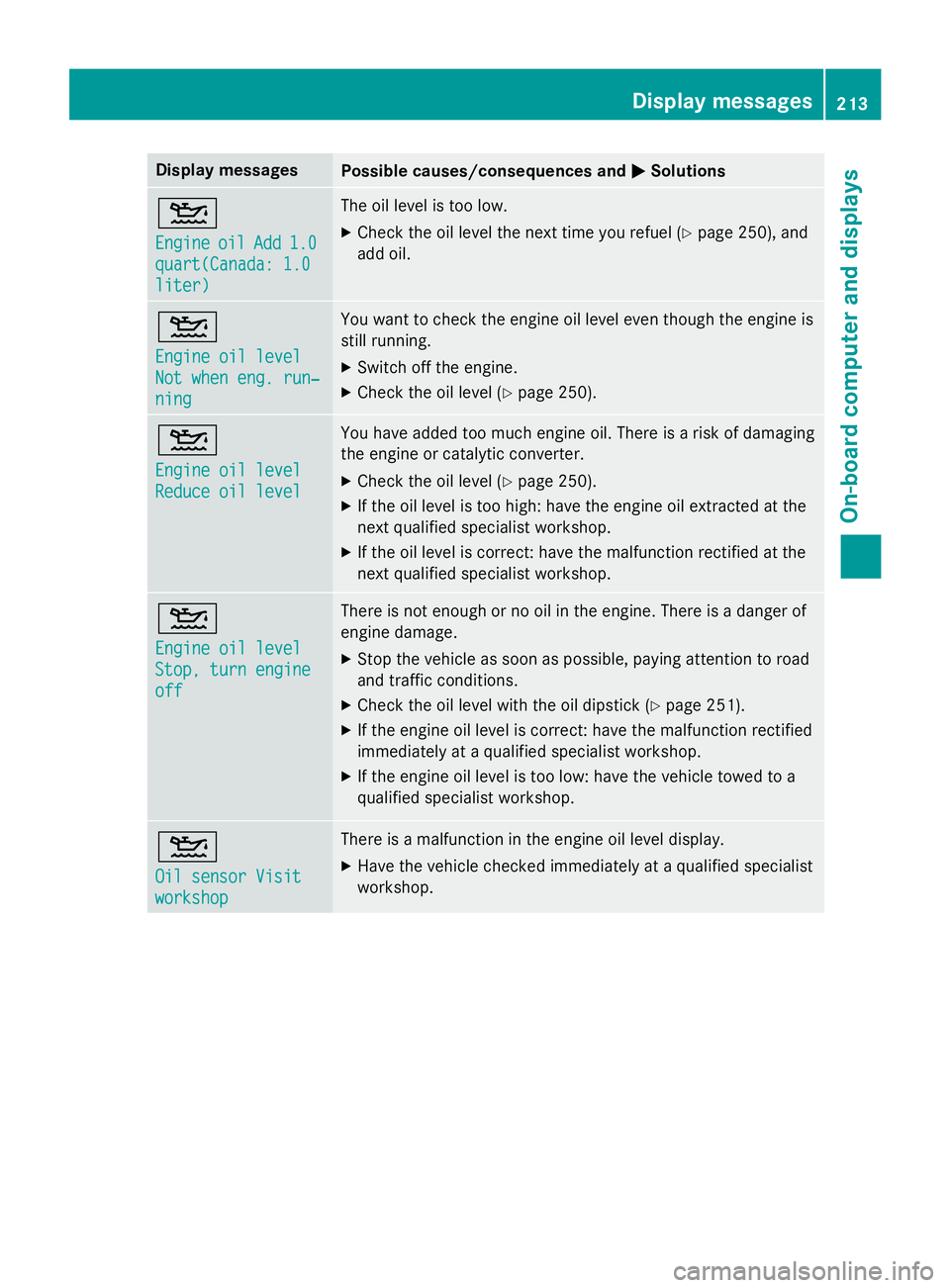
Display messages
Possible causes/consequences and
0050
0050Solutions 00B2
Engine Engine
oil
oilAdd
Add 1.0
1.0
quart(Canada: 1.0
quart(Canada: 1.0
liter) liter) The oil level is too low.
X Check the oil level the next time you refuel (Y page 250), and
add oil. 00B2
Engine oil level Engine oil level
Not when eng. run‐ Not when eng. run‐
ning ning You want to check the engine oil level even though the engine is
still running.
X Switch off the engine.
X Check the oil level (Y page 250).00B2
Engine oil level Engine oil level
Reduce oil level Reduce oil level You have added too much engine oil. There is a risk of damaging
the engine or catalytic converter.
X Check the oil level (Y page 250).
X If the oil level is too high: have the engine oil extracted at the
next qualified specialist workshop.
X If the oil level is correct: have the malfunction rectified at the
next qualified specialist workshop. 00B2
Engine oil level Engine oil level
Stop, turn engine Stop, turn engine
off off There is not enough or no oil in the engine. There is a danger of
engine damage.
X Stop the vehicle as soon as possible, paying attention to road
and traffic conditions.
X Check the oil level with the oil dipstick (Y page 251).
X If the engine oil level is correct: have the malfunction rectified
immediately at a qualified specialist workshop.
X If the engine oil level is too low: have the vehicle towed to a
qualified specialist workshop. 00B2
Oil sensor Visit Oil sensor Visit
workshop workshop There is a malfunction in the engine oil level display.
X Have the vehicle checked immediately at a qualified specialist
workshop. Display
messages
213On-board computer and displays Z
Page 225 of 334
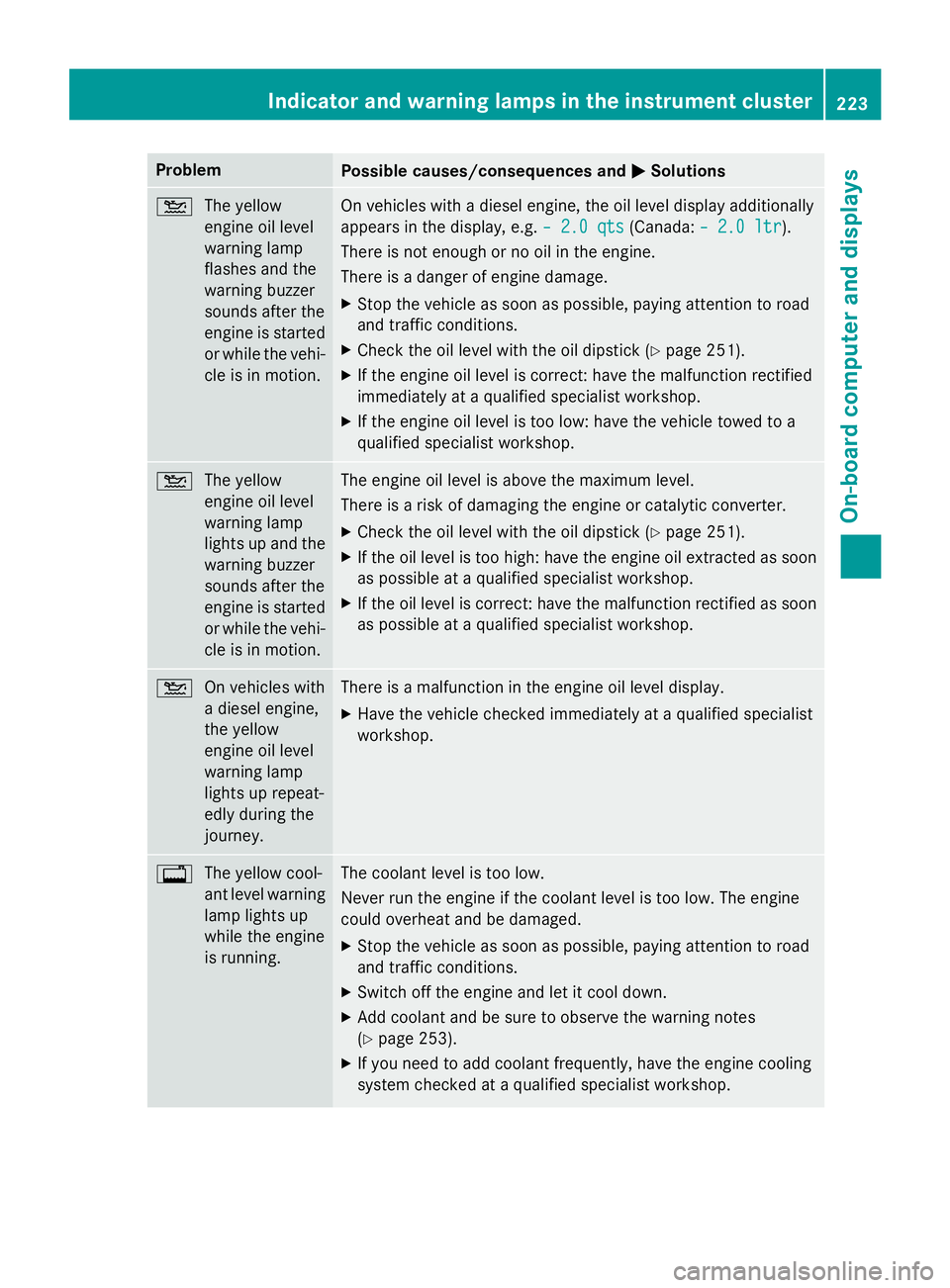
Problem
Possible causes/consequences and
0050
0050Solutions 00B2
The yellow
engine oil level
warning lamp
flashes and the
warning buzzer
sounds after the
engine is started
or while the vehi-
cle is in motion. On vehicles with a diesel engine, the oil level display additionally
appears in the display, e.g.
– 2.0 qts – 2.0 qts(Canada:– 2.0 ltr
– 2.0 ltr).
There is not enough or no oil in the engine.
There is a danger of engine damage.
X Stop the vehicle as soon as possible, paying attention to road
and traffic conditions.
X Check the oil level with the oil dipstick (Y page 251).
X If the engine oil level is correct: have the malfunction rectified
immediately at a qualified specialist workshop.
X If the engine oil level is too low: have the vehicle towed to a
qualified specialist workshop. 00B2
The yellow
engine oil level
warning lamp
lights up and the
warning buzzer
sounds after the
engine is started
or while the vehi-
cle is in motion. The engine oil level is above the maximum level.
There is a risk of damaging the engine or catalytic converter.
X Check the oil level with the oil dipstick (Y page 251).
X If the oil level is too high: have the engine oil extracted as soon
as possible at a qualified specialist workshop.
X If the oil level is correct: have the malfunction rectified as soon
as possible at a qualified specialist workshop. 00B2
On vehicles with
a diesel engine,
the yellow
engine oil level
warning lamp
lights up repeat-
edly during the
journey. There is a malfunction in the engine oil level display.
X Have the vehicle checked immediately at a qualified specialist
workshop. 003F
The yellow cool-
ant level warning
lamp lights up
while the engine
is running. The coolant level is too low.
Never run the engine if the coolant level is too low. The engine
could overheat and be damaged.
X Stop the vehicle as soon as possible, paying attention to road
and traffic conditions.
X Switch off the engine and let it cool down.
X Add coolant and be sure to observe the warning notes
(Y page 253).
X If you need to add coolant frequently, have the engine cooling
system checked at a qualified specialist workshop. Indicator and warning lamps in the instrument cluster
223On-board computer and displays Z
Page 254 of 334
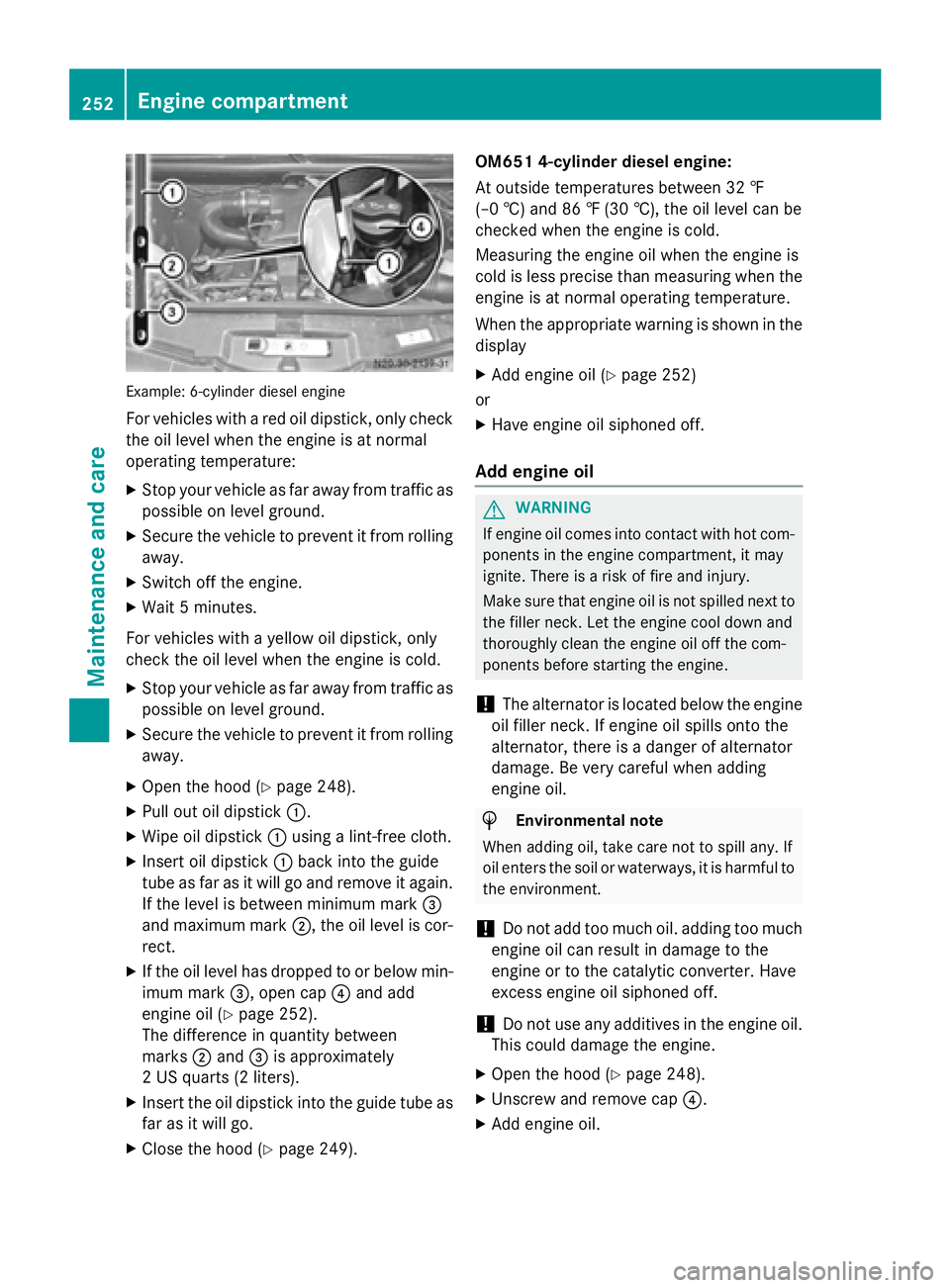
Example: 6-cylinder diesel engine
For vehicles with a red oil dipstick, only checkthe oil level when the engine is at normal
operating temperature:
X Stop your vehicle as far away from traffic as
possible on level ground.
X Secure the vehicle to prevent it from rolling
away.
X Switch off the engine.
X Wait 5 minutes.
For vehicles with a yellow oil dipstick, only
check the oil level when the engine is cold.
X Stop your vehicle as far away from traffic as
possible on level ground.
X Secure the vehicle to prevent it from rolling
away.
X Open the hood (Y page 248).
X Pull out oil dipstick 0043.
X Wipe oil dipstick 0043using a lint-free cloth.
X Insert oil dipstick 0043back into the guide
tube as far as it will go and remove it again.
If the level is between minimum mark 0087
and maximum mark 0044, the oil level is cor-
rect.
X If the oil level has dropped to or below min-
imum mark 0087, open cap 0085and add
engine oil (Y page 252).
The difference in quantity between
marks 0044and 0087is approximately
2 US quarts (2 liters).
X Insert the oil dipstick into the guide tube as
far as it will go.
X Close the hood (Y page 249). OM651 4-cylinder diesel engine:
At outside temperatures between 32 ‡
(–0 †) and 86 ‡ (30 †), the oil level can be
checked when the engine is cold.
Measuring the engine oil when the engine is
cold is less precise than measuring when the
engine is at normal operating temperature.
When the appropriate warning is shown in the
display
X Add engine oil (Y page 252)
or X Have engine oil siphoned off.
Add engine oil G
WARNING
If engine oil comes into contact with hot com- ponents in the engine compartment, it may
ignite. There is a risk of fire and injury.
Make sure that engine oil is not spilled next to
the filler neck. Let the engine cool down and
thoroughly clean the engine oil off the com-
ponents before starting the engine.
! The alternator is located below the engine
oil filler neck. If engine oil spills onto the
alternator, there is a danger of alternator
damage. Be very careful when adding
engine oil. H
Environmental note
When adding oil, take care not to spill any. If
oil enters the soil or waterways, it is harmful to the environment.
! Do not add too much oil. adding too much
engine oil can result in damage to the
engine or to the catalytic converter. Have
excess engine oil siphoned off.
! Do not use any additives in the engine oil.
This could damage the engine.
X Open the hood (Y page 248).
X Unscrew and remove cap 0085.
X Add engine oil. 252
Engine compartmentMaintenance and care
Page 323 of 334
!
If DEF comes into contact with a painted
or aluminum surface, wash the surface off
immediately with plenty of water.
High ambient temperatures
When opening the DEF tank filler cap at high
outside temperatures, ammonia vapors may
escape. Ammonia vapors have a pungent
odor and are particularly irritating for your
skin, respiratory organs and eyes. This may
result in burning eyes, nose and throat, as
well as coughing and watering eyes. Do not
inhale ammonia vapors.
If DEF heats up, e.g. in direct sunlight, in the
DEF supply reservoir for some time to over
122 ‡ (50 †), ammonia vapor will develop.
Low ambient temperatures
DEF freezes at a temperature of approx-
imately 12 ‡(00F811 †). The vehicle is equipped
with a DEF preheating system at the factory.
Winter operation is therefore also guaranteed at temperatures under 12 ‡ (00F811 †).
Additives and tap water
! Do not mix DEF with any additives and do
not dilute DEF with tap water. Otherwise,
the exhaust gas aftertreatment may be
damaged.
Observe the MB Specifications for Service
Products, Sheet No. 352.0.
Damage that arises through the use of addi- tives or tap water will invalidate the New
Vehicle Limited Warranty.
Storage
! Containers made of aluminum, copper,
copper alloys as well as unalloyed or
galvanized steel are not suitable for storing
DEF. If stored in these types of containers, DEF could cause constituents of these met- als to dissolve and cause irreparable dam-
age to the exhaust gas aftertreatment.
Damage caused by such impurities in the
DEF will invalidate the New Vehicle Limited
Warranty. Only store DEF in containers made of high-
alloy Cr‑Ni steel or Mo‑Cr‑Ni steel in accord-
ance with DIN EN 10 088 ‑1/2/3 or plastic
containers made of polypropylene or poly-
ethylene.
Purity
! Impurities in DEF (e.g. caused by other
service products, cleaning agents, dust,
etc.) result in increased emissions, mal-
functions, catalytic converter damage or
engine damage.
The purity of DEF is essential to prevent mal-
functions in the exhaust gas aftertreatment.
If DEF is pumped out of the DEF tank, e.g.
during repair work, the same liquid must not
be used to refill the tank. Its purity is no longer guaranteed.
Disposal
Observe country-specific laws and regula-
tions when disposing of DEF.
003D Environmental note
Dispose of DEF in an environmentally respon- sible manner.
DEF supply reservoir content
Depending on equipment, the DEF supply res-
ervoir content may vary. Tank contents
Diesel Exhaust Fluid (DEF)
12 Approximately 4.7 US gal (18.0 l)
DEF consumption
For vehicles with a 4-cylinder, in-line
engine (OM 651), the DEF consumption of
the vehicle is:
R as a Cargo Van/Passenger Van, approx.
2322 MPG (0.2 l/100 km)
R as a Cab Chassis, approx. 1720 MPG
(0.35 l/100 km)
12 DEF according to ISO 22241. Observe MB Specifications for Service Products, Sheet 352.0. Service products and capacities
321Technical data Z
Page 325 of 334
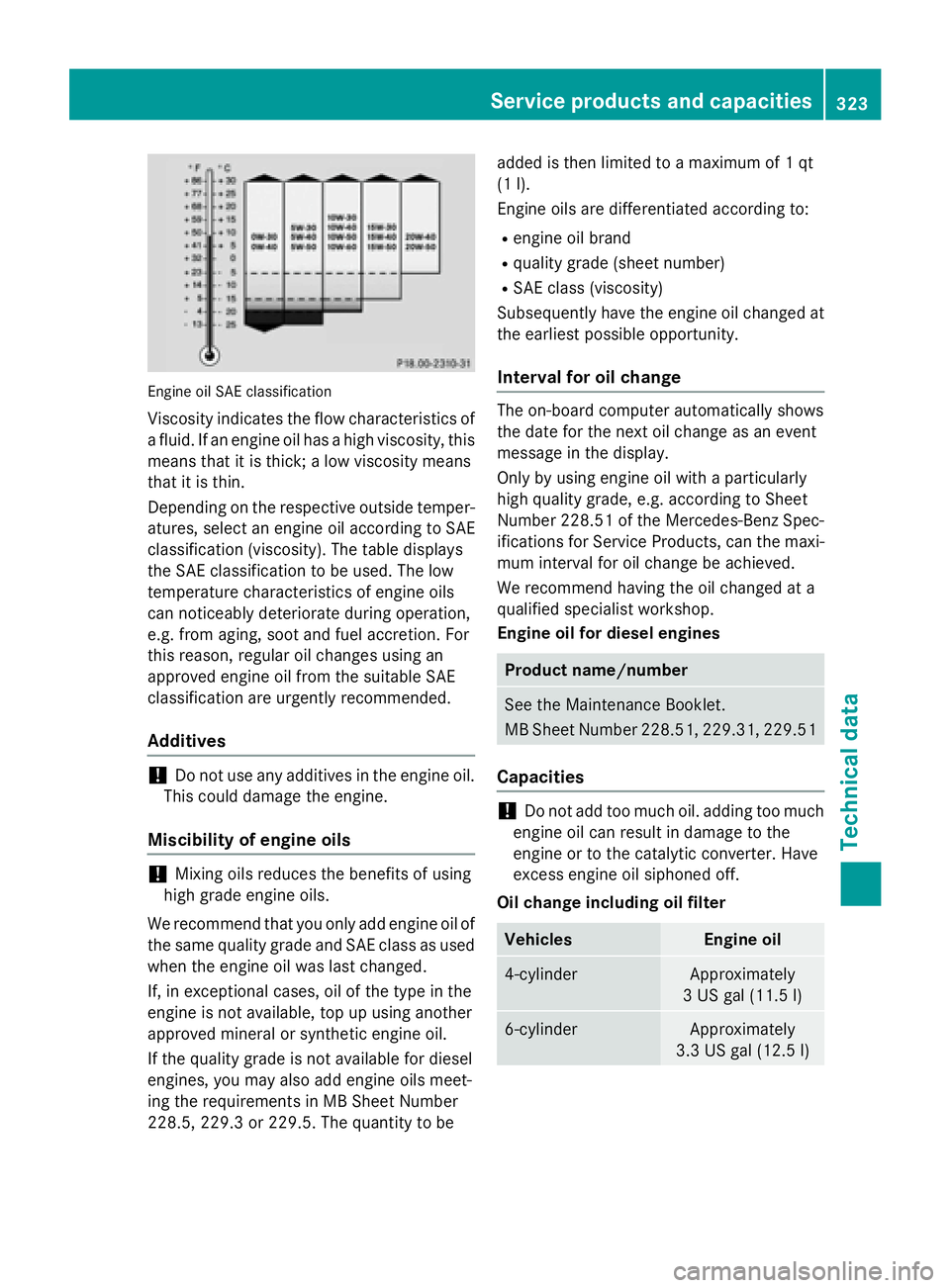
Engine oil SAE classification
Viscosity indicates the flow characteristics of a fluid. If an engine oil has a high viscosity, thismeans that it is thick; a low viscosity means
that it is thin.
Depending on the respective outside temper- atures, select an engine oil according to SAE
classification (viscosity). The table displays
the SAE classification to be used. The low
temperature characteristics of engine oils
can noticeably deteriorate during operation,
e.g. from aging, soot and fuel accretion. For
this reason, regular oil changes using an
approved engine oil from the suitable SAE
classification are urgently recommended.
Additives !
Do not use any additives in the engine oil.
This could damage the engine.
Miscibility of engine oils !
Mixing oils reduces the benefits of using
high grade engine oils.
We recommend that you only add engine oil of
the same quality grade and SAE class as used when the engine oil was last changed.
If, in exceptional cases, oil of the type in the
engine is not available, top up using another
approved mineral or synthetic engine oil.
If the quality grade is not available for diesel
engines, you may also add engine oils meet-
ing the requirements in MB Sheet Number
228.5, 229.3 or 229.5. The quantity to be added is then limited to a maximum of 1 qt
(1 l).
Engine oils are differentiated according to:
R engine oil brand
R quality grade (sheet number)
R SAE class (viscosity)
Subsequently have the engine oil changed at
the earliest possible opportunity.
Interval for oil change The on-board computer automatically shows
the date for the next oil change as an event
message in the display.
Only by using engine oil with a particularly
high quality grade, e.g. according to Sheet
Number 228.51 of the Mercedes-Benz Spec-
ifications for Service Products, can the maxi-
mum interval for oil change be achieved.
We recommend having the oil changed at a
qualified specialist workshop.
Engine oil for diesel engines Product name/number
See the Maintenance Booklet.
MB Sheet Number 228.51, 229.31, 229.51
Capacities
!
Do not add too much oil. adding too much
engine oil can result in damage to the
engine or to the catalytic converter. Have
excess engine oil siphoned off.
Oil change including oil filter Vehicles Engine oil
4-cylinder Approximately
3 US gal (11.5 l) 6-cylinder Approximately
3.3 US gal (12.5 l) Service products and capacities
323Technical data Z