light MERCEDES-BENZ SPRINTER 2016 MY16 Operator’s Manual
[x] Cancel search | Manufacturer: MERCEDES-BENZ, Model Year: 2016, Model line: SPRINTER, Model: MERCEDES-BENZ SPRINTER 2016Pages: 290, PDF Size: 6.44 MB
Page 19 of 290
Removing/mounting ...................... 273
Specia lsea tbelt retractor .................. 48
Specialist worksho p............................ 26
Speed ,controlling
see Cruis econtrol
Speedomete r
Digital (vehicles wit hsteerin g
whee lbuttons ).............................. .170
Digital (vehicles without steering
wheel buttons) ............................... 163
Selecting display unit (vehicles
with steering- wheel buttons) ........1 70
see Instrument cluster
Standing lamps
Replacing bulbs ............................... 87
Replacing bulbs (rear) ......................8 9
Standing lamps (Chassis Cab)
Replacing bulbs (rear) ......................9 0
Start-off assist
Display message ............................1 82
Starting (engine) ................................ 120
Station
see Radio
Steering wheel
Adjusting ......................................... 77
Button overview ............................... 35
Cleaning ......................................... 238
Step
see Electrical step
Stickers
General safety notes ........................ 24
Stowage spaces
see Stowage spaces and stowage
compartments
Stowage spaces and stowage com-
partments
Eyeglasses compartment ...............2 05
Glove box ....................................... 204
Important safety notes .................. 204
Paper holder .................................. 207
Stowage compartment above the
windshield ..................................... 206
Stowage compartment in the cen-
ter console ..................................... 206
Stowage compartment in the
dashboard ...................................... 205
Stowage space above the head-
liner ............................................... 206 Stowage space u
nder the rear
bench seat ..................................... 207
Stowage space under the twin co-
driver's seat ................................... 206
Summer tires ..................................... 249
Switch unit
see Control panel
Switching off the alarm (ATA) ............ 56
Switching the heater booster func-
tion on/off ......................................... 111
Switching the surround lighting
on/off (on-board computer) ............. 172
Swivel seat ........................................... 73
T
Tachometer ........................................ 162
Tail lamps
Changing ......................................... 90
Replacing bulbs ............................... 89
see Lights
Tail lamps (Chassis Cab)
Replacing bulbs ............................... 90
Tank content
Fuel gauge ..................................... 162
Range (vehicles with steering
wheel buttons) ............................... 174
Reserve fuel warning lamp ............. 200
Technical data
Capacities ...................................... 277
Cargo tie-down points .................... 285
Cargo tie-down rings ...................... 285
Loading rails .................................. 285
Roof carrier .................................... 286
Tires/wheels ......................... 257, 272
Trailer tow hitch ............................. 286
Vehicle data ................................... 285
Telephone .................................. 210, 211
Telephone (on-board computer)
Accepting an incoming call ............ 175
Display messages .......................... 193
Numbers from the phone book ...... 175
Operating ....................................... 175
Redialing ........................................ 176
Rejecting or ending a call .............. 175
Temperature
Outside temperature ...................... 162
Setting (climate control) ................ 102
Index17
Page 23 of 290

WheelsChanging a wheel .......................... 266
Checking ........................................ 248
Cleaning ......................................... 235
Important safety notes .................. 247
Installing the adapter (spare
wheel) ............................................ 269
Interchanging/changing ................ 266
Mounting a new wheel ...................2 70
Mounting a wheel .......................... 267
Removing a wheel .......................... 269
Removing and mounting the spare
wheel ............................................. 273
Snow chains .................................. 249
Storing ...........................................2 67
Tightening torque ........................... 271
Wheel size/tire size ....................... 272
Window curtain air bag ....................... 45
Windows
see Side windows
Windshield
Cleaning ......................................... 235
Defrosting ...................................... 103
Windshield heating
Problem (malfunction) ................... 104
Switching on/off ........................... 104
Windshield washer fluid
Adding ...........................................2 24
Indicator lamp ................................ 202
Windshield wipers
Problem (malfunction) ..................... 96
Rain and light sensor ....................... 93
Rear window wiper .......................... 94
Replacing the wiper blades .............. 94
Setting the sensitivity (vehicles
with steering wheel buttons and
rain/light sensor) ........................... 173
Switching on/off .............................. 93
Wiping with windshield washer
fluid ................................................. 93
Winter diesel ..................................... 278
Winter driving
Slippery road surfaces ................... 137
Snow chains .................................. 249
Winter operation
General notes ................................ 249
Radiator cover ................................. 28 Winter tires
M+S tires ................................... .... 249
Setti
ng a limit speed ......................1 34
Wiper blades
Cleaning ......................................... 235
Replacing ......................................... 94
Workshop
see Qualified specialist workshop
Index21
Page 31 of 290
The operating safety of the vehicle could be
jeopardized if you use parts, tires and wheels as
well as accessories relevant to safety which
have not been approved by Mercedes-Benz. This
could lead to malfunctions in safety-relevant
systems, e.g. the brake system. Only use genu-
ine Mercedes-Benz parts or parts of equal qual-ity. Only use tires, wheels and accessories that
have been specifically approved for your vehi-
cle.
We test genuine Sprinter parts, as well as con-
version parts and accessories that have been
specifically approved for the type of vehicle, for:
Rreliability
Rsafety
Rsuitability
Despite ongoing market research, Mercedes-
Benz is unable to assess other parts. Therefore,
we accept no responsibility for the use of such
parts in Sprinter vehicles, even if they have been
officially approved or independently approved
by a testing center.
In some countries, certain parts are only offi-
cially approved for installation or modification if
they comply with legal requirements. All genu-
ine Sprinter parts satisfy these requirements.
Make sure that all parts are suitable for your
vehicle.
Always specify the vehicle identification number
(VIN) and engine number when ordering genuine
Sprinter parts (
Ypage 276).
QR code for rescue card
The QR Code stickers are affixed to the B-pillar
on the driver's and front-passenger side.
In the event of an accident the rescue services
use the QR Code to quickly find the rescue card
for your vehicle. The current rescue card con-
tains the most important information on your
vehicle, e.g. the electric cable routes, in a com-
pact form.
Further information can be found under http://
portal.aftersales.i.daimler.com.
Data stored in the vehicle
Data Recording
A wide range of electronic components in your
vehicle contain data memories. These data memories temporarily or perma-
nently store technical information about:
Rthe vehicle's operating state
Revents
Rfaults
In general, this technical information docu-
ments the state of a component, a module, a
system or the surroundings.
These include, for example:
Roperating conditions of system components,
e.g. fluid levels
Rthe vehicle's status messages and those of its
individual components, e.g. number of wheel
revolutions/speed, deceleration in move-
ment, lateral acceleration, accelerator pedal
position
Rmalfunctions and defects in important system
components, e.g. lights, brakes
Rvehicle reactions and operating conditions in
special driving situations, e.g. airbag deploy-
ment, intervention of stability control sys-
tems
Rambient conditions, e.g. outside temperature
This data is of an exclusively technical nature
and can be used to:
Rassist in detecting and rectifying faults and
defects
Ranalyze vehicle functions, e.g. after an acci-
dent
Roptimize vehicle functions
The data cannot be used to trace the vehicle's
movements.
When your vehicle is serviced, technical infor-
mation can be read from the event data memory
and fault data memory.
Services include, for example:
Rrepair services
Rservice processes
Rwarranty events
Rquality assurance
The vehicle is read out by employees of the ser- vice network (including the manufacturer) using
special diagnostic testers. You can obtain more
information there, if required.
After a fault has been rectified, the information
is deleted from the fault memory or is continu-
ally overwritten.
When operating the vehicle, situations are con-
ceivable in which this technical data, in connec-
Introduction29
Z
Page 33 of 290
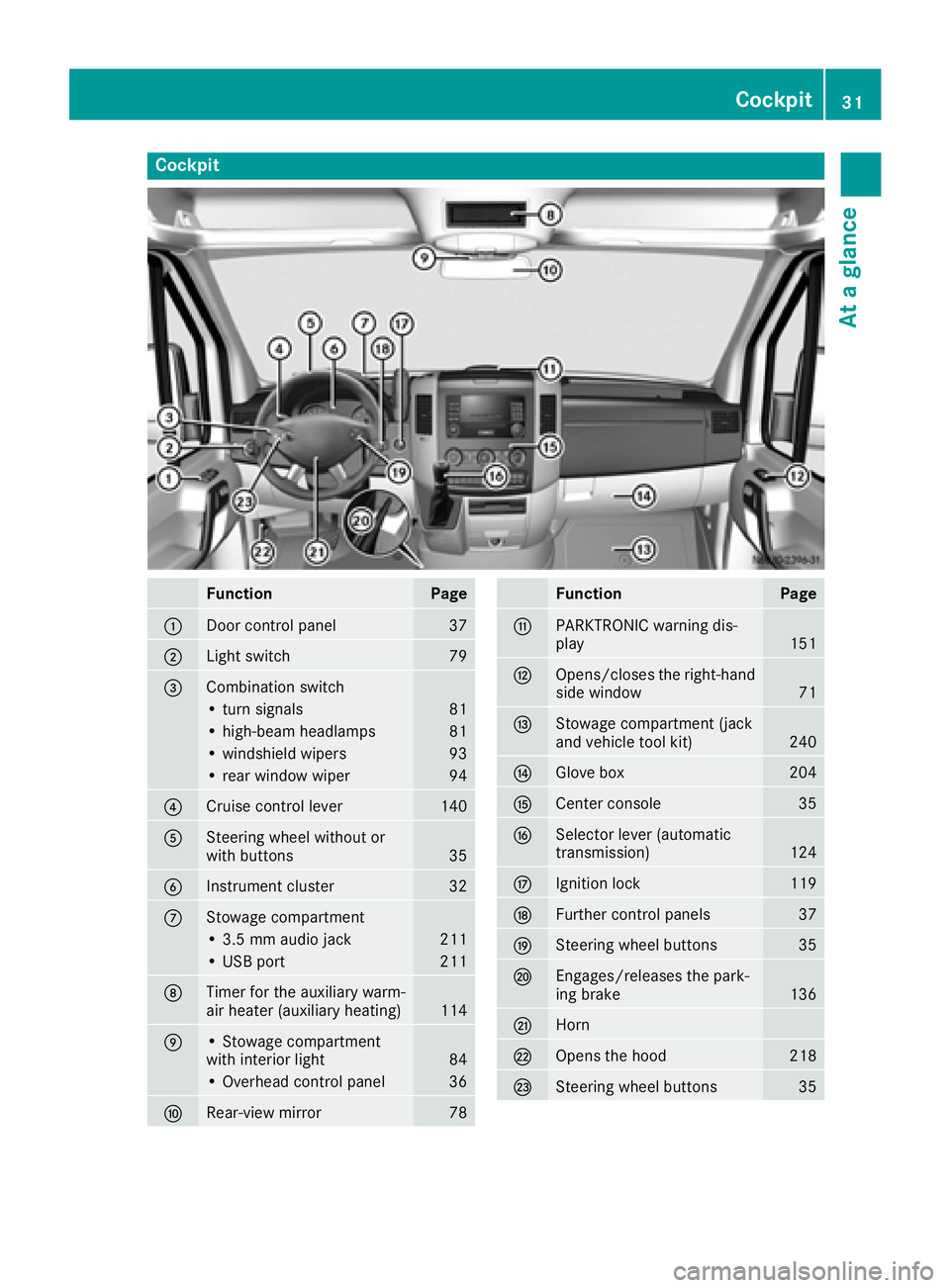
Cockpit
FunctionPage
:Door control panel37
;Light switch79
=Combination switch
• turn signals81
• high-beam headlamps81
• windshield wipers93
• rear window wiper94
?Cruise control lever140
ASteering wheel without or
with buttons35
BInstrument cluster32
CStowage compartment
• 3.5 mm audio jack211
• USB port211
DTimer for the auxiliary warm-
air heater (auxiliary heating)114
E• Stowage compartment
with interior light84
• Overhead control panel36
FRear-view mirror78
FunctionPage
GPARKTRONIC warning dis-
play151
HOpens/closes the right-hand
side window71
IStowage compartment (jack
and vehicle tool kit)240
JGlove box204
KCenter console35
LSelector lever (automatic
transmission)124
MIgnition lock119
NFurther control panels37
OSteering wheel buttons35
PEngages/releases the park-
ing brake136
QHorn
ROpens the hood218
SSteering wheel buttons35
Cockpit31
At a glance
Page 34 of 290
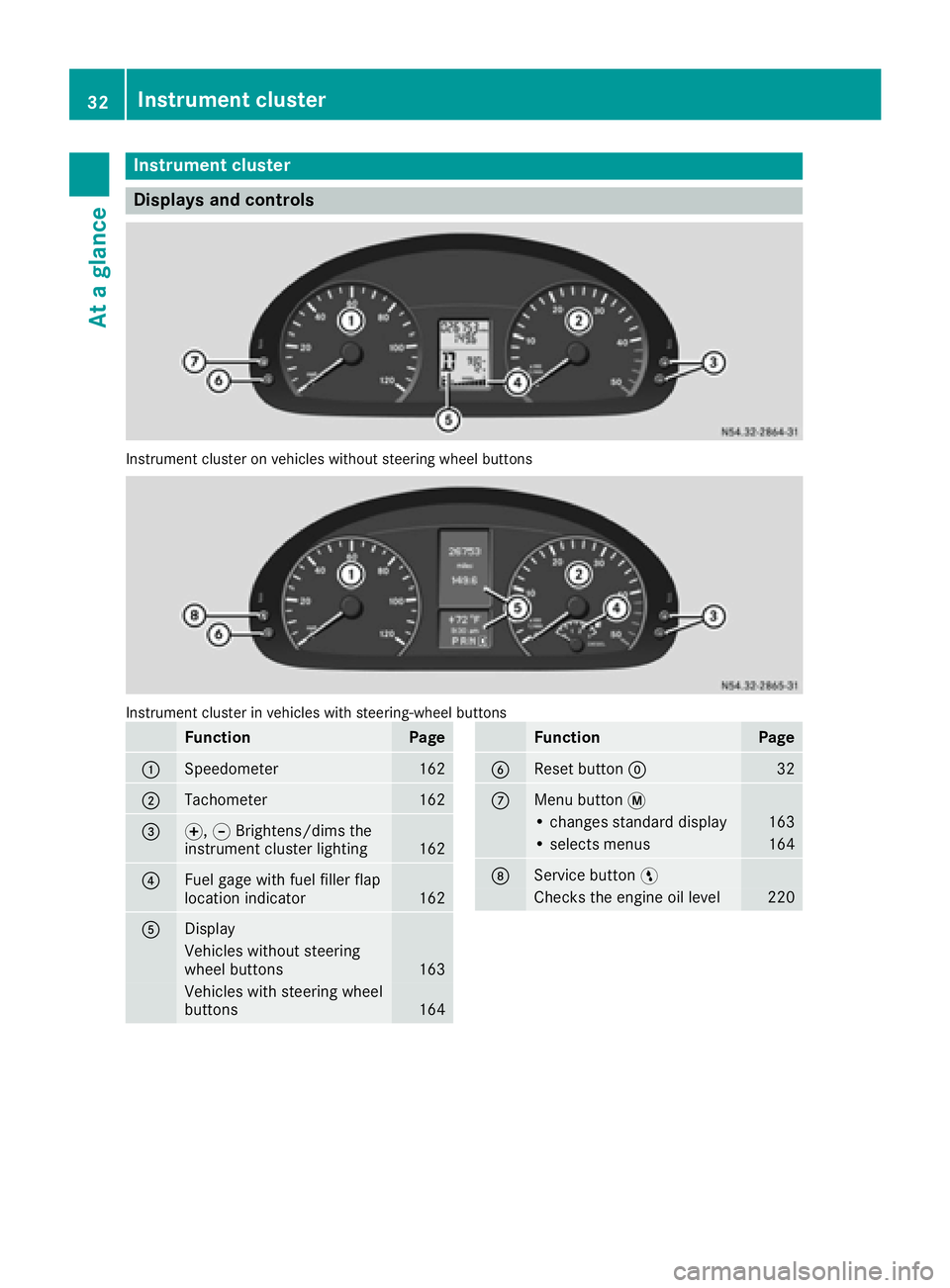
Instrument cluster
Displays and controls
Instrumentcluste ron vehicles without steering whee lbuttons
Instrumen tcluste rin vehicles wit hsteering-wheel buttons
FunctionPag e
:Speedometer162
;Tachometer162
=f, gBrightens/dims th e
instrumen tcluste rlighting16 2
?Fue lgage wit hfuel filler flap
location indicator16 2
ADisplay
Vehicles without steering
whee lbuttons16 3
Vehicles wit hsteering whee l
buttons16 4
FunctionPag e
BReset butto n932
CMen ubutto n4
• changes standard display16 3
•select smenus16 4
DService butto nË
Checks th eengin eoil level22 0
32Instrument cluster
At a glance
Page 38 of 290
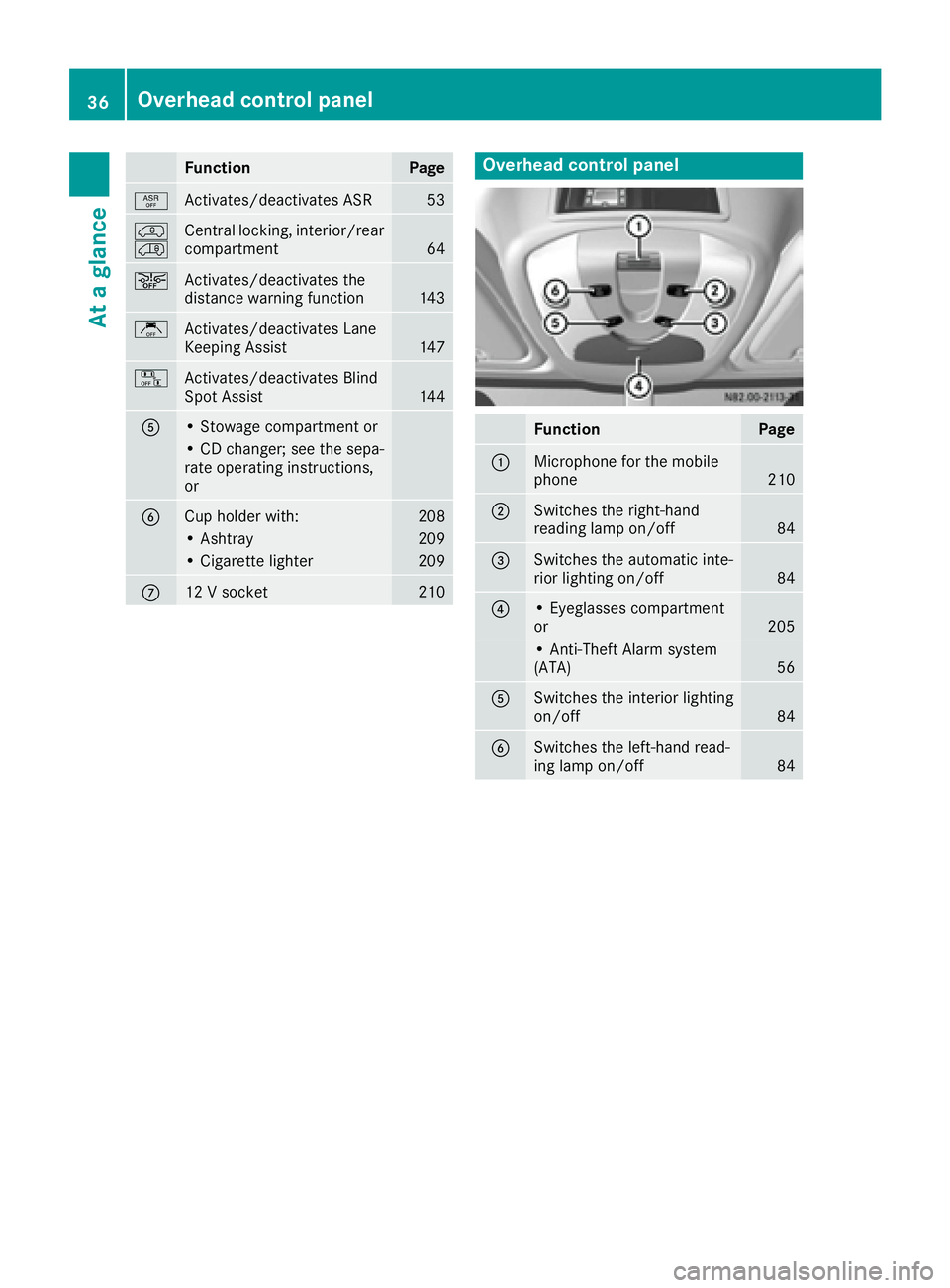
FunctionPage
àActivates/deactivates ASR53
Ã
ÄCentral locking, interior/rear
compartment64
æActivates/deactivates the
distance warning function143
jActivates/deactivates Lane
Keeping Assist147
kActivates/deactivates Blind
Spot Assist144
A• Stowage compartment or
• CD changer; see the sepa-
rate operating instructions,
or
BCup holder with:208
• Ashtray209
• Cigarette lighter209
C12 V socket210
Overhead control panel
FunctionPage
:Microphone for the mobile
phone210
;Switches the right-hand
reading lamp on/off84
=Switches the automatic inte-
rior lighting on/off84
?• Eyeglasses compartment
or205
• Anti-Theft Alarm system
(ATA)56
ASwitches the interior lighting
on/off84
BSwitches the left-hand read-
ing lamp on/off84
36Overhead control panel
At a glance
Page 40 of 290
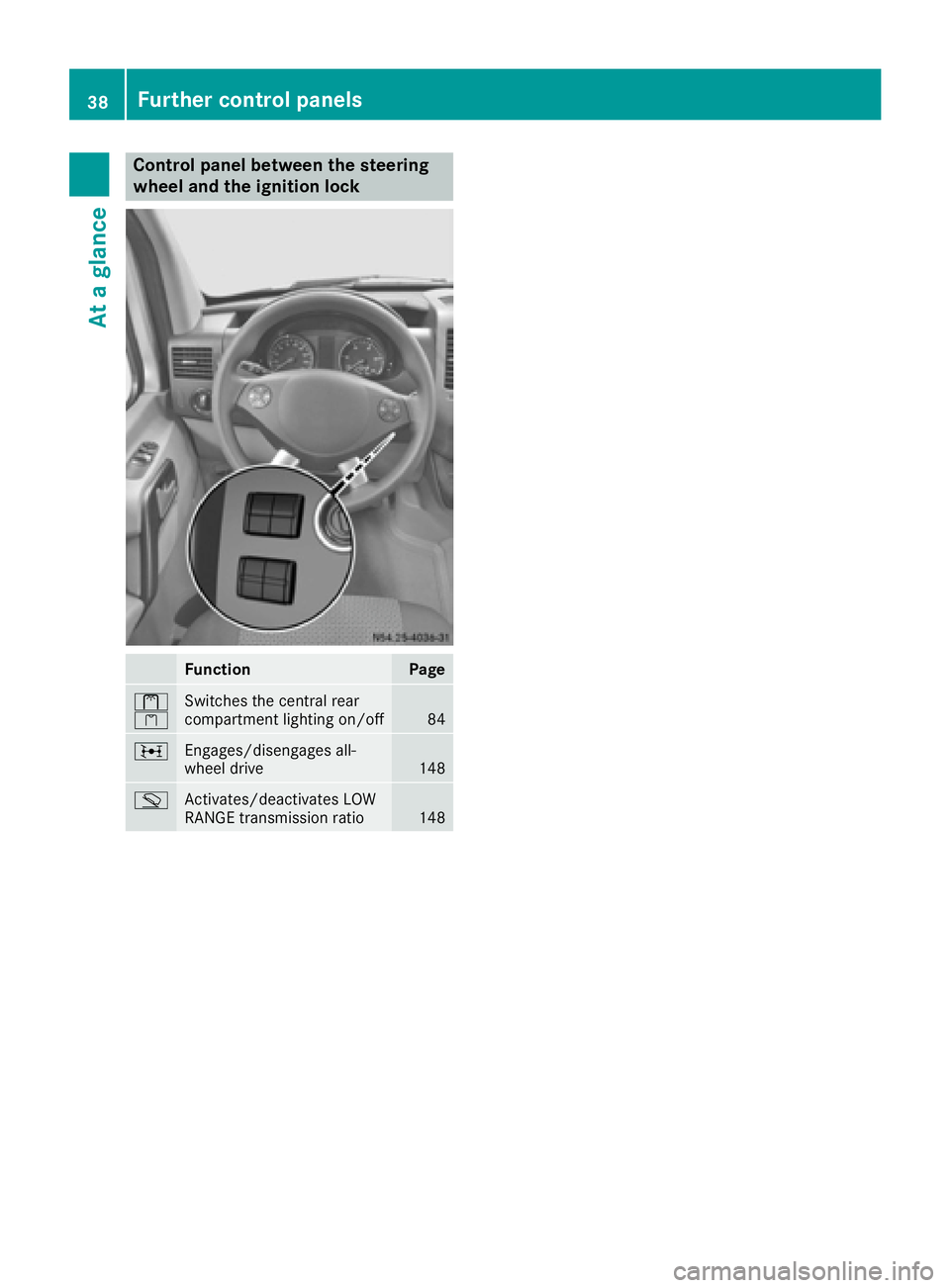
Control panel between the steering
wheel and the ignition lock
FunctionPage
l
kSwitches the central rear
compartment lighting on/off84
;Engages/disengages all-
wheel drive148
mActivates/deactivates LOW
RANGE transmission ratio148
38Further control panels
At a glance
Page 41 of 290
Useful information
This Operator's Manual describes all models as
well as standard and optional equipment of your
vehicle that were available at the time of going
to print. Country-specific variations are possi-
ble. Note that your vehicle may not be equipped
with all of the described functions. This also
applies to systems and functions relevant to
safety.
Read the information on qualified specialist
workshops (
Ypage 26).
Occupant safety
Restraint system introduction
The restraint system can reduce the risk of vehi-cle occupants coming into contact with parts of
the vehicle's interior in the event of an accident.
Furthermore, the restraint system may also
reduce the forces exerted on the vehicle occu-
pants when an accident occurs.
The restraint system includes:
RSeat belt system
RAir bags
RChild restraint system
RChild seat securing systems
The components of the restraint system work in
conjunction with each other. They can only offer
the intended level of protection if all vehicle
occupants:
Rare correctly wearing their seat belts.
(Ypage 41)
Radjust their seat and head restraint properly
(Ypage 72).
The driver is also responsible for ensuring that
the steering wheel has been correctly posi-
tioned. Observe the information relating to the
correct driver's seat position (
Ypage 72).
Always ensure the air bag can inflate properly if
deployed (
Ypage 43).
An air bag supplements a correctly fastened
seat belt. As an additional safety device, the air bag increases the level of protection for vehicle
occupants in the event of an accident. For exam-
ple, if the protection already provided by a cor-
rectly fastened seat belt will suffice, the air bags
are not deployed. Furthermore, only the air bags
that would increase the degree of protection
afforded to the vehicle occupants in the event of an accident are deployed. Seat belts and air
bags generally do not protect against objects
penetrating the vehicle from the outside.
Information on restraint system operation can
be found under "Triggering of Emergency Ten-
sioning Devices and air bags" (
Ypage 45).
See “Children in the vehicle” for information on children traveling with you as well as vehicle
restraint systems (
Ypage 47).
Important safety notes
GWARNING
Modifications to the restraint system, may
cause it to no longer work as intended. The
restraint system may then not perform its
intended protective function and may fail in an
accident or trigger unexpectedly, for example.
This poses an increased risk of injury or even fatal injury.
Never modify parts of the restraint system.
Never tamper with the wiring, the electronic
components or their software.
If it is necessary to modify an airbag system to
accommodate a person with disabilities, con-
tact an authorized Sprinter dealership for
details. USA only: contact our Customer
Assistance Center at 1‑ 877‑762‑8267 for
details.
Restraint system warning lamp
The functions of the restraint system are
checked after the ignition is switched on and at
regular intervals while the engine is running.
Therefore, malfunctions can be detected in
good time.
The 6 restraint system warning lamp in the
instrument cluster lights up when the ignition is
switched on. It goes out no later than a few sec-
onds after the vehicle is started. The compo-
nents of the restraint system are in operational
readiness.
Occupant safety39
Safety
Z
Page 42 of 290
A malfunction has occurred if the6restraint
system warning lamp:
Rdoes not light up after the ignition is switched
on
Rdoes not go out after a few seconds
Rgoes out but then lights up again while the
engine is running, for example
GWARNING
If restraint system is malfunctioning, restraint
system components may be triggered unin-
tentionally or might not be triggered at all in
the event of an accident with a high rate of
vehicle deceleration. This can affect the Emer- gency Tensioning Device or air bag, for exam-
ple. This poses an increased risk of injury or
even fatal injury.
Have the restraint system checked and
repaired in a qualified specialist workshop as
soon as possible.
Seat belts
Introduction
A correctly fastened seat belt is the most effec- tive means of restraining the movement of vehi-
cle occupants in the event of an accident or the
vehicle rolling over. This reduces the risk of
vehicle occupants coming into contact with
parts of the vehicle interior or being thrown from
the vehicle. Furthermore, the seat belt helps to
keep the vehicle occupants in the best position
in relation to the air bag.
The seat belt system consists of:
RSeat belts
REmergency Tensioning Devices for the front
seat belts
If the vehicle is equipped with a front air bag,the seat belt system also includes a seat belt
force limiter for the corresponding seat.
On vehicles with a front-passenger bench
seat, only the seat belt of the outer front-
passenger seat has a seat belt force limiter.
If the vehicle does not have a driver's air bag, the
seat belt system does not include an Emergency
Tensioning Device or a seat belt force limiter.
If the seat belt is pulled quickly or suddenly from
the belt outlet, the inertia reel locks. The belt
strap cannot be pulled out further. Emergency Tensioning Devices tighten the seat
belts in an accident, pulling them close against
the occupant's body. They do not, howe
ver, pull
vehicle occupants back towards the backrest.
Emergency Tensioning Devices do not correct
an incorrect seat position or incorrectly worn
seat belts.
When triggered, the seat belt force limiter
reduces the force exerted by the seat belt on the
vehicle occupant.
The seat belt force limiters are synchronized
with the front air bags, which absorb part of the
deceleration force. This makes it possible to
reduce the forces to which vehicle occupants
are subjected during an accident.
The Emergency Tensioning Device of the co-
driver's seat is triggered independently of the
lock status of the seat belt.
Important safety notes
The use of seat belts and child restraint systems
is required by law in:
Rall 50 states
Rthe U.S. territories
Rthe District of Columbia
Rall Canadian provinces
Even where this is not required by law, all vehicle
occupants should correctly fasten their seat
belts before starting the journey.
GWARNING
If the seat belt is incorrectly fastened, it can-
not protect as intended. Furthermore, an
incorrectly fastened seat belt can cause addi-
tional injury, for example, in an accident, dur-
ing braking or when abruptly changing direc-
tion. This poses an increased risk of injury or
even fatal injury.
Make sure that all vehicle occupants are
seated properly with a correctly fastened seat belt.
GWARNING
The seat belt does not offer the intended level of protection if you have not moved the back-
rest to an almost vertical position. When brak-
ing or in the event of an accident, you could
slide underneath the seat belt and sustain
abdomen or neck injuries, for example. This
40Occupant safety
Safety
Page 45 of 290
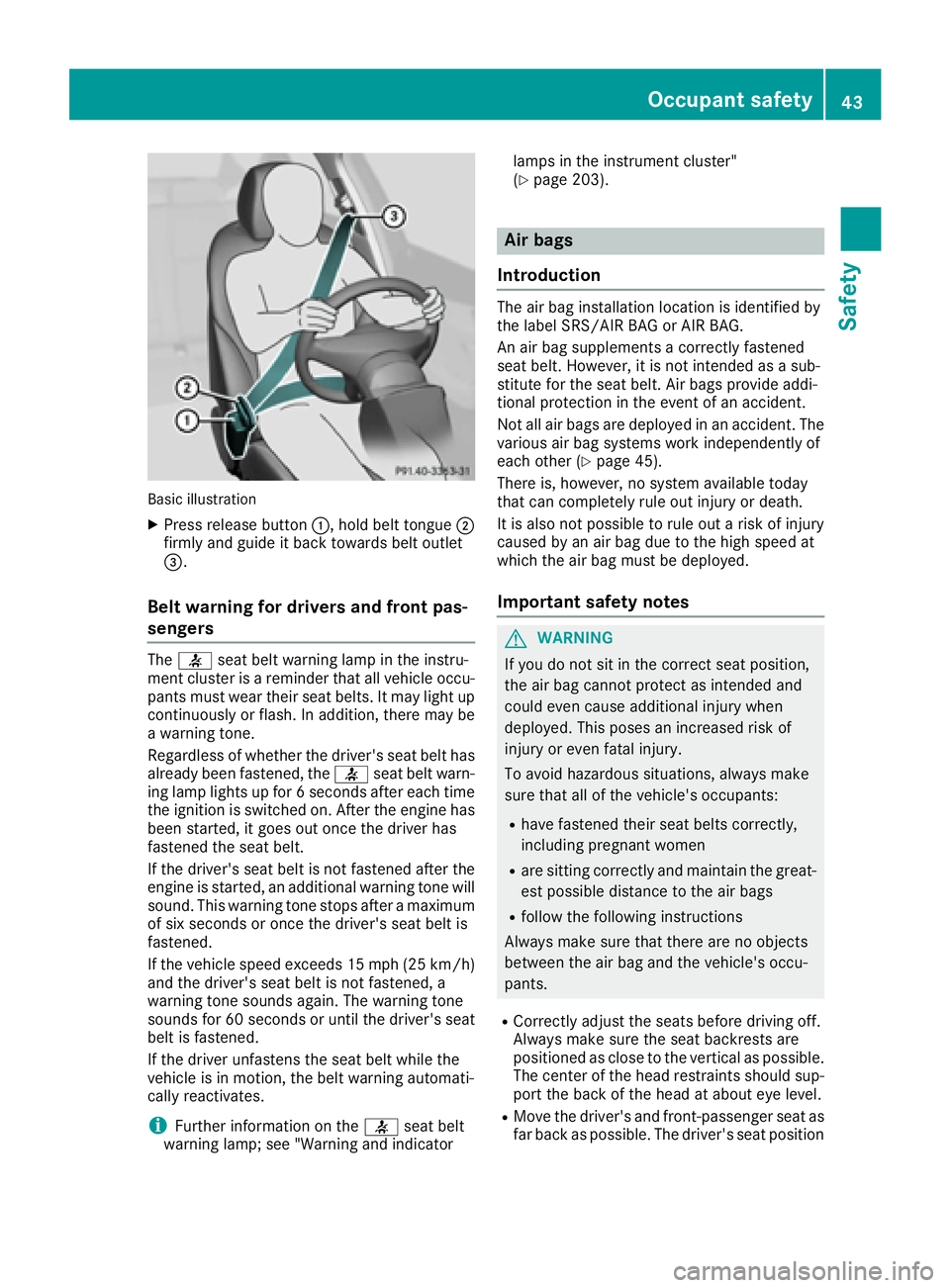
Basic illustration
XPress release button:, hold belt tongue;
firmly and guide it back towards belt outlet
=.
Belt warning for drivers and front pas-
sengers
The 7 seat belt warning lamp in the instru-
ment cluster is a reminder that all vehicle occu-
pants must wear their seat belts. It may light up
continuously or flash. In addition, there may be
a warning tone.
Regardless of whether the driver's seat belt has
already been fastened, the 7seat belt warn-
ing lamp lights up for 6 seconds after each time
the ignition is switched on. After the engine has
been started, it goes out once the driver has
fastened the seat belt.
If the driver's seat belt is not fastened after the
engine is started, an additional warning tone will
sound. This warning tone stops after a maximum
of six seconds or once the driver's seat belt is
fastened.
If the vehicle speed exceeds 15 mph (25 km/h)
and the driver's seat belt is not fastened, a
warning tone sounds again. The warning tone
sounds for 60 seconds or until the driver's seat
belt is fastened.
If the driver unfastens the seat belt while the
vehicle is in motion, the belt warning automati-
cally reactivates.
iFurther information on the 7seat belt
warning lamp; see "Warning and indicator lamps in the instrument cluster"
(
Ypage 203).
Air bags
Introduction
The air bag installation location is identified by
the label SRS/AIR BAG or AIR BAG.
An air bag supplements a correctly fastened
seat belt. However, it is not intended as a sub-
stitute for the seat belt. Air bags provide addi-
tional protection in the event of an accident.
Not all air bags are deployed in an accident. The
various air bag systems work independently of
each other (
Ypage 45).
There is, however, no system available today
that can completely rule out injury or death.
It is also not possible to rule out a risk of injury
caused by an air bag due to the high speed at
which the air bag must be deployed.
Important safety notes
GWARNING
If you do not sit in the correct seat position,
the air bag cannot protect as intended and
could even cause additional injury when
deployed. This poses an increased risk of
injury or even fatal injury.
To avoid hazardous situations, always make
sure that all of the vehicle's occupants:
Rhave fastened their seat belts correctly,
including pregnant women
Rare sitting correctly and maintain the great-
est possible distance to the air bags
Rfollow the following instructions
Always make sure that there are no objects
between the air bag and the vehicle's occu-
pants.
RCorrectly adjust the seats before driving off.
Always make sure the seat backrests are
positioned as close to the vertical as possible.
The center of the head restraints should sup-
port the back of the head at about eye level.
RMove the driver's and front-passenger seat as
far back as possible. The driver's seat position
Occupant safety43
Safety
Z