clock MERCEDES-BENZ SPRINTER 2016 MY16 Operator’s Manual
[x] Cancel search | Manufacturer: MERCEDES-BENZ, Model Year: 2016, Model line: SPRINTER, Model: MERCEDES-BENZ SPRINTER 2016Pages: 290, PDF Size: 6.44 MB
Page 242 of 290
Useful information
This Operator's Manual describes all models as
well as standard and optional equipment of your
vehicle that were available at the time of going
to print. Country-specific variations are possi-
ble. Note that your vehicle may not be equipped
with all of the described functions. This also
applies to systems and functions relevant to
safety.
Read the information on qualified specialist
workshops (
Ypage 26).
Where will I find...?
Vehicle tool kit
General notes
The vehicle tool kit is in the stowage compart-
ment in the footwell on the front-passenger
side.
The vehicle tool kit consists of:
Ra towing eye
Ra screwdriver with Torx, Phillips and slotted
bits
If your vehicle is equipped with a spare wheel
bracket and a jack, the vehicle tool kit addition-
ally contains:
Ra wheel wrench
Ra spanner
Ra pump lever rod
iThe maximum payload of the jack can be
found on the sticker on the jack itself.
The jack is maintenance-free. In the event of a
malfunction, please contact a qualified spe-
cialist workshop.
Stowage compartment in the front-
passenger footwell
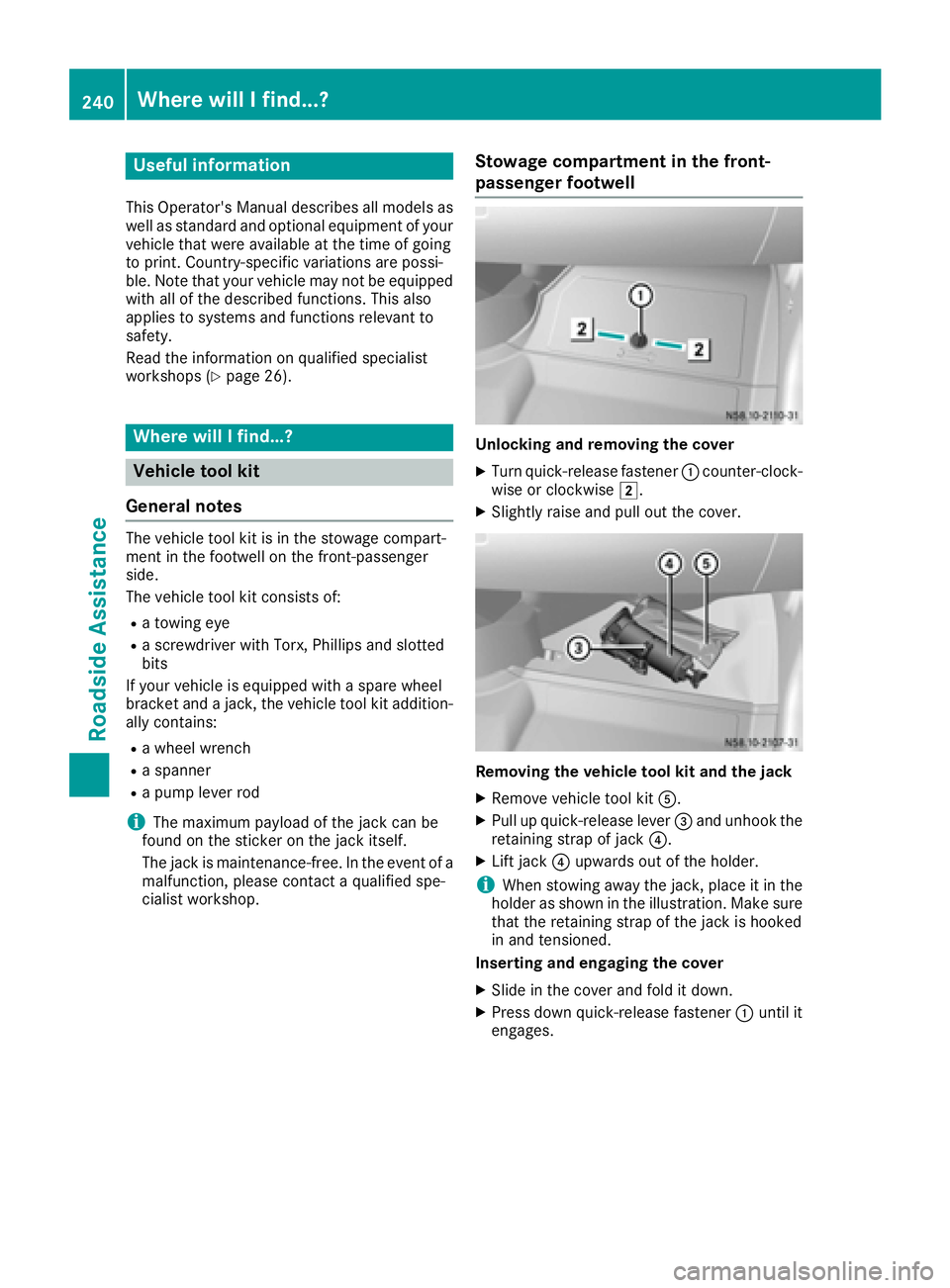
Unlocking and removing the cover
XTurn quick-release fastener :counter-clock-
wise or clockwise 2.
XSlightly raise and pull out the cover.
Removing the vehicle tool kit and the jack
XRemove vehicle tool kit A.
XPull up quick-release lever =and unhook the
retaining strap of jack ?.
XLift jack?upwards out of the holder.
iWhen stowing away the jack, place it in the
holder as shown in the illustration. Make sure
that the retaining strap of the jack is hooked
in and tensioned.
Inserting and engaging the cover
XSlide in the cover and fold it down.
XPress down quick-release fastener :until it
engages.
240Where will I find...?
Roadside Assistance
Page 246 of 290
The automatic transmission selector lever must
be in theNposition when towing the vehicle.
The battery must be connected and charged.
Otherwise, you:
Rcannot turn the key in the ignition lock to
position 2
Rcannot move the selector lever to position N
on vehicles with automatic transmission
Before the vehicle is towed, switch off the auto-
matic locking feature (
Ypage 64). You could
otherwise lock yourself out of the vehicle when
pushing or towing away the vehicle.
Installing/removing the towing eye
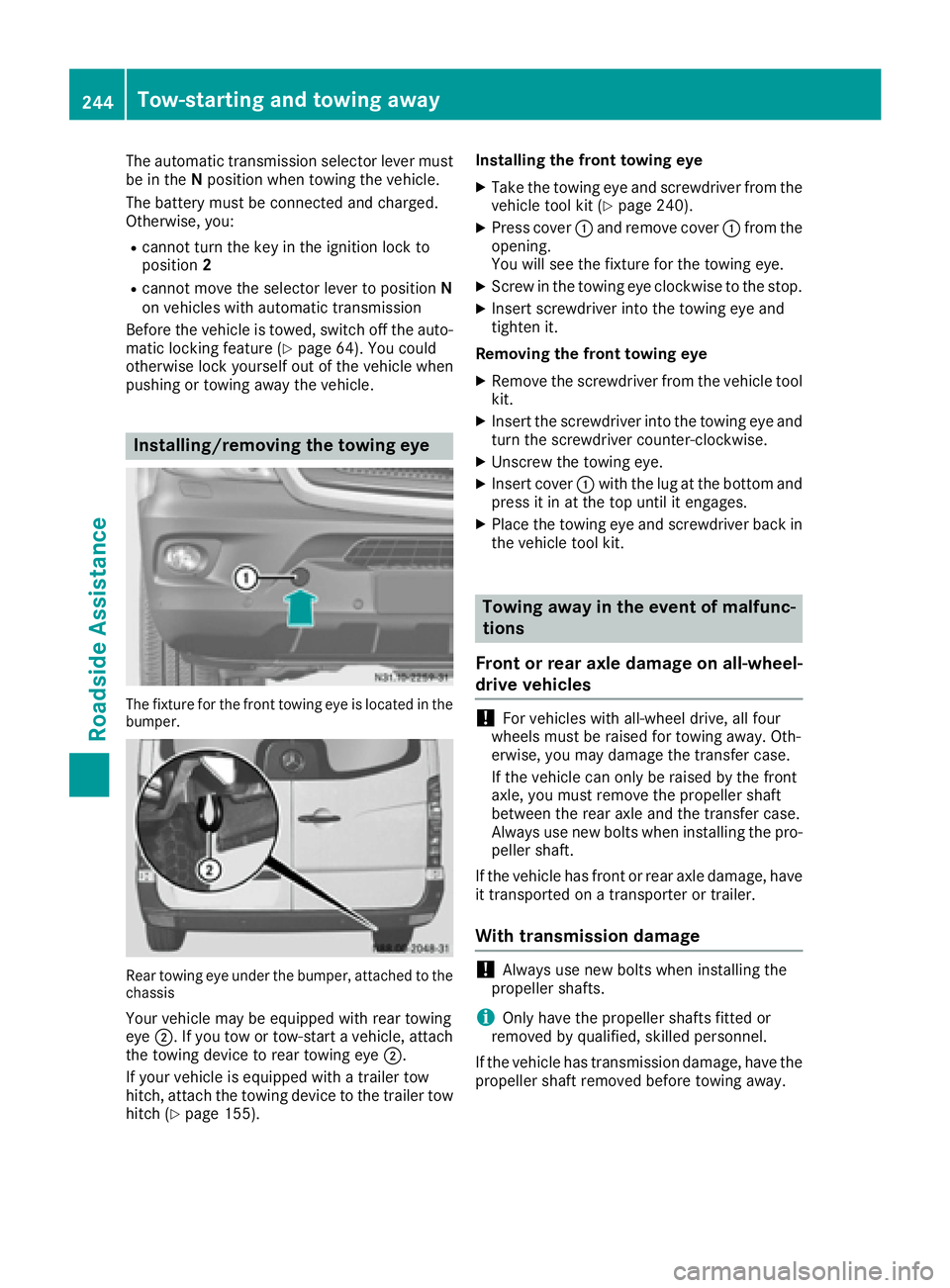
The fixture for the front towing eye is located in the
bumper.
Rear towing eye under the bumper, attached to the
chassis
Your vehicle may be equipped with rear towing
eye ;. If you tow or tow-start a vehicle, attach
the towing device to rear towing eye ;.
If your vehicle is equipped with a trailer tow
hitch, attach the towing device to the trailer tow hitch (
Ypage 155). Installing the front towing eye
XTake the towing eye and screwdriver from the
vehicle tool kit (Ypage 240).
XPress cover
:and remove cover :from the
opening.
You will see the fixture for the towing eye.
XScrew in the towing eye clockwise to the stop.
XInsert screwdriver into the towing eye and
tighten it.
Removing the front towing eye
XRemove the screwdriver from the vehicle tool
kit.
XInsert the screwdriver into the towing eye and
turn the screwdriver counter-clockwise.
XUnscrew the towing eye.
XInsert cover :with the lug at the bottom and
press it in at the top until it engages.
XPlace the towing eye and screwdriver back in
the vehicle tool kit.
Towing away in the event of malfunc-
tions
Front or rear axle damage on all-wheel-
drive vehicles
!For vehicles with all-wheel drive, all four
wheels must be raised for towing away. Oth-
erwise, you may damage the transfer case.
If the vehicle can only be raised by the front
axle, you must remove the propeller shaft
between the rear axle and the transfer case.
Always use new bolts when installing the pro-
peller shaft.
If the vehicle has front or rear axle damage, have
it transported on a transporter or trailer.
With transmission damage
!Always use new bolts when installing the
propeller shafts.
iOnly have the propeller shafts fitted or
removed by qualified, skilled personnel.
If the vehicle has transmission damage, have the
propeller shaft removed before towing away.
244Tow-starting and towing away
Roadside Assistance
Page 270 of 290
Raising the vehicle
GWARNING
If you do not position the jack correctly at the
appropriate jacking point of the vehicle, the
jack could tip over with the vehicle raised.
There is a risk of injury.
Only position the jack at the appropriate jack-
ing point of the vehicle. The base of the jack
must be positioned vertically, directly under
the jacking point of the vehicle.
GWARNING
On uphill and downhill slopes, the jack could
tip over with the vehicle raised. There is a risk
of injury.
Do not change wheels on uphill or downhill
gradients. Notify a qualified specialist work-
shop.
!Only position the jack on the jacking points
intended for this purpose. You could other-
wise damage the vehicle.
Observe the following when raising the vehicle:
RWhen raising the vehicle, only use the jack
which Mercedes-Benz has specifically
approved for your vehicle.
RThe vehicle's jack is intended only to raise the
vehicle for a short time when changing a
wheel. It is not suited for performing mainte-
nance work under the vehicle.
RAvoid changing the wheel on uphill and down- hill slopes.
RBefore raising the vehicle, secure it from roll-
ing away by applying the parking brake and
inserting wheel chocks. Never disengage the
parking brake while the vehicle is raised.
RThe jack must be placed on a firm, flat and
non-slip surface. On a loose surface, a large,
load-bearing underlay must be used. On a
slippery surface, a non-slip underlay must be
used, e.g. rubber mats.
RMake sure that the distance between the
underside of the tires and the ground does not
exceed 1.2 in(3 cm).
RNever place your hands or feet under the
ra
ised vehicle.
RNever lie under the raised vehicle.
RNever start the engine when the vehicle is
raised.
RNever open or close a door when the vehicle
is raised.
RMake sure that no persons are present in the
vehicle when the vehicle is raised.
!Only use the jack pump lever middle rod and
the rod with the largest diameter as a lug
wrench extension. Only slide the middle rod
as far as it will go onto the lug wrench. The
rods may otherwise bend and be distorted to
such an extent that they can no longer be
used as a pump lever for the jack.
!Do not place the jack on the leaf spring or
the differential case.
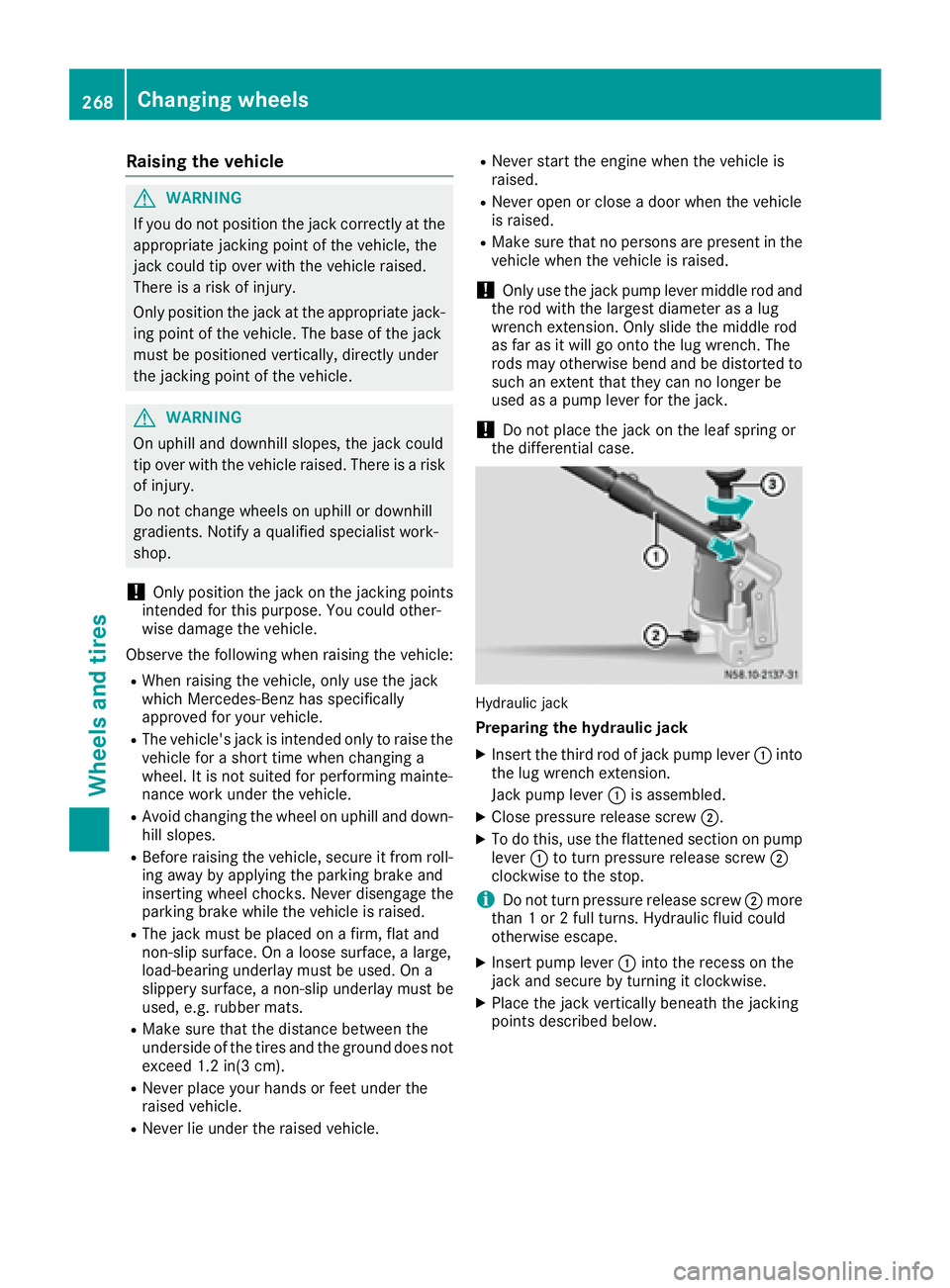
Hydraulic jack
Preparing the hydraulic jack
XInsert the third rod of jack pump lever :into
the lug wrench extension.
Jack pump lever :is assembled.
XClose pressure release screw ;.
XTo do this, use the flattened section on pump
lever:to turn pressure release screw ;
clockwise to the stop.
iDo not turn pressure release screw ;more
than 1 or 2 full turns. Hydraulic fluid could
otherwise escape.
XInsert pump lever :into the recess on the
jack and secure by turning it clockwise.
XPlace the jack vertically beneath the jacking
points described below.
268Changing wheels
Wheels and tires
Page 271 of 290
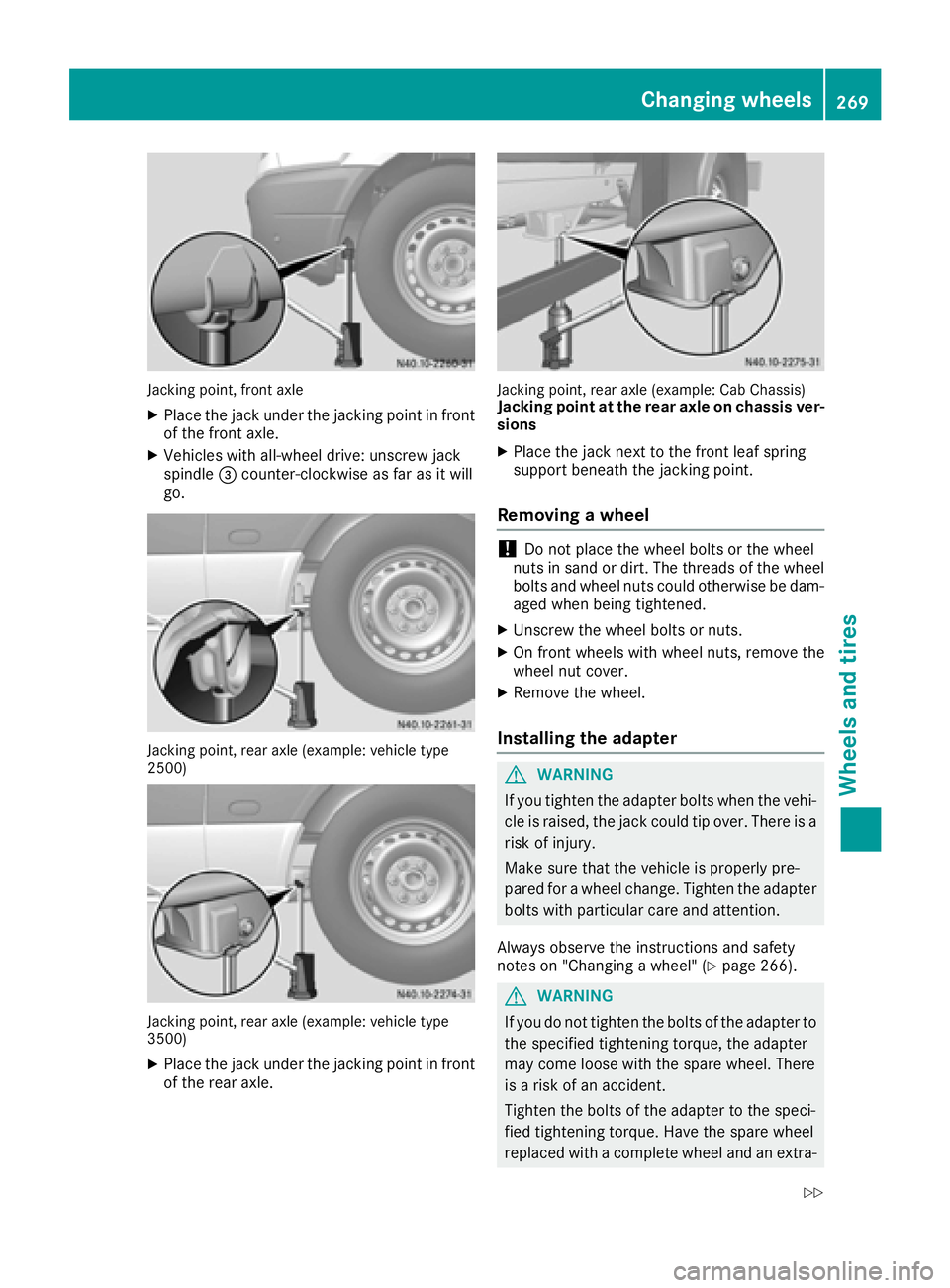
Jacking point, front axle
XPlace the jack under the jacking point in frontof the front axle.
XVehicles with all-wheel drive: unscrew jack
spindle =counter-clockwise as far as it will
go.
Jacking point, rear axle (example: vehicle type
2500)
Jacking point, rear axle (example: vehicle type
3500)
XPlace the jack under the jacking point in front
of the rear axle.
Jacking point, rear axle (example: Cab Chassis)Jacking point at the rear axle on chassis ver-
sions
XPlace the jack next to the front leaf spring
support beneath the jacking point.
Removing a wheel
!Do not place the wheel bolts or the wheel
nuts in sand or dirt. The threads of the wheel
bolts and wheel nuts could otherwise be dam-
aged when being tightened.
XUnscrew the wheel bolts or nuts.
XOn front wheels with wheel nuts, remove the
wheel nut cover.
XRemove the wheel.
Installing the adapter
GWARNING
If you tighten the adapter bolts when the vehi-
cle is raised, the jack could tip over. There is a risk of injury.
Make sure that the vehicle is properly pre-
pared for a wheel change. Tighten the adapter
bolts with particular care and attention.
Always observe the instructions and safety
notes on "Changing a wheel" (
Ypage 266).
GWARNING
If you do not tighten the bolts of the adapter to
the specified tightening torque, the adapter
may come loose with the spare wheel. There
is a risk of an accident.
Tighten the bolts of the adapter to the speci-
fied tightening torque. Have the spare wheel
replaced with a complete wheel and an extra-
Changing wheels269
Wheels and tires
Z
Page 273 of 290
Slide the new wheel onto the wheel hub and
push it on.
Wheels with centering by wheel bolts:
XVehicles with alloy wheels: take the short
wheel bolts that secure the steel spare wheel
out of the vehicle tool kit.
XScrew in the wheel bolts and tighten them
lightly.
For wheels with wheel nuts:
XFront wheels with wheel nut covers: press the
wheel nut covers onto the wheel nuts.
XScrew in the three wheel nuts over the fixing
discs of the wheel nut cover.
XTurn the wheel so that the wheel bolts are in
the middle of the holes.
XScrew on the rest of the wheel nuts.
XSlightly tighten all the wheel nuts.
Lowering the vehicle
GWARNING
The wheels could work loose if the wheel nuts and bolts are not tightened to the specified
tightening torque. There is a risk of accident.
Have the tightening torque immediately
checked at a qualified specialist workshop
after a wheel is changed.
!Only use the jack pump lever middle rod and
the rod with the largest diameter as a lug
wrench extension. Only slide the middle rod
as far as it will go onto the lug wrench. The
rods may otherwise bend and be distorted to
such an extent that they can no longer be
used as a pump lever for the jack.
!Vehicles with Super Single tires: if you
install the spare wheel, do not exceed the
maximum speed of 40 mph (60 km/h) and do
not drive further than 65 miles(100 km).
The transmission could otherwise be dam-
aged by the difference in wheel rotation
speeds.
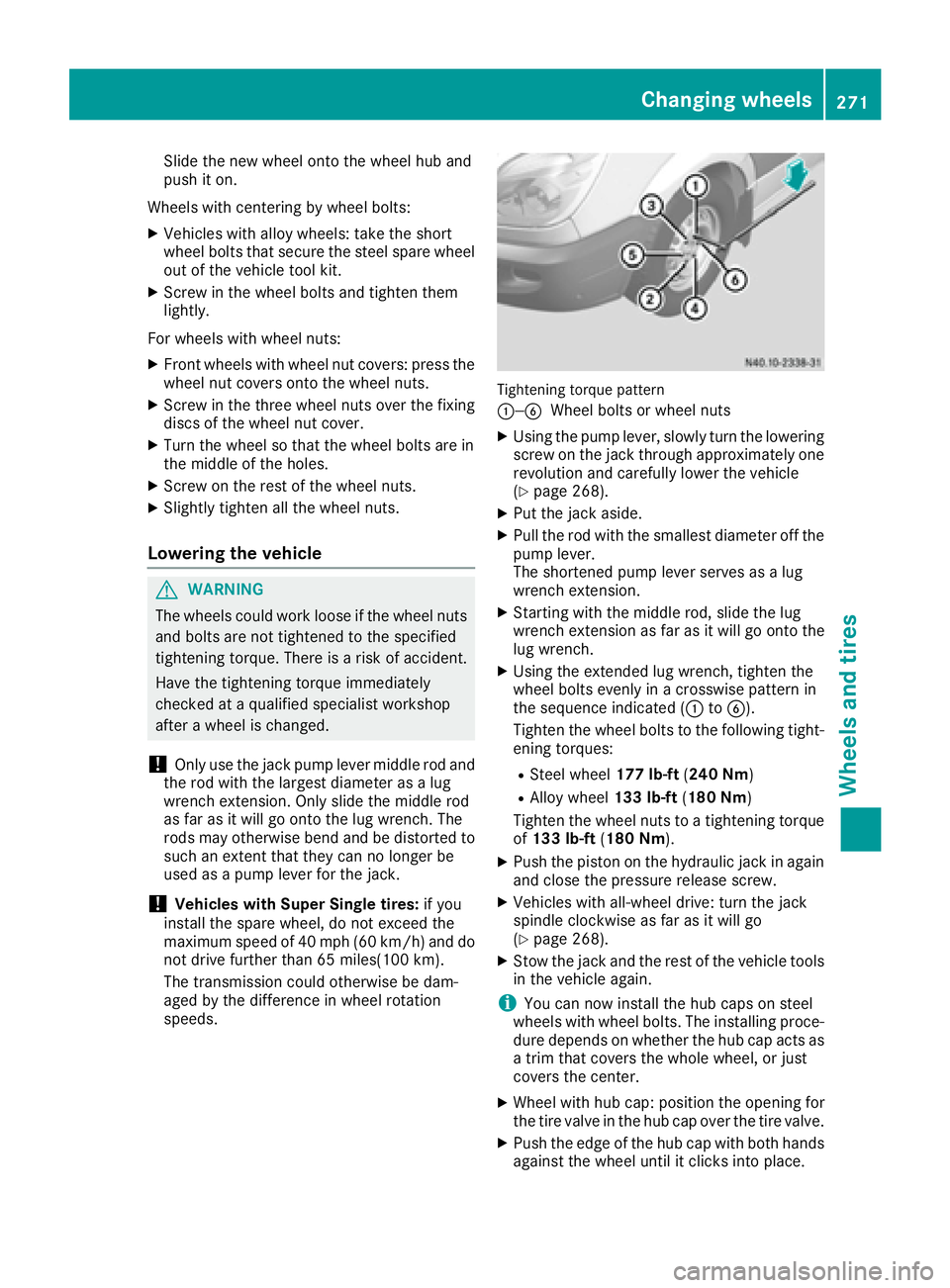
Tightening torque pattern
:—B
Wheel bolts or wheel nuts
XUsing the pump lever, slowly turn the lowering
screw on the jack through approximately one revolution and carefully lower the vehicle
(
Ypage 268).
XPut the jack aside.
XPull the rod with the smallest diameter off the
pump lever.
The shortened pump lever serves as a lug
wrench extension.
XStarting with the middle rod, slide the lug
wrench extension as far as it will go onto the
lug wrench.
XUsing the extended lug wrench, tighten the
wheel bolts evenly in a crosswise pattern in
the sequence indicated ( :toB).
Tighten the wheel bolts to the following tight-
ening torques:
RSteel wheel 177 lb-ft(240 Nm)
RAlloy wheel 133 lb-ft(180 Nm)
Tighten the wheel nuts to a tightening torque
of 133 lb-ft (180 Nm).
XPush the piston on the hydraulic jack in again
and close the pressure release screw.
XVehicles with all-wheel drive: turn the jack
spindle clockwise as far as it will go
(
Ypage 268).
XStow the jack and the rest of the vehicle tools
in the vehicle again.
iYou can now install the hub caps on steel
wheels with wheel bolts. The installing proce-
dure depends on whether the hub cap acts as
a trim that covers the whole wheel, or just
covers the center.
XWheel with hub cap: position the opening for
the tire valve in the hub cap over the tire valve.
XPush the edge of the hub cap with both hands against the wheel until it clicks into place.
Changing wheels271
Wheels and tires
Z
Page 275 of 290
You must observe the correct wheel and
tire dimensions as well as the wheel type.
When using a spare wheel of a different size, do
not exceed the maximum speed of 80 km/h.
General notes
!
Check the spare wheel regularly to see that
it is secure and has the prescribed tire pres-
sure.
The procedure for mounting the spare wheel is
described in "Mounting a wheel" (
Ypage 267).
The following should be checked regularly, par-
ticularly prior to long journeys:
Rthe tire pressure of the spare wheel, which
should then be corrected if necessary
(
Ypage 250).
Rthe fastenings of the spare wheel bracket.
The spare wheel is located in a spare wheel
bracket under the rear of the vehicle.
Replace the tires after 6 years at the latest,
regardless of wear. This also applies to the spare
wheel.
iIf you have mounted a spare wheel, the tire
pressure monitor (Ypage 253) will not func-
tion for this wheel. The spare wheel is not
equipped with a sensor for monitoring tire
pressure.
Removing and installing the spare
wheel
Cargo Van/Passenger Van
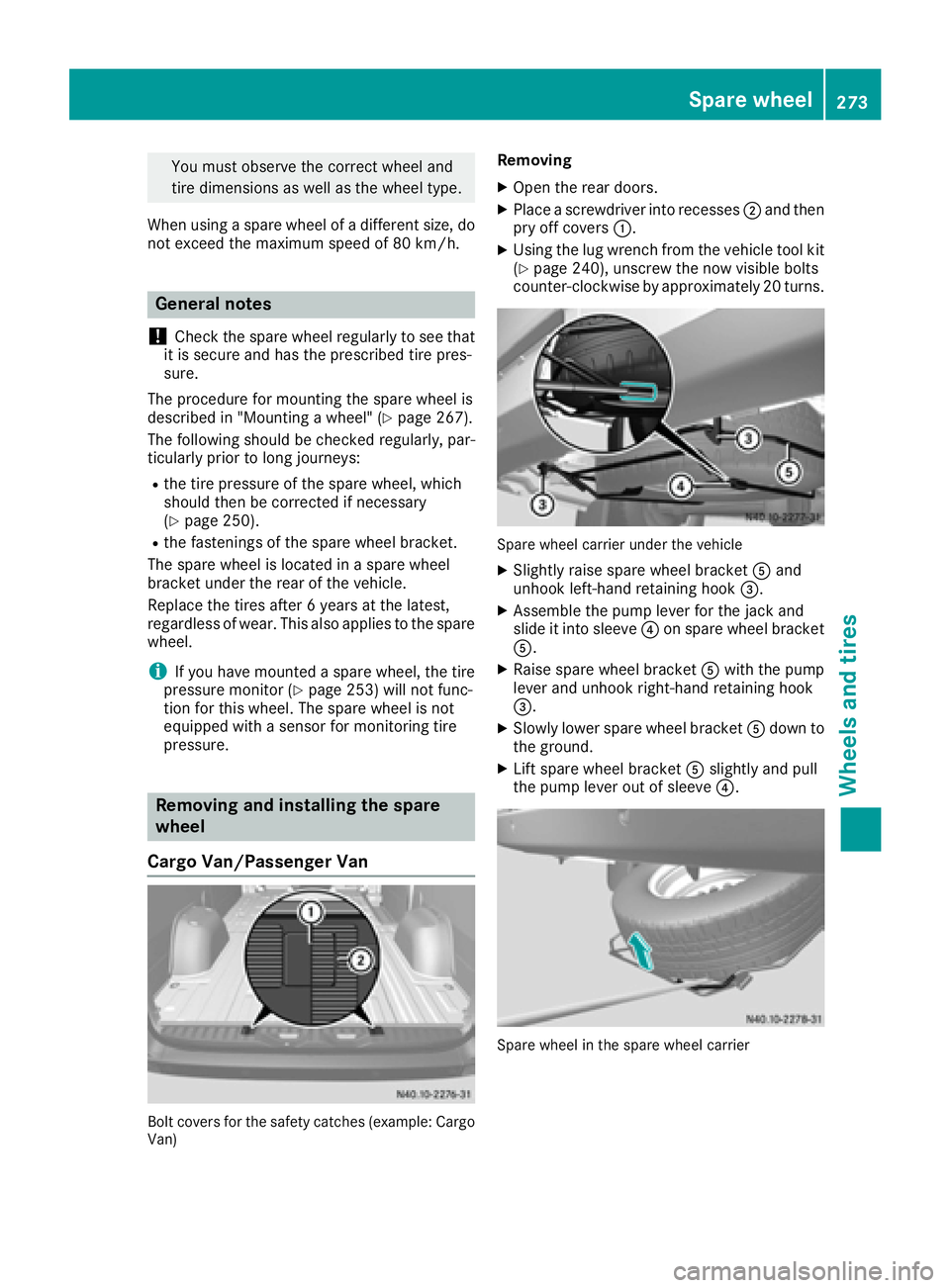
Bolt covers for the safety catches (example: Cargo
Van)
Removing
XOpen the rear doors.
XPlace a screwdriver into recesses ;and then
pry off covers :.
XUsing the lug wrench from the vehicle tool kit
(Ypage 240), unscrew the now visible bolts
counter-clockwise by approximately 20 turns.
Spare wheel carrier under the vehicle
XSlightly raise spare wheel bracket Aand
unhook left-hand retaining hook =.
XAssemble the pump lever for the jack and
slide it into sleeve?on spare wheel bracket
A.
XRaise spare wheel bracket Awith the pump
lever and unhook right-hand retaining hook
=.
XSlowly lower spare wheel bracket Adown to
the ground.
XLift spare wheel bracket Aslightly and pull
the pump lever out of sleeve ?.
Spare wheel in the spare wheel carrier
Spare wheel273
Wheels and tires
Z
Page 276 of 290
XUse the pump lever to lift the spare wheel
beyond the rear edge of the spare wheel car-
rier.
XCarefully remove the spare wheel from sparewheel bracket A.
The spare wheel is heavy. When the spare
wheel is removed, the center of gravity
changes due to the heavy weight of the wheel.
The spare wheel may slip down or tip over.
Installing
XCarefully place the spare wheel onto spare
wheel bracket A.
The spare wheel is heavy. When you place the
spare wheel onto spare wheel bracket A, the
center of gravity changes due to the weight of
the wheel. The spare wheel may slip down or
tip over.
XSlide the pump lever for the jack into
sleeve ?on spare wheel bracket A.
XRaise spare wheel bracket Awith the pump
lever and attach right-hand retaining hook =.
XSlightly raise spare wheel bracketAand
attach left-hand retaining hook =.
XPull the pump lever out of sleeve ?.
XUsing the lug wrench, tighten the retaining
hook bolts by turning them clockwise.
XReplace and engage covers:.
XClose the rear doors.
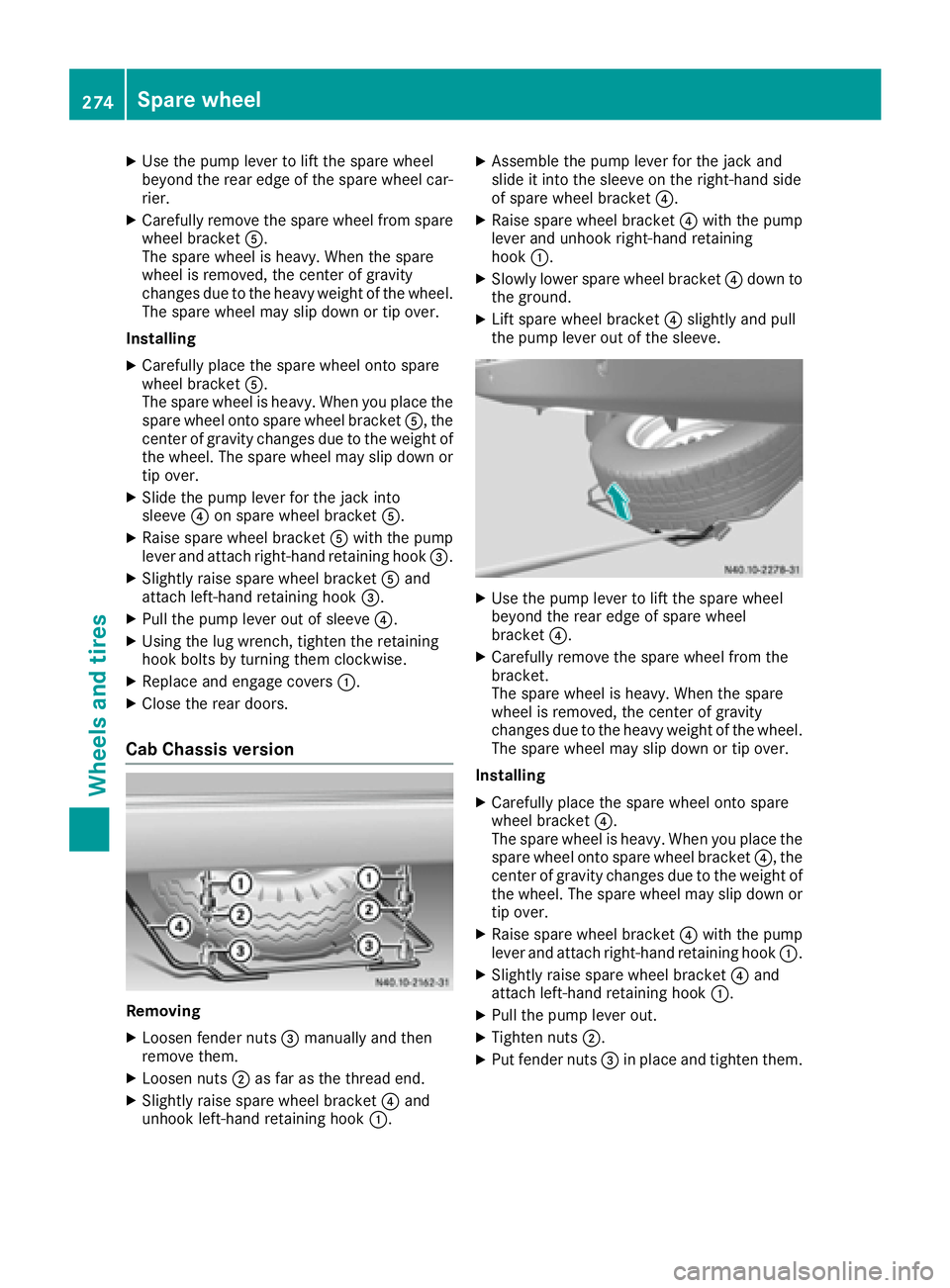
Cab Chassis version
Removing
XLoosen fender nuts=manually and then
remove them.
XLoosen nuts ;as far as the thread end.
XSlightly raise spare wheel bracket ?and
unhook left-hand retaining hook :.
XAssemble the pump lever for the jack and
slide it into the sleeve on the right-hand side
of spare wheel bracket?.
XRaise spare wheel bracket ?with the pump
lever and unhook right-hand retaining
hook :.
XSlowly lower spare wheel bracket ?down to
the ground.
XLift spare wheel bracket ?slightly and pull
the pump lever out of the sleeve.
XUse the pump lever to lift the spare wheel
beyond the rear edge of spare wheel
bracket ?.
XCarefully remove the spare wheel from the
bracket.
The spare wheel is heavy. When the spare
wheel is removed, the center of gravity
changes due to the heavy weight of the wheel.
The spare wheel may slip down or tip over.
Installing
XCarefully place the spare wheel onto spare
wheel bracket ?.
The spare wheel is heavy. When you place the
spare wheel onto spare wheel bracket ?, the
center of gravity changes due to the weight of
the wheel. The spare wheel may slip down or
tip over.
XRaise spare wheel bracket ?with the pump
lever and attach right-hand retaining hook :.
XSlightly raise spare wheel bracket?and
attach left-hand retaining hook :.
XPull the pump lever out.
XTighten nuts;.
XPut fender nuts =in place and tighten them.
274Spare wheel
Wheels and tires