seats MERCEDES-BENZ SPRINTER 2016 MY16 Operator’s Manual
[x] Cancel search | Manufacturer: MERCEDES-BENZ, Model Year: 2016, Model line: SPRINTER, Model: MERCEDES-BENZ SPRINTER 2016Pages: 290, PDF Size: 6.44 MB
Page 4 of 290
Index....................................................... 3
Introduction......................................... 22
At a glance........................................... 31
Safety................................................... 39
Opening and closing...........................59
Seats, steering wheel and mirrors ....72
Lights and windshield wipers ............79
Climate control .................................... 97
Driving and parking..........................118
On-board computer and displays ....161
Stowing and features .......................204
Transporting loads ............................212
Maintenance and care ......................218
Roadside Assistance ........................240
Wheels and tires ............................... 247
Technical data................................... 275
2Contents
Page 10 of 290
Dealership
see Qualified specialist workshop
Declarations of conformity .................26
DEF (Diesel Exhaust Flui d )
Refillin g.......................................... 12 9
Delayed switch-off ............................ 17 2
Diagnostics connection
Operatin gsafet yand vehicl e
approva l........................................... 26
Diesel .................................................. 27 8
Diesel engin e
Preglow indicato rlamp .................. 20 1
Diesel Exhaust Flui d(DEF)
Displa ymessage s(vehicles wit h
steerin gwhee lbuttons )................ .187
Display messages (vehicles with-
out steering wheel buttons) ........... 178
Indicator lamp ................................ 197
Level indicator ............................... 162
Notes ............................................. 279
Storage .......................................... 280
Tank content .................................. 280
Diesel particle filter
Display message ............................ 187
Indicator lamp ................................ 201
Short-distance driving .................... 134
Digital speedometer
Setting the unit (vehicles with
steering wheel buttons) ................. 169
Display
Display messages .......................... 176
Outside temperature (vehicles
with steering wheel buttons) ......... 167
Outside temperature display
(vehicles without steering wheel
buttons) ......................................... 163
Standard display (vehicles with
steering wheel buttons) ................. 167
Standard display (vehicles with-
ou
t steering wheel buttons) ........... 163
see Warning and indicator lamps
Display message (vehicle with
steering wheel buttons)
Service interval display .................. 226
Display message (vehicle without
steering wheel buttons)
Service interval display .................. 226 Display messages
Calling up the message memory .... 176
Driving systems ............................. 190
Engine ............................................ 187
Important safety notes .................. 176
Lights ............................................. 185
Safety systems .............................. 181
SmartKey ....................................... 193
Tires ............................................... 191
Vehicle ........................................... 192
Distance recorder ............................. 167
see Odometer
see Trip odometer
Distance warning function
Activating/deactivating ................. 143
Function/notes ............................. 142
Warning lamp ................................. 143
Door lock
see Central locking
Doors
Central locking/unlocking
(SmartKey) ....................................... 59
Control panel ................................... 37
Display message ............................ 193
Indicator lamp ................................ 203
Drinking and driving ......................... 133
Drinks holder
see Bottle holder
Driver's seat
see Seats
Driver's/front-passenger door
Unlocking ......................................... 65
Driving abroad ................................... 134
Driving off-road
see Off-road driving
Driving on flooded roads .................. 136
Driving on rough terrain
Checklist before driving off-road .... 138
Driving safety systems
4ETS (Electronic Traction Sys-
tem) ................................................. 55
ABS (Anti-lock Braking System) ....... 53
Adaptive Brake Assist .................... 143
ASR (Acceleration Skid Control) ...... 53
BAS (Brake Assist System) .............. 54
Distance warning function ............. 142
EBD (electronic brake force distri-
bution) ............................................. 54
8Index
Page 18 of 290
Correct usage .................................. 41
Display message ............................ 184
Fastening ........................................ .42
Important safety guidelines .............4 0
Introduction .....................................4 0
Releasin g ......................................... 42
Warning lamp ................................. 203
Warning lamp (function) ................... 43
Seat heating ......................................... 76
Seats
Adjusting lumbar support ................ 73
Adjusting the front-passenger
seat .................................................. 73
Adjusting the head restraint ............ 76
Armrest ............................................ 76
Cleaning the cover ......................... 238
Correct driver's seat position ........... 72
Folding seat ..................................... 74
Important safety notes .................... 72
Rear bench seat ............................... 75
Seat heating .................................... 76
Setting the driver's seat ................... 73
Swivel seat ....................................... 73
Twin front-passenger seat ................ 74
Securing loads
Important safety notes .................. 214
Selector lever
Cleaning ......................................... 238
Sensors (cleaning instructions) ....... 236
Service center
see Qualified specialist workshop
Service interval display
Calling up the service due date ...... 226
Exceeding a service due date ........ 226
Notes ............................................. 226
Service due date (automatic dis-
play) ............................................... 226
Service products
Brake fluid ..................................... 283
Coolant (engine) ............................ 283
Diesel Exhaust Fluid (DEF) ............. 279
Engine oil ....................................... 280
Fuel ................................................ 277
Important safety notes .................. 277
Power steering fluid ....................... 283
Refrigerant ..................................... 284
Transmission oi l ............................. 282
W
asher fluid ................................... 284 Setting the air distribution
............... 102
Setting the airflow ............................ 102
Setting the clock
Vehicles with steering wheel but-
tons ............................................... 171
Vehicles without steering wheel
buttons .......................................... 164
Settings
Resetting all (vehicles with steer-
ing wheel buttons) ......................... 168
Resetting submenus (vehicles
with steering wheel buttons) ......... 168
Short journeys (diesel particle fil-
ter) ...................................................... 134
Side impact air bag ............................. 45
Side windows
Cleaning ......................................... 235
Hinged side windows ....................... 70
Important safety information ........... 70
Opening/closing .............................. 71
Overview .......................................... 70
Problem (malfunction) ..................... 71
Resetting ......................................... 71
Sliding door
Cleaning ......................................... 237
Closing assist ................................... 66
Important safety notes .................... 65
Opening/closing .............................. 65
Opening/closing from the inside ..... 66
Opening/closing from the out-
side .................................................. 66
SmartKey
Changing the battery ....................... 61
Changing the locking system set-
tings ............................................... 173
Checking the battery ....................... 61
Display message ............................ 193
Door central locking/unlocking ....... 59
Important safety notes .................... 59
Loss ................................................. 63
Problem (malfunction) ..................... 63
SmartKey positions (ignition lock) .. 119
Snow chains ...................................... 249
Sockets .............................................. 210
Spare wheel
General notes ................................ 273
Important safety notes .................. 272
16Index
Page 22 of 290
Twin front-passenger seatStowage compartment .................. 206
Two-way radios
Type approval/frequency .............. 275
TWR (Tongue Weight Rating) (defi-
nition) ................................................. 266
U
Unlocking
From inside the vehicle (central
unlocking button) ............................. 64
USB port ............................................. 211
V
Vehicle
Data acquisition ............................... 29
Display message ............................ 192
Electronics ..................................... 275
Equipment ....................................... 22
Individual settings (vehicles with
steering wheel buttons) ................. 168
Limited Warranty ............................. 22
Loading .......................................... 258
Locking (SmartKey) .......................... 59
Lowering ........................................ 271
Maintenance .................................... 23
Operating safety .............................. 25
Parking for a long period ................ 132
Pulling away ................................... 121
Raising ........................................... 268
Registration ..................................... 27
Reporting problems ......................... 27
Securing from rolling away ............ 130
Towing away .................................. 243
Transporting .................................. 246
Unlocking (SmartKey) ...................... 59
Vehicle battery
see Battery (vehicle)
Vehicle bodies ..................................... 27
Body/equipment mounting direc-
tives for trucks ................................. 27
Vehicle data ....................................... 285
Vehicle identification number .......... 276
Vehicle identification plate .............. 276
Vehicle tool kit .................................. 240 Vents
see Air vents
Voltage supply
Fuses ............................................. 246
W
Warning Stickers ........................................... 24
Warning and indicator lamp
Diesel particle filter ....................... 201
Power assistance for the steering .. 203
Warning and indicator lamps
Brakes ........................................... 195
Check Engine ................................. 200
Coolant .......................................... 199
Diesel Exhaust Fluid (DEF) ............. 197
Electrical step ................................ 203
ESP
®.............................................. 194
ESP®function ................................ 197
Overview .......................................... 33
Seat belt ........................................ 203
Warning lamp .................................... 241
Warning triangle ................................ 241
Warning- and indicator lamps
ABS ................................................ 195
Air filter .......................................... 201
ASR ................................................ 194
BAS ................................................ 195
Battery charge ............................... 198
Brake wear .................................... 198
Bulbs .............................................. 203
Doors ............................................. 203
Engine oil level ............................... 198
Preglow .......................................... 201
Reserve fuel ................................... 200
Tire pressure monitor .................... 202
Water separator ............................. 202
Windshield washer fluid ................. 202
Warranty .............................................. 22
Washer fluid
Adding ........................................... 224
Capacities ...................................... 285
Display message ............................ 193
Indicator lamp ................................ 202
Notes ............................................. 284
Wiping with ...................................... 93
20Index
Page 30 of 290

Further information can be obtained at any
authorized Sprinter Dealer.
GWARNING
The function of systems or components can
be affected by conversions or modifications
to the vehicle. They might not function prop-
erly anymore and/or jeopardize the opera-
tional safety of the vehicle. There is an
increased risk of an accident and injury.
Conversions or modifications should always
be carried out at qualified specialist work-
shop.
If you intend to make modifications to your vehi-
cle, we strongly recommend that you contact
the distributor named on the inside of the front
cover. There you will receive all the necessary
information and a charge may be levied.
You alone accept the responsibility if body man-
ufacturers or dealers make modifications that
affect the final certification of the engine, the
vehicle or the equipment. This also applies to
the identification and documentation of modifi-
cations to the affected vehicle components.
You are responsible for certification and confir-
mation that:
Rall the applicable standards and regulations
that are affected by the vehicle modification
are met
Rthe modified vehicle fulfills the vehicle safety standards and emissions laws and regula-
tions
Rthe modifications or installation of accesso-
ries does not affect the safety of the vehicle
We are not responsible for the final certification,
product liability or warranty claims which result
from the modifications. This applies to:
Rthe modified components, assemblies or sys-
tems
Rany resulting noncompliance with any of the
emissions laws and regulations or the motor
vehicle safety standards
Rany consequences arising from the changes
that make the vehicle less safe or even render it defective
We do not assume responsibility as the final-
stage manufacturer or for the consequential
product liability.
Notes on the radiator
Even seemingly small changes to the vehicle,
such as attaching a radiator trim for winter driv-
ing, is not permitted. Do not cover up the radi-
ator. Do not use thermal mats, insect protection
covers or anything similar.
Otherwise, the values of the diagnostic system
may be affected. Some of these values are
legally prescribed and must always be correct.
Information on the cargo compartment
floor
!The wooden or plastic cargo area floor fitted
at the factory is an integral component of the
vehicle structure. The vehicle body could be
damaged if you have the load area floor
removed. This then affects the securing of
loads and the maximum loading capacity of
the lashing points is no longer guaranteed.
Therefore, do not have the load area floor
removed.
Genuine Mercedes-Benz parts
!
Air bags and Emergency Tensioning Devi-
ces, as well as control units and sensors for
these restraint systems, may be installed in
the following areas of your vehicle:
Rdoors
Rdoor pillars
Rdoor sills
Rseats
Rcockpit
Rinstrument cluster
Rcenter console
Do not install accessories such as audio sys-
tems in these areas. Do not carry out repairs or welding. You could impair the operating
efficiency of the restraint systems.
Have aftermarket accessories installed at a
qualified specialist workshop.
HEnvironmental note
We supply reconditioned assemblies and
parts which are of the same quality as new
parts. The same New Vehicle Limited War-
ranty applies as for new parts.
28Introduction
Page 45 of 290
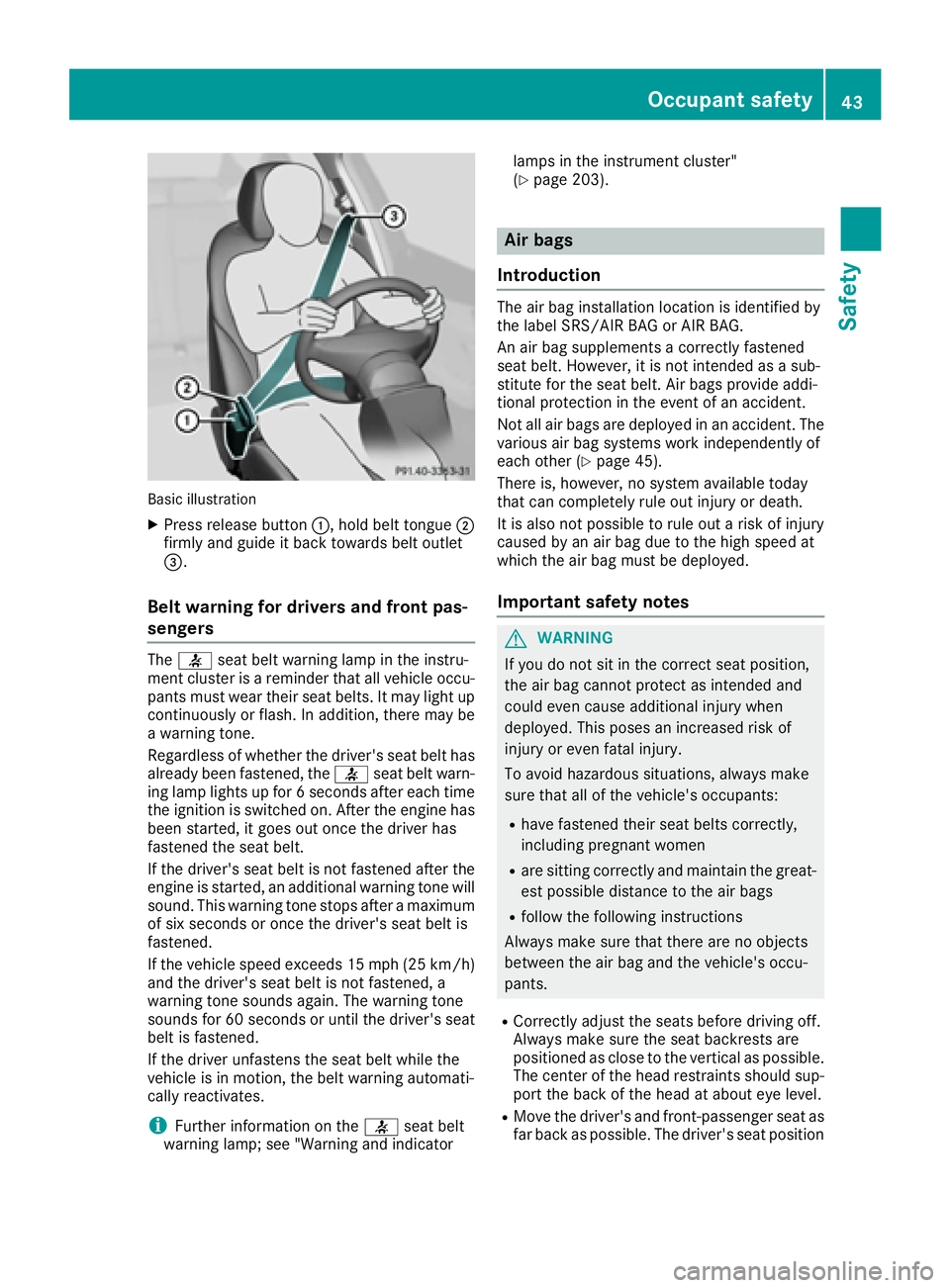
Basic illustration
XPress release button:, hold belt tongue;
firmly and guide it back towards belt outlet
=.
Belt warning for drivers and front pas-
sengers
The 7 seat belt warning lamp in the instru-
ment cluster is a reminder that all vehicle occu-
pants must wear their seat belts. It may light up
continuously or flash. In addition, there may be
a warning tone.
Regardless of whether the driver's seat belt has
already been fastened, the 7seat belt warn-
ing lamp lights up for 6 seconds after each time
the ignition is switched on. After the engine has
been started, it goes out once the driver has
fastened the seat belt.
If the driver's seat belt is not fastened after the
engine is started, an additional warning tone will
sound. This warning tone stops after a maximum
of six seconds or once the driver's seat belt is
fastened.
If the vehicle speed exceeds 15 mph (25 km/h)
and the driver's seat belt is not fastened, a
warning tone sounds again. The warning tone
sounds for 60 seconds or until the driver's seat
belt is fastened.
If the driver unfastens the seat belt while the
vehicle is in motion, the belt warning automati-
cally reactivates.
iFurther information on the 7seat belt
warning lamp; see "Warning and indicator lamps in the instrument cluster"
(
Ypage 203).
Air bags
Introduction
The air bag installation location is identified by
the label SRS/AIR BAG or AIR BAG.
An air bag supplements a correctly fastened
seat belt. However, it is not intended as a sub-
stitute for the seat belt. Air bags provide addi-
tional protection in the event of an accident.
Not all air bags are deployed in an accident. The
various air bag systems work independently of
each other (
Ypage 45).
There is, however, no system available today
that can completely rule out injury or death.
It is also not possible to rule out a risk of injury
caused by an air bag due to the high speed at
which the air bag must be deployed.
Important safety notes
GWARNING
If you do not sit in the correct seat position,
the air bag cannot protect as intended and
could even cause additional injury when
deployed. This poses an increased risk of
injury or even fatal injury.
To avoid hazardous situations, always make
sure that all of the vehicle's occupants:
Rhave fastened their seat belts correctly,
including pregnant women
Rare sitting correctly and maintain the great-
est possible distance to the air bags
Rfollow the following instructions
Always make sure that there are no objects
between the air bag and the vehicle's occu-
pants.
RCorrectly adjust the seats before driving off.
Always make sure the seat backrests are
positioned as close to the vertical as possible.
The center of the head restraints should sup-
port the back of the head at about eye level.
RMove the driver's and front-passenger seat as
far back as possible. The driver's seat position
Occupant safety43
Safety
Z
Page 46 of 290
must be such that the vehicle can be driven
safely.
RKeep hands on the outside of the steering
wheel rim. This allows the air bag to deploy
fully.
RAlways sit with your back against the seat
backrest when driving. Do not lean forward,
on the door or against the side window. Oth-
erwise, you are in the air bag deployment
area.
RAlways keep your feet in the footwell in front
of the seat. Do not, for example, place your
feet on the dashboard. Otherwise, your feet
are in the air bag deployment area.
RSuitable restraint systems must always be
used for persons under 5 ft (1.50m)in height.
The seat belt cannot be worn correctly by
persons who do not reach this height.
If children are also traveling in the vehicle,
please take note of the following points.
RAlways secure children younger than twelve
years of age and under 5 ft (1.50 m) tall in
suitable child restraint systems.
RChild restraint systems should preferably be
installed on the rear seats.
RIf you secure a child in a rearward-facing child
restraint system, always do so on a suitable
rear seat. The front-passenger front air bag
cannot be deactivated.
RBe sure to observe the instructions and safety
notes on "Children in the vehicle"
(
Ypage 47) and "Child restraint system on
the front-passenger seat" (Ypage 51) in
addition to the child restraint system manu-
facturer's installation instructions.
Objects in the passenger compartment
could prevent an air bag from functioning
properly. To prevent risks due to the required
air bag speed after deployment, ensure the fol-
lowing before starting the journey:
Rthere are no persons, animals or objects
between the vehicle occupants and an air
bag.
Rthere are no objects between the seat, door
and B-pillar.
Rno hard objects, e.g. coat hangers, hang on
the grab handles or coat hooks.
Rno accessories, such as cup holders, are
attached to the vehicle within the deployment area of an air bag, e.g. to doors or side win-
dows.
Rthere are no heavy, sharp or fragile objects in
the pockets of items of clothing. Such items
should be suitably stowed elsewhere.
GWARNING
If you modify the air bag cover or affix objects
such as stickers to it, the air bag can no longer
function correctly. There is an increased risk
of injury.
Never modify an air bag cover or affix objects
to it.
GWARNING
Sensors to control the air bags are located in
the doors. Modifications or work not per-
formed correctly to the doors or door panel-
ing, as well as damaged doors, can lead to the
function of the sensors being impaired. The air
bags might therefore not function properly
anymore. Consequently, the air bags cannot
protect vehicle occupants as they are
designed to do. There is an increased risk of
injury.
Never modify the doors or parts of the doors.
Always have work on the doors or door pan-
eling carried out at a qualified specialist work-
shop.
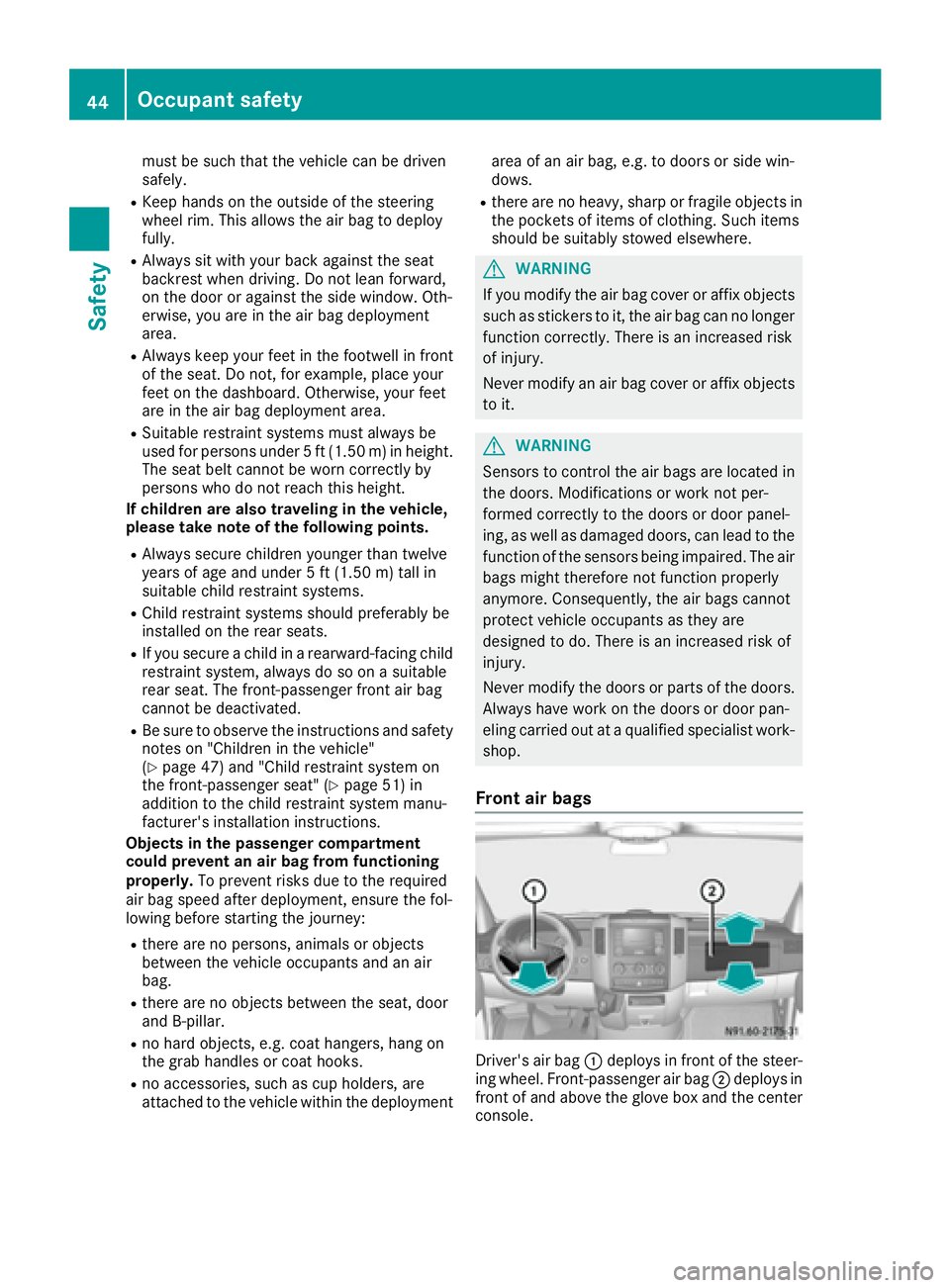
Front air bags
Driver's air bag :deploys in front of the steer-
ing wheel. Front-passenger air bag ;deploys in
front of and above the glove box and the center
console.
44Occupant safety
Safety
Page 47 of 290
When deployed, the front air bags offer addi-
tional head and thorax protection on the front
seats.
Side impact air bags
Depending on the vehicle's equipment, some
front seats are equipped with a side impact air
bag; see the AIR BAG label on the outer side of
the seat backrest.
GWARNING
Unsuitable seat covers may obstruct or even
prevent deployment of the air bags integrated
into the seats. The air bags may then fail to
protect the vehicle occupants as intended.
There is an increased risk of injury, possibly
even fatal.
Only use seat cushions that are approved for
your vehicle by the distributor named on the
inside cover page.
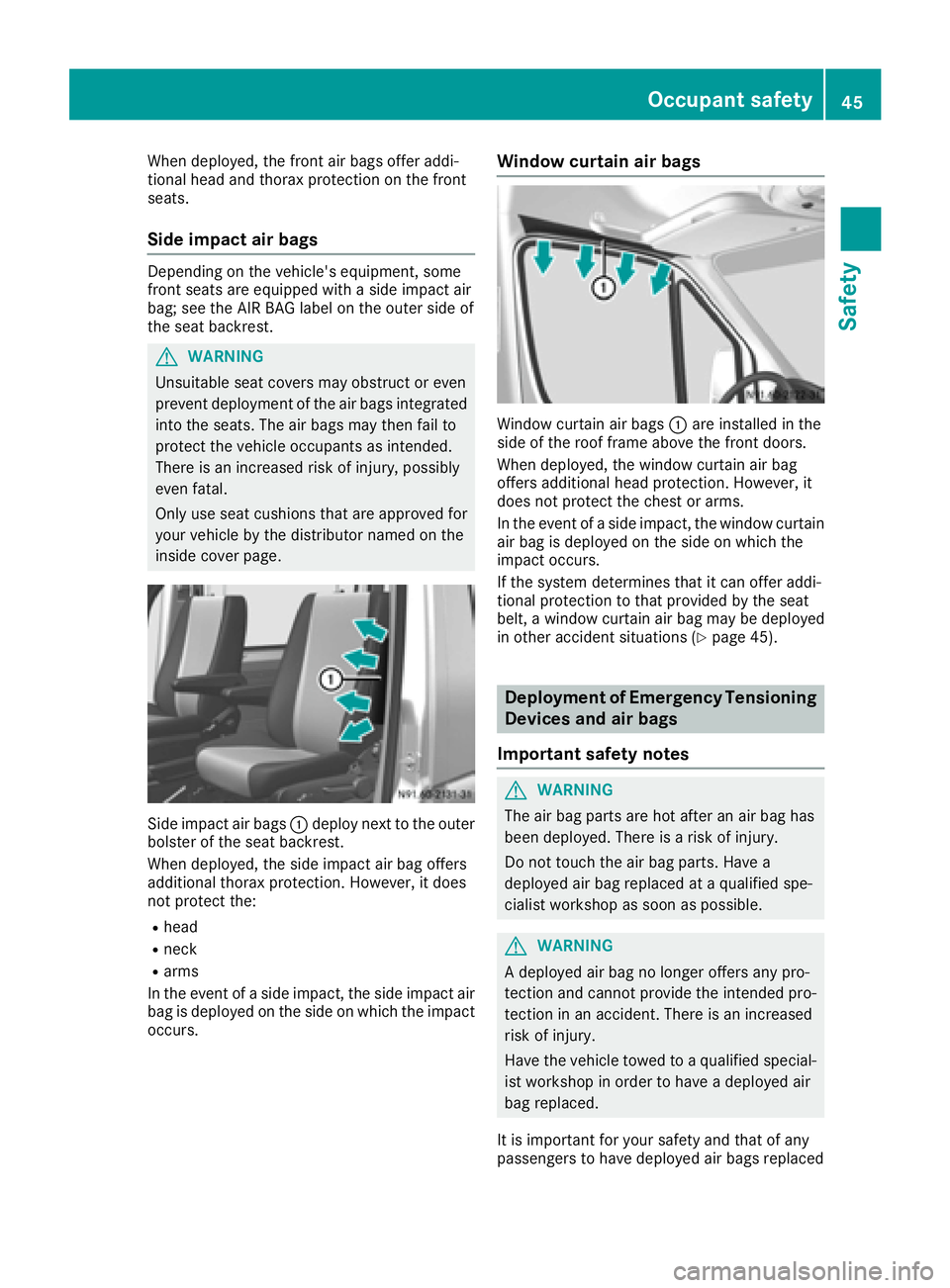
Side impact air bags :deploy next to the outer
bolster of the seat backrest.
When deployed, the side impact air bag offers
additional thorax protection. However, it does
not protect the:
Rhead
Rneck
Rarms
In the event of a side impact, the side impact air
bag is deployed on the side on which the impact
occurs.
Window curtain air bags
Window curtain air bags :are installed in the
side of the roof frame above the front doors.
When deployed, the window curtain air bag
offers additional head protection. However, it
does not protect the chest or arms.
In the event of a side impact, the window curtain
air bag is deployed on the side on which the
impact occurs.
If the system determines that it can offer addi-
tional protection to that provided by the seat
belt, a window curtain air bag may be deployed
in other accident situations (
Ypage 45).
Deployment of Emergency Tensioning
Devices and air bags
Important safety notes
GWARNING
The air bag parts are hot after an air bag has
been deployed. There is a risk of injury.
Do not touch the air bag parts. Have a
deployed air bag replaced at a qualified spe-
cialist workshop as soon as possible.
GWARNING
A deployed air bag no longer offers any pro-
tection and cannot provide the intended pro-
tection in an accident. There is an increased
risk of injury.
Have the vehicle towed to a qualified special-
ist workshop in order to have a deployed air
bag replaced.
It is important for your safety and that of any
passengers to have deployed air bags replaced
Occupant safety45
Safety
Z
Page 49 of 290
If the restraint system control unit detects a side
impact situation, the applicable components of
the restraint system are deployed independ-
ently of each other. If the system determines a
need for additional protection for the vehicle
occupants, the Emergency Tensioning Devices
are also deployed.
RSide impact air bag on the side on which the
impact occurs, independently of the Emer-
gency Tensioning Device and of the use of the
seat belt
RWindow curtain air bag on the side of the col-
lision, regardless of seat belt use and whether
front-passenger seat is occupied
iNot all air bags are deployed in an accident.
The various air bag systems work independ-
ently of each other.
How the air bag system works is determined
by the severity of the accident detected,
especially the vehicle deceleration or accel-
eration, and the apparent type of accident:
Rfrontal collision
Rside impact
Children in the vehicle
Important safety notes
Accident statistics show that children secured
in the rear seats are safer than children secured
in the front-passenger seat. For this reason, we
strongly advise that you install a child restraint
system on a rear seat. Children are generally
better protected there.
If a child younger than twelve years old and
under 5 ft (1.50 m)in height is traveling in the
vehicle:
Ralways secure the child in a child restraint
system suitable for this vehicle. The child
restraint system must be appropriate to the
age, weight and size of the child
Rbe sure to observe the instructions and safety
notes in this section in addition to the child
restraint system manufacturer's installation
instructions
GWARNING
If you leave children unsupervised in the vehi-
cle, they could set it in motion by, for example:
Rrelease the parking brake.
Rshift the automatic transmission out of the
parking position P.
Rstart the engine.
In addition, they may operate vehicle equip-
ment and become trapped. There is a risk of
an accident and injury.
When leaving the vehicle, always take the
SmartKey with you and lock the vehicle. Never
leave children unsupervised in the vehicle.
GWARNING
If persons, particularly children are subjected to prolonged exposure to extreme heat or
cold, there is a risk of injury, possibly even
fatal. Never leave children unattended in the
vehicle.
GWARNING
If the child restraint system is subjected to
direct sunlight, parts may get very hot. Chil-
dren may burn themselves on these parts,
particularly on the metal parts of the child
restraint system. There is a risk of injury.
If you leave the vehicle, taking the child with
you, always ensure that the child restraint
system is not exposed to direct sunlight. Pro- tect it with a blanket, for example. If the child
restraint system has been exposed to direct
sunlight, let it cool down before securing the
child in it. Never leave children unattended in
the vehicle.
Always ensure that all vehicle occupants have
their seat belts fastened correctly and are sitting
properly. Particular attention must be paid to
children.
Observe the safety notes on the seat belt
(
Ypage 40) and the notes on correct use of seat
belts (Ypage 41).
A booster seat may be necessary to achieve
proper seat belt positioning for children over
41 lbs (18 kg) until they reach a height where a
Children in the vehicle47
Safety
Z
Page 52 of 290
ISOFIX is a standardized securing system for
specially designed child restraint systems on
the rear seats. LATCH-type (ISOFIX) securing
rings:for a LATCH-type (ISOFIX) child
restraint system are installed between the seat
cushion and the seat backrest:
Ron the outer left and right seat on rear bench
seats with 3 seats
Ron the outer left seat on rear bench seats with
2 seats
Non-LATCH-type (ISOFIX) child seats may also
be used and can be installed using the vehicle's
seat belt system. Install the child seat according
to the manufacturer's instructions.
Top Tether
Introduction
Top Tether provides an additional connection
between the LATCH-type (ISOFIX) child restraint
system and the vehicle. This helps reduce the
risk of injury even further. If the child restraint
system has a Top Tether belt, this should be
used at all times.
Important safety notes
GWARNING
If the Top Tether belt has been incorrectly
secured, e.g. to an eyelet in the cargo com-
partment, the child restraint system is not
correctly kept in place. It therefore cannot
perform its intended protective function in the
event of an accident. There is an increased
risk of injury.
Only secure the Top Tether hook to the Top
Tether anchorage intended for this purpose.
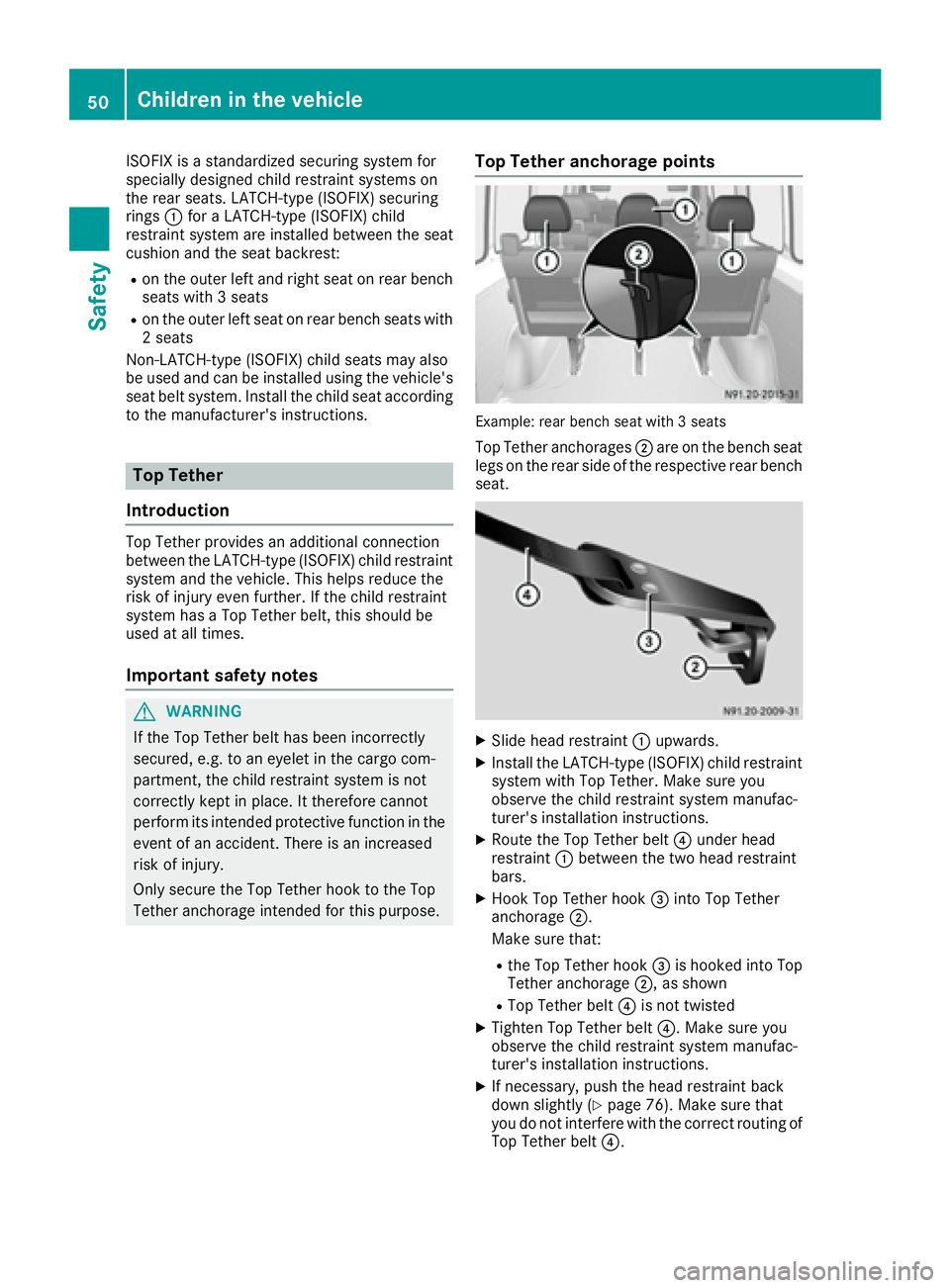
Top Tether anchorage points
Example: rear bench seat with 3 seats
Top Tether anchorages ;are on the bench seat
legs on the rear side of the respective rear bench
seat.
XSlide head restraint :upwards.
XInstall the LATCH-type (ISOFIX) child restraint
system with Top Tether. Make sure you
observe the child restraint system manufac-
turer's installation instructions.
XRoute the Top Tether belt ?under head
restraint :between the two head restraint
bars.
XHook Top Tether hook =into Top Tether
anchorage ;.
Make sure that:
Rthe Top Tether hook =is hooked into Top
Tether anchorage ;, as shown
RTop Tether belt?is not twisted
XTighten Top Tether belt ?. Make sure you
observe the child restraint system manufac-
turer's installation instructions.
XIf necessary, push the head restraint back
down slightly (Ypage 76). Make sure that
you do not interfere with the correct routing of
Top Tether belt ?.
50Children in the vehicle
Safety