window MERCEDES-BENZ SPRINTER 2017 MY17 Operator’s Manual
[x] Cancel search | Manufacturer: MERCEDES-BENZ, Model Year: 2017, Model line: SPRINTER, Model: MERCEDES-BENZ SPRINTER 2017Pages: 286, PDF Size: 4.36 MB
Page 24 of 286
Reservefuel .................................. .196
Tire pressure monitor .................... 197
Water separator .............................1 98
Windshield washer fluid ................. 198
Warranty .............................................. 23
Washer fluid
Adding ...........................................2 20
Capacities ...................................... 281
Display message ............................ 189
Indicator lamp ................................ 198
Notes ............................................. 281
Wiping with ...................................... 94
Wheels
Changing a wheel .......................... 262
Checking ........................................ 244
Cleaning ......................................... 231
Important safety notes .................. 243
Installing the adapter (spare
wheel) ............................................ 265
Interchanging/changing ................ 262
Mounting a new wheel ................... 266
Mounting a wheel .......................... 263
Removing a wheel .......................... 265
Removing and mounting the spare
wheel ............................................. 269
Snow chains .................................. 246
Storing ...........................................2 62
Tightening torque ........................... 267
Wheel size/tire size ....................... 268
Window curtain air bag ....................... 46
Windows
see Side windows
Windshield
Cleaning ......................................... 231
Defrosting ...................................... 102
Windshield heating
Problem (malfunction) ................... 103
Switching on/off ........................... 103
Windshield washer fluid
Adding ...........................................2 20
Indicator lamp ................................ 198
Windshield wipers
Problem (malfunction) ..................... 96
Rain and light sensor ....................... 94
Rear window wiper .......................... 95
Replacing the wiper blades .............. 95 Setting the sensiti
vity (vehicles
with steering wheel buttons and
rain/light sensor) ........................... 170
Switching on/off .............................. 94
Wiping with windshield washer
fluid ................................................. 94
Winter diesel ..................................... 274
Winter driving
Slippery road surfaces ................... 134
Snow chains .................................. 246
Winter operation
General notes ................................ 245
Radiator cover ................................. 29
Winter tires
M+S tires ....................................... 245
Setting a limit speed ......................1 31
Wiper blades
Cleaning ......................................... 231
Replacing ......................................... 95
Workshop
see Qualified specialist workshop
22Index
Page 27 of 286
Proper use
Observe the following information when oper-
ating your vehicle:
Rthe safety notes in these operating instruc-
tions
Rthe technical data in these Operating Instruc-
tions
Rtraffic laws and regulations
Rmotor vehicle laws and safety standards
There are various warning stickers affixed to the
vehicle. If you remove warning stickers, you and
others may fail to recognize the dangers. Leave
the warning stickers in their original position.
GWARNING
Modifications to electronic components, their software as well as wiring can impair their
function and/or the function of other net-
worked components. In particular, systems
relevant to safety could also be affected. As a
result, these may no longer function as inten-
ded and/or jeopardize the operating safety of
the vehicle. There is an increased risk of an
accident and injury.
Never tamper with the wiring as well as elec-
tronic components or their software. You
should have all work to electrical and elec-
tronic equipment carried out at a qualified
specialist workshop.
The general operating permit for your vehicle
could be rendered invalid if you carry out mod-
ifications to electronic components, their soft-
ware as well as wiring.
GWARNING
Gases and fluids from substances that con-
stitute a health hazard or react aggressively
can escape even from securely closed con-
tainers. When transporting such substances
in the vehicle interior, your ability to concen-
trate or your health could be affected during
the journey. Malfunctions, short circuits or
electrical component system failures may
also result. There is a risk of an accident and
fire.
Do not store or transport any substances in
the vehicle interior which are hazardous to
health or react aggressively.
These instructions must also be observed for
vehicles where the cargo compartment is not
fully separated from the driver's cab.
Partition with door/window: always keep the
door/window in the partition closed during
transport.
Examples of substances that are hazardous to
health and/or react aggressively:
RSolvents
RFuel
ROil and grease
RCleaning agents
RAcids
Protection of the environment
Economic and environmentally aware
driving
HEnvironmental note
Daimler's declared policy is one of compre-
hensive environmental protection.
The objectives are for the natural resources
that form the basis of our existence on this
planet to be used sparingly and in a manner
that takes the requirements of both nature
and humanity into account.
You too can help to protect the environment
by operating your vehicle in an environmen-
tally responsible manner.
Fuel consumption and the rate of engine,
transmission, brake and tire wear are affected
by these factors:
Roperating conditions of your vehicle
Ryour personal driving style
You can influence both factors. You should
bear the following in mind:
Introduction25
Z
Page 34 of 286
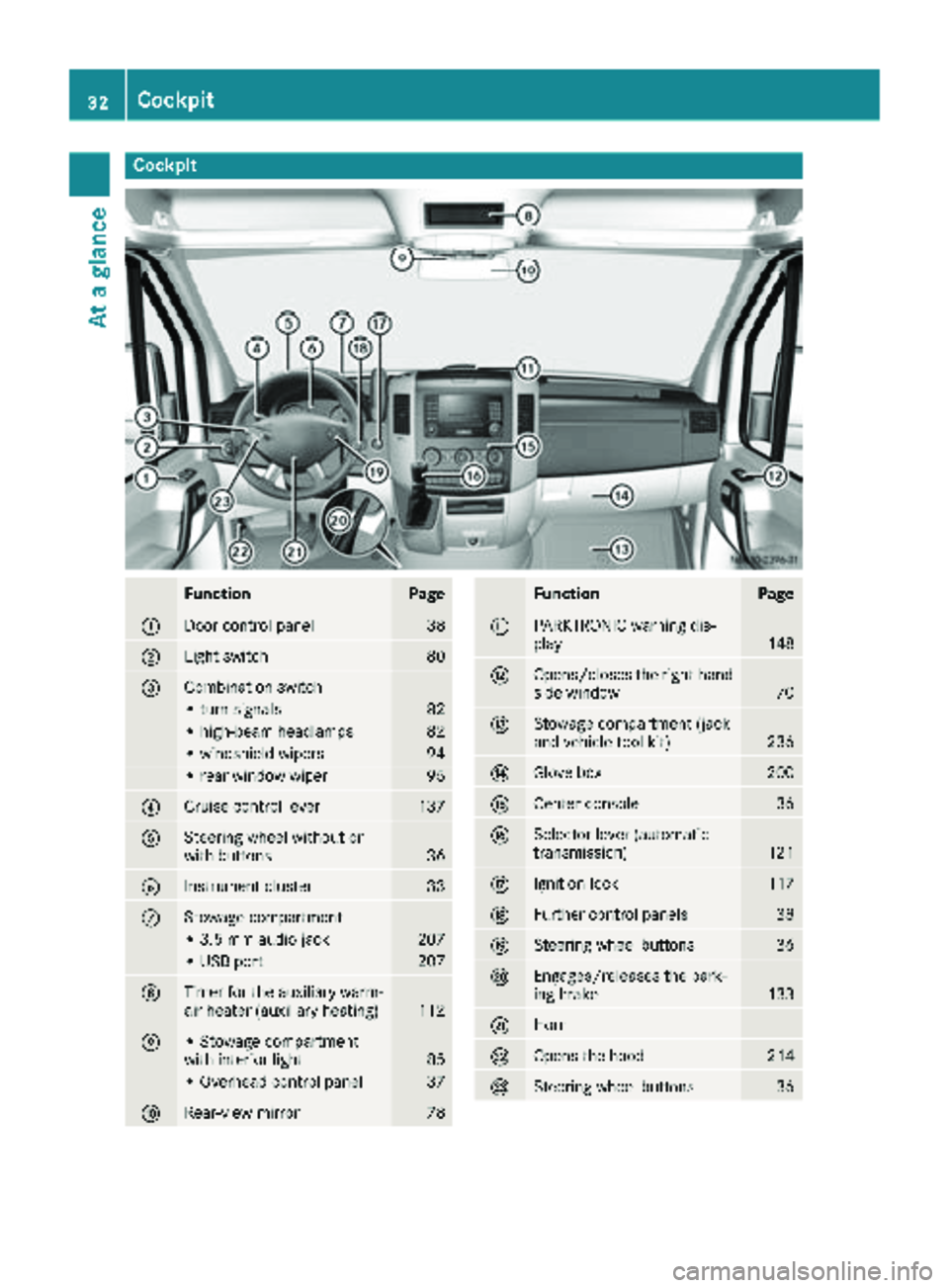
Cockpit
FunctionPage
:Door control panel38
;Light switch80
=Combination switch
• turn signals82
• high-beam headlamps82
• windshield wipers94
• rear window wiper95
?Cruise control lever137
ASteering wheel without or
with buttons36
BInstrument cluster33
CStowage compartment
• 3.5 mm audio jack207
• USB port207
DTimer for the auxiliary warm-
air heater (auxiliary heating)112
E• Stowage compartment
with interior light85
• Overhead control panel37
FRear-view mirror78
FunctionPage
GPARKTRONIC warning dis-
play148
HOpens/closes the right-hand
side window70
IStowage compartment (jack
and vehicle tool kit)236
JGlove box200
KCenter console36
LSelector lever (automatic
transmission)121
MIgnition lock117
NFurther control panels38
OSteering wheel buttons36
PEngages/releases the park-
ing brake133
QHorn
ROpens the hood214
SSteering wheel buttons36
32Cockpit
At a glance
Page 38 of 286
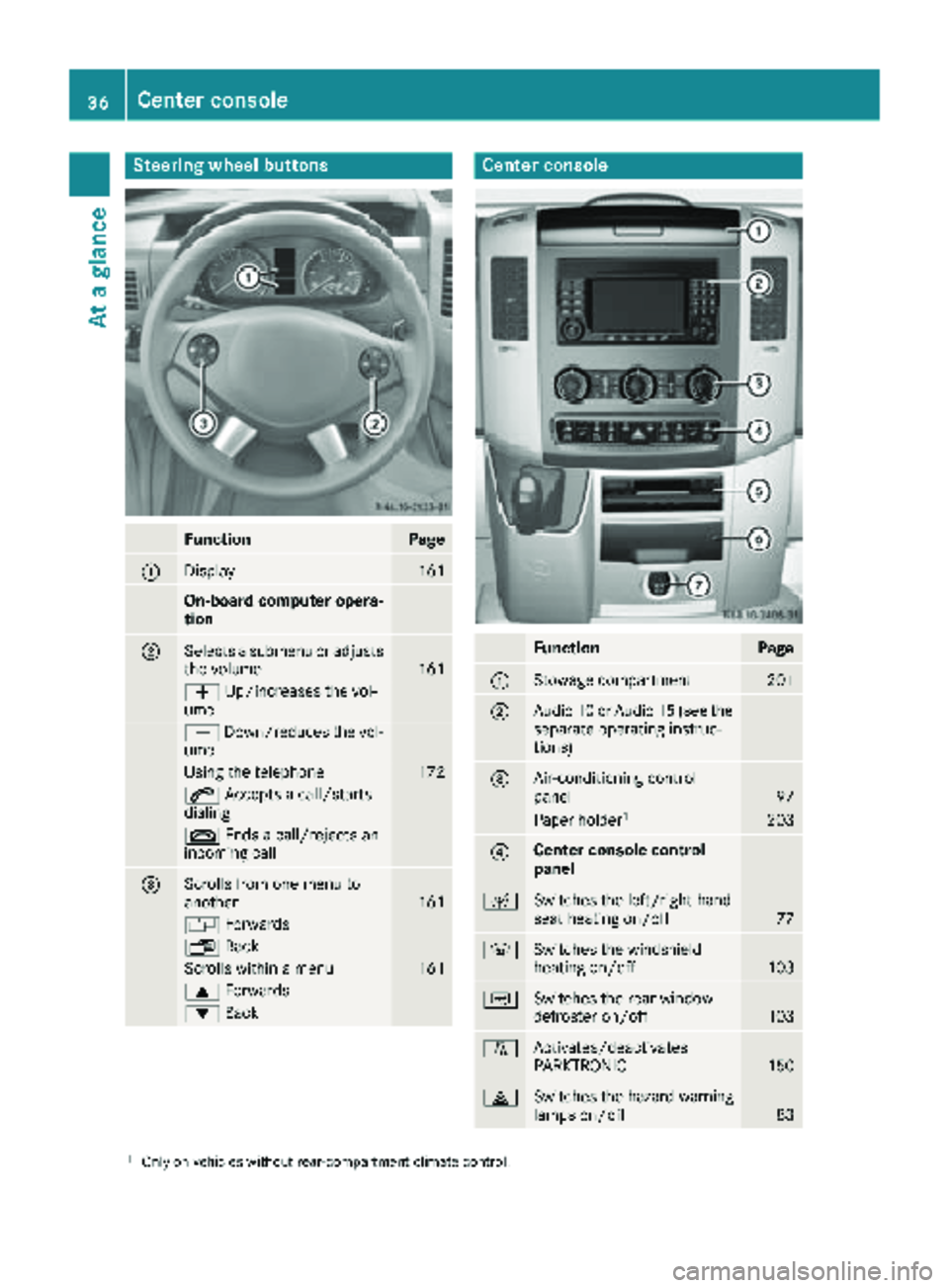
Steering wheel buttons
FunctionPage
:Display161
On-board computer opera-
tion
;Selects a submenu or adjusts
the volume161
WUp/increases the vol-
ume
X Down/reduces the vol-
ume
Using the telephone172
6 Accepts a call/starts
dialing
~ Ends a call/rejects an
incoming call
=Scrolls from one menu to
another161
V Forwards
UBack
Scrolls within a menu161
9Forwards
:Back
Center console
FunctionPage
:Stowage compartment201
;Audio 10 or Audio 15 (see the
separate operating instruc-
tions)
=Air-conditioning control
panel97
Paper holder1203
?Center console control
panel
cSwitches the left/right-hand
seat heating on/off77
zSwitches the windshield
heating on/off103
|Switches the rear window
defroster on/off103
fActivates/deactivates
PARKTRONIC150
£Switches the hazard warning
lamps on/off83
1Only on vehicles without rear-compartment climate control.
36Center console
At a glance
Page 40 of 286
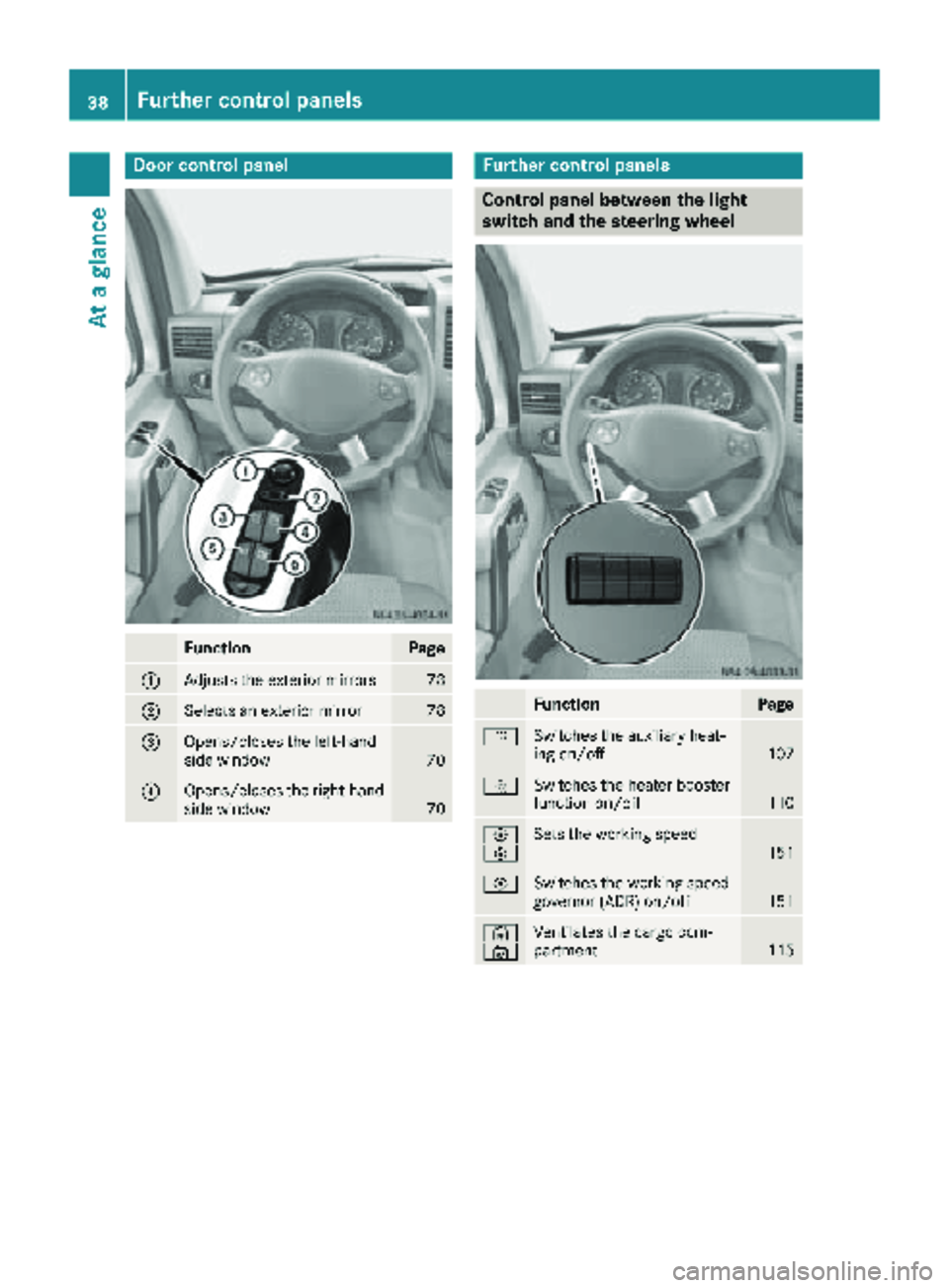
Door controlpanel
FunctionPage
:Adjust sth eexterio rmirrors78
;Selects an exterio rmirro r78
=Opens/closes th eleft-han d
sid ewindow70
?Opens/closes th eright-hand
sid ewindow70
Further contro lpanels
Contro lpanel between th eligh t
switch an dth esteering wheel
FunctionPage
ySwitches th eauxiliar yheat -
in g on/off10 7
±Switches th eheater booster
function on/off11 0
E
FSets th eworking speed15 1
ESwitches th eworking speed
governor (ADR) on/off15 1
´
·Ventilates th ecargo com-
partmen t115
38Further control panels
At a glance
Page 46 of 286
Belt warning for drivers and front pas-
sengers
The7 seat belt warning lamp in the instru-
ment cluster is a reminder that all vehicle occu-
pants must wear their seat belts. It may light up continuously or flash. In addition, there may be
a warning tone.
Regardless of whether the driver's seat belt has
already been fastened, the 7seat belt warn-
ing lamp lights up for 6 seconds after each time
the ignition is switched on. After the engine has
been started, it goes out once the driver has
fastened the seat belt.
If the driver's seat belt is not fastened when the
engine is started, an additional warning tone will
sound. This warning tone stops after a maximum
of six seconds or once the driver's seat belt is
fastened.
If the vehicle's speed exceeds 15 mph
(25 km/h) once and the driver's seat belt is not
fastened, a warning tone sounds. The warning
tone sounds for 60 seconds or until the driver's
seat belt is fastened.
If the driver's seat belt is unfastened during the
journey, the seat belt warning is activated again.
Air bags
Introduction
The installation point of an air bag can be rec-
ognized by the SRS/AIRBAG or AIRBAG mark-
ing.
An air bag complements the correctly fastened
seat belt. It is no substitute for the seat belt. The
air bag provides additional protection in appli-
cable accident situations.
Not all air bags are deployed in an accident. The
different air bag systems function independ-
ently from one another (
Ypage 46).
However, no system available today can com-
pletely eliminate injuries and fatalities.
It is also not possible to rule out a risk of injury
caused by an air bag due to the high speed at
which the air bag must be deployed.
Important safety notes
GWARNING
If you do not sit in the correct seat position,
the air bag cannot protect as intended and
could even cause additional injury when
deployed. This poses an increased risk of
injury or even fatal injury.
To avoid hazardous situations, always make
sure that all of the vehicle's occupants:
Rhave fastened their seat belts correctly,
including pregnant women
Rare sitting correctly and maintain the great-
est possible distance to the air bags
Rfollow the following instructions
Always make sure that there are no objects
between the air bag and the vehicle's occu-
pants.
RAdjust the seats properly before beginning
your journey. Always make sure that the seat
is in an almost upright position. The center of
the head restraint must support the head at
about eye level.
RMove the driver's and front-passenger seats
as far back as possible. The driver's seat posi-
tion must allow the vehicle to be driven safely.
ROnly hold the steering wheel on the outside.
This allows the air bag to be fully deployed.
RAlways lean against the backrest while driv-
ing. Do not lean forward or lean against the
door or side window. You may otherwise be in
the deployment area of the air bags.
RAlways keep your feet in the footwell in front
o
f the seat. Do not put your feet on the dash-
board, for example. Your feet may otherwise
be in the deployment area of the air bag.
RFor this reason, always secure persons less
than 5 ft (1.50 m)tall in suitable restraint sys-
tems. Up to this height, the seat belt cannot
be worn correctly.
If a child is traveling in your vehicle, also
observe the following notes:
RAlways secure children under twelve years of
age and less than 5 ft (1.50 m)tall in suitable
child restraint systems.
RChild restraint systems should be installed on
the rear seats.
RAlways secure a child in a rearward-facing
child restraint system on a suitable rear seat.
The front-passenger front air bag cannot be
deactivated.
RAlways observe the instructions and safety
notes on "Children in the vehicle"
(
Ypage 47) and on the "Child restraint sys-
44Occupant safety
Safety
Page 48 of 286
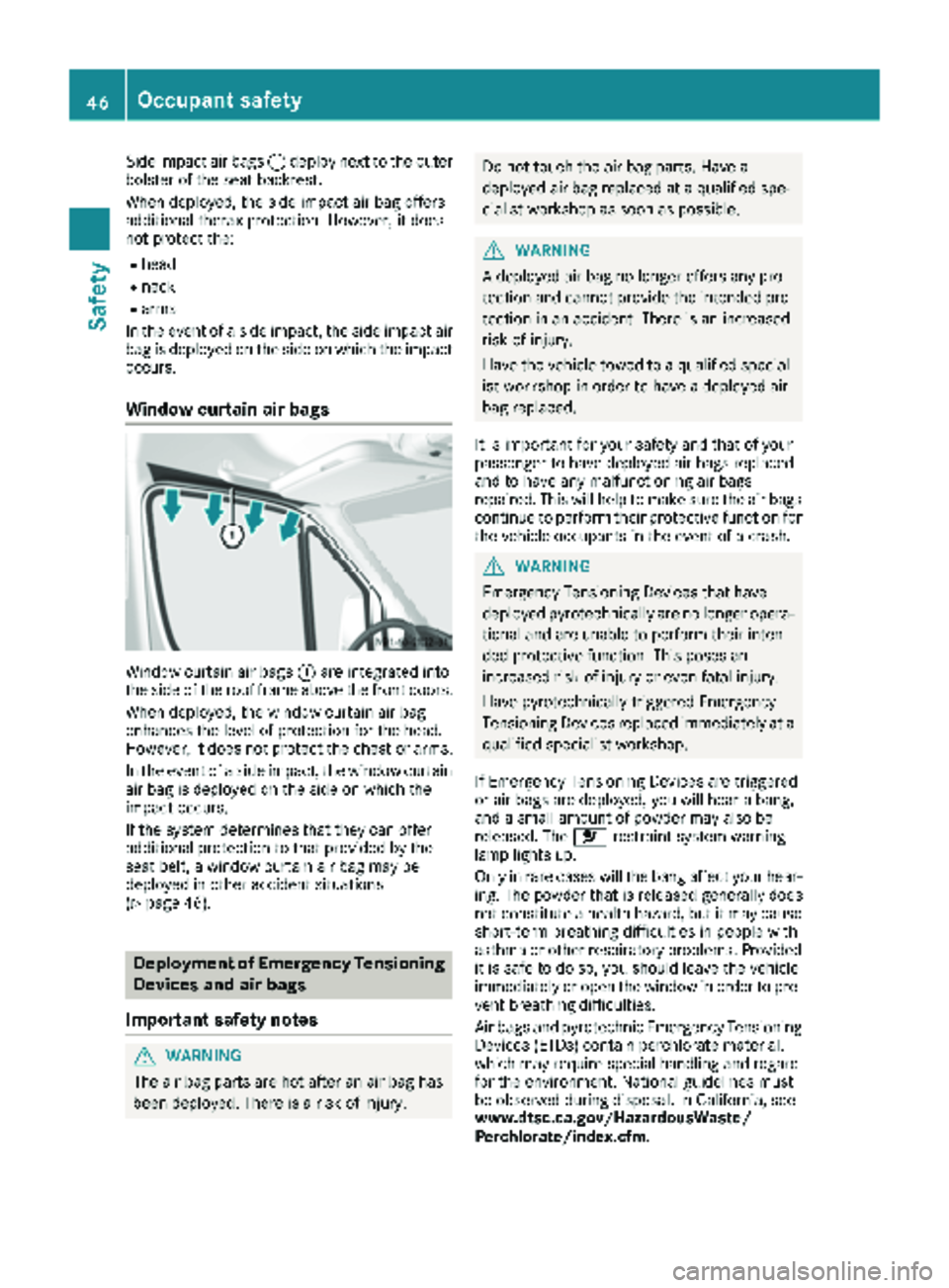
Side impact air bags:deploy next to the outer
bolster of the seat backrest.
When deployed, the side impact air bag offers
additional thorax protection. However, it does
not protect the:
Rhead
Rneck
Rarms
In the event of a side impact, the side impact air
bag is deployed on the side on which the impact
occurs.
Window curtain air bags
Window curtain air bags :are integrated into
the side of the roof frame above the front doors.
When deployed, the window curtain air bag
enhances the level of protection for the head.
However, it does not protect the chest or arms.
In the event of a side impact, the window curtain
air bag is deployed on the side on which the
impact occurs.
If the system determines that they can offer
additional protection to that provided by the
seat belt, a window curtain air bag may be
deployed in other accident situations
(
Ypage 46).
Deployment of Emergency Tensioning
Devices and air bags
Important safety notes
GWARNING
The air bag parts are hot after an air bag has
been deployed. There is a risk of injury.
Do not touch the air bag parts. Have a
deployed air bag replaced at a qualified spe-
cialist workshop as soon as possible.
GWARNING
A deployed air bag no longer offers any pro-
tection and cannot provide the intended pro-
tection in an accident. There is an increased
risk of injury.
Have the vehicle towed to a qualified special-
ist workshop in order to have a deployed air
bag replaced.
It is important for your safety and that of your
passenger to have deployed air bags replaced
and to have any malfunctioning air bags
repaired. This will help to make sure the air bags
continue to perform their protective function for
the vehicle occupants in the event of a crash.
GWARNING
Emergency Tensioning Devices that have
deployed pyrotechnically are no longer opera-
tional and are unable to perform their inten-
ded protective function. This poses an
increased risk of injury or even fatal injury.
Have pyrotechnically triggered Emergency
Tensioning Devices replaced immediately at a
qualified specialist workshop.
If Emergency Tensioning Devices are triggered
or air bags are deployed, you will hear a bang,
and a small amount of powder may also be
released. The 6restraint system warning
lamp lights up.
Only in rare cases will the bang affect your hear-
ing. The powder that is released generally does
not constitute a health hazard, but it may cause
short-term breathing difficulties in people with
asthma or other respiratory problems. Provided
it is safe to do so, you should leave the vehicle
immediately or open the window in order to pre-
vent breathing difficulties.
Air bags and pyrotechnic Emergency Tensioning
Devices (ETDs) contain perchlorate material,
which may require special handling and regard
for the environment. National guidelines must
be observed during disposal. In California, see
www.dtsc.ca.gov/HazardousWaste/
Perchlorate/index.cfm .
46Occupant safety
Safety
Page 49 of 286
Method of operation
During the first stage of a collision, the restraint
system control unit evaluates important physi-
cal data relating to vehicle deceleration or accel-
eration, such as:
Rduration
Rdirection
Rintensity
Based on the evaluation of this data, the
restraint system control unit triggers the Emer-
gency Tensioning Devices during a frontal or
rear collision.
An Emergency Tensioning Device can only be
triggered, if:
Rthe ignition is switched on
Rthe components of the restraint system are
operational. You can find further information
under: "Restraint system warning lamp"
(
Ypage 40)
Rthe seat belt buckle tongue has engaged in
the belt buckle of the respective front seat
The Emergency Tensioning Device of the front-
passenger seat is triggered independently of the
lock status of the seat belt.
If the restraint system control unit detects a
more severe accident, further components of
the restraint system are activated independ-
ently of each other in certain frontal collision
situations:
RFront air bags
RWindow curtain air bag on the side on which
the impact occurs
The activation threshold of the Emergency Ten-
sioning Devices and the air bag are determined
by evaluating the rate of vehicle deceleration or
acceleration which occurs at various points in
the vehicle. This process is pre-emptive in
nature. Deployment should take place in good
time at the start of the collision.
The rate of vehicle deceleration or acceleration
and the direction of the force are essentially
determined by:
Rthe distribution of forces during the collision
Rthe collision angle
Rthe deformation characteristics of the vehicle
Rthe characteristics of the object with which
the vehicle has collided
Factors which can only be seen and measured
after a collision has occurred do not play a deci-
sive role in the deployment of an air bag . Nor dothey provide a
n indication of air bag deploy-
ment.
The vehicle can be deformed considerably, with-
out an air bag being deployed. This is the case if
only parts which are relatively easily deformed
are affected and the rate of deceleration is not
high. Conversely, air bags may be deployed even though the vehicle suffers only minor deforma-
tion. This is the case if, for example, very rigid
vehicle parts such as longitudinal body mem-
bers are hit, and sufficient deceleration occurs
as a result.
If the restraint system control unit detects a side
impact, the relevant restraint system compo-
nents are deployed independently of each other.
If the system determines a need for additional
protection for the vehicle occupants, the Emer-
gency Tensioning Devices are triggered.
RSide impact air bag on the side of impact,
independently of the Emergency Tensioning
Device and the use of the seat belt
RWindow curtain air bag on the side of impact,independently of the use of the seat belt and
independently of whether the front-
passenger seat is occupied
iNot all air bags are deployed in an accident.
The different air bag systems work independ-
ently of each other.
How the air bag system works is determined
by the severity of the accident detected,
especially the vehicle deceleration or accel-
eration and the apparent type of accident:
Rfrontal collision
Rside impact
Children in the vehicle
Important safety notes
Accident statistics show that children secured
in the rear seats are safer than children secured
in the front-passenger seat. For this reason, we
strongly advise that you install a child restraint
system on a rear seat. Children are generally
better protected there.
If a child younger than twelve years old and
under 5 ft (1.50 m) in height is traveling in the
vehicle:
Ralways secure the child in a child restraint
system suitable for this vehicle. The child
Children in the vehicle47
Safety
Z
Page 58 of 286
Crosswind Assist is operational again as soon as
the driving conditions return to normal.
Cros swind Assist detects strong crosswind
gusts that can impair the road holding of your
veh icle when driving straight ahead. Cros swind
Assist intervenes dependin g on thedirection
and strength of the crosswind .
A stabiliz ing brake application helps you to keep
the veh icleon track.
In formation appears inthe instrument cluster In
the event that Cros swind Assist intervenes
noticeably.
On vehicles without steering wheel buttons:
the d indicator lamp inthe instrument clus-
ter flashes.
On vehicles with steering wheel buttons: the
d indicator lamp inthe instrument cluster
flashes and the message Crosswind Assist
Activeappearsinthe multifunction display.
Cros swind Assist isactive above a veh iclespeed
of 50 mph (80 km/h) when the veh icle is driving
straight ahead or cornering gently.
Emergency exit
Emergency exit window
GWAR NING
The emergency exit wind ow cannotbelocked
in plac e. You risk injury ifyou exit the vehicle
through the emergency exit wind ow.
RMake sure that nobodybecomes tr apped,
both when closing and when opening the
emergency exit wind ow.
RThe opened emergency exit wind ow must
be held in plac eby another person.
Pay attention to traff icconditions.
GWAR NING
If the emergency exit wind owisunlocked
while driv ing,itcould open and slam shut and
consequently fall down. There isa risk of an
acc iden t and injury.
Before starting off, make sure that the emer-
gency exit wind owislocked and the locking
pin s are undamage d.
!Make sure there issuff icient clearance
when opening the emergency exit wind ow.Hold the open window in position. You could
otherwise damage the emergency exit win-
dow.
The emergency exit wind
owisintended for use
in an emergency only and must not be opened
unless the vehicle isstationary. The emergency
exit window isthe first window behind the driv-
er's seat on the driver's side. It is marked by the
"Emergency Exit" label.
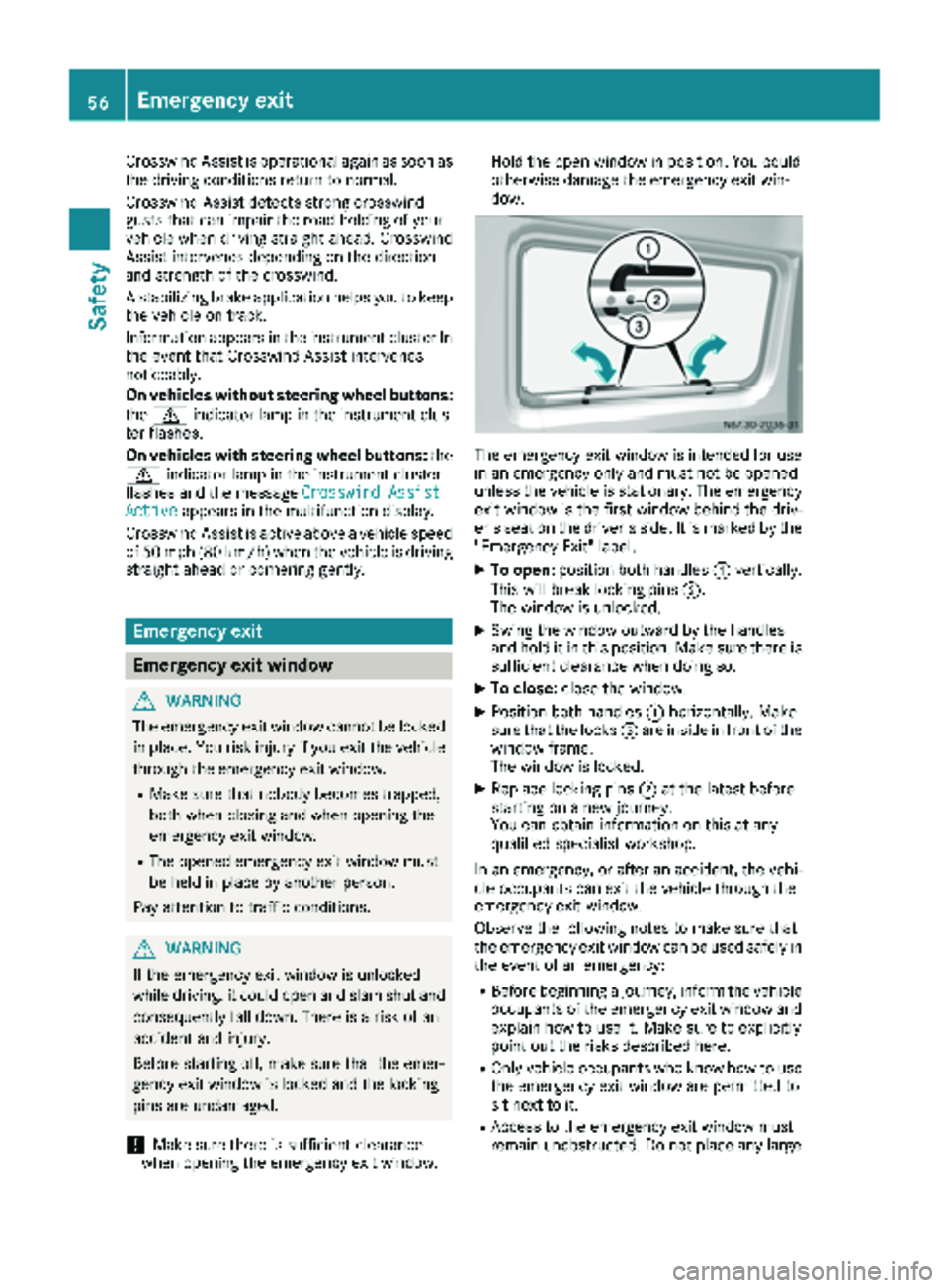
XTo open: position both handles :vertically.
This willbreak locking pins ;.
The wind ow is unlocked.
XSwin g the window outward by the handles
and hold it in this position. Make sure there is
sufficient clearance when doing so.
XTo close: close the window.
XPosition both handles :horizontally. Make
sure that the locks =are inside infront of the
window frame.
The wind ow is locked.
XReplace locking pins ;at the latest before
starting on a new journey.
You can obtain information on this at any
qualif ied specialist workshop.
In an emergency, or after an accident, the vehi-
cle occupants can exit the vehicle through the
emergency exit wind ow.
Observe the foll owing notes to make sure that
the emergency exit window can be used safely in
the event of an emergency:
RBefore beginning a journey, inform the vehicle
occupants of the emergency exit wind ow and
explain how to use it. Make sure to explicitly
poin t out the risks describe d here.
ROnlyvehicle occupants who know how to use
the emergency exit wind ow are permitted to
sit next to it.
RAccess to the emergency exit wind ow must
remain unobstructed. Do not place any large
56Emergency exit
Safety
Page 59 of 286
or heavy objects on or in front of the seats
next to the emergency exit window.
RThe window handles must not be used as
hooks, e.g. to hang up light objects, bags or
items of clothing.
RWhen exiting the vehicle through the emer-
gency exit window, pay attention to the vehi-
cle height and the local conditions. Particu-
larly children and smaller adults may require
assistance when exiting the vehicle.
Theft deterrent locking system
Immobilizer
XTo activate:remove the key from the ignition
lock.
XTo deactivate: turn the key to position 2in
the ignition lock.
The immobilizer prevents your vehicle from
being started without the correct key.
Always take the key with you and lock the vehi-
cle when leaving the vehicle. If you leave the key
in the vehicle, anyone can start the engine.
iThe immobilizer is always deactivated when
you start the engine.
In the event that the engine cannot be started
when the starter battery is fully charged, the
immobilizer may be faulty. Contact an author-
ized Sprinter dealer or call 1-877-762-8267
(in USA) or 1-800-387-0100 (in Canada).
ATA (Anti-Theft Alarm system)
XTo arm: close all doors.
XLock the vehicle with the key.
The indicator lamp in the central locking but-
ton (
Ypage 63) flashes.
XTo disarm: unlock the vehicle with the key.
The indicator lamp in the central locking but-
ton (
Ypage 63) goes out.
iCargo Van and Passenger Van only:
Unless you open a door within 40 seconds
after unlocking the vehicle:
Rthe vehicle will be locked again
Rthe anti-theft alarm system will be armed
again If the alarm system is armed, a visual and audi-
ble alarm is triggered by the following:
RUnlocking the vehicle from inside
ROpening a door
ROpening the hood
iThe alarm is not switched off, even if you
immediately close the open door that has trig- gered it, for example.
XTo stop the alarm: press the%button on
the remote control.
or
XInsert the key into the ignition lock.
The alarm stops.
Tow-away alarm
Operation
A visual and audible alarm is triggered if the
inclination of the vehicle changes when the tow- away alarm is armed. This can be the case if the
vehicle is raised on one side, for example.
Arming and disarming
The tow-away alarm is automatically armed
approximately 20 seconds after you lock the
vehicle.
The tow-away alarm is automatically deactiva-
ted when you unlock the vehicle.
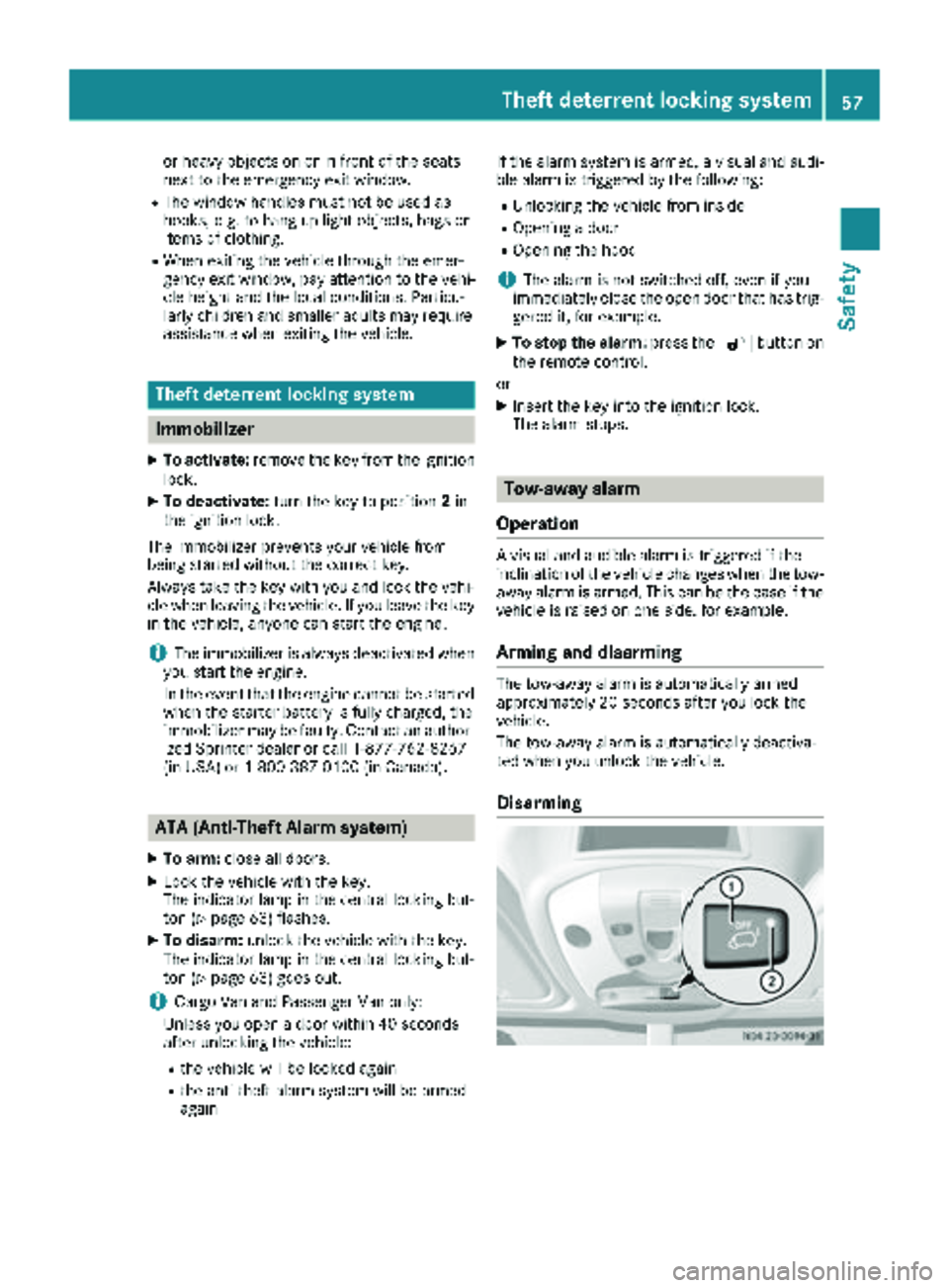
Disarming
Theft deterrent locking system57
Safety
Z