seats MERCEDES-BENZ SPRINTER 2017 MY17 Operator’s Manual
[x] Cancel search | Manufacturer: MERCEDES-BENZ, Model Year: 2017, Model line: SPRINTER, Model: MERCEDES-BENZ SPRINTER 2017Pages: 286, PDF Size: 4.36 MB
Page 256 of 286
Loading the vehicle
Instruction labels for tires and loads
GWARNING
Overloaded tires can overheat, causing a
blowout. Overloaded tires can also impair the steering and driving characteristics and lead
to brake failure. There is a risk of accident.
Observe the load rating of the tires. The load
rating must be at least half of the GAWR of
your vehicle. Never overload the tires by
exceeding the maximum load.
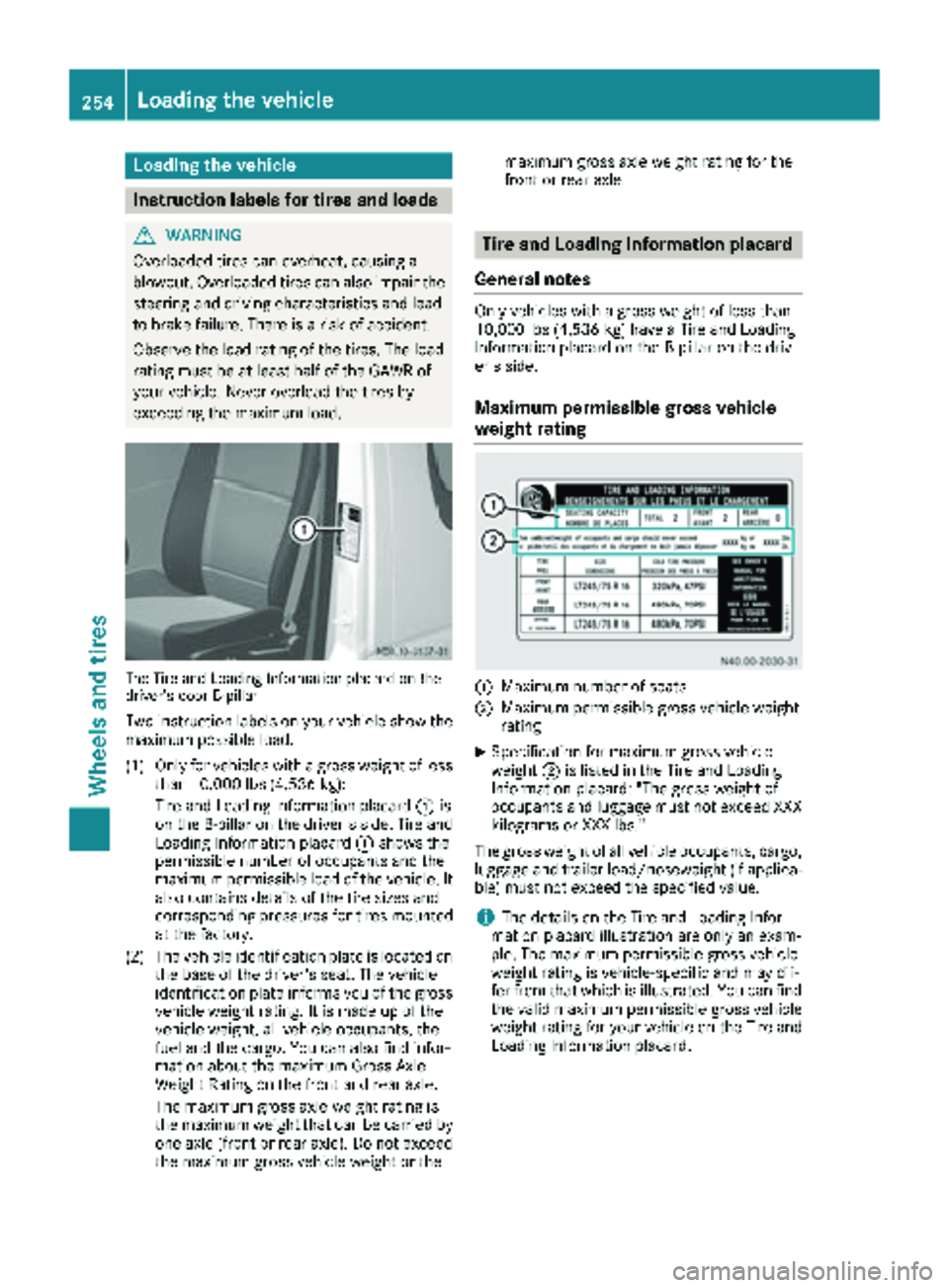
The Tire and Loading Information placard on the
driver’s door B-pillar
Two instruction labels on your vehicle show themaximum possible load.
(1) Only for vehicles with a gross weight of less than 10,000 lbs (4,536 kg):
Tire and Loading Information placard :is
on the B-pillar on the driver's side. Tire and
Loading Information placard :shows the
permissible number of occupants and the
maximum permissible load of the vehicle. It
also contains details of the tire sizes and
corresponding pressures for tires mounted
at the factory.
(2) The vehicle identification plate is located on the base of the driver's seat. The vehicle
identification plate informs you of the gross
vehicle weight rating. It is made up of the
vehicle weight, all vehicle occupants, the
fuel and the cargo. You can also find infor-
mation about the maximum Gross Axle
Weight Rating on the front and rear axle.
The maximum gross axle weight rating is
the maximum weight that can be carried by
one axle (front or rear axle). Do not exceed
the maximum gross vehicle weight or the maximum gross axle weight rating for the
front or rear axle.
Tire and Loading Information placard
General notes
Only vehicles with a gross weight of less than
10,000 lbs (4,536 kg) have a Tire and Loading
Information placard on the B-pillar on the driv-
er's side.
Maximum permissible gross vehicle
weight rating
:Maximum number of seats
;Maximum permissible gross vehicle weight
rating
XSpecification for maximum gross vehicle
weight ;is listed in the Tire and Loading
Information placard: "The gross weight of
occupants and luggage must not exceed XXX
kilograms or XXX lbs."
The gross weight of all vehicle occupants, cargo,
luggage and trailer load/noseweight (if applica-
ble) must not exceed the specified value.
iThe details on the Tire and Loading Infor-
mation placard illustration are only an exam-
ple. The maximum permissible gross vehicle
weight rating is vehicle-specific and may dif-
fer from that which is illustrated. You can find
the valid maximum permissible gross vehicle
weight rating for your vehicle on the Tire and
Loading Information placard.
254Loading the vehicle
Wheels and tires
Page 257 of 286
Number of seats
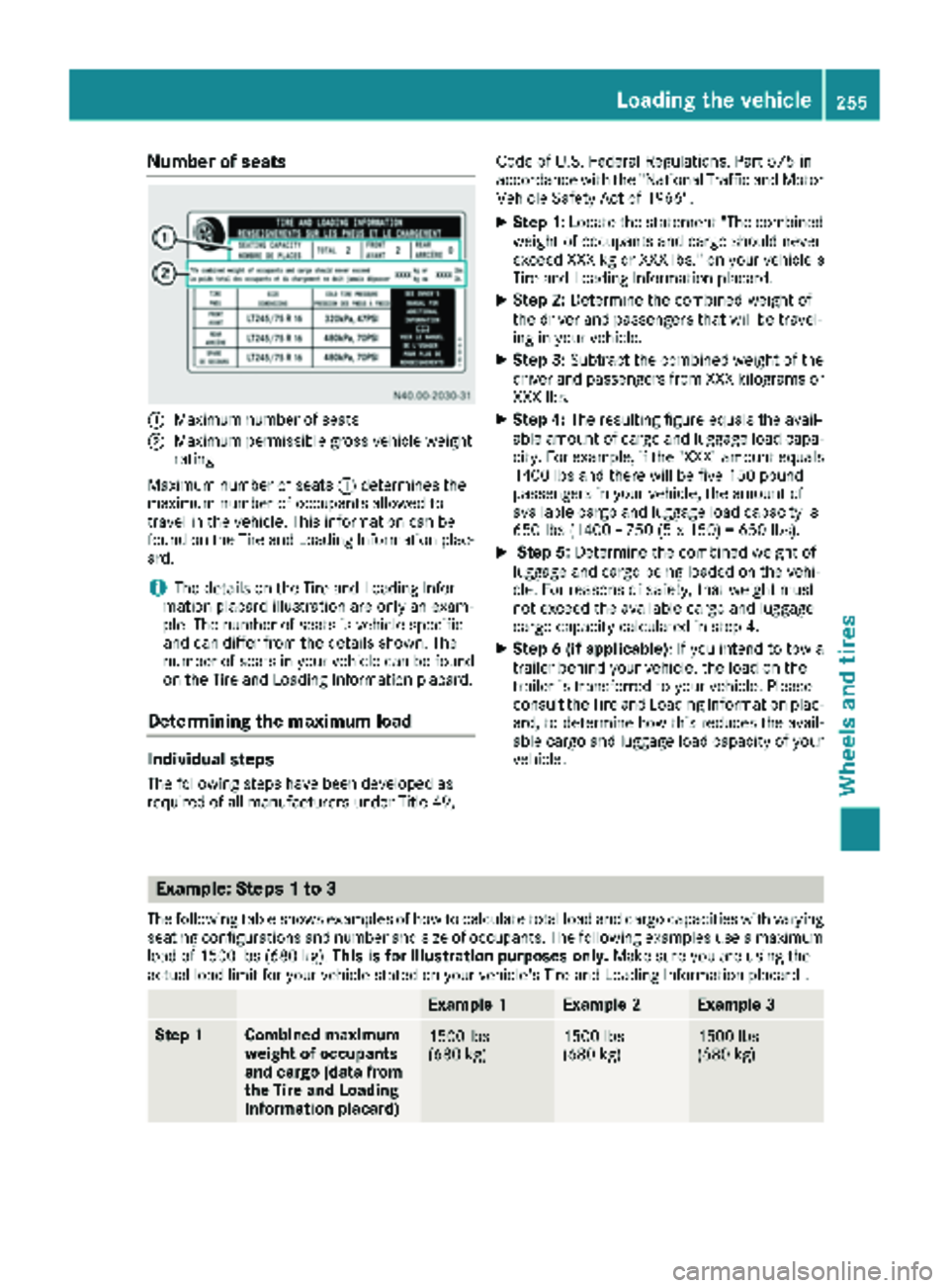
:Maximum number of seats
;Maximum permissible gross vehicle weight
rating
Maximum number of seats :determines the
maximum number of occupants allowed to
travel in the vehicle. This information can be
found on the Tire and Loading Information plac-
ard.
iThe details on the Tire and Loading Infor-
mation placard illustration are only an exam-
ple. The number of seats is vehicle-specific
and can differ from the details shown. The
number of seats in your vehicle can be found
on the Tire and Loading Information placard.
Determining the maximum load
Individual steps
The following steps have been developed as
required of all manufacturers under Title 49, Code of U.S. Federal Regulations, Part 575 in
accordance with the "National Traffic and Motor
Vehicle Safety Act of 1966".
XStep 1:
Locate the statement "The combined
weight of occupants and cargo should never
exceed XXX kg or XXX lbs." on your vehicle's
Tire and Loading Information placard.
XStep 2: Determine the combined weight of
the driver and passengers that will be travel-
ing in your vehicle.
XStep 3: Subtract the combined weight of the
driver and passengers from XXX kilograms or
XXX lbs.
XStep 4: The resulting figure equals the avail-
able amount of cargo and luggage load capa- city. For example, if the "XXX" amount equals
1400 lbs and there will be five 150 pound
passengers in your vehicle, the amount of
available cargo and luggage load capacity is
650 lbs (1400 Ò750 (5 x 150) = 650 lbs).
XStep 5: Determine the combined weight of
luggage and cargo being loaded on the vehi-
cle. For reasons of safety, that weight must
not exceed the available cargo and luggage
cargo capacity calculated in step 4.
XStep 6 (if applicable): If you intend to tow a
trailer behind your vehicle, the load on the
trailer is transferred to your vehicle. Please
consult the Tire and Loading Information plac-
ard, to determine how this reduces the avail-
able cargo and luggage load capacity of your
vehicle.
Example: Steps 1 to 3
The following table shows examples of how to calculate total load and cargo capacities with varying seating configurations and number and size of occupants. The following examples use a maximum
load of 1500 lbs (680 kg). This is for illustration purposes only. Make sure you are using the
actual load limit for your vehicle stated on your vehicle's Tire and Loading Information placard .
Example 1Example 2Example 3
Step 1Combined maximum
weight of occupants
and cargo (data from
the Tire and Loading
Information placard)1500 lbs
(680 kg)1500 lbs
(680 kg)1500 lbs
(680 kg)
Loading the vehicle255
Wheels and tires
Z
Page 263 of 286
Curb weight
The weight of a vehicle with standard equipment
including the maximum filling capacity of fuel,
oil, and coolant. It also includes the air-condi-
tioning system and optional equipment if these
are installed on the vehicle, but does not include
passengers or luggage.
Maximum tire load
The maximum tire load in kilograms or pounds is
the maximum weight for which a tire is
approved.
Maximum permissible tire pressure
Maximum permissible tire pressure for one tire.
Maximum load on one tire
Maximum load on one tire. This is calculated by
dividing the maximum axle load of one axle by
two.
PSI (Pounds per square inch)
Standard unit of measurement for tire pressure.
Aspect ratio
Relationship between tire height and width in
percent.
tire pressure
Pressure inside the tire applying an outward
force to every square inch of the tire's surface.
Tire pressure is specified in pounds per square
inch (psi), in kilopascal (kPa) or in bar. Tire pres-
sure should only be corrected when the tires are
cold.
Cold tire pressure
The tires are cold:
Rif the vehicle has been parked for at least
three hours without direct sunlight on the
tires, and
Rif the vehicle has not been driven further than
1 mile (1.6 km)
Tire tread
The part of the tire that comes into contact with the road.
Tire bead
The tire bead ensures that the tire sits securely
on t
he wheel. There are several steel wires in the
bead to prevent the tire from coming loose from
the wheel rim.
Sidewall
The part of the tire between the tread and the
tire bead.
Weight of optional extras
The combined weight of those optional extras
that weigh more than the replaced standard
parts and more than 2.3 kg (5 lbs). These
optional extras, such as high-performance
brakes, a roof rack or a high-performance bat-
tery, are not included in the curb weight and the
weight of the accessories.
TIN (Tire Identification Number)
A unique identification number which can be
used by a tire manufacturer to identify tires, for
example for a product recall, and thus identify
the purchasers. The TIN is composed of the
manufacturer identification code, tire size, tire
model code and manufacturing date.
Load bearing index
The load bearing index (also load index) is a code
that contains the maximum load bearing capa-
city of a tire.
Traction
Traction is the result of friction between the tires
and the road surface.
TWR (permissible trailer drawbar load)
The TWR is the maximum permissible weight
that may act on the ball coupling of the trailer
tow hitch.
Wear indicator
Narrow bars (tread wear bars) that are distrib-
uted over the tire tread. If the tir e tread is level
with the bars, the wear limit of áin (1.6 mm)
has been reached.
Distribution of the vehicle occupants
The distribution of vehicle occupants over des-
ignated seat positions in a vehicle.
Maximum permissible payload weight
Nominal load and goods/luggage load plus
68 kg (150lbs) multiplied by the number of
seats in the vehicle.
What you should know about wheels and tires261
Wheels and tires
Z