change time MERCEDES-BENZ SPRINTER 2017 MY17 Operator’s Manual
[x] Cancel search | Manufacturer: MERCEDES-BENZ, Model Year: 2017, Model line: SPRINTER, Model: MERCEDES-BENZ SPRINTER 2017Pages: 286, PDF Size: 4.36 MB
Page 270 of 286
iVehicles with the tire pressure monitor sys-
tem: all mounted wheels must be equipped
with functioning sensors.
Wheel and tire combination
General notes
!
Retreaded tires are neither tested nor rec-
ommended for Sprinter vehicles, since previ-
ous damage cannot always be detected on
retreaded tires. We can therefore not guar-
antee driving safety. Do not mount used tires
if you have no information about their previ-
ous usage.
The recommended tire pressures can be found:
Ron the Tire and Loading Information placard9
on the B-pillar on the driver's side
Ron the tire pressure table on the B-pillar on the driver's side
The recommended tire pressure can also be
found in the "Tire pressure table" section in this
Operator's Manual (
Ypage 252). The wheel/tire
combination for your vehicle can be found on
the tire pressure table. Further information on
wheel/tire combination can be obtained at any
qualified specialist workshop.
Check tire pressures regularly and only when
the tires are cold. Observe the notes on the rec-
ommended tire pressure (
Ypage 246).
Follow the maintenance recommendations in
the tire manufacturer's warranty book in your
vehicle documents.
Notes on the vehicle equipment – always equip the vehicle:
Rwith tires of the same size across an axle (left
and right)
Rwith the same type of tires on all wheels at a
given time (summer tires, winter tires)
Tires that have been specially designed and
approved for your vehicle are marked with MO
(Mercedes-Benz Original). You can find this
identification on the tires themselves and in the following table.
iNot all wheel/tire combinations can be
installed at the factory in all countries.
Spare wheel
Important safety notes
GWARNING
Wheel and tire dimensions as well as the type of tire can vary between the spare wheel and
the wheel to be replaced. When the spare
wheel is mounted, driving characteristics may be severely affected. There is a risk of an acci-
dent.
In order to reduce risks:
Ryou should therefore adapt your driving
style and drive carefully.
Rnever mount more than one spare wheel
that differs from the wheel to be replaced.
Ronly use a spare wheel that differs from the
wheel to be replaced for a short time.
Rdo not deactivate ESP®.
Rhave a spare wheel that differs from the
wheel that has been changed replaced at
the nearest qualified specialist workshop.
You must observe the correct wheel and
tire dimensions as well as the wheel type.
When using a spare wheel of a different size, do
not exceed the maximum speed of 80 km/h.
General notes
!
Check the spare wheel regularly to see that
it is secure and has the prescribed tire pres-
sure.
The procedure for mounting the spare wheel is
described in "Mounting a wheel" (
Ypage 263).
The following should be checked regularly, par-
ticularly prior to long journeys:
Rthe tire pressure of the spare wheel, which
should then be corrected if necessary
(
Ypage 246).
Rthe fastenings of the spare wheel bracket.
The spare wheel is located in a spare wheel
bracket under the rear of the vehicle.
Replace the tires after 6 years at the latest,
regardless of wear. This also applies to the spare
wheel.
9Only for vehicles with a gross weight of less than 10,000 lbs (4,536 kg).
268Spare wheel
Wheels and tires
Page 279 of 286
DEF supplyreservoir content
Tank content s
Diesel Exhaust Flui d(DEF)11
Approximately 4. 7US gal (18.0 l)
Engin eoil
General notes
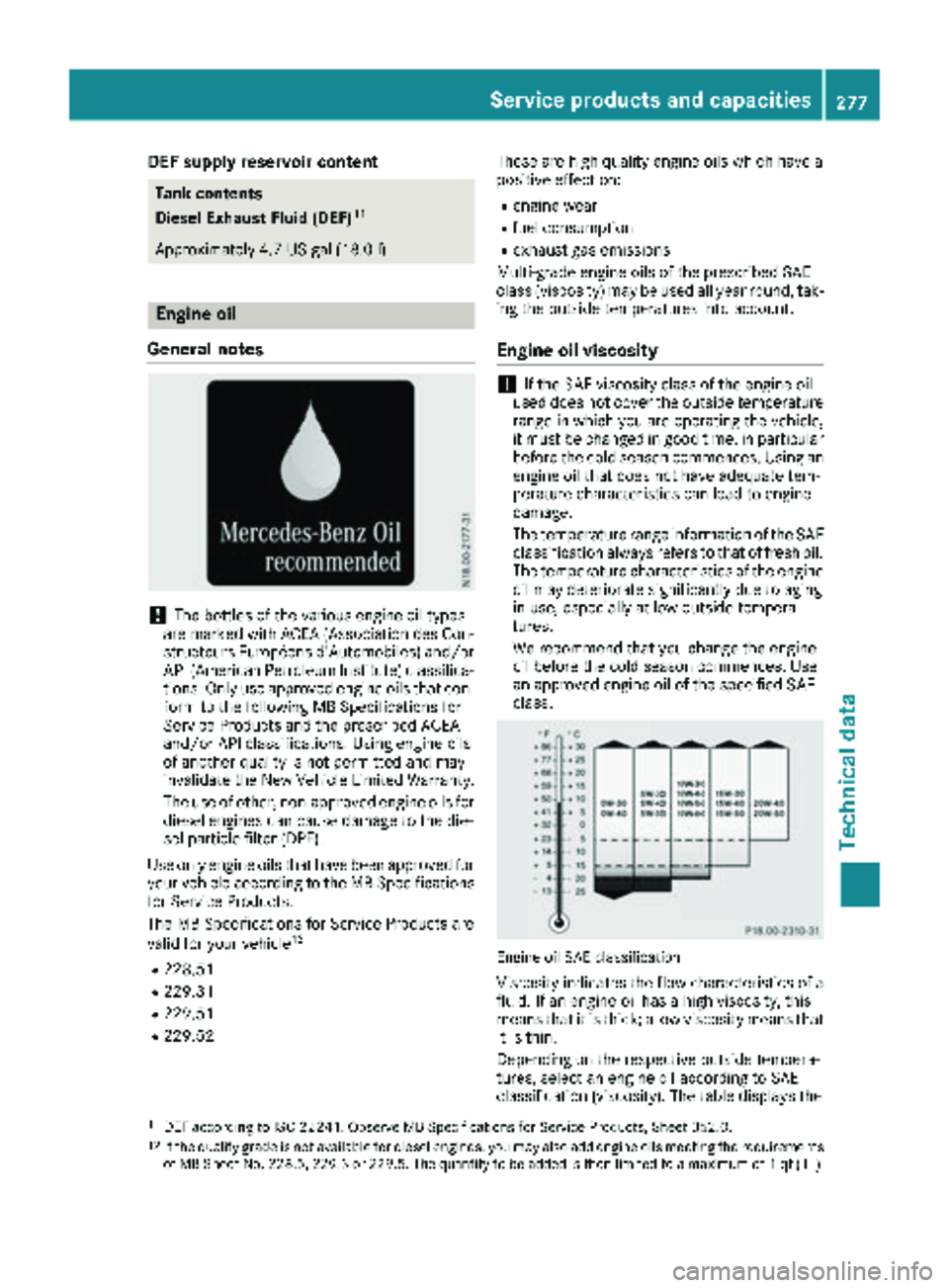
!The bottles of th evarious engin eoil types
are marke dwit hACE A(Association des Con -
structeurs Européen sd'Automobiles )and/o r
AP I(America nPetroleum Institute )classifica-
tions. Only use approve dengin eoils that con-
form to th efollowing MB Specification sfo r
Service Products and th eprescribed ACE A
and/o rAP Iclassifications. Using engin eoils
of another qualit yis no tpermitte dand may
invalidat eth eNew Vehicl eLimited Warranty.
The use of other ,non-approve dengin eoils fo r
diesel engines can caus edamage to th edie-
sel particl efilte r(DPF).
Use only engin eoils that hav ebeen approve dfo r
your vehicl eaccordin gto th eMB Specification s
fo rService Products .
The MB Specification sfo rService Products are
vali dfo ryour vehicl e
12
R228.51
R229.31
R229.51
R229.52 These are hig
hqualit yengin eoils whic hhav e a
positive effec ton :
Rengin ewear
Rfue lconsumption
Rexhaus tgas emission s
Multi-grade engin eoils of th eprescribed SA E
class (viscosity) may be used all year round ,tak -
in g th eoutside temperatures into account.
Engin eoil viscosit y
!If theSA Eviscosit yclass of th eengin eoil
used doe sno tcover th eoutside temperature
range in whic hyou are operatin gth evehicle,
it mus tbe changed in goo dtime, in particular
before th ecold season commences. Using an
engin eoil that doe sno thav eadequat etem-
perature characteristics can lead to engin e
damage.
The temperature range information of th eSA E
classification always refers to that of fresh oil.
The temperature characteristics of th eengin e
oil may deteriorate significantly due to agin g
in use, especially at low outside tempera-
tures.
We recommen dthat you chang eth eengin e
oil before th ecold season commences. Use
an approve dengin eoil of th especified SA E
class.
Engin eoil SA Eclassification
Viscosit yindicate sth eflo wcharacteristics of a
fluid. If an engin eoil has ahig hviscosity, this
means that it is thick ; alow viscosit ymeans that
it is thin .
Dependin gon th erespective outside tempera-
tures, select an engin eoil accordin gto SA E
classification (viscosity) .The table displays th e
11DEFaccordin gto IS O22241. Observ eMB Specification sfo rService Products ,Sheet 352.0.12If th equality grade is no tavailable fo rdiesel engines, you may also add engin eoils meeting th erequirements
of MB Sheet No. 228.5, 229. 3or 229.5. The quantity to be adde dis then limited to amaximum of 1qt (1 l).
Service products and capacities277
Technical data
Z
Page 280 of 286
SAE classification to be used. The low temper-
ature characteristics of engine oils can notice-
ably deteriorate during operation, e.g. from
aging, soot and fuel accretion. For this reason,
regular oil changes using an approved engine oil
from the suitable SAE classification are urgently
recommended.
Additives
!Do not use any additives in the engine oil.
This could damage the engine.
Miscibility of engine oils
!Mixing oils reduces the benefits of using
high grade engine oils.
We recommend that you only add engine oil of
the same quality grade and SAE class as used
when the engine oil was last changed.
If, in exceptional cases, oil of the type in the
engine is not available, top up using another
approved mineral or synthetic engine oil.
If the quality grade is not available for diesel
engines, you may also add engine oils meeting
the requirements in MB Sheet Number 228.5,
229.3 or 229.5. The quantity to be added is then
limited to a maximum of 1 qt (1 l).
Engine oils are differentiated according to:
Rengine oil brand
Rquality grade (sheet number)
RSAE class (viscosity)
Subsequently have the engine oil changed at the
earliest possible opportunity.
Interval for oil change
The on-board computer automatically shows
the date for the next oil change as an event
message in the display.
Only by using engine oil with a particularly high
quality grade, e.g. according to Sheet Number
228.51 of the Mercedes-Benz Specifications for
Service Products, can the maximum interval for
oil change be achieved.
We recommend having the oil changed at a
qualified specialist workshop. Engine oil for diesel engines
Product name/number
See the Maintenance Booklet.
MB Sheet Number 228.51, 229.31, 229.51,
229.52
Capacities
!Do not add too much oil. adding too much
engine oil can result in damage to the engine
or to the catalytic converter. Have excess
engine oil siphoned off.
Oil change including oil filter
VehiclesEngine oil
4-cylinderApproximately
3 US gal (11.5 l)
6-cylinderApproximately
3.3 US gal (12.5 l)
Information about oil consumption
!If the vehicle is predominantly used for
short-distance driving, this could lead to a
malfunction in the automatic cleaning func-
tion for the diesel particle filter. As a result,
fuel may accumulate in the engine oil and
cause engine failure.
Therefore, if you mainly drive short distances,
you should drive on a highway or on rural
roads for 20 minutes every 310 miles
(500 km). This ensures sufficient regenera-
tion of the diesel particle filter.
Depending on the driving style, the vehicle con-
sumes a maximum of 1.0 qt (1.0 l)of engine oil
over a distance of 620 miles (1000 km).
Oil consumption may be higher if:
RThe vehicle is new.
RYou mainly operate the vehicle under arduous
operating conditions.
RYou frequently drive at high engine speeds.
Regular maintenance is one of the preconditions
for moderate rates of consumption.
You can only estimate the oil consumption after
you have driven a considerable distance.
Check the engine oil level on a regular basis, e.g.
weekly or each time you refuel (
Ypage 216).
278Service products and capacities
Technical data