fuel filter MERCEDES-BENZ SPRINTER 2017 MY17 Operator’s Manual
[x] Cancel search | Manufacturer: MERCEDES-BENZ, Model Year: 2017, Model line: SPRINTER, Model: MERCEDES-BENZ SPRINTER 2017Pages: 286, PDF Size: 4.36 MB
Page 13 of 286
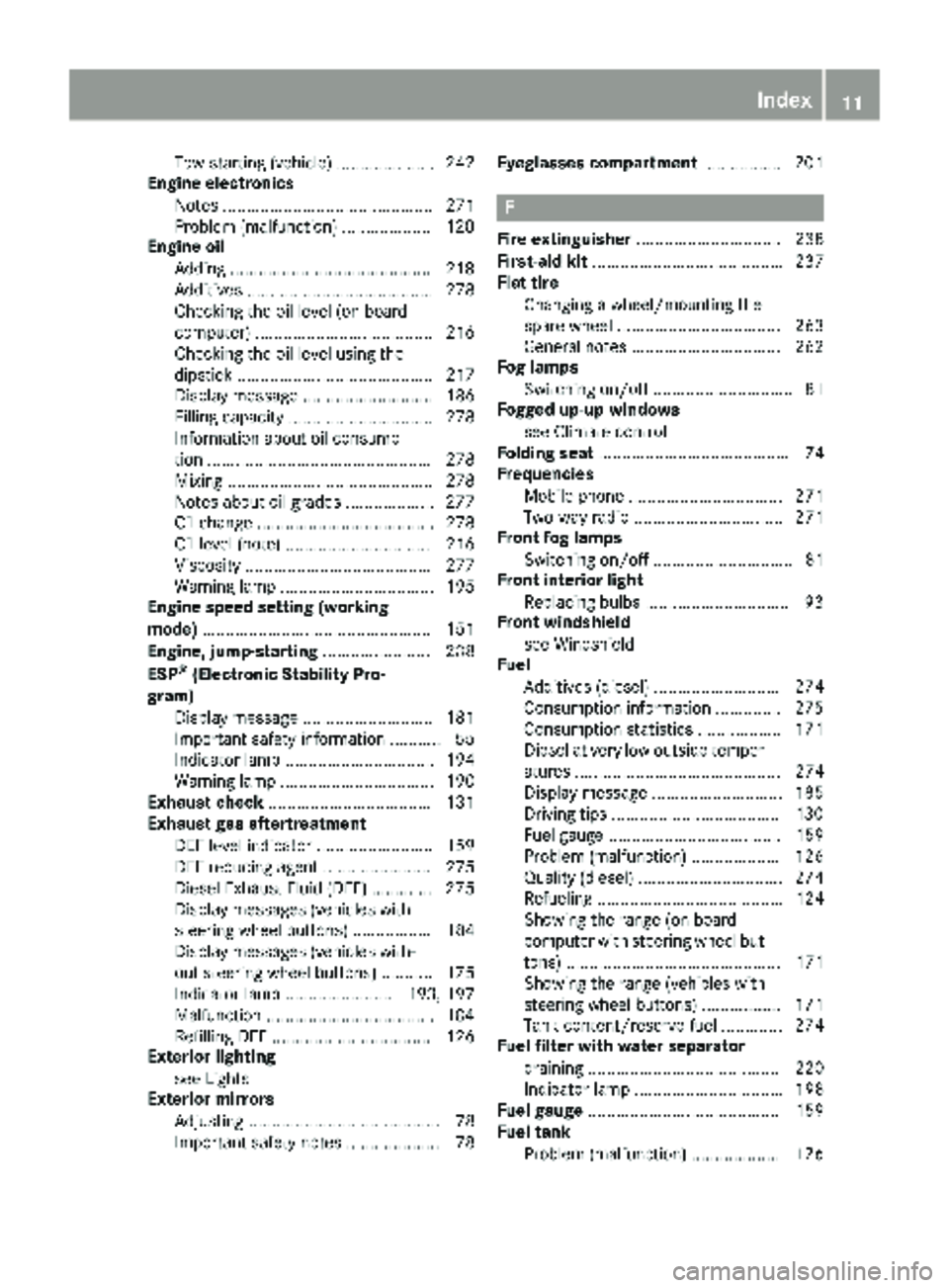
Tow-starting (vehicle) ..................... 242
Engine electronics
Notes ............................................. 271
Problem (malfunction) ...................1 20
Engine oil
Adding ...........................................2 18
Additives ........................................ 278
Checking the oil level (on-board
computer) ...................................... 216
Checking the oil level using the
dipstick .......................................... 217
Display message ............................ 186
Filling capacity ............................... 278
Information about oil consump-
tion ................................................ 278
Mixing ............................................ 278
Notes about oil grades ................... 277
Oil change ...................................... 278
Oil level (note) ............................... 216
Viscosity ........................................ 277
Warning lamp ................................. 195
Engine speed setting (working
mode) ................................................. 151
Engine, jump-starting ....................... 238
ESP
®(Electronic Stability Pro-
gram)
Display message ............................ 181
Important safety information ........... 55
Indicator lamp ................................ 194
Warning lamp ................................. 190
Exhaust check ................................... 131
Exhaust gas aftertreatment
DEF level indicator ......................... 159
DEF reducing agent ....................... 275
Diesel Exhaust Fluid (DEF) ............. 275
Display messages (vehicles with
steering wheel buttons) ................. 184
Display messages (vehicles with-
out steering wheel buttons) ........... 175
Indicator lamp ....................... 193, 197
Malfunction ....................................1 84
Refilling DEF .................................. 126
Exterior lighting
see Lights
Exterior mirrors
Adjusting ......................................... 78
Important safety notes .................... 78 Eyegl
asses compartment
................. 201
F
Fire extinguisher............................... 238
First-aid kit ......................................... 237
Flat tire
Changing a wheel/mounting the
spare wheel ................................... 263
General notes ................................ 262
Fog lamps
Switching on/off .............................. 81
Fogged up-up windows
see Climate control
Folding seat ......................................... 74
Frequencies
Mobile phone ................................. 271
Two-way radio ................................ 271
Front fog lamps
Switching on/off .............................. 81
Front interior light
Replacing bulbs ............................... 93
Front windshield
see Windshield
Fuel
Additives (diesel) ........................... 274
Consumption information .............. 275
Consumption statistics .................. 171
Diesel at very low outside temper-atures ............................................ 274
Display message ............................ 185
Driving tips ....................................1 30
Fuel gauge ..................................... 159
Problem (malfunction) ................... 126
Quality (diesel) ............................... 274
Refueling ........................................ 124
Showing the range (on-board
computer with steering wheel but-
tons) .............................................. 171
Showing the range (vehicles with
steering wheel buttons) ................. 171
Tank content/reserve fuel ............. 274
Fuel filter with water separator
draining ......................................... 220
Indicator lamp ................................ 198
Fuel gauge ......................................... 159
Fuel tank
Problem (malfunction) ................... 126
Index11
Page 18 of 286
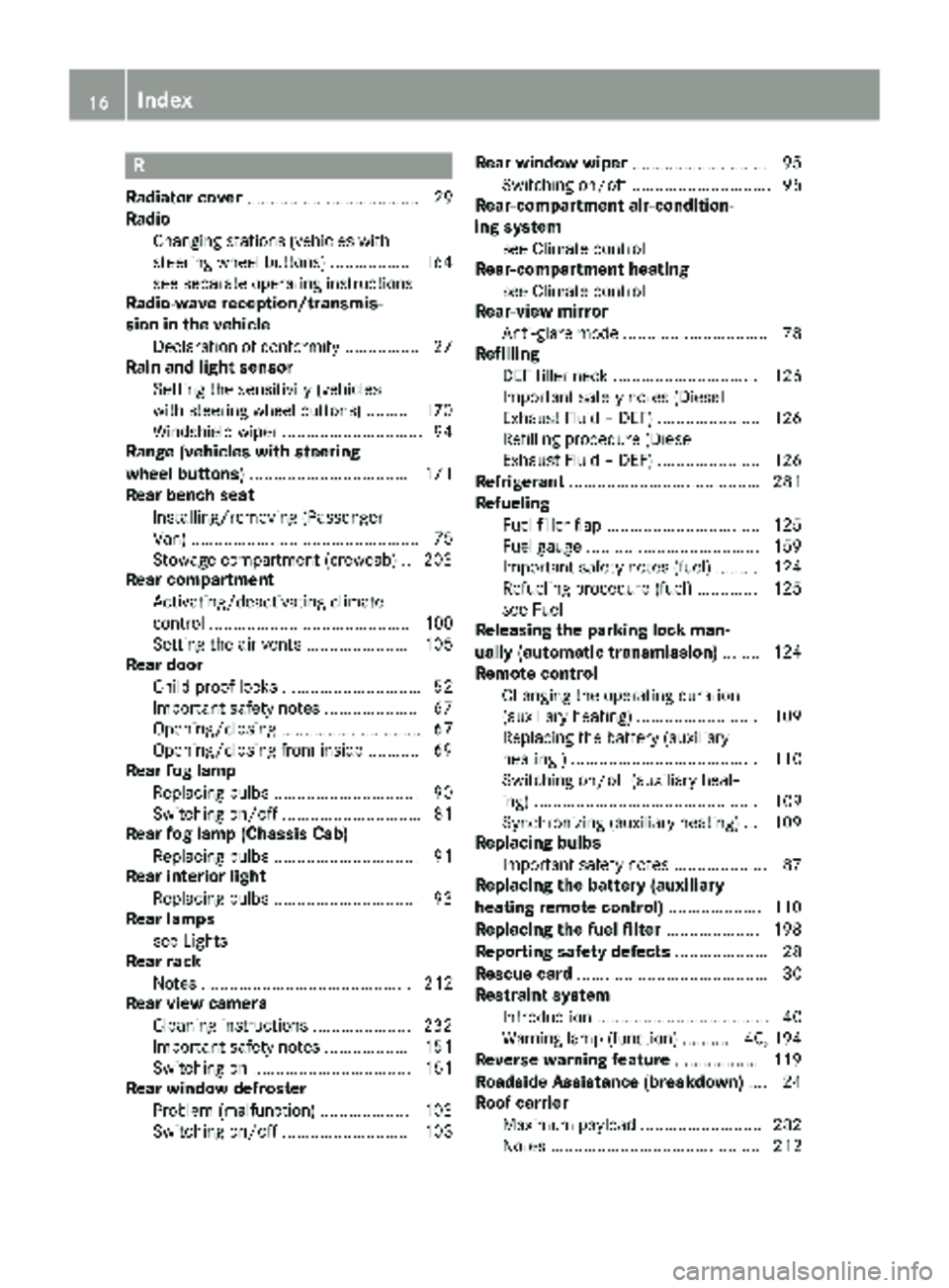
R
Radiator cover..................................... 29
Radio
Changing stations (vehicles with
steering wheel buttons) ................. 164
see separate operating instructions
Radio-wave reception/transmis-
sion in the vehicle
Declaration of conformity ................ 27
Rain and light sensor
Setting the sensitivity (vehicles
with steering wheel buttons) ......... 170
Windshield wiper .............................. 94
Range (vehicles with steering
wheel buttons) .................................. 171
Rear bench seat
Installing/removing (Passenger
Van) ................................................. 75
Stowage compartment (crewcab) .. 203
Rear compartment
Activating/deactivating climate
control ........................................... 100
Setting the air vents ...................... 105
Rear door
Child-proof locks .............................. 52
Important safety notes .................... 67
Opening/closing .............................. 67
Opening/closing from inside ........... 69
Rear fog lamp
Replacing bulbs ............................... 90
Switching on/off .............................. 81
Rear fog lamp (Chassis Cab)
Replacing bulbs ............................... 91
Rear interior light
Replacing bulbs ............................... 93
Rear lamps
see Lights
Rear rack
Notes ............................................. 212
Rear view camera
Cleaning instructions ..................... 232
Important safety notes .................. 151
Switching on .................................. 151
Rear window defroster
Problem (malfunction) ................... 103
Switching on/off ........................... 103 Rear window wiper
............................. 95
Switching on/off .............................. 95
Rear-compartment air-condition-
ing system
see Climate control
Rear-compartment heating
see Climate control
Rear-view mirror
Anti-glare mode ............................... 78
Refilling
DEF filler neck ............................... 126
Important safety notes (Diesel
Exhaust Fluid – DEF) ...................... 126
Refilling procedure (Diesel
Exhaust Flu id – DEF) ...................... 126
Re
frigerant ......................................... 281
Refueling
Fuel filler flap ................................. 125
Fuel gauge ..................................... 159
Important safety notes (fuel) ......... 124
Refueling procedure (fuel) ............. 125
see Fuel
Releasing the parking lock man-
ually (automatic transmission) ........ 124
Remote control
Changing the operating duration
(auxiliary heating) .......................... 109
Replacing the battery (auxiliary
heating ) ........................................ 110
Switching on/off (auxiliary heat-
ing) ................................................ 109
Synchronizing (auxiliary heating) ... 109
Replacing bulbs
Important safety notes .................... 87
Replacing the battery (auxiliary
heating remote control) .................... 110
Replacing the fuel filter .................... 198
Reporting safety defects .................... 28
Rescue card ......................................... 30
Restraint system
Introduction ..................................... 40
Warning lamp (function) .......... 40, 194
Reverse warning feature .................. 119
Roadside Assistance (breakdown) .... 24
Roof carrier
Maximum payload .......................... 282
Notes ............................................. 212
16Index
Page 37 of 286
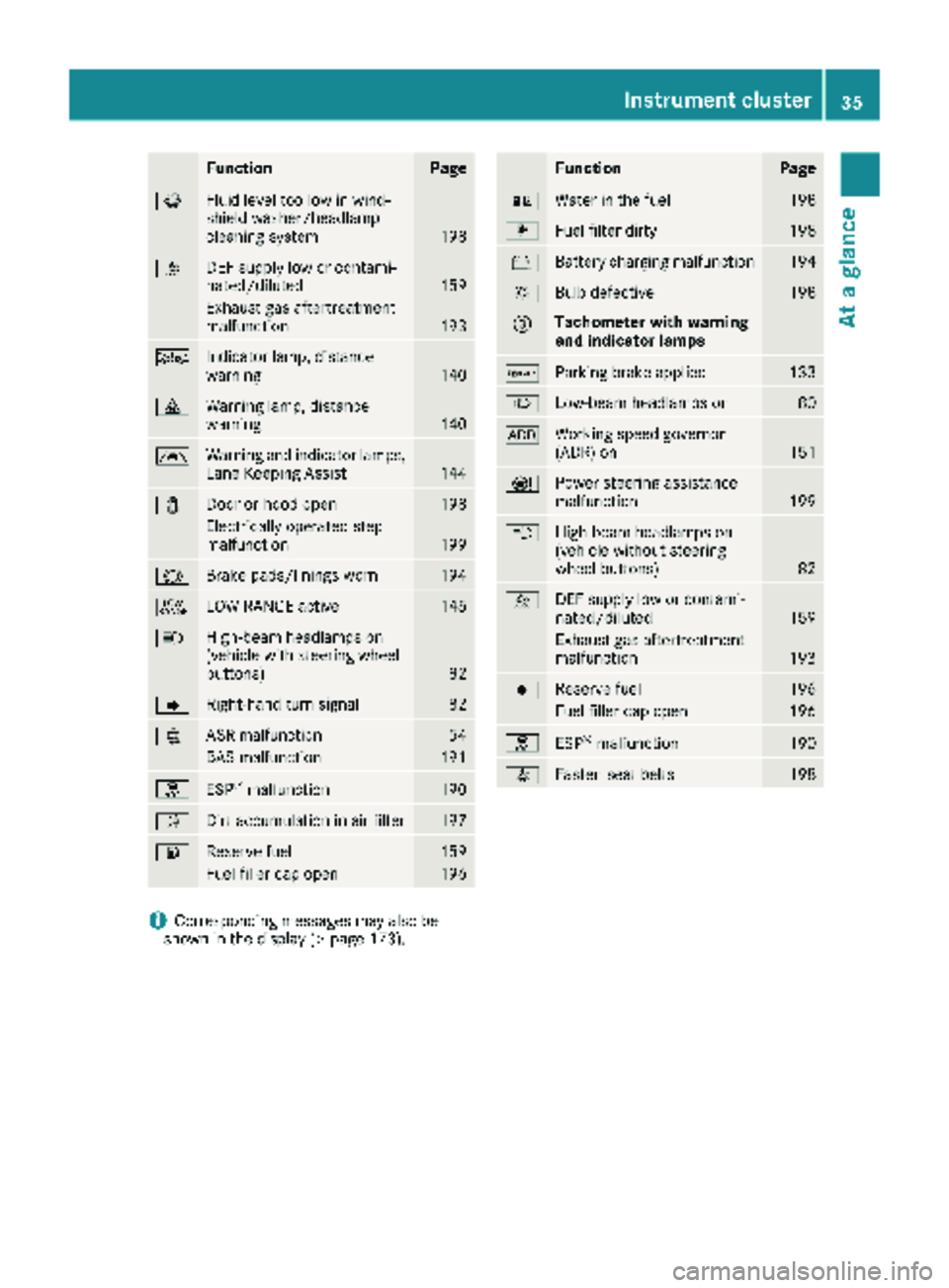
FunctionPage
¦Fluid level too low in wind-
shield washer/headlamp
cleaning system
198
åDEF supply low or contami-
nated/diluted159
Exhaust gas aftertreatment
malfunction193
ÄIndicator lamp, distance
warning140
·Warning lamp, distance
warning140
ÃWarning and indicator lamps,
Lane Keeping Assist144
1Door or hood open198
Electrically operated step
malfunction199
#Brake pads/linings worn194
+LOW RANGE active145
KHigh-beam headlamps on
(vehicle with steering wheel
buttons)
82
JRight-hand turn signal82
:ASR malfunction54
BAS malfunction191
hESP®malfunction190
ÈDirt accumulation in air filter197
6Reserve fuel159
Fuel filler cap open196
FunctionPage
:Water in the fuel198
mFuel filter dirty198
#Battery charging malfunction194
bBulb defective198
=Tachometer with warning
and indicator lamps
cParking brake applied133
LLow-beam headlamps on80
KWorking speed governor
(ADR) on151
ÐPower steering assistance
malfunction199
KHigh-beam headlamps on
(vehicle without steering
wheel buttons)
82
åDEF supply low or contami-
nated/diluted159
Exhaust gas aftertreatment
malfunction193
|Reserve fuel196
Fuel filler cap open196
hESP®malfunction190
7Fasten seat belts198
iCorresponding messages may also be
shown in the display (Ypage 173).
Instrument cluster35
At a glance
Page 127 of 286
and that it is not swallowed. Do not inhale fuelvapors. Keep fuel away from children.
If you or others come into contact with fuel,
observe the following:
RWash away fuel from skin immediately
using soap and water.
RIf fuel comes into contact with your eyes,
immediately rinse them thoroughly with
clean water. Seek medical assistance with-
out delay.
RIf fuel is swallowed, seek medical assis-
tance without delay. Do not induce vomit-
ing.
RImmediately change out of clothing which
has come into contact with fuel.
GWARNING
If you mix diesel fuel with gasoline, the flash
point is lower than that of pure diesel fuel.
When the engine is running, exhaust system
components could overheat without being
noticed. There is a risk of fire.
Never refuel with gasoline. Never mix gasoline with diesel fuel.
HEnvironmental note
If fuels are handled improperly, they pose a
danger to persons and the environment. Do
not allow fuels to run into the sewage system,
the surface waters, the ground water or into
the ground.
!Do not use gasoline to refuel vehicles with a
diesel engine. Even small amounts of gasoline
will cause damage to the fuel system and
engine.
!Do not switch on the ignition if you acciden-
tally refuel with the wrong fuel. Otherwise, the
fuel will enter the fuel lines. Notify a qualified
specialist workshop and have the fuel tank
and fuel lines drained completely.
!Overfilling the fuel tank could damage the
fuel system.
!Take care not to spill any fuel on painted
surfaces. You could otherwise damage the
paintwork.
!Filter the fuel before transferring it to the
vehicle if you are refueling the vehicle from
barrels or containers.
This will prevent malfunctions in the fuel sys-
tem due to contaminated fuel.
Further information on fuel and on fuel grades
can be found in the "Technical data" section
(
Ypage 273).
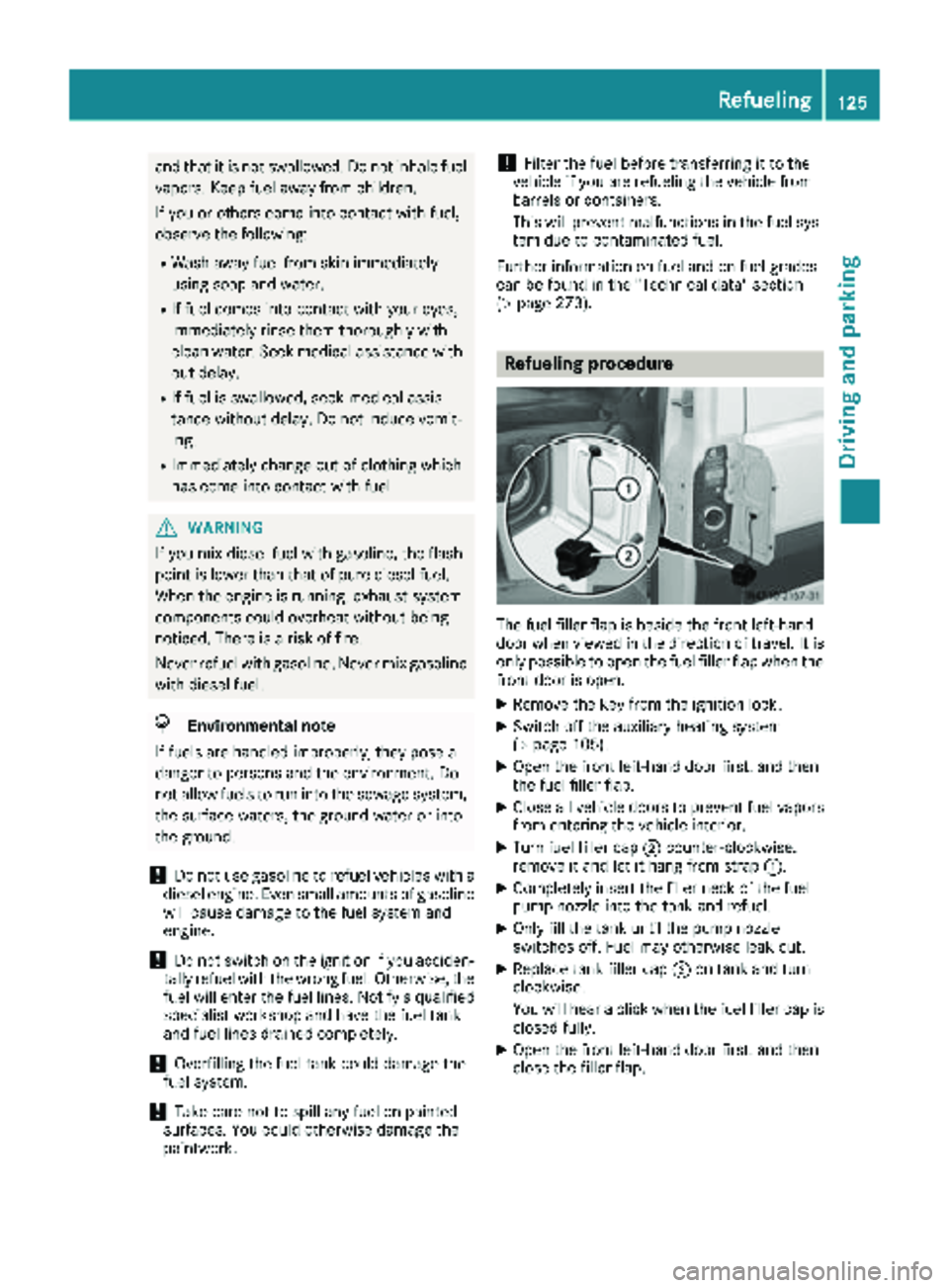
Refueling procedure
The fuel filler flap is beside the front left-hand
door when viewed in the direction of travel. It is
only possible to open the fuel filler flap when the front door is open.
XRemove the key from the ignition lock.
XSwitch off the auxiliary heating system
(Ypage 105).
XOpen the front left-hand door first, and then
the fuel filler flap.
XClose all vehicle doors to prevent fuel vaporsfrom entering the vehicle interior.
XTurn fuel filler cap ;counter-clockwise,
remove it and let it hang from strap :.
XCompletely insert the filler neck of the fuel
pump nozzle into the tank and refuel.
XOnly fill the tank until the pump nozzle
switches off. Fuel may otherwise leak out.
XReplace tank filler cap;on tank and turn
clockwise.
You will hear a click when the fuel filler cap is
closed fully.
XOpen the front left-hand door first, and then
close the filler flap.
Refueling125
Driving and parking
Z
Page 133 of 286
Do not drink or take drugs and drive or allow
anyone to drive who has been drinking or tak-ing drugs.
Emission control
GWARNING
Combustion engines emit poisonous exhaust
gases such as carbon monoxide. Inhaling
these exhaust gases leads to poisoning. There
is a risk of fatal injury. Therefore never leave
the engine running in enclosed spaces with-
out sufficient ventilation.
Certain engine systems are designed to keep
the level of poisonous substances in exhaust
fumes within legal limits.
These systems only work optimally if they are
maintained exactly in accordance with the man-
ufacturer's specifications. Any work on the
engine should therefore be carried out by quali-
fied and authorized technicians at a Sprinter
dealer.
The engine settings must not be changed under any circumstances. In addition, all specific
maintenance work must be carried out at regu-
lar intervals and in accordance with the service
requirements of the dealer listed here on the
inside title page. Details can be found in the
Maintenance Booklet.
Short journey
!
If the vehicle is predominantly used for
short-distance driving or is stationary for long
periods, this could lead to a malfunction in the automatic cleaning function for the diesel par-
ticle filter. This can lead to blockage of the
diesel particle filter. This can also result in fuel
collecting in the engine oil and cause engine
failure.
Therefore, if you mainly drive short distances,
drive on a highway or an inter-urban road for
20 minute severy 300 miles (500 km). This facil-
itates the diesel particle filter's burn-off proc-
ess.
Speed limiter
GWARNING
Exceeding the stated tire load-bearing capa-
city and the approved maximum speed could
lead to tire damage or the tire bursting. There is a risk of accident.
Therefore, only use tire types and sizes
approved for your vehicle model. Observe the
tire load rating and speed rating required for
your vehicle.
As the driver, you must find out about the max-
imum speed of the vehicle permitted for the
tires (tire and tire pressure). In particular, also
observe the tire approval regulations for each
country.
You must not exceed the speed limit for the tires
listed in the tire pressure tables. You can find
information on tire pressures in the "Wheels and
tires" section (
Ypage 246).
You can permanently limit the speed of your
vehicle to 65 mph (105 km/h) or 75 mph
(120 km/h).
We recommend that you have the speed limit
programmed at an authorized Sprinter dealer.
Before overtaking, take into consideration that
the engine speed limiter prevents the speed
increasing beyond the programmed speed limit.
Driving abroad
Service
An extensive network of authorized Sprinter
Dealers is also at your disposal when you are
traveling abroad. Nevertheless, please bear in
mind that service facilities or replacement parts may not always be immediately available. You
can obtain a list of workshops at any authorized
Sprinter Dealer.
Fuel
In some countries, only fuels with a higher sulfur
content are available.
Unsuitable fuel can cause engine damage. Infor-
mation on fuel (
Ypage 273).
Driving tips131
Driving and parking
Z
Page 188 of 286
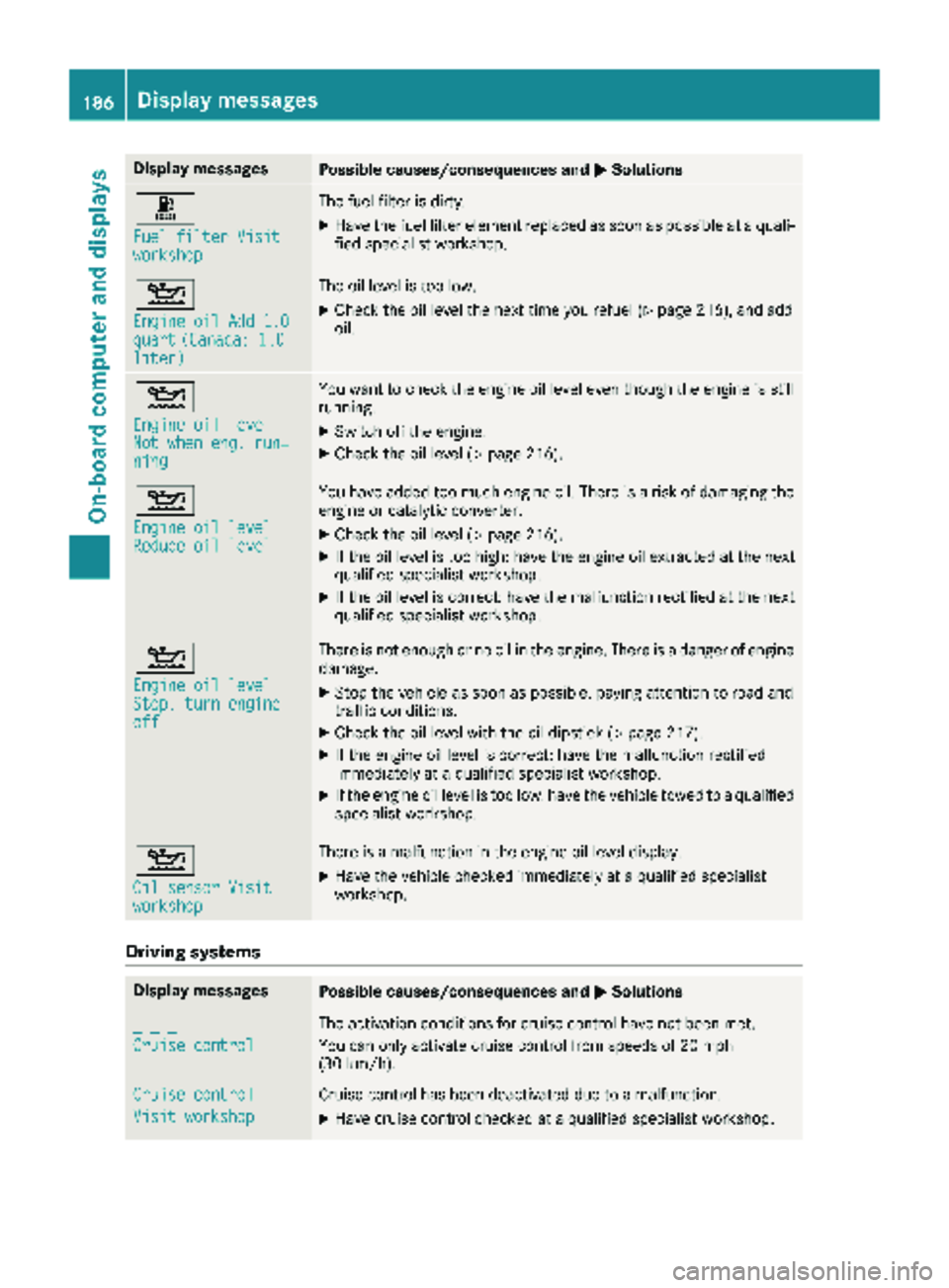
Display messagesPossible causes/consequences andMSolutions
m
Fuelfilter Visitworkshop
The fuel filter is dirty.
XHav eth efuel filter elemen treplace das soo nas possibl eat aquali-
fie dspecialist workshop .
4
Engine oil Add 1.0quart(Canada: 1.0liter)
The oil level is toolow.
XChec kth eoil level th enext time you refuel (Ypage 216), and add
oil.
4
Engine oil levelNot whe neng .run ‐ning
You wan tto chec kth eengin eoil level eve nthough th eengin eis still
running.
XSwitc hoff th eengine.
XChec kth eoil level (Ypage 216).
4
Engine oil levelReduce oil level
You haveadded to omuc hengin eoil. There is aris kof damaging th e
engin eor catalytic converter.
XChec kth eoil level (Ypage 216).
XIf theoil level is to ohigh :hav eth eengin eoil extracted at th enext
qualified specialist workshop .
XIf theoil level is correct: hav eth emalfunction rectifie dat th enext
qualified specialist workshop .
4
Engine oil levelStop, turnengineoff
There is no tenough or no oil in th eengine. There is adanger of engin e
damage.
XStop th evehicl eas soo nas possible, payin gattention to roa dand
traffic conditions.
XChec kth eoil level wit hth eoil dipstick (Ypage 217).
XIf theengin eoil level is correct: hav eth emalfunction rectifie d
immediately at aqualified specialist workshop .
XIf theengin eoil level is to olow: hav eth evehicl etowed to aqualified
specialist workshop .
4
Oil sensor Visitworkshop
There isamalfunction in th eengin eoil level display.
XHav eth evehicl echecke dimmediately at aqualified specialist
workshop .
Driving systems
Display messagesPossible causes/consequences and MSolutions
_ _ _
Cruise control
The activation condition sfor cruise control hav eno tbeen met .
You can only activat ecruise control from speeds of 20 mph
(30 km/h).
Cruise contro l
Visit workshop
Cruisecontrol has been deactivated due to amalfunction .
XHavecruise control checke dat aqualified specialist workshop .
186Display messages
On-board computer and displays
Page 200 of 286
ProblemPossible causes/consequences andMSolutions
h
US vehicles only:
The yellow tire
pressure monitor
warning lamp
flashes for
60 seconds and
then remains lit.The tire pressure monitor has malfunctioned.
XHave the tire pressure monitor and the wheels checked at a quali-
fied specialist workshop.
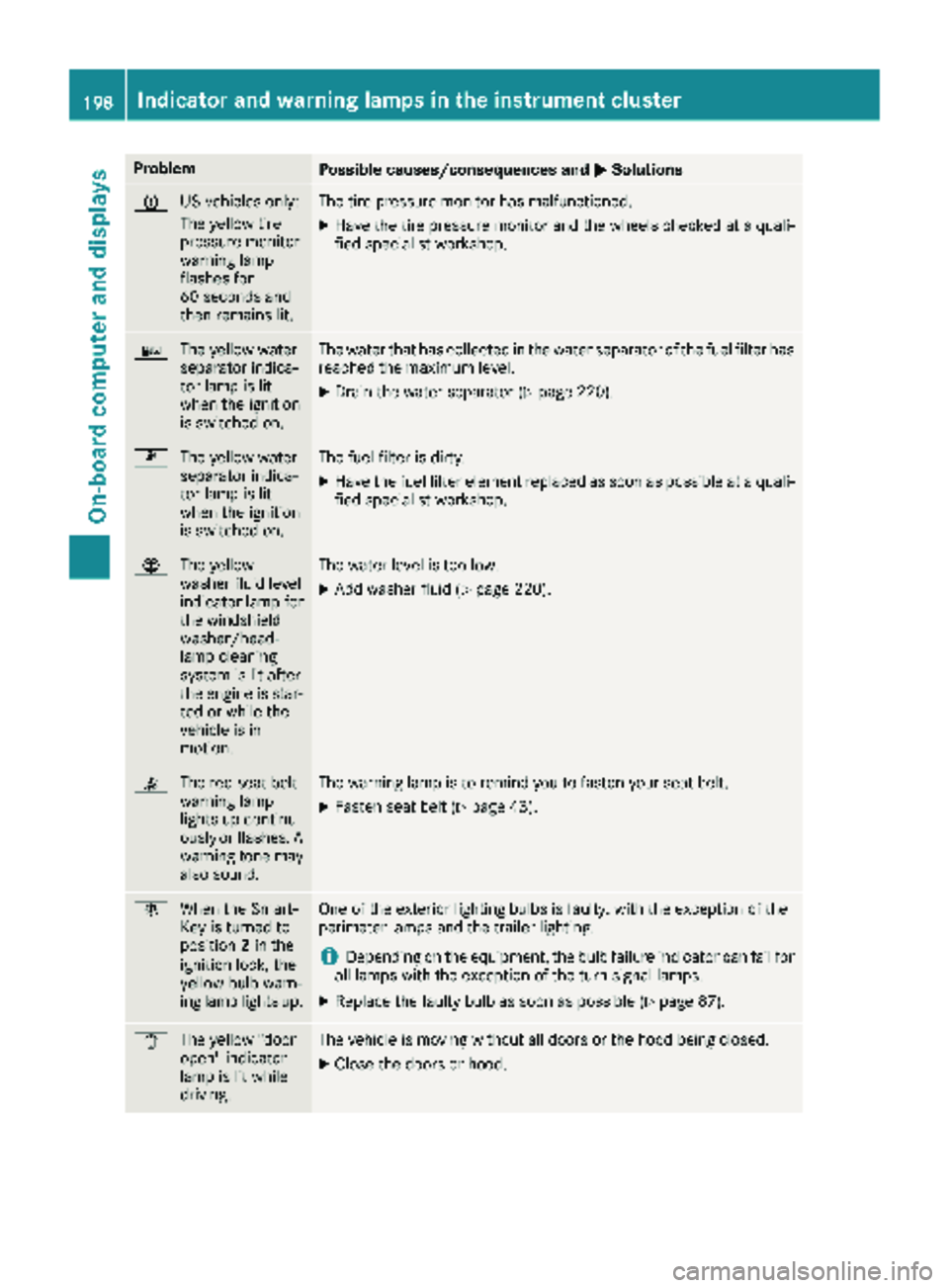
:
The yellow water
separator indica-
tor lamp is lit
when the ignition
is switched on.The water that has collected in the water separator of the fuel filter has
reached the maximum level.
XDrain the water separator (Ypage 220).
m
The yellow water
separator indica-
tor lamp is lit
when the ignition
is switched on.The fuel filter is dirty.
XHave the fuel filter element replaced as soon as possible at a quali-
fied specialist workshop.
¦The yellow
washer fluid level
indicator lamp for
the windshield
washer/head-
lamp cleaning
system is lit after
the engine is star-
ted or while the
vehicle is in
motion.The water level is too low.
XAdd washer fluid (Ypage 220).
7The red seat belt
warning lamp
lights up continu-
ously or flashes. A
warning tone may
also sound.The warning lamp is to remind you to fasten your seat belt.
XFasten seat belt (Ypage 43).
bWhen the Smart-
Key is turned to
position 2in the
ignition lock, the
yellow bulb warn-
ing lamp lights up.One of the exterior lighting bulbs is faulty, with the exception of the
perimeter lamps and the trailer lighting.
iDepending on the equipment, the bulb failure indicator can fail for
all lamps with the exception of the turn signal lamps.
XReplace the faulty bulb as soon as possible (Ypage 87).
1 The yellow "door
open" indicator
lamp is lit while
driving.The vehicle is moving without all doors or the hood being closed.
XClose the doors or hood.
198Indicator and warning lamps in the instrument cluster
On-board computer and displays
Page 222 of 286
Checking the brake fluid level
XStop your vehicle as far away from traffic as
possible on level ground.
XSwitch off the engine.
XSecure the vehicle to prevent it from rolling
away.
XOpen the hood (Ypage 214).
XCheck the brake fluid level.
The brake fluid level is correct if the level is
between the MIN mark and MAX mark on
brake fluid reservoir:.
XClose the hood.
!If the brake fluid level in the brake fluid res-
ervoir has fallen to the MIN mark or below,
check the brake system immediately for
leaks. Also check the thickness of the brake
linings. Visit a qualified specialist workshop
immediately.
Do not add brake fluid. This does not correct
the malfunction.
Washer fluid
GWARNING
Windshield washer concentrate could ignite if it comes into contact with hot engine compo-
nents or the exhaust system. There is a risk of
fire and injury.
Make sure that no windshield washer con-
centrate is spilled next to the filler neck.
!Only use washer fluid that is suitable for
plastic lamp lenses, e.g. MB SummerFit or MB WinterFit. Unsuitable washer fluid could dam-
age the plastic lenses of the headlamps.
Example: washer fluid reservoir
Add windshield washer concentrate to the
washer fluid all year round. Observe the infor-
mation on washer fluid in the "Technical data"
section (
Ypage 281).
Adding washer fluid
XMix the washer fluid to the appropriate mixing ratio in a container beforehand.
XOpen the hood (Ypage 214).
XPull cap :on the washer fluid reservoir
upwards at the tab.
XAdd the premixed washer fluid.
XPress cap :onto the filler neck until it
engages audibly.
XClose the hood.
Fuel system
Draining the fuel filter
GWARNING
Fuel is highly flammable. Improper handling of
fuel creates a risk of fire and explosion.
Avoid fire, open flames, smoking and creating
sparks under all circumstances. Switch off the
ignition and auxiliary heating before carrying
out work to the fuel system. Always wear pro-
tective gloves.
HEnvironmental note
Dispose of the water-fuel mixture in an envi-
ronmentally responsible manner.
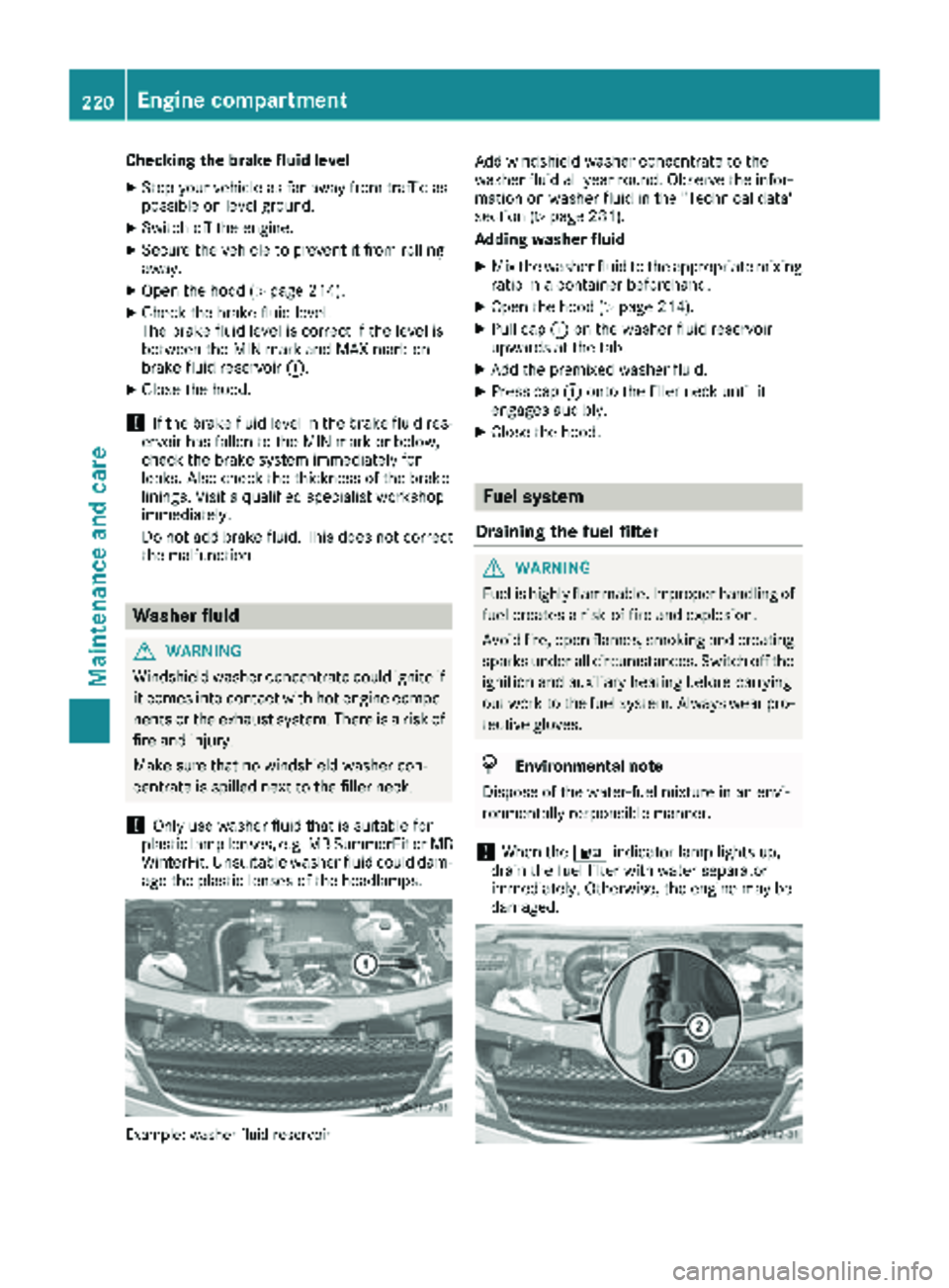
!When the :indicator lamp lights up,
drain the fuel filter with water separator
immediately. Otherwise, the engine may be
damaged.
220Engine compartment
Maintenance and care
Page 223 of 286
If the: indicator lamp in the instrument
cluster goes on, drain the fuel filter with the
water separator immediately.
iWe recommend that you have this mainte-
nance work carried out at a qualified special-
ist workshop.
XPark the vehicle safely and secure it from roll-
ing away.
XSwitch off the auxiliary heating system .
XSwitch off the engine.
XOpen the hood (Ypage 214).
XPlace a suitable receptacle under drain
hose :.
XTurn the SmartKey to position 2in the ignition
lock.
XOpen drain plug ;immediately until the
water/fuel mixture flows out of drain hose :.
XScrew in drain plug;as soon as approx-
imately 0.2 qt (0.2 l)of the water/fuel mixture
has been collected.
The electrical fuel pump automatically halts
the flow of the water/fuel mixture after
30 seconds.
XAfter draining, turn the SmartKey back to
position 0in the ignition lock.
XDispose of the collected water/fuel mixture
in an environmentally responsible manner,
e.g. at a qualified specialist workshop.
XCheck drain plug ;. The drain plug must be
closed.
When the engine is running and drain hose ;
is open, fuel is lost through drain hose :.
XClose the hood (Ypage 215).
If the : indicator lamp does not go out after
draining:
XDrain the fuel filter again.
XIf the : indicator lamp does not go out
after draining for the second time, have the
cause checked immediately at a qualified spe-
cialist workshop.
Vehicle interior
Air filter for the rear-compartment air
conditioning
!
Regularly check the air filters for visible dirt.
Clean or replace a dirty filter mat. The dirt may otherwise lead to damage to the air-condi-
tioning system.
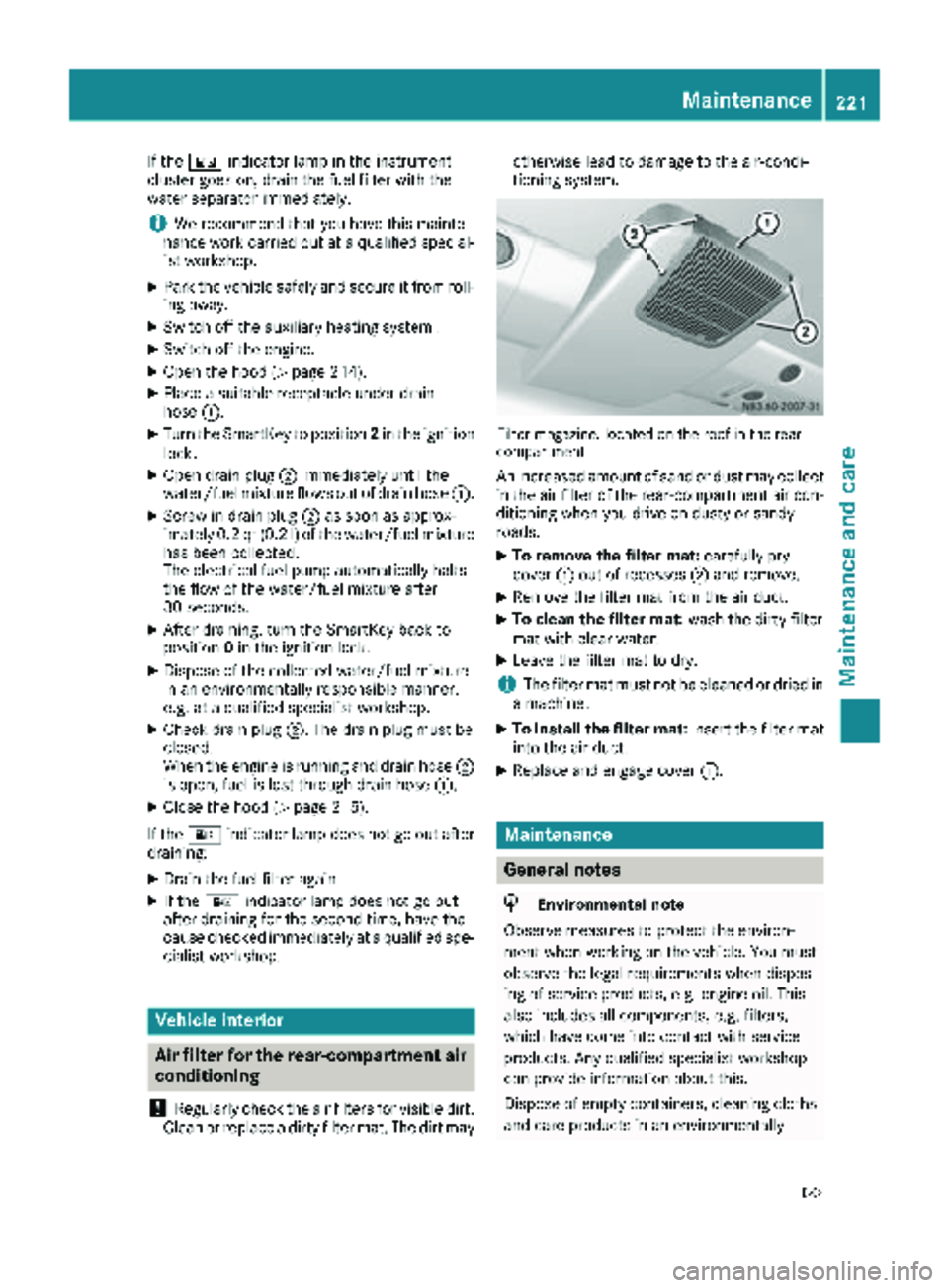
Filter magazine, located on the roof in the rear
compartment
An increased amount of sand or dust may collect
in the air filter of the rear-compartment air con-
ditioning when you drive on dusty or sandy
roads.
XTo remove the filter mat: carefully pry
cover :out of recesses ;and remove.
XRemove the filter mat from the air duct.
XTo clean the filter mat: wash the dirty filter
mat with clear water.
XLeave the filter mat to dry.
iThe filter mat must not be cleaned or dried in
a machine.
XTo install the filter mat: insert the filter mat
into the air duct.
XReplace and engage cover :.
Maintenance
General notes
HEnvironmental note
Observe measures to protect the environ-
ment when working on the vehicle. You must
observe the legal requirements when dispos-
ing of service products, e.g. engine oil. This
also includes all components, e.g. filters,
which have come into contact with service
products. Any qualified specialist workshop
can provide information about this.
Dispose of empty containers, cleaning cloths
and care products in an environmentally
Maintenance221
Maintenance and care
Z
Page 276 of 286
When handling, storing and disposing of fuels,
please observe the relevant regulations.
Tank contents
Depending on equipment, the total capacity of
the fuel tank may vary.
Vehicle typeTotal capa-cityof which
reserve fuel
2500
3500Approx-imately
26.4 US gal (100 l)Approx-
imately
5.0 US gal
(19 l)
All-wheel-
drive vehi-
clesApprox-
imately
24.6 US gal (93 l)
Diesel
Fuel grade
GWARNING
If you mix diesel fuel with gasoline, the flash
point is lower than that of pure diesel fuel.
When the engine is running, exhaust system
components could overheat without being
noticed. There is a risk of fire.
Never refuel with gasoline. Never mix gasoline with diesel fuel.
!Filter the fuel before transferring it to the
vehicle if you are refueling the vehicle from
barrels or containers.
This will prevent malfunctions in the fuel sys-
tem due to contaminated fuel.
!You will damage the diesel engine if you do
not refuel with ULSD or a diesel fuel with a
sulfur content of more than 15 ppm.
!Do not use the following:
Rmarine diesel
Rheating oil
Rvegetable oil
Rgasoline
Rparaffin
Rkerosene
Do not mix such fuels with diesel fuel and do
not use any special additives. This can other- wise lead to engine damage. This does not
include flow improvers. For further informa-
tion, see "Flow improvers".
Usually you will find information about the fuel
grade on the filling pump. If there is no identifi-
cation on the filling pump, consult a gas station
attendant.
For more information about refueling
(
Ypage 124).
Diesel at very low outside temperatures
GWARNING
If you heat fuel system components, e.g. with
a hot-air gun or open flame, these compo-
nents could be damaged. This can cause fuel
to escape and ignite. Depending on the type
of damage, fuel may also not escape until the
engine is running. There is a risk of fire and
explosion.
Never heat fuel system components. Contact
a qualified specialist workshop to rectify the
malfunction.
Refill only with commercially available ULTRA-
LOW SULFUR DIESEL (ULSD, maximum sulfur
content 15 ppm), which fulfills the ASTM D975
standard.
The flow properties of diesel may be inadequate
at low outside temperatures due to paraffin sep-
aration.
iMalfunctions resulting from paraffin sepa-
ration can only be rectified by heating the
entire fuel system. Park the vehicle in a
heated garage, for example.
To prevent operating problems, diesel with bet-
ter flow qualities is available during the winter
months. You can obtain information at the gas
station or from your fuel supplier.
Your vehicle is equipped with a fuel preheating
system. This improves the flow properties of the
diesel by approximately 14.5 ‡ (8 †). ULTRA-
LOW SULFUR DIESEL can be used without ris k
o
f malfunction down to an outside temperature
of approximately 14 ‡ ( Ò10 †).
Fuel additives
!Do not add gasoline or kerosene to diesel
fuel to improve its flow characteristics. Gas-
oline or kerosene impairs the lubricating
properties of the diesel fuel. This can result in
274Service products and capacities
Technical data