child restraint MERCEDES-BENZ SPRINTER 2018 MY18 Operator’s Manual
[x] Cancel search | Manufacturer: MERCEDES-BENZ, Model Year: 2018, Model line: SPRINTER, Model: MERCEDES-BENZ SPRINTER 2018Pages: 294, PDF Size: 4.36 MB
Page 54 of 294
Top Tether
Introduction
Top Tether provides an additional connection
between the child restraint system secured with
a LATCH-type (ISOFIX) system and the vehicle.
This helps reduce the risk of injury even further.
If the child restraint system is equipped with a
Top Tether belt, this should always be used.
Important safety notes
GWARNING
If the Top Tether belt has been incorrectly
secured, e.g. to an eyelet in the cargo com-
partment, the child restraint system is not
correctly kept in place. It therefore cannot
perform its intended protective function in the
event of an accident. There is an increased
risk of injury.
Only secure the Top Tether hook to the Top
Tether anchorage intended for this purpose.
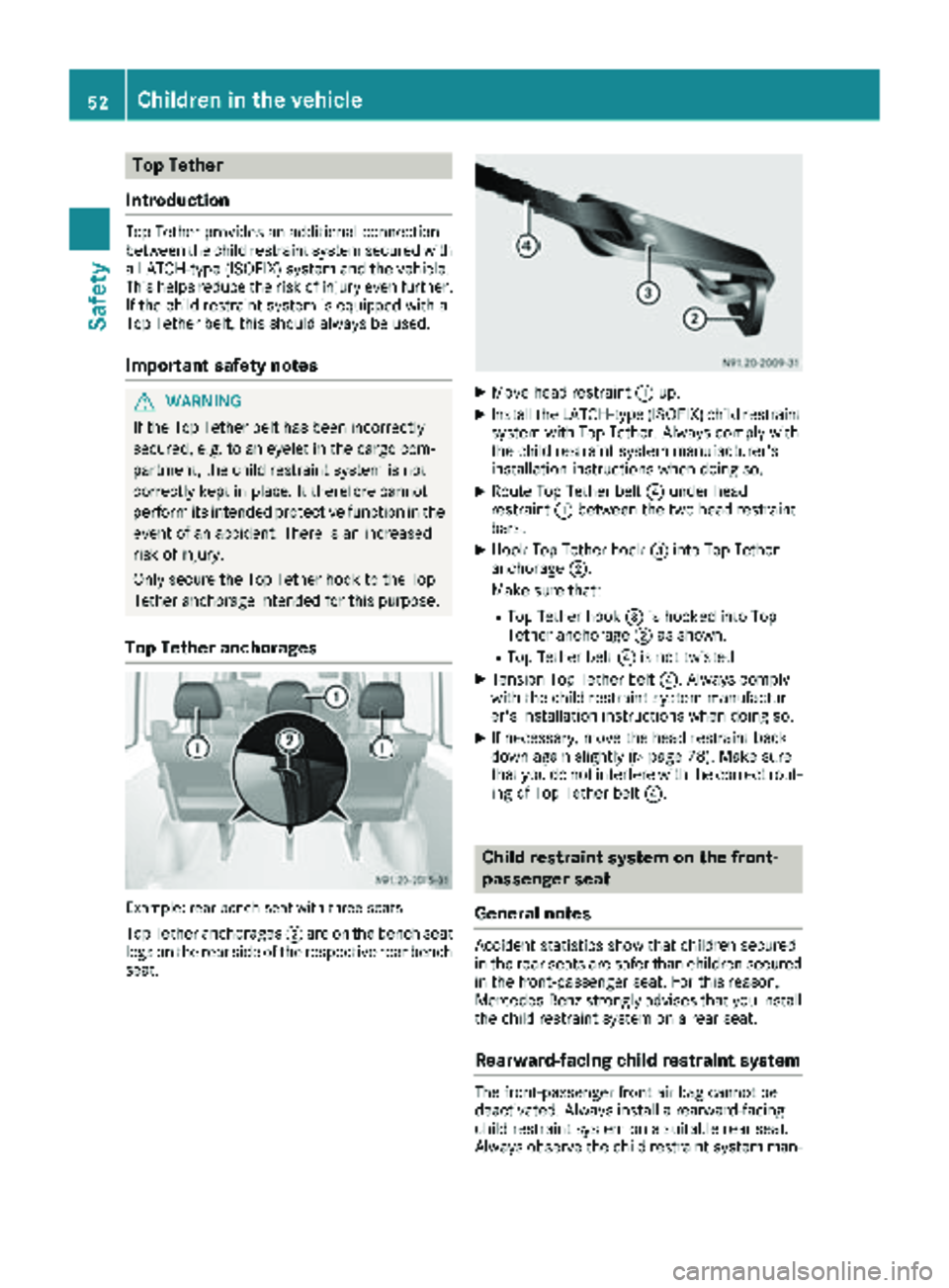
Top Tether anchorages
Example: rear bench seat with three seats
Top Tether anchorages ;are on the bench seat
legs on the rear side of the respective rear bench
seat.
XMove head restraint :up.
XInstall the LATCH-type (ISOFIX) child restraint
system with Top Tether. Always comply with
the child restraint system manufacturer's
installation instructions when doing so.
XRoute Top Tether belt ?under head
restraint :between the two head restraint
bars.
XHook Top Tether hook =into Top Tether
anchorage ;.
Make sure that:
RTop Tether hook =is hooked into Top
Tether anchorage ;as shown.
RTop Tether belt ?is not twisted
XTension Top Tether belt ?. Always comply
with the child restraint system manufactur-
er's installation instructions when doing so.
XIf necessary, move the head restraint back
down again slightly (Ypage 78). Make sure
that you do not interfere with the correct rout-
ing of Top Tether belt ?.
Child restraint system on the front-
passenger seat
General notes
Accident statistics show that children secured
in the rear seats are safer than children secured
in the front-passenger seat. For this reason,
Mercedes-Benz strongly advises that you install
the child restraint system on a rear seat.
Rearward-facing child restraint system
The front-passenger front air bag cannot be
deactivated. Always install a rearward-facing
child restraint system on a suitable rear seat.
Always observe the child restraint system man-
52Children in the vehicle
Safety
Page 55 of 294
ufacturer's installation and operating instruc-
tions.
Forward-facing child restraint system
If it isabsolute lynecessary to install a forward-
facing ch ildrestraint system on the front-
passenger seat, always move the front-
passenger seat as far back as possible. The
entire base of the ch ildrestraint system must
always rest on the seat cushion of the front-
passenger seat. The backrest of the ch ild
restraint system must lieas flat as possible
against the backrest of the front-passenger
seat. The ch ildrestraint system must not be
subjected to a load bythe head restraint. Adjust
the head restraint position accordingly. Always
make sure that the shoulder beltstrap iscor-
rectly routed from the veh icle beltoutlet to the
shoulder beltguide on the ch ildrestraint sys-
tem. The shoulder beltstrap must berouted
forward and downfrom the veh icle beltoutlet.If
necessary, adjust the veh icle beltoutlet and the
front-passenger seat accordingly.
Alwa ys observe the ch ildrestraint system man-
ufacturer's installation and operating instruc-
tions.
Override features/Child-proof locks
Important safety notes
GWAR NING
If ch ildr en are traveling inthe veh icle, they
co uld:
Ropen doors, thus endangering other people
or road users
Rexit the veh icleand becaught byoncoming
traff ic
Roperate veh icle equipment and become
trapped
There isa risk of an acc ident and injury.
Alwa ys activate the ch ild-proof locks and
overr idefeature ifch ildr en are traveling inthe
veh icle. When leaving the veh icle, always take
the key with you and lock the veh icle. Never
leave ch ildren unattended inthe veh icle.
Child- proof locks for rear doors (
Ypage 54).
GWARNING
If you leave children unsupervised in the vehi-
cle, they could set it inmotion by, for example:
Rrelease the parking brake.
Rshift the automatic transmission out of the
parking position P.
Rstart the engine.
In addition, they may operate vehicle equip-
ment and become trapped. There is a risk of
an accident and injury.
When leaving the vehicle, always take the
Sm artKey with you and lock the vehicle. Never
leave ch ildren unsupervised in the vehicle.
GWARNING
If persons, particularly ch ildren are subjected
to prolonged exposure to extreme heat or
cold, there is a risk of injury, possibly even
fatal. Never leave children unattended in the
vehicle.
GWARNING
If the child restraint system issubjected to
direct sunlight, parts may get very hot. Chil-
dren may burn thems elves on these parts,
particular lyon the metal parts of the child
restraint system. There is a risk of injury.
If you leave the vehicle, taking the child with
you, always ensure that the child restraint
system isnot exposed to direct sunlight. Pro-
tect it wit h a blanket, for example. If the child
restraint system has been exposed to direct
sunlight, let it cool down before securing the
child in it. Never leave children unattended in
the vehicle.
Children in the vehicle53
Safety
Z
Page 81 of 294
XTo set the armrest angle:fold the armrest
upwards by more than 45° ;.
The armrest is released.
XFold armrest =forwards to the stop.
XSlowly fold the armrest upwards to the
desired position.
XTo fold the armrest up: if necessary, fold the
armrest upwards :by more than 90°.
Seat heating
GWARNING
Repeatedly switching on the seat heating can
cause the seat cushion and backrest pads to
become very hot. The health of persons with
limited temperature sensitivity or a limited
ability to react to high temperatures may be
affected or they may even suffer burn-like
injuries. There is a risk of injury.
Therefore, do not switch the seat heating on
repeatedly.
!When you leave your seat, do not place any-
thing on the seat and switch off the seat heat-
ing. Do not switch the seat heating on when
the seat is not occupied, e.g. when driving
without a front passenger. The seat heating
may otherwise overheat, causing damage to
the seat.
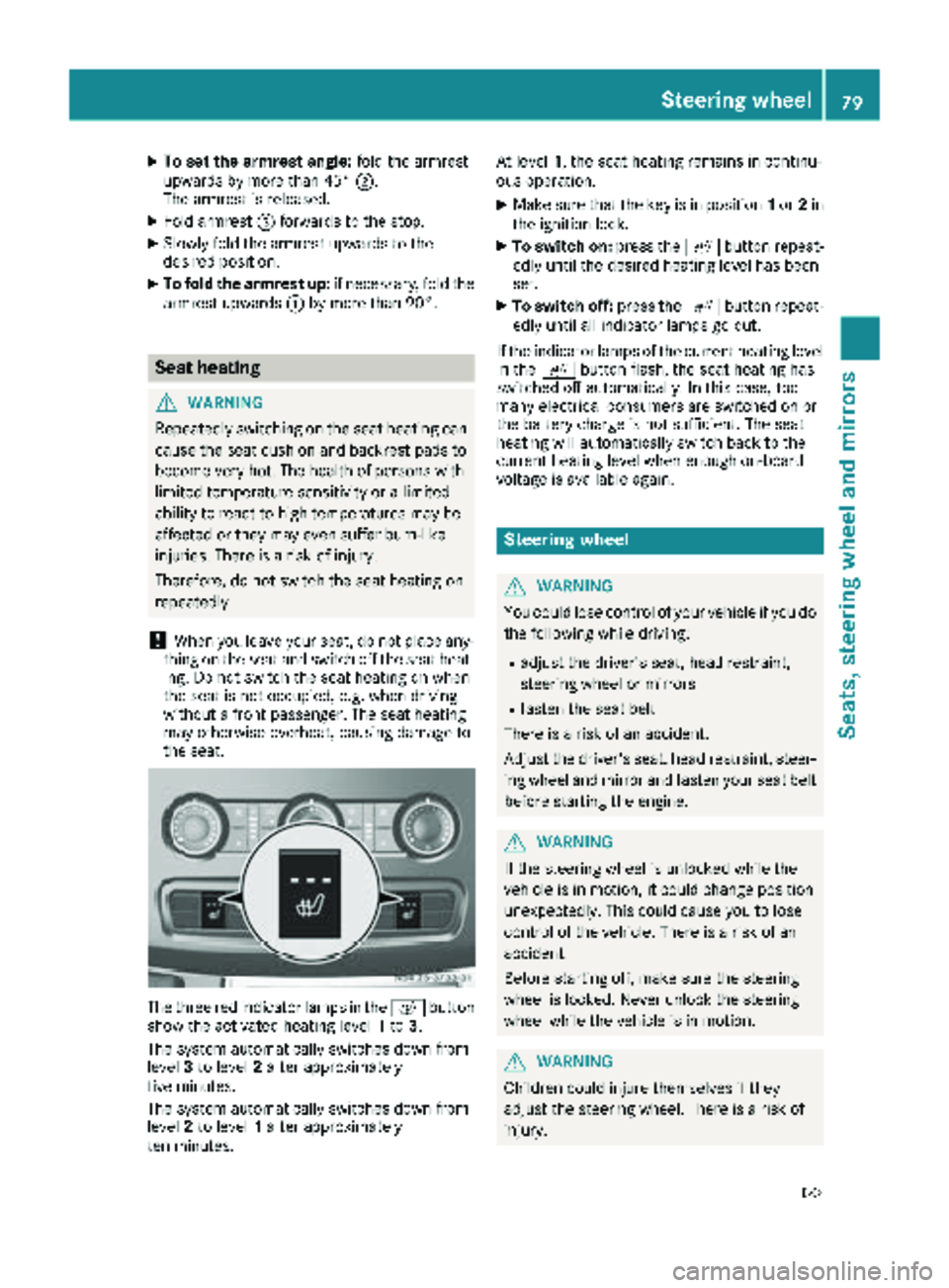
The three red indicator lamps in the cbutton
show the activated heating level 1to 3.
The system automatically switches down from
level 3to level 2after approximately
five minutes.
The system automatically switches down from
level 2to level 1after approximately
ten minutes. At level
1, the seat heating remains in continu-
ous operation.
XMake sure that the key is in position 1or 2in
the ignition lock.
XTo switch on: press thecbutton repeat-
edly until the desired heating level has been
set.
XTo switch off: press thecbutton repeat-
edly until all indicator lamps go out.
If the indicator lamps of the current heating level
in the cbutton flash, the seat heating has
switched off automatically. In this case, too
many electrical consumers are switched on or
the battery charge is not sufficient. The seat
heating will automatically switch back to the
current heating level when enough on-board
voltage is available again.
Steering wheel
GWARNING
You could lose control of your vehicle if you do the following while driving:
Radjust the driver's seat, head restraint,
steering wheel or mirrors
Rfasten the seat belt
There is a risk of an accident.
Adjust the driver's seat, head restraint, steer-
ing wheel and mirror and fasten your seat belt before starting the engine.
GWARNING
If the steering wheel is unlocked while the
vehicle is in motion, it could change position
unexpectedly. This could cause you to lose
control of the vehicle. There is a risk of an
accident.
Before starting off, make sure the steering
wheel is locked. Never unlock the steering
wheel while the vehicle is in motion.
GWARNING
Children could injure themselves if they
adjust the steering wheel. There is a risk of
injury.
Steering wheel79
Seats, steering wheel and mirrors
Z