fuel filter MERCEDES-BENZ SPRINTER 2018 MY18 Operator’s Manual
[x] Cancel search | Manufacturer: MERCEDES-BENZ, Model Year: 2018, Model line: SPRINTER, Model: MERCEDES-BENZ SPRINTER 2018Pages: 294, PDF Size: 4.36 MB
Page 281 of 294
When handling, storing and disposing of fuels,
please observe the relevant regulations.
Tank contents
Depending on equipment, the total capacity of
the fuel tank may vary.
Total capacity
All-wheel-drive vehicles:
All modelsApprox-imately
24.6 US gal (93 l)
Cargo Van/Passenger Van:
All modelsApprox-imately
24.6 US gal (93 l)
Cab Chassis/chassis:
All modelsApprox-imately
26.4 US gal (100 l)
of which reserve fuel
Models with approximately
24.6 US gal (93 l) total capa-
cityApprox-imately
5.0 US gal (19 l)
Models with approximately
26.4 US gal (100 l)total capa-
cityApprox- imately
4.8 US gal (18 l)
Diesel
Fuel grade
GWARNING
If you mix diesel fuel with gasoline, the flash
point is lower than that of pure diesel fuel.
When the engine is running, exhaust system
components could overheat without being
noticed. There is a risk of fire.
Never refuel with gasoline. Never mix gasoline with diesel fuel.
!Filter the fuel before transferring it to the
vehicle if you are refueling the vehicle from
barrels or containers. This will prevent malfunctions in the fuel sys-
tem due to contaminated fuel.
!You will damage the diesel engine if you do
not refuel with ULSD or a diesel fuel with a
sulfur content of more than 15 ppm.
!Do not use the following:
Rmarine diesel
Rheating oil
Rvegetable oil
Rgasoline
Rparaffin
Rkerosene
Do not mix such fuels with diesel fuel and do
not use any special additives. This can other-
wise lead to engine damage. This does not
include flow improvers. For further informa-
tion, see "Flow improvers".
Usually you will find information about the fuel
grade on the filling pump. If there is no identifi-
cation on the filling pump, consult a gas station
attendant.
For mo
re information about refueling
(Ypage 126).
Diesel at very low outside temperatures
GWARNING
If you heat fuel system components, e.g. with
a hot-air gun or open flame, these compo-
nents could be damaged. This can cause fuel
to escape and ignite. Depending on the type
of damage, fuel may also not escape until the
engine is running. There is a risk of fire and
explosion.
Never heat fuel system components. Contact
a qualified specialist workshop to rectify the
malfunction.
Refill only with commercially available ULTRA-
LOW SULFUR DIESEL (ULSD, maximum sulfur
content 15 ppm), which fulfills the ASTM D975
standard.
The flow properties of diesel may be inadequate
at low outside temperatures due to paraffin sep-
aration.
iMalfunctions resulting from paraffin sepa-
ration can only be rectified by heating the
entire fuel system. Park the vehicle in a
heated garage, for example.
Service products and capacities279
Technical data
Z
Page 282 of 294
To prevent operating problems, diesel with bet-
ter flow qualities is available during the winter
months. You can obtain information at the gas
station or from your fuel supplier.
Your vehicle is equipped with a fuel preheating
system. This improves the flow properties of the
diesel by approximately 14.5 ‡ (8 †). ULTRA-
LOW SULFUR DIESEL can be used without risk
of malfunction down to an outside temperature
of approximately 14 ‡ (Ò10 †).
Fuel additives
!Do not add gasoline or kerosene to diesel
fuel to improve its flow characteristics. Gas-
oline or kerosene impairs the lubricating
properties of the diesel fuel. This can result in
damage to the fuel injection system, for
example.
B20 fuels with bio-diesel content
!Continuous use of fuels with bio-diesel con-
tent over 5% (B20 fuels) can lead to fuel filter
clogging. Deposits may also form on the fuel
injector. This may reduce the engine output.
Unburned fuel can get into the oil pan. This
causes the engine oil level to rise. This can
cause engine mechanical damage.
To avoid damages and performance degrada-
tion, observe the following points:
RFill up with fuels with bio-diesel content of
5% (ULSD) or less, whenever possible.
RRegularly monitor your engine oil level if
you use B20 fuels on a regular basis.
RStrictly follow the oil change intervals quo-
ted in the instrument cluster and within
your maintenance booklet.
RUse only engine oils and filters approved for
use in your vehicle.
RIf you do not plan to drive your vehicle for
several weeks, completely fill the fuel tank
in advance with ULSD fuel.
For more information, consult the gas station
staff. The identification of fuels with bio-diesel
content (ULSD or B20) must be clear. If the
marking does not make this clear, do not refuel
from that pump.
Do not refuel with any fuels that have not been
approved for your vehicle.
For more information about refueling
(
Ypage 127).
Information on fuel consumption
HEnvironmental note
CO
2(carbon dioxide) is the gas which scien-
tists believe to be principally responsible for
global warming (the greenhouse effect). Your
vehicle's CO
2emissions are directly related to
fuel consumption and therefore depend on:
Refficient use of the fuel by the engine
Rdriving style
Rother non-technical factors, such as envi-
ronmental influences, road conditions or
traffic flow
You can minimize your vehicle's CO
2emis-
sions by driving carefully and having it serv-
iced regularly.
Fuel consumption depends on:
Rthe vehicle version
Rthe style of driving
Rthe operating conditions
Rthe type or quality of the fuel used
The vehicle will use more fuel than usual in the
following situations:
Rat very low outside temperatures
Rin city traffic
Rduring short journeys
Ron mountainous terrain
Rwhen towing a trailer
To keep fuel consumption low, observe the
advice in the "Protection of the environment"
section (
Ypage 25).
The following components of the different vehi-
cle versions influence fuel consumption:
Rtire sizes, tire tread, tire pressure, tire condi-
tion
Rbody
Rtransmission ratios for the drive assemblies
Radditional equipment (e.g. air-conditioning
system, auxiliary heating system)
For these reasons, the actual consumption fig-
ures for your vehicle may deviate from the con-
sumption figures determined according to EU
Directive 80/1268/EE C.
Data concerning fuel consumption are recorded in the on-board computer; use the steering
280Service products and capacities
Technical data
Page 285 of 294
Engine oil SAE classification
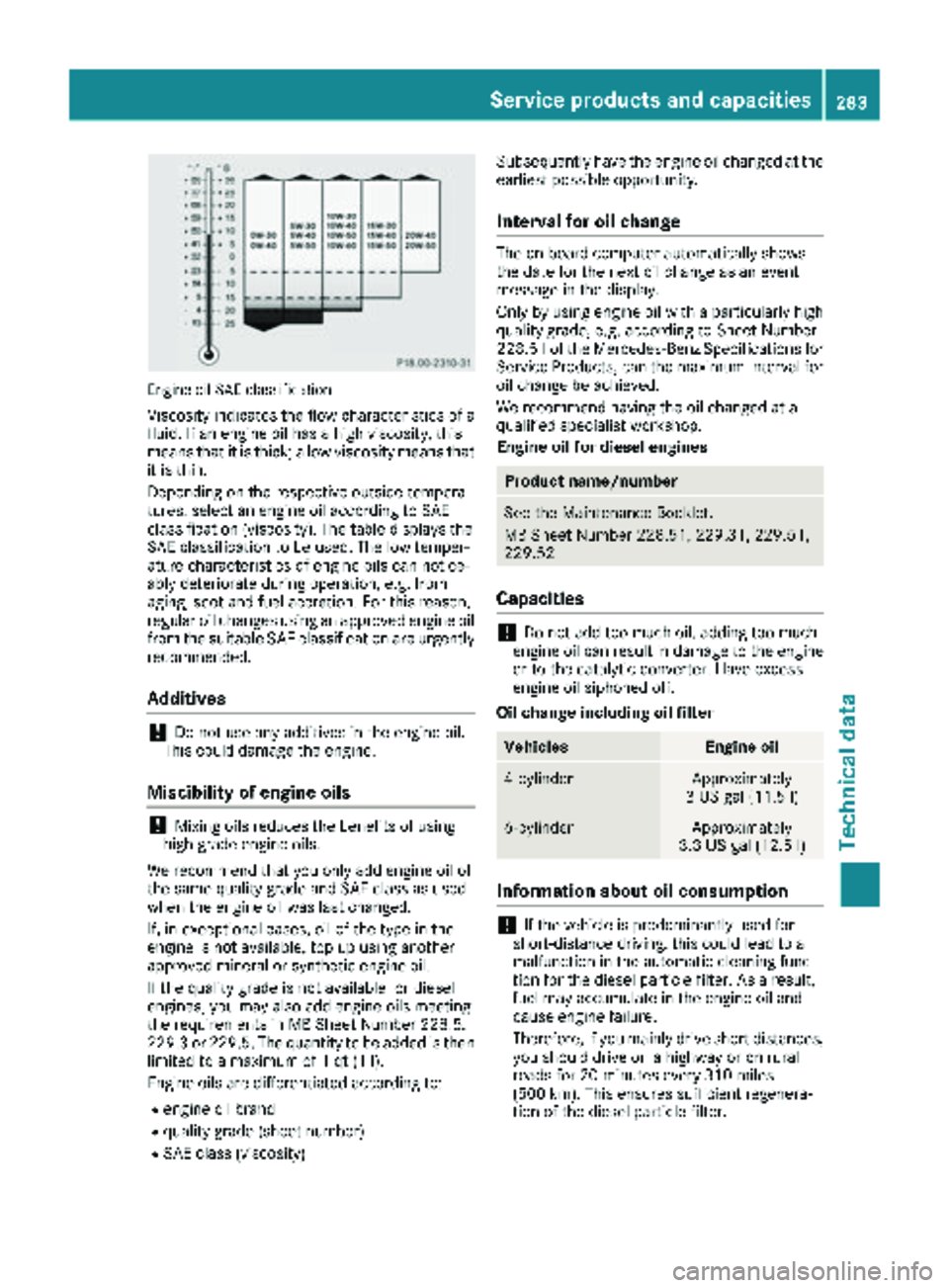
Viscosity indicates the flow characteristics of a
fluid. If an engine oil has a high viscosity, this
means that it is thick; a low viscosity means thatit is thin.
Depending on the respective outside tempera-
tures, select an engine oil according to SAE
classification (viscosity). The table displays the
SAE classification to be used. The low temper-
ature characteristics of engine oils can notice-
ably deteriorate during operation, e.g. from
aging, soot and fuel accretion. For this reason,
regular oil changes using an approved engine oil
from the suitable SAE classification are urgently
recommended.
Additives
!Do not use any additives in the engine oil.
This could damage the engine.
Miscibility of engine oils
!Mixing oils reduces the benefits of using
high grade engine oils.
We recommend that you only add engine oil of
the same quality grade and SAE class as used
when the engine oil was last changed.
If, in exceptional cases, oil of the type in the
engine is not available, top up using another
approved mineral or synthetic engine oil.
If the quality grade is not available for diesel
engines, you may also add engine oils meeting
the requirements in MB Sheet Number 228.5,
229.3 or 229.5. The quantity to be added is then
limited to a maximum of 1 qt (1 l).
Engine oils are differentiated according to:
Rengine oil brand
Rquality grade (sheet number)
RSAE class (viscosity) Subsequently have the engine oil changed at the
earliest possible opportunity.
Interval for oil change
The on-board computer automatically shows
the date for the next oil change as an event
message in the display.
Only by using engine oil with a particularly high
quality grade, e.g. according to Sheet Number
228.51 of the Mercedes-Benz Specifications for
Service Products, can the maximum interval for
oil change be achieved.
We recommend having the oil changed at a
qualified specialist workshop.
Engine oil for diesel engines
Product name/number
See the Maintenance Booklet.
MB Sheet Number 228.51, 229.31, 229.51,
229.52
Capacities
!Do not add too much oil. adding too much
engine oil can result in damage to the engine
or to the catalytic converter. Have excess
engine oil siphoned off.
Oil change including oil filter
VehiclesEngine oil
4-cylinderApproximately
3 US gal (11.5 l)
6-cylinderApproximately
3.3 US gal (12.5 l)
Information about oil consumption
!If the vehicle is predominantly used for
short-distance driving, this could lead to a
malfunction in the automatic cleaning func-
tion for the diesel particle filter. As a result,
fuel may accumulate in the engine oil and
cause engine failure.
Therefore, if you mainly drive short distances,
you should drive on a highway or on rural
roads for 20 minutes every 310 miles
(500 km). This ensures sufficient regenera-
tion of the diesel particle filter.
Service products and capacities283
Technical data
Z