technical data MERCEDES-BENZ SPRINTER 2018 MY18 Operator’s Manual
[x] Cancel search | Manufacturer: MERCEDES-BENZ, Model Year: 2018, Model line: SPRINTER, Model: MERCEDES-BENZ SPRINTER 2018Pages: 294, PDF Size: 4.36 MB
Page 217 of 294
Load distribution
General notes
!
Excessive loads on individual points of the
cargo floor or on the load surface impair vehi-
cle handling characteristics and could cause
damage to the floor covering.
The overall center of gravity of the load should
always be as low as possible, centered and
between the axles near the rear axle.
On Cargo Vans and Passenger Vans:
XAlways transport loads in the cargo compart-
ment.
XAlways place the load against the backrests of the rear bench seat.
XMove large and heavy loads as far towards the
front of the vehicle as possible against the
rear bench seat. Stow the load flush with the
rear bench seat.
XAlways additionally secure the load with suit-
able load-securing aids or tie downs.
Observe the following notes:
RDo not stack loads higher than the upper edge
of the backrests.
RTransport loads behind seats that are not
occupied.
RIf the rear bench seat is not occupied, insert
the seat belts crosswise into the buckle of the
opposite seat belt.
Securing loads
Important safety notes
GWARNING
If you attach the tie-down incorrectly when
securing the load, the following may occur in
the event of abrupt changes in direction, brak- ing maneuvers or an accident:
Rthe cargo tie-down rings may become
detached or the tie-down may tear if the
permissible load is exceeded
Rthe load may not be restrained.
This may cause the load to slip, tip over or be
tossed about, striking vehicle occupants.
There is a risk of an accident and injury.
Always tension the tie-downs in the proper
manner and only between the described
cargo tie-down rings. Always use tie-downs
designed specifically for the loads.
!Observe the information on the maximum
loading capacity of the individual cargo tie-
down points.
If you use several cargo tie-down points to
secure a load, you must always take the max-
imum loading capacity of the weakest cargo
tie-down point into account.
If you brake hard, for example, the forces act- ing could be up to several times the weight
force of the load. Always use multiple cargo
tie-down points in order to distribute the force
absorption. Load the anchorages evenly.
Spread the load evenly between the cargo tie-
down points or tie-down rings.
Please also refer to the notes about qualified
specialist workshops (
Ypage 27).
Always observe the operating instructions or the
notes of the lashing strap manufacturer for the
operation of the lashing strap.
Information about the maximum loading capa-
city of the cargo tie-down points can be found in
the "Technical data" section (
Ypage 287).
As the driver, you are responsible for ensuring
that:
RThe load is secured against slipping, tipping,
rolling or falling off. This applies both in nor-
mal traffic conditions and if the vehicle must
swerve to avoid an obstacle, in the event of
full brake application and on poor road sur
fa-
ces.
RThe applicable requirements and guidelines
relating to load-securing practices must be
met.
If this is not the case, this may constitute a
punishable offense, depending on local legis-
lation and any ensuing consequences.
You should therefore observe the respective
legal requirements for the relevant country.
Make sure that the load is secure before every
journey and at regular intervals during a long
journey. Correct an incorrectly or inadequately
secured load if necessary.
You can obtain information about securing the
load correctly from the manufacturer of the load
securing aids or tie down for securing the load.
Securing loads215
Transporting loads
Z
Page 219 of 294
Installing/removing cargo tie-down
rings for the load rails
GWARNING
If th ecargo tie-down rin gis no tproperly
installed, it may slip or become detached in
th eevent of abrup tchanges in direction ,brak -
ing maneuvers or an accident. This may caus e
objects ,luggag eor th eload to slip, ti pove ror
be tosse dabout ,striking vehicl eoccupants.
Ther eis aris kof injury.
Before usin gth ecargo tie-down rings, always
mak esur ethey are properly installed and
canno tbe moved.
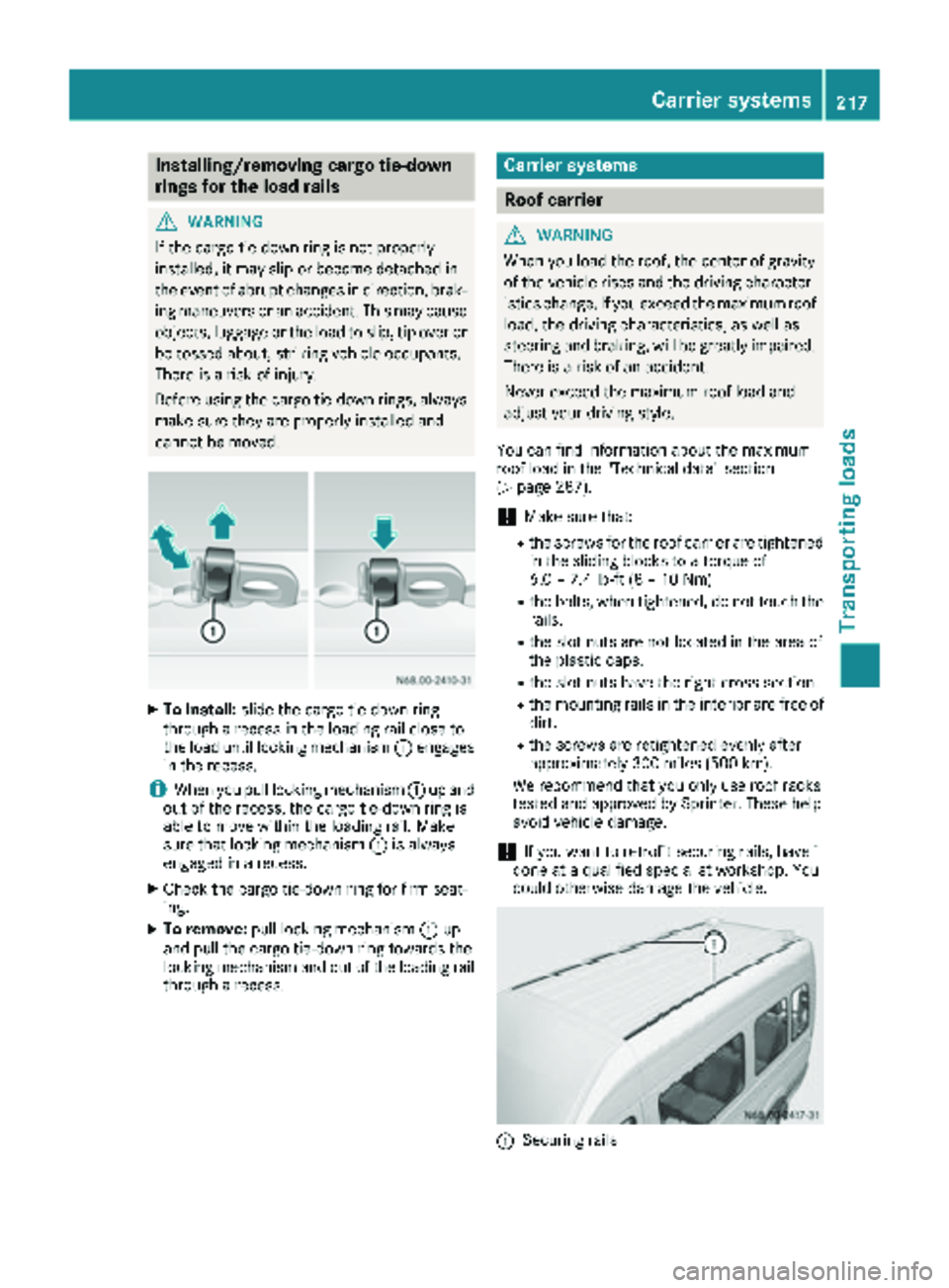
XTo install: slide thecargo tie-down rin g
throug h arecess in th eloadin grail close to
th eload until lockin gmechanism :engage s
in th erecess .
iWhen you pull lockin gmechanism :up and
out of th erecess ,th ecargo tie-down rin gis
able to mov ewithin th eloadin grail. Mak e
sur ethat lockin gmechanism :is always
engage din arecess .
XCheckth ecargo tie-down rin gfor fir mseat -
ing .
XTo remove: pull lockingmechanism :up
and pull th ecargo tie-down rin gtowards th e
lockin gmechanism and out of th eloadin grail
throug h arecess .
Carrier systems
Roof carrier
GWARNIN G
When you load th eroof, th ecenter of gravit y
of th evehicl erises and th edriving character-
istics change. If you exceed th emaximum roo f
load, th edriving characteristics ,as well as
steering and braking ,will be greatl yimpaired.
Ther eis aris kof an accident.
Never exceed th emaximum roo fload and
adjust your driving style.
You can fin dinformation about th emaximum
roo fload in th e"Technical data" section
(
Ypage 287).
!Mak esur ethat:
Rth escrews for th eroo fcarrie rare tightened
in th esliding blocks to atorque of
6. 0 – 7.4lb-ft (8 –10 Nm)
Rth ebolts, when tightened, do no ttouch th e
rails .
Rtheslot nut sare no tlocate din th earea of
th eplastic caps.
Rth eslot nut shav eth eright cross-section .
Rthemounting rails in th einterior are free of
dirt .
Rthescrews are retightened evenly after
approximately 30 0mile s(50 0km).
We recommen dtha tyou only use roo fracks
tested and approve dby Sprinter. These help
avoid vehicl edamage.
!If you wan tto retrofit securin grails, hav eit
don eat aqualified specialist workshop .You
could otherwise damage th evehicle.
:Securin grail s
Carrier systems217
Transporting loads
Z
Page 220 of 294
It is possible to install a roof carrier if your vehi-
cle is equipped with securing rails on the roof.
Special mountings (sliding blocks) are available
as accessories.
These mounting elements are available at any
authorized Sprinter Dealer.
Ladder carrier
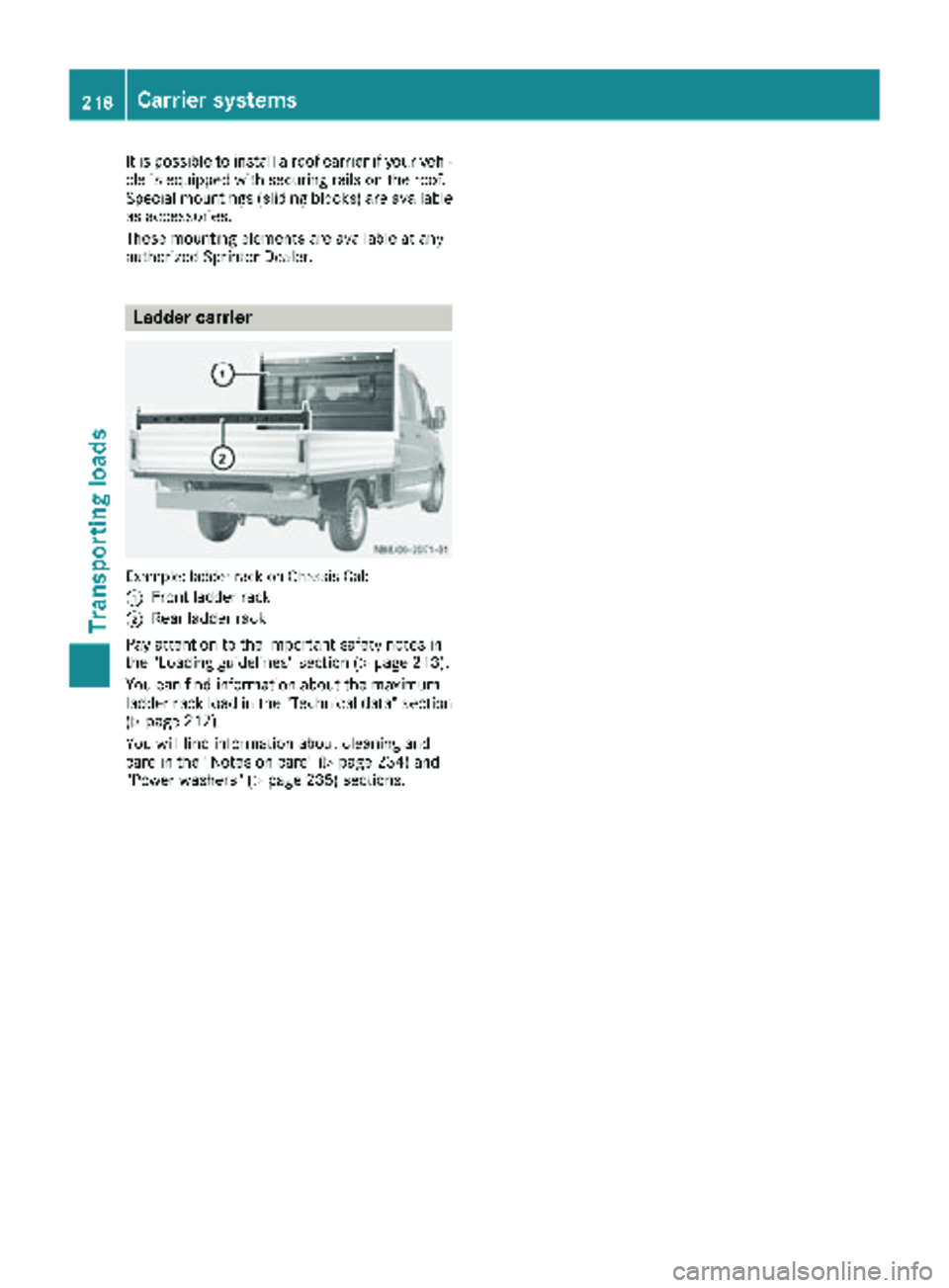
Example: ladder rack on Chassis Cab
:
Front ladder rack
;Rear ladder rack
Pay attention to the important safety notes in
the "Loading guidelines" section (
Ypage 213).
You can find information about the maximum
ladder rack load in the "Technical data" section
(
Ypage 217).
You will find information about cleaning and
care in the "Notes on care" (
Ypage 234) and
"Power washers" (Ypage 235) sections.
218Carrier systems
Transporting loads
Page 223 of 294
Overview of the engine compartment
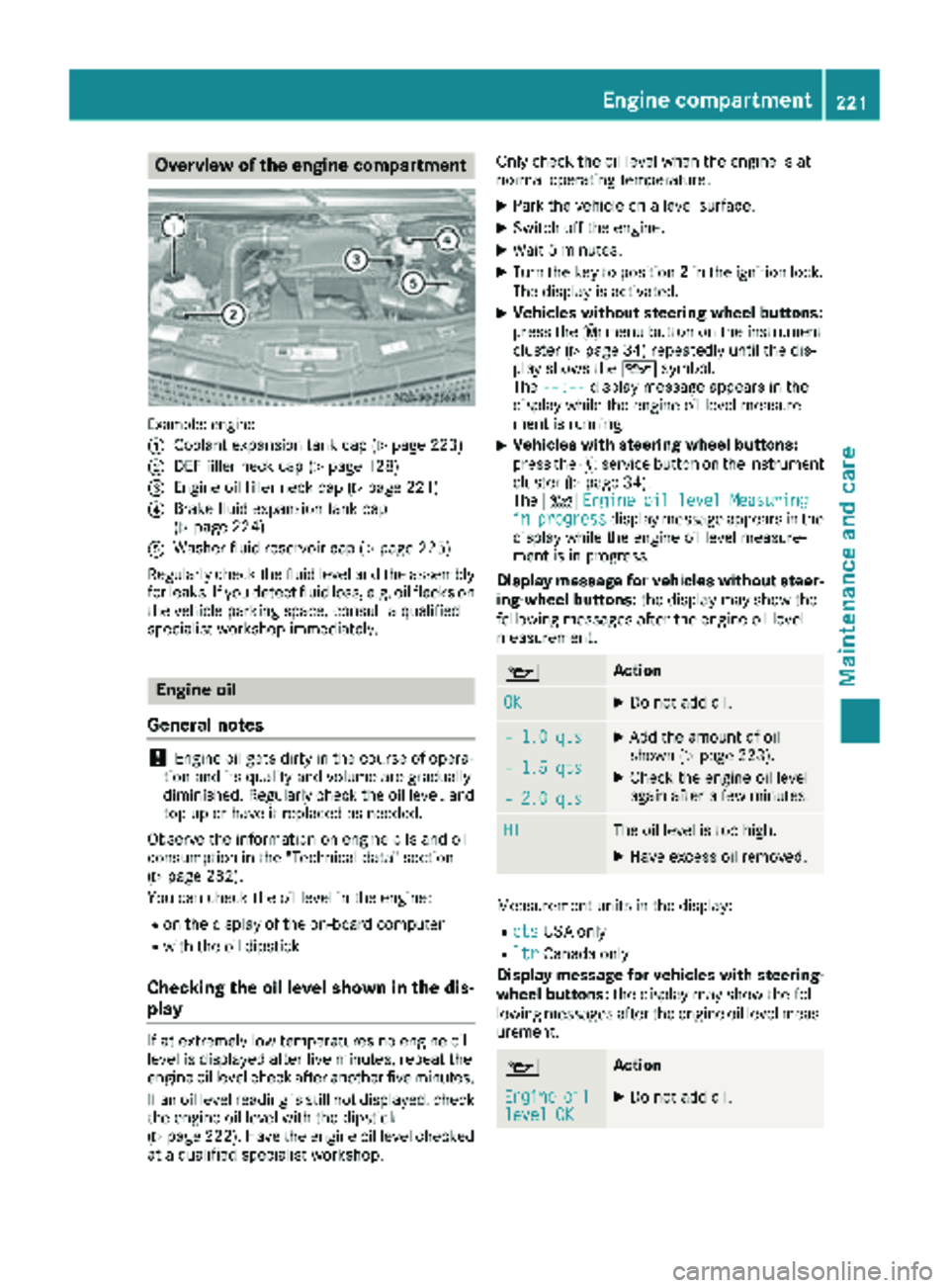
Example: engine
:
Coolant expansion tank cap (Ypage 223)
;DEF filler neck cap (Ypage 128)
=Engine oil filler neck cap (Ypage 221)
?Brake fluid expansion tank cap
(Ypage 224)
AWasher fluid reservoir cap (Ypage 225)
Regularly check the fluid level and the assembly
for leaks. If you detect fluid loss, e.g. oil flecks on
the vehicle parking space, consult a qualified
specialist workshop immediately.
Engine oil
General notes
!Engine oil gets dirty in the course of opera-
tion and its quality and volume are gradually
diminished. Regularly check the oil level, and
top up or have it replaced as needed.
Observe the information on engine oils and oil
consumption in the "Technical data" section
(
Ypage 282).
You can check the oil level in the engine:
Ron the display of the on-board computer
Rwith the oil dipstick
Checking the oil level shown in the dis-
play
If at extremely low temperatures no engine oil
level is displayed after five minutes, repeat the
engine oil level check after another five minutes.
If an oil level reading is still not displayed, check
the engine oil level with the dipstick
(
Ypage 222). Have the engine oil level checked
at a qualified specialist workshop. Only check the oil level when the engine is at
normal operating temperature.
XPark the vehicle on a level surface.
XSwitch off the engine.
XWait 5 minutes.
XTurn the key to position
2in the ignition lock.
The display is activated.
XVehicles without steering wheel buttons:
press the 4menu button on the instrument
cluster (
Ypage 34) repeatedly until the dis-
play shows the 1symbol.
The --:--
display message appears in the
display while the engine oil level measure-
ment is running.
XVehicles with steering wheel buttons:
press the Ëservice button on the instrument
cluster (
Ypage 34).
The 4 Engine oil level Measuring
inprogressdisplay message appears in the
display while the engine oil level measure-
ment is in progress.
Display message for vehicles without steer-
ing-wheel buttons: the display may show the
following messages after the engine oil level
measurement.
1Action
OKXDo not add oil.
– 1.0 qtsXAdd the amount of oil
shown (Ypage 223).
XCheck the engine oil level
again after a few minutes.– 1.5 qts
– 2.0 qts
HIThe oil level is too high.
XHave excess oil removed.
Measurement units in the display:
RqtsUSA only
RltrCanada only
Display message for vehicles with steering- wheel buttons: the display may show the fol-
lowing messages after the engine oil level meas-
urement.
1Action
Engineoillevel OKXDo not add oil.
Engine compartment221
Maintenance and care
Z
Page 226 of 294
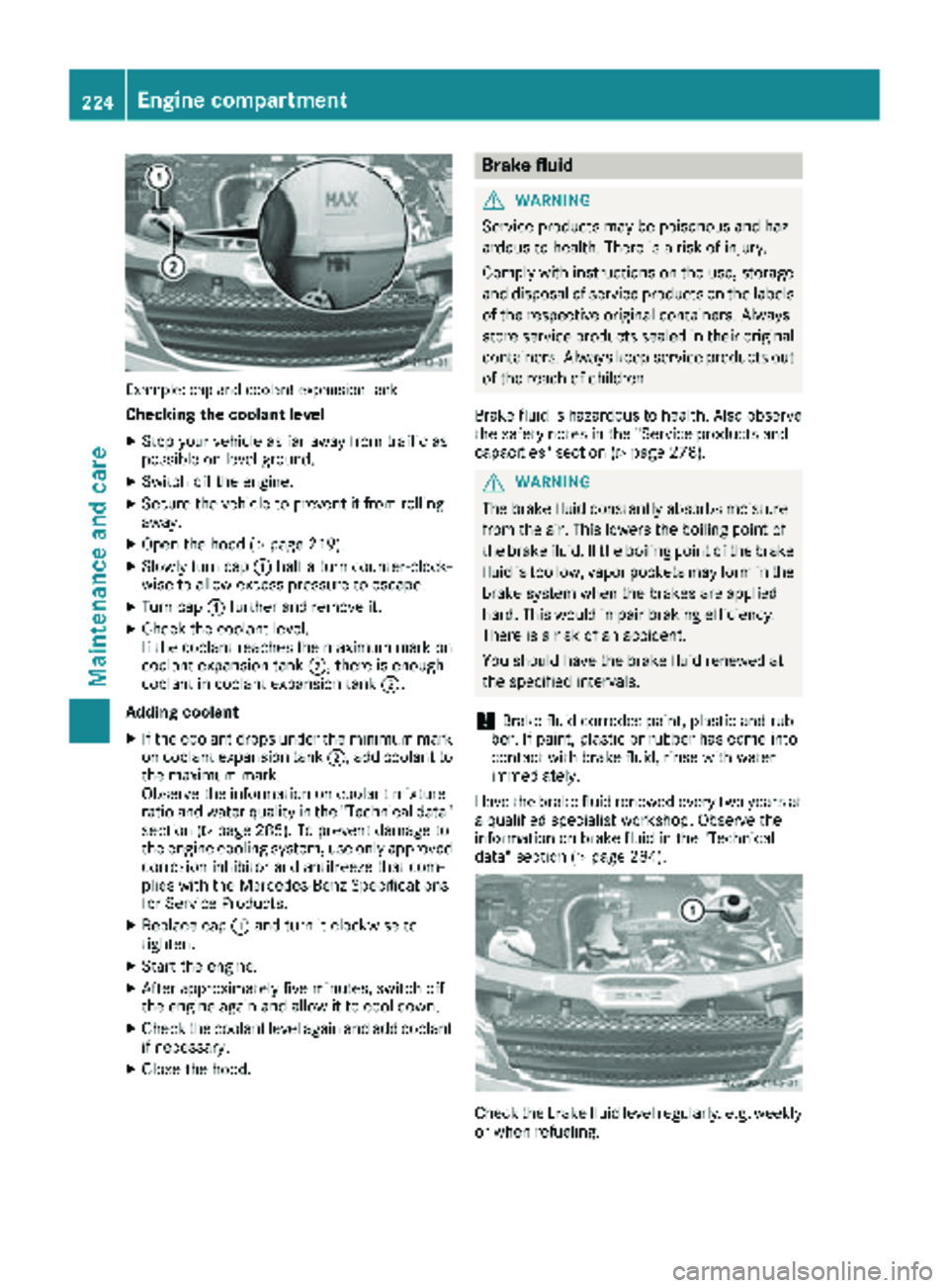
Example: cap and coolant expansion tank
Checking the coolant level
XStop your vehicle as far away from traffic as
possible on level ground.
XSwitch off the engine.
XSecure the vehicle to prevent it from rolling
away.
XOpen the hood (Ypage 219).
XSlowly turn cap:half a turn counter-clock-
wise to allow excess pressure to escape.
XTurn cap :further and remove it.
XCheck the coolant level.
If the coolant reaches the maximum mark on
coolant expansion tank ;, there is enough
coolant in coolant expansion tank ;.
Adding coolant
XIf the coolant drops under the minimum mark
on coolant expansion tank ;, add coolant to
the maximum mark.
Observe the information on coolant mixture
ratio and water quality in the "Technical data"
section (
Ypage 285). To prevent damage to
the engine cooling system, use only approved
corrosion inhibitor and antifreeze that com-
plies with the Mercedes-Benz Specifications
for Service Products.
XReplace cap :and turn it clockwise to
tighten.
XStart the engine.
XAfter approximately five minutes, switch off
the engine again and allow it to cool down.
XCheck the coolant level again and add coolant
if necessa ry.
XClose the hood.
Brake fluid
GWARNING
Service products may be poisonous and haz-
ardous to health. There is a risk of injury.
Comply with instructions on the use, storage
and disposal of service products on the labels
of the respective original containers. Always
store service products sealed in their original
containers. Always keep service products out
of the reach of children.
Brake fluid is hazardous to health. Also observe
the safety notes in the "Service products and
capacities" section (
Ypage 278).
GWARNING
The brake fluid constantly absorbs moisture
from the air. This lowers the boiling point of
the brake fluid. If the boiling point of the brake
fluid is too low, vapor pockets may form in the
brake system when the brakes are applied
hard. This would impair braking efficiency.
There is a risk of an accident.
You should have the brake fluid renewed at
the specified intervals.
!Brake fluid corrodes paint, plastic and rub-
ber. If paint, plastic or rubber has come into
contact with brake fluid, rinse with water
immediately.
Have the brake fluid renewed every two years at
a qualified specialist workshop. Observe the
information on brake fluid in the "Technical
data" section (
Ypage 284).
Check the brake fluid level regularly, e.g. weekly
or when refueling.
224Engine compartment
Maintenance and care
Page 227 of 294
Checking the brake fluid level
XStop your vehicle as far away from traffic as
possible on level ground.
XSwitch off the engine.
XSecure the vehicle to prevent it from rolling
away.
XOpen the hood (Ypage 219).
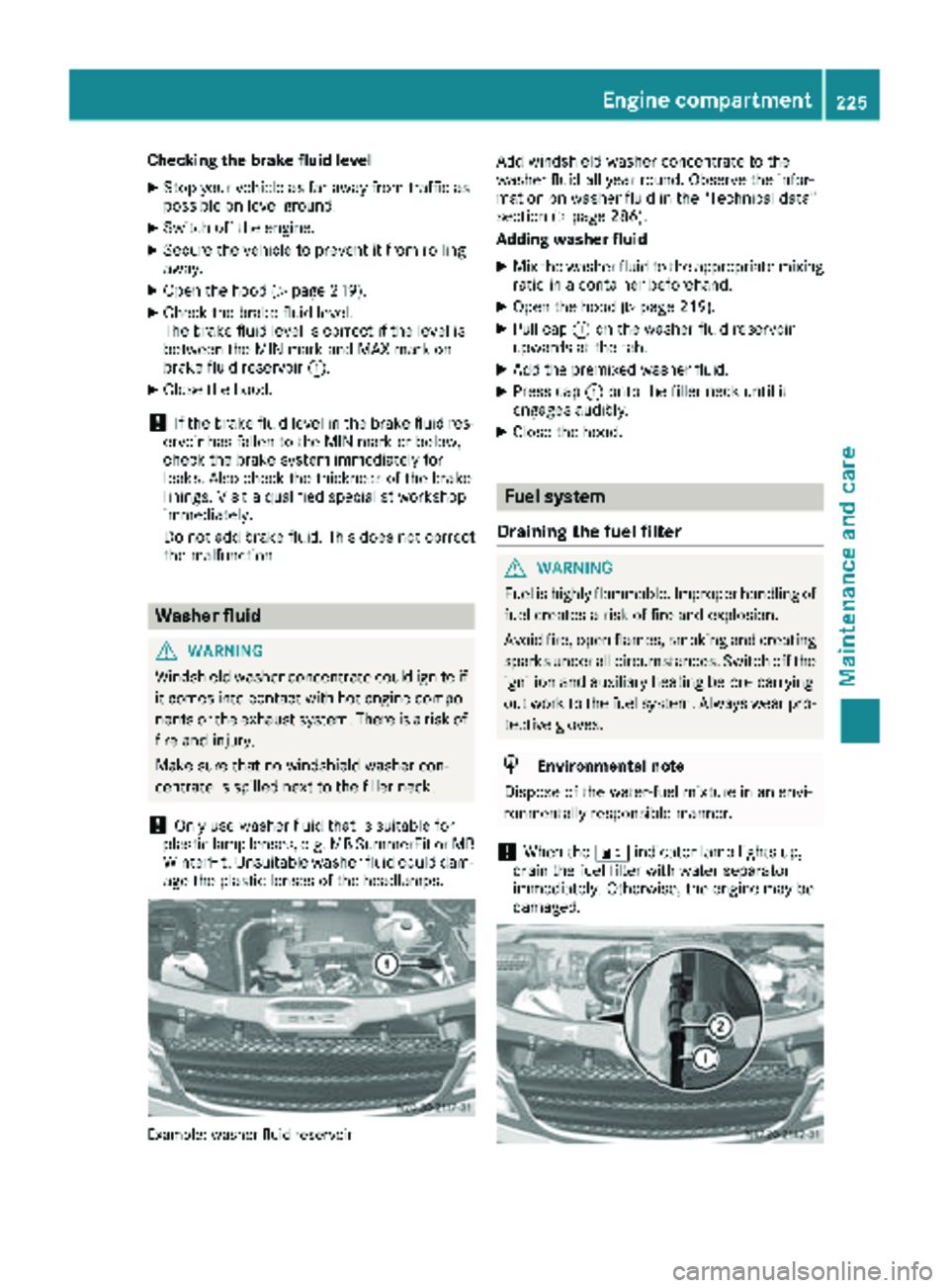
XCheck the brake fluid level.
The brake fluid level is correct if the level is
between the MIN mark and MAX mark on
brake fluid reservoir:.
XClose the hood.
!If the brake fluid level in the brake fluid res-
ervoir has fallen to the MIN mark or below,
check the brake system immediately for
leaks. Also check the thickness of the brake
linings. Visit a qualified specialist workshop
immediately.
Do not add brake fluid. This does not correct
the malfunction.
Washer fluid
GWARNING
Windshield washer concentrate could ignite if it comes into contact with hot engine compo-
nents or the exhaust system. There is a risk of
fire and injury.
Make sure that no windshield washer con-
centrate is spilled next to the filler neck.
!Only use washer fluid that is suitable for
plastic lamp lenses, e.g. MB SummerFit or MB WinterFit. Unsuitable washer fluid could dam-
age the plastic lenses of the headlamps.
Example: washer fluid reservoir
Add windshield washer concentrate to the
washer fluid all year round. Observe the infor-
mation on washer fluid in the "Technical data"
section (
Ypage 286).
Adding washer fluid
XMix the washer fluid to the appropriate mixing ratio in a container beforehand.
XOpen the hood (Ypage 219).
XPull cap :on the washer fluid reservoir
upwards at the tab.
XAdd the premixed washer fluid.
XPress cap :onto the filler neck until it
engages audibly.
XClose the hood.
Fuel system
Draining the fuel filter
GWARNING
Fuel is highly flammable. Improper handling of
fuel creates a risk of fire and explosion.
Avoid fire, open flames, smoking and creating
sparks under all circumstances. Switch off the
ignition and auxiliary heating before carrying
out work to the fuel system. Always wear pro-
tective gloves.
HEnvironmental note
Dispose of the water-fuel mixture in an envi-
ronmentally responsible manner.
!When the :indicator lamp lights up,
drain the fuel filter with water separator
immediately. Otherwise, the engine may be
damaged.
Engine compartment225
Maintenance and care
Z
Page 278 of 294
Useful information
This Operator's Manual describes all models as
well as standard and optional equipment of your
vehicle that were available at the time of going
to print. Country-specific variations are possi-
ble. Note that your vehicle may not be equipped
with all of the described functions. This also
applies to systems and functions relevant to
safety.
Read the information on qualified specialist
workshops (
Ypage 27).
Vehicle electronics
Tampering with the engine electron-
ics
!
Only have engine electronics and the corre-
sponding parts, such as control units, actua-
tors, sensors or connector leads, serviced at a
qualified specialist workshop. Otherwise, the
vehicle parts may wear more quickly. This can
lead to loss of the New Vehicle Limited War-
ranty.
Installing electrical or electronic
equipment
You and others can suffer health-related dam-
age through electromagnetic radiation. By using
an exterior antenna, a possible health risk
caused by electromagnetic fields, as discussed
in scientific circles, is taken into account. Only
have the exterior antenna installed by a qualified specialist workshop.
Electrical and electronic devices may have a
detrimental effect on both the comfort and the
operating safety of the vehicle. If equipment of
this kind is installed, its electromagnetic com-
patibility must be checked and verified.
If these devices are linked to functions associ-
ated with resistance to interference, they must
have type approval. This applies to the device or
its interfaces to the vehicle electronics, e.g.
charging brackets.
A telephone or two-way radio to be installed in
the vehicle must be approved. Further informa-
tion can be obtained from any Sprinter Dealer.
For operation of mobile phones and two-way
radios, Mercedes-Benz recommends connec- tion to an approved exterior antenna. This is the
only way to ensure optimum reception quality
inside the vehicle and to minimize mutual inter-
ference between the vehicle electronics, mobile
phones and two-way radios.
The transmission output of the mobile phone or
two-way radio may not exceed the following
maximum transmission output (PEAK):
Frequency rangeMaximum trans-
mission output
(PEAK)
Shortwave
(f < 50 MHz)100 W
4 m waveband30 W
2 m waveband50 W
Trunked radio/Tetra35 W
70 cm waveband35 W
GSM/UMTS/LTE10 W
Identification plates
Vehicle identification plate with vehi-
cle identification number (VIN)
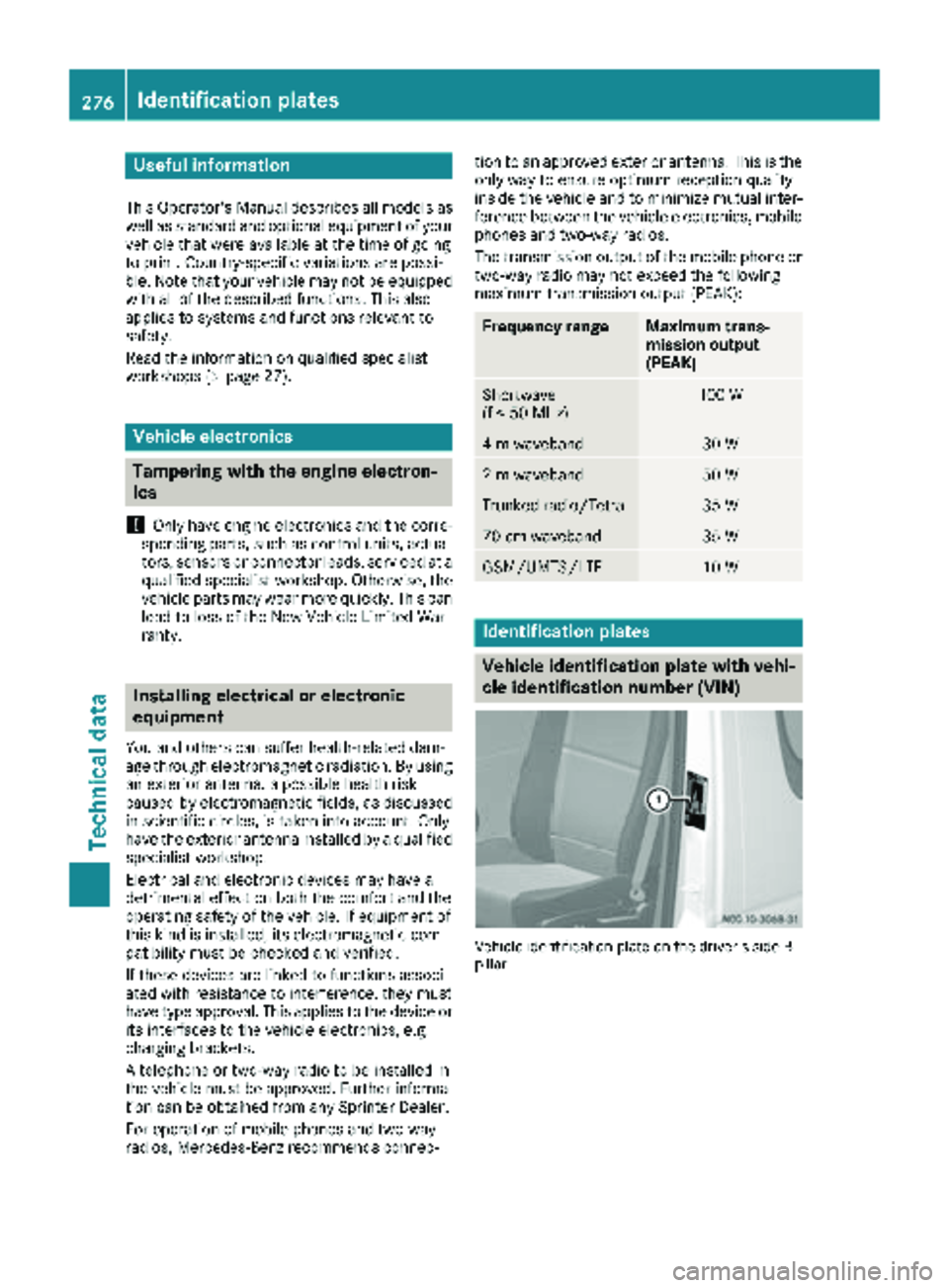
Vehicle identification plate on the driver's side B-
pillar
276Identification plates
Technical data
Page 279 of 294
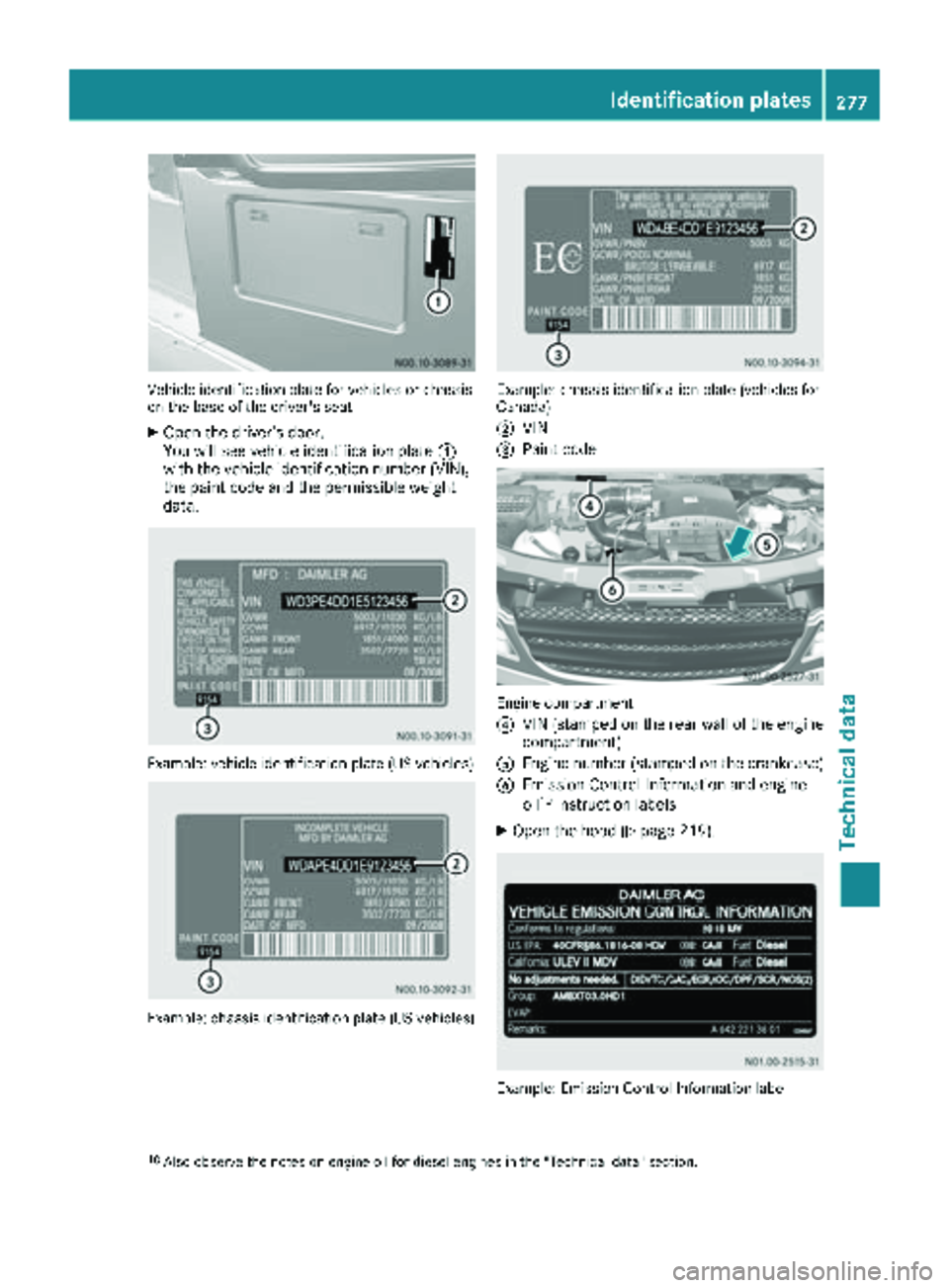
Vehicle identification plate for vehicles or chassis
on the base of the driver's seat
XOpen the driver’s door.
You will see vehicle identification plate:
with the vehicle identification number (VIN),
the paint code and the permissible weight
data.
Example: vehicle identification plate (US vehicles)
Example: chassis identification plate (US vehicles)
Example: chassis identification plate (vehicles for
Canada)
;
VIN
=Paint code
Engine compartment
?
VIN (stamped on the rear wall of the engine
compartment)
AEngine number (stamped on the crankcase)
BEmission Control Information and engine
oil10instruction labels
XOpen the hood (Ypage 219).
Example: Emission Control Information label
10Also observe the notes on engine oil for diesel engines in the "Technical data" section.
Identification plates277
Technical data
Page 280 of 294
iSuch data is vehicle-specific and may differ
from that shown. Always observe the specifi-
cations on your vehicle's identification plate.
Engine number
The engine number is stamped on the crank-
case. More information may be obtained at any
qualified specialist workshop.
Service products and capacities
Important safety notes
GWARNING
Service products may be poisonous and haz-
ardous to health. There is a risk of injury.
Comply with instructions on the use, storage
and disposal of service products on the labels
of the respective original containers. Always
store service products sealed in their original
containers. Always keep service products out
of the reach of children.
HEnvironmental note
Dispose of service products in an environ-
mentally responsible manner.
Service products include the following:
RFuels, e.g. diesel
RAdditives for the exhaust gas aftertreatment,
e.g. Diesel Exhaust Fluid (DEF)
RLubricants, e.g. engine oil, transmission oil
RCoolant
RBrake fluid
RWasher fluid
RClimate control system refrigerants
Approved service products comply with the
highest quality standards and are listed in the
MB Specifications for Service Products. Only
use service products approved for the vehicle.
This is an important condition for the warranty.
You will recognize the approved service prod-
ucts by the inscription on the container: MB
Approval (e.g. MB Approval 228.5)
Other identifications and recommendations
refer to quality level or a specification according to an MB Sheet Number (e.g. MB 228.5). They
are therefore not necessarily approved.
More information can be obtained at any quali-
fied specialist workshop.
Additives for approved service products are nei-
ther required nor permitted. Approved fuel addi- tives are the exception. Additives can cause
engine damage and must therefore not be
added to the service products.
The use of additives is always the responsibility
of the vehicle operator. The use of additives may
result in the restriction or loss of you
r Limited
Warranty entitlements.
Fuel
Important safety notes
GWARNING
Fuel is highly flammable. Improper handling of
fuel creates a risk of fire and explosion.
Avoid fire, open flames, smoking and creating
sparks under all circumstances. Switch off the
engine and, if applicable, the auxiliary heating
before refueling.
GWARNING
Fuel is poisonous and hazardous to health.
There is a risk of injury.
You must make sure that fuel does not come into contact with your skin, eyes or clothing
and that it is not swallowed. Do not inhale fuel
vapors. Keep fuel away from children.
If you or others come into contact with fuel,
observe the following:
RWash away fuel from skin immediately
using soap and water.
RIf fuel comes into contact with your eyes,
immediately rinse them thoroughly with
clean water. Seek medical assistance with-
out delay.
RIf fuel is swallowed, seek medical assis-
tance without delay. Do not induce vomit-
ing.
RImmediately change out of clothing which
has come into contact with fuel.
278Service products and capacities
Technical data
Page 281 of 294
When handling, storing and disposing of fuels,
please observe the relevant regulations.
Tank contents
Depending on equipment, the total capacity of
the fuel tank may vary.
Total capacity
All-wheel-drive vehicles:
All modelsApprox-imately
24.6 US gal (93 l)
Cargo Van/Passenger Van:
All modelsApprox-imately
24.6 US gal (93 l)
Cab Chassis/chassis:
All modelsApprox-imately
26.4 US gal (100 l)
of which reserve fuel
Models with approximately
24.6 US gal (93 l) total capa-
cityApprox-imately
5.0 US gal (19 l)
Models with approximately
26.4 US gal (100 l)total capa-
cityApprox- imately
4.8 US gal (18 l)
Diesel
Fuel grade
GWARNING
If you mix diesel fuel with gasoline, the flash
point is lower than that of pure diesel fuel.
When the engine is running, exhaust system
components could overheat without being
noticed. There is a risk of fire.
Never refuel with gasoline. Never mix gasoline with diesel fuel.
!Filter the fuel before transferring it to the
vehicle if you are refueling the vehicle from
barrels or containers. This will prevent malfunctions in the fuel sys-
tem due to contaminated fuel.
!You will damage the diesel engine if you do
not refuel with ULSD or a diesel fuel with a
sulfur content of more than 15 ppm.
!Do not use the following:
Rmarine diesel
Rheating oil
Rvegetable oil
Rgasoline
Rparaffin
Rkerosene
Do not mix such fuels with diesel fuel and do
not use any special additives. This can other-
wise lead to engine damage. This does not
include flow improvers. For further informa-
tion, see "Flow improvers".
Usually you will find information about the fuel
grade on the filling pump. If there is no identifi-
cation on the filling pump, consult a gas station
attendant.
For mo
re information about refueling
(Ypage 126).
Diesel at very low outside temperatures
GWARNING
If you heat fuel system components, e.g. with
a hot-air gun or open flame, these compo-
nents could be damaged. This can cause fuel
to escape and ignite. Depending on the type
of damage, fuel may also not escape until the
engine is running. There is a risk of fire and
explosion.
Never heat fuel system components. Contact
a qualified specialist workshop to rectify the
malfunction.
Refill only with commercially available ULTRA-
LOW SULFUR DIESEL (ULSD, maximum sulfur
content 15 ppm), which fulfills the ASTM D975
standard.
The flow properties of diesel may be inadequate
at low outside temperatures due to paraffin sep-
aration.
iMalfunctions resulting from paraffin sepa-
ration can only be rectified by heating the
entire fuel system. Park the vehicle in a
heated garage, for example.
Service products and capacities279
Technical data
Z