ECO mode MERCEDES-BENZ SPRINTER 2018 MY18 Operator’s Manual
[x] Cancel search | Manufacturer: MERCEDES-BENZ, Model Year: 2018, Model line: SPRINTER, Model: MERCEDES-BENZ SPRINTER 2018Pages: 294, PDF Size: 4.36 MB
Page 191 of 294
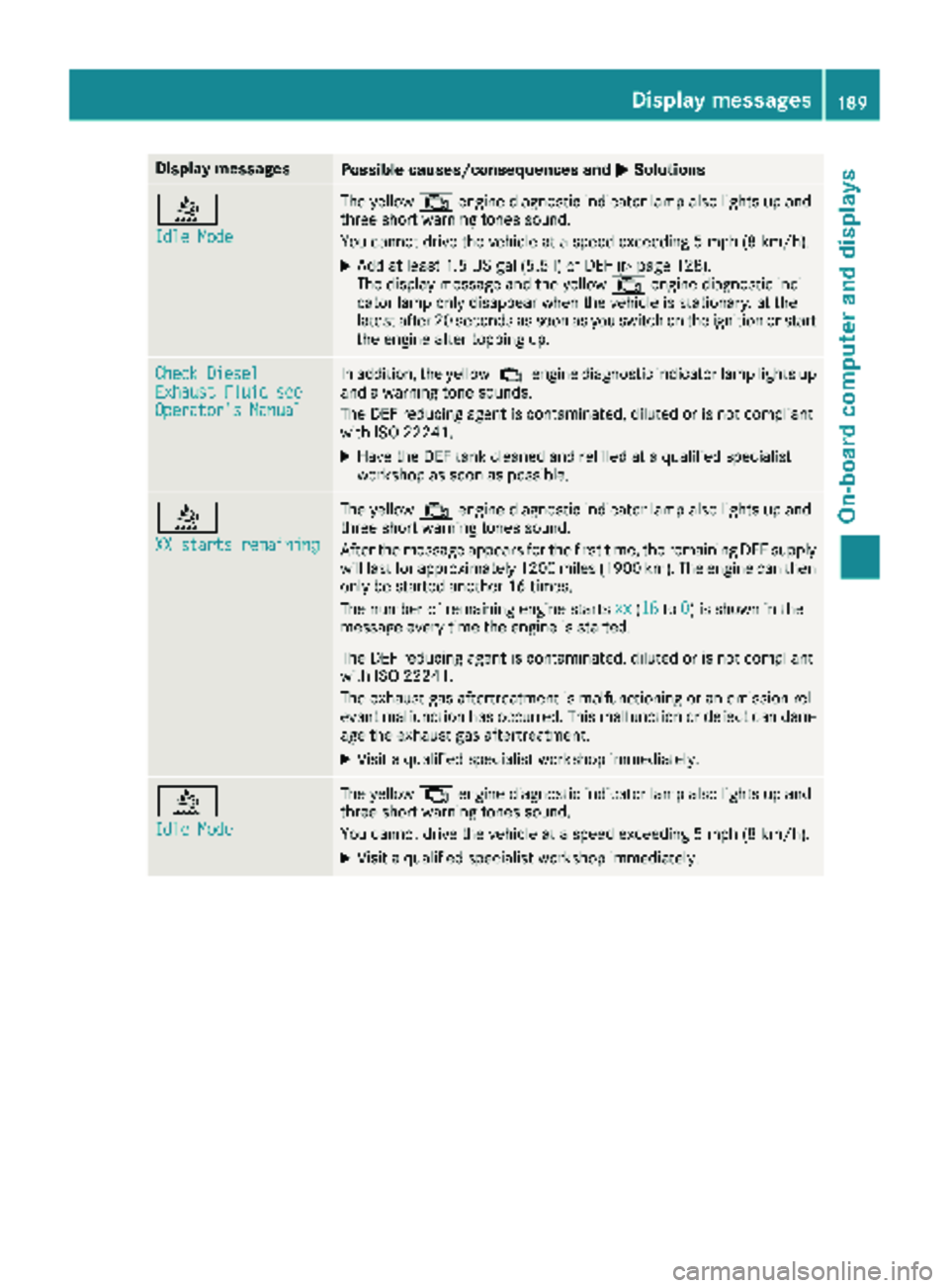
Display messagesPossible causes/consequences andMSolutions
å
IdleMod e
The yellow ;enginediagnostic indicator lamp also lights up and
three short warning tone ssound.
You canno tdrive th evehicl eat aspeed exceedin g 5mph (8 km/h).
XAddat least 1. 5US gal (5.5l)of DEF (Ypage 128).
The display message and the yellow ;engine diagnostic indi-
cator lamp only disappear when the vehicle is stationary, at the
latest after 20 seconds as soon as you switch on the ignition or start
the engine after topping up.
Check DieselExhaust Fluid seeOperator's Manual
In addition, the yellow ;engine diagnostic indicator lamp lights up
and a warning tone sounds.
The DEF reducing agent is contaminated, diluted or is not compliant
with ISO 22241.
XHave the DEF tank cleaned and refilled at a qualified specialist
workshop as soon as possible.
å
XX starts remaining
The yellow ;engine diagnostic indicator lamp also lights up and
three short warning tones sound.
After the message appears for the first time, the remaining DEF supply
will last for approximately 1200 miles (1900 km). The engine can then
only be started another 16 times.
The number of remaining engine starts xx
(16to0) is shown in the
message every time the engine is started.
The DEF reducing agent is contaminated, diluted or is not compliant
with ISO 22241.
The exhaust gas aftertreatment is malfunctioning or an emission rel-
evant malfunction has occurred. This malfunction or defect can dam-
age the exhaust gas aftertreatment.
XVisit a qualified specialist workshop immediately.
å
Idle Mode
The yellow ;engine diagnostic indicator lamp also lights up and
three short warning tones sound.
You cannot drive the vehicle at a speed exceeding 5 mph (8 km/h).
XVisit a qualified specialist workshop immediately.
Display messages189
On-board computer and displays
Z
Page 213 of 294
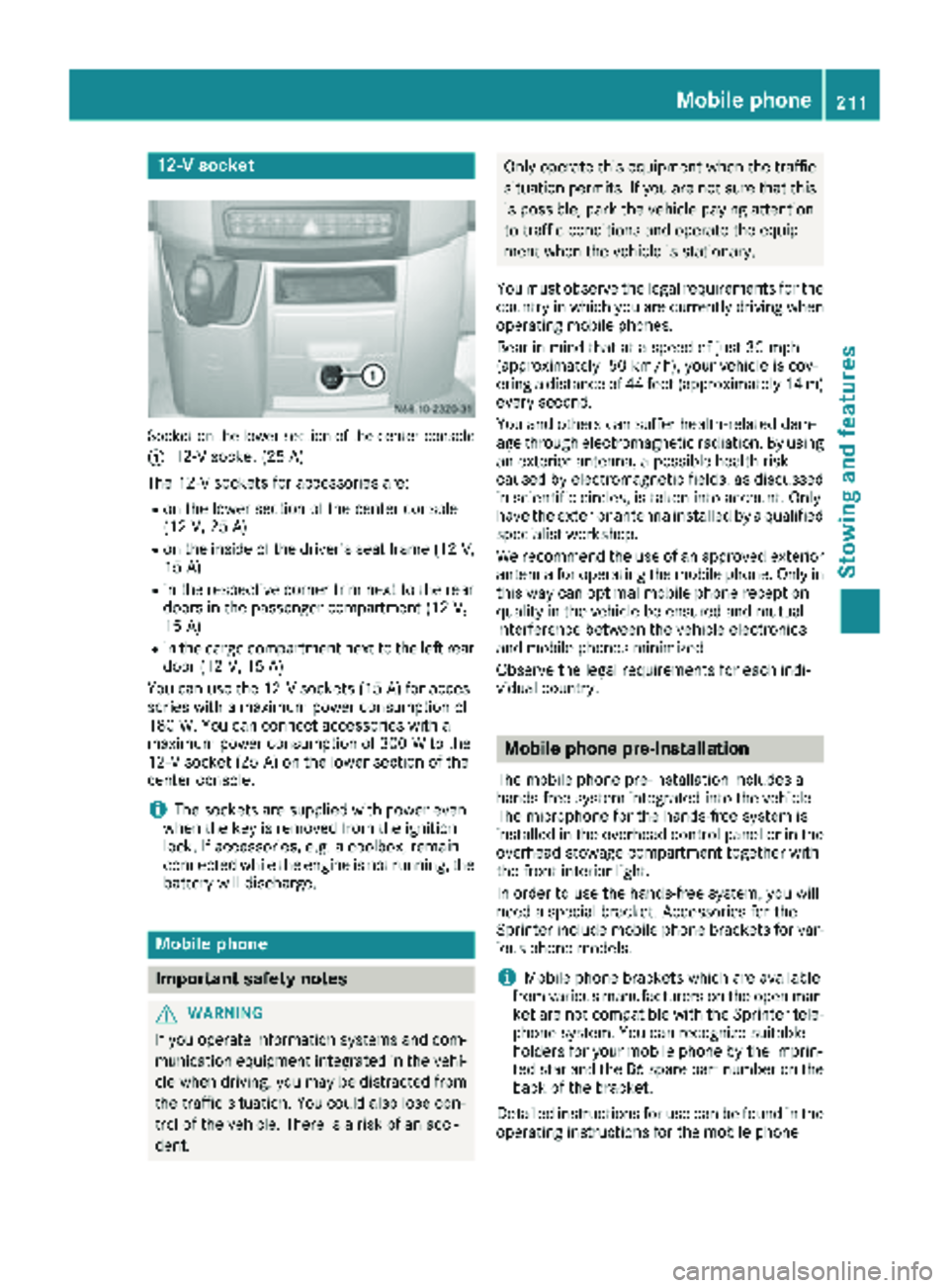
12-V socket
Socket on the lower section of the center console
:
12-V socket (25 A)
The 12-V sockets for accessories are:
Ron the lower section of the center console
(12 V, 25 A)
Ron the inside of the driver's seat frame (12V,
15 A)
Rin the respective corner trim next to the rear
doors in the passenger compartment (12 V,
15 A)
Rin the cargo compartment next to the left rear
door (12 V, 15 A)
You can use the 12-V sockets (15 A) for acces-
sories with a maximum power consumption of
180 W. You can connect accessories with a
maximum power consumption of 300 W to the
12-V socket (25 A) on the lower section of the
center console.
iThe sockets are supplied with power even
when the key is removed from the ignition
lock. If accessories, e.g. a coolbox, remain
connected while the engine is not running, the
battery will discharge.
Mobile phone
Important safety notes
GWARNING
If you operate information systems and com-
munication equipment integrated in the vehi-
cle when driving, you may be distracted from
the traffic situation. You could also lose con-
trol of the vehicle. There is a risk of an acci-
dent.
Only operate this equipment when the traffic
situation permits. If you are not sure that this is possible, park the vehicle paying attention
to traffic conditions and operate the equip-
ment when the vehicle is stationary.
You must observe the legal requirements for the
country in which you are currently driving when
operating mobile phones.
Bear in mind that at a speed of just 30 mph
(approximately 50 km/h), your vehicle is cov-
ering a distance of 44 feet (approximately 14 m)
every second.
You and others can suffer health-related dam-
age through electromagnetic radiation. By using
an exterior antenna, a possible health risk
caused by electromagnetic fields, as discussed
in scientific circles, is taken into account. Only
have the exterior antenna installed by a qualified
specialist workshop.
We recommend the use of an approved exterior
antenna for operating the mobile phone. Only in
this way can optimal mobile phone reception
quality in the vehicle be ensured and mutual
interference between the vehicle electronics
and mobile phones minimized.
Observe the legal requirements for each indi-
vidual country.
Mobile phone pre-installation
The mobile phone pre-installation includes a
hands-free system integrated into the vehicle.
The microphone for the hands-free system is
installed in the overhead control panel or in the
overhead stowage compartment together with
the front interior light.
In order to use the hands-free system, you will
need a special bracket. Accessories for the
Sprinter include mobile phone brackets for var-
ious phone models.
iMobile phone brackets which are available
from various manufacturers on the open mar- ket are not compatible with the Sprinter tele-
phone system. You can recognize suitable
holders for your mobile phone by the imprin-
ted star and the B6 spare part number on the
back of the bracket.
Detailed instructions for use can be found in the
operating instructions for the mobile phone
Mobile phone211
Stowing and features
Z
Page 221 of 294
Useful information
This Operator's Manual describes all models as
well as standard and optional equipment of your
vehicle that were available at the time of going
to print. Country-specific variations are possi-
ble. Note that your vehicle may not be equipped
with all of the described functions. This also
applies to systems and functions relevant to
safety.
Read the information on qualified specialist
workshops (
Ypage 27).
Engine compartment
Hood
Important safety notes
GWARNING
If the hood is unlatched, it may open up when the vehicle is in motion and block your view.
There is a risk of an accident.
Never unlatch the hood while driving.
GWARNING
Opening the hood when the engine is over-
heated or when there is a fire in the engine
compartment could expose you to hot gases
or other service products. There is a risk of
injury.
Let an overheated engine cool down before
opening the hood. If there is a fire in the
engine compartment, keep the hood closed
and contact the fire department.
GWARNING
The engine compartment contains moving
components. Certain components, such as
the radiator fan, may continue to run or start
again suddenly when the ignition is off. There is a risk of injury.
If you need to do any work inside the engine
compartment:
Rswitch off the ignition
Rnever reach into the area where there is a
risk of danger from moving components,
such as the fan rotation area
Rremove jewelry and watches
Rkeep items of clothing and hair, for exam-
ple, away from moving parts
GWARNING
The fuel injection system operates with a high
voltage. If you touch the live components, you could receive an electric shock. There is a risk
of injury.
Never touch components of the fuel injection
system when the ignition is switched on.
The live components of the fuel injection system
are, for example, the injectors.
GWARNING
Certain components in the engine compart-
ment, such as the engine, radiator and parts
of the exhaust system, can become very hot.
Working in the engine compartment poses a
risk of injury.
Where possible, let the engine cool down and touch only the components described in the
following.
If you have to carry out work in the engine com-
partment, only touch the following components:
RHood
ROil dipstick
REngine oil filler neck cap
RWasher fluid reservoir cap
RCoolant expansion tank cap
Opening the hood
!Make sure that the windshield wipers are
not folded away from the windshield. You
could otherwise damage the windshield wip-
ers or the hood.
Engine compartment219
Maintenance and care
Z
Page 250 of 294
Useful information
This Operator's Manual describes all models as
well as standard and optional equipment of your
vehicle that were available at the time of going
to print. Country-specific variations are possi-
ble. Note that your vehicle may not be equipped
with all of the described functions. This also
applies to systems and functions relevant to
safety.
Read the information on qualified specialist
workshops (
Ypage 27).
Important safety notes
GWarning
A flat tire severely impairs the driving, steer-
ing and braking characteristics of the vehicle.
There is a risk of an accident.
do not drive with a flat tire. Immediately
replace the flat tire with your spare wheel, or
consult a qualified specialist workshop.
GWARNING
If wheels and tires of the wrong size are used, the wheel brakes or suspension components
may be damaged. There is a risk of an acci-
dent.
Always replace wheels and tires with those
that fulfill the specifications of the original
part.
When replacing wheels, make sure to use the
correct:
Rdesignation
Rmodel
When replacing tires, make sure to use the
correct:
Rdesignation
Rmanufacturer
Rmodel
Accessories that are not approved for your vehi-
cle by Mercedes-Benz or are not being used cor-
rectly can impair operating safety. Before purchasing and using non-approved
accessories, visit a qualified specialist work-
shop and inquire about:
Rsuitability
Rlegal stipulations
Rfactory recommendations
Contact an authorized Sprinter dealer if you
require information on tested and recommen-
ded wheels and tires for summer and winter
driving. Advice on purchasing and caring for
tires is also available there.
Information on tire and wheel dimensions and
types as well as the recommended tire pressure
for your vehicle can be found in the "Tire pres-
sure" section (
Ypage 257).
This data can also be found on the Tire and
Loading Information placard on the B-pillar.
Modifications to the brake system or wheels are
not permitted. The use of a spacer and brake
dust shields is not permitted. This invalidates
the general operating permit for the vehicle.
iFurther information on wheels and tires can
be obtained at any qualified specialist work-
shop.
Operation
Information for a journey
If the vehicle is heavily laden, check the tire
pressures, and correct them, if necessary
(
Ypage 251).
While driving, pay attention to vibrations, noises
and unusual handling characteristics, e.g. pull-
ing to one side. This may indicate that the
wheels or tires are damaged. If you suspect that
a tire is defective, reduce your speed immedi-
ately. Stop the vehicle as soon as possible to
check the wheels and tires for damage. Hidden
tire damage could also be causing the unusual
handling characteristics. If you find no signs of
damage, have the tires and wheels checked at a
qualified specialist workshop.
When parking your vehicle, make sure that the
tires do not get deformed by the curb or other
obstacles. If it is necessary to drive over curbs,
speed humps or similar elevations, try to do so
slowly and not at a sharp angle. Otherwise, the
tires, particularly the sidewalls, can get dam-
aged.
248Operation
Wheels and tires
Page 278 of 294
Useful information
This Operator's Manual describes all models as
well as standard and optional equipment of your
vehicle that were available at the time of going
to print. Country-specific variations are possi-
ble. Note that your vehicle may not be equipped
with all of the described functions. This also
applies to systems and functions relevant to
safety.
Read the information on qualified specialist
workshops (
Ypage 27).
Vehicle electronics
Tampering with the engine electron-
ics
!
Only have engine electronics and the corre-
sponding parts, such as control units, actua-
tors, sensors or connector leads, serviced at a
qualified specialist workshop. Otherwise, the
vehicle parts may wear more quickly. This can
lead to loss of the New Vehicle Limited War-
ranty.
Installing electrical or electronic
equipment
You and others can suffer health-related dam-
age through electromagnetic radiation. By using
an exterior antenna, a possible health risk
caused by electromagnetic fields, as discussed
in scientific circles, is taken into account. Only
have the exterior antenna installed by a qualified specialist workshop.
Electrical and electronic devices may have a
detrimental effect on both the comfort and the
operating safety of the vehicle. If equipment of
this kind is installed, its electromagnetic com-
patibility must be checked and verified.
If these devices are linked to functions associ-
ated with resistance to interference, they must
have type approval. This applies to the device or
its interfaces to the vehicle electronics, e.g.
charging brackets.
A telephone or two-way radio to be installed in
the vehicle must be approved. Further informa-
tion can be obtained from any Sprinter Dealer.
For operation of mobile phones and two-way
radios, Mercedes-Benz recommends connec- tion to an approved exterior antenna. This is the
only way to ensure optimum reception quality
inside the vehicle and to minimize mutual inter-
ference between the vehicle electronics, mobile
phones and two-way radios.
The transmission output of the mobile phone or
two-way radio may not exceed the following
maximum transmission output (PEAK):
Frequency rangeMaximum trans-
mission output
(PEAK)
Shortwave
(f < 50 MHz)100 W
4 m waveband30 W
2 m waveband50 W
Trunked radio/Tetra35 W
70 cm waveband35 W
GSM/UMTS/LTE10 W
Identification plates
Vehicle identification plate with vehi-
cle identification number (VIN)
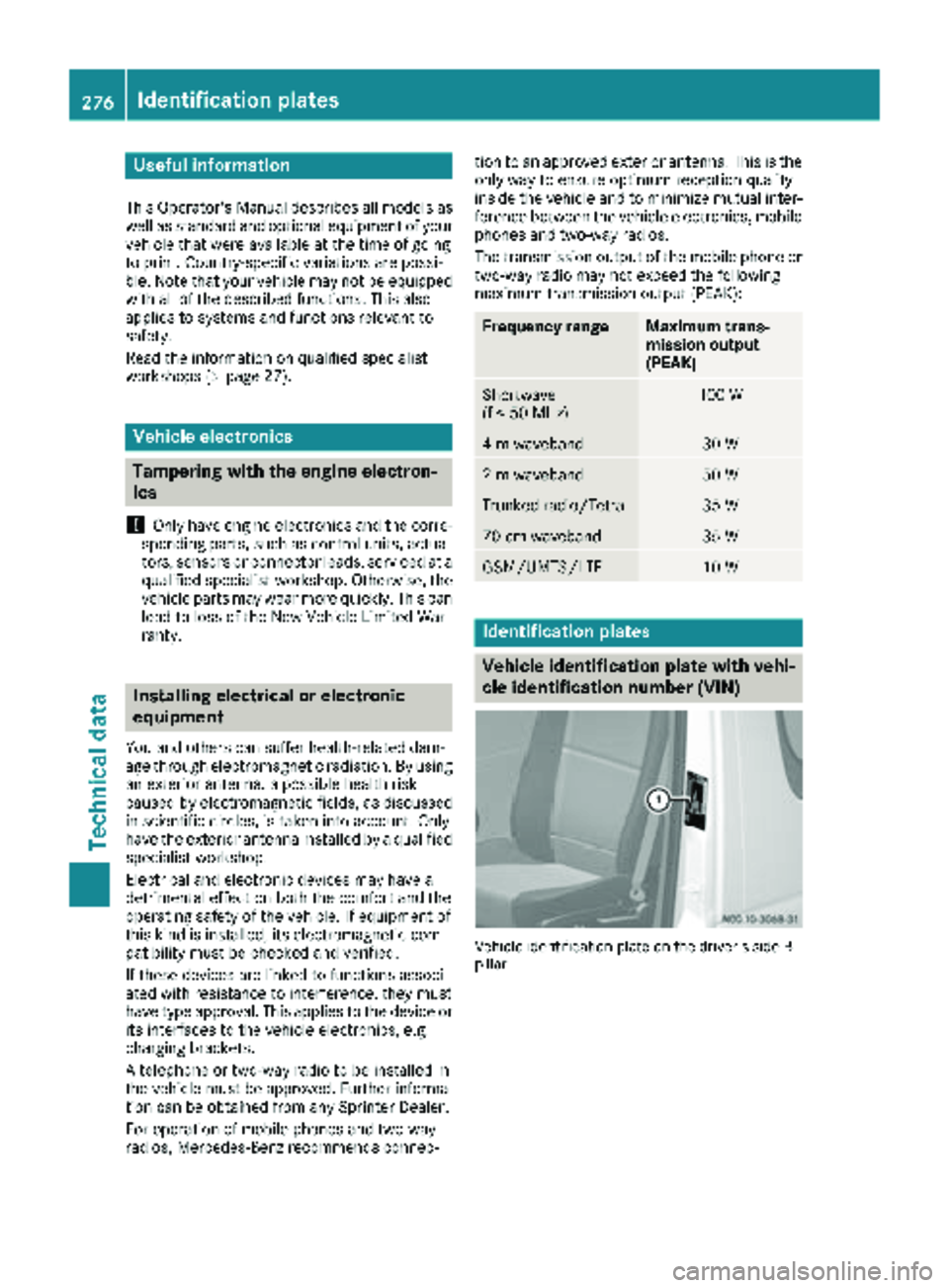
Vehicle identification plate on the driver's side B-
pillar
276Identification plates
Technical data
Page 283 of 294
wheel buttons to call up theTrip computer
menu (Ypage 173).
Diesel Exhaust Fluid (DEF)
General notes
When opening the DEF tank filler cap at high
outside temperatures, ammonia vapors may
escape.
Ammonia vapors have a pungent smell and pri-
marily cause irritation of the:
Rskin
Rmucous membranes
Reyes
You may experience a burning sensation in your
eyes, nose and throat, as well as coughing and
watering of the eyes.
Do not inhale ammonia vapors. Avoid contact
with DEF.
Do not allow DEF to come into direct contact
with your skin; it is hazardous to your health.
Rinse any affected areas off with plenty of clean water. Consult a doctor if necessary.
If DEF heats up, e.g. in direct sunlight, in the DEF
supply reservoir for some time to over 122 ‡
(50 †) , ammonia vapor will develop.
To conform to emission regulations, you must
operate the vehicle with DEF and refill the supply
regularly. The engine management recognizes
attempts to operate the vehicle without DEF,
with thinned DEF or with another reducing
agent. After previous warning messages, the
engine management then prevents a further
engine start.
When the number of remaining engine starts is 0
the engine management prevents the vehicle
from being driven at a speed exceeding 5 mph
(8 km/h). The multifunction display shows the
Idle Mode
message.
DEF consumption
DEF consumption depends on operational and
driving conditions and it is not necessary to wait
until the next scheduled service to replenish the
fluid. Therefore, refill the DEF supply tank regu-
larly during vehicle operation or, at the latest,
after receiving the first warning message via the
on-board computer.
Low ambient temperatures
DEF freezes at a temperature of approximately
12‡(Ò11 †). The vehicle is equipped with a DEF
preheating system at the factory. Winter oper-
ation is therefore also guaranteed at tempera-
tures under 12 ‡ (Ò11 †).
iIf you add DEF at temperatures below 12 ‡
(Ò11 †) it is possible that the level is not
shown correctly due to the frozen DEF.
Drive for at least 20 minutes (heating phase in
the fuel tank activated) and then stop the
vehicle for at least 30 seconds. The level is
then shown correctly.
Additives
!Do not mix DEF with any additives and do
not dilute DEF with tap water. Otherwise, the
exhaust gas aftertreatment may be damaged.
Observe the MB Specifications for Service
Products, Sheet No. 352.0.
Damage that arises through the use of addi-
tives or tap water will invalidate the New Vehi-
cle Limited Warranty.
Storage
!Containers made of aluminum, copper, cop-
per alloys as well as unalloyed or galvanized
steel are not suitable for storing DEF. If stored
in these types of containers, DEF could cause
constituents of these metals to dissolve and
cause irreparable damage to the exhaust gas
aftertrea tment.
Da
mage caused by such impurities in the DEF
will invalidate the New Vehicle Limited War-
ranty.
Only store DEF in containers made of high-alloy
Cr‑ Ni steel or Mo ‑Cr‑Ni steel in accordance with
DIN EN 10 088 ‑1/2/3 or plastic containers
made of polypropylene or polyethylene.
Purity
!Impurities in DEF (e.g. caused by other ser-
vice products, cleaning agents, dust, etc.)
result in increased emissions, malfunctions,
catalytic converter damage or engine dam-
age.
The purity of DEF is essential to prevent mal-
functions in the exhaust gas aftertreatment.
If DEF is pumped out of the DEF tank, e.g. during
repair work, the same liquid must not be used to
refill the tank. Its purity is no longer guaranteed.
Service products and capacities281
Technical data
Z
Page 286 of 294
Depending on the driving style, the vehicle con-
sumes a maximum of 1.0 qt (1.0l)of engine oil
over a distance of 620 miles (1000 km).
Oil consumption may be higher if:
RThe vehicle is new.
RYou mainly operate the vehicle under arduous
operating conditions.
RYou frequently drive at high engine speeds.
Regular maintenance is one of the preconditions
for moderate rates of consumption.
You can only estimate the oil consumption after
you have driven a considerable distance.
Check the engine oil level on a regular basis, e.g.
weekly or each time you refuel (
Ypage 221).
Transmission and power steering oil
Automatic transmission
Service product: automatic transmission
fluid
Product name/numberMaintenance interval
Shell ATF 3403/M-115
MB Sheet No. 236.10—
Fuchs/Shell ATF 3353
MB Sheet No. 236.12
Further information can be obtained at any
qualified specialist workshop.
Rear axle
Service product: transmission oil
Product name/numberMaintenanceinterval
BP Energear Hypo DC
80W-90
MB Sheet No. 235.20—
Mobil Delvac Synthetic
Gear Oil 75W-90
MB Sheet No. 235.8
Further information can be obtained at any
qualified specialist workshop.
Steering
Service product: power steering fluid
Product name/numberMaintenanceinterval
Mobil ATF‑D,
Exxon Mobil Corporation
or equivalent
MB Sheet No. 236.3—
The steering is maintenance-free. Further infor-
mation can be obtained at any qualified special-
ist workshop.
Brake fluid
GWARNING
The brake fluid constantly absorbs moisture
from the air. This lowers the boiling point of
the brake fluid. If the boiling point of the brake
fluid is too low, vapor pockets may form in the
brake system when the brakes are applied
hard. This would impair braking efficiency.
There is a risk of an accident.
You should have the brake fluid renewed at
the specified intervals.
!Brake fluid corrodes paint, plastic and rub-
ber. If paint, plastic or rubber has come into
contact with brake fluid, rinse with water
immediately.
When handling, storing and disposing of brake
fluid, please observe the relevant regulations
and the important safety notes for service prod-
ucts.
Over a period of time, the brake fluid absorbs
moisture from the air. This reduces its boiling
point.
Have the brake fluid replaced at specified inter-
vals by a qualified specialist workshop.
iThere is usually a notice in the engine com-
partment to remind you when the next brake
fluid change is due.
Only use brake fluid approved by Mercedes-
Benz in accordance with MB-Freigabe or MB-
Approval 331.0.
284Service products and capacities
Technical data