oil type MERCEDES-BENZ SPRINTER 2018 MY18 Operator’s Manual
[x] Cancel search | Manufacturer: MERCEDES-BENZ, Model Year: 2018, Model line: SPRINTER, Model: MERCEDES-BENZ SPRINTER 2018Pages: 294, PDF Size: 4.36 MB
Page 16 of 294
Message memory (on-board com-
puter).................................................. 175
Mirrors
Exterior mirrors ................................ 80
Rear-view mirror .............................. 80
Mobile navigation devices ................212
Mobile phone
Important safety notes .................. 211
Pre-installation ............................... 211
Type approval/frequency .............. 276
Mobile phone
see Mobile phone
Mounting wheels
Lowering the vehicle ......................2 72
Mounting a new wheel ................... 271
Preparing the vehicle ..................... 268
Raising the vehicle ......................... 268
Removing a wheel .......................... 270
Removing and mounting the spare
wheel ............................................. 274
Securing the vehicle against roll-
ing away ........................................ 268
N
Navigation
Fittings for PND mobile navigation
devices .......................................... 212
Notes on breaking-in a new vehi-
cle ....................................................... 118
O
Occupant safety
Air bags ...........................................4 5
Belt warning ..................................... 45
Children in the vehicle .....................4 9
Important safety notes .................... 41
Introduction to the restraint sys-
tem .................................................. 41
Pets in the vehicle ........................... 54
Restraint system warning lamp ........ 41
Seat belt .......................................... 42
Odometer
Display (vehicles with steering
wheel buttons) ............................... 166
Display (vehicles without steering
wheel buttons) ............................... 162 Off-road driving
Checklist after driving off-road ...... 138
Checklist before driving off-road .... 138
Important safety notes .................. 137
Rules for driving off-road ............... 138
Oil
see Engine oil
Oil sensor
Display message ............................ 191
On-board computer (vehicles with
steering wheel buttons)
Audio menu ................................... 166
Checking the oil level ..................... 221
Display message ............................ 175
Illumination submenu .................... 170
Menu overview .............................. 165
Operating ....................................... 163
Operation menu ............................. 165
Settings menu ............................... 167
Standard display ............................ 166
Telephone menu ............................ 173
Trip computer menu ...................... 173
On-board computer (vehicles with-
out steering wheel buttons)
Checking the oil level ..................... 221
Display message ............................ 175
General notes ................................ 162
Setting the clock ............................ 163
Standard display ............................ 162
Operating Instructions
Before the first journey .................... 23
Limited Warranty ............................. 23
Operating safety
Limited Warranty ............................. 23
Operating safety and vehicle
approval
Attachments and bodies .................. 28
Changing the engine power out-
put ................................................... 27
C
orrect use ...................................... 25
Declaration of conformity ................ 27
Equipment and conversions ............. 28
Important safety notes .................... 26
Information about body/equip-
ment mounting directives ................ 28
Notes on operating the vehicle ........ 26
Qualified specialist workshop .......... 27
Registering your vehicle ................... 28
14Index
Page 23 of 294
Two-way radiosType approval/frequency .............. 276
TWR (Tongue Weight Rating) (defi-
nition) ................................................. 266
Type plate
Vehicle identification number
(VIN) .............................................. 276
U
UnlockingFrom inside the vehicle (central
unlocking button) ............................. 65
USB port ............................................. 212
V
Vehicle
Data acquisition ............................... 30
Display message ............................ 194
Electronics ..................................... 276
Equipment ....................................... 23
Individual settings (vehicles with
steering wheel buttons) ................. 167
Limited Warranty ............................. 23
Loading .......................................... 259
Locking (SmartKey) .......................... 61
Lowering ........................................ 272
Maintenance .................................... 24
Operating safety .............................. 26
Parking for a long period ................ 131
Pulling away ................................... 121
Raising ........................................... 268
Registration ..................................... 28
Reporting problems ......................... 28
Securing from rolling away ............ 129
Towing away .................................. 244
Transporting .................................. 247
Unlocking (SmartKey) ...................... 61
Vehicle battery
see Battery (vehicle)
Vehicle bodies ..................................... 28
Body/equipment mounting direc-
tives for trucks ................................. 28
Vehicle data ....................................... 286
Vehicle identification number .......... 276
Vehicle identification plate .............. 276
Vehicle tool kit .................................. 241 VIN
...................................................... 276
Voltage supply
Fuses ............................................. 247
W
WarningStickers ........................................... 25
Warning and indicator lamp
Power assistance for the steering .. 204
Warning and indicator lamps
Brakes ........................................... 197
Check Engine ................................. 201
Coolant .......................................... 200
Diesel Exhaust Fluid (DEF) ............. 198
Distance warning function ............. 195
Electrical step ................................ 204
ESP
®.............................................. 195
ESP®function ................................ 199
Lane Keeping Assist ...................... 195
Overview .......................................... 35
Seat belt ........................................ 203
Warning lamp .................................... 242
Warning triangle ................................ 242
Warning- and indicator lamps
ABS ................................................ 196
Air filter .......................................... 202
ASR ................................................ 195
BAS ................................................ 196
Battery charge ............................... 199
Brake wear .................................... 199
Bulbs .............................................. 203
Doors ............................................. 203
Engine oil level ............................... 200
Preglow .......................................... 202
Reserve fuel ................................... 201
Tire pressure monitor .................... 202
Water separator ............................. 203
Windshield washer fluid ................. 203
Warranty .............................................. 23
Washer fluid
Adding ........................................... 225
Capacities ...................................... 286
Display message ............................ 194
Indicator lamp ................................ 203
Notes ............................................. 286
Wiping with ...................................... 96
Index21
Page 135 of 294
Do not drink or take drugs and drive or allow
anyone to drive who has been drinking or tak-ing drugs.
Emission control
GWARNING
Combustion engines emit poisonous exhaust
gases such as carbon monoxide. Inhaling
these exhaust gases leads to poisoning. There
is a risk of fatal injury. Therefore never leave
the engine running in enclosed spaces with-
out sufficient ventilation.
Certain engine systems are designed to keep
the level of poisonous substances in exhaust
fumes within legal limits.
These systems only work optimally if they are
maintained exactly in accordance with the man-
ufacturer's specifications. Any work on the
engine should therefore be carried out by quali-
fied and authorized technicians at a Sprinter
dealer.
The engine settings must not be changed under any circumstances. In addition, all specific
maintenance work must be carried out at regu-
lar intervals and in accordance with the service
requirements of the dealer listed here on the
inside title page. Details can be found in the
Maintenance Booklet.
Short journey
!
If the vehicle is predominantly used for
short-distance driving or is stationary for long
periods, this could lead to a malfunction in the automatic cleaning function for the diesel par-
ticle filter. This can lead to blockage of the
diesel particle filter. This can also result in fuel
collecting in the engine oil and cause engine
failure.
Therefore, if you mainly drive short distances,
drive on a highway or an inter-urban road for
20 minute severy 300 miles (500 km). This facil-
itates the diesel particle filter's burn-off proc-
ess.
Speed limiter
GWARNING
Exceeding the stated tire load-bearing capa-
city and the approved maximum speed could
lead to tire damage or the tire bursting. There is a risk of accident.
Therefore, only use tire types and sizes
approved for your vehicle model. Observe the
tire load rating and speed rating required for
your vehicle.
As the driver, you must find out about the max-
imum speed of the vehicle permitted for the
tires (tire and tire pressure). In particular, also
observe the tire approval regulations for each
country.
You must not exceed the speed limit for the tires
listed in the tire pressure tables. You can find
information on tire pressures in the "Wheels and
tires" section (
Ypage 251).
You can permanently limit the speed of your
vehicle to 65 mph (105 km/h) or 75 mph
(120 km/h).
We recommend that you have the speed limit
programmed at an authorized Sprinter dealer.
Before overtaking, take into consideration that
the engine speed limiter prevents the speed
increasing beyond the programmed speed limit.
Driving abroad
Service
An extensive network of authorized Sprinter
Dealers is also at your disposal when you are
traveling abroad. Nevertheless, please bear in
mind that service facilities or replacement parts may not always be immediately available. You
can obtain a list of workshops at any authorized
Sprinter Dealer.
Fuel
In some countries, only fuels with a higher sulfur
content are available.
Unsuitable fuel can cause engine damage. Infor-
mation on fuel (
Ypage 278).
Driving tips133
Driving and parking
Z
Page 229 of 294
Do not run the engine for longer than neces-
sary when the vehicle is stationary.
Before having maintenance and repairs per-
formed, it is essential to read the materials rela-
ted to the maintenance and repairs:
Rthe applicable sections of the technical doc-
umentation, e.g. the Operator's Manual and
workshop information.
Rregulations such as industrial safety regula-
tions and accident prevention regulations.
While working under the vehicle, you must
secure the vehicle on jack stands with sufficient load capacity.
Never use the jack as a substitute. The vehicle's
jack is intended only to raise the vehicle for a
short time when changing a wheel. It is not
suited for performing maintenance work under
the vehicle.
Please also refer to the notes about qualified
specialist workshops (
Ypage 27).
The scope and regularity of the inspection and
maintenance work primarily depend on the
often diverse operating conditions. Specialist
knowledge beyond the scope of this Operator's
Manual is required when carrying out testing
and maintenance work. This work should only be
carried out by trained staff.
The vehicle Maintenance Booklet describes the scope and fre que
ncy of maintenance work and
contains additional notes on the New Vehicle
Limited Warranty and on service products.
Maintenance services must be carried out in
accordance with the provisions and recommen-
dations in the Maintenance Booklet. Not doing
so could void the warranty claim and lead to
refusal of goodwill gestures after the manufac-
turer has submitted a damage report.
iObserve the notes on genuine Sprinter parts
(Ypage 29).
Service interval display
General notes
A service that is due is displayed in the service
interval display about one month in advance. A
message is then displayed while the vehicle is in
motion or when the ignition is switched on.
iThe service interval display does not provide
information about the engine oil level. The service interval display should therefore not
be confused with the
5engine oil level
display.
The service due date is displayed in days or
miles (kilometers), depending on the total dis-
tance driven.
The symbols or letters on the service display
show the type of service that is due.
¯ orA
for a minor service
° orB
for a major service
Service due date display
Vehicles with steering wheel buttons: the
following messages may be displayed.
R¯ Service A due in ... days
R¯Service A due in ... mi(km)
R¯ Service A Carry out now
Vehicles without steering wheel buttons:
the following messages may be displayed.
R¯for service A
R°for Service B
Additionally, you will see the remaining distance
in miles ( mi
) or kilometers ( km) or the remaining
time in days ( d).
Service due date has been exceeded
Vehicles with steering wheel buttons: if you
have missed the service due date, one of the
following messages appears in the display and
warning tone also sounds.
R¯ Service A overdue by ... days
R¯Service A overdue by ... km(km)
Vehicles without steering wheel buttons: if
you have missed the service due date, the ¯
or ° symbol for the service flashes for ten
seconds after the ignition is switched on. A
minus sign also appears in front of the service
due date.
Calling up the service due date
XTurn the key to position 2in the ignition lock.
The display is activated.
Vehicles without steering wheel buttons
XPress the 4menu button on the instrument
cluster repeatedly until the ¯or°
symbol for the service appears in the display.
Maintenance227
Maintenance and care
Z
Page 241 of 294
XSwitch off the audio equipment and let the
display cool down.
XClean the display surface with a commercially
available microfiber cloth and cleaner for
TFT/LCD displays.
XDry the display surface using a dry microfiber
cloth.
Cleaning the plastic trim
GWARNING
Care products and cleaning agents containing solvents cause surfaces in the cockpit to
become porous. As a result, plastic parts may
come loose in the event of air bag deploy-
ment. There is a risk of injury.
Do not use any care products and cleaning
agents to clean the cockpit.
!Do not affix the following to plastic surfaces:
Rstickers
Rfilms
Rscented oil bottles or similar items
You can otherwise damage the plastic.
!Do not allow cosmetics, insect repellent or
sunscreen to come into contact with the plas-
tic trim. This maintains the high-quality look of
the surfaces.
XWipe the plastic trim and the cockpit with a
damp, lint-free cloth, e.g. a microfiber cloth.
XHeavy soiling: use a mild detergent or care
products and cleaning agents recommended
and approved by Mercedes-Benz.
Cleaning the steering wheel and selec-
tor lever
XThoroughly wipe with a damp cloth.
Cleaning the trim elements
!Do not use solvent-based cleaning agents
such as tar remover, wheel cleaners, polishes
or waxes. There is otherwise a risk of damag- ing the surface.
XWipe the trim elements with a damp, lint-free
cloth, e.g. a microfiber cloth.
XHeavy soiling: use care products and clean-
ing agents recommended and approved for
Sprinter vehicles.
Cleaning the seat covers
!Do not use microfiber cloths to clean artifi-
cial leather covers. If used often, a microfiber
cloth can damage the cover.
!Clean:
Rartificial leather covers with a cloth mois-
tened with a solution containing 1% deter-
gent, e.g. dish washing liquid.
Rcloth covers with a microfiber cloth mois-
tened with a solution containing 1% deter-
gent, e.g. dish washing liquid. Wipe entire
seat sections carefully to avoid leaving visi-
ble lines. Leave the seat to dry afterwards.
Cleaning results depend on the type of dirt
and how long it has been there.
Cleaning the seat belts
GWARNING
Seat belts can become severely weakened if
bleached or dyed. This could cause the seat
belts to tear or fail, for instance, in the event of an accident. This poses an increased risk of
injury or fatal injury.
Never bleach or dye the seat belts.
!Do not clean the seat belts using chemical
cleaning agents. Do not dry the seat belts by
heating at temperatures above 176 ‡(80 †)
or in direct sunlight.
Remove any stains or dirt immediately. This will
avoid residue or damage.
XUse clean, lukewarm water and soap solution.
Cleaning the headliner
XUse a soft brush or dry shampoo to remove
heavy soiling.
Care239
Maintenance and care
Z
Page 281 of 294
When handling, storing and disposing of fuels,
please observe the relevant regulations.
Tank contents
Depending on equipment, the total capacity of
the fuel tank may vary.
Total capacity
All-wheel-drive vehicles:
All modelsApprox-imately
24.6 US gal (93 l)
Cargo Van/Passenger Van:
All modelsApprox-imately
24.6 US gal (93 l)
Cab Chassis/chassis:
All modelsApprox-imately
26.4 US gal (100 l)
of which reserve fuel
Models with approximately
24.6 US gal (93 l) total capa-
cityApprox-imately
5.0 US gal (19 l)
Models with approximately
26.4 US gal (100 l)total capa-
cityApprox- imately
4.8 US gal (18 l)
Diesel
Fuel grade
GWARNING
If you mix diesel fuel with gasoline, the flash
point is lower than that of pure diesel fuel.
When the engine is running, exhaust system
components could overheat without being
noticed. There is a risk of fire.
Never refuel with gasoline. Never mix gasoline with diesel fuel.
!Filter the fuel before transferring it to the
vehicle if you are refueling the vehicle from
barrels or containers. This will prevent malfunctions in the fuel sys-
tem due to contaminated fuel.
!You will damage the diesel engine if you do
not refuel with ULSD or a diesel fuel with a
sulfur content of more than 15 ppm.
!Do not use the following:
Rmarine diesel
Rheating oil
Rvegetable oil
Rgasoline
Rparaffin
Rkerosene
Do not mix such fuels with diesel fuel and do
not use any special additives. This can other-
wise lead to engine damage. This does not
include flow improvers. For further informa-
tion, see "Flow improvers".
Usually you will find information about the fuel
grade on the filling pump. If there is no identifi-
cation on the filling pump, consult a gas station
attendant.
For mo
re information about refueling
(Ypage 126).
Diesel at very low outside temperatures
GWARNING
If you heat fuel system components, e.g. with
a hot-air gun or open flame, these compo-
nents could be damaged. This can cause fuel
to escape and ignite. Depending on the type
of damage, fuel may also not escape until the
engine is running. There is a risk of fire and
explosion.
Never heat fuel system components. Contact
a qualified specialist workshop to rectify the
malfunction.
Refill only with commercially available ULTRA-
LOW SULFUR DIESEL (ULSD, maximum sulfur
content 15 ppm), which fulfills the ASTM D975
standard.
The flow properties of diesel may be inadequate
at low outside temperatures due to paraffin sep-
aration.
iMalfunctions resulting from paraffin sepa-
ration can only be rectified by heating the
entire fuel system. Park the vehicle in a
heated garage, for example.
Service products and capacities279
Technical data
Z
Page 282 of 294
To prevent operating problems, diesel with bet-
ter flow qualities is available during the winter
months. You can obtain information at the gas
station or from your fuel supplier.
Your vehicle is equipped with a fuel preheating
system. This improves the flow properties of the
diesel by approximately 14.5 ‡ (8 †). ULTRA-
LOW SULFUR DIESEL can be used without risk
of malfunction down to an outside temperature
of approximately 14 ‡ (Ò10 †).
Fuel additives
!Do not add gasoline or kerosene to diesel
fuel to improve its flow characteristics. Gas-
oline or kerosene impairs the lubricating
properties of the diesel fuel. This can result in
damage to the fuel injection system, for
example.
B20 fuels with bio-diesel content
!Continuous use of fuels with bio-diesel con-
tent over 5% (B20 fuels) can lead to fuel filter
clogging. Deposits may also form on the fuel
injector. This may reduce the engine output.
Unburned fuel can get into the oil pan. This
causes the engine oil level to rise. This can
cause engine mechanical damage.
To avoid damages and performance degrada-
tion, observe the following points:
RFill up with fuels with bio-diesel content of
5% (ULSD) or less, whenever possible.
RRegularly monitor your engine oil level if
you use B20 fuels on a regular basis.
RStrictly follow the oil change intervals quo-
ted in the instrument cluster and within
your maintenance booklet.
RUse only engine oils and filters approved for
use in your vehicle.
RIf you do not plan to drive your vehicle for
several weeks, completely fill the fuel tank
in advance with ULSD fuel.
For more information, consult the gas station
staff. The identification of fuels with bio-diesel
content (ULSD or B20) must be clear. If the
marking does not make this clear, do not refuel
from that pump.
Do not refuel with any fuels that have not been
approved for your vehicle.
For more information about refueling
(
Ypage 127).
Information on fuel consumption
HEnvironmental note
CO
2(carbon dioxide) is the gas which scien-
tists believe to be principally responsible for
global warming (the greenhouse effect). Your
vehicle's CO
2emissions are directly related to
fuel consumption and therefore depend on:
Refficient use of the fuel by the engine
Rdriving style
Rother non-technical factors, such as envi-
ronmental influences, road conditions or
traffic flow
You can minimize your vehicle's CO
2emis-
sions by driving carefully and having it serv-
iced regularly.
Fuel consumption depends on:
Rthe vehicle version
Rthe style of driving
Rthe operating conditions
Rthe type or quality of the fuel used
The vehicle will use more fuel than usual in the
following situations:
Rat very low outside temperatures
Rin city traffic
Rduring short journeys
Ron mountainous terrain
Rwhen towing a trailer
To keep fuel consumption low, observe the
advice in the "Protection of the environment"
section (
Ypage 25).
The following components of the different vehi-
cle versions influence fuel consumption:
Rtire sizes, tire tread, tire pressure, tire condi-
tion
Rbody
Rtransmission ratios for the drive assemblies
Radditional equipment (e.g. air-conditioning
system, auxiliary heating system)
For these reasons, the actual consumption fig-
ures for your vehicle may deviate from the con-
sumption figures determined according to EU
Directive 80/1268/EE C.
Data concerning fuel consumption are recorded in the on-board computer; use the steering
280Service products and capacities
Technical data
Page 284 of 294
Disposal
HEnvironmental not e
Dispose of DE Fin an environmentally respon -
sibl emanner.
Observ ecountry-specific laws and regulation s
when disposing of DEF.
DEF suppl yreservoir content
Tank content s
Diesel Exhaust Flui d(DEF)11
Approximately 4. 7US gal (18.0 l)
Engin eoil
General notes
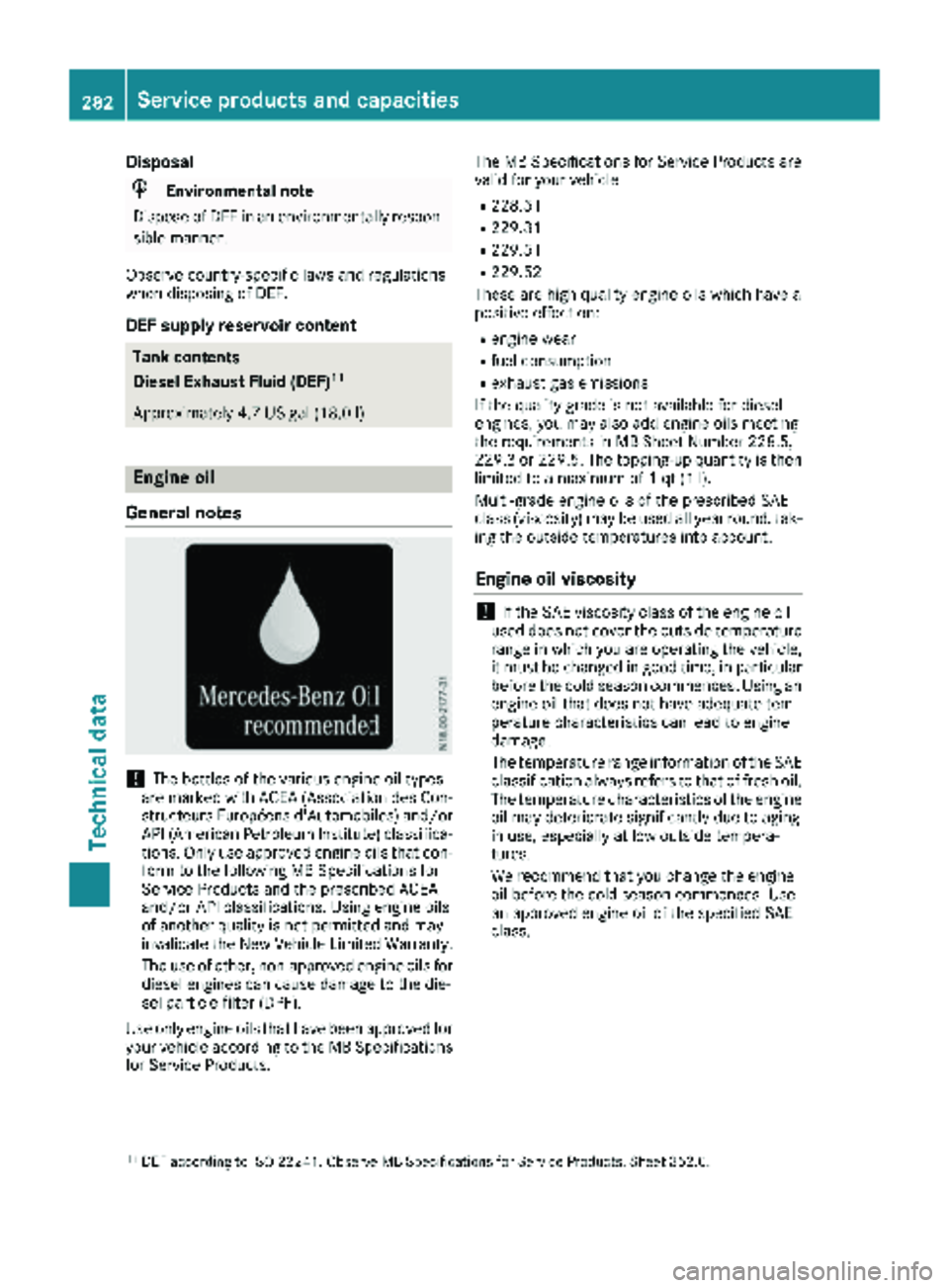
!The bottles of th evarious engin eoil types
are marke dwit hACE A(Association des Con -
structeurs Européen sd'Automobiles )and/o r
AP I(America nPetroleum Institute )classifica-
tions. Only use approve dengin eoils that con-
form to th efollowing MB Specification sfo r
Service Products and th eprescribed ACE A
and/o rAP Iclassifications. Using engin eoils
of another qualit yis no tpermitte dand may
invalidat eth eNew Vehicl eLimited Warranty.
The use of other ,non-approve dengin eoils fo r
diesel engines can caus edamage to th edie-
sel particl efilte r(DPF).
Use only engin eoils that hav ebeen approve dfo r
your vehicl eaccordin gto th eMB Specification s
fo rService Products . The MB Specification
sfo rService Products are
vali dfo ryour vehicl e
R228.51
R229.31
R229.51
R229.52
These are hig hqualit yengin eoils whic hhav e a
positive effec ton :
Rengin ewear
Rfue lconsumption
Rexhaus tgas emission s
If th equalit ygrade is no tavailable fo rdiesel
engines, you may also add engin eoils meeting
th erequirements in MB Sheet Number 228.5,
229. 3or 229.5. The topping-up quantity is then
limite dto
ama
ximum of 1qt (1 l).
Multi-gr ade engine oils of the prescribed SAE
class (viscosity) may be used all year round, tak-
ing the outside temperatures into account.
Engine oil viscosity
!If the SAE viscosity class of the engine oil
used does not cover the outside temperature
range in which you are operating the vehicle,
it must be changed in good time, in particular
before the cold season commences. Using an
engine oil that does not have adequate tem-
perature characteristics can lead to engine
damage.
The temperature range information of the SAE
classification always refers to that of fresh oil.
The temperature characteristics of the engine
oil may deteriorate significantly due to aging
in use, especially at low outside tempera-
tures.
We recommend that you change the engine
oil before the cold season commences. Use
an approved engine oil of the specified SAE
class.
11DE Faccording to IS O2224 1.Observe MB Specifications for Service Products, Sheet 352.0.
282Service products and capacities
Technical data
Page 285 of 294
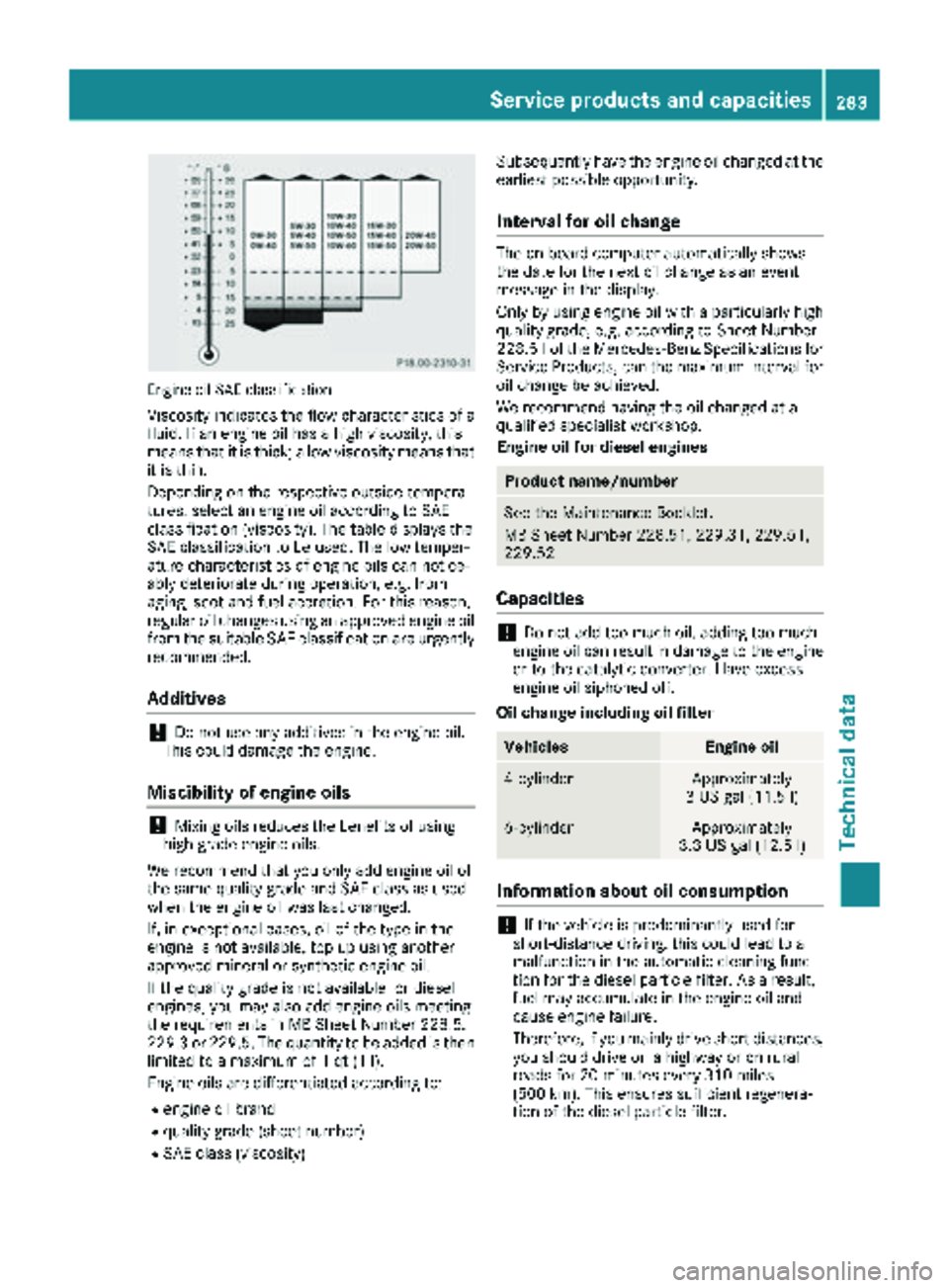
Engine oil SAE classification
Viscosity indicates the flow characteristics of a
fluid. If an engine oil has a high viscosity, this
means that it is thick; a low viscosity means thatit is thin.
Depending on the respective outside tempera-
tures, select an engine oil according to SAE
classification (viscosity). The table displays the
SAE classification to be used. The low temper-
ature characteristics of engine oils can notice-
ably deteriorate during operation, e.g. from
aging, soot and fuel accretion. For this reason,
regular oil changes using an approved engine oil
from the suitable SAE classification are urgently
recommended.
Additives
!Do not use any additives in the engine oil.
This could damage the engine.
Miscibility of engine oils
!Mixing oils reduces the benefits of using
high grade engine oils.
We recommend that you only add engine oil of
the same quality grade and SAE class as used
when the engine oil was last changed.
If, in exceptional cases, oil of the type in the
engine is not available, top up using another
approved mineral or synthetic engine oil.
If the quality grade is not available for diesel
engines, you may also add engine oils meeting
the requirements in MB Sheet Number 228.5,
229.3 or 229.5. The quantity to be added is then
limited to a maximum of 1 qt (1 l).
Engine oils are differentiated according to:
Rengine oil brand
Rquality grade (sheet number)
RSAE class (viscosity) Subsequently have the engine oil changed at the
earliest possible opportunity.
Interval for oil change
The on-board computer automatically shows
the date for the next oil change as an event
message in the display.
Only by using engine oil with a particularly high
quality grade, e.g. according to Sheet Number
228.51 of the Mercedes-Benz Specifications for
Service Products, can the maximum interval for
oil change be achieved.
We recommend having the oil changed at a
qualified specialist workshop.
Engine oil for diesel engines
Product name/number
See the Maintenance Booklet.
MB Sheet Number 228.51, 229.31, 229.51,
229.52
Capacities
!Do not add too much oil. adding too much
engine oil can result in damage to the engine
or to the catalytic converter. Have excess
engine oil siphoned off.
Oil change including oil filter
VehiclesEngine oil
4-cylinderApproximately
3 US gal (11.5 l)
6-cylinderApproximately
3.3 US gal (12.5 l)
Information about oil consumption
!If the vehicle is predominantly used for
short-distance driving, this could lead to a
malfunction in the automatic cleaning func-
tion for the diesel particle filter. As a result,
fuel may accumulate in the engine oil and
cause engine failure.
Therefore, if you mainly drive short distances,
you should drive on a highway or on rural
roads for 20 minutes every 310 miles
(500 km). This ensures sufficient regenera-
tion of the diesel particle filter.
Service products and capacities283
Technical data
Z
Page 288 of 294
Refrigerant
The air-conditioning system uses the refrigerant
R‑134a. This refrigerant does not damage the
ozone layer.
Product name/numberMaintenance interval
Refrigerant R ‑134a
MB Sheet No. 361.0—
More information can be obtained at any quali-
fied specialist workshop.
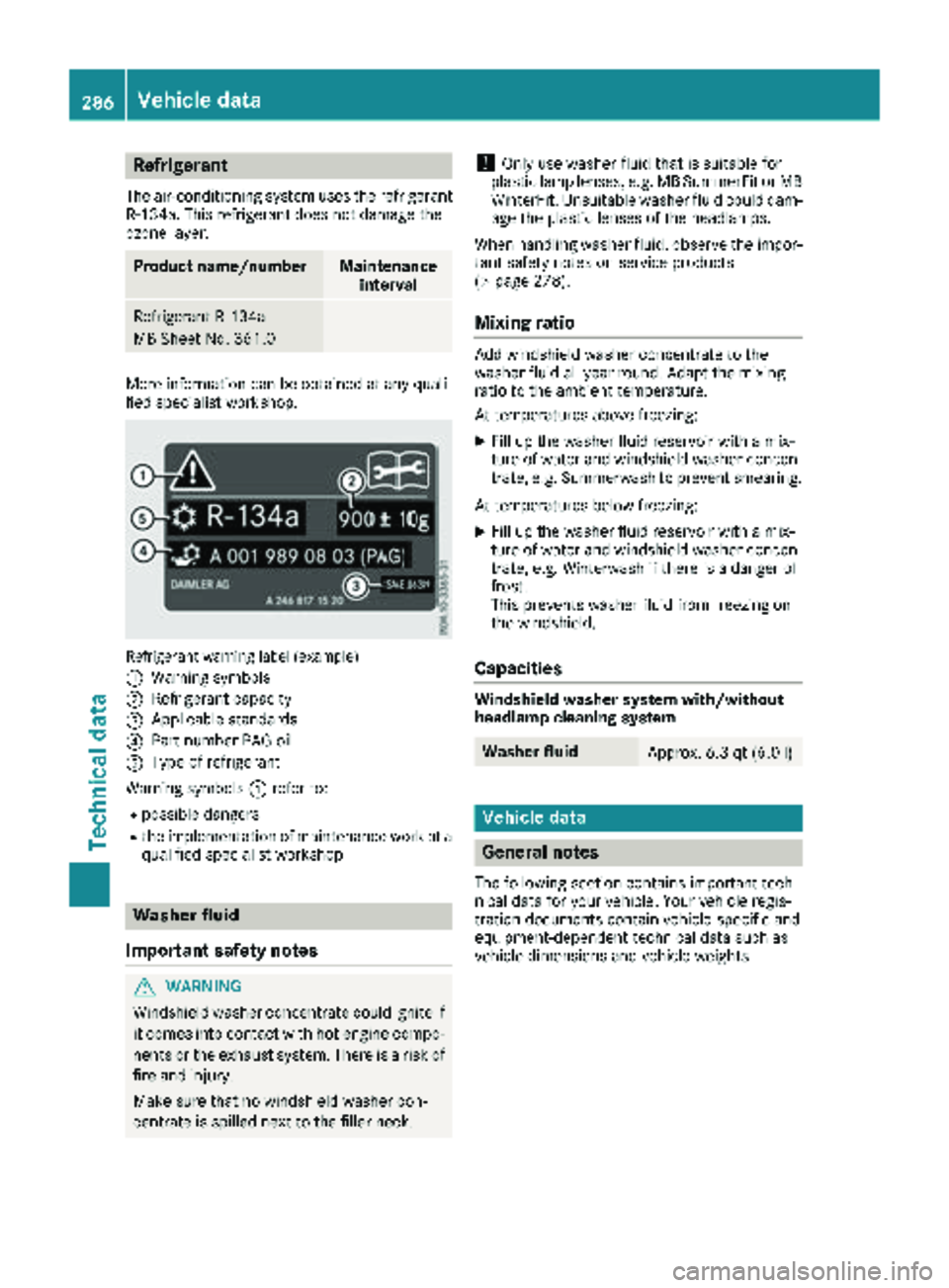
Refrigerant warning label (example)
:
Warning symbols
;Refrigerant capacity
=Applicable standards
?Part number PAG oil
AType of refrigerant
Warning symbols :refer to:
Rpossible dangers
Rthe implementation of maintenance work at a
qualified specialist workshop
Washer fluid
Important safety notes
GWARNING
Windshield washer concentrate could ignite if it comes into contact with hot engine compo-
nents or the exhaust system. There is a risk of
fire and injury.
Make sure that no windshield washer con-
centrate is spilled next to the filler neck.
!Only use washer fluid that is suitable for
plastic lamp lenses, e.g. MB SummerFit or MB WinterFit. Unsuitable washer fluid could dam-
age the plastic lenses of the headlamps.
When handling washer fluid, observe the impor-
tant safety notes on service products
(
Ypage 278).
Mixing ratio
Add windshield washer concentrate to the
washer fluid all year round. Adapt the mixing
ratio to the ambient temperature.
At temperatures above freezing:
XFill up the washer fluid reservoir with a mix-
ture of water and windshield washer concen-
trate, e.g. Summerwash to prevent smearing.
At temperatures below freezing:
XFill up the washer fluid reservoir with a mix-
ture of water and windshield washer concen-
trate, e.g. Winterwash if there is a danger of
frost.
This prevents washer fluid from freezing on
the windshield.
Capacities
Windshield washer system with/without
headlamp cleaning system
Washer fluidApprox. 6.3 qt (6.0 l)
Vehicle data
General notes
The following section contains important tech-
nical data for your vehicle. Your vehicle regis-
tration documents contain vehicle-specific and
equipment-dependent technical data such as
vehicle dimensions and vehicle weights.
286Vehicle data
Technical data