child lock MERCEDES-BENZ SPRINTER 2018 MY18 Operator’s Manual
[x] Cancel search | Manufacturer: MERCEDES-BENZ, Model Year: 2018, Model line: SPRINTER, Model: MERCEDES-BENZ SPRINTER 2018Pages: 294, PDF Size: 4.36 MB
Page 4 of 294
Index....................................................... 4
Introduction......................................... 23
Operating Instructions .......................... .23
Service and vehicle operation ................ 23
Proper use ............................................. 25
Protection of the environment ............... 25
Operating safety and vehicle approval
............................................................... 26
Genuine Mercedes-Benz parts ............... 29
QR code for rescue card ........................ 30
Data stored in the vehicle ...................... 30
At a glance ........................................... 33
Cockpit .................................................. 33
Instrument cluster ................................. 34
Steering wheel buttons .......................... 37
Center console ...................................... 37
Overhead control panel ......................... 38
Door control panel ................................. 39
Further control panels ........................... 39
Safety ................................................... 41
Useful information ................................. 41
Occupant safety .................................... 41
Children in the vehicle ........................... 49
Pets in the vehicle ................................. 54
Driving safety systems ........................... 54
Emergency exit ...................................... 57
Theft deterrent locking system .............. 58
Opening and closing ...........................61
Useful information ................................. 61
Key ........................................................ 61
Central locking ...................................... 65
Driver's door and front-passenger
door ....................................................... 66
Sliding door ........................................... 67
Electrical step ........................................ 68
Rear doors ............................................. 69
Partition sliding door ............................. 71
Side windows ......................................... 72
Seats, steering wheel and mirrors ....74
Useful information ................................. 74
Seats ..................................................... 74
Steering wheel ....................................... 79
Mirrors ................................................... 80
Lights and windshield wipers ............82
Useful information ................................. 82
Exterior lighting ..................................... 82
Interior lighting ...................................... 87
Changing bulbs ...................................... 89
Windshield wipers .................................. 96
Climate control .................................... 99
Useful information ................................. 99
Overview of climate control systems ..... 99
Operating the climate control system .. 102
Adjusting the air vents ......................... 106
Operating the auxiliary heating sys-
tem ...................................................... 107
Operating the cargo compartment air
vents .................................................... 117
Driving and parking ..........................118
Useful information ............................... 118
Breaking-in notes ................................. 118
Driving ................................................. 118
Automatic transmission ....................... 123
Refueling ............................................. 126
Parking ................................................ 129
Driving tips .......................................... 132
Driving systems ................................... 139
Working mode ..................................... 153
Towing a trailer .................................... 154
On-board computer and displays ....160
Useful information ............................... 160
Important safety notes ........................ 160
Instrument cluster ............................... 160
On-board computer (vehicles without
steering wheel buttons) ....................... 162
On-board computer (vehicles with
steering wheel buttons) ....................... 163
Display messages ................................ 175
2Contents
Page 9 of 294
Change of address.............................. 24
Change of ownership .......................... 24
Changing bulbs
Additional indicators (roof) .............. 94
Additional turn signals .................... .91
Backup lamp (Chassis Cab) ............. 93
Backup lamps .................................. 92
Bi-Xenon bulbs ................................. 89
Brake lamps ..................................... 92
Brake lamps (Chassis Cab) .............. 93
Cornering lamps .............................. 90
Courtesy lights ................................. 94
Daytime running lamps (halogen
headlamps) ...................................... 90
Display message ............................ 185
Front interior light ............................ 95
High-beam headlamps ..................... 90
Interior light ..................................... 95
Interior lighting ................................ 95
License plate lamp ........................... 93
License plate lamp (Chassis Cab) .... 93
Low-beam headlamps ...................... 90
Overview of lamp types (front
bulbs) ............................................... 89
Overview of lamp types (rear
bulbs, Chassis Cab) ......................... 93
Overview of lamp types (rear
bulbs) ............................................... 92
Parking lamps .................................. 91
Perimeter lamp .......................... 93, 94
Perimeter/side marker lamp ........... 91
Rear fog lamp .................................. 92
Rear fog lamp (Chassis Cab) ............ 93
Rear interior light ............................. 95
Standing lamps (rear, Chassis
Cab) ................................................. 93
Standing lamps (rear) ...................... 92
Tail lamps ........................................ 92
Tail lamps (Chassis Cab) .................. 93
Turn signals (front) ........................... 91
Turn signals (rear, Chassis Cab) ....... 93
Turn signals (re ar) ............................ 92
W
arning and indicator lamps ......... 203
Changing bulbs
see Replacing bulbs
Checklist
Before driving off-road ................... 138 Child
Restraint system .............................. 50
Child seat
Forward-facing restraint system ...... 53
LATCH-type (ISOFIX) child seat
anchors ............................................ 51
On the front-passenger seat ............ 52
Rearward-facing restraint system .... 52
Top Tether ....................................... 52
Child-proof locks
Important safety notes .................... 53
Rear door ......................................... 54
Children
Special seat belt retractor ............... 49
Children in the vehicle
Important safety notes .................... 49
Chock ................................................. 131
Cigarette lighter ................................ 210
Cleaning
Mirror turn signal ........................... 237
Trailer tow hitch ............................. 238
Cleaning
see Care
Climate control
Air conditioning in the rear com-
partment ........................................ 102
Air-conditioning system ................. 100
Auxiliary heating ............................ 107
Checking/cleaning the air filter
(rear-compartment air condition-
ing) ................................................ 226
Cooling with air dehumidification .. 103
Defrosting the windows ................. 104
Heating ............................................ 99
Heating in the rear compartment ... 101
Important safety notes .................... 99
Operating the cargo compartment
air vents ......................................... 117
Overview of systems ........................ 99
Problem with the rear window
defroster ........................................ 105
Problems with the windshield
heating .......................................... 105
Rear-compartment air condition-
ing ................................................. 102
Rear-compartment heating ............ 101
Reheat function (air dehumidifica-
tion) ............................................... 104
Index7
Page 14 of 294
High-beam headlampsReplacing bulbs ...............................9 0
Switching on/off .............................. 84
Highbeam Assist
Activating/deactivating (vehicles
with steering wheel buttons) ......... 170
Activating/deactivating (vehicles
without steering wheel buttons) .... 163
Display messages (vehicles with
steering wheel buttons) ................. 187
Display messages (vehicles with-
out steering wheel buttons) ........... 180
Function/notes ................................ 86
Hood
Closing ........................................... 220
Display message ............................ 194
Important safety notes .................. 219
Indicator lamp ................................ 203
Opening ......................................... 219
Hot-water auxiliary heater
Problem (malfunction) ................... 113
Hydroplaning ..................................... 136
I
Ignition lock
see Key positions
Immobilizer .......................................... 58
Indicator lamp
see Warning and indicator lamps
Indicators
see Turn signals
Insect protection on the radiator ...... 29
Installing a wheel
Installing the adapter (spare
wheel) ............................................ 270
Instrument cluster
Fuel gauge ..................................... 161
Important safety notes .................. 160
Instrument cluster lighting ............. 161
Outside temperature display .......... 161
Overview .......................................... 34
Speedometer ................................. 161
Tachometer ................................... 161
Warning and indicator lamps ........... 35
Instrument cluster lighting .............. 161
Interior lighting ................................... 87
Front ................................................ 87 Motion detectors ............................. 88
Notes on replacing bulbs ................. 95
Overview .......................................... 87
Replacing bulbs ............................... 95
Switching the load-compartment
lighting on/off ................................. 88
Switching the rear compartment
lighting on centrally ......................... 87
Interior motion sensor
Arming ............................................. 59
Deactivating ..................................... 60
Function ........................................... 59
Switching off .................................... 59
J
JackJacking points ................................ 268
Preparation .................................... 268
Storage location ............................ 241
Using ............................................. 268
Jump-starting ..................................... 243
K
Key
Position in the ignition lock ............ 119
Key positions ..................................... 119
Kickdown ........................................... 125
L
Lamps
see Warning and indicator lamps
Lane Keeping Assist
Activating/deactivating ................. 146
Display messages (vehicles with
steering wheel buttons) ................. 192
Display messages (vehicles with-
out steering wheel buttons) ........... 180
Function/notes ............................. 145
Indicator lamp ................................ 195
Language
Display (vehicles with steering
wheel buttons) ............................... 169
Lashing points and tie downs
Permissible tensile load ................. 287
LATCH-type (ISOFIX) child seat
anchors ................................................ 51
12Index
Page 16 of 294
Message memory (on-board com-
puter).................................................. 175
Mirrors
Exterior mirrors ................................ 80
Rear-view mirror .............................. 80
Mobile navigation devices ................212
Mobile phone
Important safety notes .................. 211
Pre-installation ............................... 211
Type approval/frequency .............. 276
Mobile phone
see Mobile phone
Mounting wheels
Lowering the vehicle ......................2 72
Mounting a new wheel ................... 271
Preparing the vehicle ..................... 268
Raising the vehicle ......................... 268
Removing a wheel .......................... 270
Removing and mounting the spare
wheel ............................................. 274
Securing the vehicle against roll-
ing away ........................................ 268
N
Navigation
Fittings for PND mobile navigation
devices .......................................... 212
Notes on breaking-in a new vehi-
cle ....................................................... 118
O
Occupant safety
Air bags ...........................................4 5
Belt warning ..................................... 45
Children in the vehicle .....................4 9
Important safety notes .................... 41
Introduction to the restraint sys-
tem .................................................. 41
Pets in the vehicle ........................... 54
Restraint system warning lamp ........ 41
Seat belt .......................................... 42
Odometer
Display (vehicles with steering
wheel buttons) ............................... 166
Display (vehicles without steering
wheel buttons) ............................... 162 Off-road driving
Checklist after driving off-road ...... 138
Checklist before driving off-road .... 138
Important safety notes .................. 137
Rules for driving off-road ............... 138
Oil
see Engine oil
Oil sensor
Display message ............................ 191
On-board computer (vehicles with
steering wheel buttons)
Audio menu ................................... 166
Checking the oil level ..................... 221
Display message ............................ 175
Illumination submenu .................... 170
Menu overview .............................. 165
Operating ....................................... 163
Operation menu ............................. 165
Settings menu ............................... 167
Standard display ............................ 166
Telephone menu ............................ 173
Trip computer menu ...................... 173
On-board computer (vehicles with-
out steering wheel buttons)
Checking the oil level ..................... 221
Display message ............................ 175
General notes ................................ 162
Setting the clock ............................ 163
Standard display ............................ 162
Operating Instructions
Before the first journey .................... 23
Limited Warranty ............................. 23
Operating safety
Limited Warranty ............................. 23
Operating safety and vehicle
approval
Attachments and bodies .................. 28
Changing the engine power out-
put ................................................... 27
C
orrect use ...................................... 25
Declaration of conformity ................ 27
Equipment and conversions ............. 28
Important safety notes .................... 26
Information about body/equip-
ment mounting directives ................ 28
Notes on operating the vehicle ........ 26
Qualified specialist workshop .......... 27
Registering your vehicle ................... 28
14Index
Page 18 of 294
Windshield wiper .............................. 96
Range (vehicles with steering
wheel buttons) ..................................1 73
Rear bench seat
Installing/removing (Passenger
Van) ................................................. 77
Stowage compartment (crewcab) .. 208
Rear compartment
Activating/deactivating climate
control ...........................................1 02
Setting the air vents ......................1 07
Rear door
Child-proof locks .............................. 54
Important safety notes .................... 69
Opening/closing from inside ........... 71
Opening/closing from the out-
side ..................................................7 0
Rear fog lamp
Replacing bulbs ............................... 92
Switching on/off .............................. 83
Rear fog lamp (Chassis Cab)
Replacing bulbs ............................... 93
Rear interior light
Replacing bulbs ............................... 95
Rear view camera
Cleaning instructions ..................... 237
Important safety notes .................. 153
Switching on .................................. 153
Rear window defroster
Problem (malfunction) ................... 105
Switching on/off ........................... 105
Rear window wiper
Switching on/off .............................. 97
Rear-compartment air-condition-
ing system
see Climate control
Rear-compartment heating
see Climate control
Rear-view mirror
Anti-glare mode ............................... 80
Refilling
DEF filler neck ............................... 128
Important safety notes (Diesel
Exhaust Fluid – DEF) ...................... 128
Refilling procedure (Diesel
Exhaust Fluid – DEF) ...................... 128
Refrigerant ......................................... 286 Refueling
Fuel filler flap ................................. 127
Important safety notes (fuel) ......... 126
Refueling procedure (fuel) ............. 127
see Fuel
Releasing the parking lock man-
ually (automatic transmission) ........ 126
Remote contro l
C
hanging the operating duration
(auxiliary heating) .......................... 111
Replacing the battery (auxiliary
heating ) ........................................ 112
Switching on/off (auxiliary heat-
ing) ................................................ 111
Synchronizing (auxiliary heating) ... 111
Replacing bulbs
Important safety notes .................... 89
Replacing the battery (auxiliary
heating remote control) .................... 112
Replacing the fuel filter .................... 203
Reporting safety defects .................... 28
Rescue card ......................................... 30
Reserve fuel
Display message ............................ 190
Restraint system
Display message ............................ 184
Introduction ..................................... 41
Warning lamp ................................. 199
Warning lamp (function) ................... 41
Reverse warning feature .................. 121
Roadside Assistance (breakdown) .... 24
Roof carrier
Maximum payload .......................... 287
Notes ............................................. 217
Roof load (roof carrier) ..................... 287
S
Safety
Children in the vehicle ..................... 49
Operating safety .............................. 26
see Occupant safety
Safety system
see Driving safety systems
Seat belts
Adjusting the height ......................... 44
Cleaning ......................................... 239
Correct usage .................................. 43
16Index
Page 44 of 294
A malfunction has occurred if the6restraint
system warning lamp:
Rdoes not light up after the ignition is switched
on
Rdoes not go out after a few seconds
Rgoes out but then lights up again while the
engine is running, for example
GWARNING
If the restraint system is malfunctioning,
restraint system components may be trig-
gered unintentionally or may not deploy as
intended during an accident. This can affect
for example the Emergency Tensioning
Device or the air bag. This poses an increased
risk of injury or even fatal injury.
Have the restraint system checked and
repaired in a qualified specialist workshop as
soon as possible.
Seat belts
Introduction
Seat belts are the most effective means of
restricting the movement of vehicle occupants
in the event of an accident or the vehicle rolling
over. This reduces the risk of vehicle occupants coming into contact with parts of the vehicle
interior or being ejected from the vehicle. Fur-
thermore, the seat belt helps to keep the vehicle
occupant in the best position in relation to the
air bag.
The seat belt system comprises:
RSeat belts
REmergency Tensioning Devices for the front
seat belts
The seat belt system also includes a seat belt force limiter for the relevant seat if the vehicle
is equipped with a front air bag.
On vehicles with a front-passenger bench
seat, only the seat belt of the outer front-
passenger seat has a seat belt force limiter.
The seat belt system does not include an Emer- gency Tensioning Device and a seat belt force
limiter if the vehicle does not have a driver's air
bag.
If the seat belt is pulled out of the belt outlet
quickly or with a jerky movement, the belt retractor locks. The belt strap cannot be extrac-
ted any further.
The Emergency Tensioning Device tightens the
seat belt in an accident, pulling the belt close
against the body. However it does not
pul
l the
vehicle occupant back in the direction of the
backrest.
The Emergency Tensioning Device does not cor-
rect an incorrect seat position or the routing of
an incorrectly fastened seat belt.
When triggered, a seat belt force limiter helps to
reduce the force exerted by the seat belt on the
vehicle occupant.
The seat belt force limiters are synchronized
with the front air bags which absorb part of the
deceleration force. This can reduce the force
exerted on the vehicle occupants during an acci-
dent.
The Emergency Tensioning Device of the front-
passenger seat is triggered independently of the
lock status of the seat belt.
Important safety notes
The use of seat belts and child restraint systems
is required by law in:
Rall 50 states
Rthe U.S. territories
Rthe District of Columbia
Rall Canadian provinces
Even where this is not required by law, all vehicle
occupants should correctly fasten their seat
belts before starting the journey.
GWARNING
If the seat belt is not worn correctly, it cannot
perform its intended protective function. An
incorrectly fastened seat belt can also cause
injuries, for example, in the event of an acci-
dent or when braking or changing direction
abruptly. This poses an increased risk of injury
or even fatal injury.
Always ensure that all vehicle occupants have
their seat belts fastened correctly and are sit-
ting properly.
42Occupant safety
Safety
Page 51 of 294
REmergency Tensioning Devices, if the systemdetermines that deployment can offer addi-
tional protection in this situation
RWindow curtain air bags on the driver's and
front-passenger side in certain situations
when the vehicle rolls over, if the system
determines that deployment can offer addi-
tional protection to that provided by the seat
belt
iNot all air bags are deployed in an accident.
The different air bag systems work independ- ently of each other.
How the air bag system works is determined
by the severity of the accident detected,
especially the vehicle deceleration or accel-
eration and the apparent type of accident:
RFrontal collision
RSide impact
RRollover
Children in the vehicle
Important safety notes
Accident statistics show that children secured
in the rear seats are safer than children secured
in the front-passenger seat. For this reason, we
strongly advise that you install a child restraint
system on a rear seat. Children are generally
better protected there.
If a child younger than twelve years old and
under 5 ft (1.50 m) in height istraveling in the
vehicle:
Ralways secure the child in a child restraint
system suitable for this vehicle. The child
restraint system must be appropriate to the
age, weight and size of the child
Rbe sure to observe the instructions and safety
notes in this section in addition to the child
restraint system manufacturer's installation
instructions
GWARNING
If you leave children unsupervised in the vehi-
cle, they could set it in motion by, for example:
Rrelease the parking brake.
Rshift the automatic transmission out of the
parking position P.
Rstart the engine.
In addition, they may operate vehicle equip-
ment and become trapped. There is a risk of
an accident and injury.
When leaving the vehicle, always take the
SmartKey with you and lock the vehicle. Never
leave children unsupervised in the vehicle.
GWARNING
If persons, particularly children are subjected to prolonged exposure to extreme heat or
cold, there is a risk of injury, possibly even
fatal. Never leave children unattended in the
vehicle.
GWARNING
If the child restraint system is subjected to
direct sunlight, parts may get very hot. Chil-
dren may burn themselves on these parts,
particularly on the metal parts of the child
restraint system. There is a risk of injury.
If you leave the vehicle, taking the child with
you, always ensure that the child restraint
system is not exposed to direct sunlight. Pro- tect it with a blanket, for example. If the child
restraint system has been exposed to direct
sunlight, let it cool down before securing the
child in it. Never leave children unattended in
the vehicle.
Always ensure that all vehicle occupants have
their seat belts fastened correctly and are sitting
properly. Particular attention must be paid to
children.
Observe the safety notes on the seat belt
(
Ypage 42) and the notes on correct use of seat
belts (Ypage 43).
A booster seat may be necessary to achieve
proper seat belt positioning for children over
41 lb s(18 kg) until they reach a height where a
three-point seat belt can be properly fastened
without a booster seat.
Special seatbelt retractor
GWARNING
If the seat belt is released while driving, the
child restraint system will no longer be
Children in the vehicle49
Safety
Z
Page 55 of 294
ufacturer's installation and operating instruc-
tions.
Forward-facing child restraint system
If it isabsolute lynecessary to install a forward-
facing ch ildrestraint system on the front-
passenger seat, always move the front-
passenger seat as far back as possible. The
entire base of the ch ildrestraint system must
always rest on the seat cushion of the front-
passenger seat. The backrest of the ch ild
restraint system must lieas flat as possible
against the backrest of the front-passenger
seat. The ch ildrestraint system must not be
subjected to a load bythe head restraint. Adjust
the head restraint position accordingly. Always
make sure that the shoulder beltstrap iscor-
rectly routed from the veh icle beltoutlet to the
shoulder beltguide on the ch ildrestraint sys-
tem. The shoulder beltstrap must berouted
forward and downfrom the veh icle beltoutlet.If
necessary, adjust the veh icle beltoutlet and the
front-passenger seat accordingly.
Alwa ys observe the ch ildrestraint system man-
ufacturer's installation and operating instruc-
tions.
Override features/Child-proof locks
Important safety notes
GWAR NING
If ch ildr en are traveling inthe veh icle, they
co uld:
Ropen doors, thus endangering other people
or road users
Rexit the veh icleand becaught byoncoming
traff ic
Roperate veh icle equipment and become
trapped
There isa risk of an acc ident and injury.
Alwa ys activate the ch ild-proof locks and
overr idefeature ifch ildr en are traveling inthe
veh icle. When leaving the veh icle, always take
the key with you and lock the veh icle. Never
leave ch ildren unattended inthe veh icle.
Child- proof locks for rear doors (
Ypage 54).
GWARNING
If you leave children unsupervised in the vehi-
cle, they could set it inmotion by, for example:
Rrelease the parking brake.
Rshift the automatic transmission out of the
parking position P.
Rstart the engine.
In addition, they may operate vehicle equip-
ment and become trapped. There is a risk of
an accident and injury.
When leaving the vehicle, always take the
Sm artKey with you and lock the vehicle. Never
leave ch ildren unsupervised in the vehicle.
GWARNING
If persons, particularly ch ildren are subjected
to prolonged exposure to extreme heat or
cold, there is a risk of injury, possibly even
fatal. Never leave children unattended in the
vehicle.
GWARNING
If the child restraint system issubjected to
direct sunlight, parts may get very hot. Chil-
dren may burn thems elves on these parts,
particular lyon the metal parts of the child
restraint system. There is a risk of injury.
If you leave the vehicle, taking the child with
you, always ensure that the child restraint
system isnot exposed to direct sunlight. Pro-
tect it wit h a blanket, for example. If the child
restraint system has been exposed to direct
sunlight, let it cool down before securing the
child in it. Never leave children unattended in
the vehicle.
Children in the vehicle53
Safety
Z
Page 56 of 294
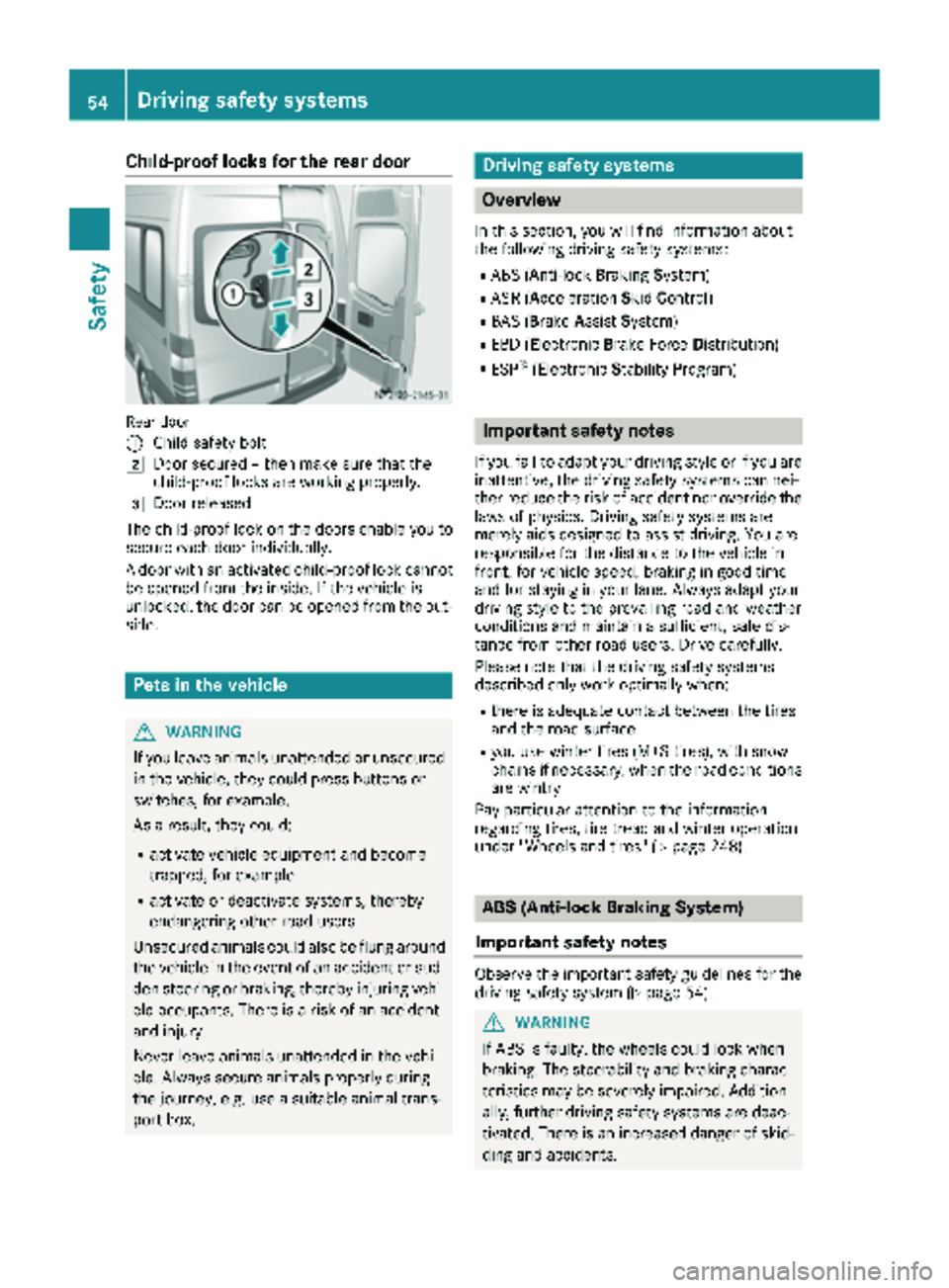
Child-proof locks for the rear door
Rear door
:
Child safety bolt
2Door secured – then make sure that the
child-proof locks are working properly.
3Door released
The child-proof lock on the doors enable you to
secure each door individually.
A door with an activated child-proof lock cannot
be opened from the inside. If the vehicle is
unlocked, the door can be opened from the out-
side.
Pets in the vehicle
GWARNING
If you leave animals unattended or unsecured
in the vehicle, they could press buttons or
switches, for example.
As a result, they could:
Ractivate vehicle equipment and become
trapped, for example
Ractivate or deactivate systems, thereby
endangering other road users
Unsecured animals could also be flung around
the vehicle in the event of an accident or sud-
den steering or braking, thereby injuring vehi-
cle occupants. There is a risk of an accident
and injury.
Never leave animals unattended in the vehi-
cle. Always secure animals properly during
the journey, e.g. use a suitable animal trans-
port box.
Driving safety systems
Overview
In this section, you will find information about
the following driving safety systems:
RABS (Anti-lock Braking System)
RASR (Acceleration SkidControl)
RBAS (B rakeAssist System)
REBD (Electronic Brake Force Distribution)
RESP®(Electronic StabilityProgram)
Important safety notes
If you fail to adapt your driving style or if you are
inattentive, the driving safety systems can nei-
ther reduce the risk of accident nor override the
laws of physics. Driving safety systems are
merely aids designed to assist driving. You are
responsible for the distance to the vehicle in
front, for vehicle speed, braking in good time
and for staying in your lane. Always adapt your
driving style to the prevailing road and weather
conditions and maintain a sufficient, safe dis-
tance from other road users. Drive carefully.
Please note that the driving safety systems
described only work optimally when:
Rthere is adequate contact between the tires
and the road surface
Ryou use winter tires (M+S tires), with snow
chains if necessary, when the road conditions
are wintry
Pay particular attention to the information
regarding tires, tire tread and winter operation
under "Wheels and tires" (
Ypage 248).
ABS (Anti-lock Braking System)
Important safety notes
Observe the important safety guidelines for the
driving safety system (Ypage 54).
GWARNING
If ABS is faulty, the wheels could lock when
braking. The steerability and braking charac-
teristics may be severely impaired. Addition-
ally, further driving safety systems are deac-
tivated. There is an increased danger of skid-
ding and accidents.
54Driving safety systems
Safety
Page 60 of 294
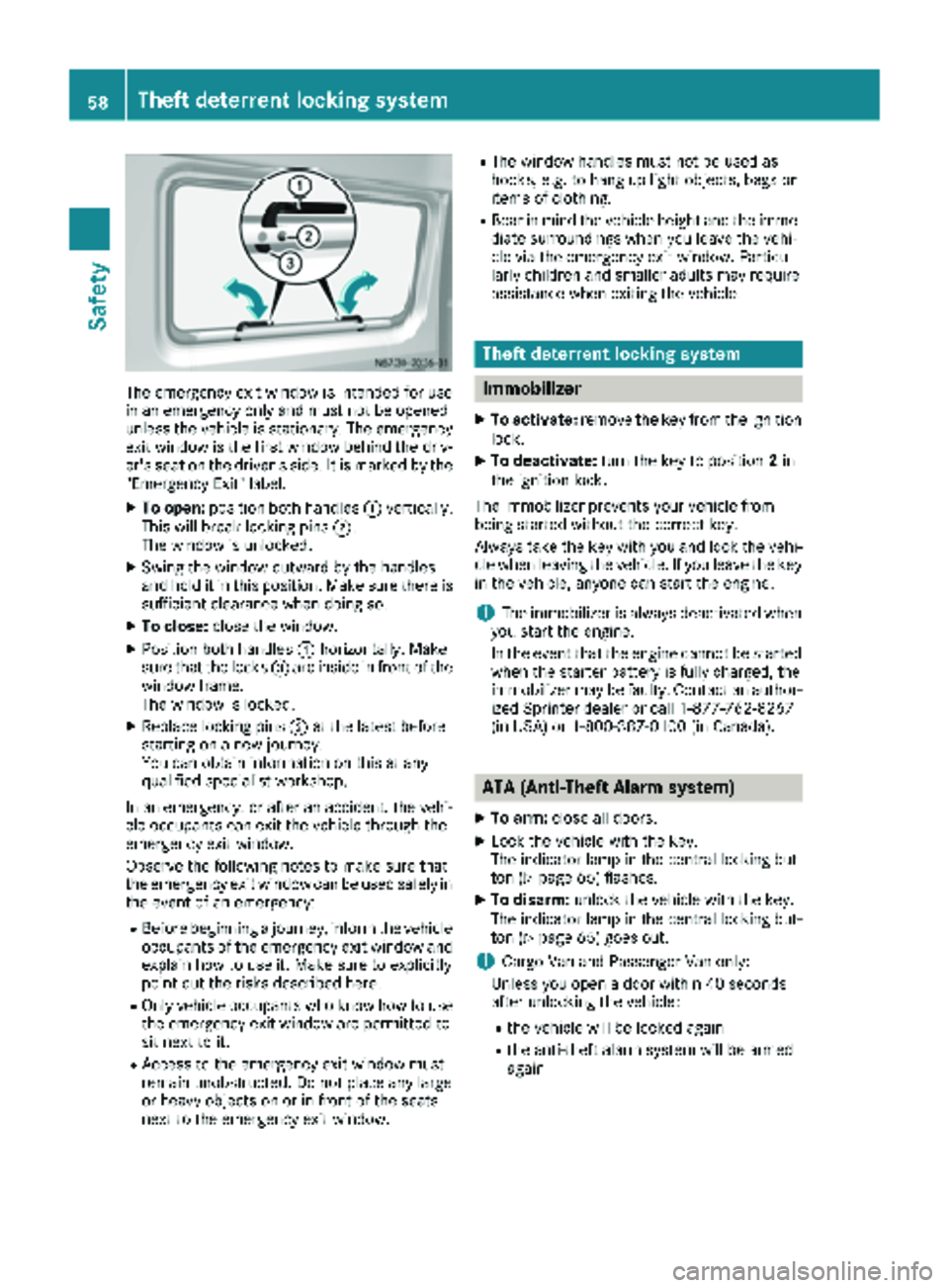
The emergency exit window is intended for use
in an emergency only and must not be opened
unless the vehicle is stationary. The emergency
exit window is the first window behind the driv-
er's seat on the driver's side. It is marked by the
"Emergency Exit" label.
XTo open:position both handles :vertically.
This will break locking pins ;.
The window is unlocked.
XSwing the window outward by the handles
and hold it in this position. Make sure there is
sufficient clearance when doing so.
XTo close: close the window.
XPosition both handles :horizontally. Make
sure that the locks =are inside in front of the
window frame.
The window is locked.
XReplace locking pins ;at the latest before
starting on a new journey.
You can obtain information on this at any
qualified specialist workshop.
In an emergency, or after an accident, the vehi-
cle occupants can exit the vehicle through the
emergency exit window.
Observe the following notes to make sure that
the emergency exit window can be used safely in
the event of an emergency:
RBefore beginning a journey, inform the vehicle
occupants of the emergency exit window and explain how to use it. Make sure to explicitly
point out the risks described here.
ROnly vehicle occupants who know how to use
the emergency exit window are permitted to
sit next to it.
RAccess to the emergency exit window must
remain unobstructed. Do not place any large
or heavy objects on or in front of the seats
next to the emergency exit window.
RThe window handles must not be used as
hooks, e.g. to hang up light objects, bags or
items of clothing.
RBear in mind the vehicle height and the imme-
diate surroundings when you leave the vehi-
cle via the emergency exit window. Particu-
larly children and smaller adults may require
assistance when exiting the vehicle.
Theft deterrent locking system
Immobilizer
XTo activate: remove the key from the ignition
lock.
XTo deactivate: turn the key to position 2in
the ignition lock.
The immobilizer prevents your vehicle from
being started without the correct key.
Always take the key with you and lock the vehi-
cle when leaving the vehicle. If you leave the key
in the vehicle, anyone can start the engine.
iThe immobilizer is always deactivated when
you start the engine.
In the event that the engine cannot be started
when the starter battery is fully charged, the
immobilizer may be faulty. Contact an author-
ized Sprinter dealer or call 1-877-762-8267
(in USA) or 1-800-387-0100 (in Canada).
ATA (Anti-Theft Alarm system)
XTo arm: close all doors.
XLock the vehicle with the key.
The indicator lamp in the central locking but-
ton (
Ypage 65) flashes.
XTo disarm: unlock the vehicle with the key.
The indicator lamp in the central locking but-
ton (
Ypage 65) goes out.
iCargo Van and Passenger Van only:
Unless you open a door within 40 seconds
after unlocking the vehicle:
Rthe vehicle will be locked again
Rthe anti-theft alarm system will be armed
again
58Theft deterrent locking system
Safety