interior lights MERCEDES-BENZ SPRINTER 2018 MY18 Operator’s Manual
[x] Cancel search | Manufacturer: MERCEDES-BENZ, Model Year: 2018, Model line: SPRINTER, Model: MERCEDES-BENZ SPRINTER 2018Pages: 294, PDF Size: 4.36 MB
Page 4 of 294
Index....................................................... 4
Introduction......................................... 23
Operating Instructions .......................... .23
Service and vehicle operation ................ 23
Proper use ............................................. 25
Protection of the environment ............... 25
Operating safety and vehicle approval
............................................................... 26
Genuine Mercedes-Benz parts ............... 29
QR code for rescue card ........................ 30
Data stored in the vehicle ...................... 30
At a glance ........................................... 33
Cockpit .................................................. 33
Instrument cluster ................................. 34
Steering wheel buttons .......................... 37
Center console ...................................... 37
Overhead control panel ......................... 38
Door control panel ................................. 39
Further control panels ........................... 39
Safety ................................................... 41
Useful information ................................. 41
Occupant safety .................................... 41
Children in the vehicle ........................... 49
Pets in the vehicle ................................. 54
Driving safety systems ........................... 54
Emergency exit ...................................... 57
Theft deterrent locking system .............. 58
Opening and closing ...........................61
Useful information ................................. 61
Key ........................................................ 61
Central locking ...................................... 65
Driver's door and front-passenger
door ....................................................... 66
Sliding door ........................................... 67
Electrical step ........................................ 68
Rear doors ............................................. 69
Partition sliding door ............................. 71
Side windows ......................................... 72
Seats, steering wheel and mirrors ....74
Useful information ................................. 74
Seats ..................................................... 74
Steering wheel ....................................... 79
Mirrors ................................................... 80
Lights and windshield wipers ............82
Useful information ................................. 82
Exterior lighting ..................................... 82
Interior lighting ...................................... 87
Changing bulbs ...................................... 89
Windshield wipers .................................. 96
Climate control .................................... 99
Useful information ................................. 99
Overview of climate control systems ..... 99
Operating the climate control system .. 102
Adjusting the air vents ......................... 106
Operating the auxiliary heating sys-
tem ...................................................... 107
Operating the cargo compartment air
vents .................................................... 117
Driving and parking ..........................118
Useful information ............................... 118
Breaking-in notes ................................. 118
Driving ................................................. 118
Automatic transmission ....................... 123
Refueling ............................................. 126
Parking ................................................ 129
Driving tips .......................................... 132
Driving systems ................................... 139
Working mode ..................................... 153
Towing a trailer .................................... 154
On-board computer and displays ....160
Useful information ............................... 160
Important safety notes ........................ 160
Instrument cluster ............................... 160
On-board computer (vehicles without
steering wheel buttons) ....................... 162
On-board computer (vehicles with
steering wheel buttons) ....................... 163
Display messages ................................ 175
2Contents
Page 8 of 294
Display message ............................ 183
Notes ............................................. 284
Warning lamp ................................. 197
Brake force distribution
Display message ............................ 183
see EBD (electronic brake force
distribution)
Brake lamps
Replacing bulbs ............................... 92
Brake lamps (Chassis Cab)
Replacing bulbs ............................... 93
Brake linings
Display message ............................ 182
Indicator lamp ................................ 199
Brake pads/linings
New ............................................... 135
Brake system
Warning lamp ................................. 196
Brakes
ABS .................................................. 54
Adaptive Brake Assist .................... 142
Applying the parking brake ............ 130
BAS .................................................. 56
Brake fluid (notes) ......................... 284
Checking brake fluid level .............. 224
Display message ............................ 183
EBD .................................................. 56
Important safety notes .................. 134
New brake pads/linings ................ 135
Parking brake (notes) ..................... 135
Riding tips ...................................... 134
Breakdown
Fire extinguisher ............................ 243
First-aid kit .................................... 242
Jump-starting ................................. 243
Reflective safety jacket .................. 242
Vehicle tool kit ............................... 241
Warning lamp ................................. 242
Warning triangle ............................ 242
see Towing away
Bulb failure indicator .......................... 82
C
California
Important notice for retail cus-
tomers and lessees .......................... 23 Car
see Vehicle
Care
Access step in the bumper ............ 238
Car wash ........................................ 234
Display ........................................... 238
Exterior lights ................................ 237
Interior ........................................... 238
Notes ............................................. 234
Paint .............................................. 236
Plastic trim .................................... 239
Power washer ................................ 235
Rear view camera .......................... 237
Roof lining ...................................... 239
Seat belt ........................................ 239
Seat cover ..................................... 239
Selector lever ................................ 239
Sensors ......................................... 237
Sliding door ................................... 238
Steering wheel ............................... 239
Step (electrical) ............................. 238
Trim pieces .................................... 239
Washing by hand ........................... 235
Washing the engine ....................... 235
Wheels ........................................... 236
Windows ........................................ 236
Wiper blades .................................. 236
Cargo compartment
Activating/deactivating ventila-
tion ................................................ 117
Cargo compartment floor ................... 29
Cargo tie-down points and tie
downs
Important safety notes .................. 215
Cargo tie-down rings
Installing ........................................ 217
Permissible tensile load ................. 287
Carrier system
Ladder rack ................................... 218
Center console overview .................... 37
Central locking
Automatic locking ............................ 66
Important safety notes .................... 65
Locking/unlocking (buttons) ........... 65
Locking/unlocking (SmartKey) ........ 61
Locking/unlocking manually ............ 65
Central locking system
see Central locking
6Index
Page 9 of 294
Change of address.............................. 24
Change of ownership .......................... 24
Changing bulbs
Additional indicators (roof) .............. 94
Additional turn signals .................... .91
Backup lamp (Chassis Cab) ............. 93
Backup lamps .................................. 92
Bi-Xenon bulbs ................................. 89
Brake lamps ..................................... 92
Brake lamps (Chassis Cab) .............. 93
Cornering lamps .............................. 90
Courtesy lights ................................. 94
Daytime running lamps (halogen
headlamps) ...................................... 90
Display message ............................ 185
Front interior light ............................ 95
High-beam headlamps ..................... 90
Interior light ..................................... 95
Interior lighting ................................ 95
License plate lamp ........................... 93
License plate lamp (Chassis Cab) .... 93
Low-beam headlamps ...................... 90
Overview of lamp types (front
bulbs) ............................................... 89
Overview of lamp types (rear
bulbs, Chassis Cab) ......................... 93
Overview of lamp types (rear
bulbs) ............................................... 92
Parking lamps .................................. 91
Perimeter lamp .......................... 93, 94
Perimeter/side marker lamp ........... 91
Rear fog lamp .................................. 92
Rear fog lamp (Chassis Cab) ............ 93
Rear interior light ............................. 95
Standing lamps (rear, Chassis
Cab) ................................................. 93
Standing lamps (rear) ...................... 92
Tail lamps ........................................ 92
Tail lamps (Chassis Cab) .................. 93
Turn signals (front) ........................... 91
Turn signals (rear, Chassis Cab) ....... 93
Turn signals (re ar) ............................ 92
W
arning and indicator lamps ......... 203
Changing bulbs
see Replacing bulbs
Checklist
Before driving off-road ................... 138 Child
Restraint system .............................. 50
Child seat
Forward-facing restraint system ...... 53
LATCH-type (ISOFIX) child seat
anchors ............................................ 51
On the front-passenger seat ............ 52
Rearward-facing restraint system .... 52
Top Tether ....................................... 52
Child-proof locks
Important safety notes .................... 53
Rear door ......................................... 54
Children
Special seat belt retractor ............... 49
Children in the vehicle
Important safety notes .................... 49
Chock ................................................. 131
Cigarette lighter ................................ 210
Cleaning
Mirror turn signal ........................... 237
Trailer tow hitch ............................. 238
Cleaning
see Care
Climate control
Air conditioning in the rear com-
partment ........................................ 102
Air-conditioning system ................. 100
Auxiliary heating ............................ 107
Checking/cleaning the air filter
(rear-compartment air condition-
ing) ................................................ 226
Cooling with air dehumidification .. 103
Defrosting the windows ................. 104
Heating ............................................ 99
Heating in the rear compartment ... 101
Important safety notes .................... 99
Operating the cargo compartment
air vents ......................................... 117
Overview of systems ........................ 99
Problem with the rear window
defroster ........................................ 105
Problems with the windshield
heating .......................................... 105
Rear-compartment air condition-
ing ................................................. 102
Rear-compartment heating ............ 101
Reheat function (air dehumidifica-
tion) ............................................... 104
Index7
Page 13 of 294
Notes about oil grades ................... 282
Oil change ...................................... 283
Oil level (note) ............................... 221
Viscosity ........................................ 282
Warning lamp .................................200
Engine speed setting (working
mode) ................................................. 153
ESP
®(Electronic Stability Pro-
gram)
Crosswind Assist .............................5 7
Display message ............................ 184
Important safety information ........... 56
Indicator lamp ................................ 199
Warning lamp ................................. 195
Exhaust check ................................... 133
Exhaust gas aftertreatment
DEF level indicator .........................1 61
DEF reducing agent ....................... 281
Diesel Exhaust Fluid (DEF) ............. 281
Indicator lamp ................................ 202
Refilling DEF .................................. 128
Exterior lighting
see Lights
Exterior mirrors
Adjusting ......................................... 80
Important safety notes .................... 80
Eyeglasses compartment ................. 206
F
Fire extinguisher............................... 243
First-aid kit ......................................... 242
Flat tire
Changing a wheel/mounting the
spare wheel ................................... 268
General notes ................................ 267
Fog lamps
Switching on/off .............................. 83
Fogged up-up windows
see Climate control
Folding seat ......................................... 76
Frequencies
Mobile phone ................................. 276
Two-way radio ................................ 276
Front interior light
Replacing bulbs ............................... 95
Fuel
Additives (diesel) ........................... 280 Consumption information .............. 280
Consumption statistics .................. 173
Diesel at very low outside temper-
atures ............................................ 279
Driving tips ....................................1 32
Fuel gauge ..................................... 161
Problem (malfunction) ................... 128
Quality (diesel) ............................... 279
Refueling ........................................ 126
Showing the range (vehicles with
steering wheel buttons) ................. 173
Tank content/reserve fuel ............. 279
Fuel filter with water separator
draining ......................................... 225
Indicator lamp ................................ 203
Fuel gauge ......................................... 161
Fuel tank
Problem (malfunction) ................... 128
Fuel tank
see Fuel tank
Fuses .................................................. 247
G
Gasoline
Reserve fuel warning lamp ............. 201
General driving tips
Driving short distances .................. 133
Genuine parts ...................................... 29
Glove box ........................................... 205
GTW (Gross Trailer Weight) (defini-
tion) .................................................... 265
H
Handbrake
see Parking brake
Hazard warning lamps ........................ 85
Head restraints
Adjusting ......................................... 78
Headlamps
Adding fluid to cleaning system ..... 225
Cleaning system (function) .............. 85
Fogging up ....................................... 86
see Automatic headlamp mode
Headliner (cleaning instructions) .... 239
Heating
see Climate control
Index11
Page 15 of 294
License plate lampReplacing bulbs .............................. .93
License plate lamp (Chassis Cab)
Replacing bulbs .............................. .93
Light sensor ........................................ .83
Lighting
see Lights
Lights
Activating/deactivating daytime
running lamps (vehicles with
steering wheel buttons) ................ .170
Activating/deactivating daytime
running lamps (vehicles without
steering wheel buttons) ................. 163
Activating/deactivating High-
beam Assist (vehicles with steer-
ing wheel buttons) ......................... 170
Activating/deactivating High-
beam Assist (vehicles without
steering wheel buttons) ................. 163
Activating/deactivating surround
lighting (vehicles with steering
wheel buttons) ............................... 171
Automatic headlamp mode .............. 83
Bulb failure indicator ........................ 82
Cornering light function ................... 85
Driving abroad ............................... 134
Fog lamps ........................................ 83
Hazard warning lamps ..................... 85
Headlamp range .............................. 84
High beam flasher ............................ 84
High-beam headlamps ..................... 84
Highbeam Assist .............................. 86
Important safety notes .................... 82
Light switch ..................................... 82
Low-beam headlamps ......................8 2
Parking lamps ..................................8 2
Rear fog lamp .................................. 83
Settin gth eexterio rlighting
delaye dswitch-off (vehicles wit h
steerin gwhee lbuttons )................
.171
Sw
itching the daytime running
lamps on/off (switch) ......................8 2
Turn signals .....................................8 4
see Changing a bulb
see Interior lighting
Limited Warranty ................................ 23
Load distribution ...............................2 15Load securing aids
Carrier systems .............................2 17
Loading guidelines
Important safety notes .................. 213
Loading rails
Installing cargo tie-down rings ....... 217
Maximum tensile strength ............. 287
Loads
Securing ........................................ 215
Transporting .................................. 213
Locator lighting
Setting (vehicles with steering
wheel buttons) ............................... 171
Locking
see Central locking
Locking and unlocking manually ....... 65
Locking centrally
see Central locking
LOW RANGE ....................................... 147
LOW RANGE transmission ratio ....... 147
Low-beam headlamps
Display message ............................ 185
Driving abroad ............................... 134
Replacing bulbs ............................... 90
Switching on/off .............................. 82
Lumbar support ................................... 75
M
M+S tires............................................ 250
Maintenance ...................................... 226
Malfunctions
Message memory (on-board com-
puter) ............................................. 175
Maximum speed
Speed limitation .............................1 33
Menu (vehicles with steering
wheel buttons)
Audio ............................................. 166
Operation ....................................... 165
Settings ......................................... 167
Telephone ...................................... 173
Menu (vehicles without steering
wheel buttons)
Overview ........................................ 162
Message
see Display message
Index13
Page 43 of 294
Useful information
This Operator's Manual describes all models as
well as standard and optional equipment of your
vehicle that were available at the time of going
to print. Country-specific variations are possi-
ble. Note that your vehicle may not be equipped
with all of the described functions. This also
applies to systems and functions relevant to
safety.
Read the information on qualified specialist
workshops (
Ypage 27).
Occupant safety
Restraint system introduction
The restraint system can reduce the risk of vehi-cle occupants coming into contact with parts of
the vehicle's interior in the event of an accident.
The restraint system can also reduce the forces to which vehicle occupants are subjected during
an accident.
The restraint system comprises:
RSeat belt system
RAir bags
RChild restraint system
RChild seat securing systems
The components of the restraint system work in
conjunction with each other. They can only
deploy their protective function if, at all times, all
vehicle occupants:
Rhave fastened their seat belts correctly
(Ypage 43)
Rhave the seat and head restraint adjusted
properly (Ypage 74)
As the driver, you also have to make sure that
the steering wheel is adjusted correctly.
Observe the information relating to the correct
driver's seat position (
Ypage 74).
You also have to make sure that an air bag can
inflate properly if deployed (
Ypage 45).
An air bag supplements a correctly worn seat
belt. As an additional safety device, the air bag
increases the level of protection for vehicle
occupants in the event of an accident. For exam-
ple, if, in the event of an accident, the protection
offered by the seat belt is sufficient, the air bags are not deployed. When an accident occurs, only
the air bags that increase protection in that par-
ticular accident situation are deployed. How- ever, seat belts and air bags generally do not
protect against objects penetrating the vehicle
from the outside.
Information on restraint system operation can
be found under "Triggering of the Emergency
Tensioning Devices and air bags" (
Ypage 47).
See "Children in the vehicle" for information on
children traveling with you in the vehicle as well
as on child restraint systems (
Ypage 49).
Important safety notes
GWARNING
Modifications to the restraint system may
cause it to no longer work as intended. The
restraint system may then not perform its
intended protective function and may fail in an
accident or trigger unexpectedly, for example.
This poses an increased risk of injury or even fatal injury.
Never modify parts of the restraint system.
Never tamper with the wiring, the electronic
components or their software.
If it is necessary to modify components of the
restraint system to accommodate a person with
disabilities, contact an authorized Sprinter
dealer for details. USA only: contact our Cus-
tomer Assistance Center at 1‑ 877‑762‑ 8267 for
details.
Restraint system warning lamp
The functions of the restraint system are
checked after the ignition is switched on and at regular intervals while the engine is running.
Therefore, malfunctions can be detected in
good time.
The 6 restraint system warning lamp on the
instrument cluster lights up when the ignition is
switched on. It goes out no later than a few sec-
onds after the vehicle is started. The compo-
nents of the restraint system are in operational
readiness.
Occupant safety41
Safety
Z
Page 44 of 294
A malfunction has occurred if the6restraint
system warning lamp:
Rdoes not light up after the ignition is switched
on
Rdoes not go out after a few seconds
Rgoes out but then lights up again while the
engine is running, for example
GWARNING
If the restraint system is malfunctioning,
restraint system components may be trig-
gered unintentionally or may not deploy as
intended during an accident. This can affect
for example the Emergency Tensioning
Device or the air bag. This poses an increased
risk of injury or even fatal injury.
Have the restraint system checked and
repaired in a qualified specialist workshop as
soon as possible.
Seat belts
Introduction
Seat belts are the most effective means of
restricting the movement of vehicle occupants
in the event of an accident or the vehicle rolling
over. This reduces the risk of vehicle occupants coming into contact with parts of the vehicle
interior or being ejected from the vehicle. Fur-
thermore, the seat belt helps to keep the vehicle
occupant in the best position in relation to the
air bag.
The seat belt system comprises:
RSeat belts
REmergency Tensioning Devices for the front
seat belts
The seat belt system also includes a seat belt force limiter for the relevant seat if the vehicle
is equipped with a front air bag.
On vehicles with a front-passenger bench
seat, only the seat belt of the outer front-
passenger seat has a seat belt force limiter.
The seat belt system does not include an Emer- gency Tensioning Device and a seat belt force
limiter if the vehicle does not have a driver's air
bag.
If the seat belt is pulled out of the belt outlet
quickly or with a jerky movement, the belt retractor locks. The belt strap cannot be extrac-
ted any further.
The Emergency Tensioning Device tightens the
seat belt in an accident, pulling the belt close
against the body. However it does not
pul
l the
vehicle occupant back in the direction of the
backrest.
The Emergency Tensioning Device does not cor-
rect an incorrect seat position or the routing of
an incorrectly fastened seat belt.
When triggered, a seat belt force limiter helps to
reduce the force exerted by the seat belt on the
vehicle occupant.
The seat belt force limiters are synchronized
with the front air bags which absorb part of the
deceleration force. This can reduce the force
exerted on the vehicle occupants during an acci-
dent.
The Emergency Tensioning Device of the front-
passenger seat is triggered independently of the
lock status of the seat belt.
Important safety notes
The use of seat belts and child restraint systems
is required by law in:
Rall 50 states
Rthe U.S. territories
Rthe District of Columbia
Rall Canadian provinces
Even where this is not required by law, all vehicle
occupants should correctly fasten their seat
belts before starting the journey.
GWARNING
If the seat belt is not worn correctly, it cannot
perform its intended protective function. An
incorrectly fastened seat belt can also cause
injuries, for example, in the event of an acci-
dent or when braking or changing direction
abruptly. This poses an increased risk of injury
or even fatal injury.
Always ensure that all vehicle occupants have
their seat belts fastened correctly and are sit-
ting properly.
42Occupant safety
Safety
Page 61 of 294
If the alarm system is armed, a visual and audi-
ble alarm is triggered by the following:
RUnlocking the vehicle from inside
ROpening a door
ROpening the hood
iThe alarm is not switched off, even if you
immediately close the open door that has trig-
gered it, for example.
XTo stop the alarm: press the%button on
the remote control.
or
XInsert the key into the ignition lock.
The alarm stops.
Tow-away alarm
Operation
A visual and audible alarm is triggered if the
inclination of the vehicle changes when the tow- away alarm is armed. This can be the case if the
vehicle is raised on one side, for example.
Arming and disarming
The tow-away alarm is automatically armed
approximately 20 seconds after you lock the
vehicle.
The tow-away alarm is automatically deactiva-
ted when you unlock the vehicle.
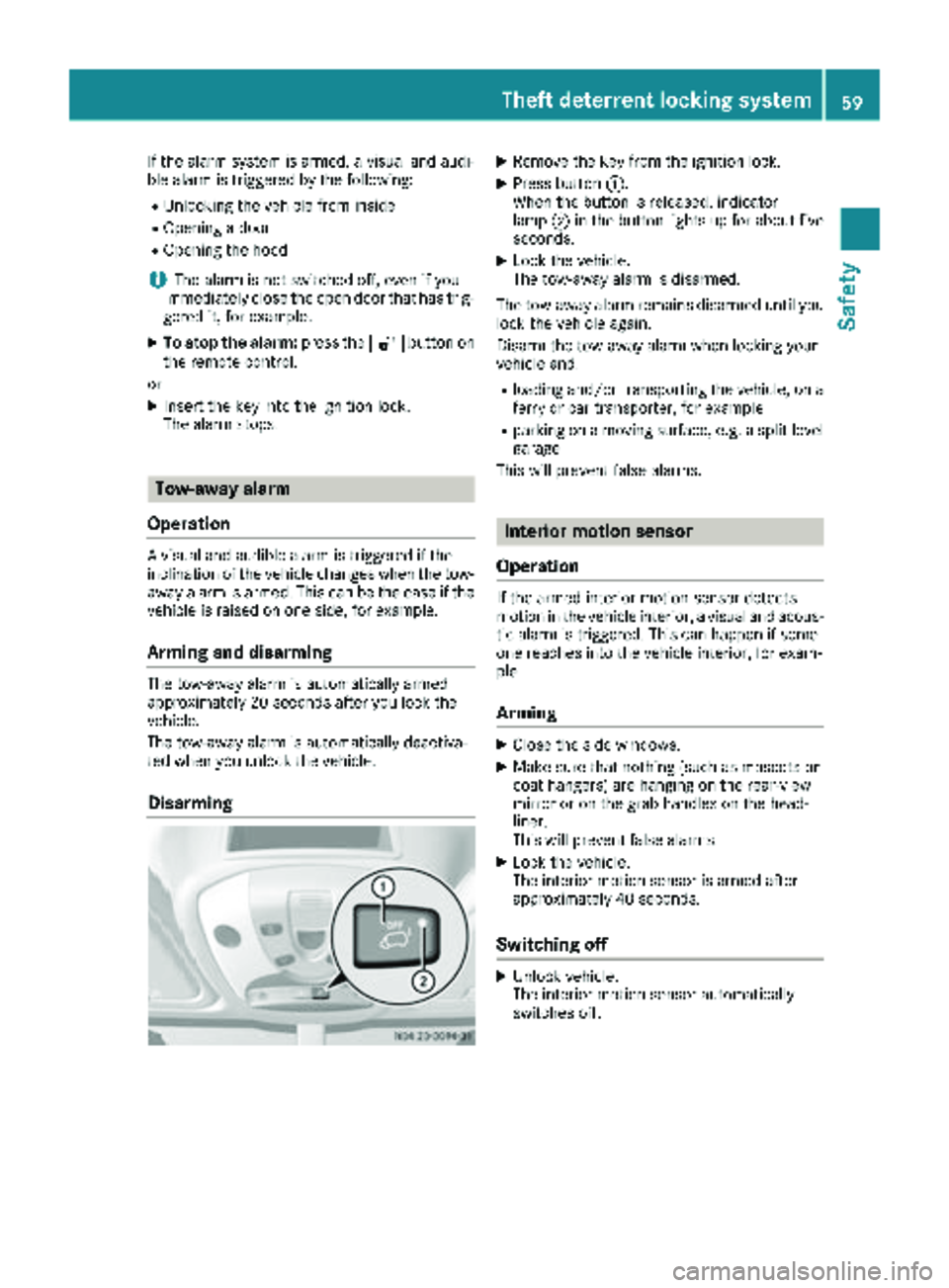
Disarming
XRemove the key from the ignition lock.
XPress button :.
When the button is released, indicator
lamp ;in the button lights up for about five
seconds.
XLock the vehicle.
The tow-away alarm is disarmed.
The tow-away alarm remains disarmed until you
lock the vehicle again.
Disarm the tow-away alarm when locking your
vehicle and:
Rloading and/or transporting the vehicle, on a
ferry or car transporter, for example
Rparking on a moving surface, e.g. a split-level
garage
This will prevent false alarms.
Interior motion sensor
Operation
If the armed interior motion sensor detects
motion in the vehicle interior, a visual and acous-
tic alarm is triggered. This can happen if some-
one reaches into the vehicle interior, for exam-
ple.
Arming
XClose the side windows.
XMake sure that nothing (such as mascots or
coat hangers) are hanging on the rear-view
mirror or on the grab handles on the head-
liner.
This will prevent false alarms.
XLock the vehicle.
The interior motion sensor is armed after
approximately 40 seconds.
Switching off
XUnlock vehicle.
The interior motion sensor automatically
switches off.
Theft deterrent locking system59
Safety
Z
Page 89 of 294
Interior lighting
Switching the dashboard lighting on/
off
Overview
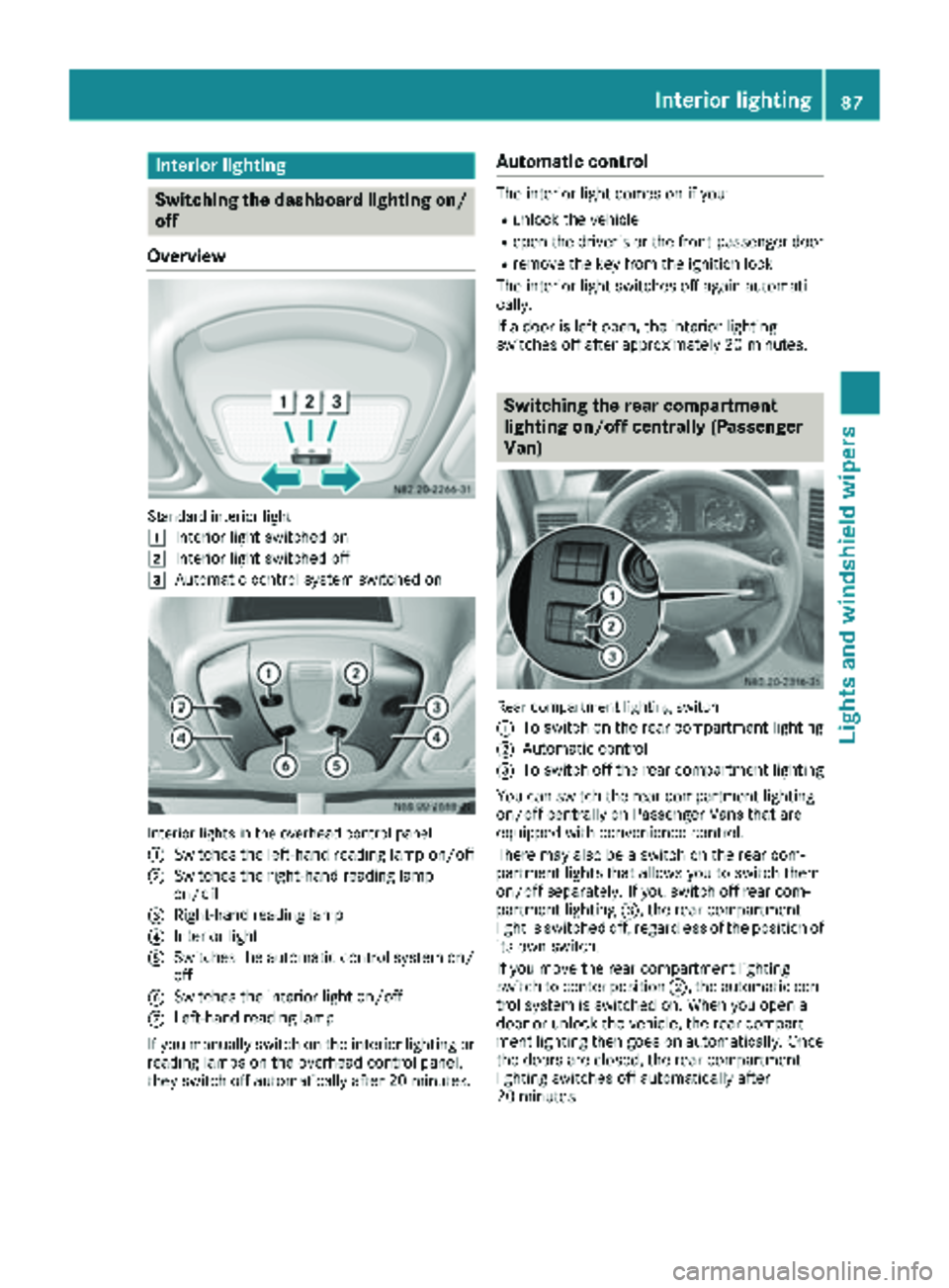
Standard interior ligh t
1
Interio rligh tswitched on
2Interio rligh tswitched off
3Automatic control system switched on
Interio rlights in th eoverhead control panel
:
Switches th eleft-han dreading lamp on/off
;Switches th eright-hand reading lamp
on/off
=Right-hand reading lamp
?Interio rligh t
ASwitches th eautomatic control system on /
off
BSwitches th einterio rligh ton/off
CLeft-han dreading lamp
If you manually switch on th einterio rlighting or
reading lamp son th eoverhead control panel,
they switch off automatically after 20 minutes.
Automatic control
The interior ligh tcomes on if you:
Runlock th evehicl e
Ropen th edriver' sor th efront-passenger door
Rremove th eke yfrom th eignition loc k
The interior ligh tswitches off again automati-
cally.
If adoor is lef topen ,th einterior lighting
switches off after approximately 20 minutes.
Switching the rear compartment
lighting on/off centrally (Passenger
Van)
Rear compartmen tlighting switch
:
To switch on th erear compartmen tlighting
;Automatic control
=To switch off th erear compartmen tlighting
You can switch th erear compartmen tlighting
on/off centrally on Passenger Van sthat are
equipped wit hconvenience control .
Ther emay also be aswitch on th erear com-
partmen tlights that allows you to switch them
on/off separately. If you switch off rear com-
partmen tlighting =,therear compartmen t
ligh tis switched off ,regardless of th eposition of
it s own switch .
If you mov eth erear compartmen tlighting
switch to center position ;,theautomatic con-
trol system is switched on .When you open a
door or unlock th evehicle, th erear compart-
men tlighting then goes on automatically. Once
th edoor sare closed, th erear compartmen t
lighting switches off automatically after
20 minutes.
Interior lighting87
Lights and windshield wipers
Z
Page 90 of 294
Switching the rear/cargo compart-
ment lamp on/off
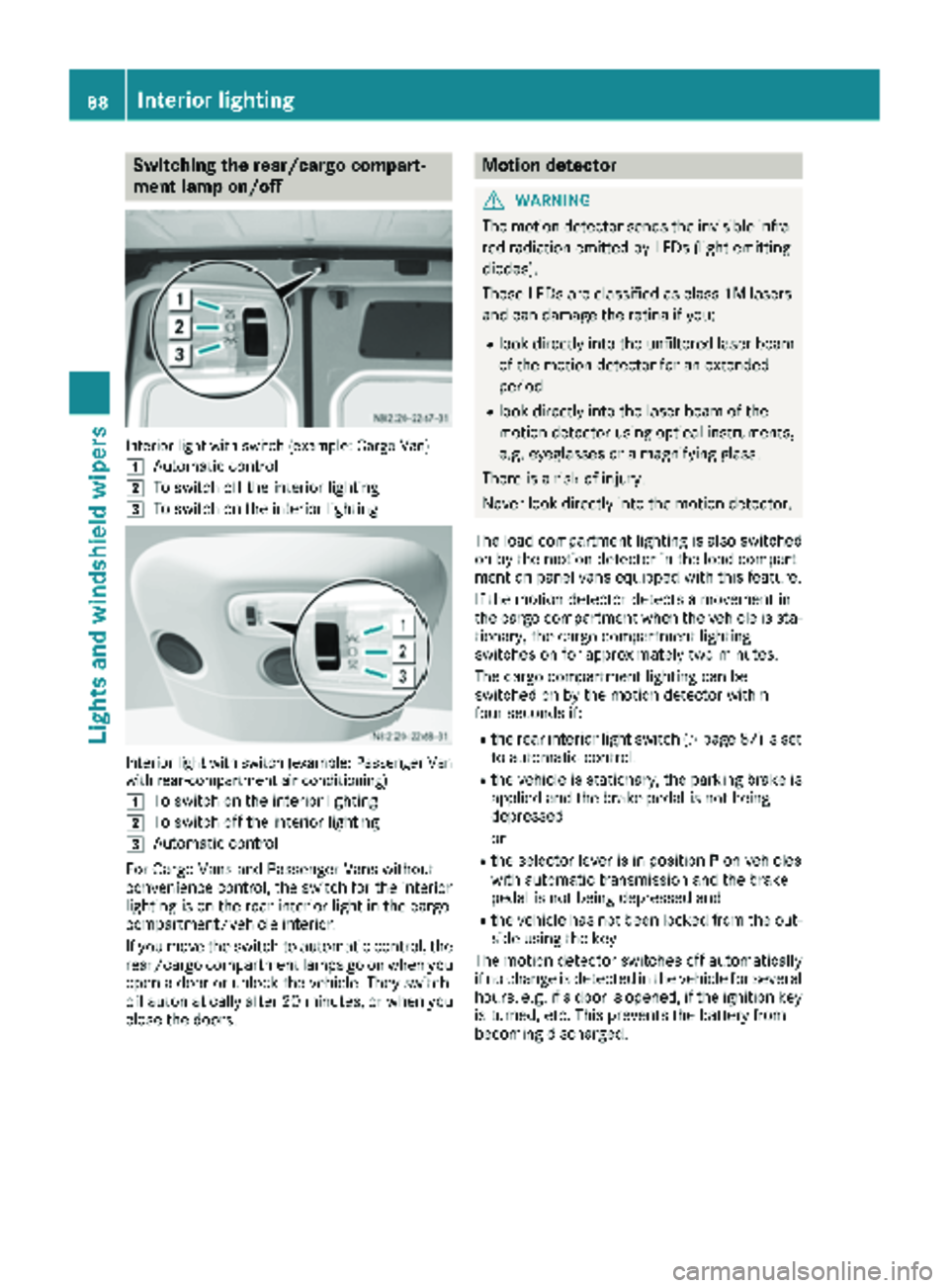
Interior light with switch (example: Cargo Van)
1
Automatic control
2To switch off the interior lighting
3To switch on the interior lighting
Interior light with switch (example: Passenger Van
with rear-compartment air conditioning)
1
To switch on the interior lighting
2To switch off the interior lighting
3Automatic control
For Cargo Vans and Passenger Vans without
convenience control, the switch for the interior
lighting is on the rear interior light in the cargo
compartment/vehicle interior.
If you move the switch to automatic control, the
rear/cargo compartment lamps go on when you
open a door or unlock the vehicle. They switch
off automatically after 20 minutes, or when you
close the doors.
Motion detector
GWARNING
The motion detector sends the invisible infra- red radiation emitted by LEDs (light emitting
diodes).
These LEDs are classified as class 1M lasers
and can damage the retina if you:
Rlook directly into the unfiltered laser beam
of the motion detector for an extended
period
Rlook directly into the laser beam of the
motion detector using optical instruments,
e.g. eyeglasses or a magnifying glass.
There is a risk of injury.
Never look directly into the motion detector.
The load compartment lighting is also switched
on by the motion detector in the load compart-
ment on panel vans equipped with this feature.
If the motion detector detects a movement in
the cargo compartment when the vehicle is sta-
tionary, the cargo compartment lighting
switches on for approximately two minutes.
The cargo compartment lighting can be
switched on by the motion detector within
four seconds if:
Rthe rear interior light switch (Ypage 87) is set
to automatic control.
Rthe vehicle is stationary, the parking brake is
applied and the brake pedal is not being
depressed
or
Rthe selector lever is in position Pon vehicles
with automatic transmission and the brake
pedal is not being depressed and
Rthe vehicle has not been locked from the out-
side using the key
The motion detector switches off automatically
if no change is detected in the vehicle for several
hours, e.g. if a door is opened, if the ignition key
is turned, etc. This prevents the battery from
becoming discharged.
88Interior lighting
Lights and windshield wipers