traction control MERCEDES-BENZ SPRINTER 2018 MY18 Operator’s Manual
[x] Cancel search | Manufacturer: MERCEDES-BENZ, Model Year: 2018, Model line: SPRINTER, Model: MERCEDES-BENZ SPRINTER 2018Pages: 294, PDF Size: 4.36 MB
Page 6 of 294
1, 2, 3 ...
4ETS (Electronic Traction System).... 57
12-V socket ........................................ 211
A
ABS (Anti-lock Braking System)
Display message ............................ 181
Function/notes ................................ 54
Important safety notes .................... 54
Indicator lamp ................................ 196
Access step in the bumper
Cleaning .........................................2 38
Activating/deactivating cooling
with air dehumidification ................. 103
Activating/deactivating the roof
ventilator ...........................................1 17
Adaptive Brake Assist
Function/notes .............................1 42
ADAPTIVE ESP
®
see ESP®(Electronic Stability Program)
Add-on equipment ............................... 28
Additional indicators
Replacing bulbs ............................... 91
Replacing bulbs (roof) ......................9 4
Additives
Diesel ............................................ 280
Engine oil ...................................... .283
Adjusting the headlamp range ........... 84
ADR (working speed governor) ........153
Air bags
Deployment ..................................... 47
Front air bag (driver, front
passenger) ....................................... 46
Important safety notes .................... 45
Introduction ..................................... 45
Side impact air bag .......................... 46
Window curtain air bag .................... 47
Air filter
Indicator lamp ................................ 202
Air pressure
see Tire pressure
Air vents
Adjusting for the passenger com-
partment ........................................ 107
Adjusting on the roof ..................... 107
Importa nt sa
fety notes .................. 106 Setting the center air vents ........... 106
Setting the side air vents ...............1
07
Air vents
see Air vents
Air-conditioning system
Refrigerant ..................................... 286
see Climate control
Air-recirculation mode
Important safety notes .................. 105
Switching on/off ........................... 105
All-wheel drive
Engaging/disengaging ................... 147
Important safety notes .................. 146
LOW RANGE transmission ratio ..... 147
Anti-lock braking system
see ABS (Anti-lock Braking System)
Anti-theft system
Interior motion sensor ..................... 59
Armrests .............................................. 78
Ashtray ............................................... 210
ASR (acceleration skid control)
Activating/deactivating ................... 55
Display message ............................ 182
Function/notes ................................ 55
Important safety notes .................... 55
Indicator lamp ................................ 196
ATA (Anti-Theft Alarm system)
Activating/deactivating ................... 58
Switching off the alarm .................... 58
Authorized workshop
see Qualified specialist workshop
Automatic car wash (care) ...............234
Automatic headlamp mode ................ 83
Automatic locking ............................... 66
Automatic transmission
Accelerator pedal position ............. 125
Changing gear ............................... 124
Changing gear yourself .................. 124
Driving tips .................................... 125
Emergency running mode .............. 126
Important safety notes .................. 123
Kickdown ....................................... 125
Maneuvering .................................. 125
Overview ........................................ 123
Problem (malfunction) ................... 126
Releasing the parking lock man-
ually ............................................... 126
4Index
Page 11 of 294
Switching on/off (vehicles with-
out steering wheel buttons) ........... 163
Dealership
see Qualified specialist workshop
Declarations of conformity ................. 27
DEF (Diesel Exhaust Fluid )
Refilling .......................................... 128
Delayed switch-off ............................ 171
Diagnostics connection
Operating safety and vehicle
approval ........................................... 27
Diesel .................................................. 279
Diesel engine
Preglow indicator lamp .................. 202
Diesel Exhaust Fluid (DEF)
Display messages (vehicles with
steering wheel buttons) ................. 187
Display messages (vehicles with-
out steering wheel buttons) ........... 177
Indicator lamp ................................ 198
Level indicator ............................... 161
Notes ............................................. 281
Storage .......................................... 281
Tank content .................................. 282
Diesel particle filter
Short-distance driving .................... 133
Digital speedometer
Setting the unit (vehicles with
steering wheel buttons) ................. 168
Display
Outside temperature (vehicles
with steering wheel buttons) ......... 166
Outside temperature display
(vehicles without steering wheel
buttons) ......................................... 162
Standard display (vehicles with
steering wheel buttons) ................. 166
Standard display (vehicles with-
out steering wheel buttons) ........... 162
see Warning and indicator lamps
Display
see Warning and indicator lamps
Display messages
Calling up the message memory .... 175
Driving systems ............................. 191
Engine ............................................ 187
Important safety notes .................. 175
Lights ............................................. 185 Safety systems .............................. 181
Service interval display .................. 227
SmartKey ....................................... 194
Ti
res ............................................... 193
Ve
hicle ........................................... 194
Distance recorder ............................. 166
see Odometer
see Trip odometer
Distance warning function
Activating/deactivating ................. 142
Indicator lamp ................................ 142
Warning lamp ................................. 195
Door lock
see Central locking
Doors
Central locking/unlocking
(SmartKey) ....................................... 61
Control panel ................................... 39
Display message ............................ 194
Indicator lamp ................................ 203
Drinking and driving ......................... 132
Drinks holder
see Bottle holder
Driver's/front-passenger door
Unlocking ......................................... 66
Driving abroad ................................... 133
Driving off-road
DSR (Downhill Speed Regulation) .. 148
see Off-road driving
Driving on flooded roads .................. 136
Driving safety systems
4ETS (Electronic Traction Sys-
tem) ................................................. 57
ABS (Anti-lock Braking System) ....... 54
Adaptive Brake Assist .................... 142
ASR (Acceleration Skid Control) ...... 55
BAS (Brake Assist System) .............. 56
Distance warning function ............. 141
EBD (electronic brake force distri-
bution) ............................................. 56
ESP
®(Electronic Stability Pro-
gram) ............................................... 56
Important safety information ........... 54
Overview .......................................... 54
Driving system
Display messages (vehicle with-
out steering wheel buttons) ........... 180
Index9
Page 12 of 294
Driving systemsBlind Spot Assis t............................ 14 3
Cruis econtrol ................................ 13 9
Displa ymessage ............................ 19 1
Lan eKeepin gAssis t...................... 14 5
PARKTRONI C................................. 150
Driving tips
Automati ctransmissio n................ .125
Brakes ...........................................1 34
Break-in period .............................. 118
Checking brake lining thickness .... 135
Downhill gradient ........................... 134
Drinking and driving ....................... 132
Driving abroad ............................... 133
Driving in winter .............................1 36
Driving on flooded roads ................ 136
Driving on wet roads ......................1 36
Exhaust check ............................... 133
Fuel ................................................ 132
General .......................................... 132
Hydroplaning ................................. 136
Icy road surfaces ........................... 136
Important safety notes .................. 118
Limited braking efficiency on sal-
ted roads ....................................... 135
New brake disks ............................ 135
New brake pads/linings ................ 135
Off-road driving .............................. 137
Overrun cut-off .............................. 132
Snow chains .................................. 251
Speed limitation .............................1 33
Towing a trailer .............................. 154
Transport by rail .............................1 34
Wet road surface ........................... 135
DSR (Downhill Speed Regulation) .... 148
E
EBD (electronic brake force distri-
bution)
Display message ............................ 183
Function/notes ................................ 56
Indicator lamps .............................. 196
Electrical closing assist ......................68
Electrical step
Cleaning ........................................ .238
Display message ............................ 194
Emergency release .......................... 68 Function ...........................................6
8
Important safety notes .................... 68
Indicator lamp ................................ 204
Manual retraction ............................ 68
Obstacle detection ........................... 68
Electrical system
Battery main switch ....................... 118
Electronic brake force distribution
see EBD (electronic brake force
distribution)
Electronic Stability Program
see ESP
®(Electronic Stability Program)
Emergency exit .................................... 57
Emergency exit window .....................57
Emergency Tensioning Devices
Activation ........................................ .47
Emissions control
Service and warranty information .... 23
Engine
ADR (working speed governor) ...... 153
Changing the power output ............ .27
Check Engine warning lamp .......... .201
Cleaning instructions ..................... 235
Engine number ............................... 278
Engine speed setting (working
mode) ............................................ 154
Irregular running ............................ 122
Jump-starting ................................. 243
Operating safety .............................. 27
Starting .......................................... 120
Starting problems .......................... 122
Switching off .................................. 131
Tow-starting (vehicle) ..................... 247
Engine electronics
Notes ............................................. 276
Probl
em (malfunction) ................... 122
Engine oil
Adding ...........................................2 23
Additives ........................................ 283
Checking the oil level (on-board
computer) ...................................... 221
Checking the oil level using the
dipstick .......................................... 222
Display message ............................ 191
Filling capacity ............................... 283
Information about oil consump-
tion ................................................ 283
Mixing ............................................ 283
10Index
Page 57 of 294
Drive on carefully. Have ABS checked imme-
diately at a qualified specialist workshop.
If ABS is malfunctioning, other systems will also
fail, including driving safety systems. Observe
the information relating to the !warning
lamp (
Ypage 196).
ABS regulates brake pressure in such a way that the wheels do not lock when you brake. This
allows you to continue steering the vehicle when
braking.
ABS works from a speed of about 5 mph
(8 km/h), regardless of road-surface conditions. ABS works on slippery surfaces, even when you
only brake gently.
The yellow !warning lamp in the instrument
cluster lights up when the ignition is switched
on. The lamp goes out when the engine starts
running.
Braking
If ABS intervenes when braking, you will feel a
pulsating in the brake pedal.
The pulsating brake pedal can be an indication
of hazardous road conditions and functions as a
reminder to take extra care while driving.
XIf ABS intervenes: continue to depress the
brake pedal with force until the braking sit-
uation is over.
XTo make a full brake application: depress
the brake pedal with full force.
ASR (acceleration skid control)
General notes
Important safety notes
Observe the important safety guidelines for the
driving safety system (Ypage 54).
ASR can neither reduce the risk of an accident
nor suspend the laws of physics if the driver
does not pay attention when pulling away or
accelerating. ASR is only an aid. Always adapt
your driving style to suit the prevailing road and
weather conditions.
If you activate or deactivate the all-wheel drive
in a vehicle with this option, ASR will be deacti- vated for the duration of the activation/deacti-
vation process. Vehicles without steering wheel buttons: if ASR
is malfunctioning, the
:indicator lamp lights
up while the engine is running and the engine
power may be reduced (
Ypage 196).
ASR significantly improves traction, i.e. the
transmission of power from the tires to the road surface, and thus increases the vehicle's driving
stability. If the driving wheels start to spin, ASR
brakes individual drive wheels and limits the
engine torque. ASR thus significantly assists you
when pulling away and accelerating, especially
on wet or slippery roads.
If traction on the road surface is not sufficient,
even ASR will not allow you to pull awa
y without
difficulty. The type of tires and total weight of the
vehicle as well as the gradient of the road also
play a crucial role.
If ASR intervenes, the dwarning lamp in the
instrument cluster flashes.
Activating/deactivating ASR
GWARNING
If deactivated, ASR will not attempt to stabi-
lize the vehicle during pulling away and accel- eration. There is an increased risk of skidding
and of an accident.
Only deactivate ASR in the situations descri-
bed in the following.
!If you deactivate ASR, ESP®will still inter-
vene to stabilize the vehicle. Frequent braking
automatically triggered by ESP
®can damage
the brake system.
For this reason, deactivate ASR only briefly
and when absolutely necessary.
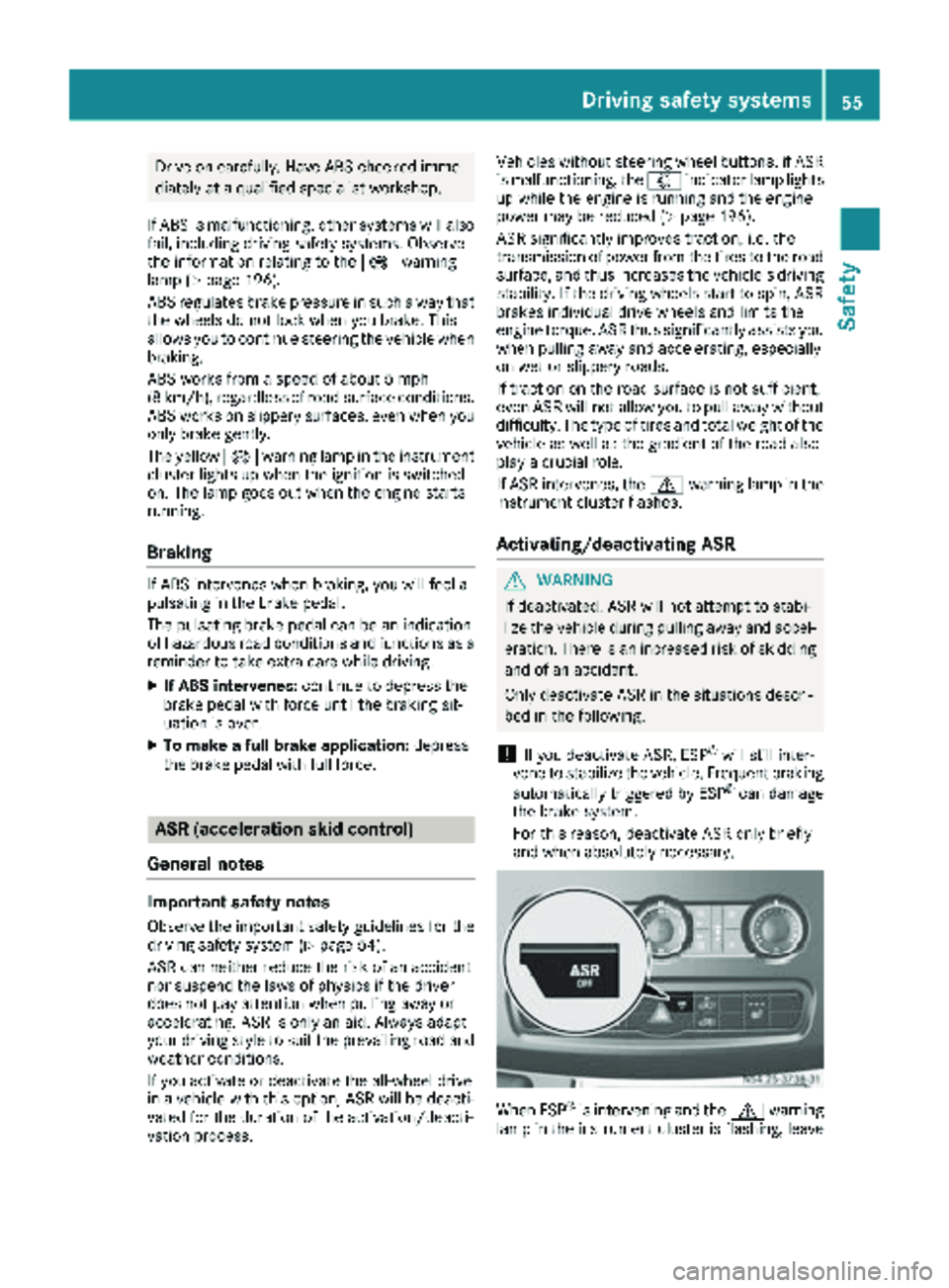
When ESP®is intervening and the dwarning
lamp in the instrument cluster is flashing, leave
Driving safet ysystem s55
Safety
Z
Page 58 of 294
ASR on. In this case, only depress the acceler-
ator pedal as far as required when pulling away.
XPress theàbutton.
If ASR is deactivated, the dwarning lamp
in the instrument cluster lights up.
ASR is automatically activated when the engine
is started.
It may be best to deactivate ASR briefly in the
following situations:
Rwhen using snow chains
Rin deep snow
Ron sand or gravel
If you deactivate ASR:
Rengine torque is not limited and the drive
wheels are able to spin. The spinning wheels
will then achieve a cutting effect for better
traction.
Rtraction control remains active through brake
intervention. If a drive wheel attains its tire
traction limit because one side of the road is
slippery, for example, that wheel is braked.
The traction is then increased in this situation.
Ractive brake intervention by ESP®to increase
driving stability remains active. The d
warning lamp in the instrument cluster
flashes when ESP
®is intervening.
BAS (Brake Assist System)
GWARNING
If BAS is malfunctioning, the braking distance
in an emergency braking situation is
increased. There is a risk of an accident.
In an emergency braking situation, depress
the brake pedal with full force. ABS prevents
the wheels from locking.
Vehicles without steering wheel buttons: if the
BAS driving safety system is malfunctioning,
the : warning lamp lights up while the
engine is running (
Ypage 196).
BAS operates in emergency braking situations.
If you depress the brake quickly, BAS automat-
ically increases the brake pressure, thereby
reducing the stopping distance.
The brakes will function as usual once you
release the brake pedal. BAS is deactivated.
EBD (electronic brake force distribu-
tion)
GWARNING
If EBD is malfunctioning, the rear wheels can
lock, e.g. under full braking. This increases the
risk of skidding and an accident.
You should therefore adapt your driving style
to the different handling characteristics. Have
the brake system checked at a qualified spe-
cialist workshop.
EBD monitors and controls the brake pressure
to the rear wheels. This enables EBD to improve
handling during braking.
Observe the information on warning and indica-
tor lamps (
Ypage 196).
ESP®(Electronic Stability Program)
Important safety notes
GWARNING
If ESP
®is malfunctioning it will not provide
any vehicle stabilization. There is an increased
risk of skidding or of an accident.
Exercise caution when continuing to drive.
Have ESP
®checked at a qualified specialist
workshop.
!Do not run the vehicle on a roller dynamom-
eter (e.g. for performance tests). If you must
operate the vehicle on a roller dynamometer,
please consult a qualified specialist workshop
in advance. You could otherwise damage the
drive train or the brake system.
If you activate or deactivate the all-wheel drive
in a vehicle with this option, ESP
®will be deac-
tivated for the duration of the activation/deac-
tivation process.
If ESP
®is malfunctioning, the hindicator
lamp lights up while the engine is running and
the engine power may be reduced
(
Ypage 195).
iOnly use wheels with the recommended tire
sizes. Only then will ESP®function properly.
56Driving safety systems
Safety
Page 59 of 294
4ETS (Electronic Traction System)
!A function or performance test should only
be carried out on a two-axle dynamometer.
Before you operate the vehicle on such a
dynamometer, please consult a qualified
workshop. You could otherwise damage the
drive train or the brake system.
4ETS is only active when all-wheel drive is acti-
vated (
Ypage 147).
4ETS ensures permanent drive for all four
wheels, and together with ESP
®it improves the
vehicle's traction.
If a driven wheel spins due to lack of traction:
RWhen pulling away, make use of the traction
control integrated in ESP®. Depress the
accelerator pedal as far as necessary.
RWhile driving, slowly take your foot off the
accelerator pedal.
In wintry driving conditions, always use winter
tires (M+S tires) and if necessary, snow chains
(
Ypage 251). This is the only way to get the full
benefit from the all-wheel drive system.
Crosswind Assist
Crosswind Assist does not work if ESP®is deac-
tivated or disabled because of a malfunction.
Crosswind Assist does not react:
Rin the event of severe jolts and vibrations, e.g.
as a result of uneven surfaces or potholes.
Rif the vehicle loses traction, e.g. on snow or
ice or when hydroplaning.
Rto large and sudden steering movements by
the driver.
Crosswind Assist is operational again as soon as
the driving conditions return to normal.
Crosswind Assist detects strong crosswind
gusts that can impair the road holding of your
vehicle when driving straight ahead. Crosswind
Assist intervenes depending on the direction
and strength of the crosswind.
A stabilizing brake application helps you to keep
the vehicle on track.
Information appears in the instrument cluster In
the event that Crosswind Assist intervenes
noticeably.
On vehicles without steering wheel buttons: the d indicator lamp in the instrument clus-
ter flashes. On vehicles with steering wheel buttons:
the
d indicator lamp in the instrument cluster
flashes and the message Crosswind Assist
Interventionappears in the multifunction dis-
play.
Crosswind Assist is active above a vehicle speed
of 50 mph (80 km/h) when the vehicle is driving
straight ahead or cornering gently.
Emergency exit
Emergency exit window
GWARNING
The emergency exit window cannot be locked in place. You risk injury if you exit the vehicle
through the emergency exit window.
RMake sure that nobody becomes trapped,
both when closing and when opening the
emergency exit window.
RThe opened emergency exit window must
be held in place by another person.
Pay attention to traffic conditions.
GWARNING
If the emergency exit window is unlocked
while driving, it could open and slam shut and consequently fall down. There is a risk of an
accident and injury.
Before starting off, make sure that the emer-
gency exit window is locked and the locking
pins are undamaged.
!Make sure there is sufficient clearance
when opening the emergency exit window.
Hold the open window in position. You could
otherwise damage the emergency exit win-
dow.
Emergency exit57
Safety
Z
Page 109 of 294
Setting the side air vents
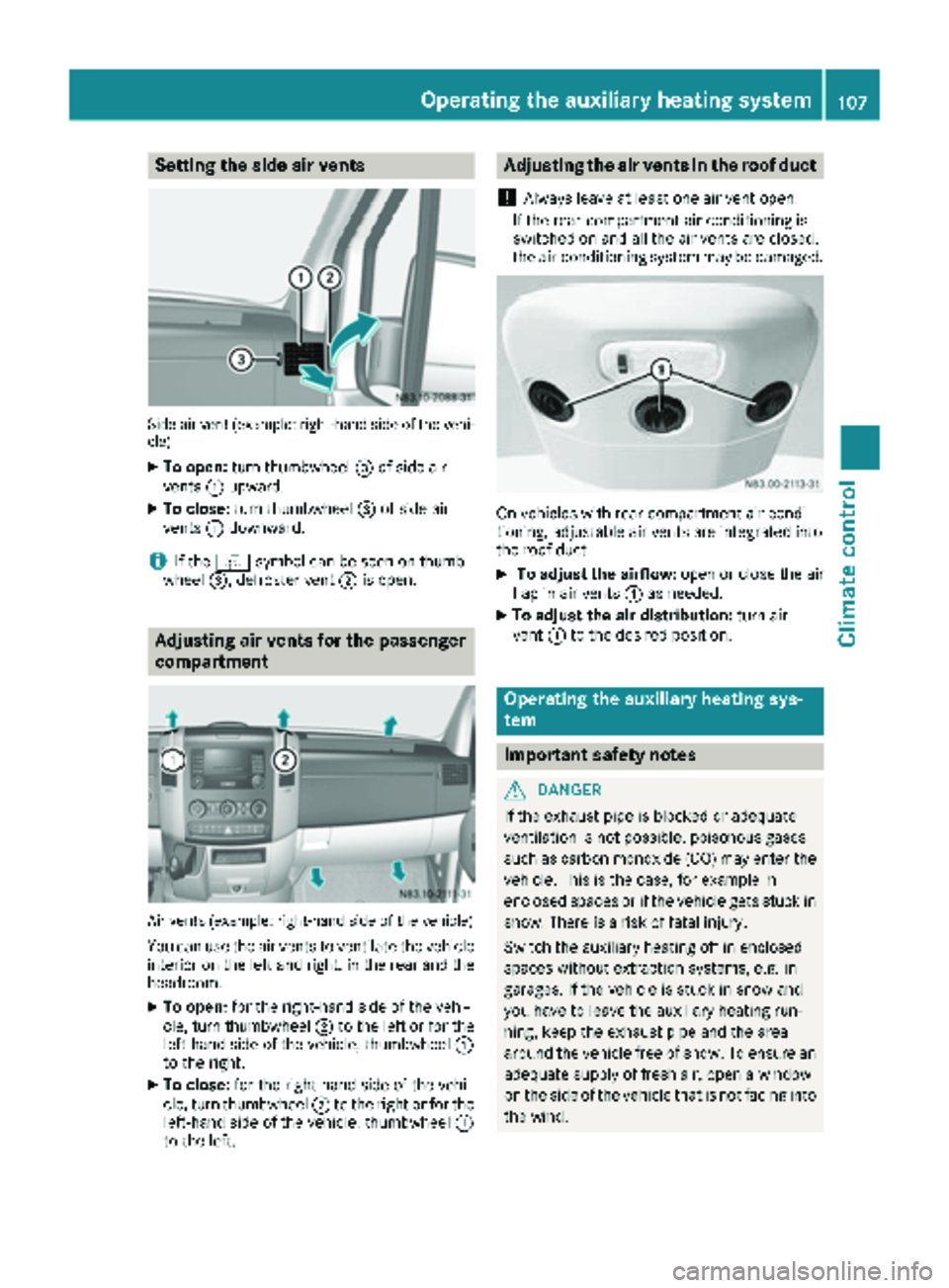
Side air vent (example: right-hand side of the vehi-
cle)
XTo open:turn thumbwheel =of side air
vents :upward.
XTo close: turn thumbwheel =of side air
vents :downward.
iIf the ® symbol can be seen on thumb-
wheel =, defroster vent ;is open.
Adjusting air vents for the passenger
compartment
Air vents (example: right-hand side of the vehicle)
You can use the air vents to ventilate the vehicle
interior on the left and right, in the rear and the
headroom.
XTo open: for the right-hand side of the vehi-
cle, turn thumbwheel ;to the left or for the
left-hand side of the vehicle, thumbwheel :
to the right.
XTo close: for the right-hand side of the vehi-
cle, turn thumbwheel ;to the right or for the
left-hand side of the vehicle, thumbwheel :
to the left.
Adjusting the air vents in the roof duct
!
Always leave at least one air vent open.
If the rear-compartment air conditioning is
switched on and all the air vents are closed,
the air-conditioning system may be damaged.
On vehicles with rear-compartment air condi-
tioning, adjustable air vents are integrated into
the roof duct.
XTo adjust the airflow: open or close the air
flap in air vents :as needed.
XTo adjust the air distribution: turn air
vent :to the desired position.
Operating the auxiliary heating sys-
tem
Important safety notes
GDANGER
If the exhaust pipe is blocked or adequate
ventilation is not possible, poisonous gases
such as carbon monoxide (CO) may enter the vehicle. This is the case, for example in
enclosed spaces or if the vehicle gets stuck in
snow. There is a risk of fatal injury.
Switch the auxiliary heating off in enclosed
spaces without extraction systems, e.g. in
garages. If the vehicle is stuck in snow and
you have to leave the auxiliary heating run-
ning, keep the exhaust pipe and the area
around the vehicle free of snow. To ensure anadequate supply of fresh air, open a window
on the side of the vehicle that is not facing into
the wind.
Operating the auxiliary heating system107
Climate control
Z
Page 141 of 294
XCheck the wheels and tires and wheel archesfor trapped foreign objects and remove them.
Trapped foreign objects can damage the
wheels and tires or may beflung out from the
veh icle when you continue driving.
XCheck the underbo dyfor trapped branches or
other parts of plants and remove them.
XClean the brake disks, brake padsand axle
jo ints, particular lyafter operation insand,
mud, grit and gravel, water or similarly dirt y
conditions.
XCheck the entire floor assembly, the tires,
wheels, bodywork structure, brakes, steering,
chassis and exhaust system for any damage.
XCheck the service brake for operating safety,
e.g. carry out a brake test.
XIf you notice strong vibrations after driving off-
road, check the wheels and drive train for for-
eign objects again. Remove any foreign
objects which can lead to imbalances and
thus cause vibrations.
Driving systems
Cruise control
General notes
Cruise control maintains the speed of the veh i-
cle for you.
Use cruise control ifroad and traff icconditions
make itappropriate to maintain a steady speed
for a prolonged period. You can set any speed
from 20 mph upwards inincrements of 1 mph.
iIfyou have set km /has the unit for the dig-
ital speedometer (Ypage 168), you can set
any speed from 30 km /hupwards inincre-
ments of 1 km/h.
Cruise control should not beactivated when
driv ing off-road or on construction sites.
Cruise control may not be ableto maintain the
stored speed on uphillordownhill gradients. If
the gradient evens out and the veh icle's speed
does not fall below 20 mph (30 km/h), the
stored speed is resumed.
iThe speed shown in the speedometer may
differ slightly from the speed stored by cruise
control.
Important safety notes
If you fail to adapt your driving style or if you are
inattentive, cruise control can neither reduce
the risk of an accident nor override the laws of
physics. Cruise control cannot take road,
weather and traffic conditions into account.
Cruise control is only an aid. You are responsible
for the distance to the vehicle in front, for vehi-
cle speed, for braking in good time and for stay-
ing in lane.
Do not use cruise control:
Rin traffic conditions that are unsuitable for
driving at a constant speed, e.g. in heavy traf-
fic, on winding roads or off-road
Ron slippery roads. Braking or accelerating can
cause the drive wheels to lose traction and
the vehicle could then skid
Rwhen visibility is poor, e.g. due to fog, heavy
rain or snow
If there is a change of drivers, make sure that
you inform the new driver about the set cruise
speed.
Cruise control lever
Operating cruise control
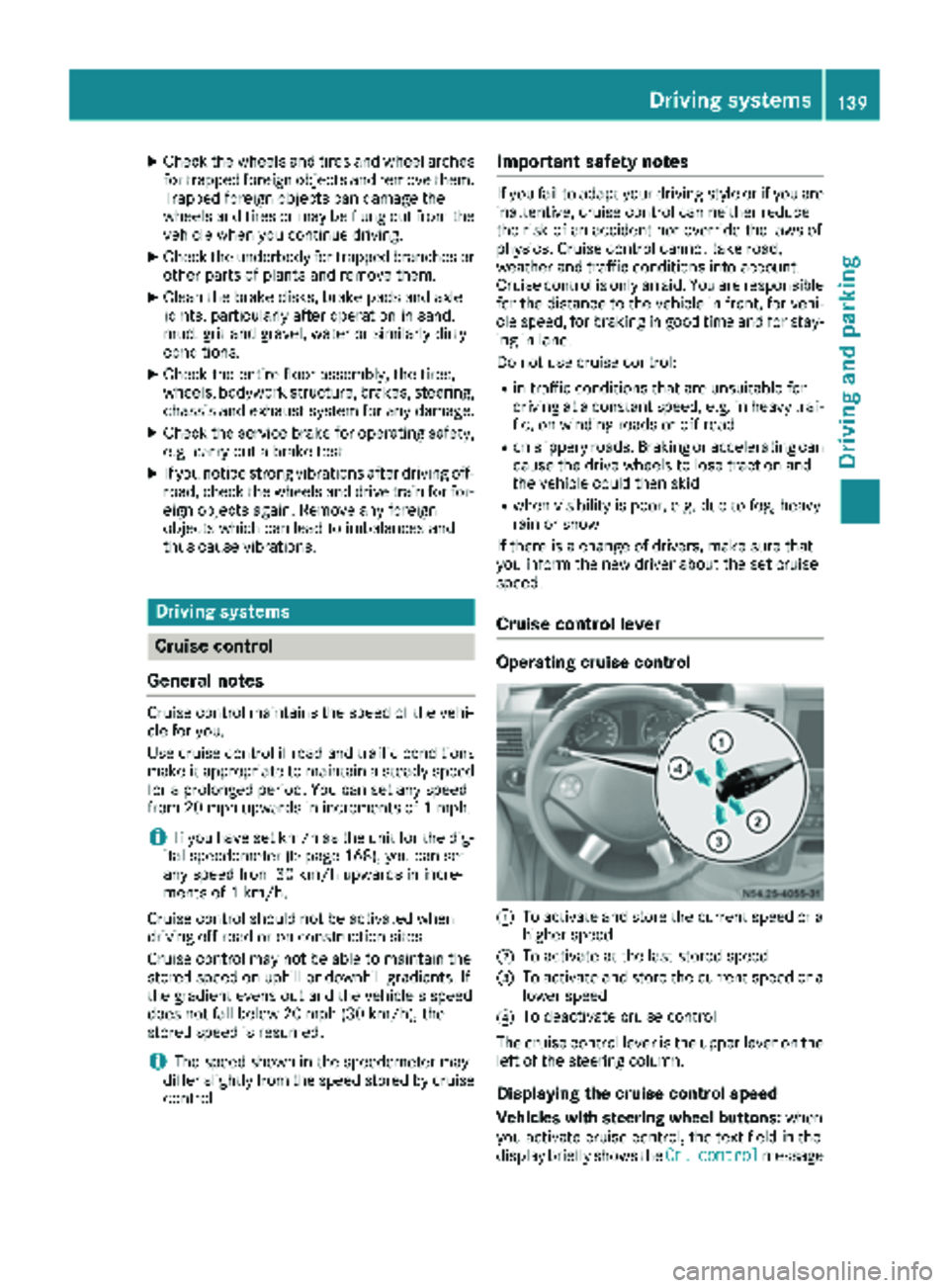
:To activate and store the current speed or a
higher speed
;To activate at the last stored speed
=To activate and store the current speed or a
lower speed
?To deactivate cruise control
The cruise control lever is the upper lever on the
left of the steering column.
Displaying the cruise control speed
Vehicles with steering wheel buttons: when
you activate cruise control, the text field in the
display briefly shows the Cr.
controlmessage
Driving systems139
Driving and parking
Z
Page 149 of 294
remain either on the ground or be fully raised.
Observe the instructions for towing the vehi-
cle with all wheels in full contact with the
ground.
!A function or performance test should only
be carried out on a two-axle dynamometer.
Before you operate the vehicle on such a
dynamometer, please consult a qualified
workshop. You could otherwise damage the
drive train or the brake system.
If you fail to adapt your driving style or if you are
inattentive, the all-wheel drive system can nei-
ther reduce the risk of an accident nor override
the laws of physics. The all-wheel drive system
cannot take road, weather and traffic conditions
into account. The all-wheel drive system is only
an aid. You are responsible for the distance to
the vehicle in front, for vehicle speed and for
braking in good time.
4ETS ensures permanent drive for all four
wheels, and together with ESP
®it improves the
vehicle's traction.
If a driven wheel spins due to lack of traction:
RWhen pulling away, make use of the traction
control integrated in ESP®. Depress the
accelerator pedal as far as necessary.
RWhile driving, slowly take your foot off the
accelerator pedal
In wintry driving conditions, always use winter
tires (M+S tires) and if necessary, snow chains
(
Ypage 251). This is the only way to get the full
benefit from the all-wheel drive system.
For information on "Driving off-road", see
(
Ypage 137).
Engaging all-wheel drive
Conditions for engaging/disengaging
All-wheel drive can only be engaged or disen-
gaged if:
Rthe engine is running
Rthe vehicle is stationary
If it is not possible to engage all-wheel-drive:
Rmove the selector lever to position N
Rrelease the brake pedal
Rpress the;button
Rmove the selector lever from Nto Dor R
Engaging/disengaging all-wheel drive
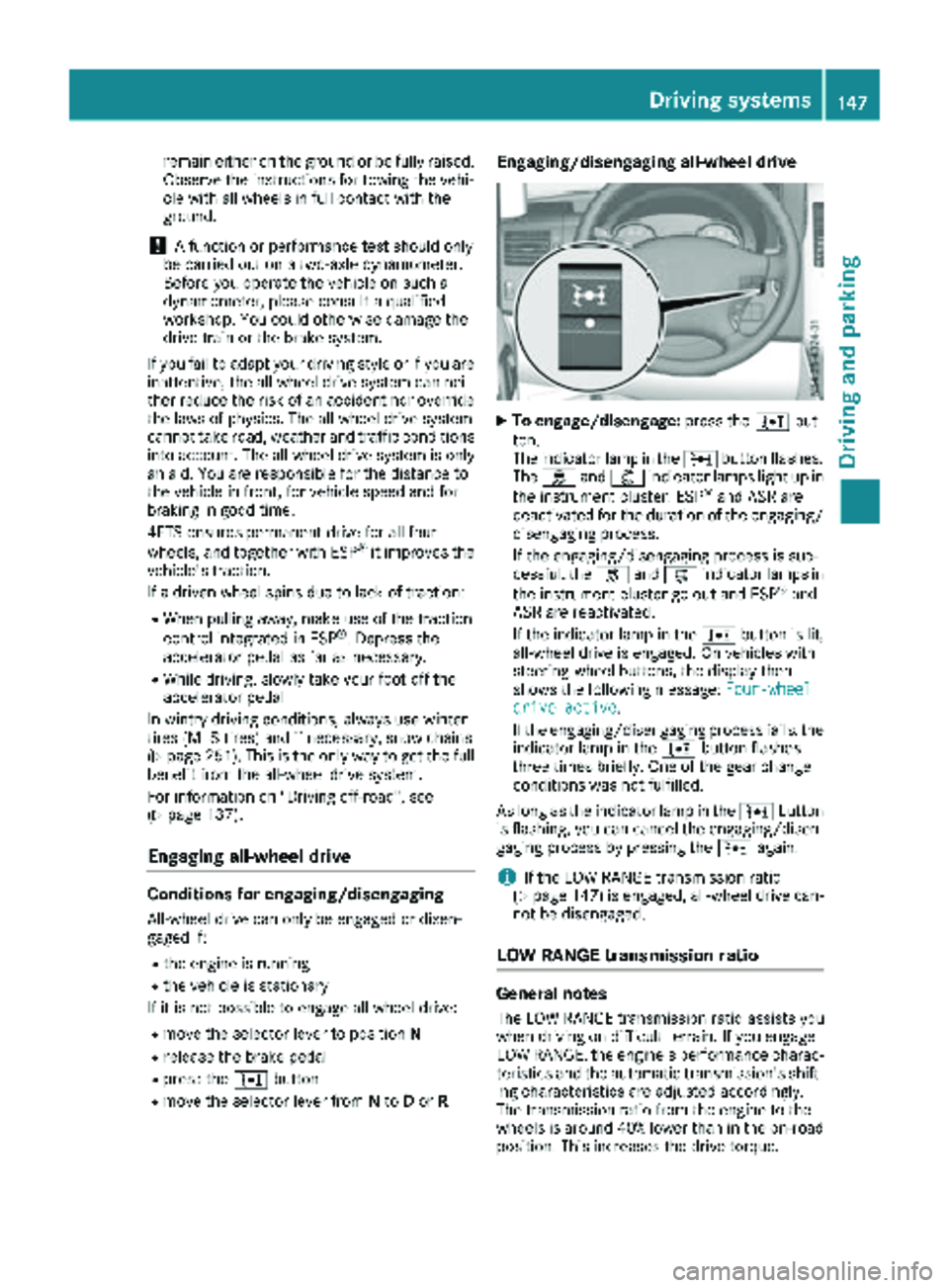
XTo engage/disengage: press the;but-
ton.
The indicator lamp in the ;button flashes.
The h and: indicator lamps light up in
the instrument cluster. ESP
®and ASR are
deactivated for the duration of the engaging/ disengaging process.
If the engaging/disengaging process is suc-
cessful, the hand: indicator lamps in
the instrument cluster go out and ESP
®and
ASR are reactivated.
If the indicator lamp in the ;button is lit,
all-wheel drive is engaged. On vehicles with
steering-wheel buttons, the display then
shows the following message: Four-wheel
drive active.
If the engaging/disengaging process fails, the indicator lamp in the ;button flashes
three times briefly. One of the gear change
conditions was not fulfilled.
As long as the indicator lamp in the ;button
is flashing, you can cancel the engaging/disen-
gaging process by pressing the ;again.
iIf the LOW RANGE transmission ratio
(Ypage 147) is engaged, all-wheel drive can-
not be disengaged.
LOW RANGE transmission ratio
General notes
The LOW RANGE transmission ratio assists you
when driving on difficult terrain. If you engage
LOW RANGE, the engine's performance charac-
teristics and the automatic transmission's shift-
ing characteristics are adjusted accordingly.
The transmission ratio from the engine to the
wheels is around 40% lower than in the on-road position. This increases the drive torque.
Driving systems147
Driving and parking
Z
Page 251 of 294
Regular wheel and tire checks
GWARNING
Damaged tires can cause tire inflation pres-
sure loss. As a result, you could lose control of
your vehicle. There is a risk of accident.
Check the tires regularly for signs of damage
and replace any damaged tires immediately.
Check the wheels and tires of your vehicle for
damage regularly, i.e. at least every two weeks,
as well as after driving off-road or on rough
roads. Damaged wheels can cause a loss of tire
pressure. Pay particular attention to damage
such as:
Rcuts in the tires
Rpunctures
Rtears in the tires
Rbulges on tires
Rdeformation or severe corrosion on wheels
Regularly check the tire tread depth and the
condition of the tread across the whole width of
the tire (
Ypage 249). If necessary, turn the
front wheels to full lock in order to inspect the
inner side of the tire surface.
All wheels must have a valve cap to protect the valve against dirt and moisture. Do not install
anything onto the valve other than the standard
valve cap or other valve caps approved for your vehicle by dealers listed on the inside of the
front cover. Do not install any other valve caps
or systems, e.g. tire pressure monitor systems.
Regularly check the pressure of all the tires,
particularly prior to long trips. Adjust the tire
pressure if ne
cessary (Ypage 251).
The service life of tires depends on various fac-
tors, including the following:
RDriving style
RTire pressure
RMileage
Tire tread
GWARNING
Insufficient tire tread will reduce tire traction.
The tire is no longer able to dissipate water.
This means that on wet road surfaces, the risk
of hydroplaning increases, in particular where
speed is not adapted to suit the driving con-
ditions. There is a risk of accident.
If the tire pressure is too high or too low, tires may exhibit different levels of wear at differ-
ent locations on the tire tread. Thus, you
should regularly check the tread depth and
the condition of the tread across the entire
width of all tires.
Minimum tire tread depth for:
RSummer tires: âin (3 mm)
RM+S tires: ãin (4 mm)
For safety reasons, replace the tires before
the legally prescribed limit for the minimum
tire tread depth is reached.
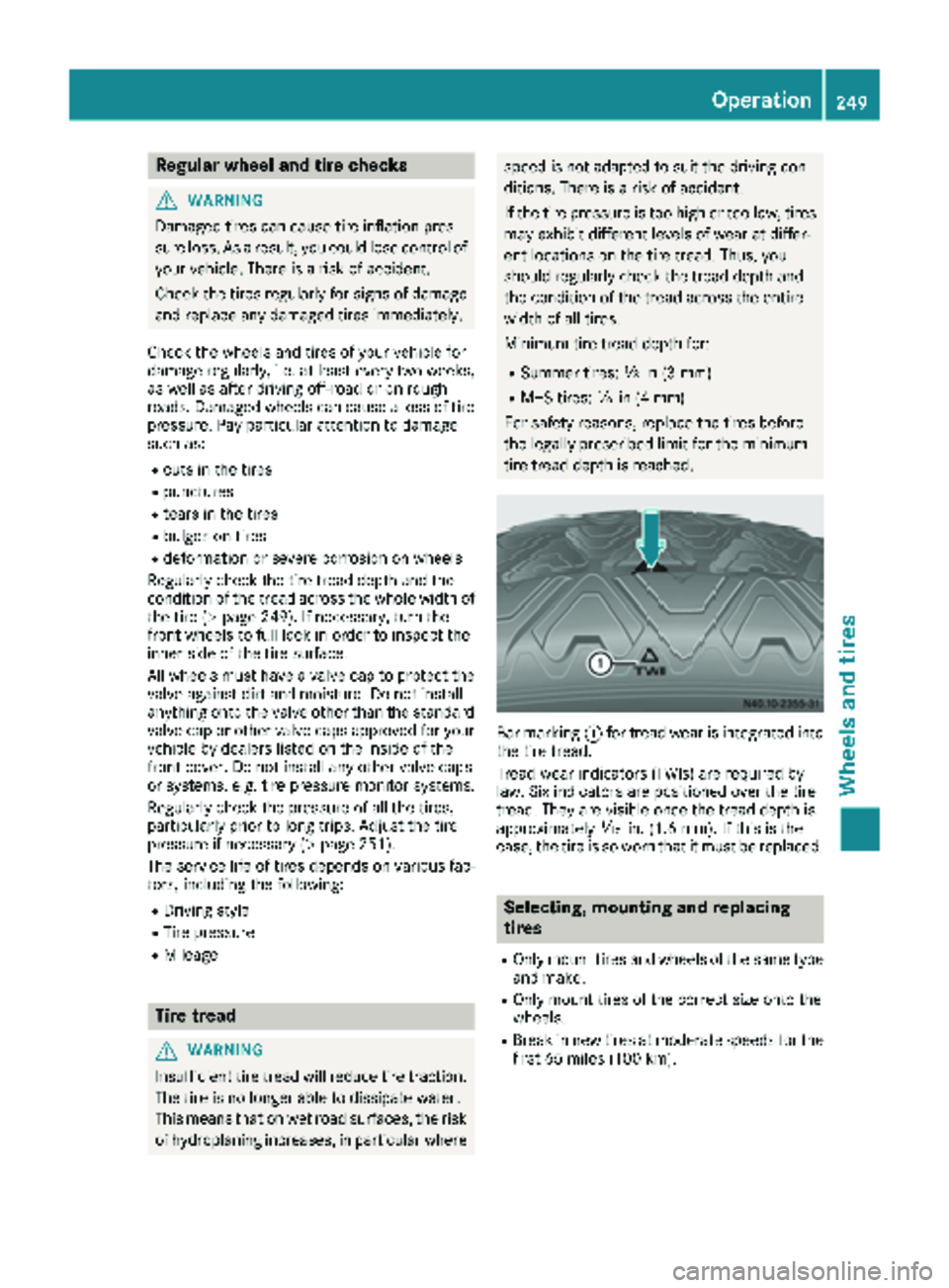
Bar marking :for tread wear is integrated into
the tire tread.
Tread wear indicators (TWIs) are required by
law. Six indicators are positioned over the tire
tread. They are visible once the tread depth is
approximately áin. (1.6 mm). If this is the
case, the tire is so worn that it must be replaced.
Selecting, mounting and replacing
tires
ROnly mount tires and wheels of the same type
and make.
ROnly mount tires of the correct size onto the
wheels.
RBreak in new tires at moderate speeds for the first 65 miles (100 km).
Operation249
Wheels and tires
Z