tires MERCEDES-BENZ SPRINTER 2020 MY20 with 7” screen
[x] Cancel search | Manufacturer: MERCEDES-BENZ, Model Year: 2020, Model line: SPRINTER, Model: MERCEDES-BENZ SPRINTER 2020Pages: 348, PDF Size: 5.84 MB
Page 179 of 348
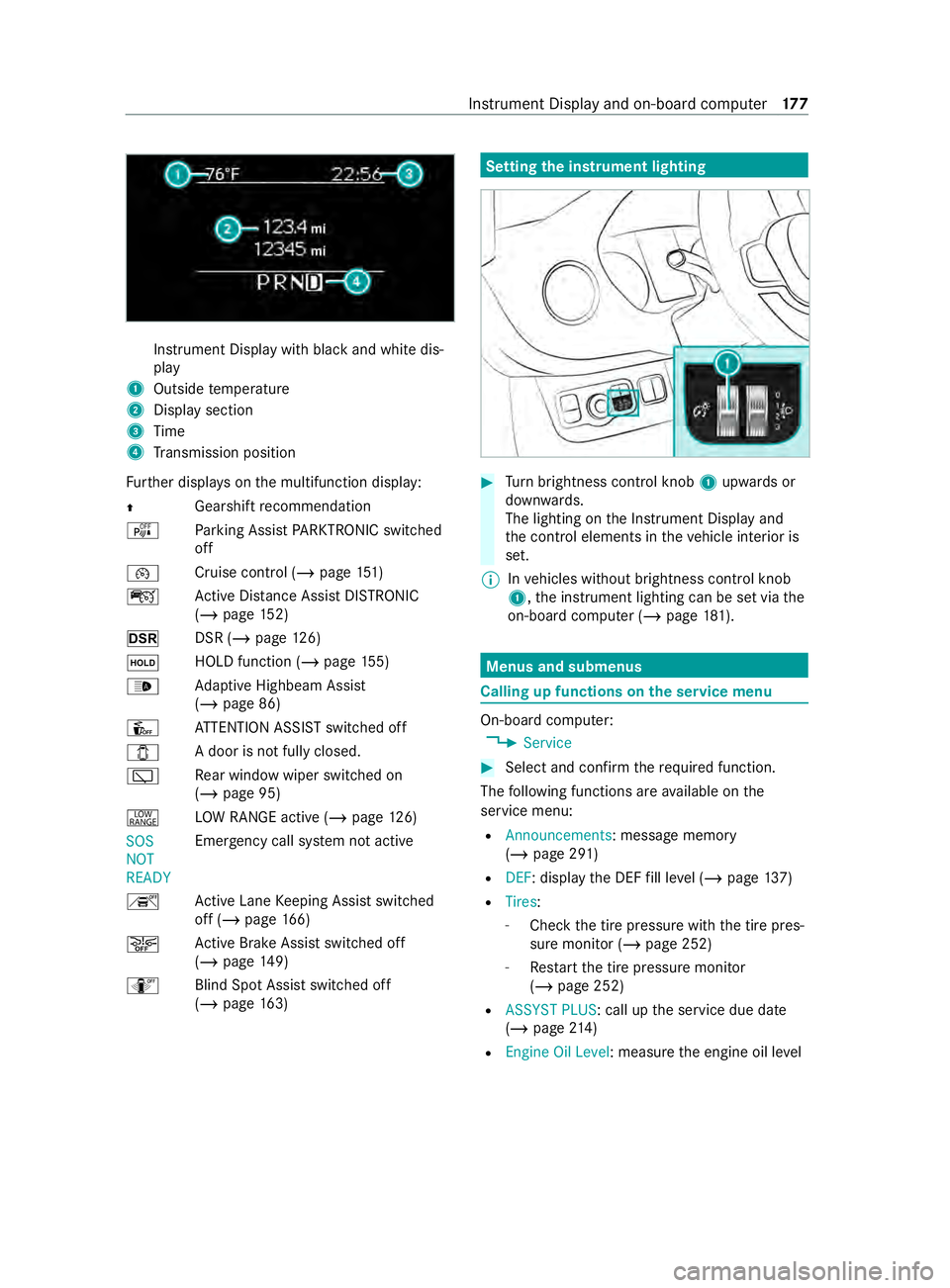
Instrument Displa
ywithb lack and whit edis‐
play
1 Outside temp erature
2 Displa ysection
3 Time
4 Transmission position
Fu rther displa yson them ultifunction display:
0097 Gearshif
trecommendation
é Parking Assis tPARKTRONIC switched
off
00B2 Cruise control (/
page 151)
ç ActiveD ista nce Assi stDISTRONIC
(/ page 152)
z DSR (/page126)
00D9 HOLD function (/
page155)
00CE Ad
aptiv eHighbeam Assist
(/ page86)
Û ATTENTION ASSIS Tswitched off
003E Ad
oor is no tfully closed.
00C5 Re
ar wind owwiper swit ched on
(/ page95)
002E LO
WR ANGE activ e(/pag e126)
SOS
NOT
READY Emergency call sy
stem no tactive
h ActiveL aneK eeping Assis tswitched
of f(/pag e166)
00D4 Ac
tiveB rake Assi stswitched off
(/ page149)
e Blind SpotAssistswitched off
(/ page163) Setting
thei nstrument lighting #
Turn brightness control knob 1upwards or
down wards.
The lighting on theI nstrument Displa yand
th ec ont role lements in thev ehicle interior is
set.
% In
vehicles without brightness contro lknob
1 ,the instrument lighting can be se tviathe
on-boar dcomputer (/ page181). Menu
sand submenus Calling up function
sonthe servic emenu On-boar
dcomputer:
4 Service #
Selec tand con firm ther equired function.
The following function sareavailable on the
service menu:
R Announcements:m essagememory
(/ page291 )
R DEF:d isplaythe DEF fill le vel(/pag e137)
R Tires :
- Che ck th etirep ressur ewitht he tir epres‐
sur em onitor (/ page252)
- Restar tt he tir epressur emonitor
(/ page252)
R ASSYST PLUS:c all upthes ervice due date
(/ page214 )
R Engine Oil Level :measur ethe engine oil le vel Instrument Displa
yand on-boar dcomputer 17 7
Page 224 of 348
#
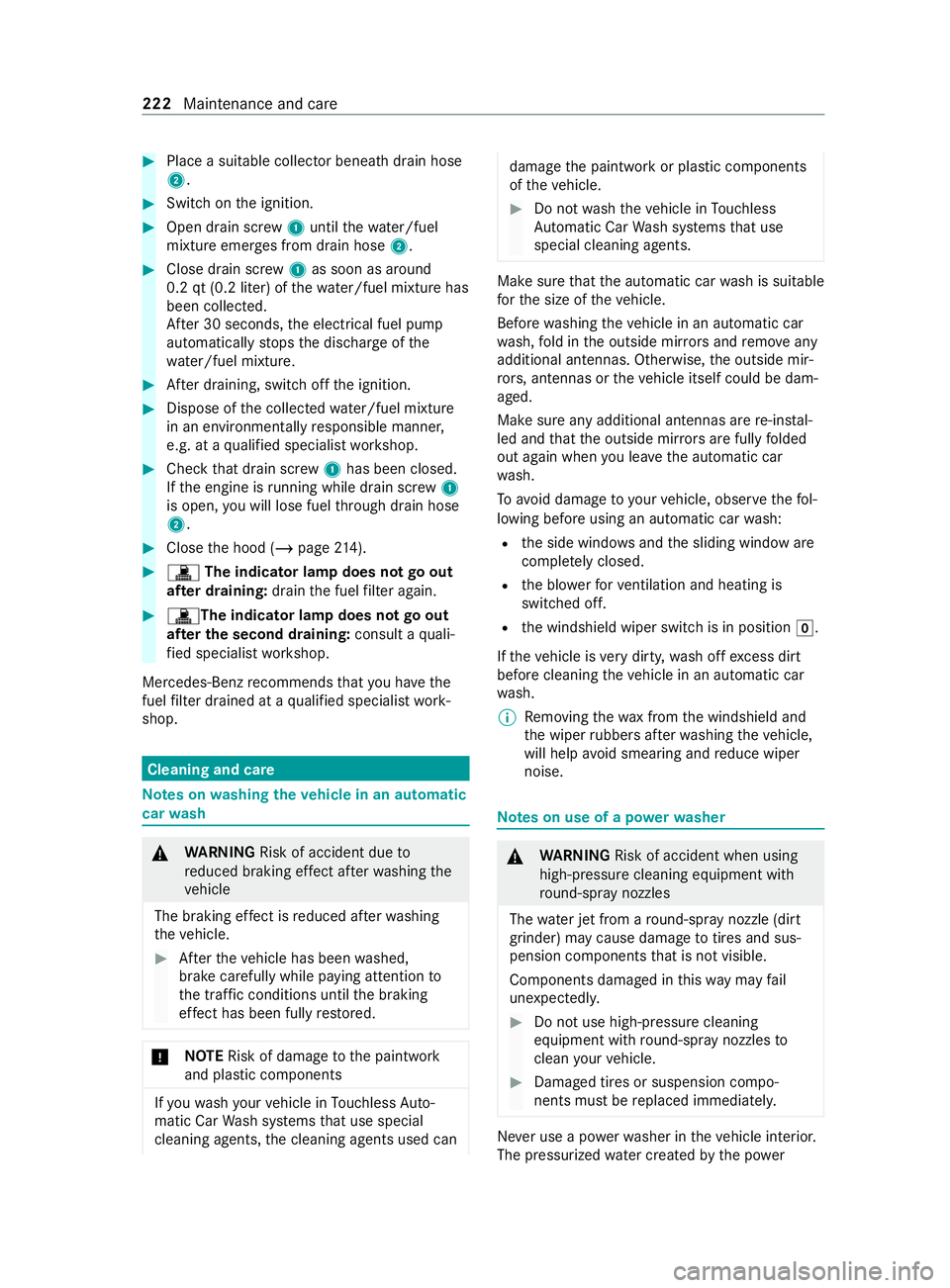
Place asuitable collector beneat hdrain hose
2. #
Switc hont he ignition. #
Open drain scr ew1 until thew ater/fuel
mixtur eemerges from drain hose 2.#
Close drain scr ew1 as soon as around
0. 2qt( 0.2l iter) of thew ater/fuel mixtur ehas
been collected.
Af ter30s econds, thee lectrical fuel pump
automaticall ystops thed ischarg eofthe
wate r/fuel mixture. #
Afterd raining, switc hoffthei gnition. #
Dispose of thec ollected water/fuel mixture
in an environmentally responsible manner,
e.g. at aqualified specialis tworks hop. #
Chec kthat drain scr ew1 has been closed.
If th ee ngine is running whil edrain scr ew 1
is open, youw ill lose fuel thro ugh drain hose
2. #
Close theh ood (/ page214). #
003A The indicator lam pdoes no tgoo ut
af te rd raining: drainthe fuel filter again. #
003ATh eindica torlam pd oesn otgo out
af te rt he second draining: consultaquali‐
fi ed specialis tworks hop.
Mercedes-Benz recommends that youh avet he
fuel filter drained at aqualified specialis twork‐
shop. Cleaning and care
Note
sonw ashingthe vehicl einana utomatic
car wash &
WARNING Risk of accident du eto
re duced braking ef fect af terw ashing the
ve hicle
The braking ef fect is reduced af terw ashing
th ev ehicle. #
Aftert he vehicle has been washed,
brak ecarefully while paying attention to
th et raffic condition suntil theb raking
ef fect has bee nfully restored. *
NO
TERisk of damag etothe paintwork
and plastic components If
yo uw ash your vehicle in Touchles sAuto‐
matic Car Wash sy stems that use special
cleaning agents, thec leaning agentsu sed can damag
ethe paintwor korplastic components
of thev ehicle. #
Do no twash thev ehicle in Touchless
Au tomatic Car Wash sy stems that use
special cleaning agents. Mak
esuret hat thea utomatic car wash is suitable
fo rt he size of thev ehicle.
Befor ewashing thev ehicle in an automatic car
wa sh, fold in theo utside mir rors and remo veany
additional antennas. Otherwise, theo utside mir‐
ro rs,a ntennas or thev ehicle itself could be dam‐
aged.
Mak esurea nyadditional antennas ar ere-in stal‐
led and that theo utside mir rors aref ullyf olded
out again when youl eave thea utomatic car
wa sh.
To avo id damag etoyourvehicle, obser vethef ol‐
lowing befor eusing an automatic car wash:
R thes ide windo wsand thes liding windo ware
comple tely closed.
R theb lowe rfor ventilation and heating is
switched off.
R thew indshield wiper switc hisinposition005A.
If th ev ehicle is very dirty ,wash of fexcess dirt
befor ecleaning thev ehicle in an automatic car
wa sh.
% Re
moving thew ax from thew indshield and
th ew iper rubber safter wa shing thev ehicle,
will help avoid smearing and reduce wiper
noise. Note
sonu se ofapowe rwasher &
WARNING Risk of accident whe nusing
high-pressu recleaning equipment wi th
ro und-spr aynozzles
The wate rjet from around-spra ynozzle (dirt
grinder) ma ycaus edamag etotires and sus‐
pension components that is no tvisible.
Component sdamaged in this wa ym ayfail
unexpec tedly. #
Do no tuse high-p ressur ecleaning
equipment wit hround-spra ynozzle sto
clea nyour vehicle. #
Damaged tires or suspension compo‐
nentsm ustber eplaced immediatel y. Ne
veru se ap owe rwashe rinthevehicle interior.
The pressurized watercreated bythep ower 222
Maintenanc eand care
Page 225 of 348
wa
sher and thea ssociated spr aycould cause
considerable damag etothevehicle.
To avo id damag etoyourvehicle, obser vethef ol‐
lowing when using apowerwa sher:
R maintain aminimum dis tance of 11.8 in
(30 cm) tothev ehicle when using 25° flat-
spr aynozzle sand di rtgrinder sor27.6in
(70 cm) whe nusing round-spra ynozzle sand
obse rvet he information in thee quipment
manufacturer's operating instructions.
R do no tdirect then ozzle of thep owerwa sher
directl yatsensitiv eparts suc hastires, slits,
electrical components, batteries, light bulbs
and ventilation slits.
R maintai naminimum di stanc eof1 9.7 in
(50 cm) forar ear vie wcamera. Wa
shing thev ehicle byhand Obser
vethel egal requirements, fore xamp le in
man ycountries washing byhand is only allo wed
at speciall ydesignated wash ba ys.Int his case,
mak esuret hat aspeciall ydesignated wash ba yis
used forw ashing byhand. #
Use amild cleaning agent, e.g. car shampoo. #
Washthev ehicle wit hlukew armw ater and a
sof tcar sponge. When doing so, do not
ex pose thev ehicle todirect sunlight. #
Carefully spr aythev ehicle wit hwater and dry
of fw ithal eather clo th.Bec arefulnot to
point thew ater je tdirectl ytow ards thea ir
inle tgrilles. The blo wershould be switched
of fw hiled oing so. #
Do no tlet thec leaning agent dr yonthe paint‐
wo rk.
At theo nse tofw inter,remo veall traces of road
salt deposits carefull yand as soon as possible. Note
sonc areofp aint and matte finish *
NO
TEPaint wo rkdamag eand cor rosion
due toinadequat ecare Fa
ilur etop romp tly and thoroughly remo ve
dir tfromb irdd roppings or other residue
could result in paintwor kdamag eand cor ro‐
sion at alater date. #
Cleand irto ffpaint and matt efinish
th oroughly and as soon as possible. Maintenance and care
223
Page 232 of 348
SA
's Cus tomer Assis tance Center at 800-FOR-
MERC.
Fo rC anada, please contact MBC’ sCustomer
Assis tance Center at 1-800-387-0 100.
Cust omer requ ests forc ove redi nformation
should be submitted via thes ame channels.
Fo ra ccident clarificatio npurposes ,the following
measures can be take nu ptoa nhour af tert he
emergency call has been initiated:
R The cur rent vehicle position can be de ter‐
mined
R Avoice connection tothev ehicle occupants
can be es tablished Flat tire
Note
sonf lat tires &
WARNING Risk of an accident whe ndriv‐
ing wi thaflat tire
Af lat tir egreatl yimp airsd rivin gc haracteris‐
tics, as well as steering and braking. #
Do no tdrive wit haf lat tire. #
Remo vethef lat tir eand ins tallthe
spar ewheel or consult aqualified spe‐
cialis tworks hop. Depending on
your vehicle's equipment, in the
eve nt of aflat tir eyou ha vethef ollowing possibil‐
ities:
R Youc an call breakdown assis tance via the
breakdown assis tance cal lbuttonint heove r‐
head control panel (/ page183).
R Chang ethe wheel (/ page263). Batte
ry Note
sont he12Vb attery &
WARNING Risk of an accident du eto
wo rkcar ried out incor rectly on theb at‐
te ry
Wo rkcar ried out incor rectl yont he battery
can, fore xamp le, lead toas hor tcircuit .This
can lead tofunction restrictions in saf ety-re l‐
eva nt sy stems, fore xamp lethel ighting sys‐
te m, ABS (anti-loc kbraking sy stem) or ESP ®
(Elect ronic Stabilit yProgram). The ope rating
saf etyofy ourvehicle ma yberestricted. Yo
uc oul dlose control of thev ehicle in the
fo llowing situations:
R when braking
R inthee vent of ab rupt steering maneuvers
and/or when thev ehicle's speed is not
adap tedtot heroad conditions #
Inthee vent of ashortcircui tora simi‐
la ri ncident, contact aqualified special‐
is tw orks hop immediately. #
Do no tcontinue driving. #
Alwaysh ave workon theb atter ycarried
out at aqualified specialis tworks hop. R
Further information on ABS (/ page146)
R Further information on ESP ®
(/ page147)
Mercedes-Benz recommends that youh avet he
12 Vb atter yreplaced at aqualified specialist
wo rkshop, e.g. at an authorized Mercedes-Benz
Center.
Should youw ant toreplace theb atter yyourself,
obser vethef ollowing information:
R Alwaysr eplace afaulty batter ywithab attery
whic hfulfills thev ehicle's specific require‐
ments.
R Carryove rdetachable parts suc hasthevent
hose, elbo wfittin gort erminal co verfromt he
batter ytober eplaced.
R Mak esuret hat thev ent hose is alw aysc on‐
nected toits original openin gonthe battery
side.
Ins tallthe existin gorn ewlysupplied stop
plugs.
Otherwise, gases or batter yacid could
escape.
R Mak esuret hat thed etachable parts ar econ‐
nec tedint he same wayasb efore.
Fo rs afet yr easons, Mercedes-Benz recommends
th at youo nly use bat teries that ha vebeen tested
and appr ovedfor your vehicle byMercedes-Benz.
These batteries pr ovide inc reased impact pr otec‐
tion topreve ntvehicle occupants from suf fering
aci db urns should theb atter ybed amaged in an
accident. 230
Breakdown assis tance
Page 246 of 348
Information on noise or unusua
ldriving
ch aracteristics
Whil edriving, pa yattention tovibrations, noises
and unusual driving characteristics, e.g .pullin gto
one side. This ma yindicat edamag etothe wheels
or tires. If yous uspect that at ireisd efective,
re duce your speed. Stop thev ehicle as soon as
possible tocheckifw heels and tires ha vebeen
damaged or ar enolonger functioning properly.
Hidden tir edamag ecould also be causing the
unusual drivin gcharacteristics. If no signs of
dama gecan be de tected, ha vethet ires and
wheels checkedataq ualified specialis twork‐
shop. Note
sonr egular lyinspecting wheels and
tires &
WARNING Risk of accident from dam‐
aged tires
Dama gedt ires can cause tir epressur eloss.
As aresult, youc oul dlose control of your
ve hicle. #
Chec kthe tires regularly fors igns of
dama geand replace an ydamaged tires
immediatel y. Chec
kthe wheels and tires of your vehicle for
damag eregular ly,i .e. at leas tevery twow eeks,
as well as af terd riving off-road or on rough
ro ads. Damaged wheels can lead toaloss of tire
pressure.
Look out fort he following types of damage, for
ex ample:
R Cuts in thet ires
R Punctures in thet ires
R Tearsint he tires
R Bulges on tires
R Deformation or se vere cor rosion on wheels &
WARNING Risk ofhydroplaning because
tir et read is tool ow
Insuf ficient tir etread will result in reduced
tir et raction .The tir etread will no longer be
able todissipat ewater.
This increase sthe risk of hydroplaning on wet
ro ad sur faces, pa rticularly when tra veling at
an inappropriat espeed. If
th et irep ressur eist oo high or tool ow ,tires
ma yexhibit dif fere nt le vels of wear at dif fer‐
ent locations on thet iret read. #
Regular lych eckt he tir etread dep thand
th ec ondition of thet iret read across
th ee ntir ew idthofa ll tires.
Minimum tread dep thforu se:
R In summer: 00CEin (3 mm)
R In winter: 00CFin (4 mm) #
Fors afet yr easons, ha vethet ires
re placed befor ethe legally prescribed
limit fort he minimum tir etread dep this
re ached. Conduct
thef ollowing checks regular lyon all
wheels, at leas tonce amonthorasr equired, e.g.
befor ealong journe yorwhen driving off- road:
R Chec kthe tir epressur e(/pag e246)
R Che ckthev alvec aps
Va lves mus tbeprotected from moistur eand
dir tw ithv alvec apss pecifically appr oved by
Mercedes-Benzf oryour vehicle.
R Visually inspect thet read dep thand thet ire
tread across thew hole tir ewidth
Fo ru se in summer ,the minimum tread dep th
is 00CE in (3 mm) and foru se in winter 00CFin
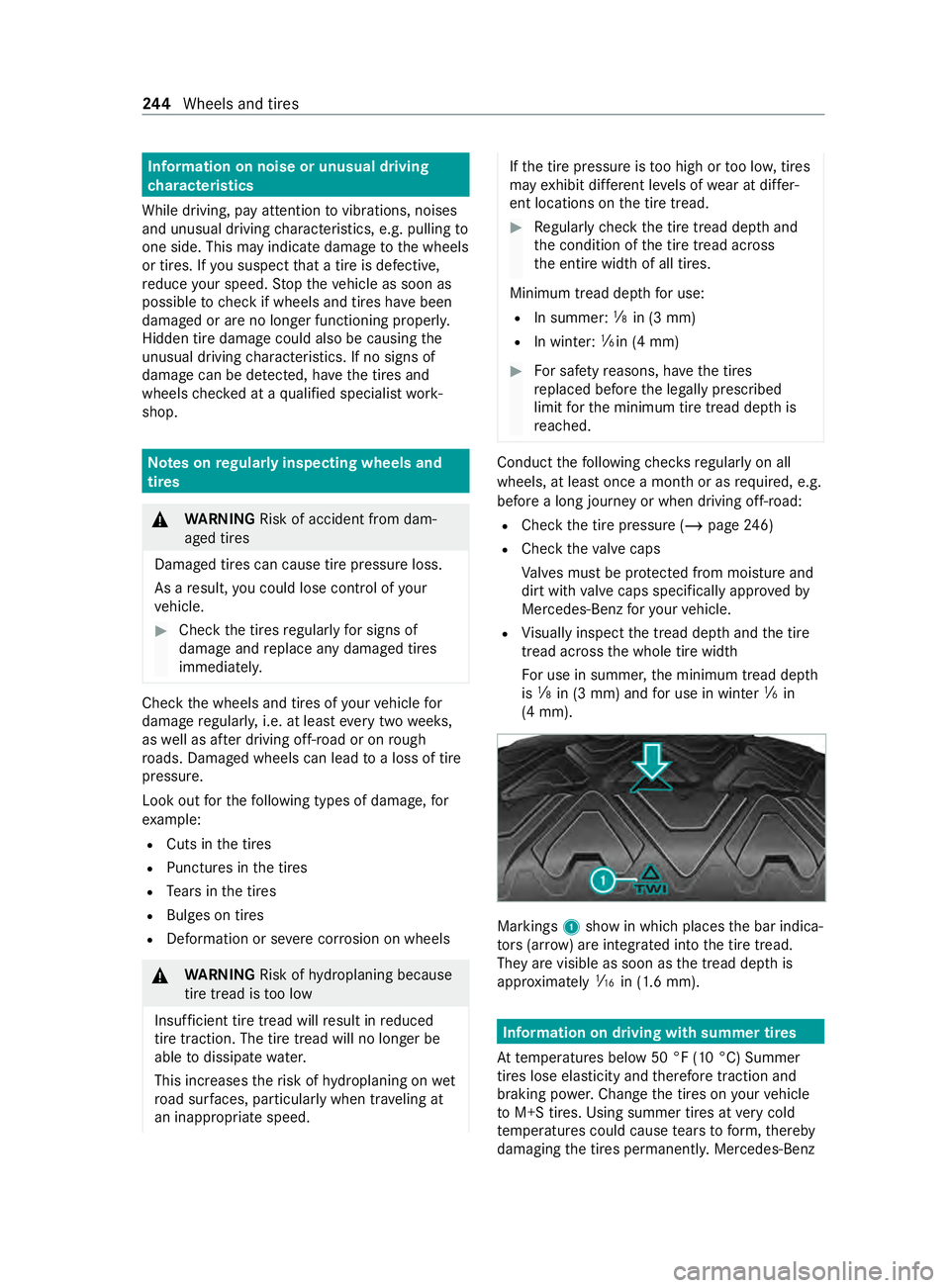
(4 mm). Markings
1showinw hichp laces theb ar indica‐
to rs (ar row )are integ ratedi ntot he tir etread.
The yarevisible as soon as thet read dep this
appr oximately 00CDin (1.6 mm). Information on driving wit
hsummer tires
At temp eratures belo w50°F(10°C) Summer
tires lose elasticit yand therefor etraction and
braking po wer.Chan gethet ires on your vehicle
to M+S tires. Using summer tires at very cold
te mp eratures could cause tear stof orm, thereby
damaging thet ires permanentl y.Mercedes-Benz 244
Wheels and tires
Page 247 of 348
canno
tacce ptresponsibility fort his type of dam‐
age.
Alw ayso bser vethem aximum permissible speed
specified fort he summer tires youh ave installed
(/ page257).
Onc eyou ha veinstalled thes ummer tires:
R Chec kthe tir epressur e(/pag e246)
R Restar tt he tir epressur emonitor
(/ page252) Information on M+S tires
At temp eratures belo w50°F(10°C) use winter
tires or all-season tires –botha remar kedw ith
M+S.
Onl ywinter tires bearing the004D snowflake
symbol in addition totheM +S marking pr ovide
th eb estp ossible grip in wintr yroad conditions.
Onl ythese tires will allo wdriving saf etys yst ems
suc hasA BS and ESP ®
to also function optimally
in winter .Thes etires ha vebeen de veloped specif‐
icall yfor driving in sno w.
Use M+S tires of thes ame mak eand tread on all
wheels tomaintain saf ehandling characteristics.
Alw ayso bser vethem aximum permissible speed
specified fort he M+S tires youh ave installed
(/ page257).
If yo ui nstall M+S tires that ha vealow er maxi‐
mum permissible spee dthan them aximum
design speed of thev ehicle, af fixana ppropria te
wa rning sign in thed rive r's field of vision. Yo u
can obtai nthis at aqualified specialis tworks hop.
Once youh avei nstalled thew inter tires, take the
fo llowing measures:
R Chec kthe tir epressur e(/pag e246)
R Restar tt he tir epressur emonitor
(/ page252) Note
sons nowc hains &
WARNING Risk of accident du etoincor‐
re ct ins tallation of sno wchains
Ve hicles with rear-wheel drive: ifyo uh ave
ins talled sno wchains tothef ront wheels,
th ey ma ydraga gains tthe vehicle body or
ch assis components.
This could cause damag etothevehicle or the
tires. #
Neverins tall sno wchains on thef ront
wheels. #
Onlyins tall sno wchains on ther ear
wheelsinp airs. #
Vehicles with twin tires: installthe
sno wchains totheo uter wheels. &
WARNING Risk of accident du eto
unsuitable sn ow chains
Ve hicles wit hall-wheel driv edonothave suf‐
fi cient clea rance on thef ront axle forc om‐
mercial lyavailable sn ow chains.
When youi nstall commerciall yavailable sn ow
ch ains ,the sno wchains ma ycom eloose and
damag echassi scomponent sorbrake hoses. #
Only ins tall sno wchains appr ovedby
Mercedes-Benzf orthese tires. Fo
rs afet yr easons, Mercedes-Benz recommends
th at youo nlyu se sn owchains that ha vebeen
ch eckeda nd appr oved.Youc an obtain informa‐
tio na bout sn ow chains from an yqualified spe‐
cialis tworks hop.
* NO
TEDama getothew heel trim from
mounted sno wchains If sno
wchains are mounted tosteel wheels,
th ew heel trims can be damaged. #
Remo vethew heel trims of steel wheels
befor emounting sno wchains. Obser
vethef ollowing no tesw hen using snow
ch ains:
R Snow ch ains ar eonlyp ermissible forc ertain
wheel/tir ecombinations .You can obtain
information on them at aqualified specialist
wo rkshop.
R Fors afet yr easons, onl yuse sn owchains that
ha ve been specifically appr ovedfor your vehi‐
cle byMercedes-Benz, or sno wchains with
th es ame quality standard.
R The sn owchains mus tberetightene dafter
driving appr oximatel y0.6 miles (1 km). This is
th eo nlyw aytoensur ethe sno wchains are
optimall yseated wit hclearanc etoadjacent
components.
R Vehicles with all-wheel drive: install snow
ch ains tothew heels on ther ear axle. On
ve hicles wit htwin tires, ins tallth es now
ch ains totheo uter wheels. Obser vethem an‐
ufacturer's ins tallation instructions. Wheels and tires
245
Page 248 of 348
R
Use sno wchains only when ther oad sur face
is comple tely sno w-covered. Re mo vethe
sno wchains as soon as possiblew henyou
come toaroad that is no tsnow-covered.
R Local regulations ma yrestrict theu se of
sno wchains. Obser vethea pplicable regula‐
tions befor einstal ling sno wchains.
R Activat eall-whee ldrive before driving of fwith
sno wchains (/ page125, 124, 125).
R If sn ow ch ains ar einstalled, them aximum
permissible speed is 30 mph(50 km/h).
R Vehicles with Parking Assis t:do no tuse
Pa rking Assis tPARKTRONIC if sno wchains
ar ei nstalled.
% Youc an deactivat eESP®
to pull away
( / pag e148). This all ows thewheels to
spin, achieving an increased driving forc e. Ti
re pressure Note
sont irep ressure &
WARNING Risk of accident du etoinsuf‐
fi cient or excessiv etirep ressure
Underinfla tedoro verinfla tedt ires pose the
fo llowing risks:
R The tires ma yburst,e speciall yasthe load
and vehicle speed increase.
R The tires ma ywear excessively and/or
une venly ,w hich ma ygreatly impair tire
traction.
R The driving characteristics, as well as
st eering and braking, ma ybegreatly
impaired. #
Compl ywitht he recommended tire
pressur eand checkt he tir epressur eof
all tires including thes par ew heel regu‐
larly:
R at leas tonce amonth
R when thel oad changes
R befor eembarkin gonalongerjourney
R if operating conditions change, e.g .off-
ro ad driving #
Adjus tthe tir epressur easn ecessar y. Driving wi
thtirep ressur ethat is tooh igh or too
lo wh asthef ollowing consequences:
R Shor tent he service lif eofthe tires.
R Cause increased tir edamage.
R Adversely af fect handling characteristic sand
th us drivin gsafet y, e.g. due tohydroplaning. &
WARNING Risk of an accident du eto
insuf ficient tir epressure
Ti re sw ithp ressur ethat is tool ow can over‐
heat and bur stas aresult.
In addition ,the ya lso suf ferf rome xcessive
and/or ir regular wear,w hic hc an significantly
impair theb raking properties and theh an‐
dling characteristics. #
Avoid excessively lo wtirep ressures in
all thet ires, including thes par ew heel. Ti
re pressur ewhichist oo lo wcan cause:
R Tire faults as aresult of overheating
R Impaired handling characteristics
R Irre gular wear
R Increased fuel consum ption &
WARNING Risk of accident from exces‐
siv etirep ressu re
Ti re sw ithe xcessivel yhigh pressur ecan bur st
because they ared amaged mor eeasil yby
highw ayfill, po tholes etc.
In addition, they also suf ferf romi rregular
we ar,w hic hc an significantl yimp air theb rak‐
ing properties and theh andling characteris‐
tics. #
Avoid excessively high tir epressures in
all thet ires, including thes par ew heel. Excessively high tir
epressur ecan result in:
R Increased braking dis tance
R Impaired handling characteristics
R Irre gular wear
R Impaired drivin gcom fort
R Susceptibility todamage &
WARNING Risk of accident caused by
re peated drop in tir epressure
If th et irep ressur edrops repeatedly ,the
wheel, valveort irem aybe damaged. 246
Wheels and tires
Page 249 of 348
Insuf
ficient tir epressur ecan cause thet ires
to bur st. #
Inspect thet iref or signs of fore ign
objects. #
Chec kwhether thew heel or valveh as a
leak. #
Ifyo ua reunabl etorectify thed amage,
contact aqualified specialis tworks hop. Yo
uc an find information on recommended tire
pressur efor thev ehicle's factor y-ins talled tires
on thef ollowing labels:
R Tire and Loadin gInforma tionp lacar dont he
B‑pi llarofyour vehicle (/ page253).
R Tire pressur etable on thei nside of thef uel
fi ller flap .
Obse rvet he maximum tir epressure
(/ page257).
Use asuitable pressur egaug etoc heckthe tire
pressure. The outer appearance of atired oes not
permit an yreliable conclusion about thet ire
pressure.
+ ENVIRONMEN
TALN OTE Environmental
damag eduetoinsuf ficient or excessive
tir ep ressure Insuf
ficient or excessiv etirep ressur eshort‐
ens thes ervice lif eofthe tires. #
Chec kthe tir epressur eregularly ,but at
leas tevery 14 days. Ve
hicles with atirep ressur emonitor: youc an
also checkt he tir epressur eusing theo n-board
computer.
Onl ychec ktirep ressur ewhen thet ires ar ecold.
Condition sfor cold tires:
R The vehicle has been par kedw itht he tires out
of direct sunlight foratl east thre eh ours.
R The vehicle has tr aveled less than 1m ile
(1.6 km).
Ar ise in thet iret emperatur eof18°F (10°C)
increases thet irep ressur ebya pprox.10k Pa
(0. 1b ar/1.5 psi). Take this int oaccount when
ch ecking thet irep ressur eofw armt ires.
The tir epressur erecommended fori ncreased
load/spee dinthe tir epressur etable ma yaffect
th er ide comfort. &
WARNING Risk of accident du eto
unsuitable accesso ries on tir evalve
If yo um ountunsuitable accesso ries ont otire
va lves ,the tir evalves ma ybeoverloaded and
malfunction ,whic hc an cause aloss of tire
pressure. Af term arke ttirep ressur emonitor‐
ing sy stems will cause thet irev alvetor emain
open ,depending on thed esign. This can also
re sult in aloss of tir epressure. #
Only scr ewstandar dvalvec aps or valve
cap sspecifically appr ovedbyM ercedes-
Benz fory our vehicle ont othe tir evalve. Note
sont railer operation
The applicable tir epressur efor thet ires of the
re ar axle is alw ayst he recommended tir epres‐
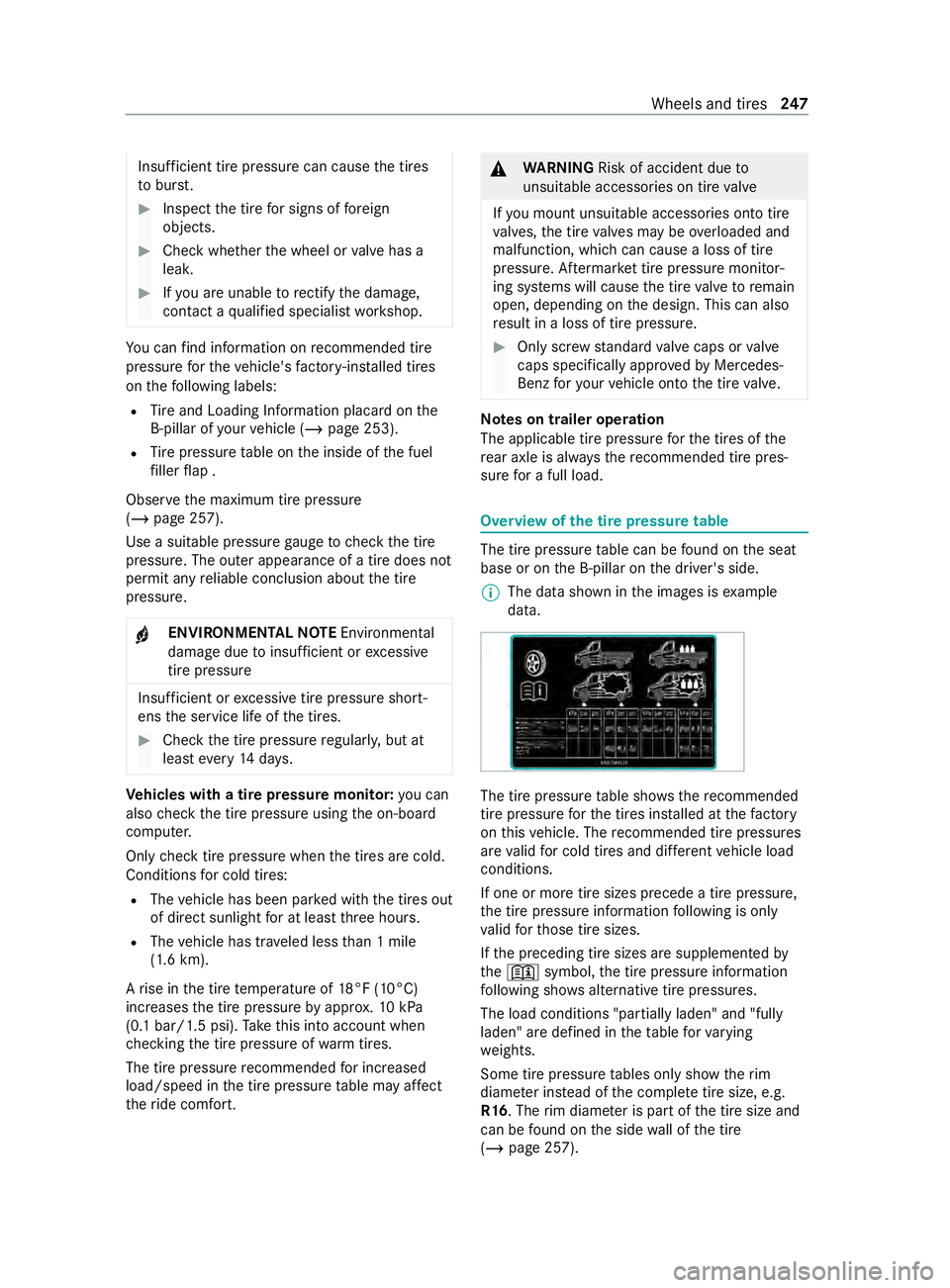
sur efor afull load. Overvie
wofthe tirepressur etable The tir
epressur etable can be found on thes eat
base or on theB ‑pillar on thed rive r's side.
% The dat
ashown in thei mages is example
data. The tir
epressur etable sho ws therecommended
tir ep ressur efor thet ires ins talled at thef actory
on this vehicle. The recommended tir epressures
ar ev alid forc old tires and dif fere nt vehicle load
conditions.
If one or mor etires izes precede atirep ressure,
th et irep ressur einformation following is only
va lid fort hose tir esizes.
If th ep receding tir esizes ar esupplemented by
the 0091 symbol, thet irep ressur einformation
fo llowing sho wsalternativ etirep ressures.
The load condition s"partiall yladen "and "fully
laden "aredefine dinthetable forv arying
we ights.
Som etirep ressur etables onl yshowt he rim
diame teri ns tead of thec omple tetires ize, e.g.
R16.T herimd iame terisp artoft he tir esize and
can be found on thes ide wall of thet ire
(/ page257). Wheels and tires
247
Page 250 of 348
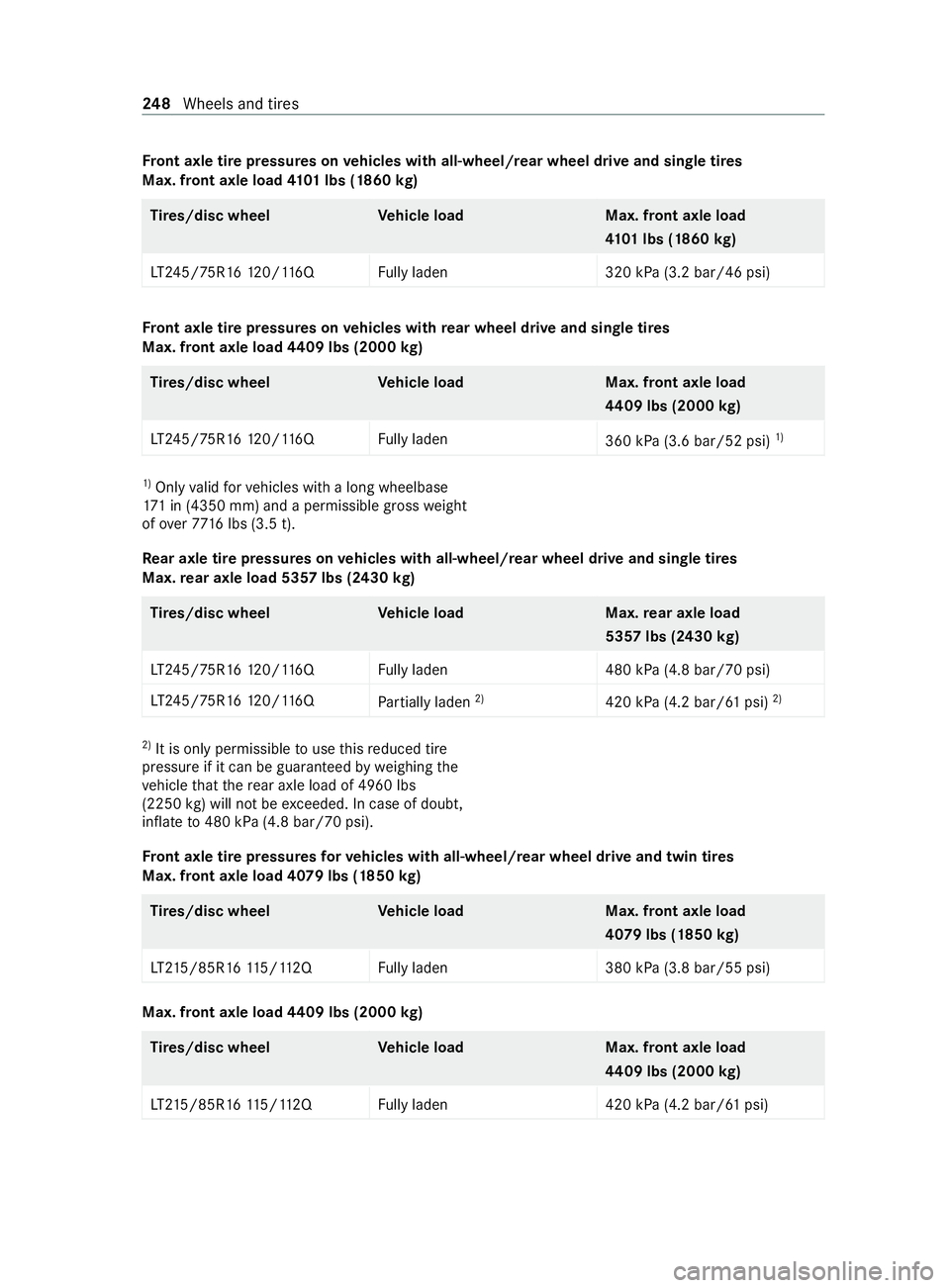
Fr
ont axle tir epressures on vehicles with all-wheel/rear wheel driv eand single tires
Max. front axle load 4101 lbs (1860 kg) Ti
re s/disc wheel Vehicl eload Max. front axle load
4101 lbs (1860 kg)
LT 24 5/75R1 6120/1 16QF ullyladen 320k Pa(3.2b ar/46 psi) Fr
ont axle tir epressures on vehicles with rear wheel driv eand single tires
Max. front axle load 4409 lbs (2000 kg) Ti
re s/disc wheel Vehicl eload Max. front axle load
4409 lbs (2000 kg)
LT 24 5/75R1 6120/1 16QF ullyladen
360k Pa(3.6b ar/52 psi) 1) 1)
Only valid forv ehicles wit halong wheelbase
17 1in( 4350 mm) and apermissible gross weight
of ove r7716l bs (3. 5t).
Re ar axle tir epressures on vehicles with all-wheel/rear wheel driv eand single tires
Max. rear axle load 535 7lbs (2430 kg) Ti
re s/disc wheel Vehicl eload Max.rear axle load
535 7lbs (2430 kg)
LT 24 5/75R1 6120/1 16QF ullyladen 480k Pa(4.8b ar/70 psi)
LT 24 5/75R1 6120/1 16 Q
Partiall yladen 2)
420 kPa(4.2b ar/6 1psi)2) 2)
It is onl ypermissible touse this reduced tire
pressur eifitcan be guaranteed byweighing the
ve hicle that ther ear axle load of 4960 lbs
(2250 kg)w ill no tbee xceeded. In case of doubt,
inflat eto4 80 kPa(4.8 bar/70 psi).
Fr ont axle tir epressures forv ehicles wit hall-wheel/rear wheel driv eand twin tires
Max. front axle load 4079 lbs (1850 kg)Ti
re s/disc wheel Vehicl eload Max. front axle load
4079 lbs (1850kg)
LT 21 5/85R1 6115/112 QF ullyladen 380k Pa(3.8b ar/55 psi) Max. front axl
eload 4409 lbs (2000 kg) Ti
re s/disc wheel Vehicl eload Max. front axle load
4409 lbs (2000 kg)
LT 21 5/85R1 6115/112 QF ullyladen 420k Pa(4.2b ar/ 61psi) 248
Wheels and tires
Page 251 of 348
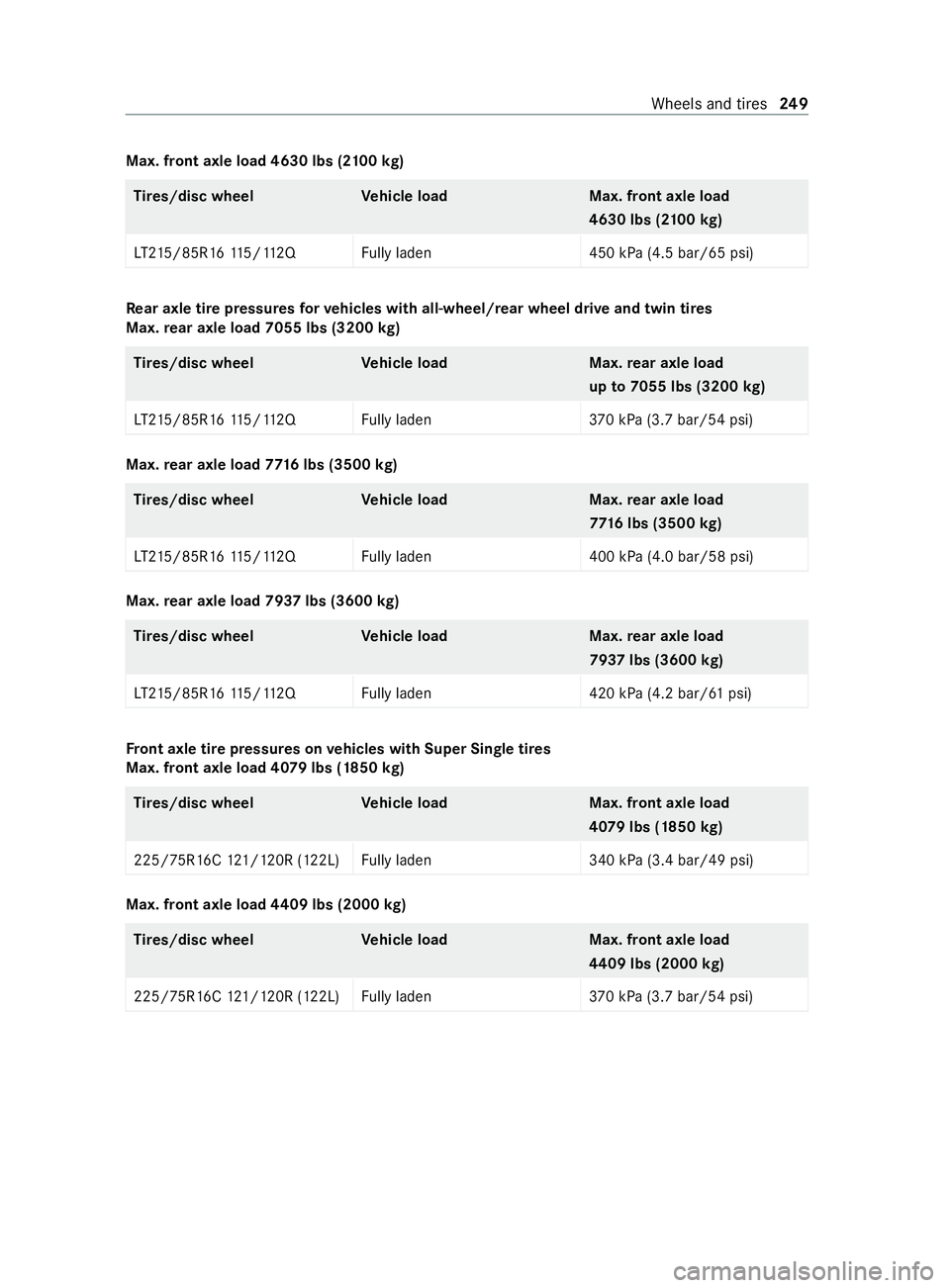
Max. front axle load 4630 lbs (2
100k g) Ti
re s/disc wheel Vehicl eload Max. front axle load
4630 lbs (2100k g)
LT 21 5/85R1 6115/112 QF ullyladen 450k Pa(4.5b ar/65 psi) Re
ar axle tir epressures forv ehicles wit hall-wheel/rear wheel driv eand twin tires
Max. rear axle load 7055 lbs (3200 kg)Ti
re s/disc wheel Vehicl eload Max.rear axle load
up to7055 lbs (3200 kg)
LT 21 5/85R1 6115/112 QF ullyladen 370k Pa(3.7 bar/5 4psi) Max.
rear axle load 7716 lbs (3500 kg) Ti
re s/disc wheel Vehicl eload Max.rear axle load
77 16 lbs (3500 kg)
LT 21 5/85R1 6115/112 QF ullyladen 400k Pa(4.0b ar/58 psi) Max.
rear axle load 793 7lbs (3600 kg) Ti
re s/disc wheel Vehicl eload Max.rear axle load
793 7lbs (3600 kg)
LT 21 5/85R1 6115/112 QF ullyladen 420k Pa(4.2b ar/ 61psi) Fr
ont axle tir epressures on vehicles with Super Single tires
Max. front axle load 4079 lbs (1850 kg)Ti
re s/disc wheel Vehicl eload Max. front axle load
4079 lbs (1850kg)
225/75R16C 121/120R (122L) Fullyl aden 340 kPa(3.4b ar/4 9psi) Max
.fro nt axle load 4409 lbs (2000 kg) Ti
re s/disc wheel Vehicl eload Max. front axle load
4409 lbs (2000 kg)
225/75R16C 121/120R (122L) Fullyl aden 370k Pa(3.7 bar/5 4psi) Wheels and tires
249