trailer MERCEDES-BENZ SPRINTER 2020 MY20 with 7” screen
[x] Cancel search | Manufacturer: MERCEDES-BENZ, Model Year: 2020, Model line: SPRINTER, Model: MERCEDES-BENZ SPRINTER 2020Pages: 348, PDF Size: 5.84 MB
Page 171 of 348
#
Install and secur ethe ball coupling as
described in theb all coupling manufac‐
turer's ins tallation instructions. #
When theb all coupling has been ins tal‐
led, ensur ethat it is cor rectly secu red
befor eevery trip. *
NO
TEWearing out theb rake linings by
continuously dep ressing theb rake pedal #
Do no tdepress theb rake pedal continu‐
ously whils tdriving. #
Touse theb raking ef fect of thee ngine,
shif ttoa lowe rgear in good time. Alw
aysc ompl ywitht he operating instructions of
th em anufacturer of thet railer coupling and the
ball nec k.
Place your vehicle/trailer combination on sur fa‐
ces that ar ease vena spossible and secu reit
agains trolling away ( /pag e140). Coupl eand
uncoupl ethe trailer carefully.
When backing up thet ow ing vehicle, ensur ethat
th er eisn o-one between thev ehicle and the
traile r.
If yo udon otcouple thet railer tothet ow ing vehi‐
cle cor rectly ,the trailer ma ybecome de tach ed.
Onceith as been coupled and is roadwor thy, the
traile rmustbeinah orizontalp osition behin dthe
to wing vehicle.
No tethef ollowing rega rding thet ongue weight:
R Mak efull use of them aximum tongu eweight,
wher epossible.
R Neverfall belo walegally prescribed minimum
to ngu eweight ;the tongu eweight must
alw aysbep ositive.
R Do no texceed or fall belo wthe permissible
to ngu eweights –this mus tbeobservedd ur‐
ing loading and unloading of thet railer.
Do no texceed thef ollowing values:
R Perm itted braked or unbraked towing capa‐
city
The maximum permissible towing capacity for
unbraked trailer sis1,653 lbs (750 kg).
R Perm issible rear axle load of thet ow ing vehi‐
cle
R Perm issible gross mass of thet ow ing vehicle
R Perm issible gross mass of thet railer R
Perm issible grosscombination mass
R Maxi mump ermissible speed of thet railer
The releva nt pe rmitted values, whic hmustn otbe
exc eeded, can be found in thef ollowing places:
R Inyour vehicle documents
R Onthei dentification plat eofthe trailer hitch
R Onthet railer's identification plate
R Onthev ehicle identification plate
If th er ea rediscrepancies between thev alues, the
lo we stone shall appl y.
Befor edriving off, ensu rethef ollowing:
R The tir epressur eont herear axle of thet ow‐
ing vehicle has been se tfor them aximum
load.
R The headlamps ha vebeen se tcorrectly.
Va lues appr ovedbyt he manufacturer can be
fo und on thei dentification plates and in thes ec‐
tion fort he towing vehicle (/ page247).
Yo ur vehicle will beha vediffere ntly wi thatrailer
re lativ etow ithout atrailer:
R The vehicle/trailer combination will be heav‐
ier.
R The vehicle/trailer combination will be
re stricted in its acceleration and climbing
ability.
R The vehicle/trailer combination will ha vean
inc reased brakin gdista nce.
R The vehicle/trailer combination will be more
susceptible tocrosswind gu sts.
R The vehicle/trailer combination will require
mor esensitiv esteering.
R The vehicle/trailer combination will ha ve a
lar gerturning circle.
This ma yimp airt he vehicle's driving characteris‐
tics.
When drivin gwithav ehicle/trailer combination,
alw aysa dap tyour speed tothec urrent road and
we ather conditions. Driv ecarefull y.Ke ep asuffi‐
cient saf edista nce.
Co mp ly wi th th emaximum speed of 49 mph
(80 km/h) or 62 mph(100k m/h) ,eveninc oun‐
trie sinw hich highe rspeed sareperm itted for
ve hicle/trailer combinations.
Comply wit hthe legally prescribed maximum
speed forv ehicle/trailer combination sinforce in
th ec ount ry,s tate or Canadian pr ovinc einq ues‐
tion. Befor esetting off, consult thet railer's vehi‐ Driving and parking
16 9
Page 172 of 348
cle documents
tosee them aximum permissible
speed fory our trailer.
At tach onl yana pproved trailer hitc htoyourvehi‐
cle. Use only aball nec kthat has been appr oved
fo ry our vehicle. Further information about availa‐
bilit yand ins tallation of thet railer electrics is
av ailable from an yqualified specialis tworks hop.
The trailer hitc hisone of them ostimp ortant
ve hicle parts forr oad saf ety. Compl ywitht he
instructions on operating, maintaining and servic‐
ing in them anufacturer's operating instructions.
% Yo
ur vehicle's bumper sarenots uitable for
ins talling de tach able trailer towh itch es.
Do no tattac hanyrented traile rtow hitches or
an yo ther de tach able trailer towh itch es tothe
bumpers.
% When using
atrailer ,remember that
PA RKTRONI Cisavailable onl ytoalimited
ex tent, if at all.
% The height of
theb all head will change
depending on thev ehicle's load. In this case,
use atrailer wit haheight-adjus table dr aw‐
bar.
Driving no tes
The maximum permissible speed forv ehicle/
trailer combination sdepends on thet ype of
trailer .Befor esetting off, consult thet railer's
ve hicle documents tosee them aximum permissi‐
ble speed fory our trailer.
Yo ur vehicle will beha vediffere ntl yw ithat railer
re lativ etow ithout atrailer ,and will consume
mor efuel. In thec ase of along and steep
descent, youm usts elec tshif trange 3,2or 1in
good time.
% This also applies if
thec ruise cont rolis
switched on.
Yo uw illthereb ymakeu se of thee ngine' sbraking
ef fect and will no thave tobrak easo ften tocon‐
trol thes peed. This will take some of thes train
of ft he brak esystema nd pr event theb rake sf rom
ove rheating and wearing tooq uickl y.Ifyo un eed
additional braking, depress theb rake pedal inter‐
mittently rath er than continuousl y.
Drivin gtips
If th et railer sw ays, remember thef ollowing
points:
R Do no taccelerat eunder an ycircums tances.
R Do no tcounter steer.
R If necessar y,appl ythe brakes. %
Yo
uc an pr eventthet railer from sw aying and
rock ingbyretrofitting stabilizer bar or trailer
st abilit yprograms. Youc an obtain fur ther
information from an authorized Mercedes-
Benz Center.
When youa redrivin gwithat railer ,compl ywith
th ef ollowing points:
R Maintain agreater dis tance than when driving
without atrailer.
R Avoid braking abruptl y.If possible, brak egen‐
tl yf irst of al lsot hatthet railer closes up
behind your vehicle. Then, increase theb rak‐
ing forc er apidl y.
R The values given fors tart-o ff gradeability
re fertos ea level. When driving in moun tain‐
ous areas, no tethat engine output, and there‐
fo re start-of fgradeability ,will dec rease with
inc reasin galtitude. Coupling/uncoupling
atrailer Coupling
atrailer
* NO
TEDama getothev ehicle batter ydue
to full discharge Charging
thet railer batter yusing thep ower
supply of thet railer can damag ethe vehicle
batter y. #
Do no tuse thev ehicle's po wersupply
to charge thet railer batter y. #
Shif tthe selector le vertop osition 005D. #
Appl ythe vehicle's parking brake. #
Close all thed oors. #
Position thet railer on alevel sur face behind
th ev ehicle.
% The ball head height
changes depending on
th ev ehicle's load. In this case, use atrailer
wit hah eight-adjus table trailer dr awbar. #
Couple up thet railer. #
Establish all electrical and other connections
to thet railer. #
Remo veobject sordevices whic hpreve nt the
traile rfromr olling, e.g. wheel choc ks. #
Release thet railer's parking brake.
% The
vehicle harness has acable connection
to theb rake light indicator lamp.
Obser vethem aximum permissible trailer dimen‐
sions (widt hand length). 17 0
Driving and pa rking
Page 173 of 348
Mos
tUSs tatesa nd all Canadian pr ovinces pre‐
scribe thef ollowing points, and youa reurge ntly
re commended tocomply wi th these:
R Safetyc hains between thet ow ing vehicle and
th et railer .The chains shoul dberouted in a
criss-cross patter nunde rthe trailer dr awbar.
The ym ustbec onnected tothet railer tow
hitc hand no ttothe bumper or tothev ehicle
axle.
Lea vesuf ficient sla ckinthec hains. This
allo wsfore vens harp cornering.
R Aseparat ebrake system is requ ired forc er‐
ta in trailers.
R Asafet yf eatur eisrequired forb rake dt railers.
De term ine thes pecific requirements acco rd‐
ing tother ele vant la ws.
If th et railer becomes de tach ed from thet ow‐
ing vehicle, thes afet yf eatur etrigger sthe
trailer brakes and can thus reduce thed anger.
Un coupling atrailer &
WARNING Risk of being crushed and
becoming trapped whe nuncoupling a
trailer
Whe nuncoupling atrail er wi than engaged
ine rtia-activated brake, your han dmay
become trapped between thev ehicle and the
traile rdrawbar. #
Do no tuncouple trailer swithan
engaged overrun brake. Do no
tuncouple atrailer wit hanoverrun brak ein
as tate ofove rrun. Otherwise, ther ebound of the
ove rrunb rake can damag eyour vehicle. #
Shif tthe selector le vertop osition 005D. #
Appl ythe vehicle's parking brake. #
Close all thed oors. #
Appl ythe trailer's parking brake. #
Secur ethe trailer agains trolling away wit ha
wheel choc kors imilar object. #
Remo vethet railer cables and saf etyc hains. #
Uncouple thet railer. Information about
towing atrailer Operatin
gatrailer is subject toman ystatutory
re gulations suc hasspeedrestrictions.
Man ystatesa lso requ ireana uxiliaryseparate
functional brakin gsystem when towing aweight
th at exc eeds acertain limit .For your saf ety, it is re
commended touse aseparat efunctional brak‐
ing sy stem on an ytowe dvehicle.
Mak esuret hat your trailer combinatio nmeets
local regulations. This no tonlya pplies to your
plac eofr esidence, but also to your destination.
In fo rm atio nont his can be obtained from the
police and local authorities.
Compl ywitht he following when driving wit ha
trailer:
R Practice cornering, stopping and backing up
in at raffic-free location. In this wa y,yo uw ill
ga in driving experience and become accus‐
to med tothen ew handling characteristics.
R Befor edriving, checkt he following:
- that thet railer towh itch and ball coupling
ar es ecure
- that thes afet ys wit ch forb rake dt railer sis
functioning cor rectly
- that thes afet yc hains ar esecur eand
undamaged
- that thee lectrical connection saresecure
- that thel ights ar efunctioning cor rectly
- thew heels ford ama geand cor rect tire
pressu re (/ pag e244)
R Adjus tthe outside mir rors so that youh ave a
clea rviewoft herear sectio nofthe trailer.
R Ifth et railer is equipped wit hanindividual
braking sy stem, checkb efor eeachj ourney
whe ther theb rake sa refunctioning cor rectl y.
R Ifth et railer has electronicall ycont rolled
brakes, pull away carefully wi th thevehicle/
trailer combination .Brake manually using the
brak econtroller and checkw hether the
brakes ar efunctioning cor rectl y.
R Secu rethel oad on thet railer in line wit hthe
re qu irements and rules forl oad-securing
me thods.
R When driving wit hatrailer ,chec katr egular
inter vals that thel oad is secur eand that the
light sand brakes ar efunctioning cor rectl y.
R Bea rinm indthat theh andling characteristics
ar em oreu nstable when towing atrailer than
when drivin gwithout atrailer .Avoid sudden
st eering mo vements.
R The vehicle/trailer combination is heavier,
accelerates mor eslowl y,has areduced
climbing ability and an increased braking dis‐
ta nce. It is mor esusceptible toside winds
and requ ires careful steering. Driving and parking
171
Page 174 of 348
R
If possible, do no tbrake suddenl y,but rath er
moderatel yatfirst so that thet railer can acti‐
va te its brakes. Then inc rease thep ressur eon
th eb rake pedal.
R Ifth ea utomatic transmission shifts between
ge arsonu phill or downhill gradients ,restrict
th es hiftrange. Select shif trang e4,3,2or1.
Al owe rgear and reduced speed decrease the
ri sk of engine damage.
R When driving on adownhill gradient, shif ttoa
lo we rgear touse thee ngine' sbraking ef fect.
Av oid cons tant braking, as this could cause
th ev ehicle brakes and possibly also the
traile rbrake stoo verheat.
R Ifth ec oolant temp eratur eincreases signifi‐
cant lywhen thea ir-conditionin gsystemis
switched on, switc hthe air-conditioning sys‐
te mo ff.
Coolant heat can also be dissipated by
switching thea irflow and thet emperatur eof
th eh eater or air conditioning tothem aximum
le ve l. Open thew indo wsif necessar y.
R When overtaking ,pay particular attention to
th ei ncreased overtakin gdista nce of your
ve hicle/trailer combination.
Due tothel engt hofy ourvehicle/trailer com‐
bination youw illrequ ireal onger stre tchof
ro ad befor eswit ching bac ktothe original
lane. Pe
rm issible trailer loads and trailer dr awbar
nose weights We
ight information &
WARNING Risk of accident du eto
unbraked trailer wit hexcessivel yhigh
gross weight
If yo ut ow atrailer without aseparat efunc‐
tional brakin gsystema ndagross trailer
we ight (G TW)ofm oret han 1635 lbs (750 kg),
th en thev ehicle brak esystemm ayove rheat.
This increases theb raking dis tance and the
brak esystem ma yevenf ail. #
Alwaysu seatrailer wit haseparate
functional braking sy stem when towing
at railer wit hagross trailer weight
(G TW )ofm oret han 1635 lbs (750 kg). *
NO
TEDama getothed rive train, trans‐
mission or trailer towh itch due toexc ess
gross combination weight The permissible
grosscombination weight is
exc eeded.
The driv etrain, thet ransmission or thet railer
to wh itch ma ybed amaged. #
Compl ywitht he permissible gross com‐
bination weight. Fo
rv ehicles wit hapermissible gross vehicle
we ight of 11030 lbs (5003 kg),th ep ermissible
gross combination weight is less than thes um of
th ep ermissible gross vehicle weight plus thep er‐
missible trailer load. If either thev ehicle or the
traile risfully laden, thep ermitted gross vehicle
we ight or thep ermitted trailer load values are
re duced accordingly .Inthis case, youm ayonly
partially load thet railer or thev ehicle.
The gross trailer weight (G TW)isc alculated by
addin gthe weight of thet railer tothew eight of
th el oad and equipment. If thet railer is equipped
wit has eparat ebraking sy stem, then them axi‐
mum gross trailer weight is 500 0lbs (226 8kg) or
75 00 lbs (3402 kg).
Th em aximu mpermissible trailer dr awbar nose‐
we ight on theb all head is 500 lbs (22 7kg) or
75 0lbs (340 kg). Ho wever,th ea ctual trailer
dr aw bar nose weight mus tnotexc eed thev alue
given on thet railer towh itch or trailer identifica‐
tion plates. Wher ethe values dif fer, th el owest
va lue alw aysa pplies.
The permissible gross weight forv ehicle-trailer
combination s(GCWR)isc alculatedbyaddin gthe
gross weight of thet railer totheg ross vehicle
we ight including adrive r's weight of appr ox‐
imatel y150 lbs (68 kg). The maximum permissi‐
ble gross combination weight is vehicle-specific
and equipment-dependent .When driving wit ha
trailer ,you should no texceed them aximum per‐
mitted permissible gross weight forv ehicle-trailer
combination s(GCWR).
The permissible values, whic hmustn otbe exc ee‐
ded, can be found in your vehicle documents and
on thei dentification plates of thet railer tow
hitch, thet railer and thev ehicle. The values
appr ovedbyt he manufacturer can also be found
in the" Tech nical data" section. Wher ethe values
dif fer, th el owest value alw aysa pplies.
Loading thet railer
Use adrawbar nose weight that is as close as
possible tothem aximum permissible nose‐ 17 2
Driving and pa rking
Page 175 of 348
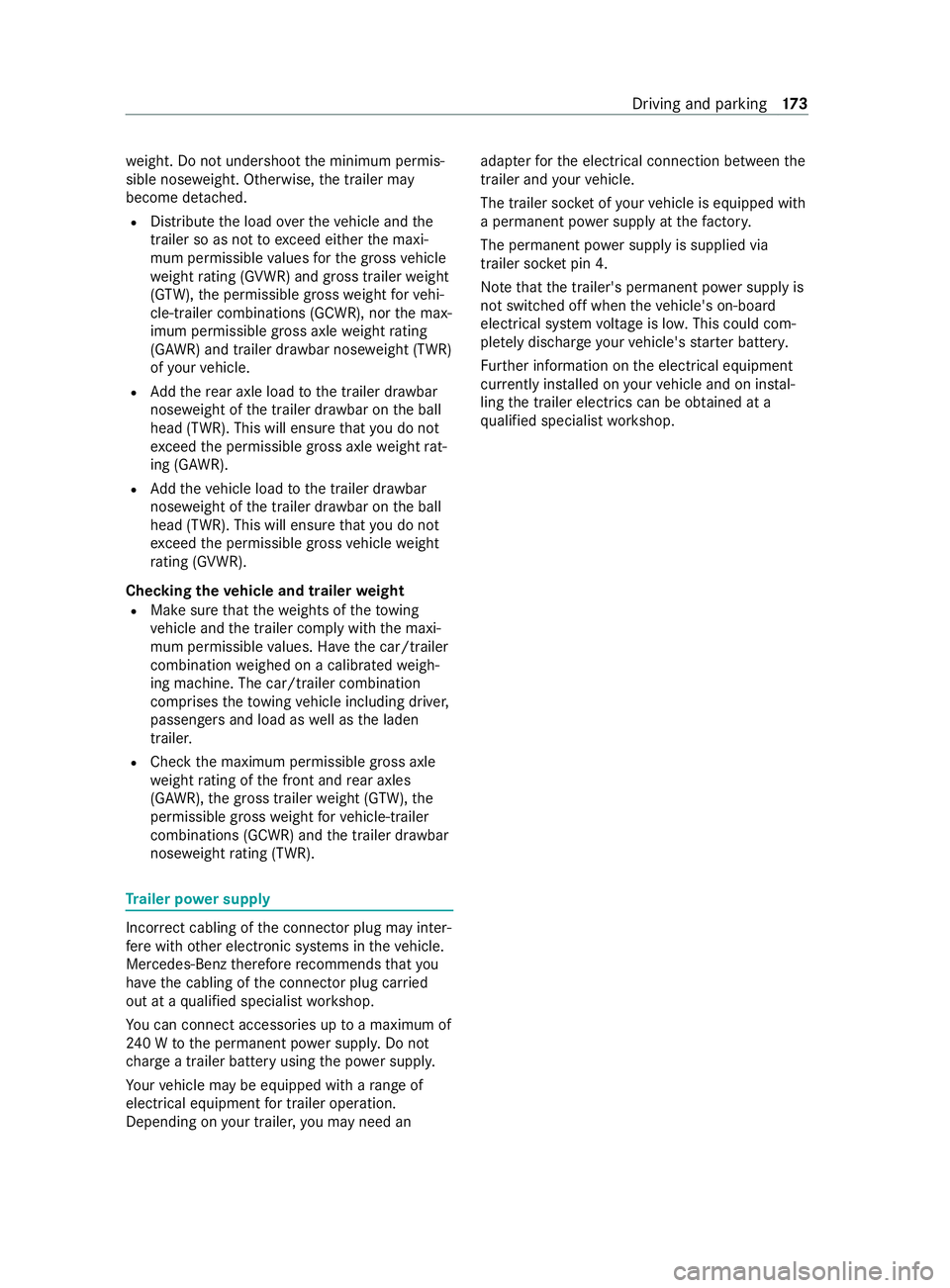
we
ight .Don otundershoo tthe minimum permis‐
sible nose weight .Otherwise, thet railer may
become de tach ed.
R Distribut ethe load over thev ehicle and the
traile rsoasn ot toexceed either them axi‐
mum permissible values fort he gross vehicle
we ight rating (GVWR )and gross traile rweight
(G TW ),th ep ermissible gross weight forv ehi‐
cle-trailer combination s(GCWR), nor them ax‐
imum permissible gross axle weight rating
(GAWR )and traile rdrawbar nose weight (TWR)
of your vehicle.
R Addthe rear axle load tothet railer dr awbar
nose weight of thet railer dr awbar on theb all
head (TWR). This will ensur ethat youdon ot
exc eed thep ermissible gross axle weight rat‐
ing (G AWR).
R Addthe vehicle load tothet railer dr awbar
nose weight of thet railer dr awbar on theb all
head (TWR). This will ensur ethat youdon ot
ex ceed thep ermissible gross vehicle weight
ra ting (GVWR).
Che cking thev ehicle and trailer weight
R Mak esuret hat thew eights of thet ow ing
ve hicle and thet railer comply wit hthe maxi‐
mum permissible values. Ha vethec ar/t railer
combination weighed on acalibrated weigh‐
ing machine. The car/trailer combination
comprises thet ow ing vehicle including driver,
passenger sand load as well as thel aden
trailer.
R Chec kthe maximum permissible gross axle
we ight rating of thef ront and rear axles
(GAWR), theg ross trailer weight (G TW),the
permissible gross weight forv ehicle-trailer
combination s(GCWR)a ndthet railer dr awbar
nose weight rating (TWR). Tr
aile rpowe rsupply Incor
rect cabling of thec onnector plug ma yinter‐
fe re wit ho ther electronic sy stems in thev ehicle.
Mercedes-Ben ztherefor erecommends that you
ha ve thec abling of thec onnector plug car ried
out at aqualified specialis tworks hop.
Yo uc an connec taccesso ries up toam aximum of
24 0Wtot he permanent po wersupply .Don ot
ch arge atrailer batter yusingthe po wersupp ly.
Yo ur vehicle ma ybeequipped wit harangeof
electrica lequ ipment fort railer operation.
Depending on your trailer ,you ma yneedan adap
terf or thee lectrical connection between the
traile rand your vehicle.
The trailer soc ketofy ourvehicle is equipped with
ap ermanent po wersupp lyat thef actor y.
The permanent po wersupp lyis supplied via
trailer soc ketp in4.
No tethat thet railer's permanen tpowe rsupp lyis
no ts witched of fwhen thev ehicle's on-board
electrical sy stem voltag eisl ow.This could com‐
ple tely dischar geyour vehicle's star terb atter y.
Fu rther information on thee lectrical equipment
cur rentl yins talled on your vehicle and on ins tal‐
ling thet railer electrics can be obtained at a
qu alified specialis tworks hop. Driving and parking
17 3
Page 227 of 348
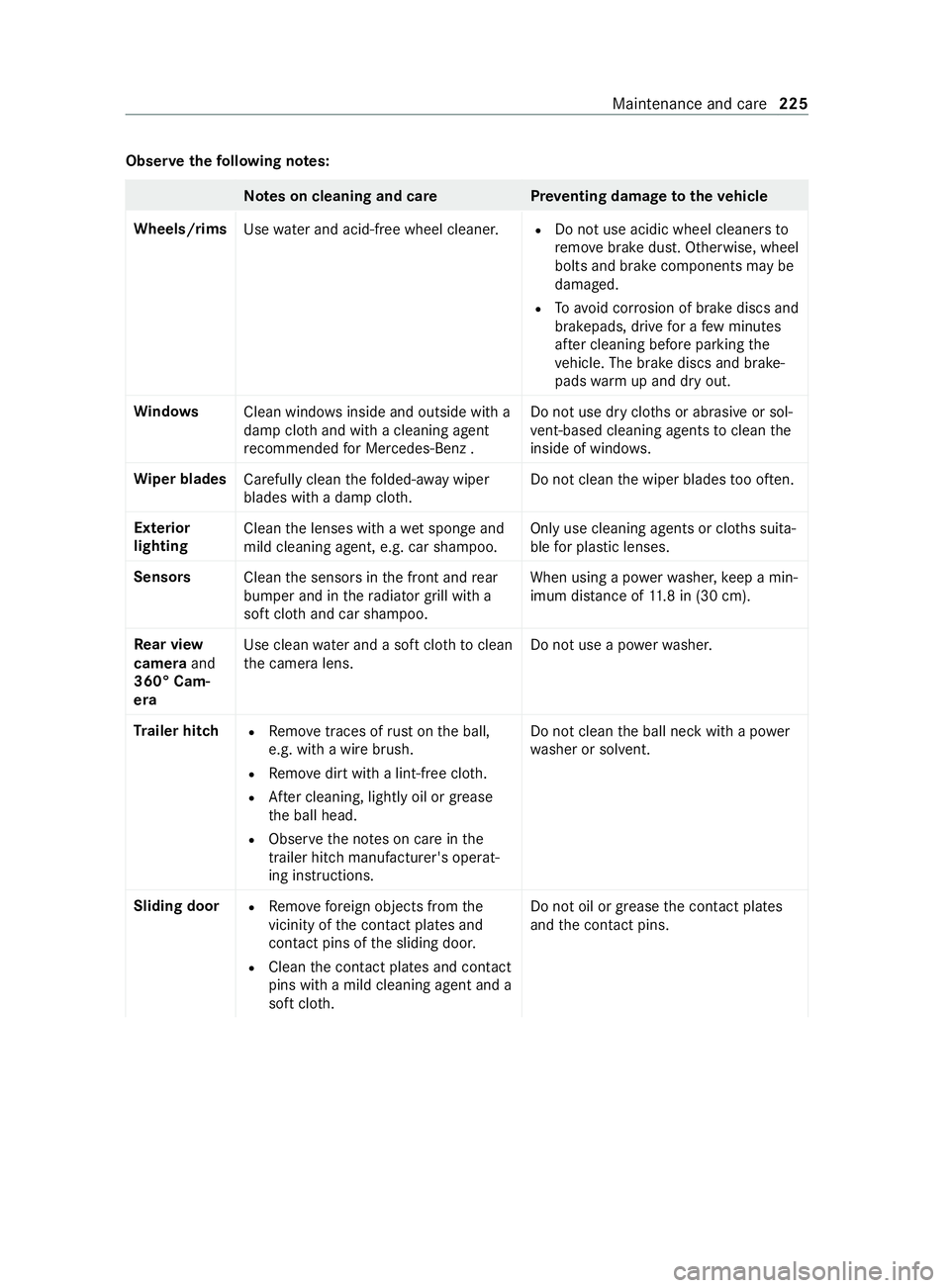
Obser
vethef ollowing no tes: Note
sonc leaning and car eP reve nting damag etothevehicle
Wheels/rims Usewate rand acid-free whee lcleaner. R
Do no tuse acidi cwhee lcleaner sto
re mo vebrak edust. Otherwise, wheel
bolts and brak ecomponents ma ybe
damaged.
R Toavo id cor rosion of brak ediscs and
brakepads, driv efor afew minutes
af te rc leaning befor eparking the
ve hicle. The brak ediscs and brake‐
pads warm up and dr yout.
Wi ndo ws
Clean wind owsinside and outsid ewitha
dam pcloth and wit hacleaning agent
re commended forM ercedes-Benz . Do no
tuse dr ycloth sora brasiv eorsol‐
ve nt-based cleaning agents toclea nthe
insid eofw indows.
Wi per blades
Carefully clea nthe folded-a wayw iper
blade swithad ampcloth. Do no
tclean thew iper blades tooo ften.
Exterior
lighting Clean
thel enses wit hawetspong eand
mil dc leaning agent, e.g .car sha mpoo. Onl
yuse cleaning agents or clo thss uita‐
ble forp last ic lenses.
Sensors Cleanthes ensor sinthe front and rear
bumper and in ther adiator grill wit ha
sof tcloth and car shampoo. When usin
gapowerwashe r,ke ep am in‐
imum dis tance of 11.8 in (30 cm).
Re ar view
camera and
360° Cam‐
era Use clea
nwater and asoftc loth toclean
th ec amer alens. Do no
tuse ap owe rwashe r.
Tr aile rhitch
R
Remo vetrace sofrustont he ball,
e.g. wit hawireb rush.
R Remo vedirtw ithal int-free clo th.
R Afterc leaning, lightly oil or grease
th eb all head.
R Obser vethen otes on car einthe
trailer hitc hmanufactu rer's operat‐
ing instructions. Do no
tclean theb all nec kwithap ower
wa sher or sol vent.
Slidin gdoor
R
Remo vefore ign object sfromt he
vicinity of thec ontact plates and
contact pins of thes liding door.
R Clean thec ontact plates and contact
pins wit hamild cleaning agent and a
sof tcloth. Do no
toilor grease thec ontact plates
and thec ontact pins. Maintenanc
eand care 225
Page 239 of 348
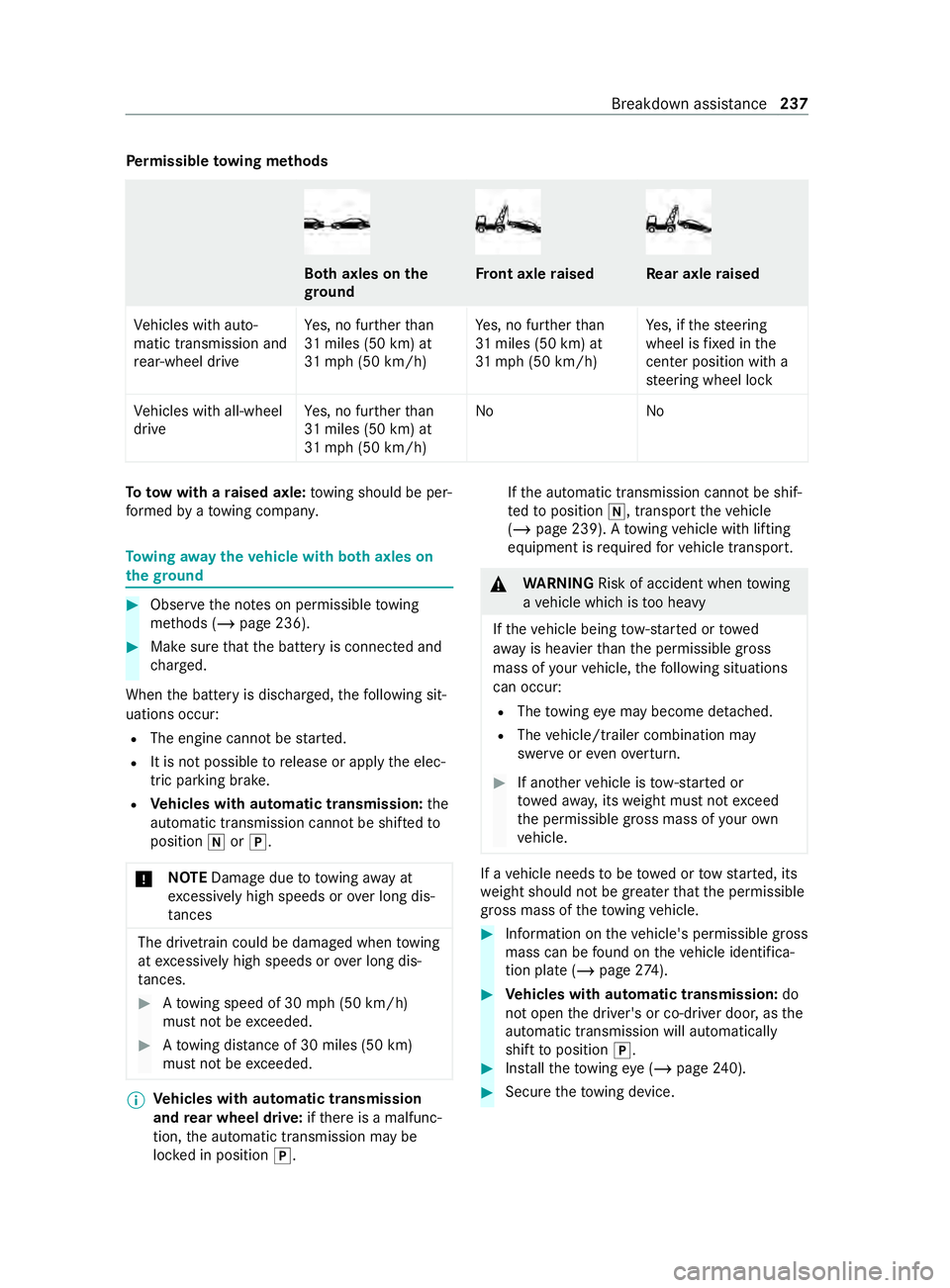
Pe
rm issible towing me thods Bo
th axle sont he
gr ound Fr
ont axle raised Re
ar axle raised
Ve hicles wit hauto‐
matic transmission and
re ar-wheel drive Ye
s, no fur ther than
31 miles (50 km) at
31 mp h(50 km/h) Ye
s, no fur ther than
31 miles (50 km) at
31 mp h(50 km/h) Ye
s, if thes teering
wheel is fixe dint he
center position wit ha
st eering wheel lock
Ve hicles wit hall-wheel
drive Ye
s, no fur ther than
31 miles (50 km) at
31 mp h(50 km/h) No
NoTo
toww ithar aisedaxle: towing should be per‐
fo rm ed byatow ing compan y. To
wing away thev ehicle wit hbotha xleson
th eg round #
Obser vethen otes on permissible towing
me thods (/ page236). #
Mak esuret hat theb atter yisc onnected and
ch arge d.
When theb atter yisd ischar ged, thef ollowing sit‐
uations occur:
R The engine canno tbestarted.
R It is no tpossible torelease or appl ythe elec‐
tric parking brake.
R Vehicles with automatic transmission: the
automatic transmission canno tbeshiftedto
position 005Cor005D.
* NO
TEDama gedue to to wing away at
exc essivel yhigh speeds or overlong dis‐
ta nces The driv
etra in could be damaged when towing
at exc essively high speeds or over long dis‐
ta nces. #
Atow ing speed of 30 mph(50 km/h)
mus tnotbe exc eeded. #
Atow ing distanc eof30miles (50 km)
mus tnotbe exc eeded. %
Ve
hicles with automatic transmission
and rear wheel drive: ifth er eisam alfunc‐
tion, thea utomatic transmission ma ybe
loc kedinp osition 005D. If
th ea utomatic transmission cann otbe shif‐
te dtop osition 005C,transpor tthe vehicle
(/ page239). Atow ing vehicle wit hlifting
equipment is requ ired forv ehicle transport. &
WARNING Risk of accident whe ntow ing
av ehicle whic histoo heavy
If th ev ehicle being tow- star tedort owed
aw ay is heavier than thep ermissible gross
mass of your vehicle, thef ollowing situations
can occur:
R The towing eyem aybecome de tach ed.
R The vehicle/trailer combination may
swer veoreve noverturn. #
If ano ther vehicle is tow- star tedor
to we da way,its weight mus tnotexc eed
th ep ermissible gross mass of your own
ve hicle. If
av ehicle needs tobe towe dort ow st arted, its
we ight should no tbegreater that thep ermissible
gross mass of thet ow ing vehicle. #
Information on thev ehicle's permissible gross
mass can be found on thev ehicle identifica‐
tion plat e(/pag e274). #
Vehicles with automatic transmission: do
no to pen thed rive r's or co-driver door ,asthe
automatic transmission will automatically
shif ttop osition 005D. #
Installth et ow ing eye( /pag e240). #
Secur ethe towing device. Breakdown assis
tance 237
Page 240 of 348
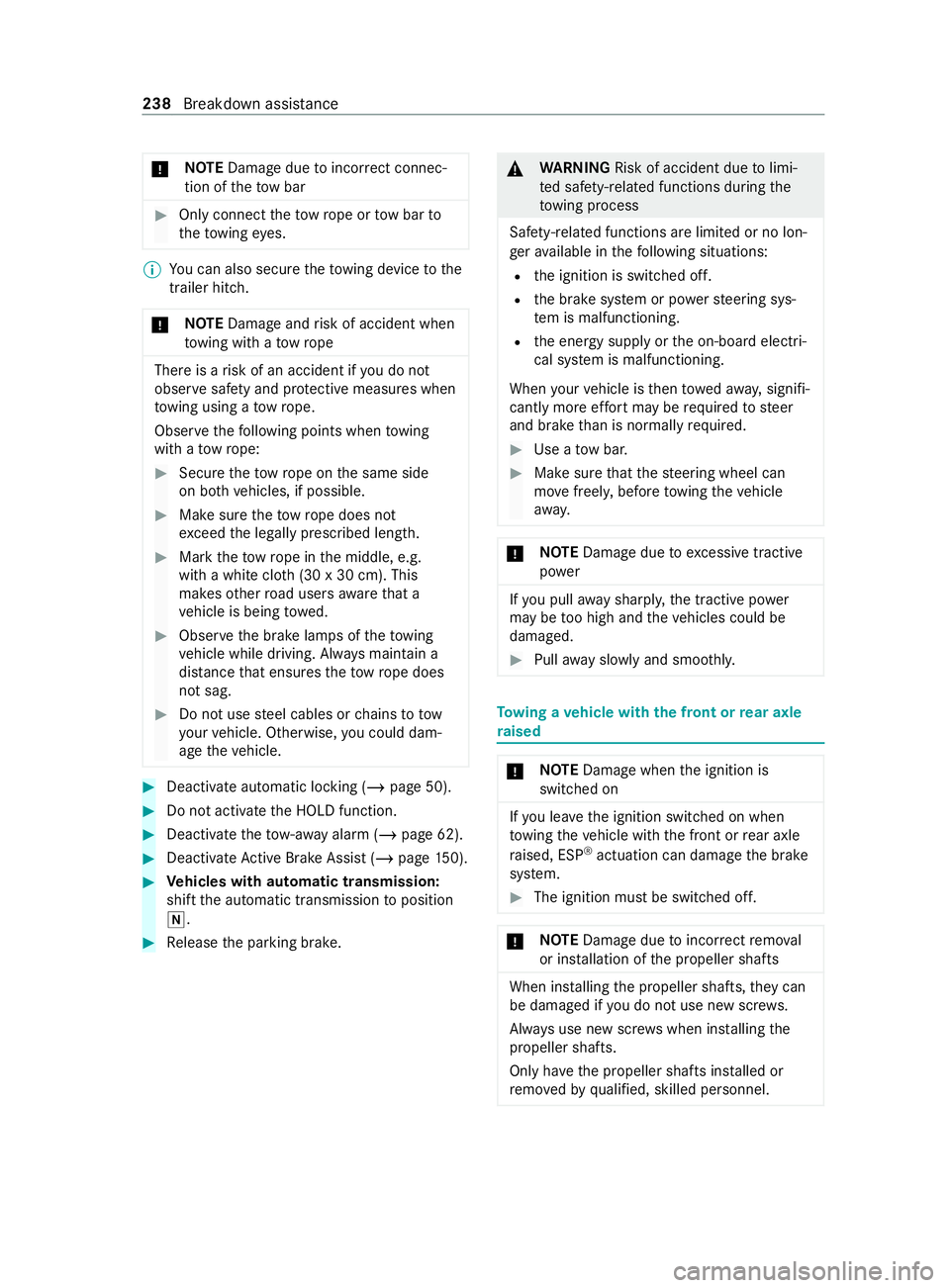
*
NO
TEDama gedue toincor rect connec‐
tion of thet ow bar #
Onlyconnec tthe towr ope or towb arto
th et ow ing eyes. %
Yo
uc an also secur ethe towing devic etothe
trailer hitch.
* NO
TEDama geand risk of accident when
to wing wit hatow ro pe Ther
eisar isk of an accident if youdon ot
obse rves afet ya nd pr otectiv emeasures when
to wing using atow ro pe.
Obser vethef ollowing points when towing
wit hat ow ro pe: #
Secur ethe towr ope on thes ame side
on bo thvehicles, if possible. #
Mak esuret he towr ope does not
exc eed thel egally prescribed length. #
Mar kthe towr ope in them iddle, e.g.
wit haw hitec loth (30 x30c m). This
makes other road user sawarethat a
ve hicle is being towe d. #
Obser vetheb rake lamps of thet ow ing
ve hicle while driving. Alw aysm aintain a
dis tance that ensures thet ow ro pe does
no ts ag. #
Do no tuse steel cables or chains to tow
yo ur vehicle. Otherwise, youc oul dd am‐
ag et he vehicle. #
Deactivat eautomatic locking (/ page50). #
Do no tactivat ethe HOLD function. #
Deactivat ethe tow- aw ay alar m(/pag e62). #
Deactivat eActiv eBrake Assi st (/ pag e150). #
Vehicles with automatic transmission:
shif tthe automatic transmission toposition
005C. #
Release thep arking brake. &
WARNING Risk of accident du etolimi‐
te ds afet y-re lated function sduring the
to wing process
Saf ety-re lated function sarelimited or no lon‐
ge ra vailable in thef ollowing situations:
R thei gnition is switched off.
R theb rake system or po wersteering sys‐
te mism alfunctioning.
R thee nergy suppl yorthe on-boar delectri‐
cal sy stem is malfunctioning.
When your vehicle is then towe da way,signifi‐
cantly mor eeffor tm aybe requ ired tosteer
and brak ethan is normally required. #
Use atow bar. #
Mak esuret hat thes teering wheel can
mo vefreely ,befor etow ing thev ehicle
aw ay. *
NO
TEDama gedue toexc essiv etractive
po wer If
yo up ullaway sharpl y,thet ractiv epower
ma ybet oo high and thev ehicles could be
damaged. #
Pull away slowl yand smoo thly. To
wing avehicle wit hthe front or rear axle
ra ised *
NO
TEDama gewhen thei gnition is
switched on If
yo ul eave thei gnition switched on when
to wing thev ehicle wit hthe front or rear axle
ra ised, ESP ®
actuation can damag ethe brake
sy stem. #
The ignition mus tbeswitched off. *
NO
TEDama gedue toincor rect remo val
or ins tallation of thep ropeller shafts When ins
talling thep ropeller shafts, they can
be damaged if youdon otuse ne wscrew s.
Alw aysu se ne wscrew sw hen ins talling the
propeller shafts.
Onl yhave thep ropeller shafts ins talled or
re mo vedbyq ualified, skilled personnel. 238
Breakd owna ssis tance
Page 287 of 348
Tr
aile rhitch Note
sont he trailer hitch &
WARNING Risk of accident du etoafter‐
mar ketins tallation of atrailer hitc hthat
is no tpermissible
If af term arke tins tallation of atrailer hitc his
no tp ermissible and youi nstallat railer hitch
or other assembly parts, thel ongitudinal
frame member will be weakene dand may
break .Inthis case, thet railer ma ycome
loose from thev ehicle.
Ther eisar isk of an accident.
Only ins tallat railer hitc haftermar ketifitis
pe rm issible. Obser
vethen otes on trailer operation
(/ page168).
Re trofitting atrailer hitchiso nly pe rmissible if a
to wing capacity is specified in your vehicle docu‐
ments.
Yo uc an obtain fur ther information on thet railer
hitc hataq ualified specialis tworks hop.
Mercedes-Benz recommends that youh ave a
traile rhitch retrofitted at an au thorized
Mercedes-Benz Center.
Onl yuseatrailer hitc hwhichh as been tested
and speciall yappr ove dbyM ercedes-Benzf or
yo ur vehicle.
Use onl yaball nec kthat has been appr ovedfor
yo ur vehicle and fory our Sprinter trailer hitch.
No tesont he permissible dimensions of theb all
nec kcan also be found on thei dentification plate
of thet railer hitch.
The maximum permissible towing capacity for
traile rswithout aseparat ebrakin gsystemis
1, 653 lbs (750 kg). Tr
aile rloads The permissible
weight sand loads whic hmust
no tbee xceeded can also be obtained from the
fo llowing sources of information:
R Vehicle documents
R The identification plates of thet railer hitch,
trailer and vehicle
The values appr ovedbyt he manufacturer can be
fo und in thef ollowing table. If thev alues dif fer,
th el ow estv alue applies. Use acalibrated weigh‐ ing machine
tocheckt he weight restrictions ha ve
been complied wit hbefor eyou star ty our journe y. Te
ch nica ldata 285
Page 289 of 348
Ve
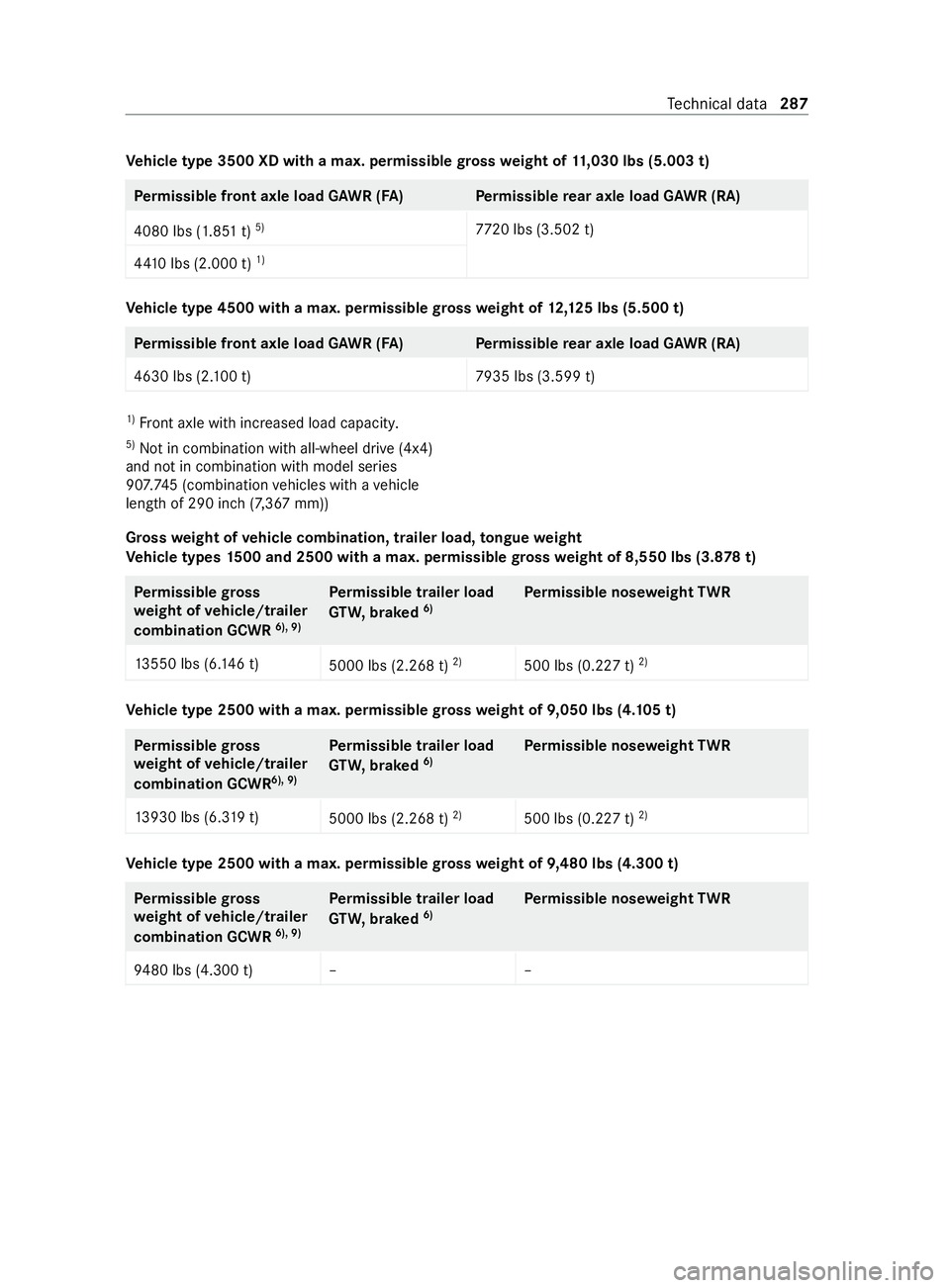
hicl etype 3500 XD with amax. permissible gross weight of 11,03 0lbs (5.00 3t) Pe
rm issible front axle load GAWR (FA) Perm issible rear axle load GAWR (RA)
4080 lbs (1.85 1t)5)
7720 lbs (3.502 t)
44 10 lbs (2.000 t) 1) Ve
hicl etype 4500 with amax. permissible gross weight of 12,125 lbs (5.500 t) Pe
rm issible front axle load GAWR (FA) Perm issible rear axle load GAWR (RA)
4630 lbs (2. 100t )7 935 lbs (3.599 t)1)
Front axle wit hincreased load capacity.
5) No tinc ombination wit hall-wheel driv e(4x4)
and no tincombination wit hmodel series
90 7.74 5( combination vehicles wit havehicle
lengt hof2 90 inc h(7,36 7m m))
Gross weight of vehicl ecombination, traile rload, tongue weight
Ve hicl etypes 1500 and 2500 wit hamax.p ermissible gross weight of 8,550 lbs (3.8 78t) Pe
rm issible gross
we ight of vehicle/trailer
combination GCWR 6), 9)Pe
rm issible trailer load
GT W, braked 6) Pe
rm issible nose weight TWR
13 550 lbs (6. 146t)
5000 lbs (2.268 t) 2)
500 lbs (0.22 7t)2) Ve
hicl etype 2500 with amax. permissible gross weight of 9,050 lbs (4. 105t) Pe
rm issible gross
we ight of vehicle/trailer
combination GCWR 6), 9)Pe
rm issible trailer load
GT W, braked 6) Pe
rm issible nose weight TWR
13 930 lbs (6.3 19t)
5000 lbs(2.268 t) 2)
500lbs (0 .227t) 2) Ve
hicl etype 2500 with amax. permissible gross weight of 9,480 lbs (4.300 t) Pe
rm issible gross
we ight of vehicle/trailer
combination GCWR 6), 9)Pe
rm issible trailer load
GT W, braked 6) Pe
rm issible nose weight TWR
94 80 lbs (4.300 t) –– Te
ch nica ldata 287