belt MERCEDES-BENZ SPRINTER 2020 MY20 with 7” screen
[x] Cancel search | Manufacturer: MERCEDES-BENZ, Model Year: 2020, Model line: SPRINTER, Model: MERCEDES-BENZ SPRINTER 2020Pages: 348, PDF Size: 5.84 MB
Page 155 of 348
Sy
stem limitations
The sy stem ma ybeimpaired or ma ynotfunction
in thef ollowing ins tances:
R The radar sensor sareaffected bysno w,rain,
fo g, heavy spr ay,g lare, direct sunlight or
greatly varying ambien tlight.
R The radar sensor smaymalfunction in parking
ga rage soronr oads wit hsteep uphill or
downhill gradients.
R Ifth er adar sensor saredirty or co vered.
R On icy or slipper yroads, braking or accelerat‐
ing can caus ethe driv ewheels tolose trac‐
tion and thev ehicle could then skid.
R Stationar yobject sarenotd etected if these
we renotp reviousl ydetected as moving.
R On bends, target vehicles ma ybelostorn ot
re cognized cor rectl y.As aresult, atarget
ve hicle is no tused toregulat ethe speed
whic hmaylead tounwa nted accele ration.
Do no tuse ActiveD ista nce Assi stDISTRONI Cin
th ese situations. &
WARNING Risk of accident from acceler‐
ation or braking byActiveD ista nce Assi st
DISTRONIC
Ac tiveD ista nce Assi stDISTRONI Cmayaccel‐
erat eorb rake inthef ollowing cases, for
ex ample:
R Ifth ev ehicle pulls away usin gActiv eDis‐
ta nce Assi stDISTRONIC.
R Ifth es tore ds peed is called up and is con‐
siderably faster or slo werthan thec ur‐
re ntly driven speed.
R IfAc tiveD ista nce Assi stDISTRONI Cno
longer de tects avehicle in front or does
no treact toreleva nt objects. #
Alwaysc arefully obser vethet raffic con‐
ditions an dbereadytobrak eata ll
times. #
Take intoa ccount thet raffic situation
befor ecallin gupt hestored speed. &
WARNING Risk of accident du etoinsuf‐
fi cient deceleration byActiveD ista nce
Assi stDISTRONIC
Ac tiveD ista nce Assi stDISTRONI Cbrakes
yo ur vehicle wit hupto5 0% ofthem aximum
possible deceleration. If this deceleration is no
ts ufficient, ActiveD ista nce Assi st
DISTRONI Calertsy ou wit havisualand
acoustic warning. #
Inthese cases, adjus tyour speed and
ke ep asufficient dis tance. #
Brak ethe vehicle yourself and/or take
ev asiv eaction. &
WARNING Risk of accident if de tection
function of ActiveD istan ce Assi st
DISTRONI Cisimpaired
Ac tiveD ista nce Assi stDISTRONI Cdoesn ot
re act or has alimited reaction:
R when drivin gonadiffe re nt lane or when
ch anging lanes
R topedestrians, animals, bicycles or sta‐
tionar yvehicles, or unexpected obs tacles
R tocomple xtraffic conditions
R tooncomin gvehicles and crossing traf fic
As aresult, ActiveD ista nce Assi stDISTRONIC
ma yneith er giv ewarnings nor inter vene in
su ch situations. #
Alwayso bser vethet raffic conditions
carefull yand react according ly. Ac
tiveD ista nce Assi stDISTRONI Cmaynotd etect
nar row vehicles driving in front, e.g. mo torcyc les
and vehicles driving on adiffe re nt line.
Ope ratin gA ctive Distance Assis tDISTRONIC
Re quirements:
R The vehicle has been star ted.
R The parking brak ehas been released.
R ESP ®
is activated and is no tinter vening.
R The transmissio nisinposition005B.
R The driver' sand thef ront-passen gerd oor are
closed.
R The seat occupancy recognition on thed riv‐
er's seat has de tected that thed rive rh as fas‐
te ned thes eat belt.
R The checkoft heradar sensor sy stem has
been successfully comple ted. Driving and parking
15 3
Page 157 of 348
Information on Hill
StartA ssist Hill
StartA ssisth olds thev ehicle foras horttime
when pulling away on ahill under thef ollowing
conditions:
R Vehicles with automatic transmission: the
transmission is in position 005Bor005E.
R The pa rking brak ehas been released.
This gives youe nough tim etomoveyour foot
from theb rake pedal tothea ccelerator pedal and
depress it befor ethe vehicle begins toroll. &
WARNING Risk of accident and inju ry
due tothev ehicle rolling away
Af teras horttime, Hill StartA ssistnol onger
holds thev ehicle and it can rollaw ay. #
Therefore, swiftl ymove your foot from
th eb rake pedal tothea ccelerator
pedal. Ne vera ttem pttolea vethev ehi‐
cle if it is being held byHill StartA ssist. HOLD function
HOLD function
Re quirements:
R The seat occupancy recognition on thed riv‐
er's seat has de tected that thed rive rh as fas‐
te ned thes eat belt.
The HOLD function holds thev ehicle at astand‐
st ill without requ iring youtod epress theb rake
pedal, e.g. when pulling away on steep slopes or
when waitin gint raffic. Whe nyou depress the
accelerator pedal topull away,the braking ef fect
is canceled and theH OLD function is deactiva‐
te d.
The HOLD function is onl yanaid. The responsibil‐
ity fort he vehicle safel ystandi ngstill remains
wit hthe driver.
Sy stem limits
The HOL Dfunction is onl yintende dtoprovide
assis tance when driving and is no tasufficient
means of safeguarding thev ehicle agains trolling
aw ay when stationar y.
R The incline mus tnotbe greater than 30%.
Ac tivating/deactivatin gthe HOL Dfunction
Requ irements: R
The vehicle is stationar y.
R The engine is running or it ha sbeena utomati‐
cally switched of fbythe EC Ostart/s topf unc‐
tion.
R The driver is seated and belted.
R The electric parking brak eisreleased.
R Vehicles with automatic transmission: the
selector le verisinp osition005B,005Eor005C.
R ActiveD ista nce Assi stDISTRONI Cisdeacti va‐
te d.
Ac tivatin gthe HOL Dfunction &
WARNING Risk of an accident du etothe
HOLD function being acti vatedw heny ou
lea vethev ehicle
If yo ul eave thev ehicle while only theH OLD
function is braking thev ehicle, thev ehicle
can rollaw ay inthef ollowing situations:
R Ifth er eisam alfunction in thes ystemor
in thep owe rsupp ly.
R Ifth eH OLD function is deactivated by
depressing thea ccelera torp eda lorb rake
pedal, e.g. byavehicle occupant. #
Alwaysd eactivat ethe HOLD function
and secur ethe vehicle agains trolling
aw ay befor eleaving thev ehicle. *
NO
TEDama gefrom auto matic braking When
ActiveB rake Assi st,A ctiv eDista nce
Assi stDISTRONI Corthe HOLD function are
activated, thev ehicle brakes autonomously in
cer tains ituations.
To avo id damag etothevehicle, deactivate
th ese sy stems in thef ollowing or similars it‐
uations: #
During towing #
Inac arwa sh #
Mak esuret hat thea ctivation conditions are
met. #
Depress theb rake pedal until the00D9 dis‐
pla yappear sinthe multifunction displa y.
The HOLD function is activated. Youc an
re lease theb rake pedal.
% If depressing
theb rake pedal thef irst time
does no tactivate theH OLD function, wait
brief lyand then tr yagain. Driving and parking
15 5
Page 165 of 348
The
ATTENTION ASSIS Tdrows iness or alertness
assessment is dele teda nd restar tedw hen con‐
tinuin gthe journe yinthefollowing situations:
R Ifyo us wit ch offt he engine
R Youu nfas teny our seat belt and open thed riv‐
er's door (e.g. chang edrive rs or tak eabreak)
Setting ATTENTION ASSI ST
Multimedia sy stem:
4 © 5
Settings 5
Assistance
5 Attention Assist
Setting options #
Select Standard, SensitiveorOff. Blind Spo
tAssist Fu
nction of Blind Spo tAssis twith exitwa rn‐
ing
Blind Spo tAssis tuses tw olateral, rear-facing
ra dar sensor stomonitor thea read irectl ynextto
and on thes ide behind thev ehicle.
% US
Ao nly:
This device has been appr ovedbyt he FCC as
a" Vehicular Radar Sy stem". The radar sensor
is intended foru se in an automotiv eradar
sy stem onl y.Re mo val,ta mp ering, or altering
of thed evice will void an ywarranties, and is
no tp ermit tedbyt he FCC. Do no ttamper
with, alter or use in an ynon-appr ovedw ay.
An yu nauthorize dmodificatio ntothis device
could void theu ser's authority tooperat ethe
equipment. &
WARNING Risk of accident despit eBlind
Spo tAssist
Blind Spo tAssis treacts neither tostationary
object snortovehicles approaching and over‐
ta king youatag reatly di fferent speed.
As aresult, Blind Spo tAssis tcanno twarn
driver sinthese situations. #
Alwaysp aycareful attention tothet raf‐
fi cs ituation and maintai nasafed is‐
ta nce at thes ide of thev ehicle. Blind Spo
tAssis tiso nlyana id. It ma yfail to
de tect some vehicles and is no substitut efor
attentiv edriving. Alw ayse nsur ethat ther eiss uf‐
fi cient dis tance tothes ide foro ther road users
and obs tacles.
If av ehicle is de tected ab oves peeds of appr ox‐
imatel y7.5mp h(12 km/h) and this vehicle sub‐
sequentl yenter sthe monitoring rang ed irec tly next
toyour vehicle, thew arning lam pinthe out‐
side mir rorlights up red.
% When
atrailer is connected, ther adar sen‐
sor's field of vision ma ybeimpaired, thereby
making limited monitoring possible. Alw ays
pa yc areful attention tothet raffic situation
and maintain asafed ista nce at thes ide of
th ev ehicle.
If av ehicle is de tected clos etoyourvehicle in the
lateral monitoring rang ea nd yous wit ch on the
tur ns igna lindica torint he cor responding direc‐
tion, awarning tone sounds. The redw arning
lam pint he outside mir rorf lashes. If thet urns ig‐
nal indicator remains switched on, all other
de tected vehicles ar eindicated only bythef lash‐
ing of ther ed warning lamp.
If yo uo vertak eav ehicle quickl y,no warning is
given.
Exit warning
The exitwa rning is an additional function of Blind
Spo tAssis tand warnsv ehicle occupants when
leaving thev ehicle about an yapproaching vehi‐
cles. &
WARNING Risk of accident despit eexit
wa rning
The exitwa rning react sneith er tostationary
object snortovehicles approaching youata
great lydif fere nt speed.
As aresult, thee xit warning canno twarnd riv‐
er sint hese situations. #
Alwaysp ayparticular attention tothe
traf fics ituation whe nopening thed oors
and mak esuret her eiss ufficient clear‐
ance. %
An
exitwa rning is no tissued fors liding doors
and rear-en ddoors. Drivin
gand parking 16 3
Page 210 of 348
R
Fasten thel oad tothet ie-down eyes and dis‐
tribut ethe load evenlya mong them.
R Use tie-down eyes and fastening components
whic haresuitable fort he weight and size of
th el oad. Load distribution
* NO
TERisk of damag etothefloor co ver‐
ing Excessiv
epoint loading on thec argo com‐
partmen tfloor or on thel oad area can nega‐
tivel yaffect thed riving characteristic sand
could damag ethe floor co vering. #
Vehicles with rear-wheel drive: dis‐
tribu tethel oad uniformly .When doing
so, ensur ethat theo verall cen terof
gr av ity of thel oad is alw aysasl owand
close tothec enter as possible and
between thea xles near ther ear axle. #
Vehicles with all-wheel drive: distrib‐
ut et he load uniforml y.When doing so,
ensur ethat theo verall cen terofg ravity
of thel oad is alw aysasl owand close to
th ec enter as possible and between the
axles. Fo
rC argo Vans, buses and Passenger Vans:
R Alwayst ranspor tloads in thec argo compart‐
ment.
R Alwaysp lace thel oad agains tthe seat backr‐
ests of ther ear benc hseat.
R Movelarge and heavy loads as fart ow ards
th ef ront of thev ehicle as possible in the
direction of tra vela ga ins tthe rear ben ch
seat. Stow loads flush wit hthe rear ben ch
seat.
R Alwaysa dditionally secur ethe load wit hsuita‐
ble load securing aids or tie downs.
R The load mus tnotprotru de abo vetheu pper
edg eoft he seat backrests.
R Transpor tloads behin dseat sthat ar enot
occupied.
R Ifth er ear benc hseat is no toccupied, insert
th es eat belts crosswise int othe seat belt
buckle of theo pposit eseat belt. Securing loads
Note
sonl oad securing &
WARNING Risk of accident and injury
du etoi ncorrect use of thel ashing stra ps
If yo ua ttac hthe lashing stra pi ncor rectly
whe nsecu ring loads, thef ollowing ma yoccur
in thee vent of abrup tchanges in direction,
braking maneuver or an accident:
R The tie-down eyes ma ybecome de tach ed
or thel ashing stra pm aytear if thep er‐
missible load is exceeded.
R The load cann otbe restra ined.
This ma ycause thel oad toslip, tip overorbe
fl ung about ,striking vehicle occupants. #
Alwayst ension thel ashing stra ps in the
proper manner and onl ybetwe en the
described tie-down eyes. #
Alwaysu se lashing stra ps designed spe‐
cificall yfor thel oads. %
Obser
vethei nformation relatin gtot he maxi‐
mum loading capacity of thei ndividual cargo
tie-down point. If youc ombin evarious cargo
tie-down points tosecur eaload, alw ayst ake
th em aximum loading capacity of thew eak‐
es tc argo tie-down poin tint oa ccount .During
maximum full- stop braking, forc es ma yact
whic hcan multipl ythe weight of thel oad.
Alw aysu se se veralc argo tie-down point sto
distribut eand spread thel oad. Spread the
load evenly between thec argo tie-down
points or tie-down eyes.
Alw ayso bser vetheo perating instruction sorthe
lashing stra pm anufacturer's instruction sfor the
operation of thel ashing stra p.
Obser vethei nformation relatin gtot he maximum
loading capacity of thec argo tie-down points
(/ page289).
As thed rive r,yo ua re re sponsible fore nsuring the
fo llowing:
R The load is secured agains tslipping, tipping,
ro lling or falling off.
Ta ke usual traf ficc onditions as well as swerv‐
ing or full brak eapplication and bad roads
int oa ccount.
R The applicable requ irements and guidelines
re latin gtol oad-securing practices ar emet.
If th is is no tthe case, this ma yconstitut ea
punishable of fense, depending on local legis‐ 208
Transporting
Page 213 of 348
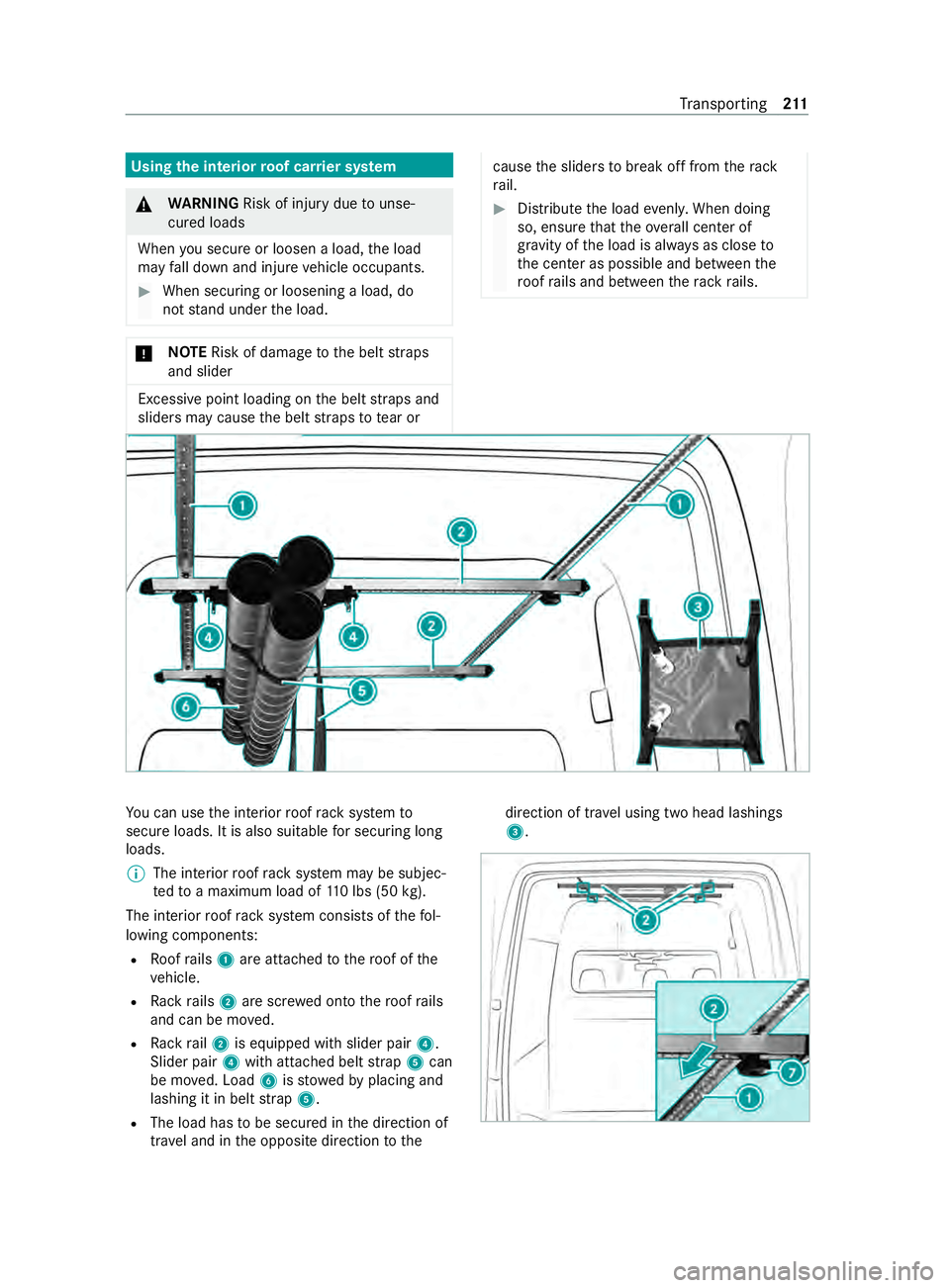
Using the interior
roof car rier sy stem &
WARNING Risk of inju rydue tounse‐
cured loads
When yous ecur eorl oosen aload, thel oad
ma yfall down and injur evehicle occupants. #
When securing or loosening aload, do
no ts tand unde rthe load. *
NO
TERisk of damag etothe belt stra ps
and slider Excessiv
epoint loading on theb elt stra ps and
slider smaycause theb elt stra ps totear or cause
thes lider stob reak of ffro mt herack
ra il. #
Distribut ethe load evenly. When doing
so, ensur ethat theo verall cen terof
gr av ity of thel oad is alw aysasc loseto
th ec enter as possible and between the
ro of rails and between ther ackr ails. Yo
uc an use thei nterior roof rack system to
secur eloads. It is also suitable fors ecuring long
loads.
% The interior
roof rack system ma ybesubjec‐
te dtoam aximum load of 110l bs (50 kg).
The interior roof rack system consists of thef ol‐
lowing components:
R Roofrails 1 area ttached tother oof of the
ve hicle.
R Rack rails 2 ares crew ed ont othe roof rails
and can be mo ved.
R Rack rail2 is equipped wit hslider pair 4.
Slider pair 4witha ttached belt strap 5can
be mo ved. Load 6isstowe dbyp lacing and
lashing it in belt strap 5.
R The load has tobe secured in thed irection of
tra vela nd in theo pposit edirection tothe direction of tra
velu sing tw ohead lashings
3. Tr
ansporting 211
Page 214 of 348
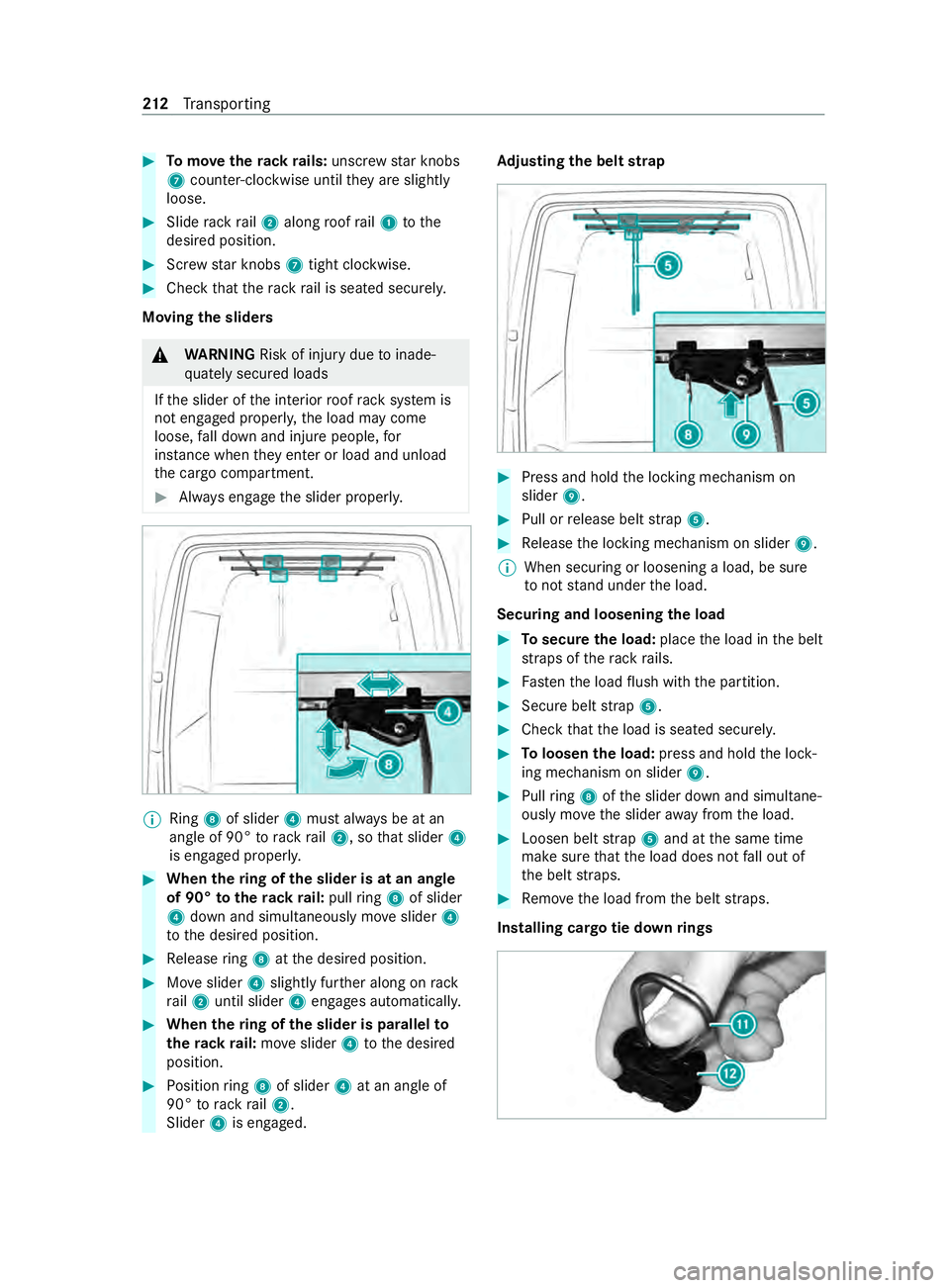
#
Tomo vether ackr ails: unscr ewstar knobs
7 coun ter-clockwise until they ares lightly
loose. #
Sliderackr ail 2 along roof rail1 tothe
desired position. #
Screw star knobs 7tight clo ckwise. #
Chec kthat ther ackr ail is seated securely.
Moving thes liders &
WARNING Risk of inju rydue toinade‐
qu atel ysecured loads
If th es lider of thei nterior roof rack system is
no te ngaged proper ly,t he load ma ycome
loose, fall down and injur epeople, for
ins tance when they enter or load and unload
th ec argo compartment. #
Alwayse ngag ethe slider properly. %
Ring
8of slider 4mus talway sbeatan
angle of 90° torack rail2,sot hat slider 4
is engaged proper ly. #
When ther ing of thes lider is at an angle
of 90° tother ackr ail: pullring 8of slider
4 down an dsimul taneously mo veslider 4
to thed esired position. #
Release ring 8 atthed esired position. #
Moveslider 4slightl yfurther along on rack
ra il2 until slider 4engages automaticall y. #
When ther ing of thes lider is pa rallel to
th er ackr ail: moveslider 4tothed esired
position. #
Position ring 8 of slider 4at an angle of
90° torack rail2.
Slider 4is engaged. Ad
justin gthe belt strap #
Press and hold thel ocking mechanism on
slider 9. #
Pull or release belt strap 5. #
Release thel ocking mechanism on slider 9.
% When securing or loosening
aload, be sure
to nots tand unde rthe load.
Securing and loosening thel oad #
Tosecur ethe load: placethel oad in theb elt
st ra ps of ther ackr ails. #
Fasten thel oad flush wit hthe partition. #
Secur ebelt strap 5. #
Chec kthat thel oad is seated securel y. #
Toloosen thel oad: press and hold thel ock‐
ing mechanism on slider 9. #
Pull ring 8 ofthes lider down and simultane‐
ously mo vethes lider away from thel oad. #
Loosen belt strap 5and at thes ame time
mak esuret hat thel oad does no tfall out of
th eb elt stra ps. #
Remo vethel oad from theb elt stra ps.
Installing cargo tie down rings 212
Transporting
Page 228 of 348
Note
sonc leaning and car eP reve nting damag etothevehicle
Ste ps
R
Clea nthe electrically operated steps
and their housing wit hapower
wa sher.
R Afterc leaning, spr aythel ateral
guides wit hsilicone spr ay.
R Clean thes teps in theb umper wit ha
po we rw ashe r. Do no
tuse oil or grease as alubricant.
Aluminum
dropsides R
Brush down thea luminum dropsides
wit hw ater and aneutral or mild alka‐
line cleaning agent. Do no
tuse abrasiv ecleaning agents to
clea nthe dropsides. Note
soni nterior care &
WARNING Risk of inju ryfrom pla stic
parts breakin goffafte rt he use of sol‐
ve nt-based car eproducts
Ca reand cleaning products con tainin gsol‐
ve nts can cause su rfaces in thec ockpit to
become porous.
When thea irbags ar edeplo yed, plastic parts
ma ybreak away. #
Do no tuse anyc areorc leaning prod‐
ucts containing sol vents toclea nthe
cockpit. &
WARNING Risk of inju ryor deat hfrom
bleached seat belts
Bleaching or dyeing seat belts can se verely
we aken them.
This can, fore xamp le, cause seat belt stotear
or fail in an accident. #
Neverb lea ch or dy eseat belts. Obser
vethef ollowing no tes: Note
sonc leaning and car eP reve nting damag etothevehicle
Seat belts Clean withlukewa rmsoap ywater. R
Do no tuse chemical cleaning
agents.
R Do no tdrythes eat belt byheating
abo ve176°F (80°C )orindirect sun‐
light.
Display Cleanthes urface carefully wi tham icro‐
fi ber clo thand LCD/TFT displ aycare
product. R
Switc hoffthed ispla yand le titcool
down.
R Do no tuse an yother agents.
Plastic trim R
Clean wit hadampm icrofiber clo th.
R Forh eavy soiling: use car eproduct
re commended forM ercedes-Benz . R
Do no taffix sticke rs,f ilms or similar.
R Do no tallowtoc ome int ocontact
wi th cosmetics, insect repellent and
sun creams.
Re alwo od/
trim ele‐
ments R
Clean wit hamicro fiber clo th.
R Blackpiano-lacquer look: clean with
ad am pcloth and soap ywater.
R Forh eavy soiling: use car eproduct
re commended forM ercedes-Benz . Do no
tuse sol vent-based cleaning
agents, polishes or waxes. 226
Maintenance and care
Page 320 of 348
Seat belt
Wa
rning/indicator
lamp Po
ssible causes/consequences and 0050 0050Solutions
0076
Seat belt warning lamp
fl ashes The seat belt
redw arning lam pflashes and an intermit tent wa rning tone
sounds.
*The driver or front passenger doe snothave their belt on while the
ve hicle is in motion (speeds abo ve15 mp h(25 km/h)). #
Putont he seat belt (/ page34).
*Ther eareobject sonthe front passenger seat. #
Remo vetheo bject sfromt he front passenger seat.
0076
Seat belt warning lamp
light sup The seat belt
redw arning lam plight supa fter thee ngine has star ted.
Aw arning tone ma yalsos ound.
*Whe nthe vehicle is stationary: The seat belt warning lam preminds
driver sand front passenger stoput on their seat belt. #
Put on thes eat belt (/ page34).
Objects on thef ront passenger seat ma ypreve nt thes eat belt warn‐
ing lam pfromg oing out. Driving sy
stems Wa
rning/indicator
lamp Po
ssible causes/consequences and 0050 0050Solutions
00BA
Dis tance warning lamp The
redd ista nce warning lam plight supw hileyoua redrivin gand a
wa rning tone sounds.
*Y ou ar eapproaching an obs tacle at tooh igh aspeed. #
Beready toappl ythe brakes immediatel y. #
Increase thed ista nce. Ve
hicle Wa
rning/indicator
lamp Po
ssible causes/consequences and 0050 0050Solutions
00CC
Po we rsteering sy stem
wa rning lamp The po
wersteering sy stem redw arning lam plight supw hilethee ngine
is on.
*The po wersteering assis tance or thes teering itself is malfunctioning. &
WARNING Risk of accident if steering capability is impaired
If th es teering no longer functions as intended, thev ehicle's oper‐
ating saf etyisj eopardized. #
Consult aqualified specialis tworks hop. #
Obser vethem essages on them ultifunction displa y. 318
Displaymessa gesa nd warning and indicator lamps
Page 325 of 348
Overvie
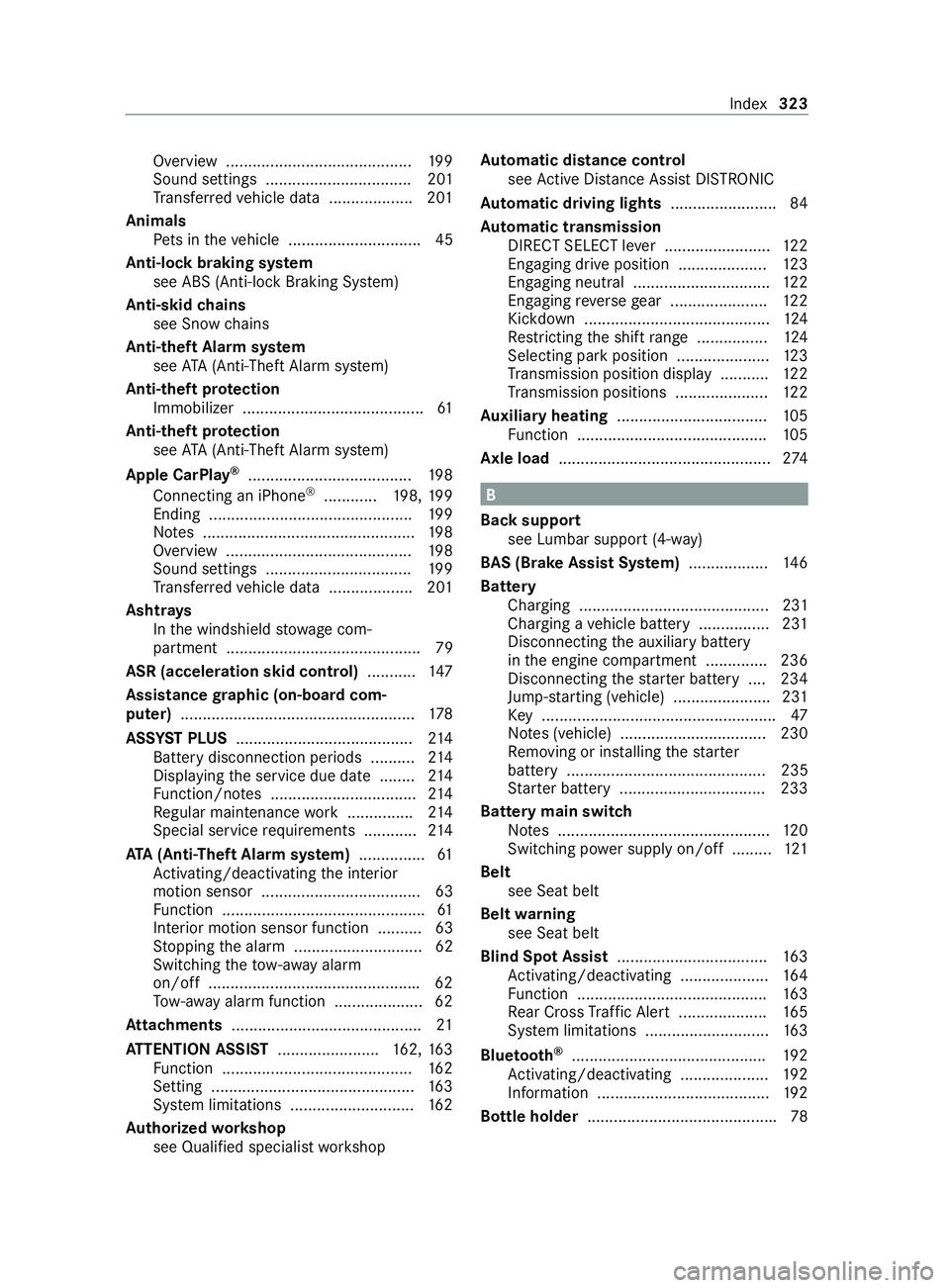
w.......................................... 19 9
Sound settings ................................. 201
Tr ans ferred vehicle dat a...................2 01
Animals Pets in thev ehicle .............................. 45
Anti-loc kbraking sy stem
see AB S(Anti-loc kBrakin gS ystem)
Anti-skid chains
see Sno wchains
Anti-thef tAlarms ystem
see ATA( Anti -Thef tAlarms ystem)
Anti-thef tprotection
Immobilizer ........................................ .61
Anti-thef tprotection
see ATA( Anti -Thef tAlarms ystem)
Apple CarPlay ®
.....................................1 98
Connecting an iPhone ®
............ 198, 19 9
Ending .............................................. 19 9
No tes. ............................................... 19 8
Overvie w.......................................... 19 8
Sound settings ................................. 19 9
Tr ans ferred vehicle dat a...................2 01
Asht rays
In thew indshield stowagec om‐
partment ............................................ 79
ASR (acceleration skid cont rol) .......... .147
Assistance graphic (on-boar dcom‐
puter) ..................................................... 178
ASS YSTP LUS ........................................ 214
Batter ydisconnection period s.......... 214
Displ aying thes ervice due dat e........ 214
Fu nction/no tes. ................................ 214
Re gular maintenance work ............... 214
Special service requirements ............ 214
ATA (Anti-Thef tAlarms ystem) .............. .61
Ac tivating/deactivating thei nterior
motion sensor .................................... 63
Fu nctio n.............................................. 61
Interior motion sensor function .......... 63
St opping thea larm. ............................ 62
Switching thet ow -awa ya larm
on/of f............................................... .62
To w- aw ay alar mfunction .................... 62
At tachments .......................................... .21
AT TENTION ASSI ST....................... 162, 16 3
Fu nctio n........................................... 16 2
Setting .............................................. 16 3
Sy stem limitations ............................1 62
Au thorized workshop
see Qualified specialis tworks hop Au
tomatic distanc econtrol
se eA ctiv eDista nce Assi stDISTRONIC
Au tomatic drivin glights ....................... .84
Au tomatic transmission
DIRECT SELEC Tleve r........................ 12 2
Engaging driv eposit ion. ................... 12 3
Engaging neutral ............................... 12 2
Engaging reve rseg ear ...................... 12 2
Kickdown .......................................... 124
Re stricting thes hiftrang e................ 124
Selecting pa rkposition .....................1 23
Tr ansmission position displa y........... 12 2
Tr ansmission position s..................... 12 2
Au xiliar yheating ..................................1 05
Fu nctio n........................................... 105
Axle load ................................................ 274 B
Bac ksuppo rt
see Lumbar suppor t(4-w ay)
BA S(Brak eAssis tSystem) .................. 14 6
Battery Charging ........................................... 231
Charging avehicle batter y................2 31
Disconnecting thea uxiliar ybattery
in thee ngine compartmen t.............. 236
Disconnecting thes tarter batter y.... 234
Jump -sta rting (vehicle )..................... .231
Ke y. .................................................... 47
No tes( vehicle) ................................. 230
Re moving or ins talling thes tarter
batter y............................................. 235
St arterb atter y................................. 233
Batter ymain switch
No tes. ............................................... 12 0
Switching po wersupp lyon/of f......... 121
Belt see Sea tbelt
Bel twarning
see Sea tbelt
Blind Spo tAssist .................................. 16 3
Ac tivating/deactivating .................... 16 4
Fu nctio n........................................... 16 3
Re ar Cross Traf ficA lert. ................... 16 5
Sy stem limitations ............................1 63
Blue tooth ®
............................................ 19 2
Ac tivating/deactivating .................... 19 2
Information .......................................1 92
Bottle holder .......................................... .78 Index
323
Page 327 of 348
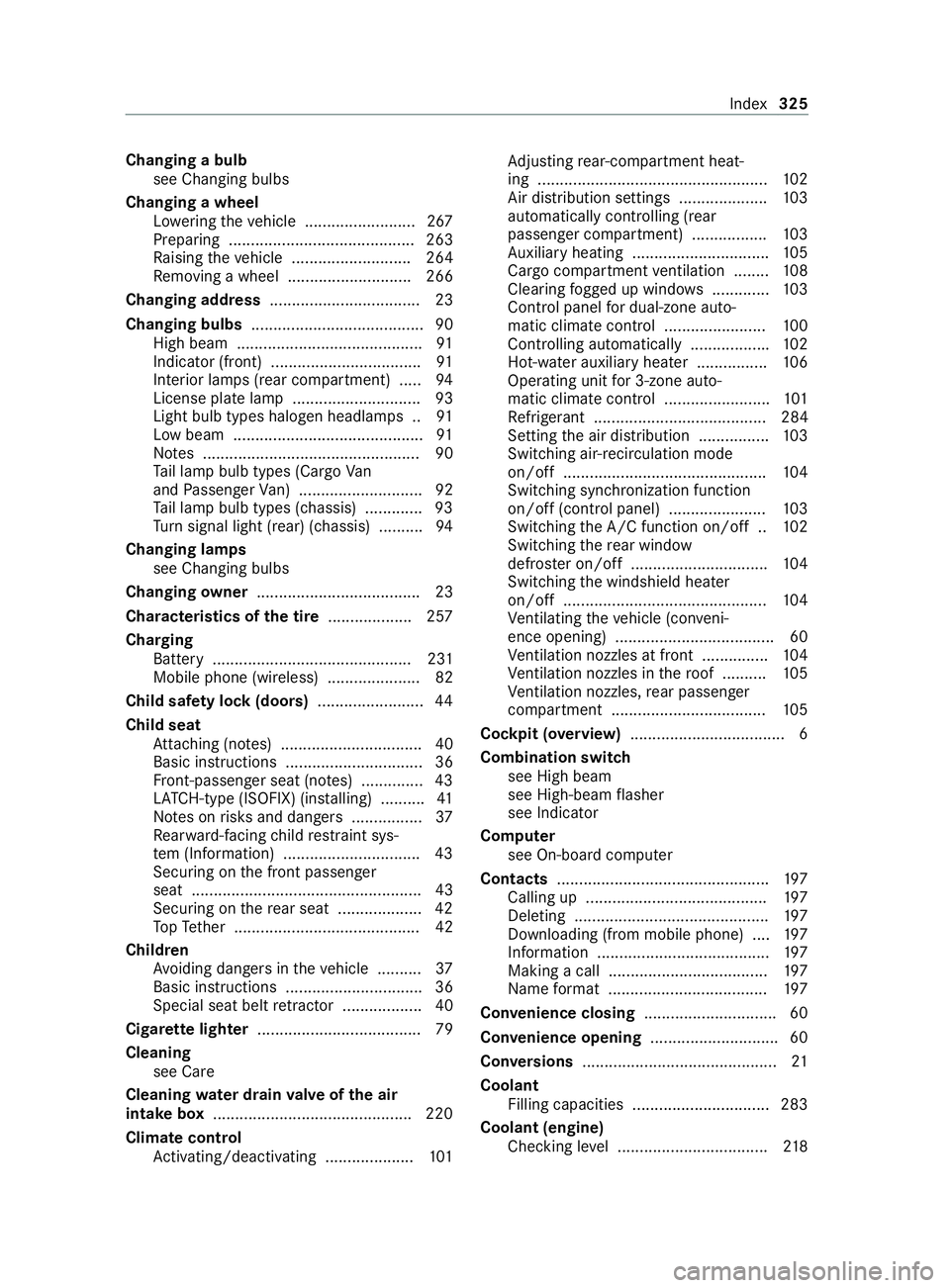
Changing
abulb
see Changing bulbs
Changing awheel
Lo we ring thev ehicle .........................2 67
Preparing .......................................... 263
Ra ising thev ehicle ........................... 264
Re moving awhee l............................ 266
Changing address .................................. 23
Changing bulbs ....................................... 90
High beam. ......................................... 91
Indicator (front) .................................. 91
Interior lamps (rear compartment) ..... 94
License plate lamp............................. 93
Ligh tbulbt ypes haloge nheadlamps .. 91
Lo wb eam ........................................... 91
No tes. ................................................90
Ta il lam pbulb types (Cargo Van
and Passenger Van) ............................ 92
Ta il lam pbulb types (chassis) ............ .93
Tu rn signal light (rear) (chassis) ..........94
Changing lamps see Changing bulbs
Changing owner .....................................23
Cha racteristics of thet ire .................. .257
Cha rging
Bat tery ............................................. 231
Mobil ephone (wireless )..................... 82
Child saf etyl oc k( doors) ........................ 44
Child seat Attach ing (no tes) ................................ 40
Basic instructions ...............................36
Fr ont-passenger seat (no tes) .............. 43
LA TC H-type (ISOFIX )(ins talling) .......... 41
No tesonr isksa nd danger s................37
Re arwa rd-facing child restra int sys‐
te m( Information) .............................. .43
Secu ring on thef ront passenger
seat ....................................................43
Secu ring on ther ear seat ................... 42
To pT ether .......................................... 42
Children Avoiding danger sinthevehicle ..........37
Basi cinstructions ............................... 36
Special sea tbeltr etra ctor .................. 40
Ci ga rettel ighter ..................................... 79
Cleaning see Ca re
Cleaning waterd rain valveoft he air
intak ebox ............................................ .220
Climat econtrol
Ac tivating/deactivating .................... 101Ad
justing rear-compartment heat‐
ing .................................................... 102
Air di stribution settings .................... 103
automaticall ycontrollin g(rear
passenger compartment )................. 103
Au xilia ryheating ...............................1 05
Carg ocompartmentv entilation ........ 108
Clearing fogged up windo ws............. 103
Control panel ford ual-zone auto‐
matic clima tecontrol ....................... 100
Controllin gautomaticall y................. .102
Hot-water auxiliar yheater. .............. .106
Operating unit for3 -zone auto‐
matic clima tecontrol ........................ 101
Re frigerant ....................................... 284
Setting thea ir distribution ................1 03
Switching air- recirculation mode
on/of f.............................................. 104
Switching synchronization function
on/of f(control panel )...................... 103
Switching theA /C function on/of f..1 02
Switching ther ear window
defros tero n/of f.............................. .104
Switching thew indshield heater
on/of f..............................................1 04
Ve ntilating thev ehicle (con veni‐
ence opening) .................................... 60
Ve ntilation nozzles at front ............... 104
Ve ntilation nozzles in ther oof ..........1 05
Ve ntilation nozzles, rear passenger
compartment .................................. .105
Cock pit (o verview) .................................. .6
Combination switch see High beam
see High-beam flasher
see Indicator
Compu ter
see On-boar dcomputer
Contacts ................................................ 197
Callin gup. ........................................ 197
Del eting ............................................ 197
Downloading (from mobil ephone). ... 197
Information ....................................... 197
Making acall .................................... 197
Na me form at .................................... 197
Con venience closing .............................. 60
Con venience opening ............................. 60
Con versions ............................................ 21
Coolant Fillin gcapacitie s............................... 283
Coolan t(engine)
Che cking le vel. ................................ .218 Index
325