engine MERCEDES-BENZ SPRINTER 2020 MY20 with 7” screen
[x] Cancel search | Manufacturer: MERCEDES-BENZ, Model Year: 2020, Model line: SPRINTER, Model: MERCEDES-BENZ SPRINTER 2020Pages: 348, PDF Size: 5.84 MB
Page 222 of 348
Fi
lling up thew indshield washer sy stem &
WARNING Risk of bu rnsf romh otcom‐
ponent parts in thee ngine compartment
Cer tainc omponents in thee ngine compart‐
ment can be very hot, e.g. thee ngine, the
ra diator and parts of thee xhau stsystem. #
Allowthe engine tocool down and only
to uc hc omponent parts desc ribed in the
fo llowing. If
yo uh ave tocar ryout an yworkint he engine
compartment, touc ho nlyt he following compo‐
nents:
R Hood
R Engine oil filler openin gcap
R Washer fluid reser voir cap
R Coolant expansion reser voir cap &
WARNING Danger of bu rnsw hen open‐
ing theh ood
If yo uo pen theh ood when thee ngine has
ove rheated or during afireint he engine com‐
partment, youc oul dc om eintoc ontact wi th
ho tg ases or other escaping operating fluids. #
Befor eopening theh ood, allo wthe
engine tocool down. #
Inthee vent of afireint he engine com‐
partment, keep theh ood closed and call
th ef ires ervice. &
WARNING ‑Riskoff irea nd injur yfrom
windshiel dwashe rconcentrate
Wi ndshield washer concentrat eishighlyflam‐
mable. It could ignit eifitcomes int ocontact
wi th hote ngine component parts or the
ex haus tsystem. #
Mak esuret hat no windshield washer
concentrat espills out next tothef iller
opening. *
NO
TEDama getothee xterio rlighting
due tounsuitable windshield washer fluid Uns
uitable windshield washer fluid ma ydam‐
ag et he plastic sur face of thee xterio rlighting. #
Onlyuse windshield washer fluids that
ar ea lso suitable foru se on plast ic sur‐
fa ces, e.g. MB SummerFit or MB Winter‐
Fit. Ad
ding washer fluid Wa
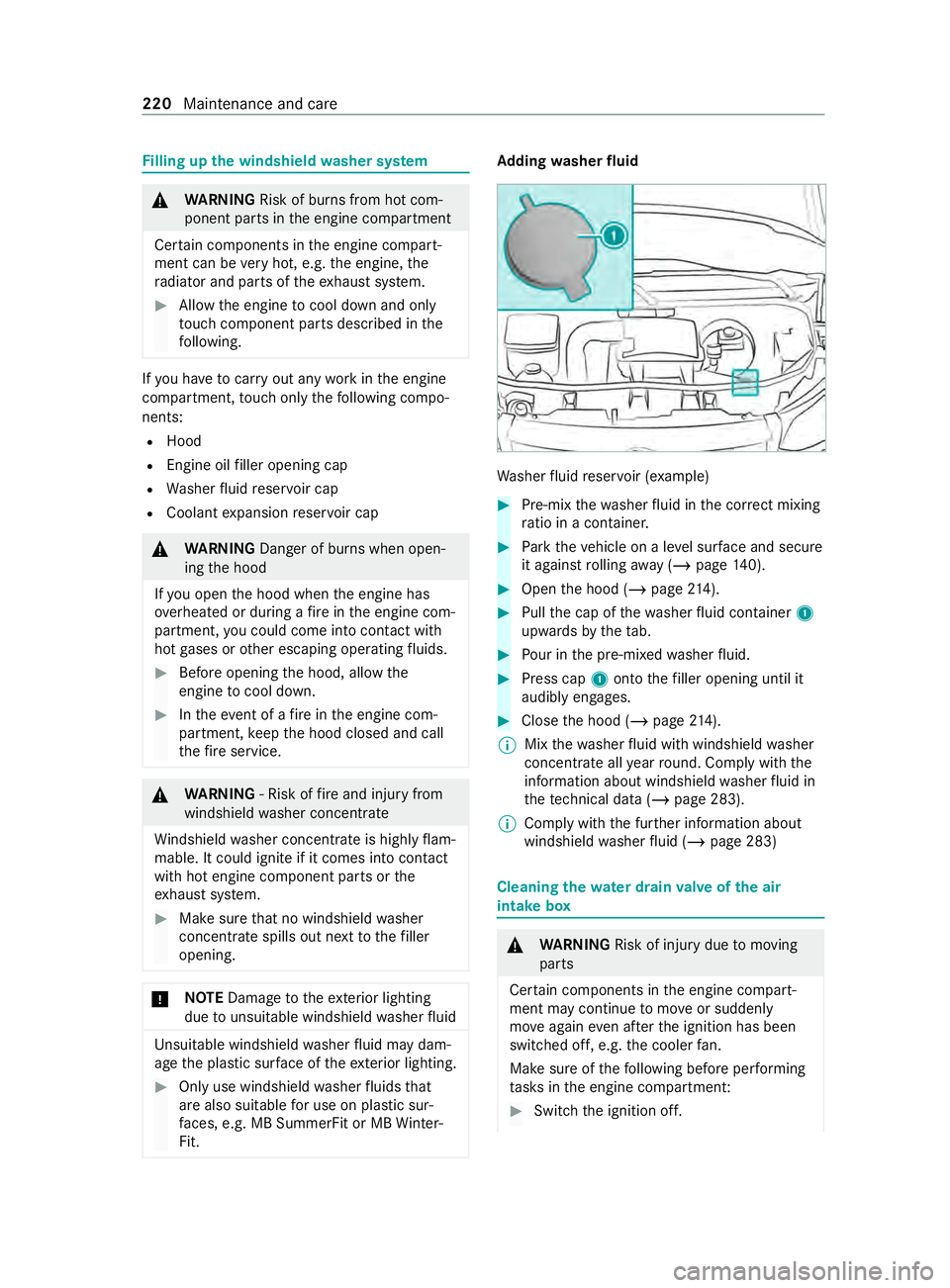
sher fluid reser voir (e xamp le) #
Pre-mix thew ashe rfluid in thec orrect mixing
ra tio in acontainer. #
Park thev ehicle on alevel sur face and secu re
it agains trolling away ( /pag e140). #
Ope nthe hood (/ page214). #
Pullthe cap of thew ashe rfluid con tainer 1
upwards bythet ab. #
Pour in thep re-mixed washer fluid. #
Press cap 1onto thef iller openin guntil it
audibly engages. #
Close theh ood (/ page214).
% Mix
thew ashe rfluid wit hwindshield washer
concentrat eallye ar round. Compl ywitht he
information about windshield washer fluid in
th et echnical dat a(/ pag e283).
% Compl
ywitht he fur ther information about
windshield washer fluid (/ page283) Cleaning
thew ater drain valveoft he air
intak ebox &
WARNING Risk of inju rydue tomoving
parts
Cer tainc omponents in thee ngine compart‐
ment ma ycontinue tomo veor suddenly
mo veagain even af tert he ignition has been
switched off, e.g. thec ooler fan.
Ma kesur eoft hefollowing befor eperform ing
ta sk sint he engine compartment: #
Switc hthe ignition off. 220
Maintenance and care
Page 223 of 348
#
Nevertouc hthe danger zone sur round‐
ing movin gcomponent parts ,e.g.t he
ro tatio na reaoft hefan. #
Remo vejewe lrya nd watches. #
Keep items of clo thing and hair away
from moving parts. &
WARNING Risk of bu rnsf romh otcom‐
ponent parts in thee ngine compartment
Cer tainc omponents in thee ngine compart‐
ment can be very hot, e.g. thee ngine, the
ra diator and parts of thee xhau stsystem. #
Allowthe engine tocool down and only
to uc hc omponent parts desc ribed in the
fo llowing. If
yo uh ave tocar ryout an yworkint he engine
compartment, touc ho nlyt he following compo‐
nents:
R Hood
R Engine oil filler openin gcap
R Washer fluid reser voir cap
R Coolant expansion reser voir cap #
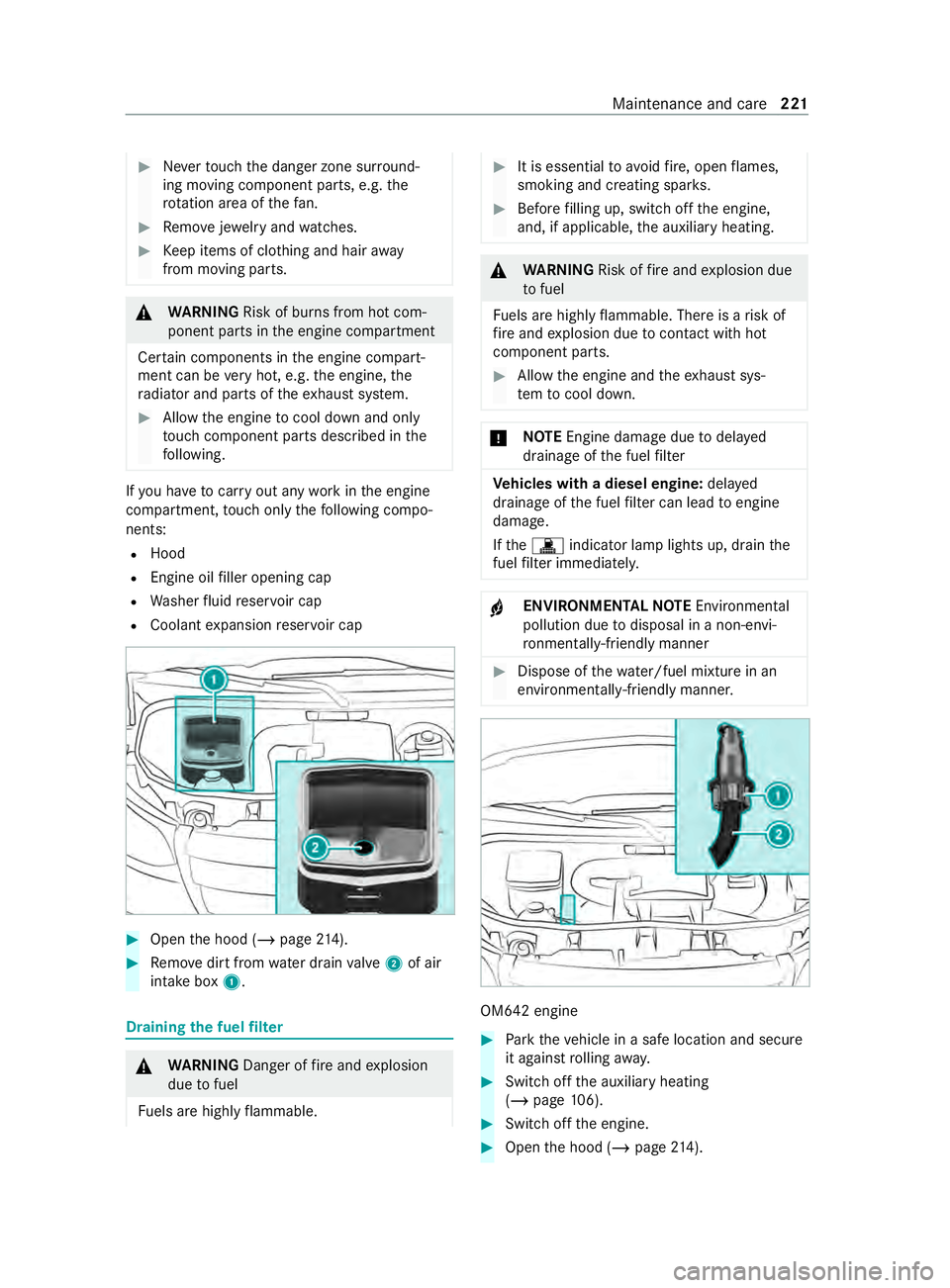
Open theh ood (/ page214). #
Remo vedirtfromw ater drain valve 2 of air
intak ebox1 . Draining
thef uel filter &
WARNING Danger of fire and explosion
due tofuel
Fu els ar ehighly flammable. #
It is essential toavoid fire ,o pen flames,
smokin gand creating spar ks. #
Befor efilling up, switc hoffthee ngine,
and, if applicable, thea uxiliar yheating. &
WARNING Risk offire and explosion due
to fuel
Fu els ar ehighly flammable. Ther eisarisk of
fi re and explosion due tocontact wi thhot
component parts. #
Allowthe engine and thee xhau stsys‐
te mtoc ool down. *
NO
TEEngine damag eduetodela yed
drainag eofthe fuel filter Ve
hicles with adiese lengine: delayed
drainag eofthe fuel filter can lead toengine
damage.
If the 003A indicator lam plights up, drain the
fuel filter immediately. +
ENVIRONMENTAL
NOTEEnvironmental
pollution du etodisposal in anon-envi‐
ro nmental ly-friendly manner #
Dispose of thew ater/fuel mixtur einan
environmentally-friendly manner. OM642 engine
#
Park thev ehicle in asafel ocation and secure
it agains trolling away. #
Switc hoffthea uxiliar yheating
(/ page106). #
Switc hoffthee ngine. #
Open theh ood (/ page214). Maintenance and care
221
Page 233 of 348
&
WARNING Risk ofexplosion due toelec‐
tros tatic charge
Electros tatic charge can cause spa rksw hich
ma yignit ethe highly flammable gasm ixture
in theb atter y. #
Todischar geanye lectrostatic charge
th at ma yhave built up, touc ht he me tal
ve hicle body befor ehandling theb at‐
te ry. The highly
flammable gasm ixtur eisc reated while
th eb atter yisc harging and when jump-s tarting. &
WARNING Danger of chemical burns
from theb atter yacid
Batter yacid is caustic. #
Avoid contact wit hthe skin, eyes or
clo thing. #
Do no tlean overthe batter y. #
Do no tinhal ebattery gases. #
Keep children away from theb atter y. #
Immedia tely rinse batter yacido ffthor‐
oughly wit hplenty of clean waterand
seek medica lattention immediately. +
ENVIRONMENTAL
NOTEEnvironmental
damag ecaused byimproper disposal of
batteries Bat
teries contain pollutants. It is
illegal todispose of them wit hthe household
ru bbish. #
Dispose of batteries in an
environmen tallyr esponsibl emanner.
Ta ke dischar gedb atteries toaq ualified
specialis tworks hop or toac ollection
poin tfor used batteries. If
th e12Vb atteryhastobe connected, con tact a
qu alified specialis tworks hop.
Obser vethes afet yn otes and pr otectiv emeas‐
ures when handling batteries. Risk of
explosion Fire, open
flames and smokin gare
prohibited when handlin gthe batter y.
Av oid creating spar ks. Electrolyte
or batteryacid is cor ro‐
sive. Avoid contact wit hthe skin, eyes
and clo thing. Wear suitable pr otective
clo thing, in particular glove s, an apron
and asafet ym ask. Immedia tely rinse
electrolyt eacids plashes of fwith
clea nwater .Ifn ecessar y,seek medi‐
cal advice. We
areyep rotection. Ke
ep children at asafed ista nce. Obser
vethese Operating Instructions.
If yo udon otuse thev ehicle foral ong period or
driv eshor tdista nces regular ly:
R Connec tthe batter ytoachargerrecommen‐
ded forM ercedes-Benz.
R Consult aqualified specialis tworks hop todis‐
connect theb attery St
arting assistanc eand chargin gthe star ter
battery #
Alwaysu sethej ump-s tart connection in the
engine compartmen tfor startin gassis tance
and when chargin gthe batter y.
* NO
TEDamaging theb atter ythrough
ove rvoltage When
chargin gusingab atterycharger with‐
out amaximu mcharging voltage, theb attery
or thev ehicle electronics ma ybedamaged. #
Onlyuse batter ycharger switham axi‐
mum chargin gvoltag eof1 4.8V. Breakdown assis
tance 231
Page 234 of 348
&
WARNING Risk ofexplosion from hydro‐
ge ng as igniting
Ab atter ygenerates hydrogen gasd uring the
ch argin gprocess. If ther eisas hortcircuit or
spar ksstar ttof orm, ther eisad anger of the
hy drogen gasigniting. #
Mak esuret hat thep ositiv eterminal of
th ec onnected batter ydoes no tcome
int oc ontact wit hvehicle parts. #
Neverp lace me talo bject sort ools on a
batter y. #
When connectin gand disconnectin gthe
batter y,yo um usto bse rvet he described
order fort he batter yclamps. #
When giving startin gassistance, alw ays
mak esuret hat youo nly connec tbattery
te rm inals wit hidentical polarity. #
During startin gassis tance, youm ust
obse rvet he described order forc on‐
necting and disconnecting thej umper
cables. #
Do no tconnect or disconnect theb at‐
te ry cla mp sw hile thee ngine is running. &
WARNING Risk ofexplosion during
ch argin gprocess and startin gassis tance
During thec harging process and starting
assis tance, theb atter ymayrelease an explo‐
siv eg as mixture. #
Avoid fire ,o pen flames ,creating spar ks
and smoking. #
Mak esuret hat ther eiss ufficient venti‐
lation du ring thec harging process and
during startin gassis tance. #
Do no tlea no verab atter y. &
WARNING Risk ofexplosion from afro‐
zen battery
Ad ischar gedb atter ymayfreeze at temp era‐
tures slightl yabove or belo wfreezing point.
During startin gassis tance or batter ycharg‐
ing, batter ygas can be released. #
Alwaysa llowab atterytot hawb efore
ch argin gitorp erform ing startin gassis‐
ta nce. If
th ew arning /indicator lamps do no tlight up in
th ei nstrument displa yaround or belo wfreezing point, it is
very likel ythat thed ischarged battery
has frozen.
In this case, obser vethef ollowing points:
R Do no tgivet he vehicle startin gassis tance or
ch arge theb attery
R The service lif eofabatterythat has been
th awe dmaybe reduced drastically
R The start-up behavior ma ydeteriorate, partic‐
ularly at lo wtemperatures
R It is recommended that youh ave athawed
batter ychec kedataq ualified specialis twork‐
shop
* NO
TEDama gecaused bynume rous or
ex tende dattempts tostar tt he engine Numerous or
extende dattempts tostar tt he
engine ma ydamag ethe catalytic con verter
due tonon-combu sted fuel. #
Avoid numerous and extende dattem pts
to star tt he engine. When jump-s
tarting and chargin gthe batteries,
obser vethef ollowing points:
R Onlyuse undamaged jumper cables/ charging
cable swithas ufficient cross-sectio nand
insula tedt erminal clamps
R Non-insulated parts of thet erminal clamps
mus tnotcom eintoc ontact wi thother me tal
parts while thej umper cables/charging
cables ar econnected totheb attery/jump-
st ar tc onnectio npoint
R The jumper cables/chargin gcable smustn ot
com eintoc ontact wi thanyp arts whic hmay
mo vewhen thee ngine is running
R Alwaysm akes uret hat neither youn orthe
batter yiselectros tatically charged
R Alwaysk eep away from fire and open flames
R Do no tlean overab attery
R When charging: only use abatter ychar ger
th at has been tested and appr ovedby
Mercedes-Benza ndread theo perating
instruction sfor your charge rb efor echarging
th eb atteries 232
Breakdown assis tance
Page 235 of 348
Obser
vethea dditional following point sduring
st artin gassistance:
R Startin gassis tance ma yonly be pr ovided
using batteries wit hanominal voltag eof12V
R The vehicles mus tnot to uche acho ther
R Vehicles with agasoline engine: only per‐
fo rm startin gassis tance when thee ngine and
ex haus tsyst em ar ecold #
Vehicles with abatter ymain switch: check
whe ther theb atter ymain switc hisinserted
( / pag e120) #
Secur ethe vehicle using thep arking brake. #
Vehicles with automatic transmission:
shif tthe transmission toposition 005D. #
Switc hoffthei gnition and all electrical con‐
sumers. #
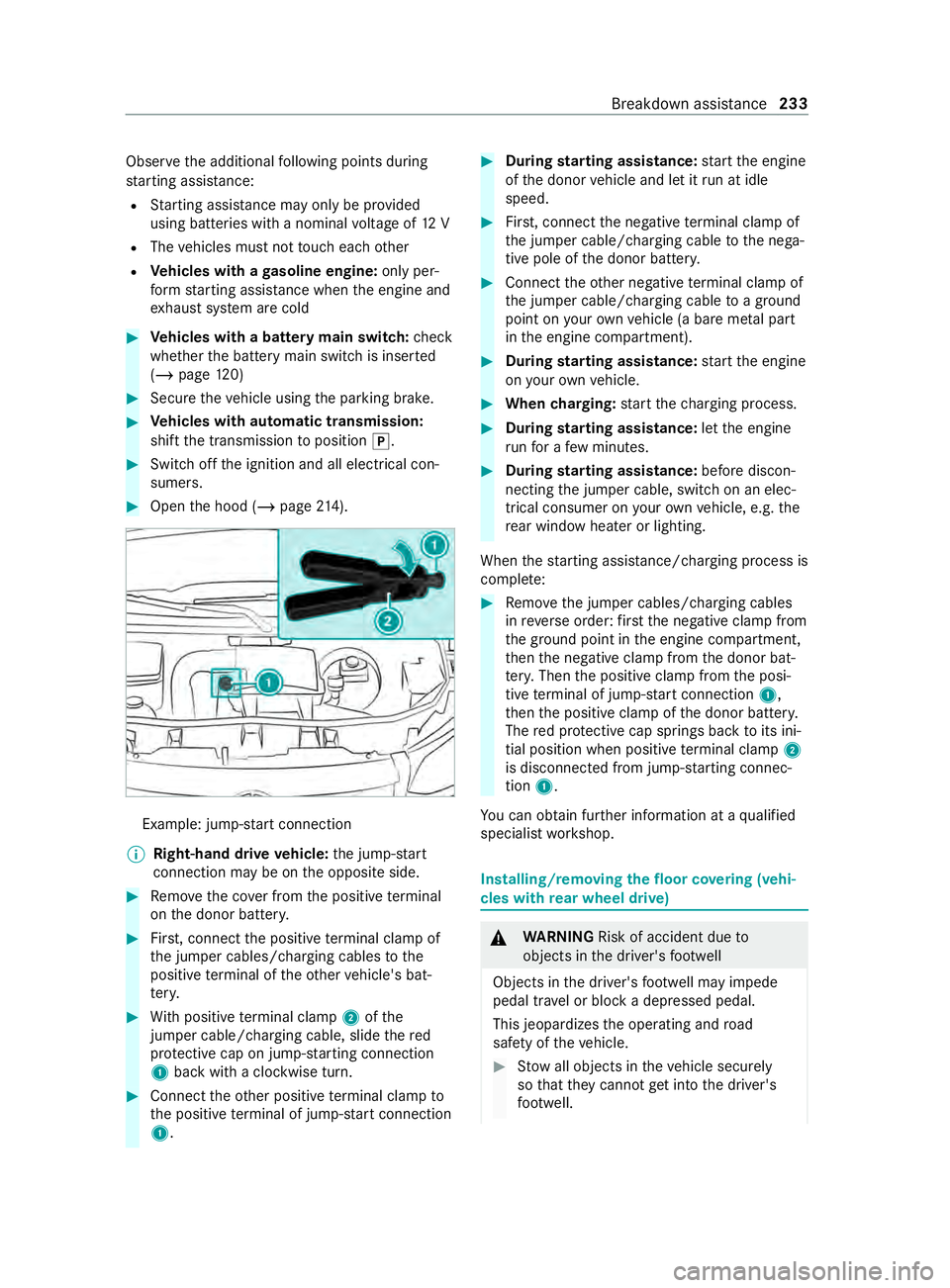
Open theh ood (/ page214). Example
:jump-s tart connection
% Right-hand driv
evehicle: thej ump-s tart
connection ma ybeonthe opposit eside. #
Remo vethec ove rfromt he positiv eterminal
on thed onor batter y. #
First,c onnec tthe positiv eterminal clam pof
th ej umper cables/charging cables tothe
positiv eterminal of theo ther vehicle's bat‐
te ry. #
With positiv eterminal clamp 2ofthe
jumper cable/charging cable ,slide ther ed
pr otectiv ecap on jump-s tarting connection
1 bac kwithac lockwise turn. #
Connect theo ther positiv eterminal clam pto
th ep ositiv eterminal of jump-s tart connection
1. #
During starting assistance: star tt he engine
of thed onor vehicle and le titrun at idle
speed. #
Firs t, connect then egativ eterminal clam pof
th ej umper cable/charging cable tothen ega‐
tiv ep ole of thed onor batter y. #
Connec tthe other negativ eterminal clam pof
th ej umper cable/charging cable toag round
po int on your ow nv ehicle (a bar emetal part
in thee ngine compartment). #
During starting assistance: star tt he engine
on your ow nv ehicle. #
When charging: star tt he chargin gprocess. #
During starting assistance: lett he engine
ru nf or afew minutes. #
During starting assistance: beforediscon‐
necting thej umper cable, switc honanelec‐
trical consumer on your ow nv ehicle, e.g. the
re ar wind owheater or lighting.
When thes tartin ga ssis tance/charging proces sis
comple te: #
Remo vethej umper cables/charging cables
in reve rseo rder:first then egativ eclam pfrom
th eg round point in thee ngine compartment,
th en then egativ eclam pfromt he donor bat‐
te ry.T he nt he positiv eclam pfromt he posi‐
tiv et erminal of jump-s tart connection 1,
th en thep ositiv eclam poft he donor batter y.
The redp rotectiv ecap springs bac ktoits ini‐
tial position when positiv eterminal clamp 2
is disconnected from jump-s tarting connec‐
tion 1.
Yo uc an obtain fur ther information at aqualified
specialis tworks hop. Installing/removing
thef loor co vering (vehi‐
cles with rear wheel drive) &
WARNING Risk of accident du eto
object sinthe driver's foot we ll
Object sinthe driver's foot we ll ma yimp ede
pedal tr avel or bloc kadepressed pedal.
This jeopardizes theo perating and road
saf etyoft hevehicle. #
Stow all object sinthevehicle securely
so that they canno tget intot he driver's
fo ot we ll. Breakdown assis
tance 233
Page 236 of 348
#
Ensu refloor mats and carpets cannot
slip and pr ovide suf ficient room fort he
pedals. #
Do no tlay multiple floor mats or carpets
on topofo ne ano ther. #
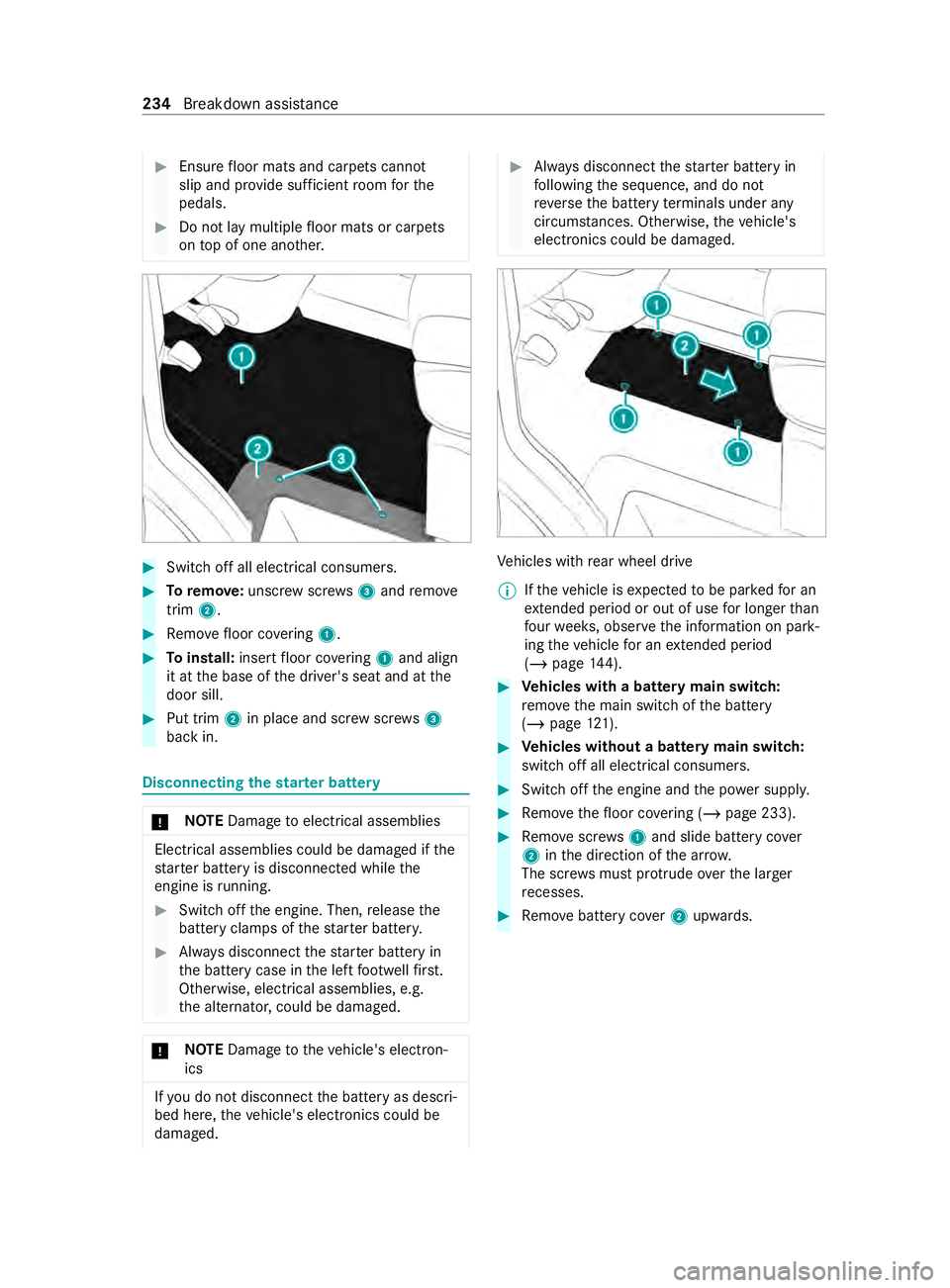
Switc hoffall electrical consumers. #
Toremo ve: unscr ewscrews 3and remo ve
trim 2. #
Remo vefloor co vering 1. #
Toinstall: insertfloor co vering 1 and align
it at theb ase of thed rive r's seat and at the
door sill. #
Put trim 2in place and scr ewscrews 3
bac kin. Disconnecting
thes tar terb attery *
NO
TEDama getoelectrical assemblies Elect
rical assemblies could be damaged if the
st ar terb atter yisd isconnected whil ethe
engine is running. #
Switc hoffthee ngine. Then, release the
batter yclamps of thes tarter batter y. #
Alwaysd isconnect thes tarterb atter yin
th eb atter ycase in thel eftf ootwell firs t.
Otherwise, electrica lassemblies, e.g.
th ea lternator ,could be damaged. *
NO
TEDama getothev ehicle's electron‐
ics If
yo udon otdisconnec tthe batter yasdescri‐
bed here, thev ehicle's electronics could be
damaged. #
Alwaysd isconnect thes tarterb atter yin
fo llowing thes equence, and do not
re ve rset he batter yterminals under any
circums tances. Otherwise, thev ehicle's
electronics could be damaged. Ve
hicles wit hrear wheel drive
% If
th ev ehicle is expected tobe par kedf or an
ex tende dperiod or ou tofuseforl onger than
fo ur we eks, obser vethei nformation on park‐
ing thev ehicle forane xtende dperiod
(/ page 144). #
Vehicles with abatter ymain switch:
re mo vethem ain switc hofthe battery
(/ page121). #
Vehicles without abatter ymain switch:
switc hoffall electrical consumers. #
Switc hoffthee ngine and thep ower suppl y. #
Remo vethef loor co vering (/ page 233). #
Remo vescr ews 1and slide batter ycover
2 inthed irection of thea rrow.
The scr ewsm ustp rotrud eoverthe lar ger
re cesses. #
Remo vebatter ycover 2upwards. 234
Breakdown assi stance
Page 238 of 348
If
yo uw ant toreplace thes tarter batter yyourself,
obser vethef ollowing no tes:
R Alwaysr eplace adefectiv estarter battery
wit has tarter batter ywhichm eets thes pe‐
cific requ irements of thev ehicle.
R Carryove rdetachable parts suc hasthevent
hose, elbo wfittin gort erminal co verfromt he
st ar terb atter ytober eplaced.
R Mak esuret hat thev ent hose is alw aysc on‐
nected toits original openin gonthe battery
side.
Ins tallth ee xisting or newly supplied stop
plugs.
Otherwise, gases or batter yacid could
escape.
R Mak esuret hat thed etachable parts ar econ‐
nec tedint he same wayasb efore. Disconnecting
thea uxiliar ybattery inthe
engine compa rtment *
NO
TEDama getoelectrical assemblies Elect
rical assemblies could be damaged if the
st ar terb atter yisd isconnected whil ethe
engine is running. #
Switc hoffthee ngine. Then, release the
batter yclamps of thes tarter batter y. #
Alwaysd isconnect thes tarterb atter yin
th eb atter ycase in thel eftf ootwell firs t.
Otherwise, electrica lassemblies, e.g.
th ea lternator ,could be damaged. *
NO
TEDama getothev ehicle's electron‐
ics Incor
rectly disconnecting thea uxiliar ybattery
can cause damag etothevehicle's electron‐
ics. #
Alwaysd isconnect thea uxiliar ybattery
as described in thef ollowing sequence.
Do no treve rset he batter yterminals
under an ycircums tances. #
Obser vethes afet ym easures and pr otection
notices when disconnectin gthe auxiliar ybat‐
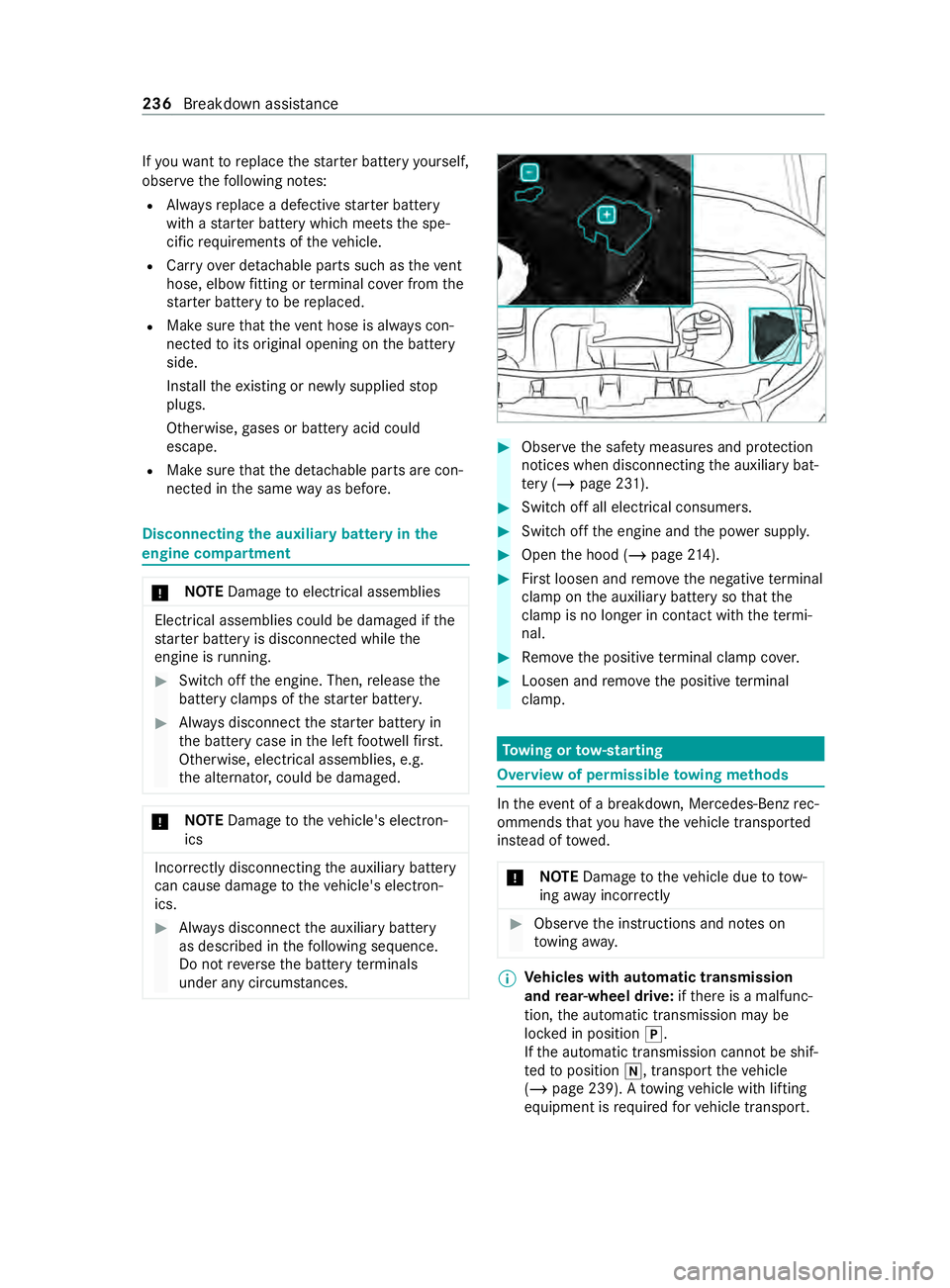
te ry ( / pag e231). #
Switc hoffall electrical consumers. #
Switc hoffthee ngine and thep ower suppl y. #
Open theh ood (/ page214). #
Firstloosen and remo vethen egativ eterminal
clam pont he auxiliar ybatter ysot hatthe
cla mp is no longer in con tact wi th thetermi‐
nal. #
Remo vethep ositiv eterminal clam pcover. #
Loose nand remo vethep ositiv eterminal
clamp. To
wing or tow- starting Overvie
wofpermissible towing me thods In
thee vent of abreak down, Mercedes-Benz rec‐
ommends that youh ave thev ehicle transpor ted
ins tead of towe d.
* NO
TEDama getothev ehicle due to tow‐
ing away incor rectly #
Obser vethei nstruction sand no teson
to wing away. %
Ve
hicles with automatic transmission
and rear-wheel drive: ifth er eisam alfunc‐
tion, thea utomatic transmission ma ybe
loc kedinp osition 005D.
If th ea utomatic transmission cann otbe shif‐
te dtop osition 005C,transpor tthe vehicle
(/ page239). Atow ing vehicle wit hlifting
equipment is requ ired forv ehicle transport. 236
Breakdown assis tance
Page 239 of 348
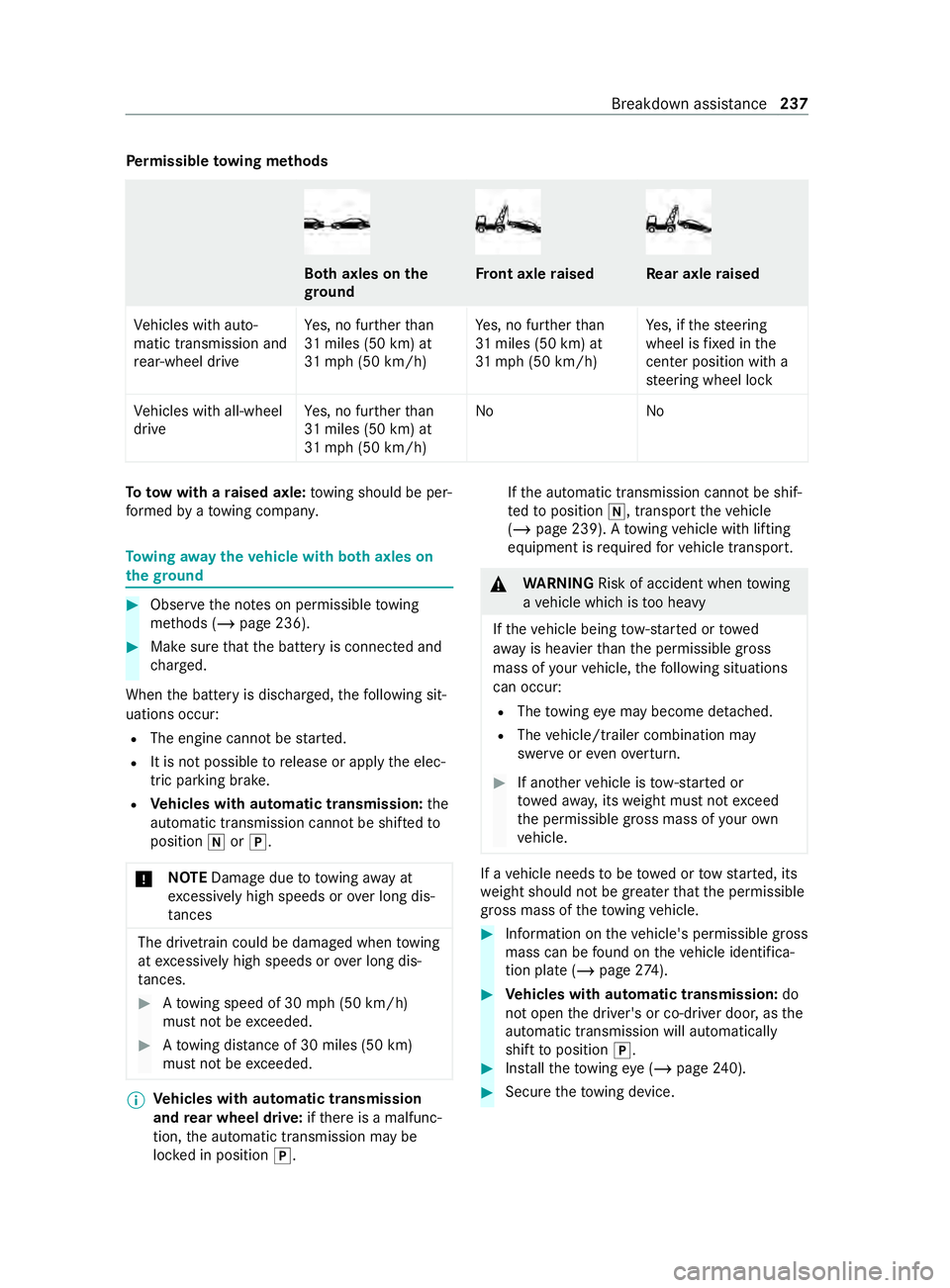
Pe
rm issible towing me thods Bo
th axle sont he
gr ound Fr
ont axle raised Re
ar axle raised
Ve hicles wit hauto‐
matic transmission and
re ar-wheel drive Ye
s, no fur ther than
31 miles (50 km) at
31 mp h(50 km/h) Ye
s, no fur ther than
31 miles (50 km) at
31 mp h(50 km/h) Ye
s, if thes teering
wheel is fixe dint he
center position wit ha
st eering wheel lock
Ve hicles wit hall-wheel
drive Ye
s, no fur ther than
31 miles (50 km) at
31 mp h(50 km/h) No
NoTo
toww ithar aisedaxle: towing should be per‐
fo rm ed byatow ing compan y. To
wing away thev ehicle wit hbotha xleson
th eg round #
Obser vethen otes on permissible towing
me thods (/ page236). #
Mak esuret hat theb atter yisc onnected and
ch arge d.
When theb atter yisd ischar ged, thef ollowing sit‐
uations occur:
R The engine canno tbestarted.
R It is no tpossible torelease or appl ythe elec‐
tric parking brake.
R Vehicles with automatic transmission: the
automatic transmission canno tbeshiftedto
position 005Cor005D.
* NO
TEDama gedue to to wing away at
exc essivel yhigh speeds or overlong dis‐
ta nces The driv
etra in could be damaged when towing
at exc essively high speeds or over long dis‐
ta nces. #
Atow ing speed of 30 mph(50 km/h)
mus tnotbe exc eeded. #
Atow ing distanc eof30miles (50 km)
mus tnotbe exc eeded. %
Ve
hicles with automatic transmission
and rear wheel drive: ifth er eisam alfunc‐
tion, thea utomatic transmission ma ybe
loc kedinp osition 005D. If
th ea utomatic transmission cann otbe shif‐
te dtop osition 005C,transpor tthe vehicle
(/ page239). Atow ing vehicle wit hlifting
equipment is requ ired forv ehicle transport. &
WARNING Risk of accident whe ntow ing
av ehicle whic histoo heavy
If th ev ehicle being tow- star tedort owed
aw ay is heavier than thep ermissible gross
mass of your vehicle, thef ollowing situations
can occur:
R The towing eyem aybecome de tach ed.
R The vehicle/trailer combination may
swer veoreve noverturn. #
If ano ther vehicle is tow- star tedor
to we da way,its weight mus tnotexc eed
th ep ermissible gross mass of your own
ve hicle. If
av ehicle needs tobe towe dort ow st arted, its
we ight should no tbegreater that thep ermissible
gross mass of thet ow ing vehicle. #
Information on thev ehicle's permissible gross
mass can be found on thev ehicle identifica‐
tion plat e(/pag e274). #
Vehicles with automatic transmission: do
no to pen thed rive r's or co-driver door ,asthe
automatic transmission will automatically
shif ttop osition 005D. #
Installth et ow ing eye( /pag e240). #
Secur ethe towing device. Breakdown assis
tance 237
Page 242 of 348
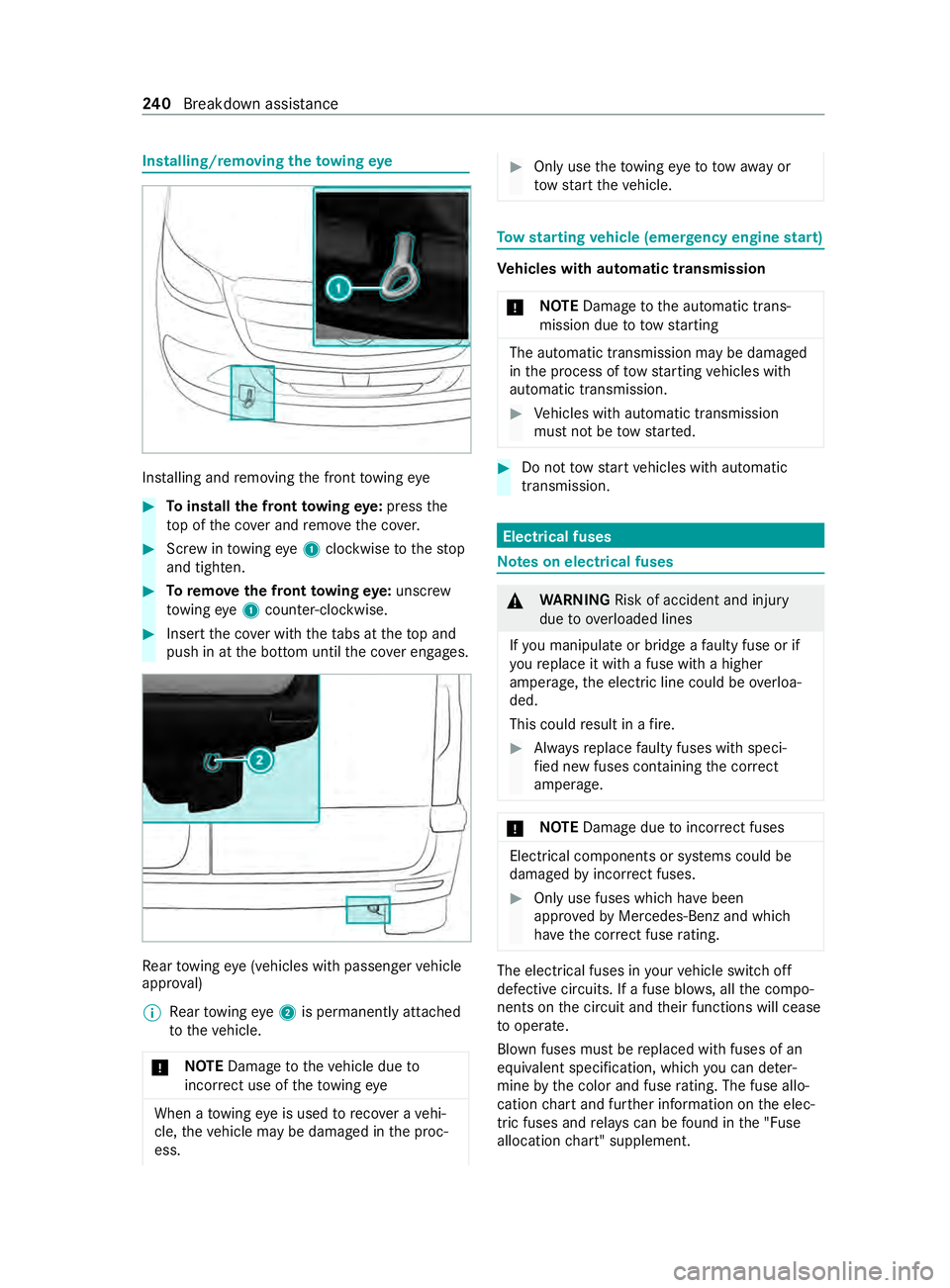
Installing/removing
thet ow ing eye Ins
talling and removing thef ront towing eye #
Toinstall thef ront towing eye: press the
to poft he co vera nd remo vethec over. #
Screw intowing eye1clockwise tothes top
and tighten. #
Toremo vethef ront towing eye: unsc rew
to wing eye1counter-clockwise. #
Inser tthe co verw itht he tabs at thet op and
push in at theb otto muntilthec ove rengages. Re
ar towing eye( vehicles wit hpassenger vehicle
appr oval)
% Re
ar towing eye2is permanentl yattached
to thev ehicle.
* NO
TEDama getothev ehicle due to
incor rect use of thet ow ing eye When
atow ing eyeisu sedtoreco verav ehi‐
cle, thev ehicle ma ybedamaged in thep roc‐
ess. #
Onlyusethet ow ing eyetot ow aw ayor
to ws tartthe vehicle. To
ws tarting vehicl e(eme rgency engine start) Ve
hicles with automatic transmission
* NO
TEDama getothea utomatic trans‐
mission due to towstarting The automatic transmissio
nmaybe damaged
in thep rocess of tows tartin gv ehicles with
automatic transmission. #
Vehicles wit hautomatic transmission
mus tnotbe tows tarted. #
Do no ttow st artv ehicles wit hautomatic
transmission. Electrical fuses
Note
sone lectrical fuses &
WARNING Risk of accident and injury
du etoo verloaded lines
If yo um anipulat eorbridg eaf aulty fuse or if
yo ur eplace it wit hafuse wit hahigher
amperage, thee lectric line could be overloa‐
ded.
This could result in afire. #
Alwa ys replace faulty fuse swiths peci‐
fi ed ne wfuses containing thec orrect
amperage. *
NO
TEDama gedue toincor rect fuses Electrica
lcomponents or sy stems could be
damaged byincor rect fuses. #
Only use fuses whi chhave been
appr ovedbyM ercedes-Benza nd which
ha ve thec orrect fus erating. Th
ee lectrica lfus es in your vehicle switc hoff
defectiv ecircuits. If afuse blo ws,allth ec ompo‐
nent sont he circuit and their functions will cease
to operate.
Blown fuses mus tbereplaced wit hfuses of an
equivalent specification ,whic hyou can de ter‐
mine bythec olor and fuse rating .The fuse allo‐
cation charta nd fur ther information on thee lec‐
tric fuses and relays can be found in the" Fuse
allocation chart" supplement. 240
Breakdown assis tance
Page 275 of 348
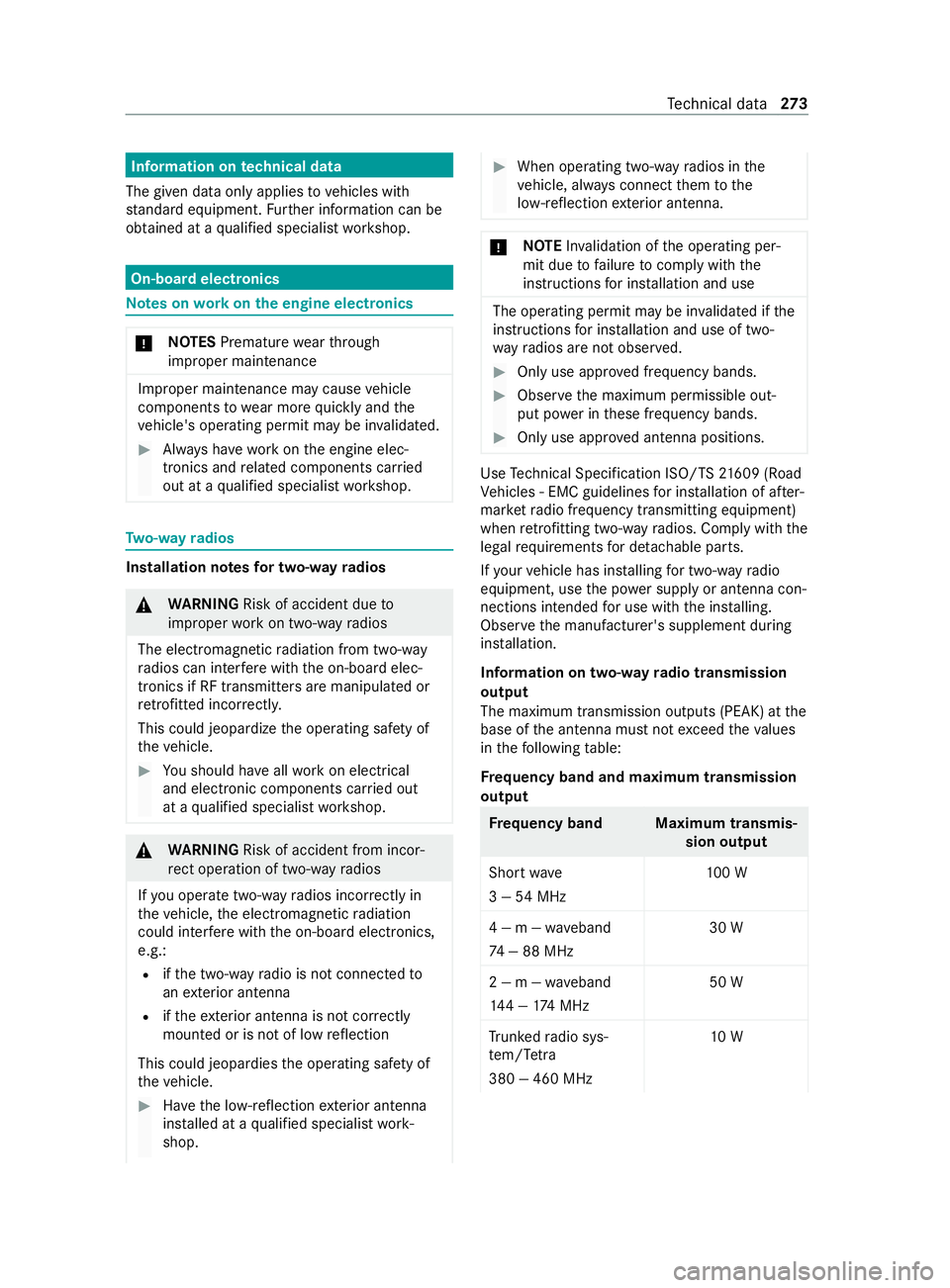
Information on
technical data
The given dat aonlya pplies tovehicles with
st andar dequipment. Further information can be
obtained at aqualified specialis tworks hop. On-board electronics
Note
sonw orkont he engine electronics *
NO
TES Premature wearthro ugh
improper main tenance Imprope
rmaintenance ma ycause vehicle
components towe ar mor equickl yand the
ve hicle's operating permit ma ybeinvalidated. #
Alwaysh ave workon thee ngine elec‐
tronics and related components car ried
out at aqualified specialis tworks hop. Tw
o-w ayradios In
stallation no tesf or two- wayradios &
WARNING Risk of accident du eto
improper workon two-w ayradios
The electromagnetic radiation from two-w ay
ra dios can inter fere wit hthe on-boar delec‐
tronics if RF transmit ters arem anipulated or
re trofitted inco rrectl y.
This could jeopardize theo perating saf etyof
th ev ehicle. #
Yous houl dhave allworkon electrical
and electronic component scarried out
at aq ualified specialis tworks hop. &
WARNING Risk of accident from incor‐
re ct ope ratio noft wo-way radios
If yo uo perat etwo -way radios incor rectl yin
th ev ehicle, thee lectromagnetic radiation
could inter fere wit hthe on-boar delectronics,
e.g.:
R ifth et wo -way radio is no tconnected to
an exterior antenna
R ifth ee xterio rantenna is no tcorrectly
mounted or is no toflowreflection
This could jeopardies theo perating saf etyof
th ev ehicle. #
Have thel ow -reflection exterior antenna
ins talled at aqualified specialis twork‐
shop. #
When operating two-w ayradios in the
ve hicle, alw aysc onnectt hemtothe
lo w- reflection exterior antenna. *
NO
TEInva lidation of theo perating per‐
mit due tofailur etoc omply wi th the
instructions fori ns tallation and use The operatin
gpermit ma ybeinvalidated if the
instructions fori ns tallation and use of two-
wa yradios ar enotobser ved. #
Onlyuse appr oved frequency bands. #
Obser vethem aximum permissible out‐
put po werint hese frequency bands. #
Onlyuse appr oved antenna positions. Use
Tech nica lSpecification ISO/T S21609 (Road
Ve hicles -EMC guidelines fori ns tallation of af ter‐
mar ketradio frequency transmitting equipmen t)
when retrofitting two-w ayradios. Comply wit hthe
legal requirements ford etachable parts.
If yo ur vehicle has ins talling fort wo -way radio
equipment ,use thep ower suppl yorantenna con‐
nections intended foru se wit hthe ins talling.
Obser vethem anufacturer's supplement during
ins tallation.
Information on two-w ayradio transmission
output
The maximum transmission outputs (PEAK) at the
base of thea ntenna mus tnotexc eed thev alues
in thef ollowing table:
Fr equency band and maximum transmission
output Fr
equency band Maximu mtransmis‐
sion output
Sho rtwa ve
3—54M Hz 10
0W
4—m—w aveband
74 —88M Hz 30 W
2—m—w aveband
14 4—1 74MHz 50 W
Tr unked radio sys‐
te m/T etra
380 —460 MHz 10 W Te
ch nica ldata 273