light MERCEDES-BENZ SPRINTER 2020 MY20 with 7” screen
[x] Cancel search | Manufacturer: MERCEDES-BENZ, Model Year: 2020, Model line: SPRINTER, Model: MERCEDES-BENZ SPRINTER 2020Pages: 348, PDF Size: 5.84 MB
Page 150 of 348
Ac
tivating/deactivatin gESP®
(Electronic Sta‐
bility Prog ram) Multimedia sy
stem:
4 © 5
Settings 5
Quick Access
5 ESP
% ESP®
can onl ybeactivated and deactivated
via quicka ccess when at leas tone other
function is available in quicka ccess. Other‐
wise, youc an find ESP ®
in the Assistance
menu. #
Select ESP.
Ap romp tappears. #
Select Onor00BB Off.
If the 00BB ESP®
OFF warning lam plight supc on‐
st antly in thei nstrument clus ter,ESP ®
is deacti‐
va ted.
Obser vethei nformation on warning lamps and
displa ymessages whic hmayappear in thei nstru‐
ment clus ter. Fu
nctions of ESP ®
Crosswind Assist Crosswind Assis
tdoes no treact under thef ollow‐
ing conditions:
R The vehicle is subjected tosevere jolts and
vib rations, e.g .asar esult of une vens urfaces
or po tholes.
R The vehicle loses traction, e.g. on sno worice
or when hydroplaning.
R The driver is per form ing sudden and lar ge
st eering mo vements.
Crosswind Assis tisoperational again as soon as
th ed riving conditions retur nton ormal.
Crosswind Assi stdetects stro ng crosswind gu sts
th at can impair abilit yofyourvehicle todrive
st ra ight ahead. Crosswin dAssis tinter venes
depending on thed irection and stre ngt hoft he
crosswind.
As tabilizing brak eapplicatio nhelps youtok eep
th ev ehicle on trac k.
Information is shown in thei nstrument clus terin
th ee vent of aclearly discernible inter vention by
Crosswind Assist.
Crosswind Assis tisactiveabove avehicle speed
of 50 mph(80 km/h )when driving stra ight or
slight lycornering. Fu
nction of ESP ®
trailer stabilization &
WARNING Risk of accident in poo rroad
and weather conditions
In poor road and weather conditions, the
traile rstabilizatio ncanno tpreve nt lu rching of
th ev ehicle/trailer combination .Trailer sw ith
ah igh cen terofg ravity ma ytipover before
ESP ®
de tects this. #
Alwaysa dap tyour driving styletos uit
th ec urrent road and weather condi‐
tions. ESP
®
trailer stabilizatio ncoun tera cts critica ldriv‐
ing situations in goo dtime and thereb yprovides
conside rable assis tance when driving wi th a
traile r. Trailer stabilizatio nispartofE SP®
.
If th es ensor sy stem and evaluatio nlogic de tect
trailer swinging mo vements, ESP ®
trailer stabili‐
zation initiall ybrake sindividual vehicle wheels in
at arge tedm anner .Itthus cou nteracts swinging
mo vements. If thes winging mo vements do not
st op, thev ehicle is braked until thev ehicle/
trailer combination is stabilized. If necessar y,the
ve hicle's engine output is limited.
If yo ur vehicle wit htrailer (vehicle/trailer combi‐
nation) starts toswer ve,y ou ar eable tostabilize
th ev ehicle/trailer combination onl ybybraking.
ESP ®
trailer stabilizatio nhelps youtos tabilize
th ev ehicle/trailer combination in this situation.
ESP ®
trailer stabilizatio nisactiveats peeds
abo veappr oximately 40 mph(65 km/h).
If ESP ®
is de activated because of amalfunction,
trailer stabilizatio nwill no tfunction. Fu
nction of EBD (electronic brak eforce distri‐
bution) EB
Dh asthef ollowing characteristics:
R monitoring and controllin gthe braking force
on ther ear wheels
R impr oving driving stabilizatio nwhen braking,
especiall yonb ends 14 8
Driving and pa rking
Page 151 of 348
Fu
nction of Activ eB rake Assi st Ac
tiveB rake Assi stconsi stsoft hefollowing func‐
tions:
R Distance warning function
R Autonomous braking function
R Situation-dependent braking assis tance
Ac tiveB rake Assi stcan hel pyou tominimize the
ri sk of acollision wit hvehicles or pedestrians or
to reduce thee ffects of suc hacollision.
If Ac tiveB rake Assi sthas de tected arisk of colli‐
sion, youw ill be warned visuall yand acousticall y.
If yo udon otreact tothev isual or acoustic warn‐
ing, autonomous brakin gcan be initiated in criti‐
cal situations.
If th er ea repedestrians and cyclists crossing: in
especiall ycritical situations, ActiveB rake Assi st
can initiat eauton omous braking di rectl y.In this
case, thev isual and acoustic warning occurs
simultaneousl ywitht he braking application.
If yo ua ppl ythe brak eyourself in acritical situa‐
tion, or appl ythe brakes during autonomous
braking, situation-dependent braking assis tance
occu rs.T he brak epressur eincreases up tomaxi‐
mum full-s topb raking if necessar y.Situation-
dependent braking assis tance only inter venes
when theb rake sa reapplied firm ly;o therwise, it
re mains within thea utonomous braking process. &
WARNING Risk of accident caused by
limited de tection per form anc eofA ctive
Brak eAssist
Ac tiveB rake Assi stcanno talway sc lea rly
identify object sand comple xtraffic situa‐
tions. Du
etot he natur eofthe sy stem, complex
driving conditions ma yalso cause Brake
Assis ttointervene or no tinter vene wi thout
re ason .Ins uchc ases, and in thee vent of
Ac tiveB rake Assi stmalfunctioning, theb rake
sy stem will continue tobe available wit hfull
brak eboos tand BAS. #
Alwaysp aycareful attention tothet raf‐
fi cs ituation; do no trelyo nA ctiv eBrake
Assi stalone. ActiveB rake Assi stis only
an aid. The driver of thev ehicle is
re sponsible fork eeping asufficiently
saf ed ista nce tothev ehicle in front, for
ve hicle speed and forb raking in good
time. #
Be prepare dtobrake or swer veif nec‐
essar y. Also obser
vethes ysteml imits of ActiveB rake
Assi st.
The individua lsubfunctions ar eavailable in
th ef ollowing speed ranges:
Distance warning function
The dis tance warning function warnsy ou at
speeds greater than appr oximatel y4mph
(7 km/h), if your vehicle is critically close to a
ve hicle or pedestrian.
An intermittent warning tone sounds and the
00BA distance warning lam plight supint he
instrument clus ter.
Brak eimmedia tely or take eva sivea ction, pr ovi‐
ded it is saf etodosoa ndthet raffic situation
allo ws th is.
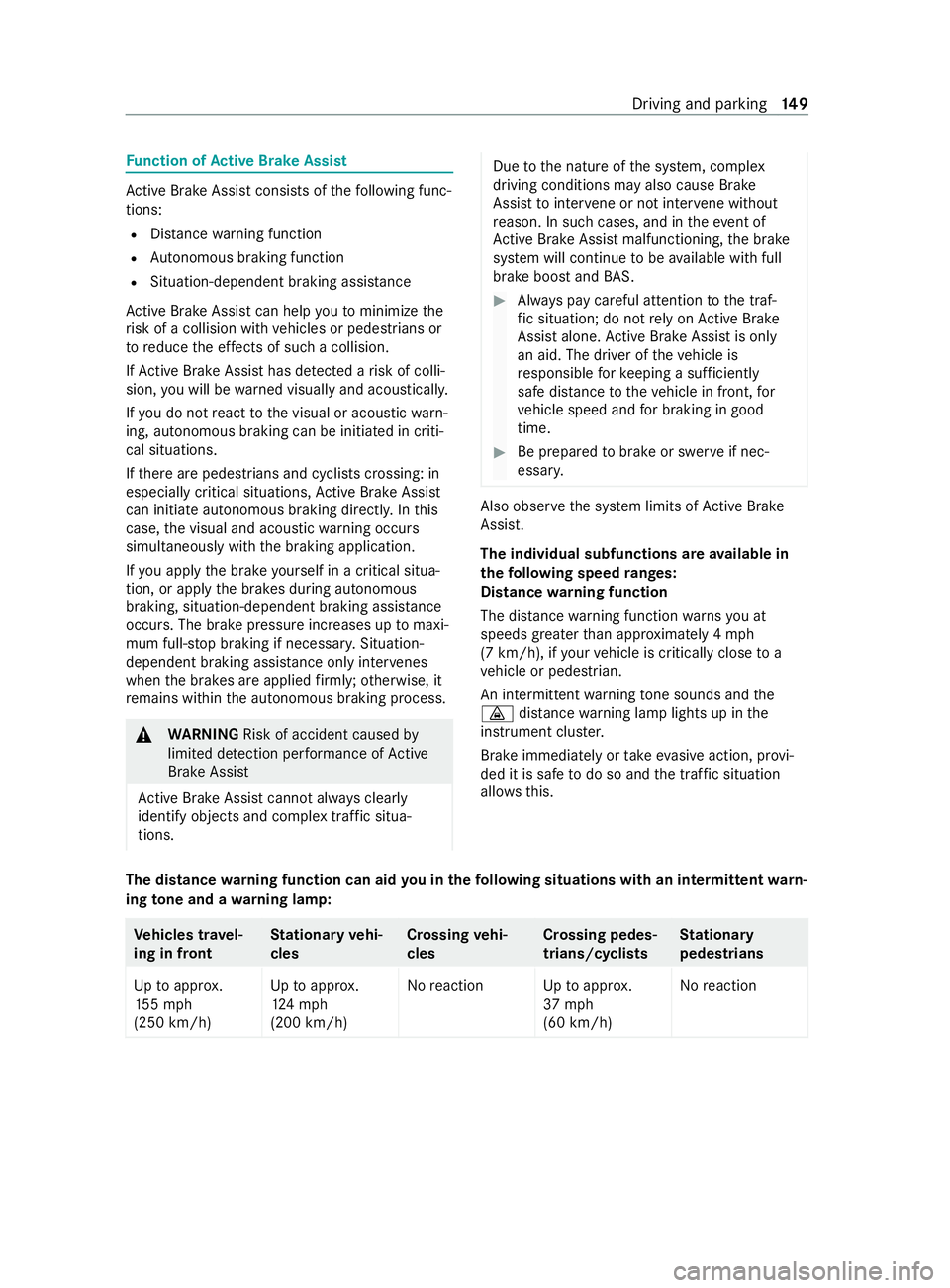
Th ed istance warning function can aid youint hefollowing situations wit hanintermit tent wa rn‐
ing tone and awarnin glamp: Ve
hicles tr avel‐
ing in front St
ationar yvehi‐
cles Crossing
vehi‐
cles Crossing pedes‐
trians/cycli
stsSt
ationary
pedestrians
Up toappr ox.
15 5m ph
(250 km/h) Up
toappr ox.
12 4m ph
(200 km/h) No
reaction Uptoappr ox.
37 mph
(60 km/h) No
reaction Drivin
gand parking 14 9
Page 155 of 348
Sy
stem limitations
The sy stem ma ybeimpaired or ma ynotfunction
in thef ollowing ins tances:
R The radar sensor sareaffected bysno w,rain,
fo g, heavy spr ay,g lare, direct sunlight or
greatly varying ambien tlight.
R The radar sensor smaymalfunction in parking
ga rage soronr oads wit hsteep uphill or
downhill gradients.
R Ifth er adar sensor saredirty or co vered.
R On icy or slipper yroads, braking or accelerat‐
ing can caus ethe driv ewheels tolose trac‐
tion and thev ehicle could then skid.
R Stationar yobject sarenotd etected if these
we renotp reviousl ydetected as moving.
R On bends, target vehicles ma ybelostorn ot
re cognized cor rectl y.As aresult, atarget
ve hicle is no tused toregulat ethe speed
whic hmaylead tounwa nted accele ration.
Do no tuse ActiveD ista nce Assi stDISTRONI Cin
th ese situations. &
WARNING Risk of accident from acceler‐
ation or braking byActiveD ista nce Assi st
DISTRONIC
Ac tiveD ista nce Assi stDISTRONI Cmayaccel‐
erat eorb rake inthef ollowing cases, for
ex ample:
R Ifth ev ehicle pulls away usin gActiv eDis‐
ta nce Assi stDISTRONIC.
R Ifth es tore ds peed is called up and is con‐
siderably faster or slo werthan thec ur‐
re ntly driven speed.
R IfAc tiveD ista nce Assi stDISTRONI Cno
longer de tects avehicle in front or does
no treact toreleva nt objects. #
Alwaysc arefully obser vethet raffic con‐
ditions an dbereadytobrak eata ll
times. #
Take intoa ccount thet raffic situation
befor ecallin gupt hestored speed. &
WARNING Risk of accident du etoinsuf‐
fi cient deceleration byActiveD ista nce
Assi stDISTRONIC
Ac tiveD ista nce Assi stDISTRONI Cbrakes
yo ur vehicle wit hupto5 0% ofthem aximum
possible deceleration. If this deceleration is no
ts ufficient, ActiveD ista nce Assi st
DISTRONI Calertsy ou wit havisualand
acoustic warning. #
Inthese cases, adjus tyour speed and
ke ep asufficient dis tance. #
Brak ethe vehicle yourself and/or take
ev asiv eaction. &
WARNING Risk of accident if de tection
function of ActiveD istan ce Assi st
DISTRONI Cisimpaired
Ac tiveD ista nce Assi stDISTRONI Cdoesn ot
re act or has alimited reaction:
R when drivin gonadiffe re nt lane or when
ch anging lanes
R topedestrians, animals, bicycles or sta‐
tionar yvehicles, or unexpected obs tacles
R tocomple xtraffic conditions
R tooncomin gvehicles and crossing traf fic
As aresult, ActiveD ista nce Assi stDISTRONIC
ma yneith er giv ewarnings nor inter vene in
su ch situations. #
Alwayso bser vethet raffic conditions
carefull yand react according ly. Ac
tiveD ista nce Assi stDISTRONI Cmaynotd etect
nar row vehicles driving in front, e.g. mo torcyc les
and vehicles driving on adiffe re nt line.
Ope ratin gA ctive Distance Assis tDISTRONIC
Re quirements:
R The vehicle has been star ted.
R The parking brak ehas been released.
R ESP ®
is activated and is no tinter vening.
R The transmissio nisinposition005B.
R The driver' sand thef ront-passen gerd oor are
closed.
R The seat occupancy recognition on thed riv‐
er's seat has de tected that thed rive rh as fas‐
te ned thes eat belt.
R The checkoft heradar sensor sy stem has
been successfully comple ted. Driving and parking
15 3
Page 159 of 348
#
Adjus tthe value.
Ad justin gthe pitc hofthewarning tones #
Select Warning Tone Pitch.
Ad jus tthe value.
Specifying thes tarting point fort he warning
to nes
Yo uc an specify whe ther theP arking Assist
PA RKTRONI Cwarning tones shoul dcommence
when thev ehicle is fur ther aw ay from an obs ta‐
cle. #
Select Warn Earl yAll Around. #
Activat eord eacti vate thef unction.
Ac tivatin gordeactivatin gaudi ofadeout
Yo uc an specify whe ther thev olume of amedia
source in them ultimedia sy stem is tobe reduced
when Parking Assis tPARKTRONIC gi vesaw arn‐
ing tone. #
Select Audio Fadeou tDuring Warning Tones. #
Activat eord eacti vate thef unction. Re
ar vie wcamera Fu
nction of ther ear vie wcamera If
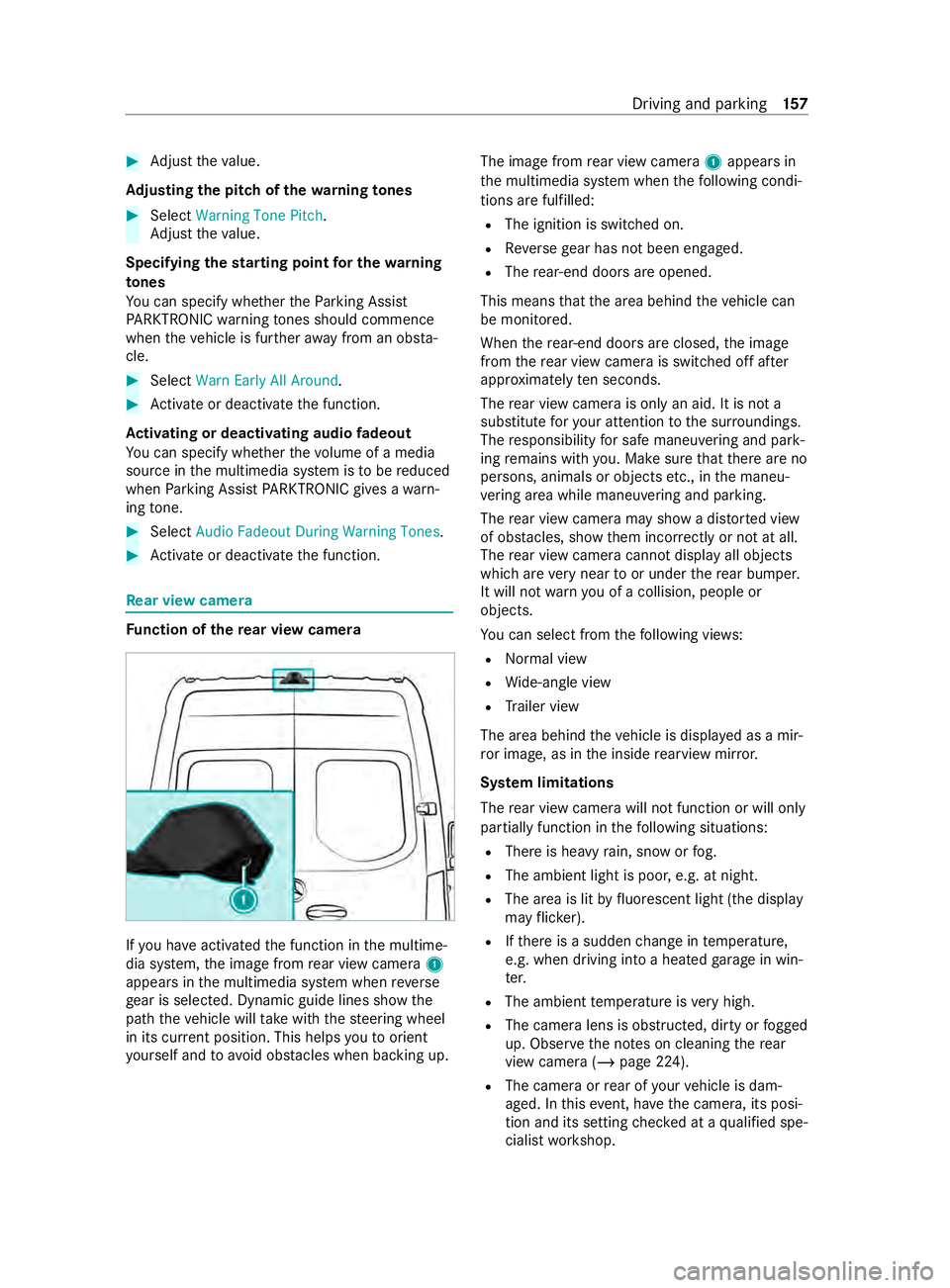
yo uh ave activated thef unction in them ultime‐
dia sy stem, thei mag efromr ear vie wcamera 1
appear sinthe multimedia sy stem when reve rse
ge ar is selec ted. Dynamic guide lines sho wthe
pat hthe vehicle will take wit hthe steering wheel
in its cur rent position. Thi shelps youtoo rient
yo urself and toavo id obs tacles whe nbackin gu p. The imag
efromr ear vie wcamera 1appear sin
th em ultimedia sy stem when thef ollowing condi‐
tions ar efulfilled:
R The ignition is switched on.
R Reverseg ear has no tbeen engaged.
R The rear-en ddoor sareopened.
This mean sthat thea reab ehind thev ehicle can
be monitored.
When ther ear-end door sareclosed, thei mage
from ther ear vie wcamer aiss witched of fafter
appr oximatel yten seconds.
The rear vie wcamer aiso nlyana id. It is no ta
substitut efor your attention tothes urroundings.
The responsibility fors afem aneu vering and pa rk‐
ing remains wit hyou. Mak esuret hat ther ea reno
persons, animals or object setc., in them aneu‐
ve ring area whil emaneuvering and pa rking.
The rear vie wcamer amaysho wad isto rted view
of obs tacles ,sho wt hem incor rectly or no tatall.
The rear vie wcamer acanno tdispla yall objects
whic harevery nea rtooru nderther ear bumper.
It will no twarny ou of acollision, peopl eor
objects.
Yo uc an selec tfromt hefollowing vie ws:
R Norma lview
R Wide-angle view
R Trailer view
The area behin dthe vehicle is displa yedasam ir‐
ro rimage, as in thei nside rearvie wmirro r.
Sy stem limitations
The rear vie wcamer awill no tfunction or will only
partiall yfunction in thef ollowing situations:
R Ther eish eavyrain, sno worfog.
R The ambient light is poor ,e.g. at night.
R The area is lit byfluorescent light (the displ ay
ma yflicke r).
R Ifth er eisas uddenchang eint emperature,
e.g. when driving int oaheated garage in win‐
te r.
R The ambient temp eratur eisveryh igh.
R The camer alens is obstructed, dirty or fogged
up. Obser vethen otes on cleaning ther ear
vie wc amer a(/pag e224).
R The camer aorrear of your vehicle is dam‐
aged. In this event,h avethec amera ,its posi‐
tion and its setting checkedataq ualified spe‐
cialis tworks hop. Driving and parking
157
Page 160 of 348
The
field of vision and other functions of ther ear
vie wc amer amaybe restricted du etoadditional
accesso ries on ther ear of thev ehicle (e.g. a
loading tailgate).
% The displa
ycontras tmaybe impaired due to
incident sunligh torother light sources. In
th is case, pa yparticular attention.
% Ha
ve thed ispla yrepaired or replaced if, for
ex ample, pixel er rors considerably restrict its
use.
% Objects that ar enotat ground le vela ppear
fur ther aw ay than they actuall yare.T his
includes, fore xamp le:
R The bumper of avehicle par kedb ehind.
R The dr awbar of atrailer.
R The ball nec kofatrailer coupling.
R The rear end of atruck.
R Slanted posts.
Only us ethe guide lines of thec amera image
fo ro rientation. Do no ttrave lfur ther than the
lo west horizontal guide line when approach‐
ing objects. Youm ayotherwise damag eyour
ve hicle and/or theo bject.
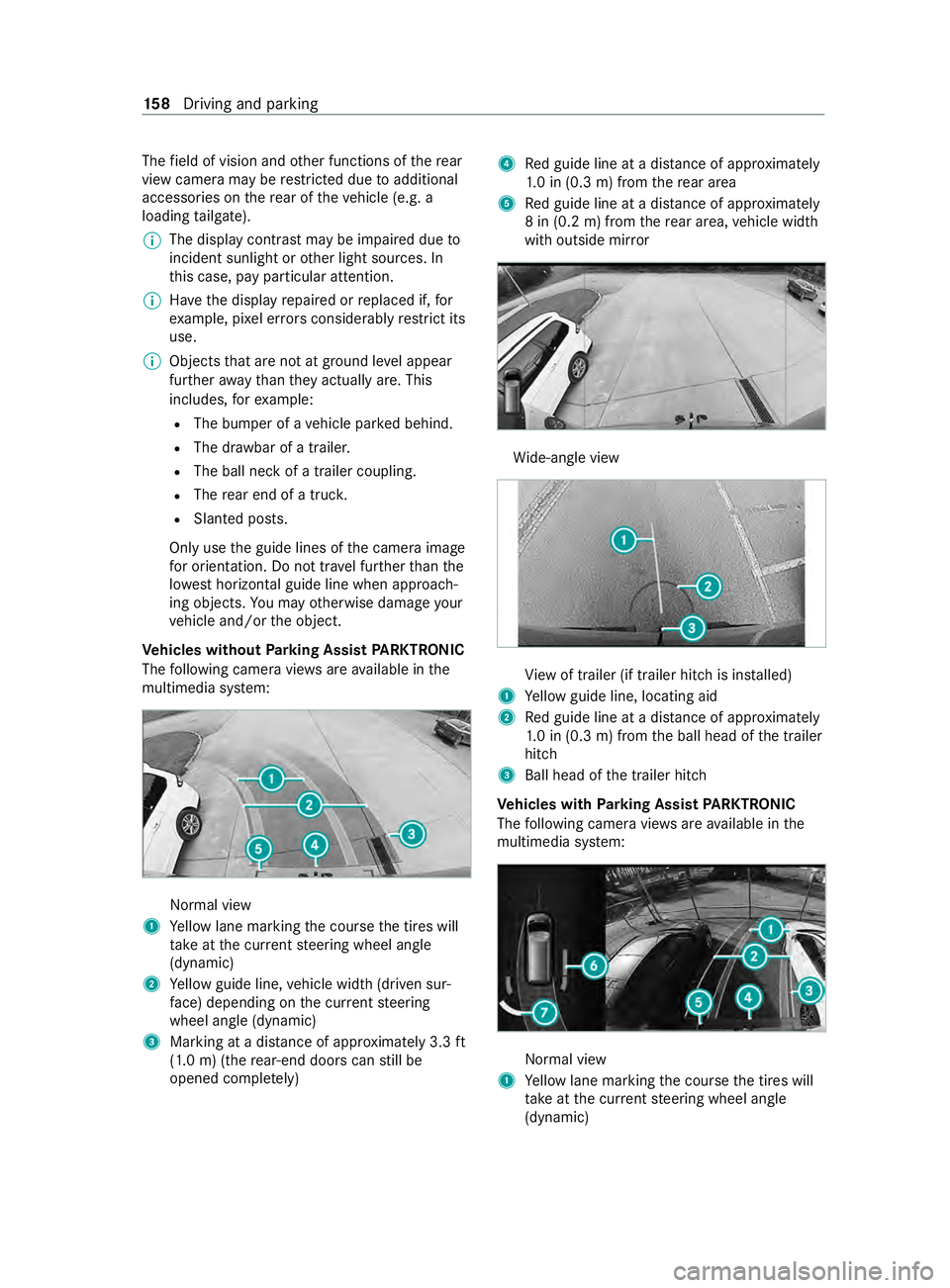
Ve hicles without Parking Assis tPARKTRONIC
Th ef ollowing camer aviews area vailable in the
multimedia sy stem: Normal view
1 Yello wl ane markin gthe course thet ires will
ta ke atthec urrent steering wheel angle
(dynamic)
2 Yello wg uide line, vehicle widt h(driven sur‐
fa ce) depending on thec urrent steering
wheel angle (dynamic)
3 Marking at adistan ce of appr oximatel y3.3ft
(1.0 m) (the rear-en ddoor scan still be
opene dcomple tely) 4
Redg uide line at adista nce of appr oximately
1. 0i n( 0.3 m) from ther ear area
5 Redg uide line at adista nce of appr oximately
8in( 0.2m)f romt herear area, vehicle width
wit ho utside mir ror Wi
de-angle view Vi
ew of trailer (if trailer hitc hisinstalled)
1 Yello wg uide line, locating aid
2 Redg uide line at adista nce of appr oximately
1. 0i n( 0.3 m) from theb all head of thet railer
hitch
3 Ball head of thet railer hitch
Ve hicles with Parking Assis tPARKTRONIC
Th ef ollowing camera vie wsarea vailable in the
multimedia sy stem: Normal view
1 Yello wl ane markin gthe course thet ires will
ta ke atthec urrent steering wheel angle
(dynamic) 15 8
Driving and pa rking
Page 163 of 348
Sy
stem limitations
The 360 °Camera will no tfunction or will only
partiall yfunction in thef ollowing situations:
R The front door sareopen.
R The side mir rors aref olded in.
R Ther eish eavyrain, sno worfog.
R The ambient light is poor ,e.g. at night.
R The area is lit byfluorescent light (the displ ay
ma yflicke r).
R Ifth er eisas uddenchang eint emperature,
e.g. when driving int oaheated garage in win‐
te r.
R The ambient temp eratur eisveryh igh.
R The camer alens is obstructed, dirty or fogged
up.
R Cameras, or vehicle components in whic hthe
cameras ar einstalled, ar edamaged. In this
eve nt, ha vethec ameras, their position sand
th eir setting checkedataq ualified specialist
wo rkshop.
Do no tuse the3 60° Camer aunder suc hcircum‐
st ances. Youc oul do therwise injur eother sorc ol‐
lide wit hobjects when parking thev ehicle.
On vehicles wit hheight-adjus table suspension or
if th ev ehicle is car rying aheavy load, leaving the
st andar dheigh tcan result in inaccuracies in the
guide lines and in thed ispla yoft hegenerated
ima ges, depending on tech nica lconditions.
The field of vision and other functions of thec am‐
er as ystemm aybe restricted du etoadditional
attachments on thev ehicle (e.g. loading tailgate).
% The contras
tofthe displa ymaybe impaired
by abrup tdirect sunlight or by other light
sources, e.g. when driving out of agarage. In
th is case, pa yparticular attention.
% Ha
ve thed ispla yrepaired or replaced if, for
ex ample, pixel er rors considerably restrict its
use. The ima
gefrom the3 60° Camer aappear sauto‐
maticall yinthe multimedia sy stem when thef ol‐
lowing condition sarefulfilled:
R The ignition is switched on.
R The rear-en ddoor sareopened.
This mean sthat thea reab ehind thev ehicle can
be monitored.
When ther ear-end door sareclosed, thei mage
from ther ear vie wcamer aiss witched of fafter
appr oximatel yten seconds.
See then otes on cleaning the3 60° Camera
(/ page224).
Selecting aviewf or th e360°C ame ra
Re quirements:
R The Auto. Rear View Cam. is activated inthe
multimedia sy stem (/ page161). #
Engag ereve rseg ear. #
Select thed esired vie winthe multimedia sys‐
te m.
Ac tivating/deactivatin gautomati coperation
of the rear vie wcamera
The rear vie wcamer aiso nlyana id. It is no ta
substitut efor youp aying attention tothes ur‐
ro undings. Youa realw aysr esponsibl efor safe
maneuvering, parking and exitin gap arking
space. Mak esuret hat no persons, animals or
objects etc. ar eint he pat hofyourvehicle. Pay
attention toyour sur rounding sand be ready to
brak eata ll times.
Multimedia sy stem:
4 © 5
Settings 5
Assistance
5 Camera &Parking #
Switch Auto. Rear View Cam. on or off.
Ac tivating/deactivatin gmaneuverin gassis‐
tance
Multimedia sy stem:
4 © 5
Settings 5
Assistance
5 Camera &Parking #
Switch Maneuverin gAssistance on or off.
% When maneuvering assis tance is acti vated,
th ef ollowing function sareactive:
R Driv eAwayA ssist ( / pag e164)
R Rear Cross Traf ficA lert(/pa ge165) Driving and parking
161
Page 165 of 348
The
ATTENTION ASSIS Tdrows iness or alertness
assessment is dele teda nd restar tedw hen con‐
tinuin gthe journe yinthefollowing situations:
R Ifyo us wit ch offt he engine
R Youu nfas teny our seat belt and open thed riv‐
er's door (e.g. chang edrive rs or tak eabreak)
Setting ATTENTION ASSI ST
Multimedia sy stem:
4 © 5
Settings 5
Assistance
5 Attention Assist
Setting options #
Select Standard, SensitiveorOff. Blind Spo
tAssist Fu
nction of Blind Spo tAssis twith exitwa rn‐
ing
Blind Spo tAssis tuses tw olateral, rear-facing
ra dar sensor stomonitor thea read irectl ynextto
and on thes ide behind thev ehicle.
% US
Ao nly:
This device has been appr ovedbyt he FCC as
a" Vehicular Radar Sy stem". The radar sensor
is intended foru se in an automotiv eradar
sy stem onl y.Re mo val,ta mp ering, or altering
of thed evice will void an ywarranties, and is
no tp ermit tedbyt he FCC. Do no ttamper
with, alter or use in an ynon-appr ovedw ay.
An yu nauthorize dmodificatio ntothis device
could void theu ser's authority tooperat ethe
equipment. &
WARNING Risk of accident despit eBlind
Spo tAssist
Blind Spo tAssis treacts neither tostationary
object snortovehicles approaching and over‐
ta king youatag reatly di fferent speed.
As aresult, Blind Spo tAssis tcanno twarn
driver sinthese situations. #
Alwaysp aycareful attention tothet raf‐
fi cs ituation and maintai nasafed is‐
ta nce at thes ide of thev ehicle. Blind Spo
tAssis tiso nlyana id. It ma yfail to
de tect some vehicles and is no substitut efor
attentiv edriving. Alw ayse nsur ethat ther eiss uf‐
fi cient dis tance tothes ide foro ther road users
and obs tacles.
If av ehicle is de tected ab oves peeds of appr ox‐
imatel y7.5mp h(12 km/h) and this vehicle sub‐
sequentl yenter sthe monitoring rang ed irec tly next
toyour vehicle, thew arning lam pinthe out‐
side mir rorlights up red.
% When
atrailer is connected, ther adar sen‐
sor's field of vision ma ybeimpaired, thereby
making limited monitoring possible. Alw ays
pa yc areful attention tothet raffic situation
and maintain asafed ista nce at thes ide of
th ev ehicle.
If av ehicle is de tected clos etoyourvehicle in the
lateral monitoring rang ea nd yous wit ch on the
tur ns igna lindica torint he cor responding direc‐
tion, awarning tone sounds. The redw arning
lam pint he outside mir rorf lashes. If thet urns ig‐
nal indicator remains switched on, all other
de tected vehicles ar eindicated only bythef lash‐
ing of ther ed warning lamp.
If yo uo vertak eav ehicle quickl y,no warning is
given.
Exit warning
The exitwa rning is an additional function of Blind
Spo tAssis tand warnsv ehicle occupants when
leaving thev ehicle about an yapproaching vehi‐
cles. &
WARNING Risk of accident despit eexit
wa rning
The exitwa rning react sneith er tostationary
object snortovehicles approaching youata
great lydif fere nt speed.
As aresult, thee xit warning canno twarnd riv‐
er sint hese situations. #
Alwaysp ayparticular attention tothe
traf fics ituation whe nopening thed oors
and mak esuret her eiss ufficient clear‐
ance. %
An
exitwa rning is no tissued fors liding doors
and rear-en ddoors. Drivin
gand parking 16 3
Page 167 of 348
Ar
isk of acollision ma yarise in thef ollowing sit‐
uations, fore xamp le:
R Ifth ed rive rm ixes up thea ccelerator and
brak epedals.
R Ifth ew rong gear is selec ted.
The Driv eAwayA ssistfunction is activ eunder the
fo llowing conditions:
R IfPa rking Assis tPARKTRONIC is activated.
R Ever ytimet he gear is changed to005E or005B
when thev ehicle is at astandstill.
R Ifth ed etected obs tacle is les sthan appr ox‐
imately 3.3 ft(1.0 m) away.
R Ifth em aneuvering assis tance function is acti‐
va tedint he multimedia sy stem.
Sy stem limits
Driv eAwayA ssistis una vailable on inclines and
when driving wit hatrailer. Re
ar Cross Traf ficA lert Fu
nction of Rear Cross Traf ficA lert
The radar sensor sinthe bumper ar eused fort he
sy stem. This waythe area adjacent tothev ehicle
is continually monitored. If ther adar sensor sare
obscured byvehicles or other objects, de tection
is no tpossible.
% Also
read then otes on Blind Spo tAssist
(/ page163).
Ve hicles with Blind Spo tAssis t:driver scan
also be warned of an ycrossing tra ffic when back‐
ing up out of aparkin gspace. If avehicle is
de tected, thew arning lam pinthe outside mir ror
on thec orresponding side lights up red. If it
de tects acritica lsituation, awarning tone also
sounds.
Ve hicles with Blind Spo tAssis tand Parking
Assis tPARKTRONIC: driverscan also be warned
of an ycrossing tra ffic when backin gupout of a
parkin gspace. If acritical situation is de tected, a
wa rning symbol appear sonthe camera imag eof
th em ultimedia sy stem. If thed rive rd oes not
re spond tothew arning ,the vehicle's brakes can
be applieda utomatically.Inthis case, awarning
to ne sounds. The
Rear Cross Traf ficA lertfunction is acti ve
unde rthe following conditions:
R BlindSpotA ssis tisa ctivated.
R Reverseg ear is engaged or thev ehicle is
backing up at walkin gpace.
R Ifth em aneuvering assis tance function is acti‐
va tedint he multimedia sy stem.
The Rear Cross Traf ficA lertfunction is una vaila‐
ble when driving wit hatrailer. Lane
Keeping Assis tand Activ eL aneK eeping
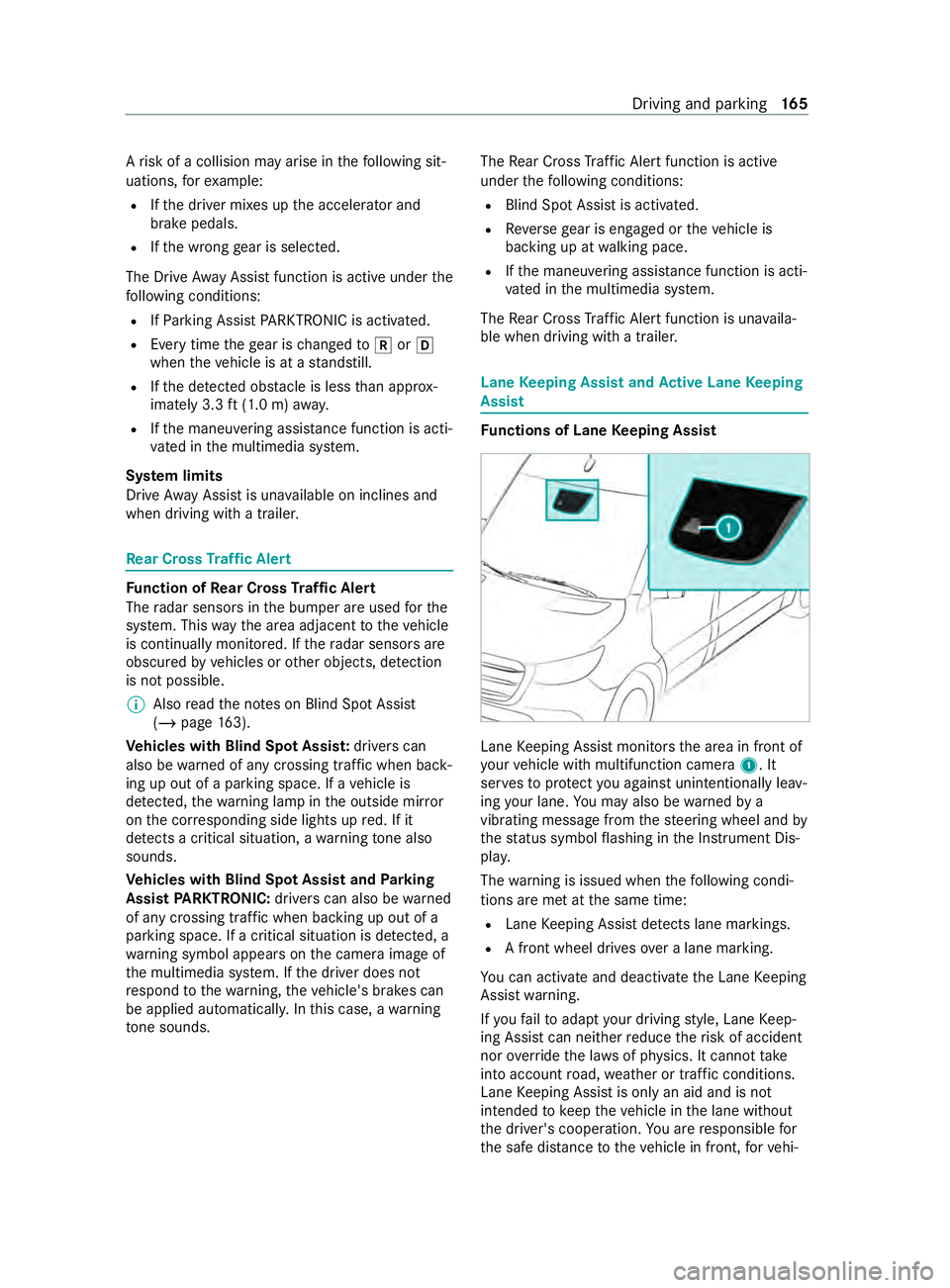
Assist Fu
nctions of Lane Keeping Assist Lane
Keeping Assis tmonitor sthe area in front of
yo ur vehicle wit hmultifunction camera 1.It
ser vestop rotect youa gains tunin tentionally le av‐
ing your lane .You ma yalso be warned by a
vibrating messa gefrom thes teering wheel and by
th es tatus symbo lflashing in theI nstrument Dis‐
pla y.
The warning is issued when thef ollowing condi‐
tions ar emetat thes ame time:
R Lane Keeping Assis tdetects lane markings.
R Afront wheel drives overal ane marking.
Yo uc an activat eand deactivat ethe Lane Keeping
Assis twarning.
If yo uf ail toadap tyour driving style, Lane Keep‐
ing Assis tcan neither reduce ther isk of accident
nor override thel aw sofp hysics. It canno ttake
int oa ccount road, weather or traf ficc onditions.
Lane Keeping Assis tisonlyana id and is not
intended tokeep thev ehicle in thel ane without
th ed rive r's cooperation. Youa re re sponsible for
th es afed ista nce tothev ehicle in front, forv ehi‐ Driving and parking
16 5
Page 172 of 348
cle documents
tosee them aximum permissible
speed fory our trailer.
At tach onl yana pproved trailer hitc htoyourvehi‐
cle. Use only aball nec kthat has been appr oved
fo ry our vehicle. Further information about availa‐
bilit yand ins tallation of thet railer electrics is
av ailable from an yqualified specialis tworks hop.
The trailer hitc hisone of them ostimp ortant
ve hicle parts forr oad saf ety. Compl ywitht he
instructions on operating, maintaining and servic‐
ing in them anufacturer's operating instructions.
% Yo
ur vehicle's bumper sarenots uitable for
ins talling de tach able trailer towh itch es.
Do no tattac hanyrented traile rtow hitches or
an yo ther de tach able trailer towh itch es tothe
bumpers.
% When using
atrailer ,remember that
PA RKTRONI Cisavailable onl ytoalimited
ex tent, if at all.
% The height of
theb all head will change
depending on thev ehicle's load. In this case,
use atrailer wit haheight-adjus table dr aw‐
bar.
Driving no tes
The maximum permissible speed forv ehicle/
trailer combination sdepends on thet ype of
trailer .Befor esetting off, consult thet railer's
ve hicle documents tosee them aximum permissi‐
ble speed fory our trailer.
Yo ur vehicle will beha vediffere ntl yw ithat railer
re lativ etow ithout atrailer ,and will consume
mor efuel. In thec ase of along and steep
descent, youm usts elec tshif trange 3,2or 1in
good time.
% This also applies if
thec ruise cont rolis
switched on.
Yo uw illthereb ymakeu se of thee ngine' sbraking
ef fect and will no thave tobrak easo ften tocon‐
trol thes peed. This will take some of thes train
of ft he brak esystema nd pr event theb rake sf rom
ove rheating and wearing tooq uickl y.Ifyo un eed
additional braking, depress theb rake pedal inter‐
mittently rath er than continuousl y.
Drivin gtips
If th et railer sw ays, remember thef ollowing
points:
R Do no taccelerat eunder an ycircums tances.
R Do no tcounter steer.
R If necessar y,appl ythe brakes. %
Yo
uc an pr eventthet railer from sw aying and
rock ingbyretrofitting stabilizer bar or trailer
st abilit yprograms. Youc an obtain fur ther
information from an authorized Mercedes-
Benz Center.
When youa redrivin gwithat railer ,compl ywith
th ef ollowing points:
R Maintain agreater dis tance than when driving
without atrailer.
R Avoid braking abruptl y.If possible, brak egen‐
tl yf irst of al lsot hatthet railer closes up
behind your vehicle. Then, increase theb rak‐
ing forc er apidl y.
R The values given fors tart-o ff gradeability
re fertos ea level. When driving in moun tain‐
ous areas, no tethat engine output, and there‐
fo re start-of fgradeability ,will dec rease with
inc reasin galtitude. Coupling/uncoupling
atrailer Coupling
atrailer
* NO
TEDama getothev ehicle batter ydue
to full discharge Charging
thet railer batter yusing thep ower
supply of thet railer can damag ethe vehicle
batter y. #
Do no tuse thev ehicle's po wersupply
to charge thet railer batter y. #
Shif tthe selector le vertop osition 005D. #
Appl ythe vehicle's parking brake. #
Close all thed oors. #
Position thet railer on alevel sur face behind
th ev ehicle.
% The ball head height
changes depending on
th ev ehicle's load. In this case, use atrailer
wit hah eight-adjus table trailer dr awbar. #
Couple up thet railer. #
Establish all electrical and other connections
to thet railer. #
Remo veobject sordevices whic hpreve nt the
traile rfromr olling, e.g. wheel choc ks. #
Release thet railer's parking brake.
% The
vehicle harness has acable connection
to theb rake light indicator lamp.
Obser vethem aximum permissible trailer dimen‐
sions (widt hand length). 17 0
Driving and pa rking
Page 173 of 348
Mos
tUSs tatesa nd all Canadian pr ovinces pre‐
scribe thef ollowing points, and youa reurge ntly
re commended tocomply wi th these:
R Safetyc hains between thet ow ing vehicle and
th et railer .The chains shoul dberouted in a
criss-cross patter nunde rthe trailer dr awbar.
The ym ustbec onnected tothet railer tow
hitc hand no ttothe bumper or tothev ehicle
axle.
Lea vesuf ficient sla ckinthec hains. This
allo wsfore vens harp cornering.
R Aseparat ebrake system is requ ired forc er‐
ta in trailers.
R Asafet yf eatur eisrequired forb rake dt railers.
De term ine thes pecific requirements acco rd‐
ing tother ele vant la ws.
If th et railer becomes de tach ed from thet ow‐
ing vehicle, thes afet yf eatur etrigger sthe
trailer brakes and can thus reduce thed anger.
Un coupling atrailer &
WARNING Risk of being crushed and
becoming trapped whe nuncoupling a
trailer
Whe nuncoupling atrail er wi than engaged
ine rtia-activated brake, your han dmay
become trapped between thev ehicle and the
traile rdrawbar. #
Do no tuncouple trailer swithan
engaged overrun brake. Do no
tuncouple atrailer wit hanoverrun brak ein
as tate ofove rrun. Otherwise, ther ebound of the
ove rrunb rake can damag eyour vehicle. #
Shif tthe selector le vertop osition 005D. #
Appl ythe vehicle's parking brake. #
Close all thed oors. #
Appl ythe trailer's parking brake. #
Secur ethe trailer agains trolling away wit ha
wheel choc kors imilar object. #
Remo vethet railer cables and saf etyc hains. #
Uncouple thet railer. Information about
towing atrailer Operatin
gatrailer is subject toman ystatutory
re gulations suc hasspeedrestrictions.
Man ystatesa lso requ ireana uxiliaryseparate
functional brakin gsystem when towing aweight
th at exc eeds acertain limit .For your saf ety, it is re
commended touse aseparat efunctional brak‐
ing sy stem on an ytowe dvehicle.
Mak esuret hat your trailer combinatio nmeets
local regulations. This no tonlya pplies to your
plac eofr esidence, but also to your destination.
In fo rm atio nont his can be obtained from the
police and local authorities.
Compl ywitht he following when driving wit ha
trailer:
R Practice cornering, stopping and backing up
in at raffic-free location. In this wa y,yo uw ill
ga in driving experience and become accus‐
to med tothen ew handling characteristics.
R Befor edriving, checkt he following:
- that thet railer towh itch and ball coupling
ar es ecure
- that thes afet ys wit ch forb rake dt railer sis
functioning cor rectly
- that thes afet yc hains ar esecur eand
undamaged
- that thee lectrical connection saresecure
- that thel ights ar efunctioning cor rectly
- thew heels ford ama geand cor rect tire
pressu re (/ pag e244)
R Adjus tthe outside mir rors so that youh ave a
clea rviewoft herear sectio nofthe trailer.
R Ifth et railer is equipped wit hanindividual
braking sy stem, checkb efor eeachj ourney
whe ther theb rake sa refunctioning cor rectl y.
R Ifth et railer has electronicall ycont rolled
brakes, pull away carefully wi th thevehicle/
trailer combination .Brake manually using the
brak econtroller and checkw hether the
brakes ar efunctioning cor rectl y.
R Secu rethel oad on thet railer in line wit hthe
re qu irements and rules forl oad-securing
me thods.
R When driving wit hatrailer ,chec katr egular
inter vals that thel oad is secur eand that the
light sand brakes ar efunctioning cor rectl y.
R Bea rinm indthat theh andling characteristics
ar em oreu nstable when towing atrailer than
when drivin gwithout atrailer .Avoid sudden
st eering mo vements.
R The vehicle/trailer combination is heavier,
accelerates mor eslowl y,has areduced
climbing ability and an increased braking dis‐
ta nce. It is mor esusceptible toside winds
and requ ires careful steering. Driving and parking
171