fuel MERCEDES-BENZ SPRINTER 2020 MY20 with no MMS Operator’s Manual
[x] Cancel search | Manufacturer: MERCEDES-BENZ, Model Year: 2020, Model line: SPRINTER, Model: MERCEDES-BENZ SPRINTER 2020Pages: 316, PDF Size: 5.38 MB
Page 175 of 316

R
Û ATTENTION ASSIS Tswitched off
R ¸ Changing Blind Spo tAssis tstatus dis‐
play
St atus displa ysforB lind Spo tAssist 1
On an dready toissue warnings
2 On and no tready toissue warnings
3 Off Calling up displa
yson thet ripm enu On-boar
dcomputer:
4 Trip #
Selec tthe desired displa yand confirm.
The following displa ysarea vailable on thet rip
menu:
R Standar ddisplay
R Rangea nd cur rent fue lconsu mption
Wi th cer tain engines arecuperation displa yis
also shown. If only asmall amount of fue lis
lef tint he fuel tank ,av ehicle being refueled
appear sins tead of thea ppr oximat erange.
R ECOd ispl ay ( /pag e119 )
R Trip computer:
- FromS tart
- FromR eset
R Digital speedom eter Instrument Displa
ywithc olor display
St andar ddispla y(example)
1 Trip dis tance
2 Totald ista nce Instrument Displa
ywithb lacka nd whit edisplay
St andar ddispla y(example)
1 Trip dis tance
2 Totald ista nce Instrument Displa
ywithc olo rdisplay
Tr ip computer (e xamp le)
1 Distance co vered( from start/ from reset)
2 Driving time (from start/from reset)
3 Averag espeed (from start/from reset)
4 Averag efuel consum ption (from start/from
re set) Instrument Displa
yand on-boar dcomputer 17 3
Page 176 of 316

Instrument Displa
ywithb lack and whit edisplay
Tr ip computer (e xamp le)
1 Distance co vered( from start/from reset)
2 Driving time (from start/from reset)
3 Averag espeed (from start/from reset)
4 Averag efuel consum ption (from start/from
re set) Re
setting values on theo n-boa rdcompu ter
trip menu On-board computer:
4 Trip
% The spelling of
thed ispla yedm ain menu may
dif fer. Therefore, pa yattention tothem enu
ove rviewf orthei nstrument display
(/ page170).
Yo uc an rese tthe values of thef ollowing func‐
tions:
R Trip Odometer:
- Reset Trip Odometer?
R Trip computer:
- FromS tart
- FromR eset
R ECOd isplay #
Selec tthe function that is tobe rese ta nd
confir mthis selection. #
Confir mtheReset Values? promptwith Yes. Calling up settings on
theo n-boa rdcompu ter On-boar
dcomputer:
4 Settings
The following ent ries can be se tonthe Settings
menu:
R DriveAssist
- Switching ESP(ESP) on and off
- Switching Akt. Spurhalte-Assistent (Active
Lane Keeping Assist) on and off
- Switching Spurhalte-Assistent (Lane
Ke eping Assist) on and off
- Switching Aktiver Brems-Assistent (Active
Brak eAssist) on and off
- Switching Totwinkel-Assistent (Blind Spot
Assist) on and off
- Switching Attention Assist (Attention
Assist) on and off
R Light
- Switching Tagfahrlicht (Daytimerunning
lights )ona nd off
- Switching Leuchtzeitinnen (Illumination
pe riod inside) on and off
- Switching Leuchtzeit außen (Illumination
period outside) on and off
- Switching Auffindbeleuchtung (Locator
lighting) on and off
- Setting Instrument lighting
R Vehicle
- Setting Winterreifen-Limit (Winter tires
limit)
- Switching Akust.Schließen (Acoustic
locking) on and off
- Switching Autom. Verriegelung (Autom.
locking) on and off
- Switching Ruhezustand (Standby) on and
off
- Switching Regensensor (Rainsensor) on
and off
R Setting Heating 174
Instrument Displa yand on-boar dcomputer
Page 194 of 316

#
Nevertouc hthe danger zone sur round‐
ing movin gcomponent parts ,e.g.t he
ro tatio na reaoft hefan. #
Remo vejewe lrya nd watches. #
Keep items of clo thing and hair away
from moving parts. &
WARNING Risk of bu rnsf romh otcom‐
ponent parts in thee ngine compartment
Cer tainc omponents in thee ngine compart‐
ment can be very hot, e.g. thee ngine, the
ra diator and parts of thee xhau stsystem. #
Allowthe engine tocool down and only
to uc hc omponent parts desc ribed in the
fo llowing. If
yo uh ave tocar ryout an yworkint he engine
compartment, touc ho nlyt he following compo‐
nents:
R Hood
R Engine oil filler openin gcap
R Washer fluid reser voir cap
R Coolant expansion reser voir cap #
Open theh ood (/ page185). #
Remo vedirtfromw ater drain valve 2 of air
intak ebox1 . Draining
thef uel filter &
WARNING Danger of fire and explosion
due tofuel
Fu els ar ehighly flammable. #
It is essential toavoid fire ,o pen flames,
smokin gand creating spar ks. #
Befor efilling up, switc hoffthee ngine,
and, if applicable, thea uxiliar yheating. &
WARNING Risk offire and explosion due
to fuel
Fu els ar ehighly flammable. Ther eisarisk of
fi re and explosion due tocontact wi thhot
component parts. #
Allowthe engine and thee xhau stsys‐
te mtoc ool down. *
NO
TEEngine damag eduetodela yed
drainag eofthe fuel filter Ve
hicles with adiese lengine: delayed
drainag eofthe fuel filter can lead toengine
damage.
If the 003A indicator lam plights up, drain the
fuel filter immediately. +
ENVIRONMENTAL
NOTEEnvironmental
pollution du etodisposal in anon-envi‐
ro nmental ly-friendly manner #
Dispose of thew ater/fuel mixtur einan
environmentally-friendly manner. OM642 engine
#
Park thev ehicle in asafel ocation and secure
it agains trolling away. #
Switc hoffthea uxiliar yheating
(/ page106). #
Switc hoffthee ngine. #
Open theh ood (/ page185). 19 2
Maintenance and care
Page 195 of 316
#
Place asuitable collector beneat hdrain hose
2. #
Switc hont he ignition. #
Open drain scr ew1 until thew ater/fuel
mixtur eemerges from drain hose 2.#
Close drain scr ew1 as soon as around
0. 2qt( 0.2l iter) of thew ater/fuel mixtur ehas
been collected.
Af ter30s econds, thee lectrical fuel pump
automaticall ystops thed ischarg eofthe
wate r/fuel mixture. #
Afterd raining, switc hoffthei gnition. #
Dispose of thec ollected water/fuel mixture
in an environmentally responsible manner,
e.g. at aqualified specialis tworks hop. #
Chec kthat drain scr ew1 has been closed.
If th ee ngine is running whil edrain scr ew 1
is open, youw ill lose fuel thro ugh drain hose
2. #
Close theh ood (/ page185). #
003A The indicator lam pdoes no tgoo ut
af te rd raining: drainthe fuel filter again. #
003ATh eindica torlam pd oesn otgo out
af te rt he second draining: consultaquali‐
fi ed specialis tworks hop.
Mercedes-Benz recommends that youh avet he
fuel filter drained at aqualified specialis twork‐
shop. Cleaning and care
Note
sonw ashingthe vehicl einana utomatic
car wash &
WARNING Risk of accident du eto
re duced braking ef fect af terw ashing the
ve hicle
The braking ef fect is reduced af terw ashing
th ev ehicle. #
Aftert he vehicle has been washed,
brak ecarefully while paying attention to
th et raffic condition suntil theb raking
ef fect has bee nfully restored. *
NO
TERisk of damag etothe paintwork
and plastic components If
yo uw ash your vehicle in Touchles sAuto‐
matic Car Wash sy stems that use special
cleaning agents, thec leaning agentsu sed can damag
ethe paintwor korplastic components
of thev ehicle. #
Do no twash thev ehicle in Touchless
Au tomatic Car Wash sy stems that use
special cleaning agents. Mak
esuret hat thea utomatic car wash is suitable
fo rt he size of thev ehicle.
Befor ewashing thev ehicle in an automatic car
wa sh, fold in theo utside mir rors and remo veany
additional antennas. Otherwise, theo utside mir‐
ro rs,a ntennas or thev ehicle itself could be dam‐
aged.
Mak esurea nyadditional antennas ar ere-in stal‐
led and that theo utside mir rors aref ullyf olded
out again when youl eave thea utomatic car
wa sh.
To avo id damag etoyourvehicle, obser vethef ol‐
lowing befor eusing an automatic car wash:
R thes ide windo wsand thes liding windo ware
comple tely closed.
R theb lowe rfor ventilation and heating is
switched off.
R thew indshield wiper switc hisinposition005A.
If th ev ehicle is very dirty ,wash of fexcess dirt
befor ecleaning thev ehicle in an automatic car
wa sh.
% Re
moving thew ax from thew indshield and
th ew iper rubber safter wa shing thev ehicle,
will help avoid smearing and reduce wiper
noise. Note
sonu se ofapowe rwasher &
WARNING Risk of accident whe nusing
high-pressu recleaning equipment wi th
ro und-spr aynozzles
The wate rjet from around-spra ynozzle (dirt
grinder) ma ycaus edamag etotires and sus‐
pension components that is no tvisible.
Component sdamaged in this wa ym ayfail
unexpec tedly. #
Do no tuse high-p ressur ecleaning
equipment wit hround-spra ynozzle sto
clea nyour vehicle. #
Damaged tires or suspension compo‐
nentsm ustber eplaced immediatel y. Ne
veru se ap owe rwashe rinthevehicle interior.
The pressurized watercreated bythep ower Maintenance and care
19 3
Page 197 of 316

Obser
vethef ollowing no tes: Note
sonc leaning and car eA voiding paintwor kdamage
Pa int
R
Insect remains: soak wit hinsect
re mo vera nd then wash off.
R Birdd roppings: soak wit hwater and
th en wash off.
R Remo vecoolant, tree resin, oils,
fuels and greases: rubg entl ywitha
clo thsoaked in petroleum ether or
lighter fluid.
R Brak efluid: wash of fwithw ater.
R Tars tains :use tarr emo ver.
R Wax: us eas ilicone remo ver. R
Do no taffix sticke rs,f ilms or similar.
R Remo vedirtass oon as possible.
Mat tefinish
R
Onlyuse car eproducts appr ovedfor
Mercedes-Benz. R
Do no tpolish thev ehicle and alloy
wheels.
R Do no tuse aw ash program that
end swithah otwa xtreatment in
au tomatic car washes.
R Do no tuse paint cleaners, buf fing or
polishing products, or gloss preserv‐
ers, e.g. wax.
R Have paint repair scarried out in a
qu alified specialis tworks hop onl y. Note
sont he car eofvehicle parts &
WARNING Risk of entrapment if the
windshield wiper sareswit ched on while
th ew indshield is being cleaned
If th ew indshield wiper saresetinm otion
while youa recleanin gthe windshield or
wiper blades, youc an be trapped bythew iper
arm. #
Alwayss witc hoffthew indshield wipers
and thei gnition befor ecleaning the
windshield or wiper blades. &
WARNING Risk of bu rning from thet ail‐
pipe or tailpipe trim
The tailpipe and tailpipe trim can become
ve ry hot. If youc om eintoc ontact wi th these
car parts, youc oul db urny ourself. #
Alwaysbep articularly careful when in
th ev icinit yoft hetailpipe and tailpipe
trims and supervise children very
closely whe ninthis area. #
Befor eanycon tact, allo wthe car parts
to cool down. Maintenance and care
19 5
Page 205 of 316

&
WARNING Risk ofexplosion during
ch argin gprocess and startin gassis tance
During thec harging process and starting
assis tance, theb atter ymayrelease an explo‐
siv eg as mixture. #
Avoid fire ,o pen flames ,creating spar ks
and smoking. #
Mak esuret hat ther eiss ufficient venti‐
lation du ring thec harging process and
during startin gassis tance. #
Do no tlea no verab atter y. &
WARNING Risk ofexplosion from afro‐
zen battery
Ad ischar gedb atter ymayfreeze at temp era‐
tures slightl yabove or belo wfreezing point.
During startin gassis tance or batter ycharg‐
ing, batter ygas can be released. #
Alwaysa llowab atterytot hawb efore
ch argin gitorp erform ing startin gassis‐
ta nce. If
th ew arning /indicator lamps do no tlight up in
th ei nstrument displa yaround or belo wfreezing
point, it is very likel ythat thed ischarged battery
has frozen.
In this case, obser vethef ollowing points:
R Do no tgivet he vehicle startin gassis tance or
ch arge theb attery
R The service lif eofabatterythat has been
th awe dmaybe reduced drastically
R The start-up behavior ma ydeteriorate, partic‐
ularly at lo wtemperatures
R It is recommended that youh ave athawed
batter ychec kedataq ualified specialis twork‐
shop
* NO
TEDama gecaused bynume rous or
ex tende dattempts tostar tt he engine Numerous or
extende dattempts tostar tt he
engine ma ydamag ethe catalytic con verter
due tonon-combu sted fuel. #
Avoid numerous and extende dattem pts
to star tt he engine. When jump-s
tarting and chargin gthe batteries,
obser vethef ollowing points:
R Onlyuse undamaged jumper cables/ charging
cable swithas ufficient cross-sectio nand
insula tedt erminal clamps
R Non-insulated parts of thet erminal clamps
mus tnotcom eintoc ontact wi thother me tal
parts while thej umper cables/charging
cables ar econnected totheb attery/jump-
st ar tc onnectio npoint
R The jumper cables/chargin gcable smustn ot
com eintoc ontact wi thanyp arts whic hmay
mo vewhen thee ngine is running
R Alwaysm akes uret hat neither youn orthe
batter yiselectros tatically charged
R Alwaysk eep away from fire and open flames
R Do no tlean overab attery
R When charging: only use abatter ychar ger
th at has been tested and appr ovedby
Mercedes-Benza ndread theo perating
instruction sfor your charge rb efor echarging
th eb atteries
Obser vethea dditional following point sduring
st artin gassis tance:
R Startin gassis tance ma yonly be pr ovided
using batteries wit hanominal voltag eof12V
R The vehicles mus tnot to uche acho ther
R Vehicles with agasoline engine: only per‐
fo rm startin gassis tance when thee ngine and
ex haus tsystema recold #
Vehicles with abatter ymain switch: check
whe ther theb atter ymain switc hisinserted
( / pag e120) #
Secur ethe vehicle using thep arking brake. #
Vehicles with automatic transmission:
shif tthe transmission toposition 005D. #
Switc hoffthei gnition and all electrical con‐
sumers. #
Open theh ood (/ page185). Breakdown assi
stance 203
Page 219 of 316

R
Use sno wchains only when ther oad sur face
is comple tely sno w-covered. Re mo vethe
sno wchains as soon as possiblew henyou
come toaroad that is no tsnow-covered.
R Local regulations ma yrestrict theu se of
sno wchains. Obser vethea pplicable regula‐
tions befor einstal ling sno wchains.
R Activat eall-whee ldrive before driving of fwith
sno wchains (/ page125, 124, 125).
R If sn ow ch ains ar einstalled, them aximum
permissible speed is 30 mph(50 km/h).
R Vehicles with Parking Assis t:do no tuse
Pa rking Assis tPARKTRONIC if sno wchains
ar ei nstalled.
% Youc an deactivat eESP®
to pull away .This
allo ws th ewheels tospin, achieving an
increased driving forc e. Ti
re pressure Note
sont irep ressure &
WARNING Risk of accident du etoinsuf‐
fi cient or excessiv etirep ressure
Underinfla tedoro verinfla tedt ires pose the
fo llowing risks:
R The tires ma yburst,e speciall yasthe load
and vehicle speed increase.
R The tires ma ywear excessively and/or
une venly ,w hich ma ygreatly impair tire
traction.
R The driving characteristics, as well as
st eering and braking, ma ybegreatly
impaired. #
Compl ywitht he recommended tire
pressur eand checkt he tir epressur eof
all tires including thes par ew heel regu‐
larly:
R at leas tonce amonth
R when thel oad changes
R befor eembarkin gonalongerjourney
R if operating conditions change, e.g .off-
ro ad driving #
Adjus tthe tir epressur easn ecessar y. Driving wi
thtirep ressur ethat is tooh igh or too
lo wh asthef ollowing consequences:
R Shor tent he service lif eofthe tires.
R Cause increased tir edamage.
R Adversely af fect handling characteristic sand
th us drivin gsafet y, e.g. due tohydroplaning. &
WARNING Risk of an accident du eto
insuf ficient tir epressu re
Ti re sw ithp ressur ethat is tool ow can over‐
heat and bur stas aresult.
In addition ,the ya lso suf ferf rome xcessive
and/or ir regular wear,w hic hc an significantly
impair theb raking properties and theh an‐
dling characteristics. #
Avoid excessively lo wtirep ressures in
all thet ires, including thes par ew heel. Ti
re pressur ewhichist oo lo wcan cause:
R Tire faults as aresult of overheating
R Impaired handling characteristics
R Irre gular wear
R Increased fuel consum ption &
WARNING Risk of accident from exces‐
siv etirep ressure
Ti re sw ithe xcessivel yhigh pressur ecan bur st
because they ared amaged mor eeasil yby
highw ayfill, po tholes etc.
In addition, they also suf ferf romi rregular
we ar,w hic hc an significantl yimp air theb rak‐
ing properties and theh andling characteris‐
tics. #
Avoid excessively high tir epressures in
all thet ires, including thes par ew heel. Excessively high tir
epressur ecan result in:
R Increased braking dis tance
R Impaired handling characteristics
R Irre gular wear
R Impaired drivin gcom fort
R Susceptibility todamage &
WARNING Risk of accident caused by
re peated drop in tir epressure
If th et irep ressur edrops repeatedly ,the
wheel, valveort irem aybe damaged. Wheels and tires
217
Page 223 of 316

Re
ar axle tir epressures on vehicles with rear wheel driv eand Super Single tires
Max. rear axle load 7055 lbs (3200 kg)Ti
re s/disc wheel Vehicl eload Max.rear axle load
7055 lbs (3200 kg)
285/65R16C 131R Fullyl aden 460 kPa(4.6b ar/6 7psi) Max
.rear axl eload 7716 lbs (3500 kg) Ti
re s/disc wheel Vehicl eload Max.rear axle load
77 16 lbs (3500 kg)
285/65R16C 131R Fullyl aden 520 kPa(5.2b ar/7 5psi) Be sur
etoalso obse rvet he following fur ther rela‐
te ds ubjects:
R Notesont irep ressur e(/pag e217 )
R Tire and Loadin gInforma tionp lacard
(/ page224 )
R Maximum tir epressur e(/pag e228) Overvie
wofthe tirepressur etable fore me rgency spa rewheels Ti
re s/emer gency spar ewheel Air pressur eIncombination with vehicle
tires
225/7 5R16C1 21/120R (122L) 1)
370k Pa(3.7 bar/5 4psi) 225/7 5R16C1 21/120R (122L)
225/7 5R16C1 21/120R (122L) 1)
690 kP a(6.9 bar/100 psi) 285/65 R16C 131R 1)
Va lid touse foras horttime as an emer gency
spa rewheel on Super Sin glev ehicles forad is‐
ta nce of maximum 100km( 62 miles) and at a
maximu mspee dof55k m/h (34 mph). Ti
re pressur emonitoring sy stem Fu
nction of thet irep ressur emonitor on sin‐
gl et ires &
DANG ER Risk of acciden tdue toincor‐
re ct tir epressure
Eac htire, including thes par e(if pr ovided),
should be checkedm onthl ywhen cold and
inflated tothei nflation pressur erecommen‐
ded bythev ehicle manufacturer on thev ehi‐
cle placar dortirei nflation pressur elabel. (If
yo ur vehicle has tires of adiffe re nt size than
th es ize indicated on thev ehicle placar dor
tir ei nflation pressur elabel, yous houl ddeter‐ mine
thep roper tir einflation pressur efor
th ose tires.)
As an added saf etyf eature, your vehicle has
been equipped wit hatirep ressur emonitor‐
ing sy stem (TPMS) that illuminates alow tire
pressur etelltale when one or mor eofyour
tires is significantl yunde r-inflated. Accord‐
ingly ,whent he lo wtirep ressur etelltale illu‐
minates, yous houl dstopa nd checky our tires
as soon as possible,a nd inflatethem tothe
proper pressure. Driving on asignificantly
under-inflated tir ecauses thet iretoo verheat
and can lead totiref ailure. Under-inf lation
also reduces fuel ef ficiency and tir etread life,
and ma yaffect thev ehicle's handling and
st opping ability .Please no tethat theT PMS is
no tas ubstitut efor proper tir emaintenance,
and it is thed rive r's responsibility tomaintain
cor rect tir epressure, evenifu nder-inflation Wheel
sand tires 221
Page 232 of 316
Load index
8 8:
R "Light load": light load tires
R "C": commercial tires Information on definitions (tires and load‐
ing)
Ti re stru ctu reand characteristics: describes
th en umber of la yers or then umber of rubber-
coated la yers inthet iret read and thet irew all.
These ar emade of steel, nylon, pol yester and
ot her materials.
Bar: metric unit fort irep ressu re.
14 .5038 pounds per squar einc h( psi) and
10 0k ilopascals (kPa) ar ethe equivalent of 1bar.
DO T(Department of Transportation): DOT
mar kedt ires fulfill ther equirements of the
U. S. Depa rtment of Transpor tatio n.
Av erag eweight of vehicl eoccupants: the
number of occupants forw hichthe vehicle is
designed multiplied by150lbs (68 kg).
Un ifor mT ireQ uality Grading Standards: auni‐
fo rm standar dtog rade theq uality of tires with
re ga rdstot read quality ,tiret raction and temp er‐
atur echaracteristics. The quality grading assess‐
men tism adebythem anufacturer in accordance
wit htests pecifications of theU .S. go vernment.
The quality grade of atireisi mprinted on the
side wall of thet ire.
Re commended tir epressu re:ther ecommen‐
ded tir epressur eist he pressur especified fort he
tires ins talled on thev ehicle at thef actor y.
The Tire and Loading In form atio nplacar dcon‐
ta ins ther ecommended tir epressures forc old
tires, them aximum permissible load and the
maximu mpermissible vehicle speed.
The tir epressur etable con tains ther ecommen‐
ded tir epressures forc old tires under various
operating conditions, i.e. load and/or speed of
th ev ehicle.
Increased vehicl eweight due tooptional
equipment: thec ombined weight of all standard
and optional equipmen tavailable fort he vehicle,
re ga rdless of whe ther it is actuall yins talled on
th ev ehicle or not.
Rim: thep artoft he wheel on whic hthe tir eis
ins talled.
GA WR (Gross AxleW eightRating): GAWR is the
gross axle weight rating .The actual load on an
axl em ustn ever exc eed theG ross Axle Weight Ra
ting .You can find theG ross Axle Weight Rating
on theB -pillar on thed rive r's side.
Speed rating: thes peed rating is pa rtof thet ire
identification .Itspecifies thes peed rang ef or
whic hatireisa pprove d.
GV W( Gross Vehicl eW eight): theG ross Vehicle
We ight includes thew eight of thev ehicle includ‐
ing fuel, tools, thes par ew heel, accessories
ins talled, occupants, luggag eand thet railer
dr aw bar nose weight if applicable. The Gross Vehi‐
cle Weight mus tnever exc eed theG ross Vehicle
We ight Rating (GVWR )specifie donthe B-pillar on
th ed rive r's side.
GV WR (Gross Vehicl eW eight Rating): the
GV WR is them aximum permitted gross weight of
th ef ully laden vehicle (weight of thev ehicle
including all accessories, occupants, fuel, lug‐
ga ge and thet railer dr awbar nose weight if appli‐
cable). The Gross Vehicle Weight Rating is speci‐
fi ed on thev ehicle identification plat eonthe B-
pillar on thed rive r's side.
Maximum weight of thel aden vehicle: the
maximu mweight is thes um of thev ehicle's curb
we ight ,weight of thea ccessories, maximum load
and thew eight of thef actor yins talled optional
equipment.
Kilopascal (kPa): metric unitfort irep ressu re.
6.9 kP aarethee quivalent of 1psi. Ano ther unit
fo rt irep ressu reis bar .100 kilopascals (kPa) are
th ee quivalent of 1bar.
Load index: in additiontothel oad-bearing index,
th el oad inde xmayalso be imprinted on thes ide‐
wa ll of thet ire. This specifies thel oad-bearing
capacity mor eprecisel y.
Cur bw eight: thew eight of avehicle wit hstand‐
ar de quipmen tincludin gthe maximum capacity
of fuel, oil and coolant. It also includes thea ir-
conditioning sy stem and optional equipment if
th ese ar einstalled on thev ehicle, but does not
include passenger sorluggage.
Maximum tir eload: them aximum tir eload is
th em aximum permissible weight in kilog rams or
lbs forw hichat ireisa pprove d.
Maximum permissible tir epressure: maximum
permissible tir epressur efor one tire.
Maximum load on one tire: maximum load on
one tire. This is calculated bydividing them axi‐
mum axle load foro ne axle bytwo.
PSI (pounds per squar einch): standar dunit of
measuremen tfor tir epressu re. 230
Wheels and tires
Page 236 of 316
Information on
thed irection of th etires' rota‐
tion Ti
re sw ithas pecified direction of rotatio nh ave
additional benefits ,e.g.ift hereisar isk ofhydro‐
planing. Youw ill on lyga in these benefits if the
cor rect directio nofrotation is obser ved.
An ar rowonthes ide wall of thet irei ndicates its
cor rect directio nofrotation.
Yo um ayalso ins tallas par ew heel agains tthe
direction of rotation. Obser vethet ime restriction
on use as well as thes peed limitation specified
on thes par ew heel. Information on
storing wheels Obser
vethef ollowing when storing wheels:
R Wheels that ha vebeen remo veds hould be
st ored in acool, dr yand, if possible, dark
place.
R Protect thet ires from oil, grease and fuel. Overvie
wofthe tire-chang etool kit Necessar
ytire-changing tools ma yinclude, for
ex ample:
R Jack
R Wheel wrench
% Yo
uw illfind them aximum load capacity of
th ej acks tatedont he adhesiv elabel
attached tothej ack.
The jac kismaintenance-free. If ther eisa
malfunction, please contact aqualified spe‐
cialis tworks hop.
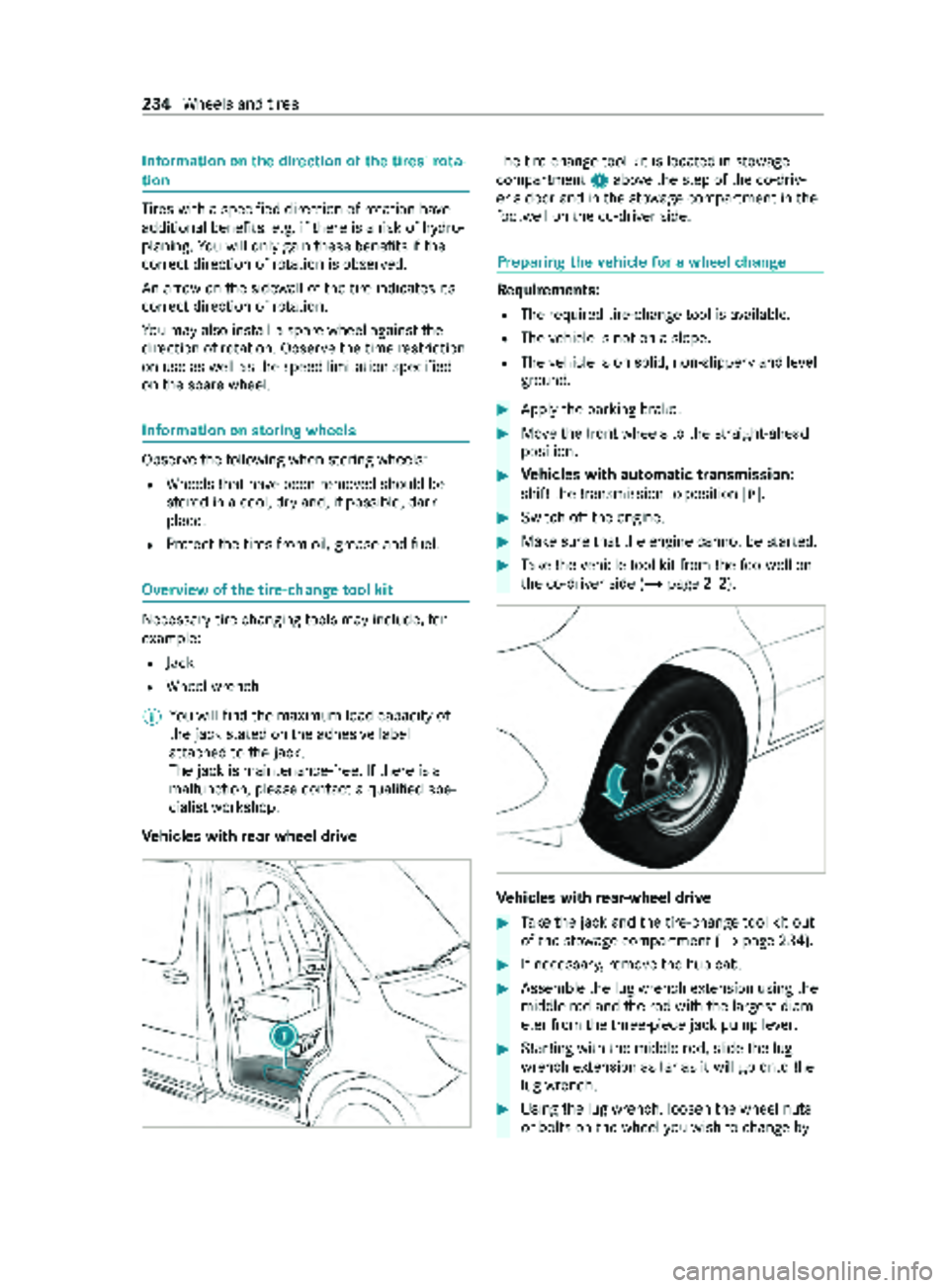
Ve hicles with rear wheel drive The tire-chang
etool kit is located in stowage
compartment 1abo vethes tepoft he co-driv‐
er's door and in thes towa ge compartment in the
fo ot we ll on thec o-driver side. Preparing
thev ehicle foraw heelchange Re
quirements:
R The requ ired tire-chang etool is available.
R The vehicle is no tonaslope.
R The vehicle is on solid, non-slipper yand le vel
ground. #
Appl ythe parking brake. #
Movethef ront wheels tothes traight-ahead
position. #
Vehicles with automatic transmission:
shif tthe transmission toposition 005D. #
Switc hoffthee ngine. #
Mak esuret hat thee ngine cann otbe star ted. #
Take thev ehicle tool kit from thef ootwell on
th ec o-driver side (/ page212). Ve
hicles with rear-wheel drive #
Take thej acka nd thet ire-chang etool kit out
of thes towa ge compartment (/ page234). #
If necessar y,remo vetheh ub cab. #
Assemble thel ug wrenc hextensio nusing the
middl erod and ther od wit hthe lar gest diam‐
et er from thet hree-piece jac kpum pleve r. #
Startin gwitht he middle rod, slide thel ug
wrenc hextensio nasfar as it will go ont othe
lug wrench. #
Using thel ug wrench, loosen thew heel nuts
or bolts on thew heel youw ish tochang eby 234
Wheels and tires