lock MERCEDES-BENZ V-CLASS MPV 2021 Workshop Manual
[x] Cancel search | Manufacturer: MERCEDES-BENZ, Model Year: 2021, Model line: V-CLASS MPV, Model: MERCEDES-BENZ V-CLASS MPV 2021Pages: 337, PDF Size: 9.88 MB
Page 156 of 337

Driving and driving saf
ety sy stems Note
s on driving sy stems and your responsi‐
bility Yo
ur vehicle is equipped with driving sy stems
which assist you in driving, parking and manoeu‐
vring theve hicle. The driving sy stems are only
aids. They are not a substitute foryo u paying
attention toyour sur roundings and do not relie ve
yo u of your responsibility per taining toroad traf‐
fi c la w.The driver is alw aysre sponsible for main‐
ta ining a safe dis tance totheve hicle in front, for
ve hicle speed, for braking in good time and for
st ay ing in lane. Alw ays pay attention tothe tra ffic
and inter vene if necessa ry. Be aware of the limi‐
ta tions rega rding the safe use of these sy stems.
Driving sy stems can neither reduce therisk of
accident if youfa ilto adapt your driving style nor
ove rride the la wsof ph ysics. They cannot alw ays
ta ke into account road, weather or traf fic condi‐
tions. In
fo rm ation on vehicle sensors and cameras Some driving and driving saf
ety sy stems use
cameras and radar or ultrasonic sensors tomoni‐
to rth e area in front of, behind or next totheve hi‐
cle. 1
Cameras in the outside mir rors
2 Multifunction camera
3 Front camera
4 Ultrasonic sensors
5 Reversing camera
% Depending on
theve hicle's equipment, the
ra dar sensors are integrated on the side of
th ere ar bumpers and/or behind the
Mercedes star in thera diator grille. &
WARNING Risk of accident due to
re stricted de tection per form ance of vehi‐
cle sensors and cameras
If th e area around vehicle sensors or cameras
is co vered, damaged or dirty, cer tain driving
and saf ety sy stems cann otfunction cor rectly.
The reis a risk of an accident. #
Keep the area around vehicle sensors or
cameras clear of any obstructions and
clean. #
Have damage tothe bumper, radiator
grille or stone chipping in the area of
th e front and rear wind owsrepaired at a
qu alified specialist workshop. Ke
ep the areas of the cameras and sensors free
of dirt, ice and slush (/ page 229). The sensors
and cameras must not be co vered and the de tec‐
tion ranges around them must be kept free. Do
not attach additional license pla tebrac kets,
ad vertisements, sticke rs,fo ils or foils toprotect
against stone chippings in the de tection range of
th e sensors and cameras. Make sure that there
are no overhanging loads pr otru ding into the
de tection range.
In theeve nt of damage, or following a se vere
impact, ha vethe function of the sensors checked
at a qualified specialist workshop. Ha vedamage
or stone chipping in the area of the cameras
re paired at a qualified specialist workshop. Overview of driving sy
stems and driving
saf ety sy stems In
this section, you will find information about the
fo llowing driving sy stems and driving saf ety sys‐
te ms:
R ABS ( Anti-lock BrakingSystem)
(/ page 154)
R BAS (Bra keAssist System) (/ page154)
R ESP ®
(Electronic Stability Program)
(/ page 154)
R EBD ( Electronic Brakeforce Distribution)
(/ page 156)
R Active Brake Assi st (/ page 156)
R Adaptive brake lights (/ page158)
R Cruise control (/ page158) and limiter
(/ page 158)
R Active Dis tance Assi stDISTRONIC
(/ page 162) Driving and pa
rking 15 3
Page 157 of 337
R
Hill start assist (/ page165)
R HOLD function (/ page165)
R Parking Assist PARKTRONIC (/ page166)
R Reversing camera (/ page167)
R 360° Camera
R Active Parking Assist (/ page169)
R ATTENTION ASSIST (/ page172)
R Traf fic Sign Assi st (/ page 173)
R Blind Sp otAssi st (/ page 174)
R Lane Keeping Assist (/ page174) Fu
nction of ABS (Anti-lock Braking Sy stem) ABS controls
the brake pressure in critical situa‐
tions:
R the wheels are pr evented from lock ing during
braking, forex ample at maximum full- stop
braking or when there is insuf ficient tyre trac‐
tion
R thesteerability of theve hicle in term s of
ph ysical possibilities is ensured when braking
If ABS inter venes, you will feel pulsations in the
brake pedal. The pulsating brake pedal may be an
indication of hazardous road conditions and func‐
tions as a reminder totake extra care while driv‐
ing. Fu
nction of BAS (Brake Assist Sy stem) BA
S suppo rts yo u with additional braking forc e in
an emer gency braking situation.
If yo u depress the brake pedal quickl y,BA S is
acti vated:
R BAS au tomatically boosts the braking forc e of
th e brakes
R BAS can sho rten the braking dis tance
R ABS pr events the wheels from locking
When youre lease the brake pedal, the brakes
function as usual again. BAS is deactivated. Fu
nction of ESP ®
(Electronic Stability Pro‐
gr am) ESP
®
can, within ph ysical limits, monitor and
impr ovedriving stability and traction in thefo l‐
lowing situations:
R when driving and pulling away on wet or slip‐
pe ry road sur faces
R when braking
If th eve hicle is deviating from the direction
desired bythe driver, ESP ®
can stabilise theve hi‐
cle byper form ing thefo llowing actions:
R one or more wheels are braked
R the engine output is adap ted according tothe
situation
% Only use wheels with
there commended tyre
sizes. Only then will ESP ®
function properly.
If th e00E5 warning lamp flashes in the instru‐
ment clus ter,one or more wheels ha vereached
th eir traction limit:
R adapt your driving style to suit the pr evailing
ro ad and weather conditions
R do not deactivate ESP ®
under any circum‐
st ances
R only depress the accelera tor pedal as far as is
necessary when pulling away
If th e00E5 warning lamp lights up continuousl y,
ESP ®
is not available due toa malfunction.
Obse rveth e information on warning lamps and
display messages (/ page 302).
When ESP ®
is deactivated, the00BB warning
lamp in the instrument clus ter lights up continu‐
ously.
Obser vethefo llowing points when ESP ®
is deac‐
tivated:
R vehicle stabilisation is dela yed and is signifi‐
cant lyreduced in the lo wer speed range
R the drive wheels may start tospin
R traction control is still active
% If ESP ®
is deactivated, ESP ®
will still support
yo u when braking. 15 4
Driving and pa rking
Page 180 of 337
Ve
hicles with a detachable trailer coupling
Re duce therisk of damage tothe trailer coupling
and cont ribute toenvironmen tal pr otection. If you
do not need the ball nec k, removeit from the ball
neck mount and fit its co ver in there ar bumper
(/ page 177). Only with the co verfitted can the
emission values indicated forre al operation be
achie ved.
% During trailer operation,
the permissible
gross vehicle weight is inc reased by100kg
fo rve hicles regis tere d as passenger vehicles.
The maximum permissible rear axle load
must be obse rved. Fi
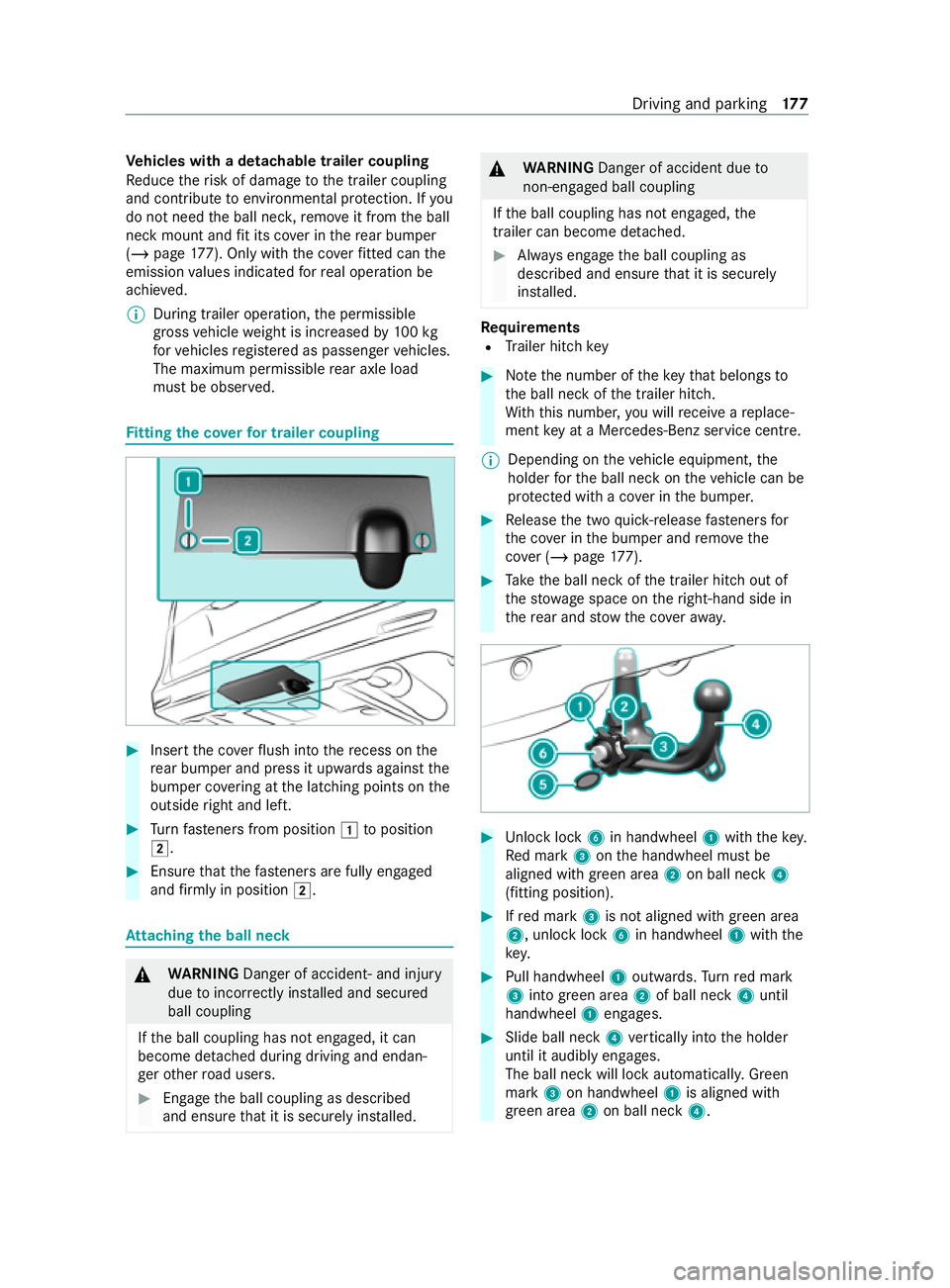
tting the co verfo r trailer coupling #
Inse rtthe co verflush into there cess on the
re ar bumper and press it upwards against the
bumper co vering at the latching points on the
outside right and left. #
Turn fast eners from position 0047toposition
0048. #
Ensure that thefast eners are fully engaged
and firm lyin position 0048. At
taching the ball neck &
WARNING Danger of accident‑ and inju ry
due toincor rectly ins talled and secured
ball coupling
If th e ball coupling has not engaged, it can
become de tach ed during driving and endan‐
ge rot her road users. #
Engage the ball coupling as described
and ensure that it is securely ins talled. &
WARNING Danger of accident due to
non-engaged ball coupling
If th e ball coupling has not engaged, the
trailer can become de tach ed. #
Always engage the ball coupling as
described and ensure that it is securely
ins talled. Re
quirements
R Trailer hit chkey #
Notethe number of theke yth at belongs to
th e ball neck of the trailer hitch.
Wi th th is numbe r,yo u will receive a replace‐
ment key at a Mercedes-Benz service centre.
% Depending on
theve hicle equipment, the
holder forth e ball neck on theve hicle can be
pr otected with a co ver in the bumper. #
Release the two quick- re lease fasteners for
th e co ver in the bumper and remo vethe
co ver (/ page177). #
Take the ball neck of the trailer hitch out of
th estow age space on theright-hand side in
th ere ar and stowthe co veraw ay. #
Unlock lock6in handwheel 1with thekey.
Re d mark 3onthe handwheel must be
aligned with green area 2on ball neck 4
(fitting position). #
Ifre d mark 3is not aligned with green area
2, unlock lock 6in handwheel 1with the
key. #
Pull handwheel 1outwards. Turn red mark
3 into green area 2of ball neck 4until
handwheel 1engages. #
Slide ball neck 4vertically into the holder
until it audibly engages.
The ball neck will lock automaticall y.Green
mark 3on handwheel 1is aligned with
green area2on ball neck 4. Driving and parking
17 7
Page 181 of 337
Only if
the green mark on the handwheel is
aligned with the green area on the ball neck is
th e ball neck securely engaged. #
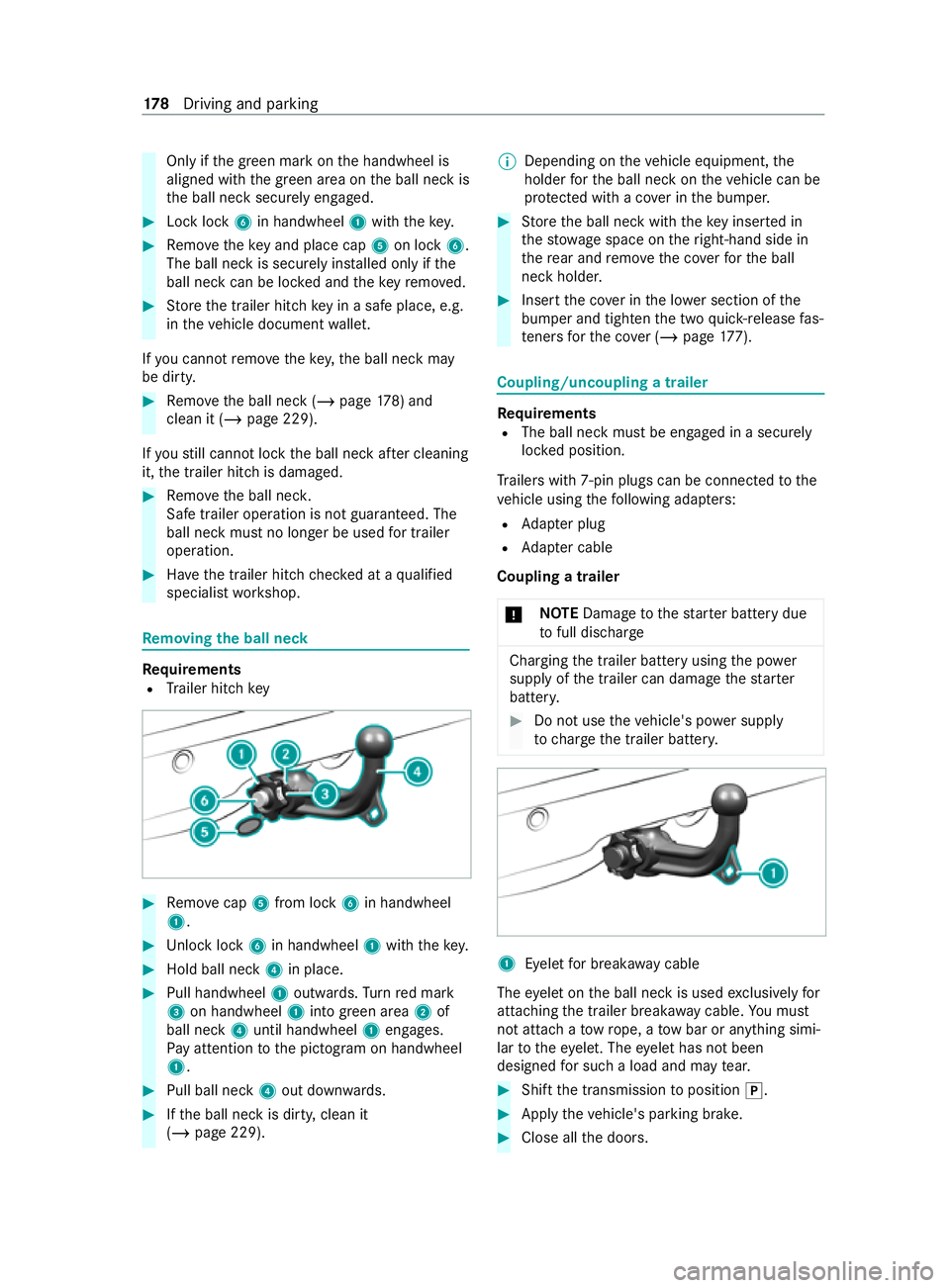
Lock lock 6in handwheel 1with thekey. #
Remo vetheke y and place cap 5on lock 6.
The ball ne ckis securely ins talled only if the
ball neck can be loc ked and theke yre mo ved. #
Store the trailer hitch key in a safe place, e.g.
in theve hicle document wallet.
If yo u cannot remo vetheke y,the ball neck may
be dirty. #
Remo vethe ball neck (/ page178) and
clean it ( /page 229).
If yo ustill cannot lock the ball neck af ter cleaning
it, the trailer hitch is damaged. #
Remo vethe ball nec k.
Safe trailer ope ration is not guaranteed. The
ball neck mu stno longer be used for trailer
operation. #
Have the trailer hitch checked at a qualified
specialist workshop. Re
moving the ball ne ck Re
quirements
R Trailer hit chkey #
Remo vecap 5from lock 6in handwheel
1. #
Unlock lock 6in handwheel 1with th ekey. #
Hold ball neck 4in place. #
Pull handwheel 1outwards. Turn red mark
3 on handwheel 1into green area 2of
ball neck 4until handwheel 1engages.
Pa y attention tothe pictogram on handwheel
1. #
Pull ball neck 4out down wards. #
Ifth e ball neck is dirty, clean it
(/ page 229). %
Depending on
theve hicle equipment, the
holder forth e ball neck on theve hicle can be
pr otected with a co ver in the bumper. #
Store the ball neck with theke y inser ted in
th estow age space on theright-hand side in
th ere ar and remo vethe co verfo rth e ball
neck holder. #
Insert the co ver in the lo wer section of the
bumper and tighten the two quick- re lease fas‐
te ners forth e co ver (/ page177). Coupling/uncoupling a
trailer Re
quirements
R The ball neck must be engaged in a securely
locked position.
Tr ailers with 7-pin plugs can be connec tedto the
ve hicle using thefo llowing adap ters:
R Adapter plug
R Adapter cable
Coupling a trailer
* NO
TEDama getothest ar ter battery due
to full discharge Charging
the trailer battery using the po wer
supply of the trailer can damage thest ar ter
batter y. #
Do not use theve hicle's po wer supply
to charge the trailer batter y. 1
Eyeletfor break away cable
The eyelet on the ball neck is used exclusively for
attaching the trailer break away cable. You must
not attach a tow rope, a tow bar or anything simi‐
lar totheey elet. The eyelet has not been
designed for such a load and may tear. #
Shiftthe transmission toposition 005D. #
Apply theve hicle's parking brake. #
Close all the doors. 17 8
Driving and pa rking
Page 194 of 337
Information about Mercedes PRO (Mercedes
me)
Mercedes-Benz Vans vehicles support thefo llow‐
ing telematics solutions depending on what is
selec ted:
R Mercedes PRO
R Mercedes me
When you ha veregis tere d and logged in with a
user account tothe Mercedes PRO Portal or
Mercedes me Portal, then services and of fers
from Mercedes-Benz Vans will be available to
yo u.
Av ailability of Mercedes PRO is countr y-depend‐
ent. You can check theav ailability of Mercedes
PRO in your country in the Mercedes PRO Portal:
http://www.mercedes.pro
Av ailability of Mercedes me is countr y-depend‐
ent. You can check theav ailability of Mercedes
me in your country in the Mercedes me Portal:
http://www.mercedes.me
Fo r more information on Mercedes PRO or
Mercedes me contact a Mercedes-Benz service
centre or visit the Mercedes PRO Portal or
Mercedes me Portal. Information about Mercedes PRO connect
(Mercedes me connect)
Mercedes PRO connect or Mercedes me connect
is the connectivity product from Mercedes-Benz
th at intelligent lyconnects your vehicle with your
smartphone, your tablet or your PC. You can then
call up diverse information about your vehicle at
any time, forex ample, or control specific vehicle
functions remo tely.
Among stothers, Mercedes PRO connect or
Mercedes me connect pr ovide thefo llowing serv‐
ices:
R Breakdown Management (breakdown assis‐
tance call button)
In theeve nt of a breakdown, you can use the
breakdown assis tance call button in theove r‐
head control panel tomake a call tothe
Mercedes-Benz Cus tomer Centre
(/ page 192).
Yo u can also select a menu ent ryinthe multi‐
media sy stem (/ page191).
R Info call/General question about your vehicle
(Info call button), if available Use
the Info call button in theov erhead con‐
trol panel tomake a call tothe Mercedes-
Benz Cus tomer Centre (/ page192).
R Mercedes-Benz Emer gency call sy stem (SOS
button)
Use the0053 button (SOS button) in the
ov erhead cont rol panel tomake a call tothe
Mercedes-Benz emergency call centre
( / page 192).
R Accident Recovery
Ac cident Recovery isavailable foryo u as a
supplement tothe Mercedes-Benz emer gency
call sy stem. If desired, at the conclusion of an
emer gency call, your call is forw arded tothe
Mercedes-Benz Cus tomer Centre, so you can
ha ve your vehicle towe daw ay toa Mercedes-
Benz service centre, forex ample
(/ page 192).
The Mercedes-Benz Cust omer Centre andthe
Mercedes-Benz emer gency call centre are availa‐
ble foryo u around the clock forth e use of the
services. Obser vethe legal requ irements forthe
country in whi chyou are stay ing.
To use the services in your vehicle, thefo llowing
conditions must be me t:
R Your vehicle is in an area with suf ficient GSM
network co verage.
R The ignition is switched on.
More information on Mercedes PRO and
Mercedes PRO connect and thera nge of services
of fere d can be found in the Mercedes PRO sup‐
plement at: https://moba.i.daimler.com/
mar kets/ece-r ow/baix/truc ks/mercedespro/
en_GB/index.html
Fu rther information about Mercedes me and
Mercedes me connect and thera nge of services
of fere d can be found in the Mercedes me supple‐
ment at: https://moba.i.daimler.com/mar kets/
ece-r ow/baix/ca rs/connectme/en_GB/
#emotions/S tartseite.html Calling
the Mercedes-Benz Cus tomer Centre
using the multimedia sy stem
Multimedia sy stem:
4 © 5
Phone 5
g #
Call Mercedes PRO connect orMercedes me
connect.
Wi th your appr oval, theve hicle transmits the
re qu ired data tothe Mercedes-Benz Cus‐ Mercedes PRO
191
Page 218 of 337
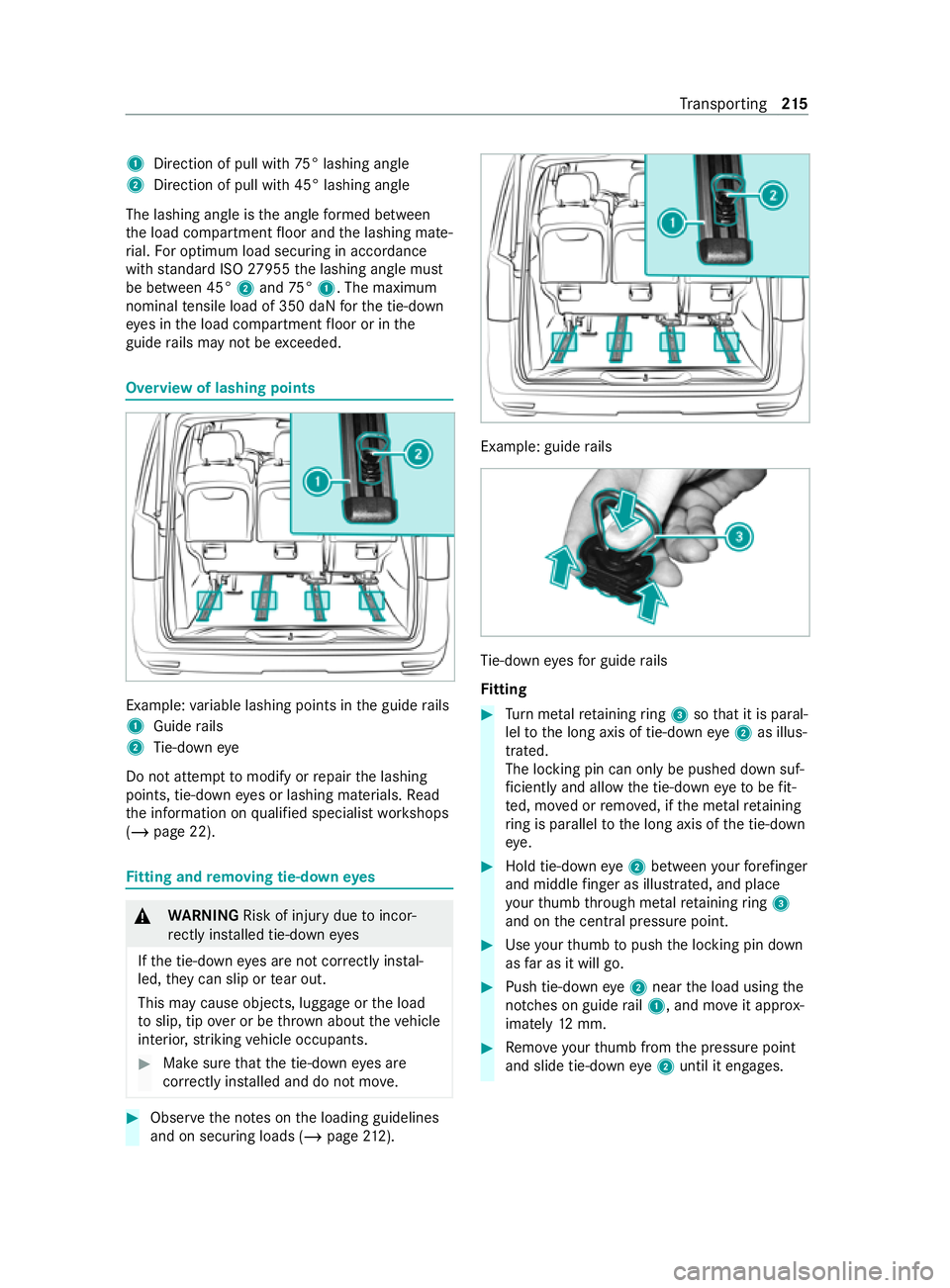
1
Direction of pull wi th75° lashing angle
2 Direction of pull with 45° lashing angle
The lashing angle is the angle form ed between
th e load compartment floor and the lashing mate‐
ri al. For optimum load securing in accordance
with standard ISO 27955 the lashing angle must
be between 45° 2and 75°1. The maximum
nominal tensile load of 350 daN forth e tie-down
ey es in the load compartment floor or in the
guide rails may not be exceeded. Overview of lashing points
Example:
variable lashing points in the guide rails
1 Guide rails
2 Tie-down eye
Do not attem pttomodify or repair the lashing
points, tie-down eyes or lashing materials. Read
th e information on qualified specialist workshops
(/ page 22). Fi
tting and removing tie-down eyes &
WARNING Risk of injury duetoincor‐
re ctly ins talled tie-down eyes
If th e tie-down eyes are not cor rectly ins tal‐
led, they can slip or tear out.
This may cause objects, luggage or the load
to slip, tip over or be throw n about theve hicle
interior, striking vehicle occupants. #
Make sure that the tie-down eyes are
cor rectly ins talled and do not mo ve. #
Obser vethe no tes on the loading guidelines
and on securing loads (/ page212). Example: guide
rails Ti
e-down eyes for guide rails
Fi tting #
Turn me tal retaining ring 3 sothat it is paral‐
lel tothe long axis of tie-down eye2 as illus‐
tra ted.
The locking pin can only be pushed down suf‐
fi ciently and allow the tie-down eyeto be fit‐
te d, mo ved or remo ved, if the me talre taining
ri ng is para lleltothe long axis of the tie-down
ey e. #
Hold tie-down eye2 between your fore finger
and middle finger as illust rated, and place
yo ur thumb thro ugh me talre taining ring 3
and on the cent ral pressure point. #
Use your thumb topush the locking pin down
as far as it will go. #
Push tie-down eye2 near the load using the
notches on guide rail1, and mo veit appr ox‐
imately 12mm. #
Remo veyour thumb from the pressure point
and slide tie-down eye2 until it engages. Tr
ansporting 215
Page 219 of 337
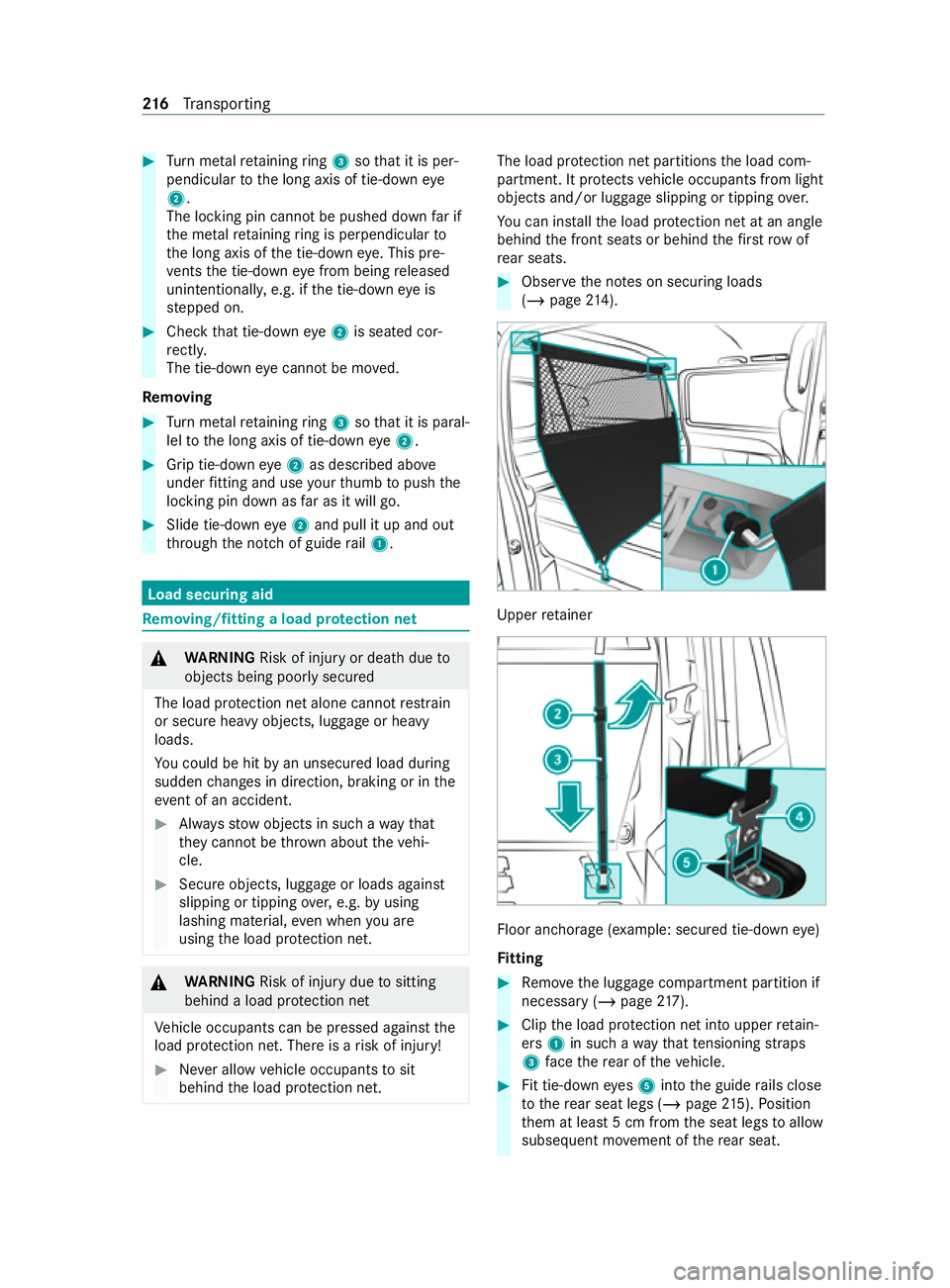
#
Turn me tal retaining ring 3 sothat it is per‐
pendicular tothe long axis of tie-down eye
2 .
The locking pin cannot be pushed downfar if
th e me talretaining ring is perp endicularto
th e long axis of the tie-down eye. This pre‐
ve nts the tie-down eye from being released
unin tentionally, e.g. if the tie-down eye is
st epped on. #
Check that tie-down eye2 is seated cor‐
re ctly.
The tie-d owney e cann otbe mo ved.
Re moving #
Turn me tal retaining ring 3 sothat it is paral‐
lel tothe long axis of tie-down eye2. #
Grip tie-down eye2 as described abo ve
under fitting and use your thumb topush the
locking pin down as far as it will go. #
Slide tie-down eye2 and pull it up and out
th ro ugh the notch of guide rail1. Load securing aid
Re
moving/fitting a load pr otection net &
WARNING Risk of injury or death dueto
objects being poorly secured
The load pr otection net alone cann otrestra in
or secure heavy objects, luggage or heavy
loads.
Yo u could be hit byan unsecured load during
sudden changes in direction, braking or in the
eve nt of an accident. #
Alwaysstow objects in such a wayth at
th ey cannot be thro wn about theve hi‐
cle. #
Secure objects, luggage or loads against
slipping or tipping over,e.g. byusing
lashing material, even when you are
using the load pr otection net. &
WARNING Risk of injury duetositting
behind a load pr otection net
Ve hicle occupants can be pressed against the
load pr otection net. There is a risk of injury! #
Never allow vehicle occupants tosit
behind the load pr otection net. The load pr
otection net partitions the load com‐
partment. It pr otects vehicle occupants from light
objects and/or luggage slipping or tipping over.
Yo u can ins tallth e load pr otection net at an angle
behind the front seats or behind thefirs tro w of
re ar seats. #
Obse rveth e no tes on securing loads
(/ page 214). Up
per retainer Floor anchorage
(exa mp le: secured tie-down eye)
Fi tting #
Remo vethe luggage compartment partition if
necessary (/ page217). #
Clip the load pr otection net into upper retain‐
ers 1in such a wayth at tensioning stra ps
3 face there ar of theve hicle. #
Fit tie-down eyes 5 into the guide rails close
to there ar seat legs (/ page215). Position
th em at least 5 cm from the seat legs toallow
subse quent mo vement of there ar seat. 216
Transporting
Page 224 of 337
R
when the engine is of ten le ftidling for long
periods
R operation in particula rly dusty conditions
and/or if air-reci rculation mode is frequent ly
used
In these or similar operating conditions, ha vethe
air filter, engine oil and oil filter, forex ample,
re placed more frequentl y.
If th eve hicle is subjected toinc reased loads, the
tyres mu stbe checked more frequentl y.Yo u can
obtain fur ther information at a qualified specialist
wo rkshop. No
n-operational times with the bat tery dis‐
connected The ASS
YST PLUS service inter val display can
calculate the service due date only when the bat‐
te ry is connecte d. #
Display and no tedown the service due date
on the instrument clus ter before disconnect‐
ing the battery (/ page 220). Engine compartment
Opening and closing
the bonnet &
WARNING Risk of accident due todriving
with the bonn etunlo cked
The bonn etmay open and block your vie w. #
Neverre lease the bonn etwhen driving. #
Before every trip, ensure that the engine
bonn etis loc ked. &
WARNING Risk of accident and inju ry
when opening and closing the bonn et
The bonnet may suddenly drop into the end
position.
There is a risk of injury for an yone in the
engine bonn et's range of mo vement. #
Do not open or close the bonn etifth ere
is a person in the bonn et's range of
mo vement. &
WARNING Risk of injury fromtouching
components under voltage
The ignition sy stem and the fuel injection sys‐
te m wo rkunder high voltage. You could
re ceive an electric shoc k. #
Neverto uch components of the ignition
sy stem or the fuel injection sy stem
when the ignition is switched on. The
following are examples of live components:
R ignition coils
R spark plug connec tors
R injectors &
WARNING Risk of burn s from hot com‐
ponent parts in the engine compartment
Cer tain component pa rts in the engine com‐
partment can be very hot, e.g. the engine, the
cooler and pa rts of theex haust sy stem. #
Allow the engine tocool down and only
to uch component parts desc ribed in the
fo llowing. *
NO
TEDama getobonn etor windscreen
wipers when opening the bonn et If
th e windscreen wipers ha vebeen folded
back from the windscreen when the bonn etis
opened, the windscreen wipers or the bonn et
may be dama ged. #
Ensure that the windscreen wipers ha ve
not been folded back from the wind‐
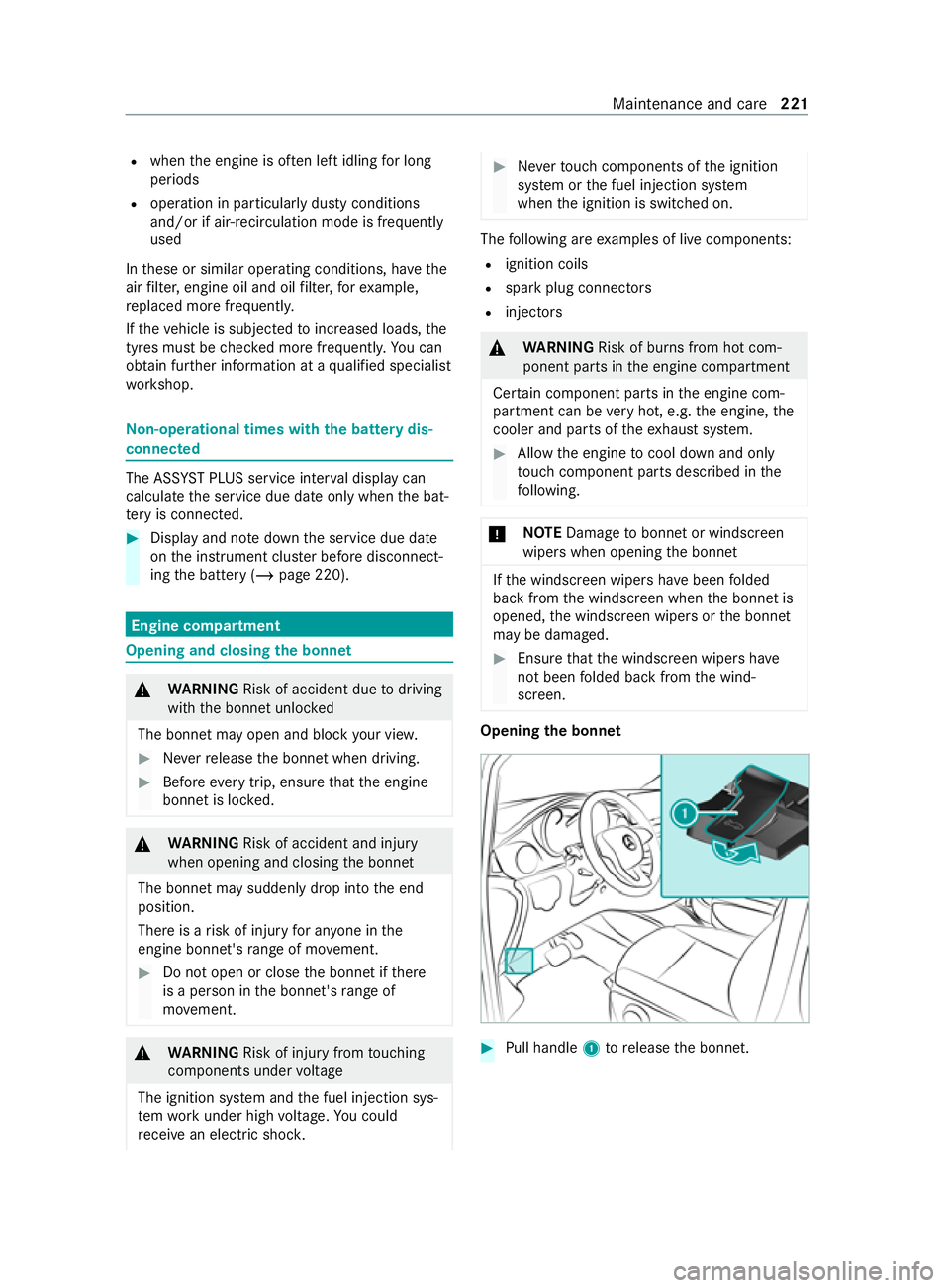
screen. Opening
the bonnet #
Pull handle 1torelease the bonn et. Maintenance and care
221
Page 229 of 337

Example: cap and coolant
expansion reser voir
Checking the coolant le vel #
Slowly turn the cap 1ofthe coolant expan‐
sion reser voir2 half a turn anti-clockwise
and allow overpressure toescape. #
Turn cap 1further and remo veit.
The coolant le vel is cor rect in thefo llowing cases:
R uptomar ker bar 3when the engine is cold
R ifth e engine is warm, up to1.5 cm over
mar ker bar 3
To pping up the coolant
Only use coolant appr ovedfo r Mercedes-Benz to
avo id damaging the engine cooling sy stem. #
Refe rto the information on coolant
(/ page 274). #
Refill th e coolant up tothe mar ker bar 3in
th efiller opening of the coolant expansion
re ser voir2. #
Replace cap 1and tighten in a clockwise
direction. #
Start the engine. #
Set thete mp erature in theve hicle interior to
th e maximum output on the cont rol panel of
th e climate cont rol. #
After about five minutes, switch off the
engine again and allow it tocool down. #
Che ckthe coolant le vel again and top up the
coolant if necessar y. Fi
lling up the windscreen washer sy stem &
WARNING Risk offire and injury from
windscreen washer concentrate
Wi ndscreen washer concentrate is highly
fl ammable. #
Avoid fire , naked flames, smoking and
th e creation of spar kswhen using wind‐
screen washer concentrate. &
WARNING Risk of burn s from hot com‐
ponent parts in the engine compartment
Cer tain component pa rts in the engine com‐
partment can be very hot, e.g. the engine, the
cooler and pa rts of theex haust sy stem. #
Allow the engine tocool down and only
to uch component parts desc ribed in the
fo llowing. *
NO
TEDama getotheex terior lighting
due tounsuitable windsc reen washer
fl uid Uns
uitable windsc reen washer fluids may
damage the plastic sur face of theex terior
lighting. #
Only use windscreen washer fluids that
are also suitable for use on plast ic sur‐
fa ces, e.g. MB SummerFit or MB Winter‐
Fit. To
pping up the washer fluid Wa
sher fluid reser voir (e xamp le) #
Obser vethe no tes on windshield cleaning
agents (/ page275). 226
Maintenance and care
Page 235 of 337
Emer
gency Re
moving the saf etyve st The saf
etyve st is located in the door stowage
compartment in the driver's door. #
Take the saf etyve st out of the door stowage
compartment.
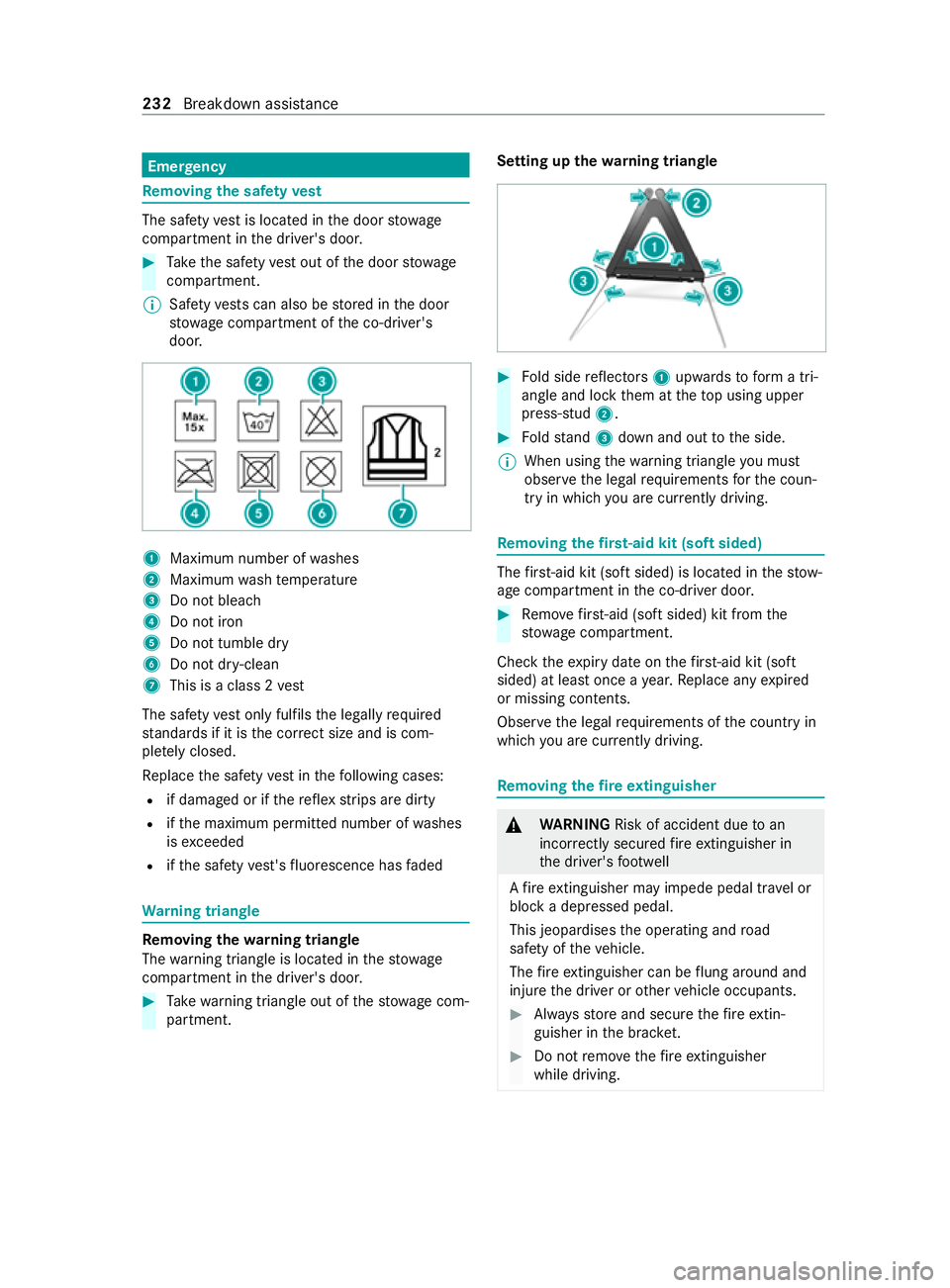
% Saf
etyve sts can also be stored in the door
stow age compartment of the co-driver's
door. 1
Maximum number of washes
2 Maximum wash temp erature
3 Do not bleach
4 Do not iron
5 Do not tumble dry
6 Do not dr y-clean
7 This is a class 2 vest
The saf etyve st only fulfils the legally required
st andards if it is the cor rect size and is com‐
ple tely closed.
Re place the saf etyve st inthefo llowing cases:
R if damaged or if there flex strips are dirty
R ifth e maximum permitted number of washes
is exc eeded
R ifth e saf etyve st's fluorescence has faded Wa
rning triangle Re
moving the warning triangle
The warning triangle is located in thestow age
compartment in the driver's door. #
Take warning triangle out of thestow age com‐
partment. Setting up
thewa rning triangle #
Fold side reflectors 1upwards toform a tri‐
angle and lock them at theto p using upper
press-stud 2. #
Foldstand 3down and out tothe side.
% When using
thewa rning triangle you must
obse rveth e legal requ irements forth e coun‐
try in which you are cur rently driving. Re
moving the firs t-aid kit (soft sided) The
firs t-aid kit (soft sided) is located in thestow‐
age compartment in the co-driver door. #
Remo vefirs t-aid (soft sided) kit from the
stow age compartment.
Check theex piry date on thefirs t-aid kit (soft
sided) at least once a year. Replace any expired
or missing con tents.
Obser vethe legal requ irements of the count ryin
which you are cur rently driving. Re
moving the fire extinguisher &
WARNING Risk of accident due toan
incor rectly secu redfire extinguisher in
th e driver's foot we ll
A fire extinguisher may impede pedal tr avel or
block a depressed pedal.
This jeopardises the operating and road
saf ety of theve hicle.
The fire extinguisher can be flung around and
injure the driver or other vehicle occupants. #
Alwaysst ore and secure thefire extin‐
guisher in the brac ket. #
Do not remo vethefire extinguisher
while driving. 232
Breakdown assi stance