ignition MERCEDES-BENZ V-CLASS MPV 2021 Owners Manual
[x] Cancel search | Manufacturer: MERCEDES-BENZ, Model Year: 2021, Model line: V-CLASS MPV, Model: MERCEDES-BENZ V-CLASS MPV 2021Pages: 337, PDF Size: 9.88 MB
Page 9 of 337
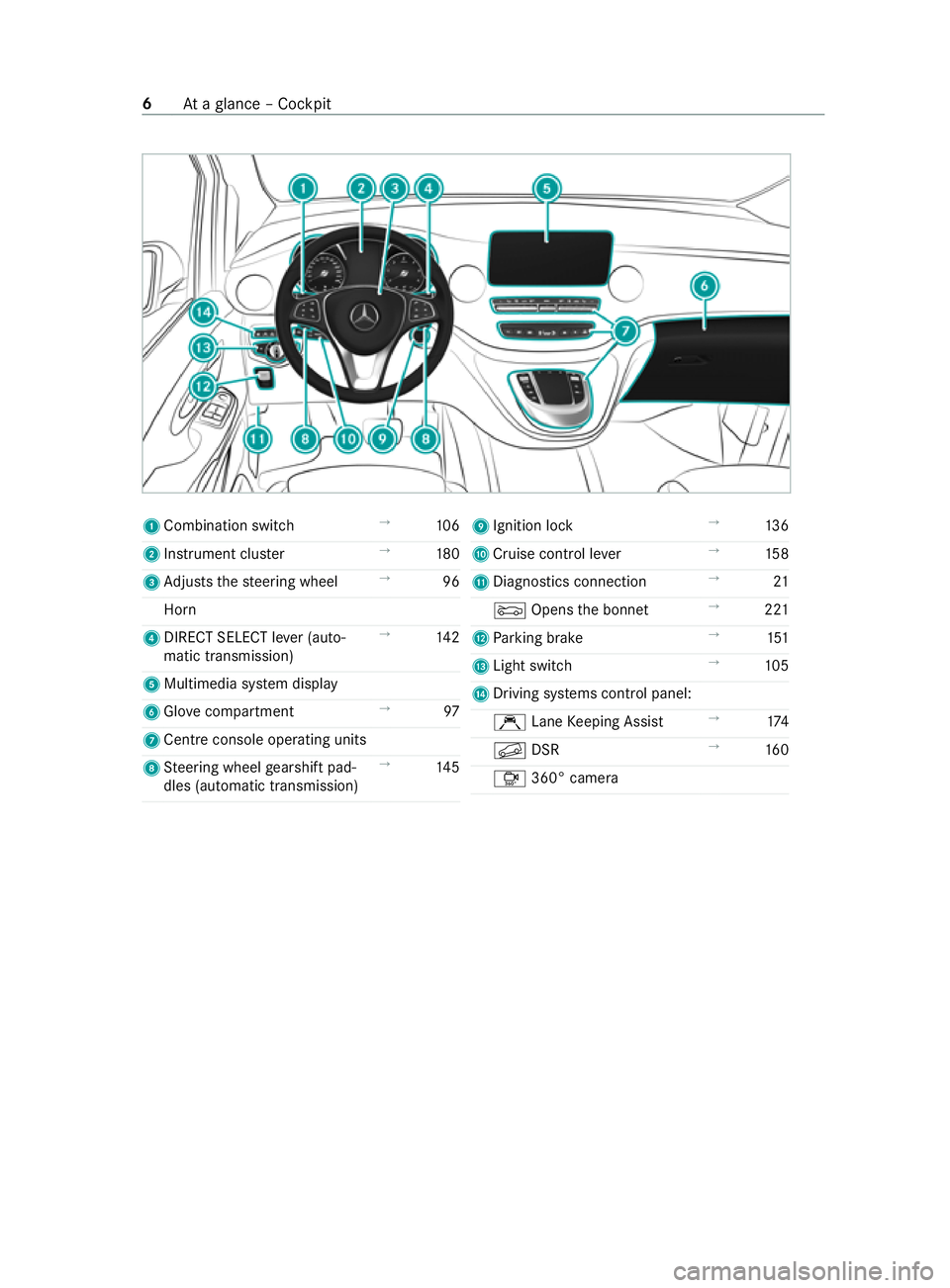
1
Combination swit ch→
106
2 Instrument clus ter →
180
3 Adjusts thesteering wheel →
96
Horn
4 DIRECT SELECT le ver (auto‐
matic transmission) →
14 2
5 Multimedia sy stem display
6 Glo vecompa rtment →
97
7 Cent reconsole ope rating units
8 Steering wheel gearshift pad‐
dles (automatic transmission) →
14 5 9
Ignition lock →
13 6
A Cruise control le ver→
15 8
B Diagnostics connection →
21
0083 Opens the bonn et →
221
C Parking brake →
151
D Light switch →
105
E Driving sy stems cont rol panel:
Ç LaneKeeping Assist →
174
0092 DSR →
16 0
Ô 360° camera 6
Ataglance – Cockpit
Page 30 of 337

Re
stra int sy stem Pr
otection pr ovided bythere stra int sy stem The
restra int sy stem includes thefo llowing com‐
ponents:
R Seat belt sy stem
R Airbags
R Child restra int sy stem
R Child seat securing sy stems
The restra int sy stem can help pr eventtheve hicle
occupants from coming into contact with parts of
th eve hicle interior in theeve nt of an accident. In
th eeve nt of an accident, there stra int sy stem can
also reduce thefo rc es towhich theve hicle occu‐
pants are subjected.
Only a seat belt which is worncor rectly can pro‐
vide the intended le vel of pr otection. Depending
on the de tected accident situation, seat belt ten‐
sioners and/or airbags supplement the pr otec‐
tion of fere dby a cor rectly wornseat belt. Seat
belt tensioners and/or airbags are not depl oyed
in eve ryaccident.
In order forth ere stra int sy stem toprov ide the
intended le vel of pr otection, each vehicle occu‐
pant must obser vethefo llowing information:
R Fasten seat belts cor rectl y.
R Sit in an almost up right seat position with
th eir back against the seat backrest.
R Sit with their feet resting on thefloor, if possi‐
ble.
R Always secure persons under 1.50 m ta ll in
an additional restra int sy stem suitable for
Mercedes-Benz vehicles.
Ho wever,no sy stem available today can com‐
ple tely eliminate injuries and fata lities in every
accident situation. In particular, the seat belt and
airbag general lydo not pr otect against objects
penetrating theve hicle from the outside. It is also
not possible tocomple tely rule out therisk of
injury caused bythe airbag deploying. Limited pr
otection pr ovided bythere stra int
sy stem &
WARNING Risk of injury or death dueto
modifications tothere stra int sy stem
Ve hicle occupants may no longer be pr otec‐
te d as intended if alterations are made tothe
re stra int sy stem. #
Never alter the parts of there stra int
sy stem. #
Neverta mp er with the wiring or any
electronic component parts or their
software. If it is necessary
toadjust theve hicle toaccom‐
modate a person with disabilities, con tact a quali‐
fi ed specialist workshop.
Mercedes-Benz recommends that you on lyuse
driving aids which ha vebeen appr oved specifi‐
cally foryo ur vehicle byMercedes-Benz. Re
stra int sy stem functionality When
the ignition is switched on, a self-test is
per form ed, during which the0075 restra int sys‐
te m wa rning lamp lights up. It goes out no later
th an a few seconds af terth eve hicle is star ted.
The components of there stra int sy stem are then
functional. Re
stra int sy stem malfunction A malfunction has occur
red in there stra int sys‐
te m in thefo llowing cases:
R The 0075 restra int sy stem warning lamp does
not light up when the ignition is switched on.
R The 0075 restra int sy stem warning lamp
lights up continuously or repeatedly during a
journe y. &
WARNING Risk of injury duetomalfunc‐
tions in there stra int sy stem
Components in there stra int sy stem may be
activated unintentionally or not deploy as
intended in an accident. #
Have there stra int sy stem checked and
re paired immediately at a qualified spe‐
cialist workshop. Fu
nction of there stra int sy stem in an acci‐
dent How
there stra int sy stem works is de term ined by
th e se verity of the impact de tected and the type
of accident anticipated:
R frontal impact
R rear impact
R side impact Occupant saf
ety27
Page 34 of 337

The seat belt
warning goes out when the driver
and co-driver fastentheir seat belts.
Only for cer tain countries: rega rdless of whe ther
th e driver and co-driver's seat belts are already
fast ened, the00E9 seat belt warning lamp comes
on for six seconds every time af ter switching on
th e ignition. Af terth eve hicle is star ted, it goes
out as soon as the driver's and the co-driver's
seat belts ha vebeen fastened. Airbags
Overview of airbags
Example:
vehicles with window airbag abo ve
front door
1 Driver's airbag
2 Co-driver airbag
3 Window airbag
4 Side airbag Example:
vehicles with window airbag for all
row s of seats
1 Driver's airbag
2 Co-driver airbag
3 Window airbag
4 Side airbag
An airbag's ins tallation location is identified by
th e label AIRB AG.
When enabled, an airbag can pr ovide additional
pr otection forth ere spective vehicle occupant. Po
ssible pr otection per airbag:
R Driver's airbag, co-driver airbag: head and rib‐
cage
R Window airbag: head
R Side airbag: ribcage and pelvis &
WARNING Risk of injury or death ifthe
co-driver airbag is enabled
If th e co-driver airbag is enabled, a child on
th e co-driver seat may be stru ck bythe co-
driver airbag during an accident.
NEVER use a rear wa rd-facing child restra int
sy stem on a seat with an ENABLED FRONT
AIRB AG; DEAT H or SERIOUS INJU RYtothe
CH ILD can occur. When
fitting a child restra int sy stem tothe co-
driver seat, obser vetheve hicle-specific informa‐
tion (/ page 46). Also be sure toobser vethe
no tes on rear wa rd-facing or forw ard-facing child
re stra int sy stems on the co-driver seat.
Information on the automatic co-d rive r airbag
shu toff
The co-driver airbag can only be deplo yed in the
eve nt of an accident if thePA SSENGER AIR BAG
OFF indicator lamp is off. If the co-driver seat is
occupied, make sure, bo thbefore and during the
jou rney ,th at thest atus of the co-driver airbag is
cor rect (/ page 34).
* NO
TEDepl oyment of components of the
re stra int sy stem when the front
passenger seat is unoccupied In an accident,
the components of the
re stra int sy stem may deploy unnecessarily on
th e front passenger side if:
R There are heavy objects on the front
passenger seat.
R The seat belt tongue is engaged in the
seat belt buckle of the front passenger
seat and the front passenger seat is unoc‐
cupied. #
Stow objects in a suitable place. #
Only one person should use each seat
belt at any one time. Occupant saf
ety31
Page 37 of 337

The co-driver airbag may
otherwise be disabled
by mis take ,fo rex ample, in thefo llowing situa‐
tions:
R The co-driver transfers their weight bysup‐
porting themselves on a vehicle armrest.
R The co-driver sits in such a wayth at their
we ight is raised from the sitting sur face. &
WARNING Risk of injury or death dueto
a disabled front passenger airbag
The front passenger airbag is disabled when
th ePA SSENGER AIR BAG OFF indicator lamp
is lit.
A person in the front passenger seat could
th en, forex ample, come into con tact with the
ve hicle interior, especially if the person is sit‐
ting too close tothe cockpit.
If th e front passenger seat is occupied,
alw ays ensure that:
R the classification of the person in the
front passenger seat is cor rect and the
front passenger airbag is enabled or disa‐
bled in accordance with the person in the
front passenger seat.
R the front passenger seat has been mo ved
as far back as possible.
R the person is seated cor rectly. #
Both before and during the journe y,
ensure that thest atus of the front
passenger airbag is cor rect. If
th e co-driver seat is occupied, the classification
of the person or child restra int sy stem on the co-
driver seat take s place af terth e co-driver airbag
shutoff self-test. The PASSENGER AIR BAG OFF
indicator lamp displa ys thest atus of the co-driver
airbag.
Alw ays obser vethe no tes on the function of the
PA SSENGER AIR BAG OFF indicator lamp
(/ page 34). Fu
nction of thePA SSENGER AIR BAG indicator
lamps The
PASSENGER AIR BAG ON indicator lamp is
inoperative. When the ignition is switched on, it
lights up brief lyand then goes out again. Only the
PA SSENGER AIR BAG OFF indicator lamp displa ys
th est atus of the co-driver airbag. The
PA SSENGER AIR BAG OFF indicator lamp may be
lit continuously or be off.
Ve hicles without an automatic co-driver airbag
shutoff ha vea special sticke r af fixe dto the side
of the cockpit on the co-driver side
(/ page 45).
Self-test of automatic co-driver airbag shutoff
The PASSENGER AIR BAG OFF indicator lamp
lights up for appro ximately six seconds du ring the
self-test when the ignition is switched on.
The status of the co-driver airbag is displa yed
af te rth e self-tes t:
R PASSENGER AIR BAG OFF is not lit: the co-
driver airbag may deploy during an accident.
R PASSENGER AIR BAG OFF lights up continu‐
ously: the co-driver airbag is disabled. It will
not be deplo yed in theeve nt of an accident.
If th ePA SSENGER AIR BAG OFF indicator lamp
and the0075 restra int sy stem warning lamp light
up simultaneousl y,the co-driver seat may not be
used. Also in this case, do not fit a child restra int
sy stem tothe co-driver seat. Ha vethe automatic
co-driver airbag shutoff checked and repaired
immediately at a qualified specialist workshop.
St atus indicator
If th e co-driver seat is occupied, ensure, bo th
before and during the journe y,that thest atus of 34
Occupant saf ety
Page 39 of 337
re
mains off, depending on there sult of the
classi fication.
- Ifth ePA SSENGER AIR BAG OFF indicator
lamp is off: mo vethe co-driver seat as far
back as possible, or the person of smaller
st ature should use a rear seat.
- Ifth ePA SSENGER AIR BAG OFF indicator
lamp is lit continuously: the person of
smaller stature should not use the co-
driver seat. &
WARNING Risk of injury or death when
th ePA SSENGER AIR BAG OFF indicator
lamp is lit
If th ePA SSENGER AIR BAG OFF indicator
lamp remains lit af terth e self-test, the front
passenger airbag is disabled.
If th e front passenger seat is occupied,
alw ays ensure that:
R The classification of the person in the
front passenger seat is cor rect and the
front passenger airbag is enabled or disa‐
bled in accordance with the person in the
front passenger seat.
R The person is seated properly with a cor‐
rectly fastened seat belt.
R The front passenger seat has been mo ved
as far back as possible. Be sure
toalso obse rveth efo llowing fur ther rela‐
te d subjects:
R Child restra int sy stem on the co-driver seat
(/ page 46).
R Suitable positioning of thech ild restra int sys‐
te m (/ page 40). PRE-SAFE
®
Sy stem Fu
nction of PRE-SAFE ®
(anticipatory occupant
pr otection) PRE-
SAFE®
can de tect cer tain hazardous situa‐
tions and take pre-em ptive measures toprotect
th eve hicle occupants.
PRE-SAFE ®
can implement thefo llowing meas‐
ures independently of each other:
R Tightening the seat belts on the driver's seat
and co-driver seat.
R Closing the side windo ws. R
Vehicles with a sliding sunroof: closingthe
sliding sunroof.
R Vehicles with memory function: adjusting
th e co-driver seat toa more favo urable seat
position.
* NO
TEDama gecaused byobjects in the
fo ot we ll or behind the seat The automatic adjustment of
the seat posi‐
tion may result in damage tothe seat and/or
th e object. #
Stow objects in a suitable place. Re
versing the PRE- SAFE®
sy stem measures If an accident did not occur,
the pre-em ptive
measures that we retak en are reve rsed.
Yo u will need tomake cer tain adjustments your‐
self. #
Ifth e seat belt pre-tensioning is not reduced,
mo vethe seat backrest back slightl y.
The locking mechanism releases. Au
tomatic measures af ter an accident
Depending on the type and se verity of the acci‐
dent, and depending on theve hicle's equipment,
th efo llowing measures can be implemente d,for
ex ample:
R activating the hazard warning lights
R triggering an automatic emer gency call
(/ page 233)
R switching off the engine
To restart theve hicle, switch the ignition off
and switch it back on (/ page136). Depend‐
ing on the type and se verity of the accident, it
may possible that theve hicle can no longer
be star ted.
R switching off the fuel supply
R unlocking theve hicle doors
R lowe ring the front side windo ws
R switching on the interior lighting 36
Occupant saf ety
Page 48 of 337

L Suitable
for semi-universal child restra int sy stems
according totheta ble in "Recommended child
re stra int sy stems", or if theve hicle and the seat are
lis ted in thech ild restrai nt sy stem manufacturer's
ve hicle model list.
1 The vehicle is equipped with automatic co-driver
airbag shutoff. The PASSENGER AIR BAG OFF indi‐
cator lamp must be lit.
2 In combination with a long seat belt buckle
(police seat) not suitable forch ild restrai nt sy stems. Securing
thech ild restra int sy stem with the
seat belt on there ar seat
When fitting a belt-secu redch ild restra int sy stem,
obser vethefo llowing:
0073 Alw
ays comply with the manufacturer's
ins tallation and operating instructions forthe
ch ild restra int sy stem used.
0073 Fo
r a child restra int sy stem in the "Univer‐
sal" or "Semi-Universal" categor y,make sure
th at the sy stem has been appr oved forthe
ve hicle seat.
Obser vethe no tes under "Suitability of seats
fo r attaching belt-secu redch ild restra int sys‐
te ms" (/ page44).
0073 When using a
category 0/0+ baby car
seat and a category I rear wa rd-facing
ch ild restra int sy stem on a rear seat:
adju stthe front seat so that the seat does
not touch thech ild restra int sy stem.
0073 When using a category I
forw ard-facing
ch ild restra int sy stem: remo vethe head
re stra int from there spective seat, if possi‐
ble.
Af terth ech ild restra int sy stem has been
re mo ved, replace the head restra int immedi‐
ately and adjust all head restra ints cor rectly.
0073 The ba
ckrest of thefo rw ard-facing child
re stra int sy stem must, as far as possible, be
re sting on the seat backrest of there ar seat.
0073 Fo
r cer tain child restra int sy stems in weight
category II or III, there may be restrictions on
th e maximum size setting, e.g. due topossi‐
ble conta ct with th ero of.
0073 The
child restra int sy stem must not be put
under stra in between thero of and the seat
cushion and/or be fitted facing the wrong
direction. Where possible, adjust the seat
cushion inclination according ly.0073
The
child restra int sy stem must not be put
under stra in by the head restra int. Adjust the
head restra ints as appropriate.
0073 Make sure
that thech ild's feet do not touch
th e front seat. If necessar y,mo vethe front
seat slightly forw ards. #
Install thech ild restra int sy stem.
The entire base of thech ild restra int sy stem
must alw aysre st on the sitting sur face of the
re ar seat. #
Always make sure that the shoulder belt strap
is cor rectly routed from the seat belt outlet of
th eve hicle tothe shoulder belt guide on the
ch ild restra int sy stem.
The shoulder belt stra p must be routed for‐
wa rds and down wards from the seat belt out‐
let.
Instructions forve hicles without automatic
co-driver airbag shutoff The
sticke r is visible when the co-driver door is
open:
Ve hicles without an automatic co-driver airbag
shutoff ha vea special sticke r af fixe dto the side
of the cockpit on the co-driver side.
If yo u turn theke yto position 0048inthe ignition
loc k,thePA SSENGER AIR BAG OFF and
PA SSENGER AIR BAG ON indicator lamps light up
brief ly. Ho wever,th ey have no function and are
not an indication of the automatic co-driver air‐
bag shutoff. Occupant saf
ety45
Page 52 of 337
Key
Overview of
key functions &
WARNING Risk of accident and inju ry
due toleaving children unat tended in the
ve hicle
If ch ildren are left unat tended in theve hicle,
th ey could, in part icular:
R open doors, thereby endangering other
persons or road users.
R get out and be stru ck byoncoming traf fic.
R operate vehicle equipment and become
trapped, forex ample.
In addition, thech ildren could also set the
ve hicle in motion by,fo rex ample:
R releasing the parking brake.
R changing the transmission position.
R starting theve hicle. #
Never lea vechildren unat tended in the
ve hicle. #
When leaving theve hicle, alw aysta ke
th eke y with you and lock theve hicle. #
Keep theve hicle key out of there ach of
ch ildren. &
WARNING Risk of accident due toinad‐
ve rtent turning of theke y in the ignition
lock
If yo u attach lar geor heavy objects totheke y,
th eke y could inadver tently turn in the ignition
lock while theve hicle is in motion. #
Do not attach any lar geor heavy objects
to thekey. #
Remo veake yring if it is cumbe rsome
before you insert theke y in the ignition
loc k. *
NO
TEDama getotheke y caused bymag‐
netic fields #
Keep theke yaw ay from strong mag‐
netic fields. Ke
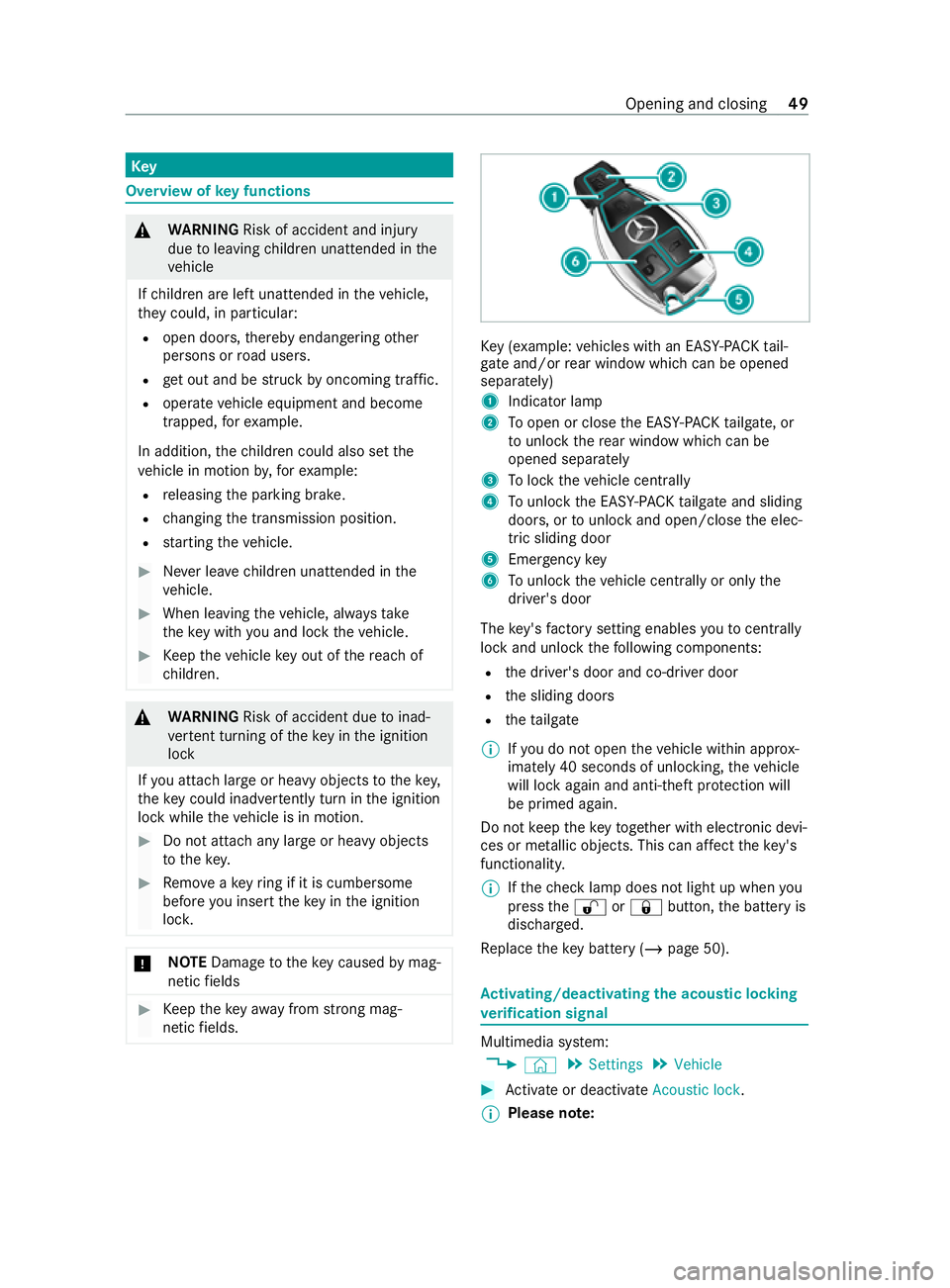
y (e xamp le:vehicles with an EAS Y-PA CK tail‐
ga te and/or rear wind owwhich can be opened
separately)
1 Indicator lamp
2 Toopen or close the EASY -PAC Ktailgate, or
to unlo ck th ere ar wind owwhich can be
opened separately
3 Tolock theve hicle centra lly
4 Tounlo ckthe EASY -PAC Ktailgate and sliding
doors, or tounlo ckand open/close the elec‐
tric sliding door
5 Emer gency key
6 Tounlo cktheve hicle centra lly or onlythe
driver's door
The key's factory setting enables youto centrally
lock and unlock thefo llowing components:
R the driver's door and co-driver door
R the sliding doors
R theta ilgate
% If
yo u do not open theve hicle within appr ox‐
imately 40 seconds of unlocking, theve hicle
will lock again and anti-theft pr otection will
be primed again.
Do not keep theke yto ge ther with electronic devi‐
ces or me tallic objects. This can af fect theke y's
functionalit y.
% If
th ech eck lamp does not light up when you
press the0036 or0037 button, the battery is
dischar ged.
Re place theke y bat tery ( / page 50). Ac
tivating/deactivating the acoustic lo cking
ve rification signal Multimedia sy
stem:
4 © 5
Settings 5
Vehicle #
Activate or deacti vate Acoustic lock .
% Please no
te: Opening and closing
49
Page 56 of 337
th
e inside, only the door that has been
opened is unlo cked.
R Ifth eve hicle has pr eviously been loc ked with
th eke y,opening a door from the inside will
trigger the anti- theft alarm sy stem. Switch off
th e alarm (/ page67). Ac
tivating/deactivating the automatic lo ck‐
ing mechanism Re
quirements
R The po wer supply or the ignition is switched
on.
R The doors are closed.
When the ignition is switched on and theve hicle
is tr avelling at a speed abo ve15 km/h, theve hi‐
cle loc ksautomaticall y. Cent
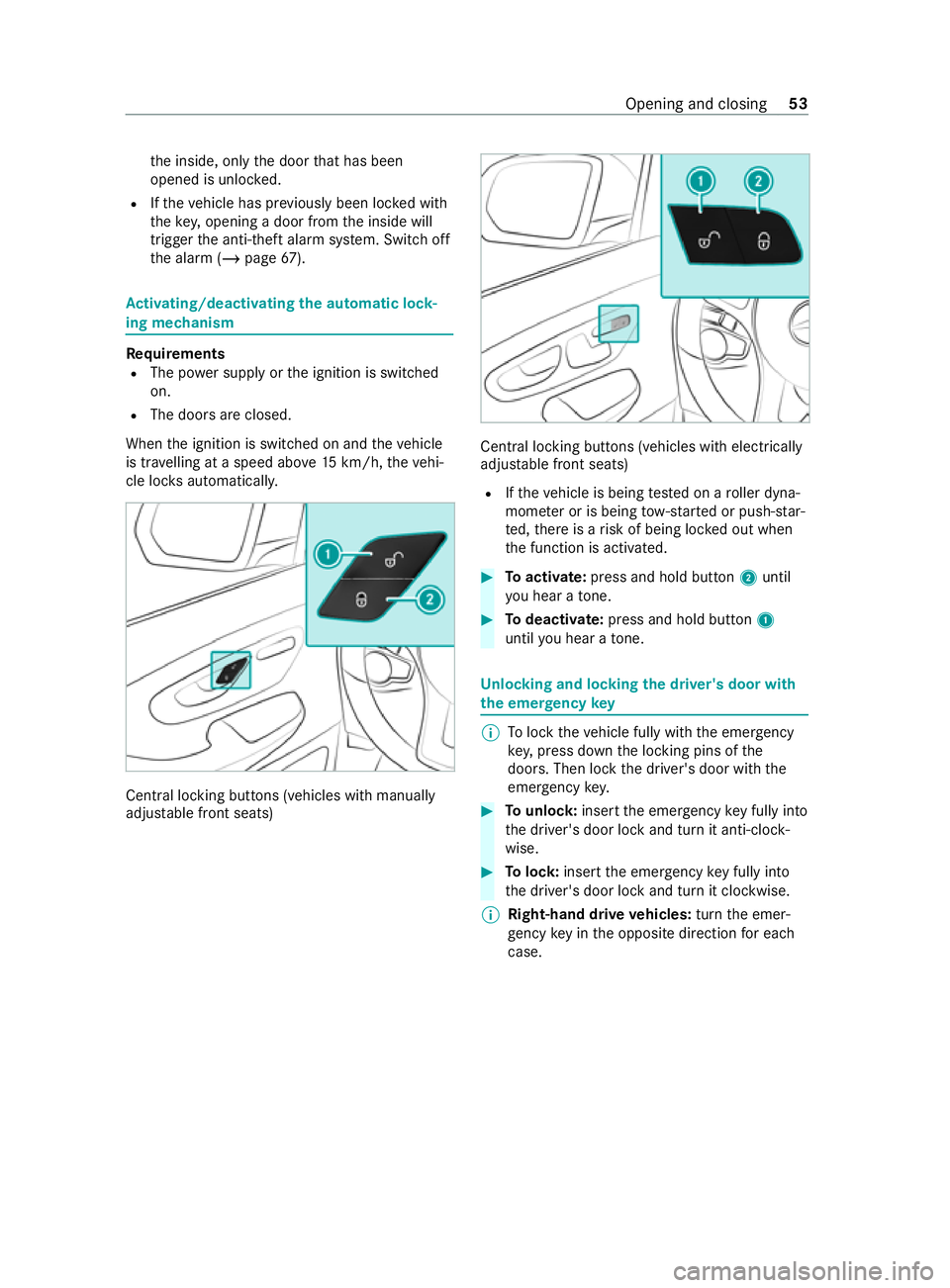
ral locking buttons (vehicles with manually
adjus table front seats) Central locking buttons (vehicles with electrically
adjus
table front seats)
R Ifth eve hicle is being tested on a roller dyna‐
mome ter or is being tow- star ted or push-s tar‐
te d, there is a risk of being loc ked out when
th e function is activated. #
Toactivate: press and hold button 2until
yo u hear a tone. #
Todeactivate: press and hold button 1
until you hear a tone. Un
locking and locking the driver's door with
th e emer gency key %
To
lock theve hicle fully with the emer gency
ke y,press down the locking pins of the
doors. Then lock the driver's door with the
emer gency key. #
Tounlo ck:insert the emer gency key fully into
th e driver's door lock and turn it anti-clock‐
wise. #
Tolock: insert the emer gency key fully into
th e driver's door lock and turn it clockwise.
% Right-hand drive
vehicles: turnthe emer‐
ge ncy key in the opposite direction for each
case. Opening and closing
53
Page 60 of 337

#
Toclose: press and hold the0042 button on
th eke yfo r longer than 0.5 seconds.
Yo u will hear two acoustic signals and the
sliding door will close automaticall y.#
Tointer rupt automatic operation: briefly
press the0042 button on thekey.
The sliding door stops moving.
% In unf
avourable operating conditions, e.g.
frost, ice or heavy soiling, press and hold the
appropriate sliding door button. The electric
sliding door mo ves with increased forc e.
Obser vethat in such circum stances, the
obs tacle de tection is less sensitive. Tostop
th e mo vement, release the sliding door but‐
to n. Opening/closing the electrical sliding door
from the outside
#
Toopen: pull door handle 1.
The sliding door unloc ks, automatic operation
is star ted and the sliding door opens. In addi‐
tion, you will hear two warning signals. #
Toclose: pull door handle 1.
The sliding door is released from its lock and
automatic operation is star ted. The sliding
door closes. #
Tointer rupt automatic operation: pull door
handle 1again. Prog
ramming the key button for the sliding
door Re
quirements
R The vehicle is equipped with two electric slid‐
ing doors.
R The sliding door tobe prog rammed is open.
R The ignition is switched on.
The 0042 button on theke y can be prog rammed.
Program the0042 button toopen theright or left
sliding door. 1
Sliding door button forth e sliding door on the
left-hand side
2 Sliding door button forth e sliding door on the
ri ght-hand side #
Press and hold sliding door button 1or2
in the cent reconsole forth e appropriate slid‐
ing door until the sliding door is closed and
fo ur tones ha vesounded.
The Left-hand electric sliding door key pro-
grammed/Right-hand electric sliding door
key programmedmessage appears inthe dis‐
pla y. Re
setting the electric sliding door Yo
u must reset the electric sliding door if there
has been a malfunction or a drop in voltage. #
Ifth e sliding door is open: close it byhand. #
Using the cor responding 0042or0041 sliding
door button on the cent reconsole, open the
sliding door at least 40 cm and then close the
sliding door comple tely. #
When the sliding door is closed, open the slid‐
ing door fully using the cor responding 0042
or 0041 sliding door button on the cent re
console.
The sliding door is reset and operational. Re
ctifying problems with the electric sliding
door The electric sliding door is loc
ked in place.
Unf avourable operating conditions, e.g. frost, ice
or heavy soiling, may obstruct the sliding door. Opening and closing
57
Page 64 of 337

Prog
ramming the key button for the tail gate
or rear window
Re quirements
R The tailgate and there ar wind oware closed.
R The ignition is swit ched on.
If yo ur vehicle is fitted wi than EA SY-PAC Ktail‐
gate ,yo u can prog ram the008C button on the
ke y either toopen/close theta ilgate or toopen
th ere ar wind ow. #
Press the buttons in the handle of theta ilgate
and in the handle of there ar wind owsimulta‐
neously for appro ximately five seconds.
Af ter successfully changing the function, the
ve hicle turn signal lamps flash once. #
Check the function of the008C button on the
key. Side window
Opening and closing
the side windo ws &
WARNING Risk of becoming trapped
when opening a side window
When you open a side wind ow, parts of the
body could be dr awn in or become trapped
between the side window and window frame. #
When opening, make sure that nobody
is touching the side windo w. #
If someone is trapped, release the but‐
to n immedia tely or pull it in order to
close the side window again. &
WARNING Risk of becoming trapped
when closing a side window
When closing a side windo w,body parts could
be trapped in the closing area in the process. #
When closing, make sure that no body
parts are in the closing area. #
If someone is trapped, release the but‐
to n immedia tely or press the button in
order toreopen the side windo w. &
WARNING Risk of becoming trapped
when children opera tethe side windo ws
Children could become trapped if they oper‐
ate the side windo ws, particularly when unat‐
te nded. #
Activate thech ild saf ety lock forthe
re ar side wind ows. #
When leaving theve hicle, alw aysta ke
th eke y with you and lock theve hicle. #
Never lea vechildren unat tended in the
ve hicle. &
WARNING Dangertolife due toexposure
to extreme heat or cold in theve hicle
If people, particular lych ildren, are exposed to
ex treme temp eratures over an extended
pe riod of time, there is a risk of serious injury
or danger tolife. #
Never lea vepersons, children in particu‐
lar, unat tended in theve hicle. #
Toopen manuall y:press and hold button 1
or 2. #
Toclose manuall y:pull and hold button 1
or 2.
The windo wsinthe front doors can also be oper‐
ated automaticall y. #
Toopen comple tely: briefly press button 1
or 2 beyond the point of resis tance.
Au tomatic operation will start. #
Toclose comple tely: briefly pull button 1
or 2 beyond the point of resis tance.
Au tomatic operation will start. #
Tointer rupt automatic operation: briefly
press or pull button 1or2 again.
Yo u can still operate the side windo wswhen the
ve hicle is par ked. This function will remain availa‐
ble for around five minutes or until you open a
front door. Opening and closing
61