fuel Mercury Milan 2007 s Service Manual
[x] Cancel search | Manufacturer: MERCURY, Model Year: 2007, Model line: Milan, Model: Mercury Milan 2007Pages: 280, PDF Size: 2.53 MB
Page 252 of 280
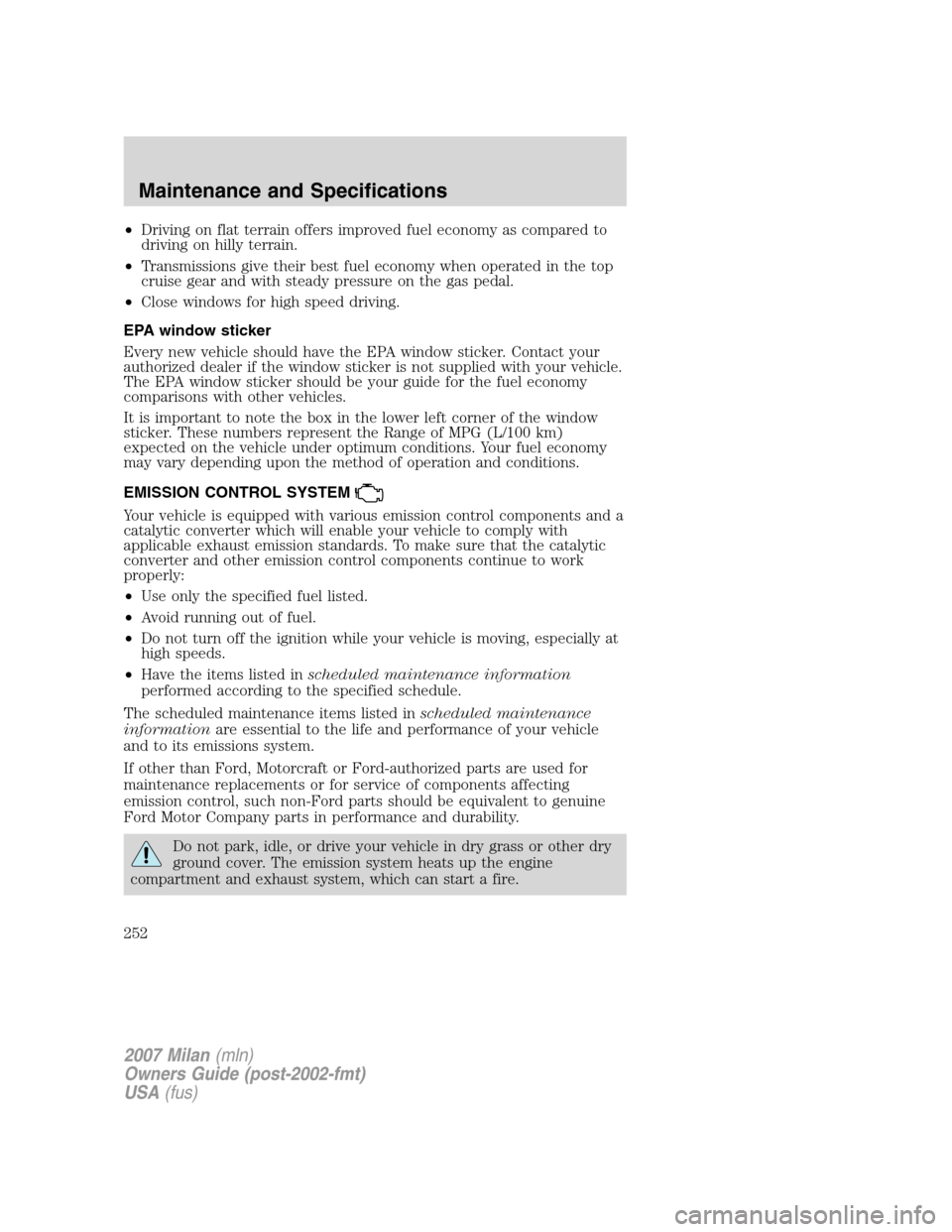
•Driving on flat terrain offers improved fuel economy as compared to
driving on hilly terrain.
•Transmissions give their best fuel economy when operated in the top
cruise gear and with steady pressure on the gas pedal.
•Close windows for high speed driving.
EPA window sticker
Every new vehicle should have the EPA window sticker. Contact your
authorized dealer if the window sticker is not supplied with your vehicle.
The EPA window sticker should be your guide for the fuel economy
comparisons with other vehicles.
It is important to note the box in the lower left corner of the window
sticker. These numbers represent the Range of MPG (L/100 km)
expected on the vehicle under optimum conditions. Your fuel economy
may vary depending upon the method of operation and conditions.
EMISSION CONTROL SYSTEM
Your vehicle is equipped with various emission control components and a
catalytic converter which will enable your vehicle to comply with
applicable exhaust emission standards. To make sure that the catalytic
converter and other emission control components continue to work
properly:
•Use only the specified fuel listed.
•Avoid running out of fuel.
•Do not turn off the ignition while your vehicle is moving, especially at
high speeds.
•Have the items listed inscheduled maintenance information
performed according to the specified schedule.
The scheduled maintenance items listed inscheduled maintenance
informationare essential to the life and performance of your vehicle
and to its emissions system.
If other than Ford, Motorcraft or Ford-authorized parts are used for
maintenance replacements or for service of components affecting
emission control, such non-Ford parts should be equivalent to genuine
Ford Motor Company parts in performance and durability.
Do not park, idle, or drive your vehicle in dry grass or other dry
ground cover. The emission system heats up the engine
compartment and exhaust system, which can start a fire.
2007 Milan(mln)
Owners Guide (post-2002-fmt)
USA(fus)
Maintenance and Specifications
252
Page 253 of 280
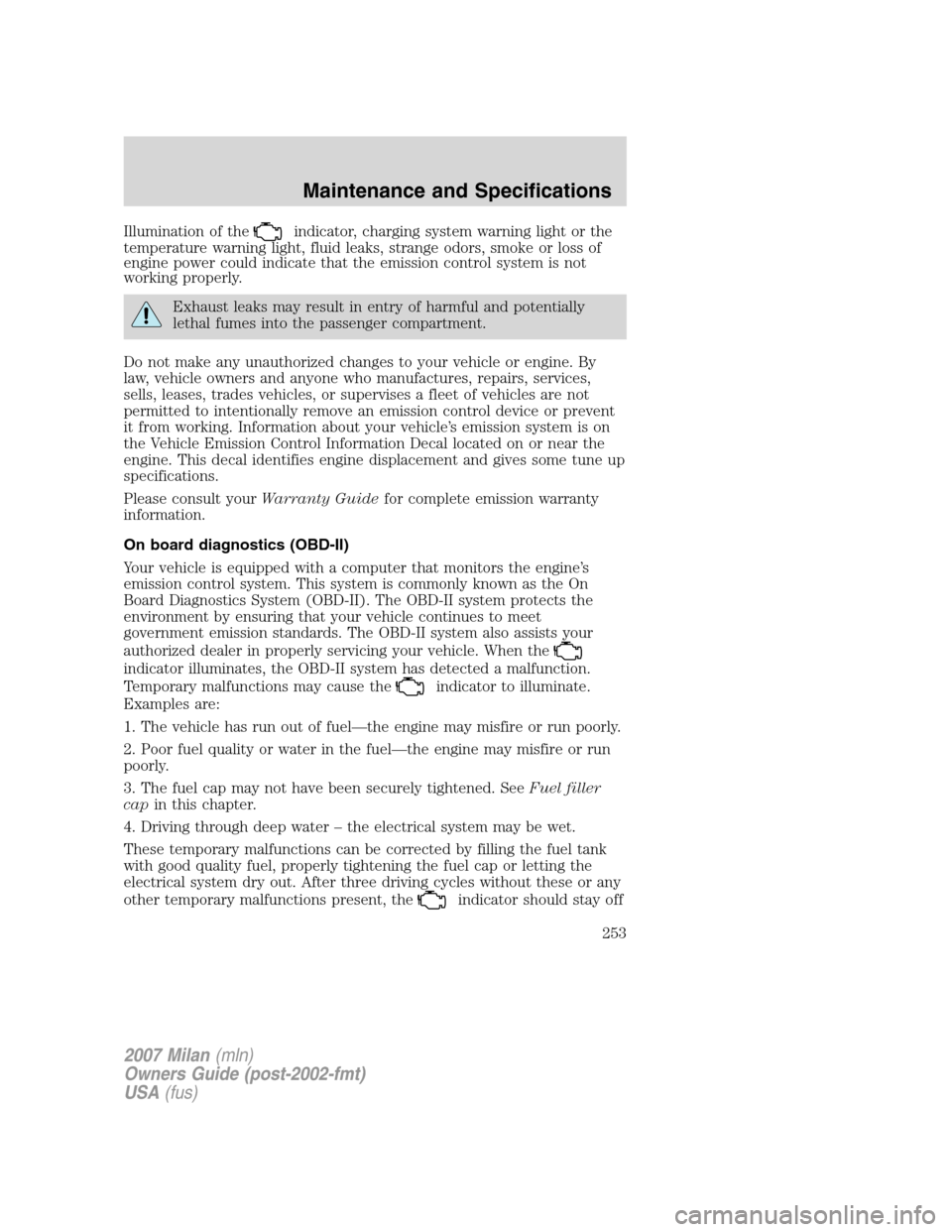
Illumination of theindicator, charging system warning light or the
temperature warning light, fluid leaks, strange odors, smoke or loss of
engine power could indicate that the emission control system is not
working properly.
Exhaust leaks may result in entry of harmful and potentially
lethal fumes into the passenger compartment.
Do not make any unauthorized changes to your vehicle or engine. By
law, vehicle owners and anyone who manufactures, repairs, services,
sells, leases, trades vehicles, or supervises a fleet of vehicles are not
permitted to intentionally remove an emission control device or prevent
it from working. Information about your vehicle’s emission system is on
the Vehicle Emission Control Information Decal located on or near the
engine. This decal identifies engine displacement and gives some tune up
specifications.
Please consult yourWarranty Guidefor complete emission warranty
information.
On board diagnostics (OBD-II)
Your vehicle is equipped with a computer that monitors the engine’s
emission control system. This system is commonly known as the On
Board Diagnostics System (OBD-II). The OBD-II system protects the
environment by ensuring that your vehicle continues to meet
government emission standards. The OBD-II system also assists your
authorized dealer in properly servicing your vehicle. When the
indicator illuminates, the OBD-II system has detected a malfunction.
Temporary malfunctions may cause the
indicator to illuminate.
Examples are:
1. The vehicle has run out of fuel—the engine may misfire or run poorly.
2. Poor fuel quality or water in the fuel—the engine may misfire or run
poorly.
3. The fuel cap may not have been securely tightened. SeeFuel filler
capin this chapter.
4. Driving through deep water – the electrical system may be wet.
These temporary malfunctions can be corrected by filling the fuel tank
with good quality fuel, properly tightening the fuel cap or letting the
electrical system dry out. After three driving cycles without these or any
other temporary malfunctions present, the
indicator should stay off
2007 Milan(mln)
Owners Guide (post-2002-fmt)
USA(fus)
Maintenance and Specifications
253
Page 254 of 280
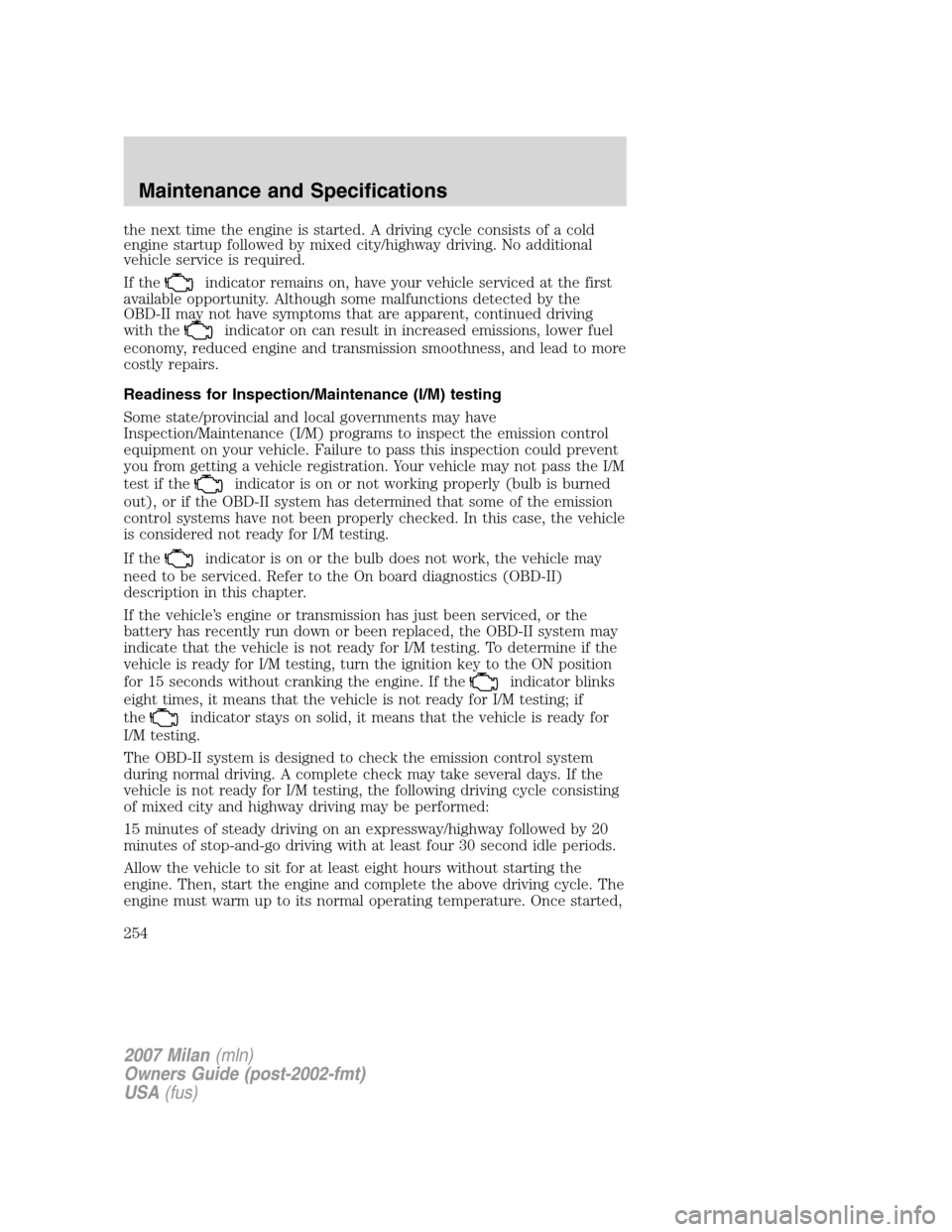
the next time the engine is started. A driving cycle consists of a cold
engine startup followed by mixed city/highway driving. No additional
vehicle service is required.
If the
indicator remains on, have your vehicle serviced at the first
available opportunity. Although some malfunctions detected by the
OBD-II may not have symptoms that are apparent, continued driving
with the
indicator on can result in increased emissions, lower fuel
economy, reduced engine and transmission smoothness, and lead to more
costly repairs.
Readiness for Inspection/Maintenance (I/M) testing
Some state/provincial and local governments may have
Inspection/Maintenance (I/M) programs to inspect the emission control
equipment on your vehicle. Failure to pass this inspection could prevent
you from getting a vehicle registration. Your vehicle may not pass the I/M
test if the
indicator is on or not working properly (bulb is burned
out), or if the OBD-II system has determined that some of the emission
control systems have not been properly checked. In this case, the vehicle
is considered not ready for I/M testing.
If the
indicator is on or the bulb does not work, the vehicle may
need to be serviced. Refer to the On board diagnostics (OBD-II)
description in this chapter.
If the vehicle’s engine or transmission has just been serviced, or the
battery has recently run down or been replaced, the OBD-II system may
indicate that the vehicle is not ready for I/M testing. To determine if the
vehicle is ready for I/M testing, turn the ignition key to the ON position
for 15 seconds without cranking the engine. If the
indicator blinks
eight times, it means that the vehicle is not ready for I/M testing; if
the
indicator stays on solid, it means that the vehicle is ready for
I/M testing.
The OBD-II system is designed to check the emission control system
during normal driving. A complete check may take several days. If the
vehicle is not ready for I/M testing, the following driving cycle consisting
of mixed city and highway driving may be performed:
15 minutes of steady driving on an expressway/highway followed by 20
minutes of stop-and-go driving with at least four 30 second idle periods.
Allow the vehicle to sit for at least eight hours without starting the
engine. Then, start the engine and complete the above driving cycle. The
engine must warm up to its normal operating temperature. Once started,
2007 Milan(mln)
Owners Guide (post-2002-fmt)
USA(fus)
Maintenance and Specifications
254
Page 265 of 280

MAINTENANCE PRODUCT SPECIFICATIONS AND CAPACITIES
Item Capacity Ford part nameFord part number /
Ford specification
Brake and clutch fluid
(if equipped)Fill between Min
and Max on
reservoirMotorcraft High
Performance DOT 3
Motor Vehicle Brake
FluidPM-1 or PM-1-C /
ESA-M6C25-A or
WSS-M6C62-A
Door weatherstrips — Silicone Spray LubricantXL-6 /
ESR-M13P4-A
Door latch, hood latch,
auxiliary hood latch,
door hinges, striker
plates, seat tracks and
fuel filler door hinge— Multi-Purpose GreaseXG-4 or XL-5 /
ESB-M1C93-B
Lock cylinders —Motorcraft Penetrating
and Lock LubricantXL-1 /
None
Engine coolant 2.3L
engine8.56 quarts
(8.1L)Motorcraft Premium
Gold Engine Coolant
(yellow-colored)
1
VC-7-B /
WSS-M97B51-A1
Engine coolant 3.0L
engine9.72 quarts
(9.2L)
Cooling system stop
leak pellets—Motorcraft Cooling
System Stop Leak PelletsVC-6 /
WSS-M99B37-B6
2007 Milan(mln)
Owners Guide (post-2002-fmt)
USA(fus)
Maintenance and Specifications
265
Page 267 of 280
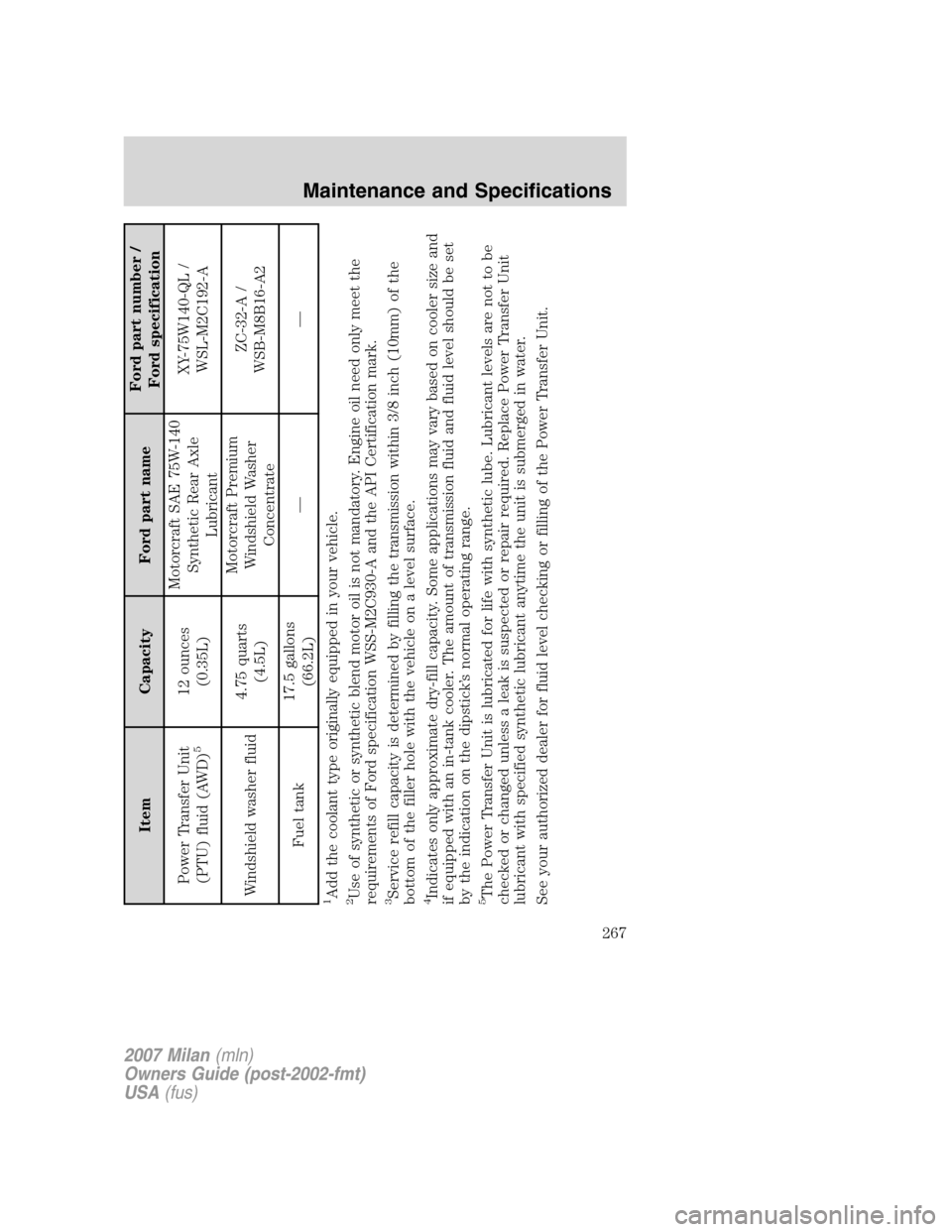
Item Capacity Ford part nameFord part number /
Ford specification
Power Transfer Unit
(PTU) fluid (AWD)
5
12 ounces
(0.35L)Motorcraft SAE 75W-140
Synthetic Rear Axle
LubricantXY-75W140-QL /
WSL-M2C192-A
Windshield washer fluid4.75 quarts
(4.5L)Motorcraft Premium
Windshield Washer
ConcentrateZC-32-A /
WSB-M8B16-A2
Fuel tank17.5 gallons
(66.2L)——
1Add the coolant type originally equipped in your vehicle.2Use of synthetic or synthetic blend motor oil is not mandatory. Engine oil need only meet the
requirements of Ford specification WSS-M2C930-A and the API Certification mark.3Service refill capacity is determined by filling the transmission within 3/8 inch (10mm) of the
bottom of the filler hole with the vehicle on a level surface.4Indicates only approximate dry-fill capacity. Some applications may vary based on cooler size and
if equipped with an in-tank cooler. The amount of transmission fluid and fluid level should be set
by the indication on the dipstick’s normal operating range.5The Power Transfer Unit is lubricated for life with synthetic lube. Lubricant levels are not to be
checked or changed unless a leak is suspected or repair required. Replace Power Transfer Unit
lubricant with specified synthetic lubricant anytime the unit is submerged in water.
See your authorized dealer for fluid level checking or filling of the Power Transfer Unit.
2007 Milan(mln)
Owners Guide (post-2002-fmt)
USA(fus)
Maintenance and Specifications
267
Page 268 of 280
ENGINE DATA
Engine 2.3L I4 engine 3.0L DOHC V6
Duratec engine
Cubic inches 140 182
Required fuel 87 octane 87 octane
Firing order 1-3-4-2 1-4-2-5-3-6
Ignition system Coil on plug Coil on plug
Spark plug gap 0.049–0.053 inch
(1.25–1.35 mm)0.052–0.056 inch
(1.32–1.42 mm)
Compression ratio 9.7:1 10.0:1
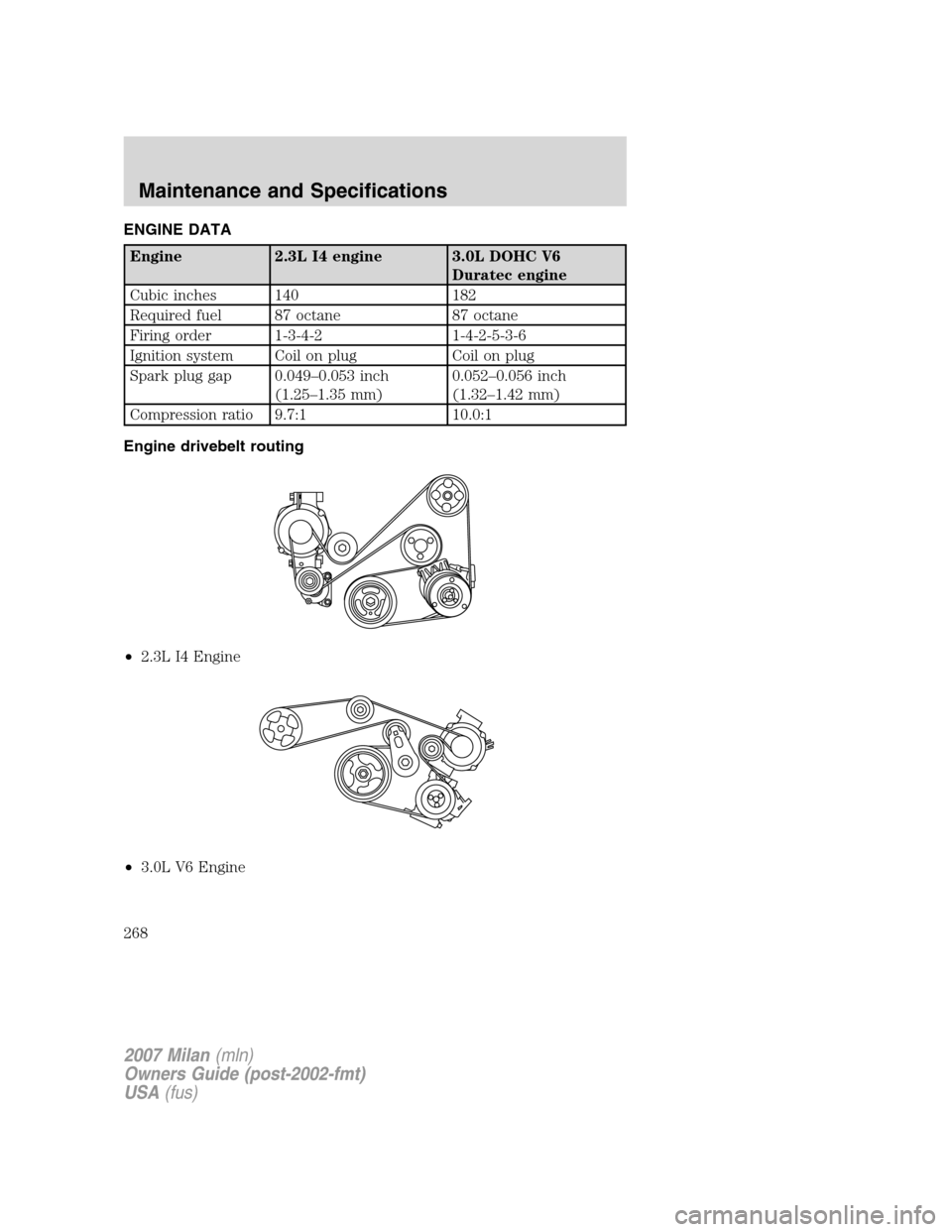
Engine drivebelt routing
•2.3L I4 Engine
•3.0L V6 Engine
2007 Milan(mln)
Owners Guide (post-2002-fmt)
USA(fus)
Maintenance and Specifications
268
Page 275 of 280
Engine oil ..................................231
change oil soon warning,
message center .......................231
checking and adding ..............231
dipstick ....................................231
filter, specifications ........235, 263
recommendations ...................235
refill capacities ........................265
specifications ..........................265
Exhaust fumes ..........................172
F
Fail safe cooling ........................243
Fluid capacities .........................265
Foglamps .....................................48
Four-Wheel Drive vehicles
driving off road .......................183
Fuel ............................................244
calculating fuel
economy ............................75, 249
cap ...........................................246
capacity ...................................265
choosing the right fuel ...........247
comparisons with EPA fuel
economy estimates .................252
detergent in fuel .....................248
filling your vehicle
with fuel ..................244, 246, 249
filter, specifications ........244, 263
fuel pump shut-off switch .....191
improving fuel economy ........249
octane rating ...................248, 268
quality ......................................248
running out of fuel .................248
safety information relating
to automotive fuels ................244
Fuel pump shut-off switch .......191
Fuses ..................................191–192G
Gas cap (see Fuel cap) ............246
Gas mileage
(see Fuel economy) .................249
Gauges .........................................13
H
Hazard flashers .........................190
Head restraints .........................100
Headlamps ...................................47
aiming ..................................49–50
autolamp system .......................47
bulb specifications ....................52
daytime running lights .............48
flash to pass ..............................49
high beam .................................49
replacing bulbs .........................52
turning on and off ....................47
Heating
heating and air conditioning
system ...........................39, 41, 43
Hood ..........................................227
How to get going ........................16
I
Ignition ...............................169, 268
Illuminated visor mirror .............63
Infant seats
(see Safety seats) .....................139
Inspection/maintenance (I/M)
testing ........................................254
Instrument panel ........................65
cleaning ...................................222
cluster ........................................10
lighting up panel and
interior .......................................49
2007 Milan(mln)
Owners Guide (post-2002-fmt)
USA(fus)
Index
275