light Mercury Mountaineer 1997 s Owner's Guide
[x] Cancel search | Manufacturer: MERCURY, Model Year: 1997, Model line: Mountaineer, Model: Mercury Mountaineer 1997Pages: 197, PDF Size: 2.08 MB
Page 74 of 197

bags, and the air bags deflate. You
may notice smoke and smell the
escaping gas after the air bags
deflate. This is normal.
You and your passenger must wear
your safety belts in order for the
air bag system to operate
effectively.
AIR BAG WARNING LIGHT AND
CHIME
When you turn the ignition key to
the ON position, the
warning
light in the instrument cluster
illuminates for approximately six
seconds to indicate the air bag
system is functional.
If you hear a group of five beeps,
or if the
warning light does
not illuminate, stays lit, or flashes,
the air bag system requires
immediate service. Have the
vehicle serviced at your dealer.
CHILD RESTRAINT
PRECAUTIONS
You are required by law to use
safety restraints in the United
States and Canada. If small
children ride in your vehicle
(generally children who are four
years of age or younger and who
weigh 18 kg [40 lb or less]), you
must put them in safety seats
made especially for children.
Check your local and state laws for
specific requirements regarding the
safety of your children.
Seating and safety restraints
74
Page 91 of 197
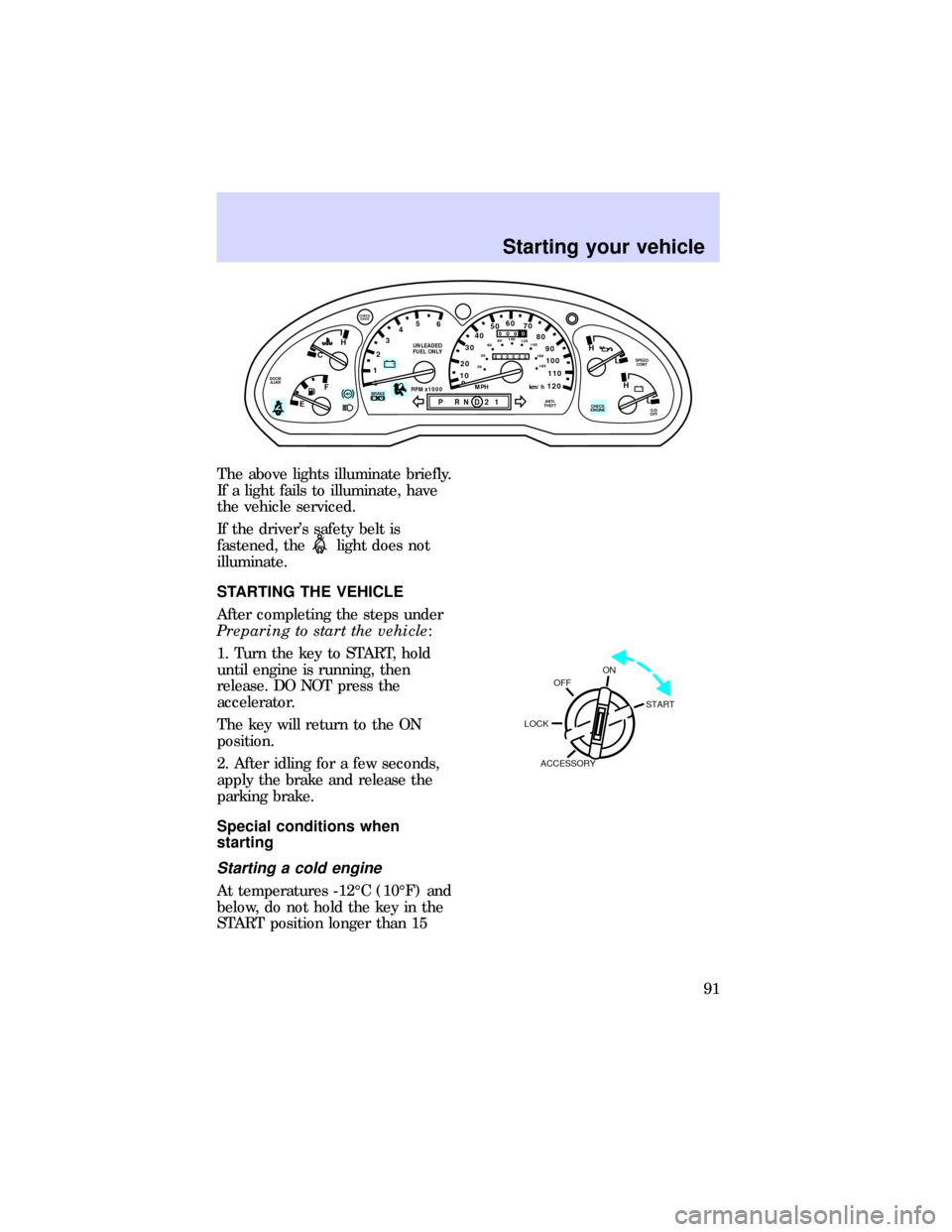
The above lights illuminate briefly.
If a light fails to illuminate, have
the vehicle serviced.
If the driver's safety belt is
fastened, the
light does not
illuminate.
STARTING THE VEHICLE
After completing the steps under
Preparing to start the vehicle:
1. Turn the key to START, hold
until engine is running, then
release. DO NOT press the
accelerator.
The key will return to the ON
position.
2. After idling for a few seconds,
apply the brake and release the
parking brake.
Special conditions when
starting
Starting a cold engine
At temperatures -12ÉC (10ÉF) and
below, do not hold the key in the
START position longer than 15
0ABS
- +
P RND21
UNLEADED
FUEL ONLY
RPM x 1000
12345
6
- +
H
H
L L
ANTI-
THEFT
CHECK
ENGINE
O/D
OFF SPEED
CONT
H
C
F
E
!P
DOOR
AJAR
BRAKE
CHECK
GAGE
0
20
1030405060
70
80
90
110
120000000
oooo
100
20406080100
120
140
160
180
MPH km/h
ON
START
LOCK
ACCESSORYOFF
Starting your vehicle
91
Page 96 of 197

BRAKES
The anti-lock brake system
(ABS)
Anti-lock brake operation differs
slightly from standard brake
operation.
Apply the brakes steadily. DO NOT
pump the brakes in a panic stop.
The brake system will prevent
wheel lockup by automatically
releasing and reapplying the
brakes.
Even with ABS, the brakes could
lock up on roads with alternating
slippery and dry patches or with
loose surfaces such as snow or
gravel. Be careful when braking.
The ABS conducts a self-test each
time the vehicle is driven. A
mechanical noise may be heard
while the system conducts its
self-test.
Occasional brake squeal during
light to moderate stops is normal.
Significantly increased squeal is an
indicator that brake service is
needed.
After driving through standing
water, gently apply the brakes
several times to dry them.
If driving down a long or steep hill,
shift to a lower gear and do not
apply the brakes continuously.
Continuously applying the brakes
on a hill could overheat them and
make them less effective.
Driving
96
Page 97 of 197
ABS warning light
TheABSlight in the instrument
cluster illuminates and remains
illuminated if an ABS fault is
detected. Have your vehicle
serviced as soon as possible.
Normal braking operation is still
effective unless the
light is
also illuminated.
Parking brake
The parking brake should be used
whenever the vehicle is parked.
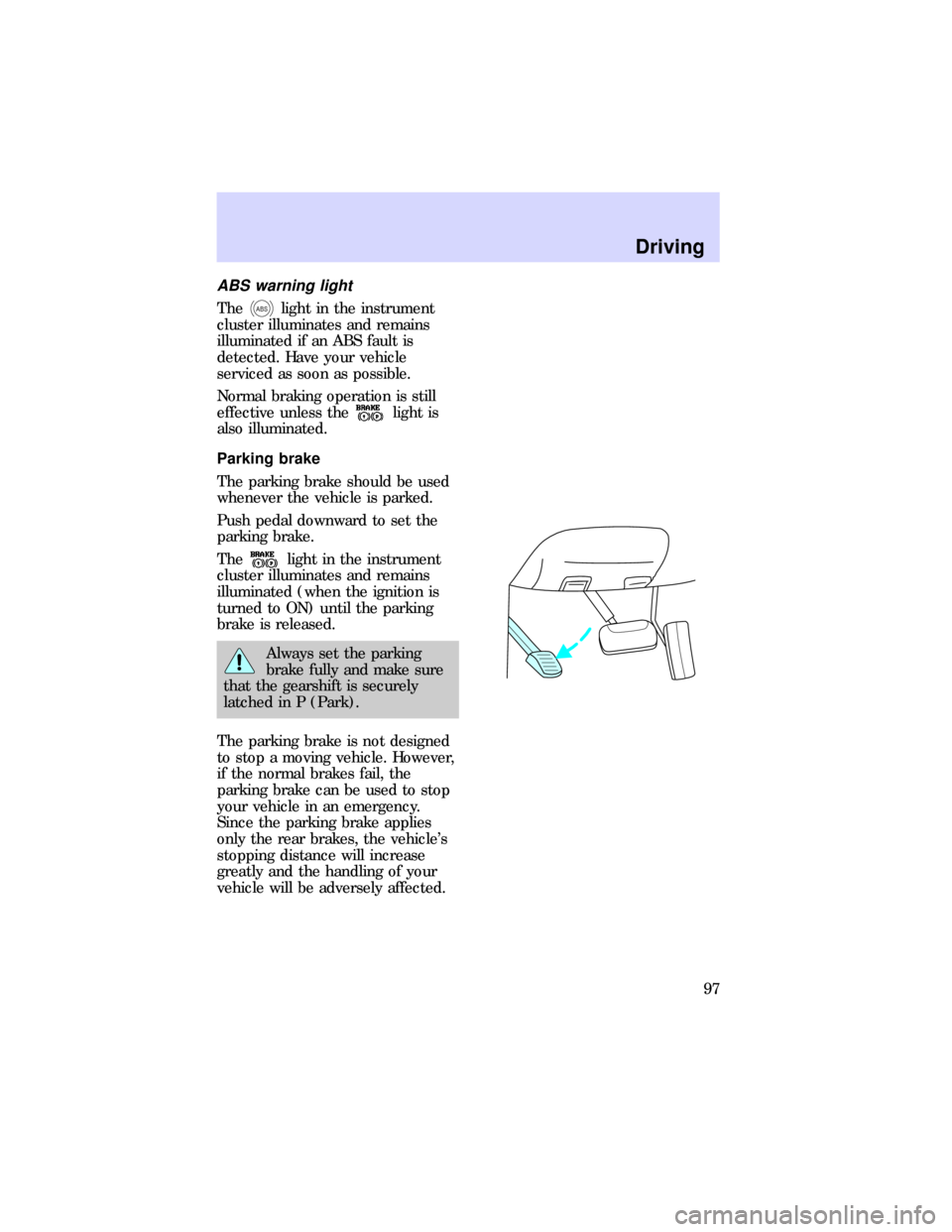
Push pedal downward to set the
parking brake.
The
light in the instrument
cluster illuminates and remains
illuminated (when the ignition is
turned to ON) until the parking
brake is released.
Always set the parking
brake fully and make sure
that the gearshift is securely
latched in P (Park).
The parking brake is not designed
to stop a moving vehicle. However,
if the normal brakes fail, the
parking brake can be used to stop
your vehicle in an emergency.
Since the parking brake applies
only the rear brakes, the vehicle's
stopping distance will increase
greatly and the handling of your
vehicle will be adversely affected.
Driving
97
Page 98 of 197
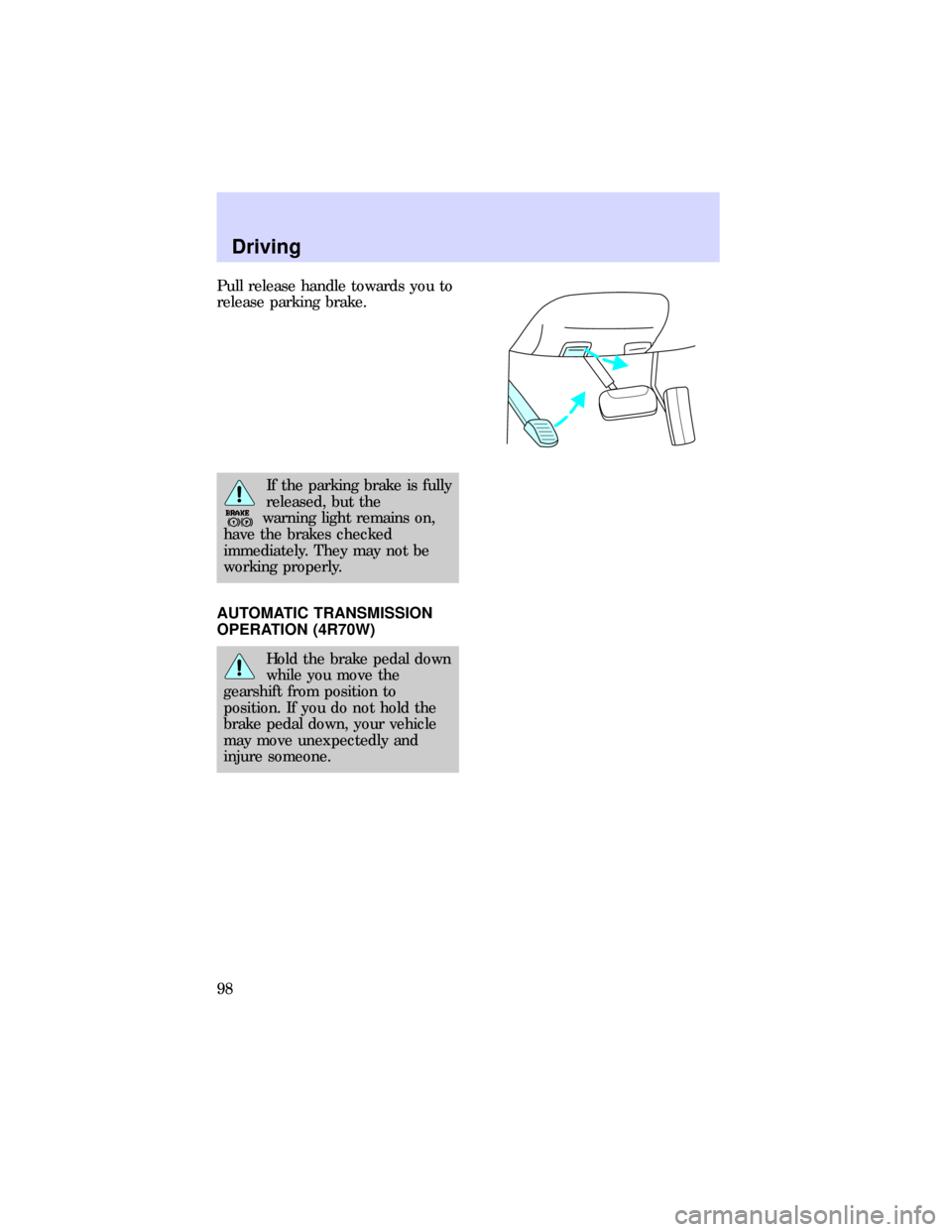
Pull release handle towards you to
release parking brake.
If the parking brake is fully
released, but the
warning light remains on,
have the brakes checked
immediately. They may not be
working properly.
AUTOMATIC TRANSMISSION
OPERATION (4R70W)
Hold the brake pedal down
while you move the
gearshift from position to
position. If you do not hold the
brake pedal down, your vehicle
may move unexpectedly and
injure someone.
Driving
98
Page 100 of 197
D- OverdriveThe normal
driving position for the best fuel
economy. Transmission operates in
gears 1-4.
D(Overdrive) can be
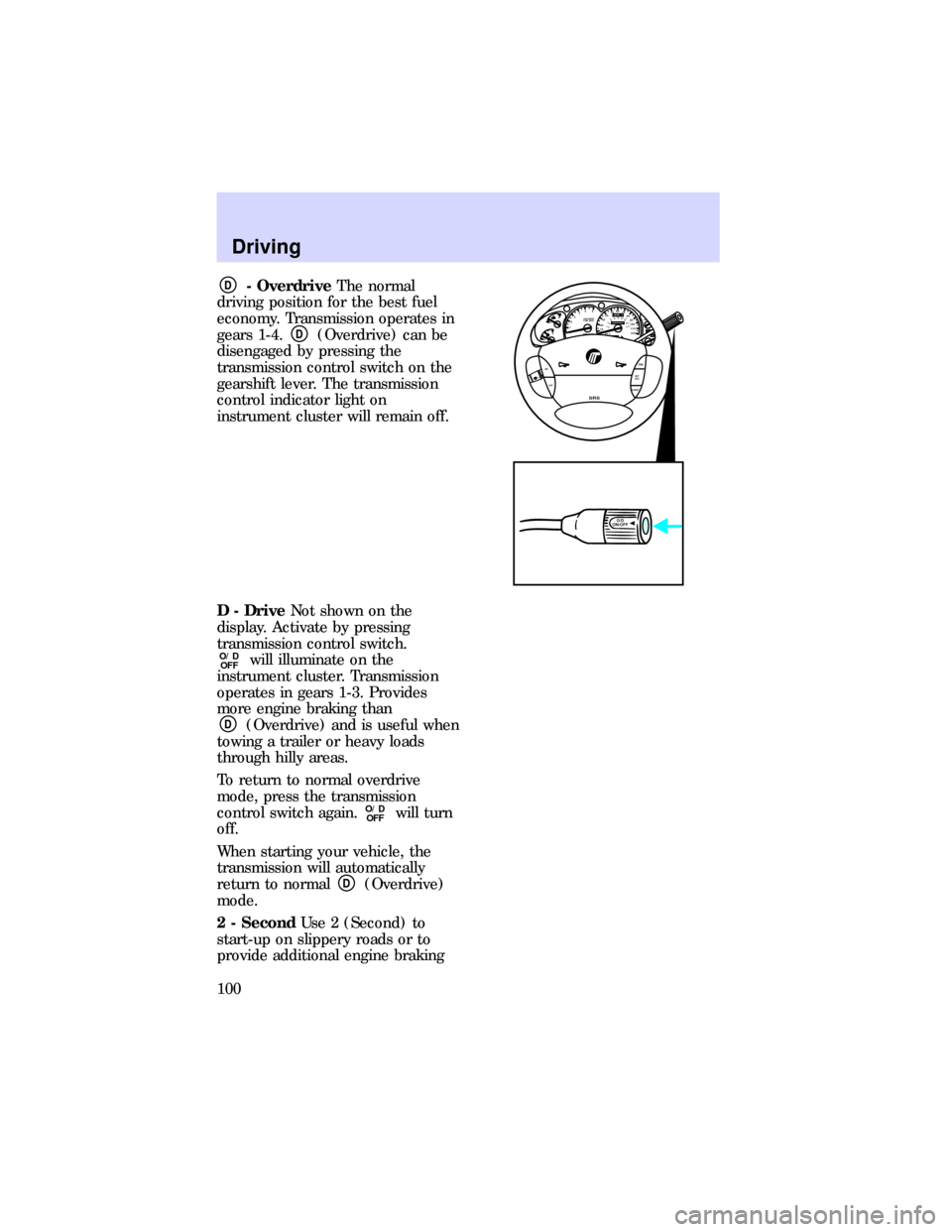
disengaged by pressing the
transmission control switch on the
gearshift lever. The transmission
control indicator light on
instrument cluster will remain off.
D - DriveNot shown on the
display. Activate by pressing
transmission control switch.
O/D
OFFwill illuminate on the
instrument cluster. Transmission
operates in gears 1-3. Provides
more engine braking than
D(Overdrive) and is useful when
towing a trailer or heavy loads
through hilly areas.
To return to normal overdrive
mode, press the transmission
control switch again.
O/D
OFFwill turn
off.
When starting your vehicle, the
transmission will automatically
return to normal
D(Overdrive)
mode.
2 - SecondUse 2 (Second) to
start-up on slippery roads or to
provide additional engine braking
0P RND21
UNLEADED
FUEL ONLY
RPM x 100012345
6H
C
F
E
RSM
SET
ACC
COAST OFF ON
SRS
- +H
H
L L020
1030405060
70
80
90
110
120000000oooo
km/h100
20406080100
120
140
160
180
O/D
ON/OFF
Driving
100
Page 102 of 197
Do not drive your vehicle
until you verify that the
brakelamps are working.
If your vehicle gets stuck in the
mud or snow it may be rocked out
of the spot. To rock the vehicle
out, shift between forward and
reverse gears in a steady rhythm.
Press lightly on the accelerator in
each gear. Do not rock the vehicle
for more than a few minutes,
because it could damage the
vehicle.
Do not spin the wheels at
over 55 km/h (35 mph).
The tires may fail and injure a
passenger or bystander.
ALL-WHEEL DRIVE (AWD)
SYSTEM (IF EQUIPPED)
Your vehicle is equipped with a
full-time All-Wheel Drive (AWD)
transfer case. Power is constantly
supplied to all four wheels through
a transfer case. The AWD system is
full-time and has no external
controls.
The AWD transfer case utilizes a
viscous clutch that distributes
torque to the front and rear
differentials (approximately 35%
front and 65% rear). The viscous
clutch is filled with a high viscosity
fluid; seeLubricant specifications
for more information.
All utility-type and AWD vehicles
have special design and equipment
Driving
102
Page 104 of 197

should either know the terrain or
examine maps of the area before
driving. Map out your route before
driving in the area. For more
information on driving off-road,
readFour-Wheelingin your
owner's portfolio.
Sand
When driving over sand, try to
keep all four wheels on the most
solid area of the trail. Do not
reduce the tire pressures but shift
to a lower gear and drive steadily
through the terrain. Apply the
accelerator slowly and avoid
spinning the wheels.
Mud and water
If you must drive through high
water, drive slowly. Traction or
brake capability may be limited.
When driving through water,
determine the depth; avoid water
higher than the bottom of the hubs
(if possible) and proceed slowly. If
the ignition system gets wet, the
vehicle may stall.
Once through water, always try the
brakes. Wet brakes do not stop the
vehicle as effectively as dry brakes.
Drying can be improved by moving
your vehicle slowly while applying
light pressure on the brake pedal.
After driving through mud, clean
off residue stuck to rotating
driveshafts and tires. Excess mud
stuck on tires and rotating
driveshafts causes an imbalance
Driving
104
Page 114 of 197
Trailer lamps
Trailer lamps are required on most
towed vehicles. Make sure your
trailer lamps conform to Federal
and local regulations. See your
dealer or trailer rental agency for
the proper instructions and
equipment for hooking up trailer
lamps.
Do not hook the trailer
lamps directly into the
vehicle's lighting system wiring.
If the trailer lamps are not
installed properly, the warning
lights in the instrument cluster
may not work properly.
Driving while you tow
Do not drive faster than 88km/h
(55 mph) while towing a trailer. Do
not drive faster than 72 km/h (45
mph) while towing in hilly country
or on hot days.
Speed control may shut off if you
are towing on very long, steep
grades.
When towing a trailer:
²Use D (3rd gear) rather than
D(Overdrive) while towing up
or down steep hills. This will
eliminate excessive downshifting
and upshifting for optimum fuel
economy and transmission
cooling.
²Anticipate stops and brake
gradually.
Driving
114
Page 115 of 197

Servicing while towing
If you tow a trailer for long
distances, your vehicle will require
more frequent service intervals.
Refer to theService Guidefor
more information.
Trailer towing
²Practice turning, stopping and
backing in an area before
starting on a trip to get the feel
of the vehicle/trailer
combination. When turning,
drive slightly beyond the normal
turning point so the trailer
wheels will clear curbs and
other obstacles.
²Allow more room for stopping
with a trailer attached.
²The trailer tongue weight should
be 10-15% of the loaded trailer
weight for a Class I or II rear
bumper hitch.
²After you have travelled about
80 km (50 miles), thoroughly
check your hitch, electrical
connections and trailer wheel
lug nuts.
²When stopped in traffic for long
periods of time in hot weather,
place the gearshift in P (Park)
to increase idle speed. This aids
engine cooling and air
conditioner efficiency.
²Vehicles with trailers should not
be parked on a grade. If you
must park on a grade, place
wheel chocks under the trailer's
wheels.
Driving
115