lock Mercury Mountaineer 1997 s Owner's Guide
[x] Cancel search | Manufacturer: MERCURY, Model Year: 1997, Model line: Mountaineer, Model: Mercury Mountaineer 1997Pages: 197, PDF Size: 2.08 MB
Page 63 of 197
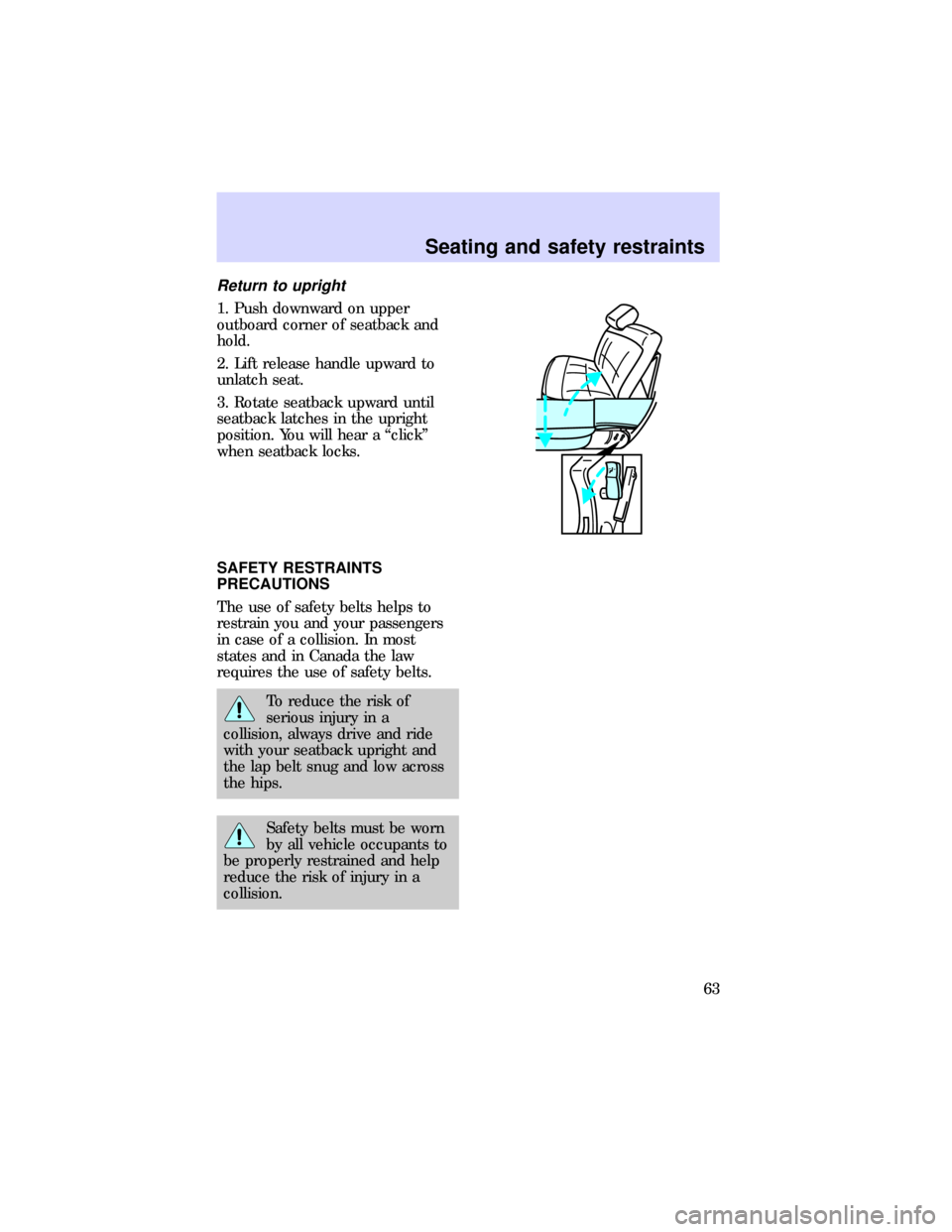
Return to upright
1. Push downward on upper
outboard corner of seatback and
hold.
2. Lift release handle upward to
unlatch seat.
3. Rotate seatback upward until
seatback latches in the upright
position. You will hear a ``click''
when seatback locks.
SAFETY RESTRAINTS
PRECAUTIONS
The use of safety belts helps to
restrain you and your passengers
in case of a collision. In most
states and in Canada the law
requires the use of safety belts.
To reduce the risk of
serious injury in a
collision, always drive and ride
with your seatback upright and
the lap belt snug and low across
the hips.
Safety belts must be worn
by all vehicle occupants to
be properly restrained and help
reduce the risk of injury in a
collision.
Seating and safety restraints
63
Page 65 of 197
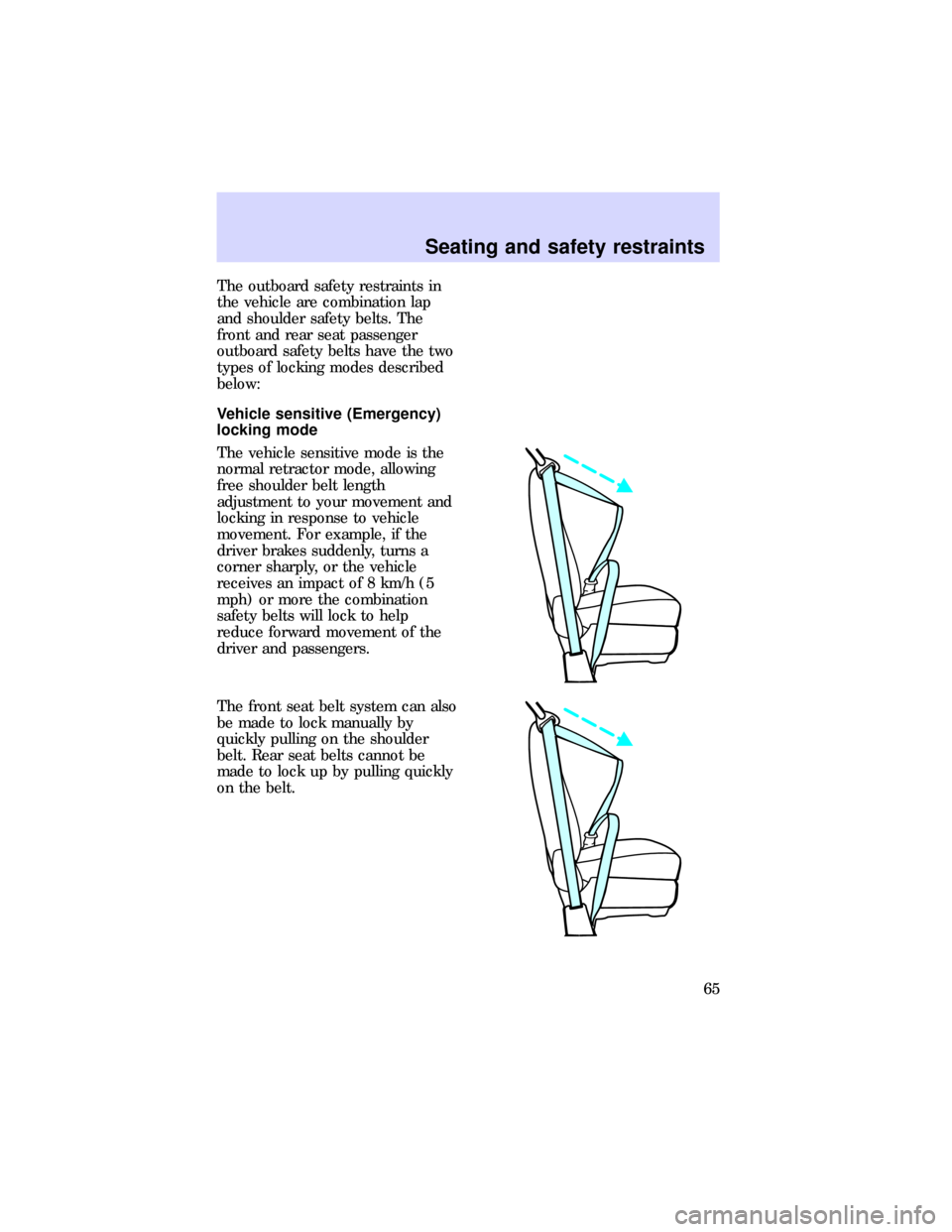
The outboard safety restraints in
the vehicle are combination lap
and shoulder safety belts. The
front and rear seat passenger
outboard safety belts have the two
types of locking modes described
below:
Vehicle sensitive (Emergency)
locking mode
The vehicle sensitive mode is the
normal retractor mode, allowing
free shoulder belt length
adjustment to your movement and
locking in response to vehicle
movement. For example, if the
driver brakes suddenly, turns a
corner sharply, or the vehicle
receives an impact of 8 km/h (5
mph) or more the combination
safety belts will lock to help
reduce forward movement of the
driver and passengers.
The front seat belt system can also
be made to lock manually by
quickly pulling on the shoulder
belt. Rear seat belts cannot be
made to lock up by pulling quickly
on the belt.
Seating and safety restraints
65
Page 66 of 197
Automatic locking mode
In this mode, the shoulder belt is
automatically pre-locked; however,
the belt will still retract to remove
any slack in the shoulder belt.
The automatic locking mode is not
available on the driver safety belt.
When to use the automatic
locking mode
²When a tight lap/shoulder belt
fit is desired.
²Any timea child safety seat is
installed in the vehicle. Refer to
Children and infant or child
safety seatslater in this section.
How to use the automatic
locking mode
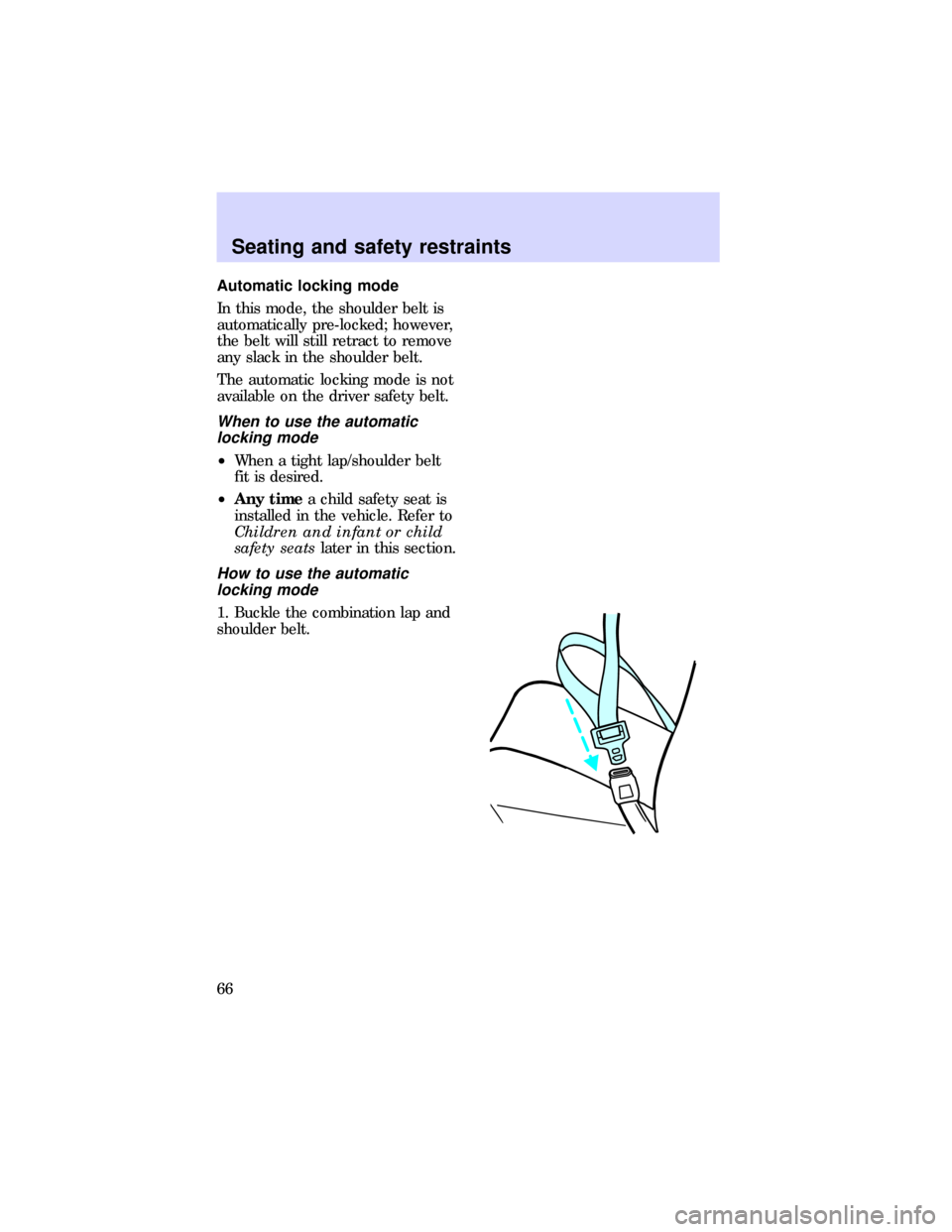
1. Buckle the combination lap and
shoulder belt.
Seating and safety restraints
66
Page 67 of 197
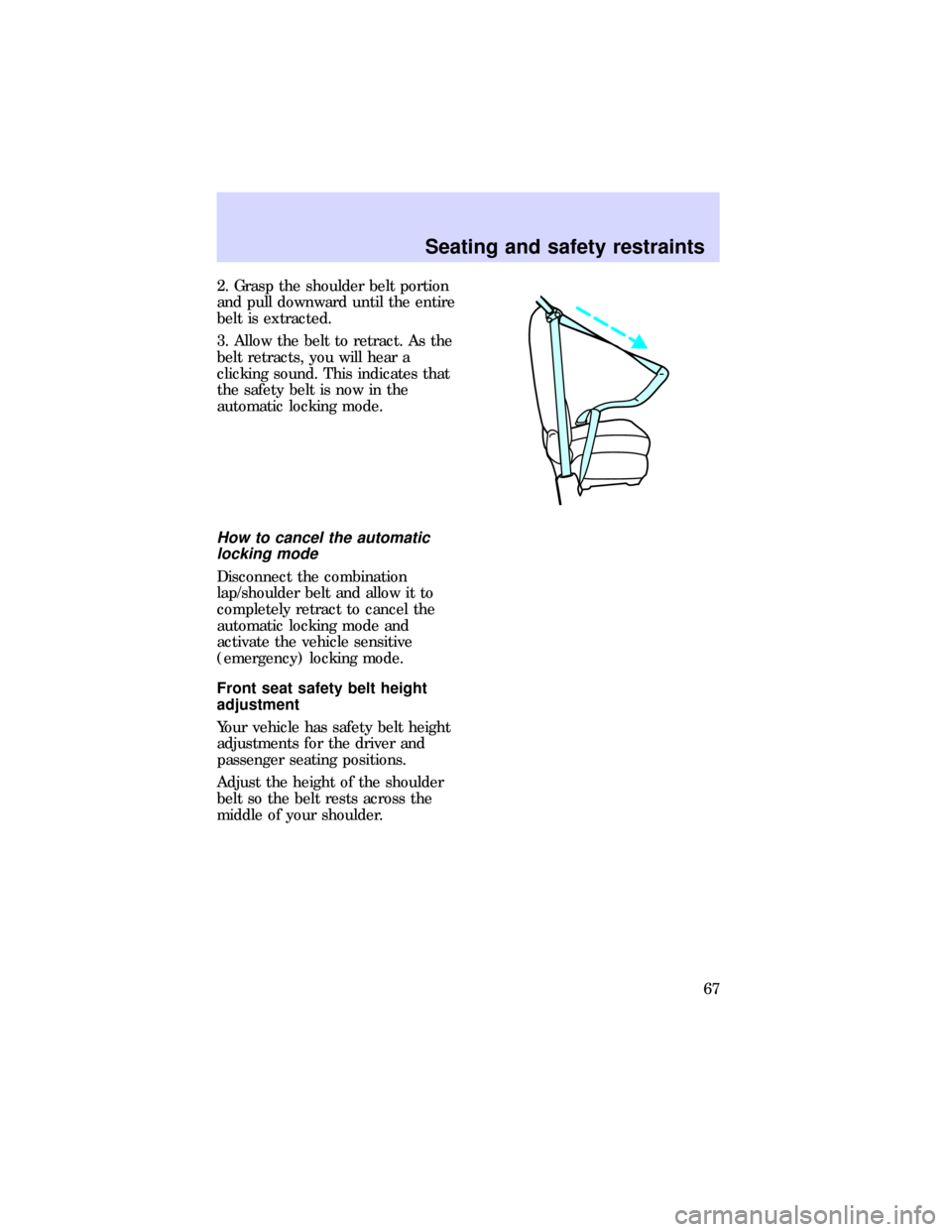
2. Grasp the shoulder belt portion
and pull downward until the entire
belt is extracted.
3. Allow the belt to retract. As the
belt retracts, you will hear a
clicking sound. This indicates that
the safety belt is now in the
automatic locking mode.
How to cancel the automatic
locking mode
Disconnect the combination
lap/shoulder belt and allow it to
completely retract to cancel the
automatic locking mode and
activate the vehicle sensitive
(emergency) locking mode.
Front seat safety belt height
adjustment
Your vehicle has safety belt height
adjustments for the driver and
passenger seating positions.
Adjust the height of the shoulder
belt so the belt rests across the
middle of your shoulder.
Seating and safety restraints
67
Page 68 of 197
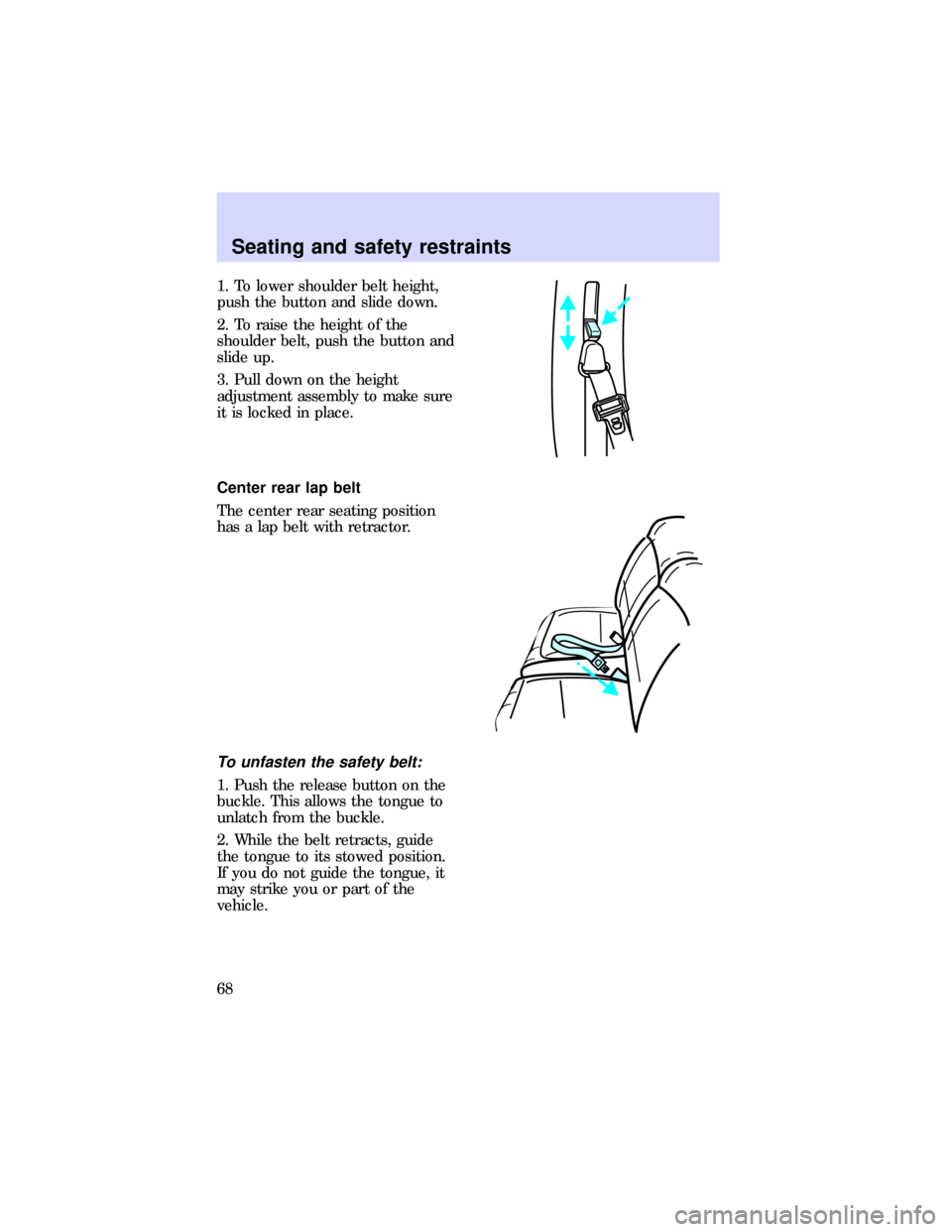
1. To lower shoulder belt height,
push the button and slide down.
2. To raise the height of the
shoulder belt, push the button and
slide up.
3. Pull down on the height
adjustment assembly to make sure
it is locked in place.
Center rear lap belt
The center rear seating position
has a lap belt with retractor.
To unfasten the safety belt:
1. Push the release button on the
buckle. This allows the tongue to
unlatch from the buckle.
2. While the belt retracts, guide
the tongue to its stowed position.
If you do not guide the tongue, it
may strike you or part of the
vehicle.
Seating and safety restraints
68
Page 76 of 197

OR
²If the child is the proper size,
restrain the child in a safety
seat.
CHILDREN AND INFANT OR
CHILD SAFETY SEATS
Carefully follow all of the
manufacturer's instructions
included with the safety seat you
put in your vehicle. If you do not
install and use the safety seat
properly, the child may be
injured in a sudden stop or
collision.
When installing a child safety seat:
²Use the correct safety belt
buckle for that seating position.
²Make sure the tongue is
securely fastened in the buckle.
²Keep the buckle release button
pointing up and away from the
safety seat, with the tongue
between the child seat and the
release button, to prevent
accidental unbuckling.
²Place seatbacks in the upright
position.
²Put the safety belt in the
automatic locking mode. Refer
toHow to use the automatic
locking mode.
PRESS
Seating and safety restraints
76
Page 78 of 197

3. While holding the shoulder and
lap belt portions together, route
the tongue through the child seat
according to the child seat
manufacturer's instructions. Be
sure the belt webbing is not
twisted.
4. Insert the belt tongue into the
proper buckle for that seating
position until you hear and feel the
latch engage. Make sure the
tongue is latched securely by
pulling on it.
5. Grasp the shoulder portion of
the belt and pull downward until
all of the belt is extracted and a
click is heard to put the retractor
in the automatic locking mode.
6. Allow the belt to retract. The
belt will click as it retracts to
indicate it is in the automatic
locking mode.
PRESS
Seating and safety restraints
78
Page 79 of 197
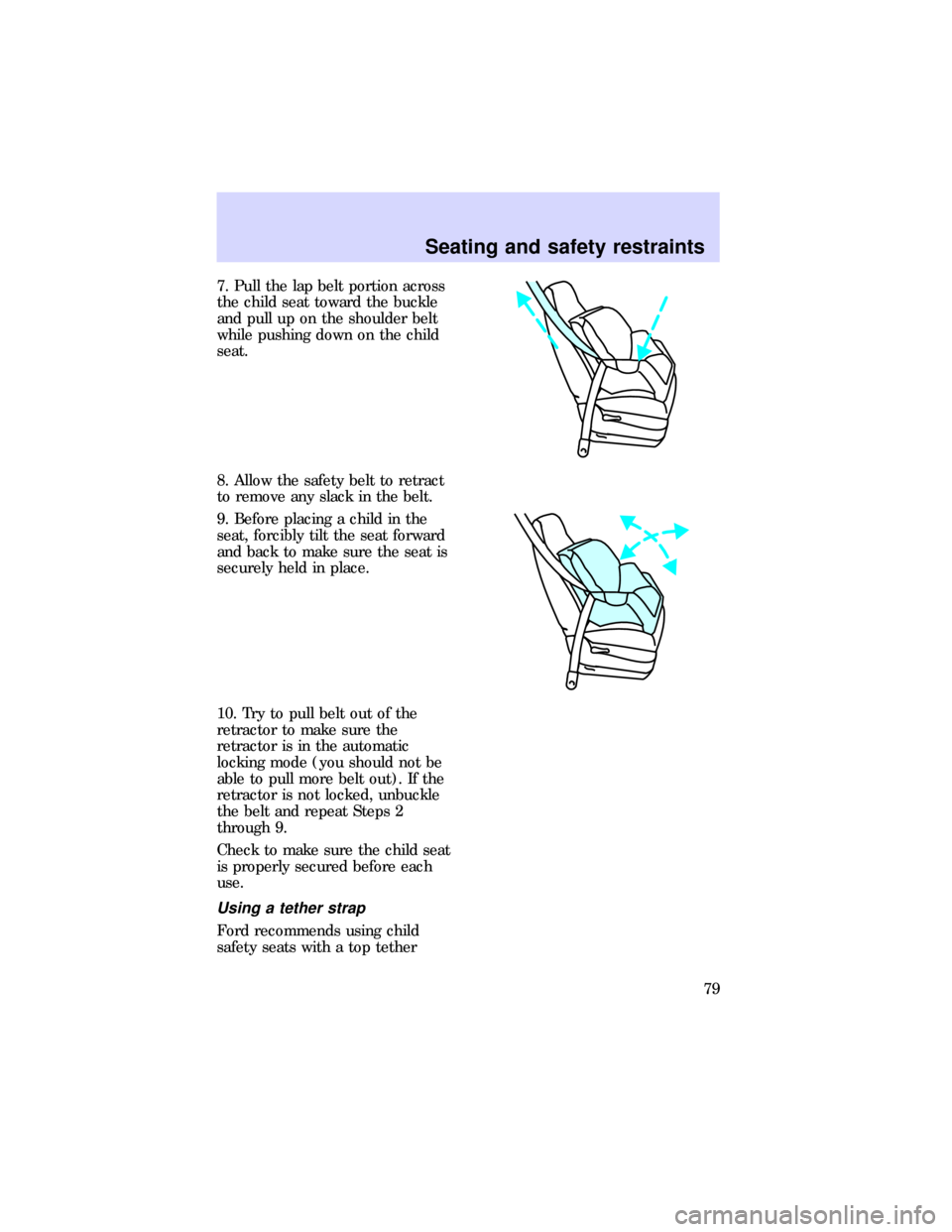
7. Pull the lap belt portion across
the child seat toward the buckle
and pull up on the shoulder belt
while pushing down on the child
seat.
8. Allow the safety belt to retract
to remove any slack in the belt.
9. Before placing a child in the
seat, forcibly tilt the seat forward
and back to make sure the seat is
securely held in place.
10. Try to pull belt out of the
retractor to make sure the
retractor is in the automatic
locking mode (you should not be
able to pull more belt out). If the
retractor is not locked, unbuckle
the belt and repeat Steps 2
through 9.
Check to make sure the child seat
is properly secured before each
use.
Using a tether strap
Ford recommends using child
safety seats with a top tether
Seating and safety restraints
79
Page 80 of 197
strap. Contact the manufacturer of
your safety seat for information
about ordering a tether strap if
one is not provided to you. Contact
your Ford dealer for a free tether
anchor kit (613D74) so you can
attach a tether anchor bracket to
the tether anchor attachment
locations in the rear floor.
Carefully follow the instructions
provided with the kit.
Only use the tether
attachment hole locations
shown. The tether anchor may
not perform properly if the
wrong mounting location is used.
Follow the child seat
manufacturer's instructions for
installing a child seat with a tether
strap.
Ford recommends you attach
tethered safety seats in a rear
seating position with the tether
strap attached to the tether
anchoring bracket as shown in the
instructions provided with the
tether anchor kit.
If a tethered seat must be installed
in the front passenger seat:
1. Buckle the safety belt in the
seat directly behind the front
passenger seat.
2. Place the rear safety belt in the
automatic locking mode. Refer to
How to use the automatic locking
modein this chapter.
3. Install the child safety seat in
the front seat. Refer to the
Seating and safety restraints
80
Page 82 of 197

Placing your child in the built-in
child seat
Failure to follow all of the
instructions on the use of
this child restraint system can
result in your child striking the
vehicle's interior during a sudden
stop or crash.
Never use the built-in
child seat as a booster
cushion with the adult safety
belts. A child using the adult
belts could slide forward and out
from under the safety belts.
The rear seatback must be
fully locked before
operating the child restraint
system.
1. Grasp the pull strap and pull
toward you approximately one
inch, then slide hand under head
restraint and slide upwards to full
position.
Seating and safety restraints
82