brake light MINI 3 door 2014 Owner's Guide
[x] Cancel search | Manufacturer: MINI, Model Year: 2014, Model line: 3 door, Model: MINI 3 door 2014Pages: 240, PDF Size: 11.05 MB
Page 158 of 240
Ensure that this action does not endanger other
traffic.
The heat generated in this process helps dry
the brake discs and pads.
In this way braking efficiency will be available
when you need it.
HillsDrive long or steep downhill gradients in the
gear that requires least braking efforts. Other‐
wise the brakes may overheat and reduce
brake efficiency.
You can increase the engine's braking effect by
shifting down, going all the way to first gear, if
needed.
Avoid stressing the brakes
Avoid placing excessive stress on the
brake system. Light but consistent brake pres‐
sure can lead to high temperatures, brakes
wearing out and possibly even brake failure. ◀
Do not drive in neutral
Do not drive in neutral or with the engine
stopped, as doing so disables engine braking.
In addition, steering and brake assist are un‐
available with the engine stopped. ◀
Brake disc corrosion
Corrosion on the brake discs and contamina‐
tion on the brake pads are furthered by:▷Low mileage.▷Extended periods when the vehicle is not
used at all.▷Infrequent use of the brakes.
Corrosion will built up when the maximum
pressure applied to the brake pads during brak‐
ing is not reached - thus discs don't get
cleaned.
Corrosion buildup on the brake discs will cause
a pulsating effect on the brakes in their re‐
sponse - generally that cannot be corrected.
Condensation under the parked vehicle
When using the automatic climate control, con‐
densation water develops collecting under‐
neath the vehicle.
These traces of water under the vehicle are
normal.
Ground clearance Limited ground clearance
Observe the limited ground clearance of
the vehicle, e. g. while entering underground
parking garages or when driving over obsta‐
cles. Otherwise, damages to the vehicle may
result. ◀Seite 154DRIVING TIPSThings to remember when driving154
Online Edition for Part no. 01 40 2 957 280 - X/14
Page 161 of 240
Securing
Follow the installation instructions of the roof
rack.
Loading Be sure that adequate clearance is maintained
for tilting and opening the glass sunroof.
Because roof racks raise the vehicle's center of
gravity when loaded, they have a major effect
on vehicle handling and steering response.
Therefore, note the following when loading and
driving:▷Do not exceed the approved roof/axle
loads and the approved gross vehicle
weight.▷Distribute the roof load uniformly.▷The roof load should not extend past the
loading area.▷Always place the heaviest pieces on the
bottom.▷Secure the roof luggage firmly, e.g., tie with
ratchet straps.▷Do not let objects project into the opening
path of the tailgate.▷Drive cautiously and avoid sudden acceler‐
ation and braking maneuvers. Take corners
gently.
Rear luggage rack
General information Installation only possible with rear luggage rack
preparation.
Rear racks are available as special accessories.
Note Follow the installation instructions of the rear
luggage rack.
Drive cautiously and avoid sudden acceleration
and braking maneuvers. Take corners gently.
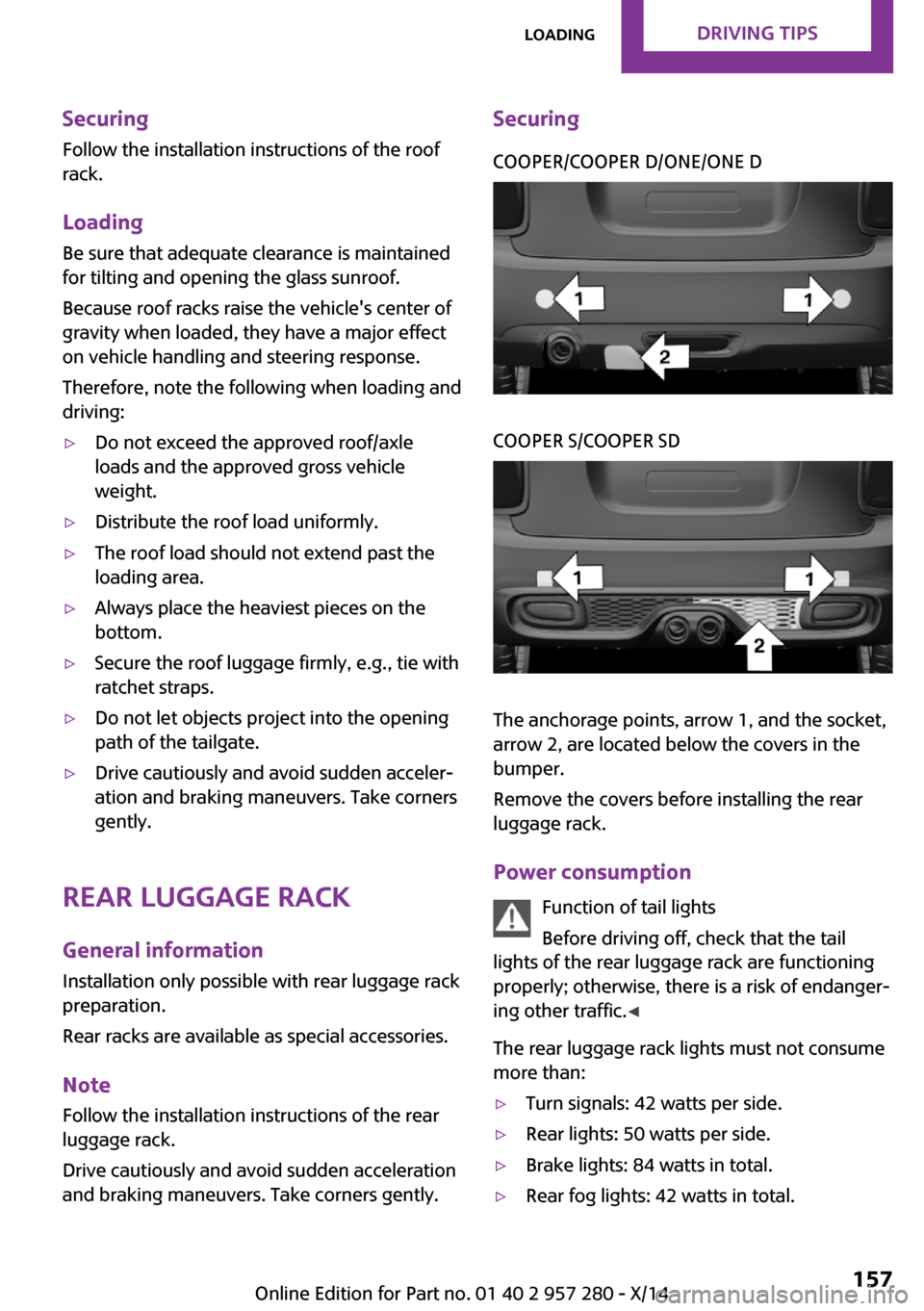
SecuringCOOPER/COOPER D/ONE/ONE DCOOPER S/COOPER SD
The anchorage points, arrow 1, and the socket,
arrow 2, are located below the covers in the
bumper.
Remove the covers before installing the rear
luggage rack.
Power consumption Function of tail lights
Before driving off, check that the tail
lights of the rear luggage rack are functioning
properly; otherwise, there is a risk of endanger‐
ing other traffic. ◀
The rear luggage rack lights must not consume
more than:
▷Turn signals: 42 watts per side.▷Rear lights: 50 watts per side.▷Brake lights: 84 watts in total.▷Rear fog lights: 42 watts in total.Seite 157LoadingDRIVING TIPS157
Online Edition for Part no. 01 40 2 957 280 - X/14
Page 203 of 240
LED parking lights/LED fog lightsFollow the general instructions on lights and
bulbs, refer to page 196.
The lights feature LED technology. Contact your
service center in the event of a malfunction.
Parking lights/fog lights/daytime
running lights
Follow the general instructions on lights and
bulbs, refer to page 196.
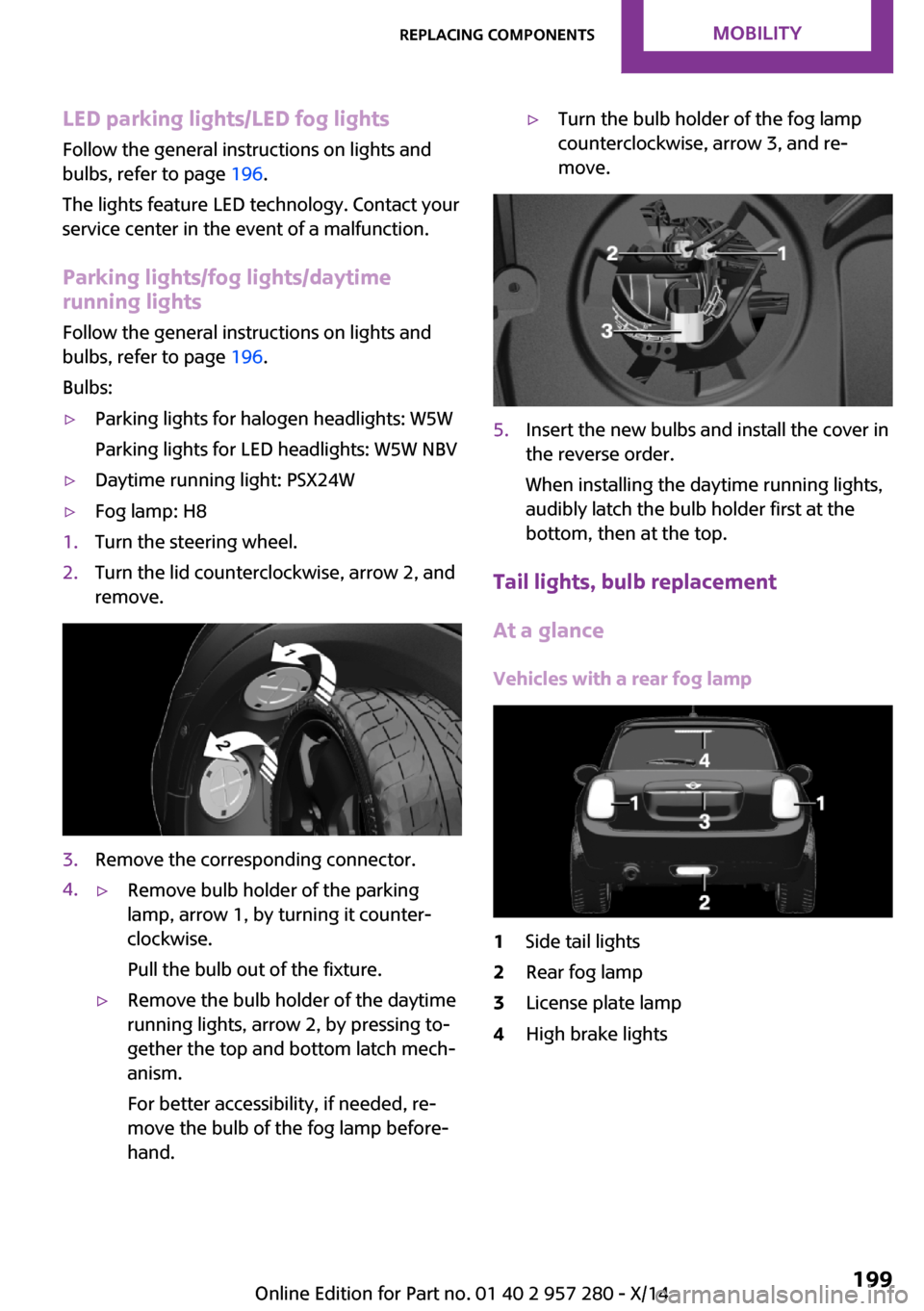
Bulbs:▷Parking lights for halogen headlights: W5W
Parking lights for LED headlights: W5W NBV▷Daytime running light: PSX24W▷Fog lamp: H81.Turn the steering wheel.2.Turn the lid counterclockwise, arrow 2, and
remove.3.Remove the corresponding connector.4.▷Remove bulb holder of the parking
lamp, arrow 1, by turning it counter‐
clockwise.
Pull the bulb out of the fixture.▷Remove the bulb holder of the daytime
running lights, arrow 2, by pressing to‐
gether the top and bottom latch mech‐
anism.
For better accessibility, if needed, re‐
move the bulb of the fog lamp before‐
hand.▷Turn the bulb holder of the fog lamp
counterclockwise, arrow 3, and re‐
move.5.Insert the new bulbs and install the cover in
the reverse order.
When installing the daytime running lights,
audibly latch the bulb holder first at the
bottom, then at the top.
Tail lights, bulb replacement
At a glance
Vehicles with a rear fog lamp
1Side tail lights2Rear fog lamp3License plate lamp4High brake lightsSeite 199Replacing componentsMOBILITY199
Online Edition for Part no. 01 40 2 957 280 - X/14
Page 204 of 240
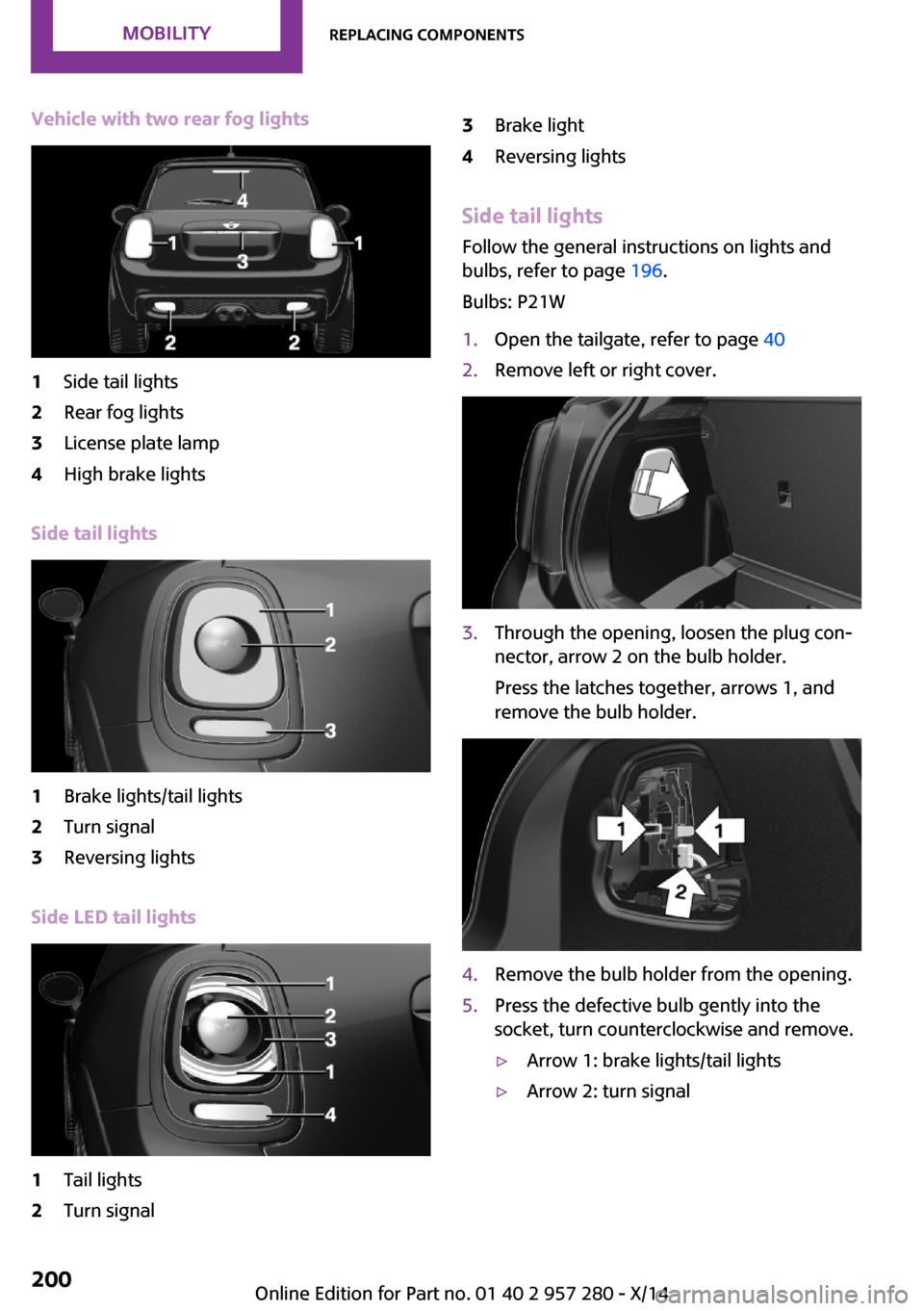
Vehicle with two rear fog lights1Side tail lights2Rear fog lights3License plate lamp4High brake lights
Side tail lights
1Brake lights/tail lights2Turn signal3Reversing lights
Side LED tail lights
1Tail lights2Turn signal3Brake light4Reversing lights
Side tail lights
Follow the general instructions on lights and
bulbs, refer to page 196.
Bulbs: P21W
1.Open the tailgate, refer to page 402.Remove left or right cover.3.Through the opening, loosen the plug con‐
nector, arrow 2 on the bulb holder.
Press the latches together, arrows 1, and
remove the bulb holder.4.Remove the bulb holder from the opening.5.Press the defective bulb gently into the
socket, turn counterclockwise and remove.▷Arrow 1: brake lights/tail lights▷Arrow 2: turn signalSeite 200MOBILITYReplacing components200
Online Edition for Part no. 01 40 2 957 280 - X/14
Page 205 of 240
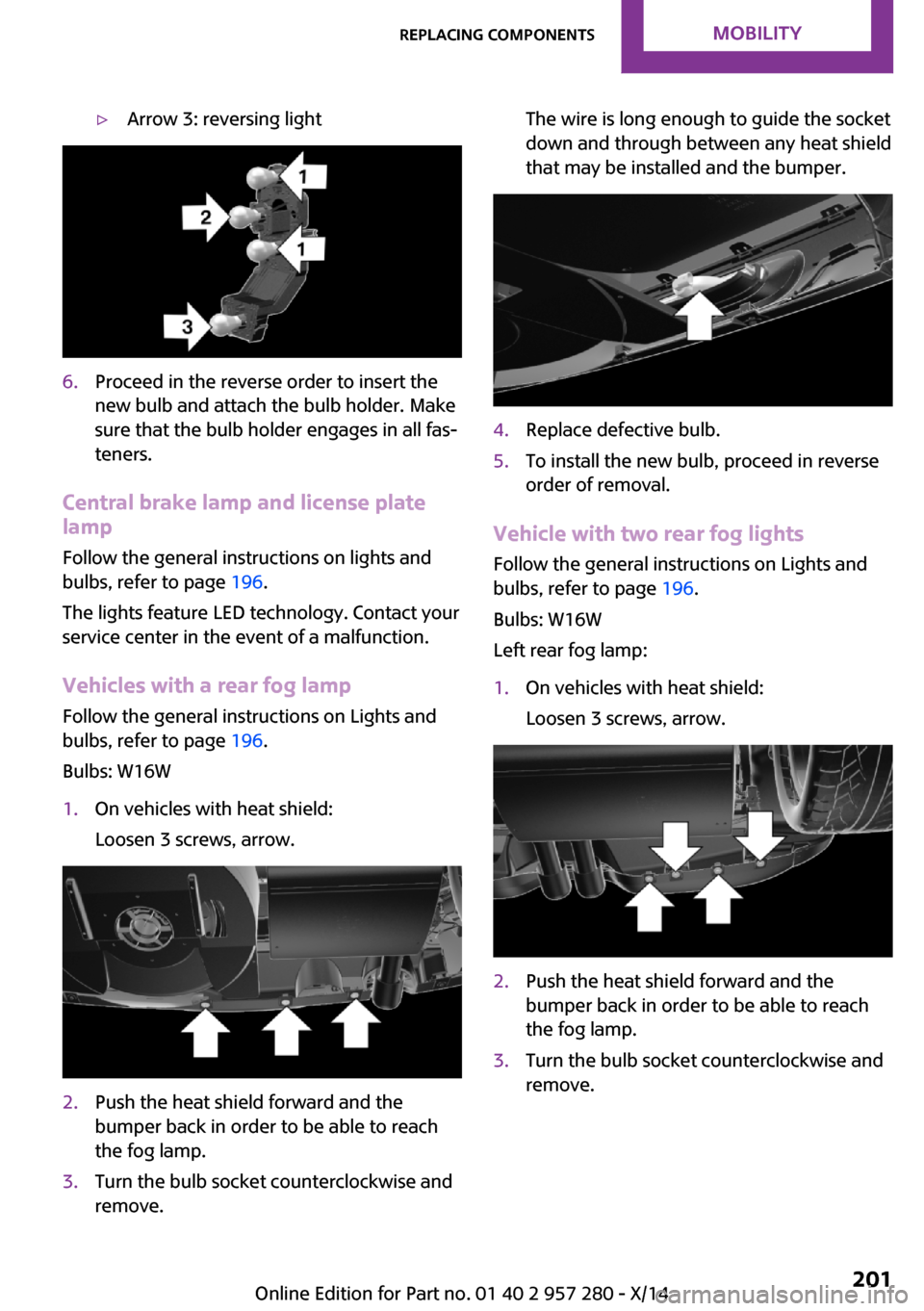
▷Arrow 3: reversing light6.Proceed in the reverse order to insert the
new bulb and attach the bulb holder. Make
sure that the bulb holder engages in all fas‐
teners.
Central brake lamp and license plate
lamp
Follow the general instructions on lights and
bulbs, refer to page 196.
The lights feature LED technology. Contact your
service center in the event of a malfunction.
Vehicles with a rear fog lamp Follow the general instructions on Lights and
bulbs, refer to page 196.
Bulbs: W16W
1.On vehicles with heat shield:
Loosen 3 screws, arrow.2.Push the heat shield forward and the
bumper back in order to be able to reach
the fog lamp.3.Turn the bulb socket counterclockwise and
remove.The wire is long enough to guide the socket
down and through between any heat shield
that may be installed and the bumper.4.Replace defective bulb.5.To install the new bulb, proceed in reverse
order of removal.
Vehicle with two rear fog lights
Follow the general instructions on Lights and
bulbs, refer to page 196.
Bulbs: W16W
Left rear fog lamp:
1.On vehicles with heat shield:
Loosen 3 screws, arrow.2.Push the heat shield forward and the
bumper back in order to be able to reach
the fog lamp.3.Turn the bulb socket counterclockwise and
remove.Seite 201Replacing componentsMOBILITY201
Online Edition for Part no. 01 40 2 957 280 - X/14
Page 213 of 240
3.Let both engines run for several minutes.4.Disconnect the jumper cables in the reverse
order.
Check the battery and recharge if needed.
Tow-starting and towing
Note Tow-starting and towing
For towing the vehicle turn, switch off the
Intelligent Safety systems; otherwise malfunc‐
tions of the individual braking systems might
lead to accidents. ◀
Switching off Intelligent Safety systems, refer to
page 102.
Steptronic transmission: transporting
your vehicle
Note Your vehicle must not be towed if the front
wheels are touching the ground. Therefore,
contact a service center in the event of a break‐
down.
Tow the vehicle only with the front axle
raised
Have the vehicle towed only with the front axle
raised or transported on a loading platform;
otherwise, damage may occur. ◀
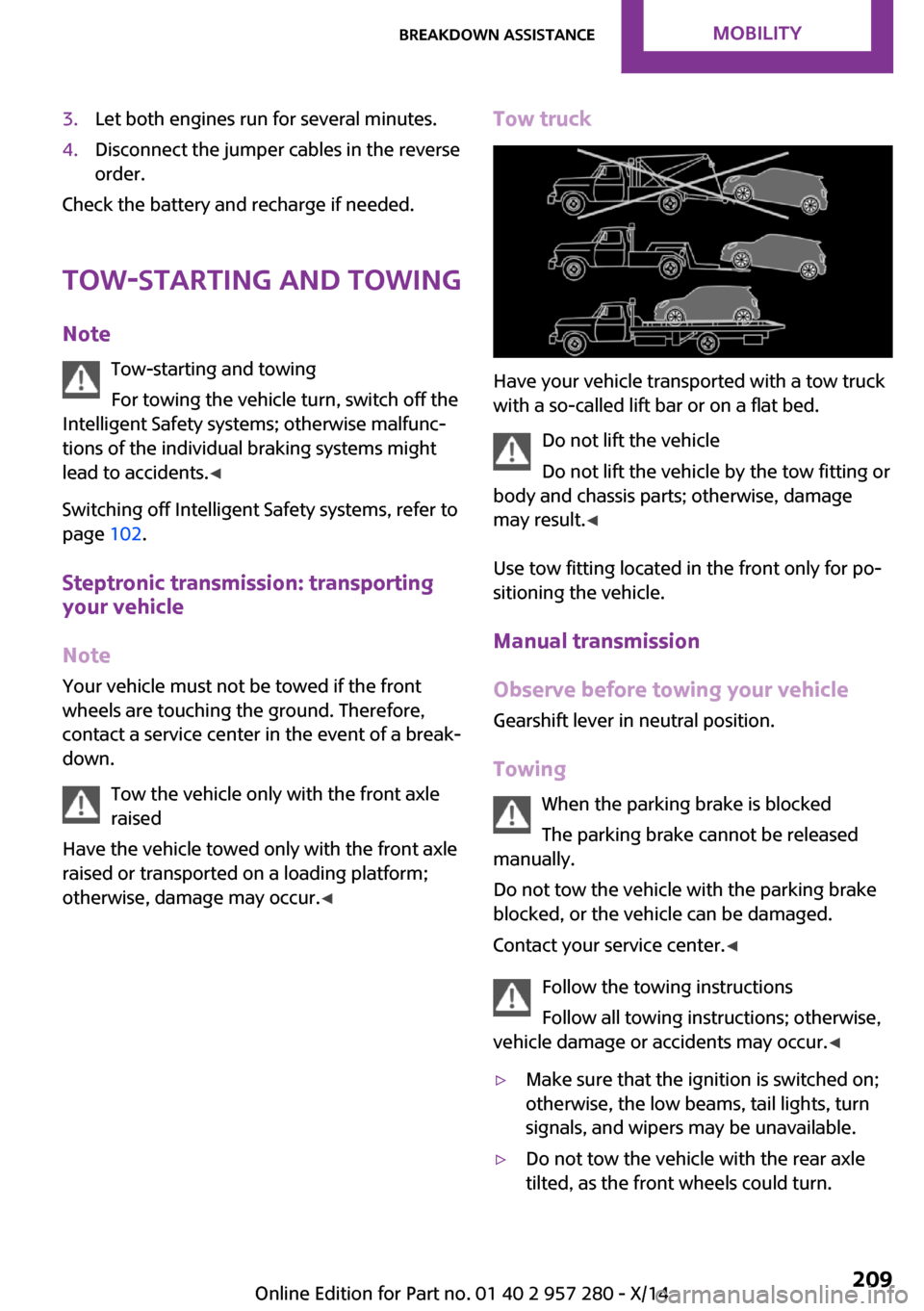
Tow truck
Have your vehicle transported with a tow truck
with a so-called lift bar or on a flat bed.
Do not lift the vehicle
Do not lift the vehicle by the tow fitting or
body and chassis parts; otherwise, damage
may result. ◀
Use tow fitting located in the front only for po‐
sitioning the vehicle.
Manual transmission
Observe before towing your vehicle
Gearshift lever in neutral position.
Towing When the parking brake is blocked
The parking brake cannot be released
manually.
Do not tow the vehicle with the parking brake
blocked, or the vehicle can be damaged.
Contact your service center. ◀
Follow the towing instructions
Follow all towing instructions; otherwise,
vehicle damage or accidents may occur. ◀
▷Make sure that the ignition is switched on;
otherwise, the low beams, tail lights, turn
signals, and wipers may be unavailable.▷Do not tow the vehicle with the rear axle
tilted, as the front wheels could turn.Seite 209Breakdown assistanceMOBILITY209
Online Edition for Part no. 01 40 2 957 280 - X/14
Page 217 of 240
Manual transmission:1.Drive into the car wash.2.Shift to neutral.3.Switch the engine off.4.Switch on the ignition.
Steptronic transmission:
1.Drive into the car wash.2.Engage selector lever position N.3.Press the Start/Stop button to reel off the
engine.
In this way, the ignition remains switched
on, and two Check-Control messages are
displayed.
A signal sounds when you leave the vehicle
while in selector lever position N.
The vehicle cannot be locked from the outside
when in selector lever position N. A signal is
sounded when an attempt is made to lock the
vehicle.
To start the engine:
1.Depress the brake pedal.2.Press the Start/Stop button.
Headlights
▷Do not rub dry and do not use abrasive or
acidic cleansers.▷Soak areas that have been dirtied e. g.,
from insects, with shampoo and wash off
with water.▷Thaw ice with de-icing spray; do not use an
ice scraper.
After washing the vehicle
After washing the vehicle, apply the brakes
briefly to dry them; otherwise, braking action
can be reduced and corrosion of the brake
discs can occur.
Completely remove all residues on the win‐
dows, to minimize loss of visibility due to
smearing and to reduce wiper noises and wiper
blade wear.
Vehicle care Car care products
MINI recommends using cleaning and care
products from MINI, since these have been
tested and approved.
Car care and cleaning products
Follow the instructions on the container.
When cleaning the interior, open the doors or
windows.
Only use products intended for cleaning vehi‐
cles.
Cleansers can contain substances that are dan‐
gerous and harmful to your health. ◀
Vehicle paint
Regular care contributes to driving safety and
value retention. Environmental influences in
areas with elevated air pollution or natural con‐
taminants, such as tree resin or pollen can af‐
fect the vehicle's paintwork. Tailor the fre‐
quency and extent of your car care to these
influences.
Aggressive substances such as spilled fuel, oil,
grease or bird droppings must be removed im‐
mediately to prevent the finish from being al‐
tered or discolored.
Leather careRemove dust from the leather often, using a
cloth or vacuum cleaner.
Otherwise, particles of dust and road grime
chafe in pores and folds, and lead to increased
wear and premature degradation of the leather
surface.
To guard against discoloration, such as from
clothing, provide leather care roughly every
two months.Seite 213CareMOBILITY213
Online Edition for Part no. 01 40 2 957 280 - X/14
Page 218 of 240

Clean light-colored leather more frequently be‐
cause soiling on such surfaces is substantially
more visible.
Use leather care products; otherwise, dirt and
grease will gradually break down the protective
layer of the leather surface.
Suitable care products are available from the
service center.
Upholstery material care
Vacuum regularly with a vacuum cleaner.
If upholstery is very dirty, e.g., with beverage
stains, use a soft sponge or microfiber cloth
with a suitable interior cleaner.
Clean the upholstery down to the seams using
large sweeping motions. Avoid rubbing the ma‐
terial vigorously.
Damage from Velcro® fasteners
Open Velcro® fasteners on pants or other
articles of clothing can damage the seat covers.
Ensure that any Velcro® fasteners are closed. ◀
Caring for special components Light-alloy wheels
When cleaning the vehicle, use only neutral
wheel cleaners having a pH value from 5 to 9.
Do not use abrasive cleaning agents or steam
jets above 140 ℉/60 ℃. Follow the manufac‐
turer's instructions.
Aggressive, acidic or alkaline cleaning agents
can destroy the protective layer of adjacent
components, such as the brake disk.
Chrome surfaces
Carefully clean components such as the radia‐
tor grille or door handles with an ample supply
of water, possibly with shampoo added, partic‐
ularly when they have been exposed to road
salt.Rubber components
Aside from water, treat only with rubber cleans‐
ers.
When cleaning rubber seals, do not use any sili‐
con-containing car care products in order to
avoid damage or noises.
Fine wood parts Clean fine wood facing and fine wood compo‐
nents only with a moist rag. Then dry with a
soft cloth.
Plastic components
These include:▷Imitation leather surfaces.▷Roofliner.▷Lamp lenses.▷Instrument cluster cover.▷Matt black spray-coated components.▷Painted parts in the interior.
Clean with a microfiber cloth.
Dampen cloth lightly with water.
Do not soak the roofliner.
No cleansers that contain alcohol or sol‐
vents
Do not use cleansers that contain alcohol or
solvents, such as lacquer thinners, heavy-duty
grease removers, fuel, or such; this could lead
to surface damage. ◀
Safety belts
Dirty belt straps impede the reeling action and
thus have a negative impact on safety.
Chemical cleaning
Do not clean chemically; this can destroy
the webbing. ◀
Use only a mild soapy solution, with the safety
belts clipped into their buckles.
Do not allow the reels to retract the safety belts
until they are dry.
Seite 214MOBILITYCare214
Online Edition for Part no. 01 40 2 957 280 - X/14
Page 230 of 240
Everything from A to ZIndexA
ABS, Antilock Brake Sys‐ tem 109
ACC, Active Cruise Control 113
Acceleration Assistant, refer to Launch Control 71
Activated-charcoal filter 135
Active Cruise Control, ACC 113
Additives, oil 189
Adjustments, seats/head re‐ straints 48
Adjustments, steering wheel 55
After washing vehicle 213
Airbags 93
Airbags, indicator/warning light 95
Air circulation, refer to Recir‐ culated-air mode 131, 134
Air conditioner 130
Air, dehumidifying, refer to Cooling function 131, 134
Air distribution, manual 131, 133
Air flow, air conditioner 131
Air flow, automatic climate control 133
Air pressure, tires 172
Air vents, refer to Ventila‐ tion 135
Alarm system 43
Alarm triggering 43
Alarm, unintentional 44
All around the center con‐ sole 16
All around the roofliner 17
All around the steering wheel 14
All-season tires, refer to Win‐ ter tires 180 Alternating-code hand-held
transmitter 138
Alternative oil types 190
Antifreeze, washer fluid 67
Antilock Brake System, ABS 109
Anti-slip control, refer to DSC 109
Approved axle load 219
Approved engine oils 190
Arrival time 82
Ash tray 141
Assistance, Roadside Assis‐ tance 207
Assistance when driving off 112
Assist system, refer to Intelli‐ gent Safety 102
AUTO intensity 133
Automatic car wash 212
Automatic climate con‐ trol 132
Automatic Curb Monitor 54
Automatic deactivation, front- seat passenger airbags 95
Automatic headlight con‐ trol 89
Automatic locking 42
Automatic recirculated-air control 134
Automatic transmission with Steptronic 68
AUTO program, automatic cli‐ mate control 133
AUTO program, intensity 133
Auto Start/Stop function 62
Average fuel consumption 81
Average speed 82
Axle loads, weights 219 B
Backrest curvature, refer to Lumbar support 49
Band-aids, refer to First aid kit 207
Bar for tow-starting/ towing 210
Battery replacement, vehicle battery 205
Battery, vehicle 205
Belts, safety belts 50
Beverage holder, cu‐ pholder 146
Bonus range, GREEN mode 162
Bottle holder, refer to Cu‐ pholder 146
Brake assistant 109
Brake discs, break-in 152
Brake pads, break-in 152
Braking, hints 153
Breakdown assistance 207
Break-in 152
Brightness of Control Dis‐ play 85
Bug light 197
Bulb replacement 196
Bulb replacement, front 197
Bulb replacement, rear 199
Bulb replacement, side 202
Bulbs and lights 196
Button, RES 115
Button, Start/Stop 60
Bypassing, refer to Jump- starting 207
C
California Proposition 65 Warning 7 Seite 226REFERENCEEverything from A to Z226
Online Edition for Part no. 01 40 2 957 280 - X/14
Page 231 of 240
Camera-based cruise control,ACC 113
Camera, care 215
Camera, rearview cam‐ era 123
Can holder, refer to Cu‐ pholder 146
Car battery 205
Car care products 213
Care, displays 215
Care, vehicle 213
Cargo 155
Cargo area 142
Cargo area, adapting size 147
Cargo area, enlarging 143
Cargo area lid 40
Cargo area, storage compart‐ ments 147
Cargo cover 142
Cargo, securing 156
Cargo straps, securing cargo 156
Car key, refer to Remote con‐ trol 34
Carpet, care 215
Car wash 212
Catalytic converter, refer to Hot exhaust system 153
CBS Condition Based Serv‐ ice 193
Center armrest 146
Center console 16
Central instrument cluster, LED ring 85
Central locking system 39
Central screen, refer to Control Display 18
Changes, technical, refer to Safety 7
Changing parts 195
Changing wheels 202
Changing wheels/tires 179
Chassis number, see vehicle identification number 9
Check Control 73 Checking the oil level elec‐
tronically 188
Children, seating position 56
Children, transporting safely 56
Child restraint fixing sys‐ tem 56
Child restraint fixing system LATCH 57
Child restraint fixing systems, mounting 56
Child safety locks 59
Child seat, mounting 56
Child seats 56
Chrome parts, care 214
Cigarette lighter 141
Cleaning, displays 215
Climate control 130, 132
Clock 77
Closing/opening via door lock 39
Closing/opening with remote control 37
Clothes hooks 147
Coasting 163
Coasting with engine decou‐ pled, coasting 163
Coasting with idling en‐ gine 163
Combination reel, refer to Turn signals 65
Combination reel, refer to Wiper system 65
Comfort Access 40
Compact wheel 203
Compartments in the doors 146
Compass 139
Compressor 181
Computer 81
Condensation on win‐ dows 134
Condensation under the vehi‐ cle 154
Condition Based Service CBS 193 Configuring driving pro‐
gram 112
Confirmation signal 42
Control Display 18
Control Display, settings 84
Controller 19
Control systems, driving stabil‐ ity 109
Convenient opening 37
Coolant 191
Cooling function 131, 134
Cooling, maximum 134
Cooling system 191
Cornering lamp 89
Corrosion on brake discs 154
Cosmetic mirror 141
Cruise control 119
Cruise control, active 113
Cruising range 77
Cupholder 146
Current fuel consumption 78
D
Damage, tires 179
Damping control, dy‐ namic 110
Data, technical 218
Date 77
Daytime running lights 89
Defrosting, refer to defrosting the windows 131
Defrosting, refer to Windows, defrosting 134
Defrosting the windows 131
Dehumidifying, air 131, 134
Deleting personal data 24
Deletion of personal data 24
Destination distance 82
Digital clock 77
Digital compass 139
Dimensions 218
Dimmable exterior mirrors 54
Dimmable interior rearview mirror 55 Seite 227Everything from A to ZREFERENCE227
Online Edition for Part no. 01 40 2 957 280 - X/14