change wheel MINI Clubman 2016 (Mini Connected) User Guide
[x] Cancel search | Manufacturer: MINI, Model Year: 2016, Model line: Clubman, Model: MINI Clubman 2016Pages: 246, PDF Size: 5.21 MB
Page 108 of 246
tire tread life, and may affect the vehicle's han‐
dling and stopping ability. Please note that the
TPMS is not a substitute for proper tire mainte‐
nance, and it is the driver's responsibility to
maintain correct tire pressure, even if under-in‐
flation has not reached the level to trigger illu‐
mination of the TPMS low tire pressure telltale.
Your vehicle has also been equipped with a
TPMS malfunction indicator to indicate when
the system is not operating properly. The TPMS
malfunction indicator is combined with the low
tire pressure telltale. When the system detects
a malfunction, the telltale will flash for approxi‐
mately one minute and then remain continu‐
ously illuminated. This sequence will continue
upon subsequent vehicle start-ups as long as
the malfunction exists. When the malfunction
indicator is illuminated, the system may not be
able to detect or signal low tire pressure as in‐
tended. TPMS malfunctions may occur for a va‐
riety of reasons, including the installation of re‐
placement or alternate tires or wheels on the
vehicle that prevent the TPMS from functioning
properly. Always check the TPMS malfunction
telltale after replacing one or more tires or
wheels on your vehicle to ensure that the re‐
placement or alternate tires and wheels allow
the TPMS to continue to function properly.
FTM Flat Tire Monitor
The concept
The system does not measure the actual infla‐
tion pressure in the tires.
It detects a tire inflation pressure loss by com‐
paring the rotational speeds of the individual
wheels while moving.
In the event of a tire inflation pressure loss, the
diameter and therefore the rotational speed of
the corresponding wheel changes. This will be
detected and reported as a flat tire.
Functional requirements
The system must have been initialized when
the tire inflation pressure was correct; other‐
wise, reliable flagging of a flat tire is not as‐
sured. Initialize the system after each correc‐
tion of the tire inflation pressure and after
every tire or wheel change.
Status display
The current status of the Flat Tire Monitor can
be displayed on the Control Display, e.g.,
whether or not the FTM is active.
On the Control Display:
1. "Vehicle info"2."Vehicle status"3. "Flat Tire Monitor (FTM)"
The status is displayed.
Initialization
When initializing the once set inflation tire pres‐
sures serve as reference values in order to de‐
tect a flat tire. Initialization is started by con‐
firming the inflation pressures.
Do not initialize the system when driving with
snow chains.
On the Control Display:
1. "Vehicle info"2."Vehicle status"3. "Perform reset"4.Start the engine - do not drive off.5.Start the initialization with "Perform reset".6.Drive away.
The initialization is completed while driving,
which can be interrupted at any time.
The initialization automatically continues when
driving resumes.
Indication of a flat tire
The yellow warning lamp lights up. A
Check Control message is displayed.
Seite 108CONTROLSSafety108
Online Edition for Part no. 01 40 2 964 571 - X/15
Page 121 of 246

Driving comfortVehicle features and op‐
tions
This chapter describes all standard, country-
specific and optional features offered with the
series. It also describes features that are not
necessarily available in your car, e. g., due to
the selected options or country versions. This
also applies to safety-related functions and sys‐
tems. The respectively applicable country provi‐
sions must be observed when using the respec‐
tive features and systems.
Camera-based cruise con‐
trol
The concept
Use this system to select a desired speed that
the vehicle will maintain automatically on clear
roads.
To the extent possible, the system automati‐
cally adjusts the speed to a slower vehicle
ahead of you.
A camera on the interior rear view mirror is
used to detect vehicles driving ahead.
The distance that the vehicle maintains to the
vehicle ahead of you can be varied.
For safety reasons, it depends on the speed.
To maintain a certain distance, the system au‐
tomatically decelerates, applies the brakes
lightly, or accelerates again if the vehicle ahead
begins moving faster.
As soon as the road is clear, the vehicle acceler‐
ates to the desired speed.
The speed is also maintained downhill, but may
not be maintained uphill if engine power is in‐
sufficient.
General information
The system is functional at speeds beginning at
approx. 20 mph/30 km/h.
Active cruise control is paused below approx.
20 mph/30 km/h.
The system does not brake to a stop.
Depending on the driving program, refer to
page 119, set, the characteristics of the cruise
control in particular areas can change.
Information
WARNING
The system does not relieve from the per‐
sonal responsibility to correctly assess the traf‐
fic situation. Based on the limits of the system,
it cannot independently react to all traffic situa‐
tions. There is risk of an accident. Adjust the
driving style to the traffic conditions. Watch
traffic closely and actively interfere in the re‐
spective situations.◀
WARNING
The system does not relieve from the per‐
sonal responsibility to correctly assess visibility
and traffic situation. There is risk of an accident.
Adjust the driving style to the traffic conditions.
Watch traffic closely and actively interfere in
the respective situations.◀
Overview
Buttons on the steering wheel
Press buttonFunctionCruise control on/off, refer to
page 122
Store/maintain speed, refer to
page 123
Seite 121Driving comfortCONTROLS121
Online Edition for Part no. 01 40 2 964 571 - X/15
Page 127 of 246

Malfunction
A Check Control message is displayed if the sys‐
tem fails or was automatically deactivated.
The system may not be fully functional in the
following situations:
▷When an object was not correctly detected.▷In heavy fog, rain, sprayed water or snow‐
fall.
▷In tight curves.▷If the field of view of the camera or the
front windshield are dirty or covered.
▷When driving toward bright lights.▷Up to 20 seconds after the start of the en‐
gine, via the Start/Stop button.
▷During calibration of the camera immedi‐
ately after vehicle delivery.
Cruise control
The concept
The system is functional at speeds beginning at
approx. 20 mph/30 km/h.
It maintains the speed that was set using the
control elements on the steering wheel.
The system brakes on downhill gradients if en‐
gine braking is insufficient.
Information
WARNING
The system does not relieve from the per‐
sonal responsibility to correctly assess the traf‐
fic situation. Based on the limits of the system,
it cannot independently react to all traffic situa‐
tions. There is risk of an accident. Adjust the
driving style to the traffic conditions. Watch
traffic closely and actively interfere in the re‐
spective situations.◀
WARNING
The use of the system can lead to an in‐
creased risk of accidents in the following situa‐
tions:
▷On winding roads.▷In heavy traffic.▷On slippery roads, in fog, snow or rain, or
on a loose road surface.
There is risk of accidents or risk of property
damage. Only use the system if driving at con‐
stant speed is possible.◀
General information
Depending on the driving program, refer to
page 119, set, the characteristics of the cruise
control in particular areas can change.
Overview
Buttons on the steering wheel
Press buttonFunctionCruise control on/offStore speedPausing cruise control
Continue cruise control with the
last setting
Increasing, maintaining or storing
the speed
Reducing, maintaining or storing
the speed
Controls
Switching on
Press button on the steering wheel.
Seite 127Driving comfortCONTROLS127
Online Edition for Part no. 01 40 2 964 571 - X/15
Page 136 of 246
▷When parking in parking spaces on the
driver's side, the corresponding turn signal
must be set.
Switching on and activating
Switching on with the button
Press button.
The LED lights up.
The current status of the parking space search
is indicated on the Control Display.
Parking assistant is activated automatically.
Switching on with reverse gear
Shift into reverse.
The current status of the parking space search
is indicated on the Control Display.
To activate: "Parking Assistant"
Indicator on the Control Display
System activated/deactivated
SymbolMeaning Gray: the system is not available.
White: the system is available but not
activated.
The system is activated.
Parking space search and system status
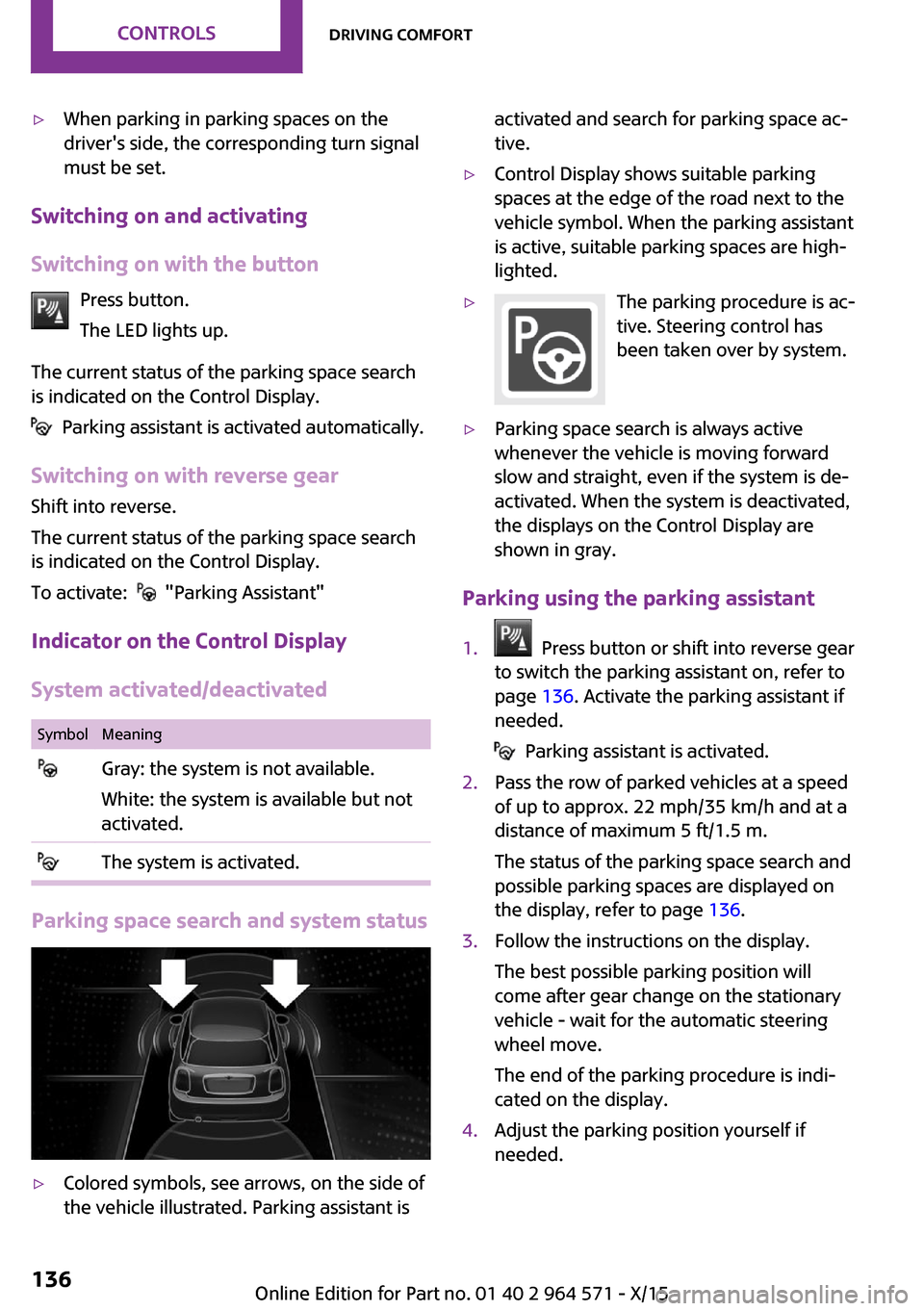
▷Colored symbols, see arrows, on the side of
the vehicle illustrated. Parking assistant is
activated and search for parking space ac‐
tive.
▷Control Display shows suitable parking
spaces at the edge of the road next to the
vehicle symbol. When the parking assistant
is active, suitable parking spaces are high‐
lighted.
▷The parking procedure is ac‐
tive. Steering control has
been taken over by system.
▷Parking space search is always active
whenever the vehicle is moving forward
slow and straight, even if the system is de‐
activated. When the system is deactivated,
the displays on the Control Display are
shown in gray.
Parking using the parking assistant
1. Press button or shift into reverse gear
to switch the parking assistant on, refer to
page 136. Activate the parking assistant if
needed.
Parking assistant is activated.
2.Pass the row of parked vehicles at a speed
of up to approx. 22 mph/35 km/h and at a
distance of maximum 5 ft/1.5 m.
The status of the parking space search and
possible parking spaces are displayed on
the display, refer to page 136.
3.Follow the instructions on the display.
The best possible parking position will
come after gear change on the stationary
vehicle - wait for the automatic steering
wheel move.
The end of the parking procedure is indi‐
cated on the display.
4.Adjust the parking position yourself if
needed.
Seite 136CONTROLSDriving comfort136
Online Edition for Part no. 01 40 2 964 571 - X/15
Page 212 of 246
Changing wheels/tires
Information
When using run-flat tires or tire sealants, a tire
does not need to be changed immediately in
the event of pressure loss due to a flat tire.
Which is why no spare tire is available.
The tools for changing wheels are available as
accessories from your dealer’s service center or
another qualified service center or repair shop.
Jacking points for the vehicle jack
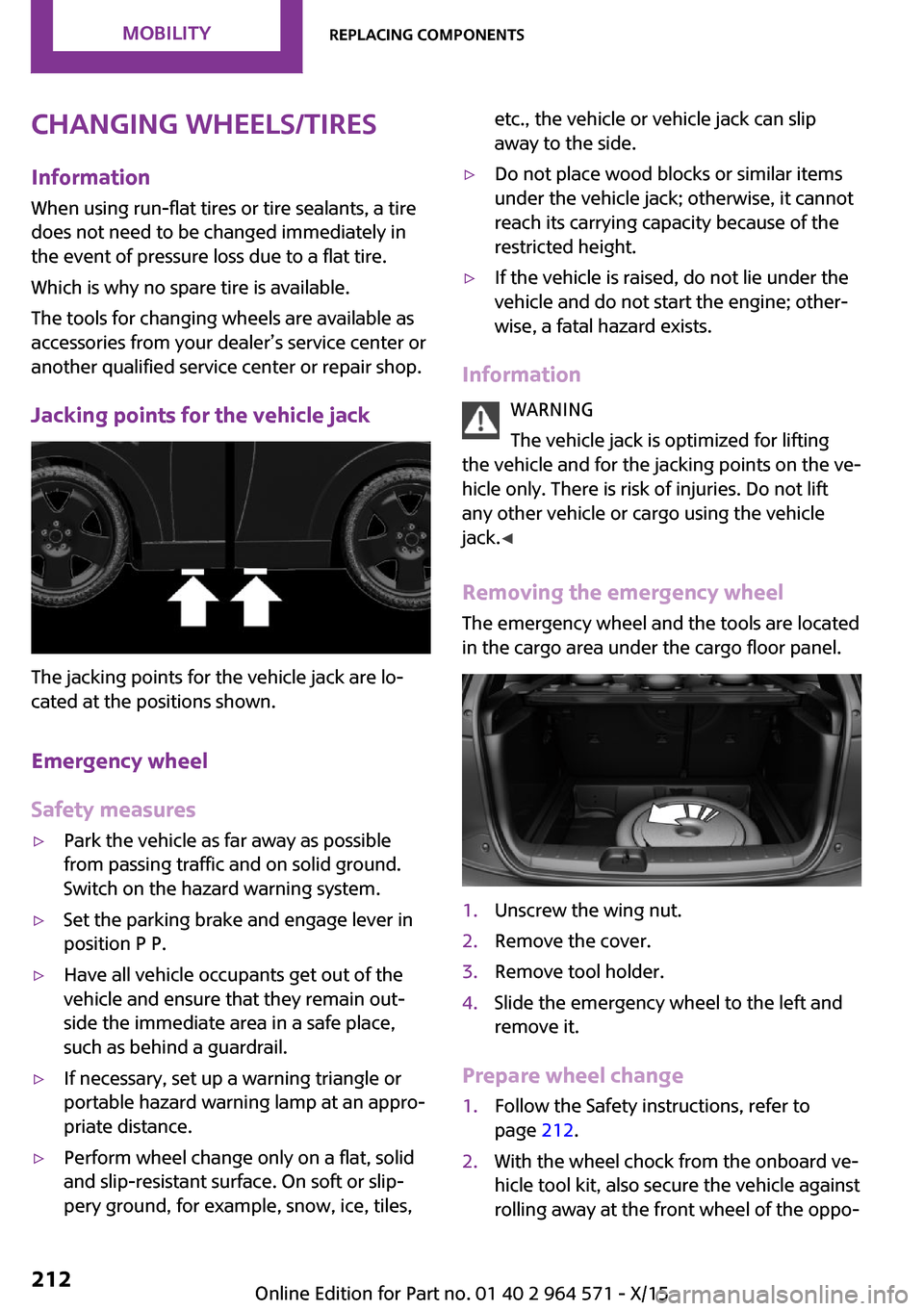
The jacking points for the vehicle jack are lo‐
cated at the positions shown.
Emergency wheel
Safety measures
▷Park the vehicle as far away as possible
from passing traffic and on solid ground.
Switch on the hazard warning system.
▷Set the parking brake and engage lever in
position P P.
▷Have all vehicle occupants get out of the
vehicle and ensure that they remain out‐
side the immediate area in a safe place,
such as behind a guardrail.
▷If necessary, set up a warning triangle or
portable hazard warning lamp at an appro‐
priate distance.
▷Perform wheel change only on a flat, solid
and slip-resistant surface. On soft or slip‐
pery ground, for example, snow, ice, tiles,
etc., the vehicle or vehicle jack can slip
away to the side.
▷Do not place wood blocks or similar items
under the vehicle jack; otherwise, it cannot
reach its carrying capacity because of the
restricted height.
▷If the vehicle is raised, do not lie under the
vehicle and do not start the engine; other‐
wise, a fatal hazard exists.
Information
WARNING
The vehicle jack is optimized for lifting
the vehicle and for the jacking points on the ve‐
hicle only. There is risk of injuries. Do not lift
any other vehicle or cargo using the vehicle
jack.◀
Removing the emergency wheel
The emergency wheel and the tools are located
in the cargo area under the cargo floor panel.
1.Unscrew the wing nut.2.Remove the cover.3.Remove tool holder.4.Slide the emergency wheel to the left and
remove it.
Prepare wheel change
1.Follow the Safety instructions, refer to
page 212.
2.With the wheel chock from the onboard ve‐
hicle tool kit, also secure the vehicle against
rolling away at the front wheel of the oppo‐
Seite 212MOBILITYReplacing components212
Online Edition for Part no. 01 40 2 964 571 - X/15
Page 213 of 246
site side. For this, place the wheel chock
behind the front wheel diagonally across.
3.Loosen the wheel lug bolts a half turn.
Jacking up the vehicle
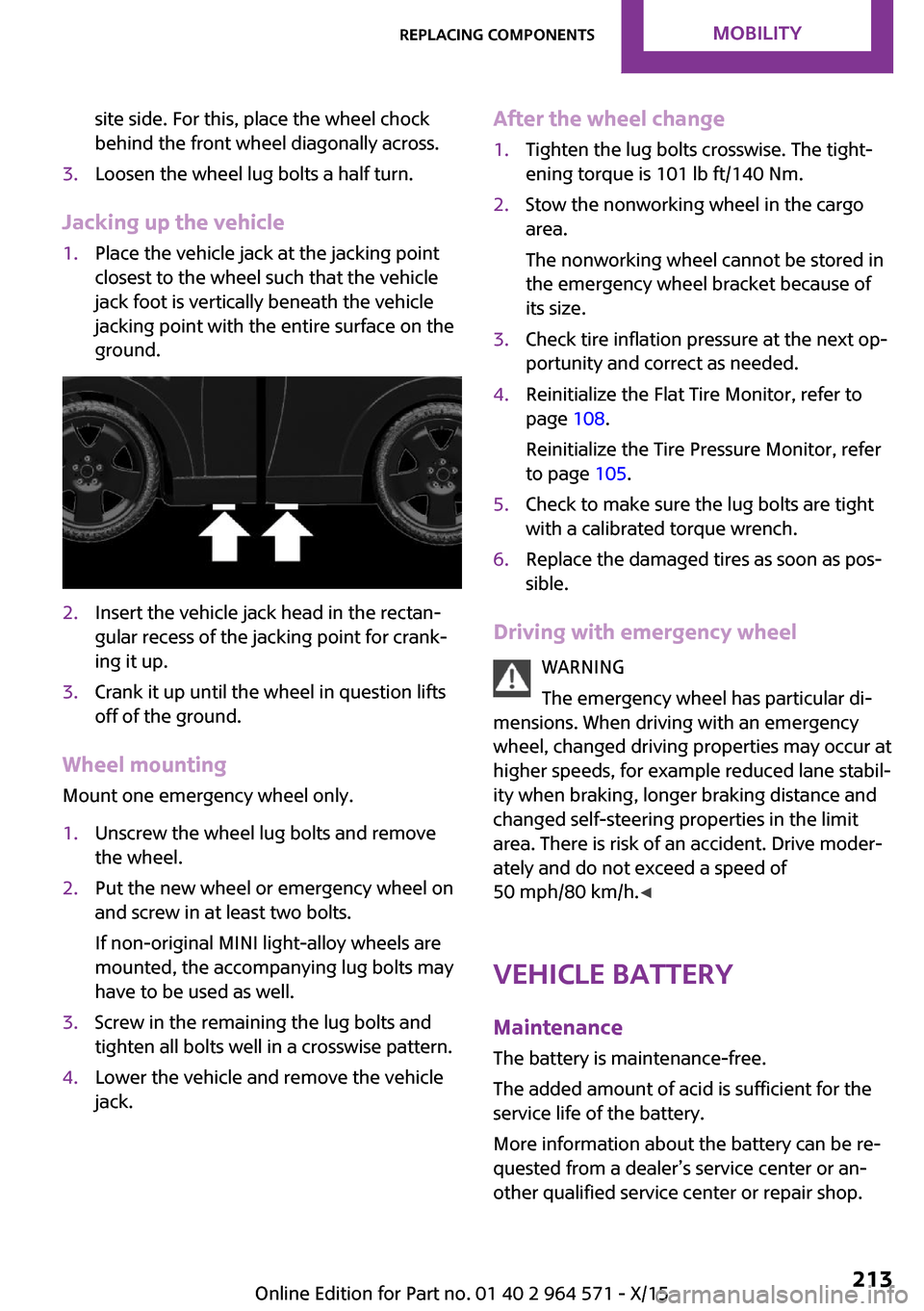
1.Place the vehicle jack at the jacking point
closest to the wheel such that the vehicle
jack foot is vertically beneath the vehicle
jacking point with the entire surface on the
ground.
2.Insert the vehicle jack head in the rectan‐
gular recess of the jacking point for crank‐
ing it up.
3.Crank it up until the wheel in question lifts
off of the ground.
Wheel mounting
Mount one emergency wheel only.
1.Unscrew the wheel lug bolts and remove
the wheel.
2.Put the new wheel or emergency wheel on
and screw in at least two bolts.
If non-original MINI light-alloy wheels are
mounted, the accompanying lug bolts may
have to be used as well.
3.Screw in the remaining the lug bolts and
tighten all bolts well in a crosswise pattern.
4.Lower the vehicle and remove the vehicle
jack.
After the wheel change1.Tighten the lug bolts crosswise. The tight‐
ening torque is 101 lb ft/140 Nm.
2.Stow the nonworking wheel in the cargo
area.
The nonworking wheel cannot be stored in
the emergency wheel bracket because of
its size.
3.Check tire inflation pressure at the next op‐
portunity and correct as needed.
4.Reinitialize the Flat Tire Monitor, refer to
page 108.
Reinitialize the Tire Pressure Monitor, refer
to page 105.
5.Check to make sure the lug bolts are tight
with a calibrated torque wrench.
6.Replace the damaged tires as soon as pos‐
sible.
Driving with emergency wheel
WARNING
The emergency wheel has particular di‐
mensions. When driving with an emergency
wheel, changed driving properties may occur at
higher speeds, for example reduced lane stabil‐
ity when braking, longer braking distance and
changed self-steering properties in the limit
area. There is risk of an accident. Drive moder‐
ately and do not exceed a speed of
50 mph/80 km/h.◀
Vehicle battery
Maintenance
The battery is maintenance-free.
The added amount of acid is sufficient for the
service life of the battery.
More information about the battery can be re‐
quested from a dealer’s service center or an‐
other qualified service center or repair shop.
Seite 213Replacing componentsMOBILITY213
Online Edition for Part no. 01 40 2 964 571 - X/15
Page 237 of 246

Camera-based cruise con‐
trol 121
Camera lenses, care 224
Camera, rearview cam‐
era 132
Can holder, see Cu‐
pholder 156
Car battery 213
Car care products 222
Care, displays 224
Care, vehicle 222
Cargo area 152
Cargo area, adapting size 157
Cargo area door, see split
doors 40
Cargo area, enlarging 153
Cargo area, storage compart‐
ments 157
Cargo cover 152
Cargo, securing 166
Cargo straps, securing
cargo 166
Car key, see Remote con‐
trol 34
Carpet, care 224
Car wash 221
Catalytic converter, see Hot
exhaust system 163
CBS Condition Based Serv‐
ice 201
Center armrest 156
Center console 16
Central instrument cluster,
LED ring 92
Central locking system 40
Central screen, refer to Control
Display 18
Changes, technical, refer to
Own Safety 7
Changing parts 203
Changing wheels 212
Changing wheels/tires 187
Chassis number, see vehicle
identification number 10
Check Control 80
Checking the oil level elec‐
tronically 195
Children, seating position 60
Children, transporting
safely 60
Child restraint fixing sys‐
tem 60
Child restraint fixing system
LATCH 62
Child restraint fixing systems,
mounting 61
Child safety locks 63
Child seat, mounting 61
Child seats 60
Chrome parts, care 223
Cigarette lighter 150
Cleaning, displays 224
Climate control 139, 141
Clock 84
Closing/opening via door
lock 39
Closing/opening with remote
control 37
Clothes hooks 157
Coasting 172
Coasting with engine decou‐
pled, coasting 172
Coasting with idling en‐
gine 172
Combination switch, see Turn
signals 70
Combi switch, see wiper sys‐
tem 71
Comfort Access 41
Compartments in the
doors 156
Compass 148
Compressor 189
Condensation on win‐
dows 143
Condensation under the vehi‐
cle 164
Condition Based Service
CBS 201
Configuring driving pro‐
gram 120
Confirmation signal 44
Control Display 18
Control Display, settings 91
Controller 19
Control systems, driving stabil‐
ity 117
Convenient opening 38
Coolant 199
Cooling function 140, 142
Cooling, maximum 142
Cooling system 199
Cornering lamp 98
Corrosion on brake discs 164
Cosmetic mirror 150
Courtesy lamps during unlock‐
ing 37
Courtesy lamps with the vehi‐
cle locked 38
Cruise control 127
Cruise control, active 121
Cruising range 85
Cupholder 156
Current fuel consumption 85
D
Damage, tires 186
Damping control, dy‐
namic 119
Data, technical 228
Date 84
Daytime running lights 98
Defrosting, see defrosting the
windows 141
Defrosting, see Windows, de‐
frosting 143
Defrosting the windows 141
Dehumidifying, air 140, 142
Deleting personal data 24
Deletion of personal data 24
Destination distance 89
Digital clock 84
Digital compass 148
Dimensions 228
Dimmable exterior mirrors 58
Dimmable interior mirror 59
Seite 237Everything from A to ZREFERENCE237
Online Edition for Part no. 01 40 2 964 571 - X/15
Page 238 of 246
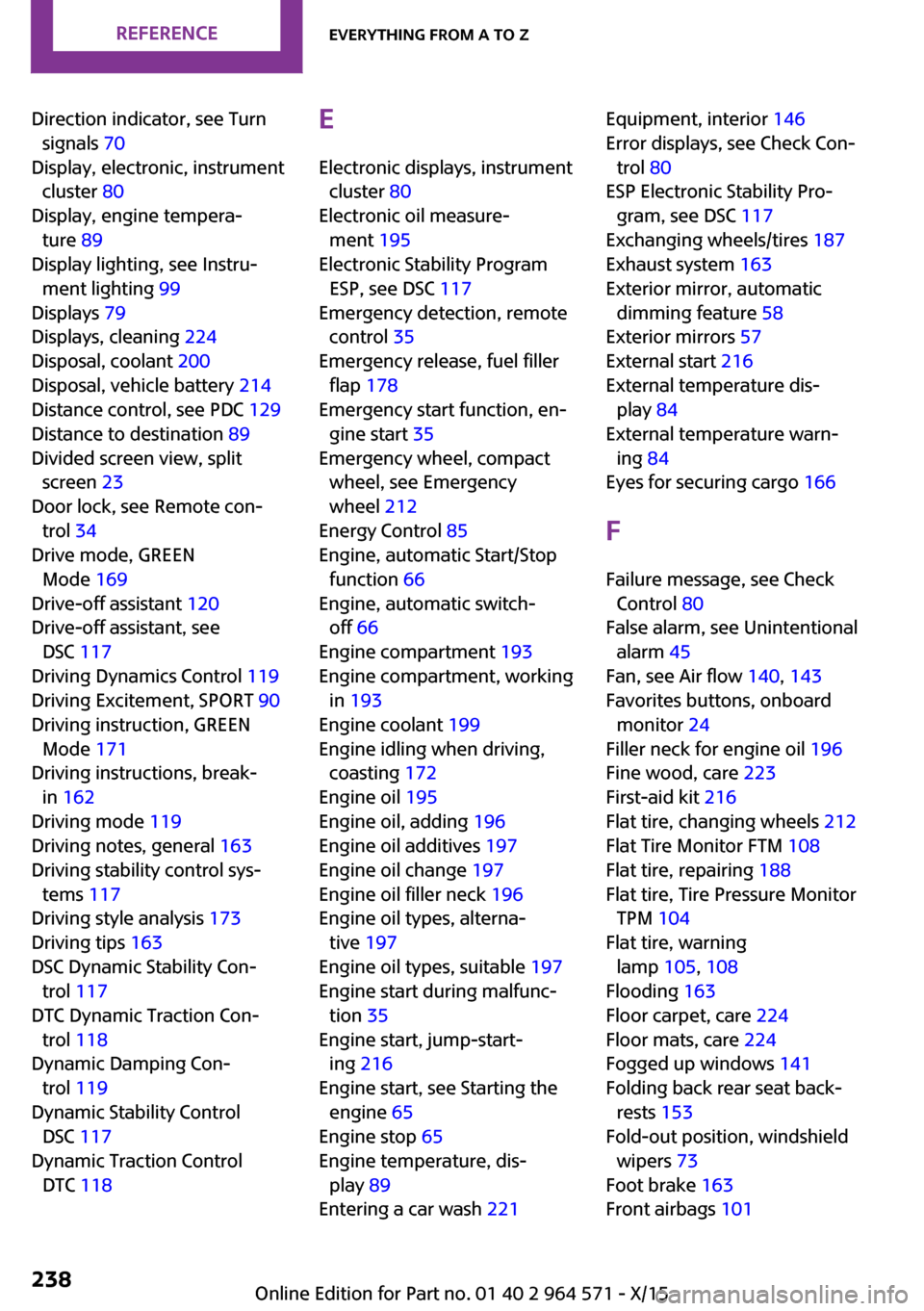
Direction indicator, see Turn
signals 70
Display, electronic, instrument
cluster 80
Display, engine tempera‐
ture 89
Display lighting, see Instru‐
ment lighting 99
Displays 79
Displays, cleaning 224
Disposal, coolant 200
Disposal, vehicle battery 214
Distance control, see PDC 129
Distance to destination 89
Divided screen view, split
screen 23
Door lock, see Remote con‐
trol 34
Drive mode, GREEN
Mode 169
Drive-off assistant 120
Drive-off assistant, see
DSC 117
Driving Dynamics Control 119
Driving Excitement, SPORT 90
Driving instruction, GREEN
Mode 171
Driving instructions, break-
in 162
Driving mode 119
Driving notes, general 163
Driving stability control sys‐
tems 117
Driving style analysis 173
Driving tips 163
DSC Dynamic Stability Con‐
trol 117
DTC Dynamic Traction Con‐
trol 118
Dynamic Damping Con‐
trol 119
Dynamic Stability Control
DSC 117
Dynamic Traction Control
DTC 118
E
Electronic displays, instrument
cluster 80
Electronic oil measure‐
ment 195
Electronic Stability Program
ESP, see DSC 117
Emergency detection, remote
control 35
Emergency release, fuel filler
flap 178
Emergency start function, en‐
gine start 35
Emergency wheel, compact
wheel, see Emergency
wheel 212
Energy Control 85
Engine, automatic Start/Stop
function 66
Engine, automatic switch-
off 66
Engine compartment 193
Engine compartment, working
in 193
Engine coolant 199
Engine idling when driving,
coasting 172
Engine oil 195
Engine oil, adding 196
Engine oil additives 197
Engine oil change 197
Engine oil filler neck 196
Engine oil types, alterna‐
tive 197
Engine oil types, suitable 197
Engine start during malfunc‐
tion 35
Engine start, jump-start‐
ing 216
Engine start, see Starting the
engine 65
Engine stop 65
Engine temperature, dis‐
play 89
Entering a car wash 221
Equipment, interior 146
Error displays, see Check Con‐
trol 80
ESP Electronic Stability Pro‐
gram, see DSC 117
Exchanging wheels/tires 187
Exhaust system 163
Exterior mirror, automatic
dimming feature 58
Exterior mirrors 57
External start 216
External temperature dis‐
play 84
External temperature warn‐
ing 84
Eyes for securing cargo 166
F
Failure message, see Check
Control 80
False alarm, see Unintentional
alarm 45
Fan, see Air flow 140, 143
Favorites buttons, onboard
monitor 24
Filler neck for engine oil 196
Fine wood, care 223
First-aid kit 216
Flat tire, changing wheels 212
Flat Tire Monitor FTM 108
Flat tire, repairing 188
Flat tire, Tire Pressure Monitor
TPM 104
Flat tire, warning
lamp 105, 108
Flooding 163
Floor carpet, care 224
Floor mats, care 224
Fogged up windows 141
Folding back rear seat back‐
rests 153
Fold-out position, windshield
wipers 73
Foot brake 163
Front airbags 101
Seite 238REFERENCEEverything from A to Z238
Online Edition for Part no. 01 40 2 964 571 - X/15
Page 241 of 246
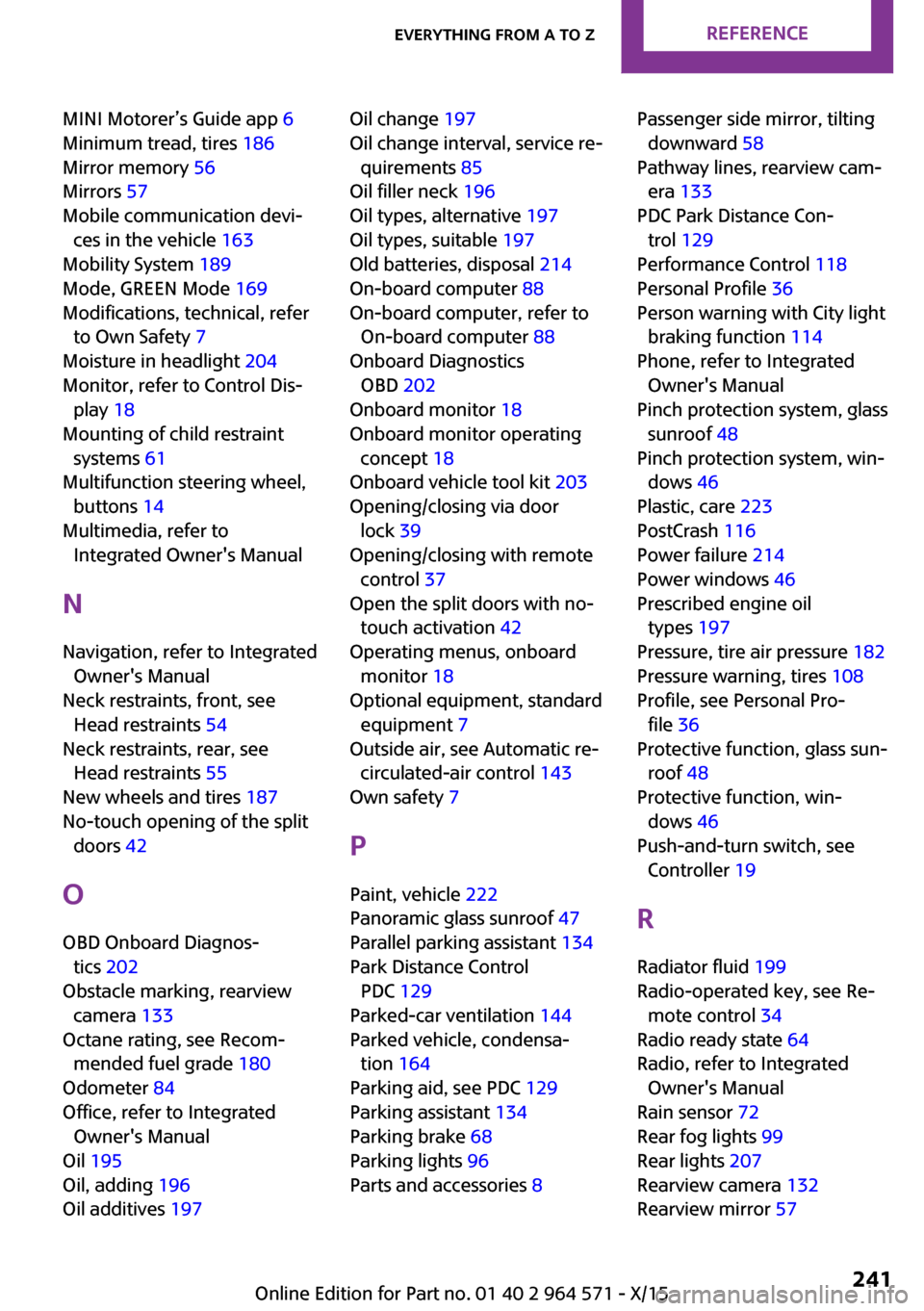
MINI Motorer’s Guide app 6
Minimum tread, tires 186
Mirror memory 56
Mirrors 57
Mobile communication devi‐
ces in the vehicle 163
Mobility System 189
Mode, GREEN Mode 169
Modifications, technical, refer
to Own Safety 7
Moisture in headlight 204
Monitor, refer to Control Dis‐
play 18
Mounting of child restraint
systems 61
Multifunction steering wheel,
buttons 14
Multimedia, refer to
Integrated Owner's Manual
N
Navigation, refer to Integrated
Owner's Manual
Neck restraints, front, see
Head restraints 54
Neck restraints, rear, see
Head restraints 55
New wheels and tires 187
No-touch opening of the split
doors 42
O
OBD Onboard Diagnos‐
tics 202
Obstacle marking, rearview
camera 133
Octane rating, see Recom‐
mended fuel grade 180
Odometer 84
Office, refer to Integrated
Owner's Manual
Oil 195
Oil, adding 196
Oil additives 197
Oil change 197
Oil change interval, service re‐
quirements 85
Oil filler neck 196
Oil types, alternative 197
Oil types, suitable 197
Old batteries, disposal 214
On-board computer 88
On-board computer, refer to
On-board computer 88
Onboard Diagnostics
OBD 202
Onboard monitor 18
Onboard monitor operating
concept 18
Onboard vehicle tool kit 203
Opening/closing via door
lock 39
Opening/closing with remote
control 37
Open the split doors with no-
touch activation 42
Operating menus, onboard
monitor 18
Optional equipment, standard
equipment 7
Outside air, see Automatic re‐
circulated-air control 143
Own safety 7
P
Paint, vehicle 222
Panoramic glass sunroof 47
Parallel parking assistant 134
Park Distance Control
PDC 129
Parked-car ventilation 144
Parked vehicle, condensa‐
tion 164
Parking aid, see PDC 129
Parking assistant 134
Parking brake 68
Parking lights 96
Parts and accessories 8
Passenger side mirror, tilting
downward 58
Pathway lines, rearview cam‐
era 133
PDC Park Distance Con‐
trol 129
Performance Control 118
Personal Profile 36
Person warning with City light
braking function 114
Phone, refer to Integrated
Owner's Manual
Pinch protection system, glass
sunroof 48
Pinch protection system, win‐
dows 46
Plastic, care 223
PostCrash 116
Power failure 214
Power windows 46
Prescribed engine oil
types 197
Pressure, tire air pressure 182
Pressure warning, tires 108
Profile, see Personal Pro‐
file 36
Protective function, glass sun‐
roof 48
Protective function, win‐
dows 46
Push-and-turn switch, see
Controller 19
R
Radiator fluid 199
Radio-operated key, see Re‐
mote control 34
Radio ready state 64
Radio, refer to Integrated
Owner's Manual
Rain sensor 72
Rear fog lights 99
Rear lights 207
Rearview camera 132
Rearview mirror 57
Seite 241Everything from A to ZREFERENCE241
Online Edition for Part no. 01 40 2 964 571 - X/15
Page 243 of 246
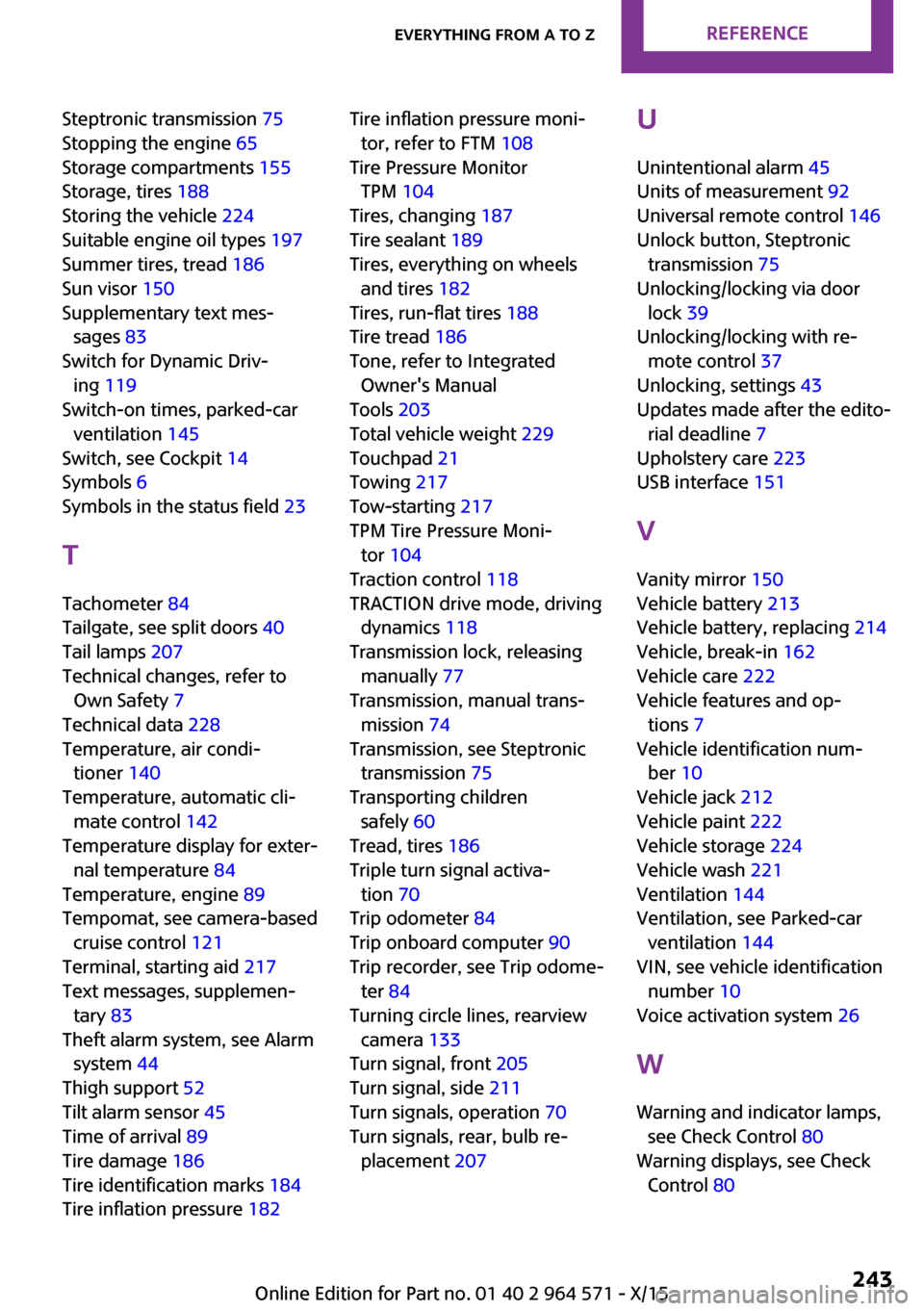
Steptronic transmission 75
Stopping the engine 65
Storage compartments 155
Storage, tires 188
Storing the vehicle 224
Suitable engine oil types 197
Summer tires, tread 186
Sun visor 150
Supplementary text mes‐
sages 83
Switch for Dynamic Driv‐
ing 119
Switch-on times, parked-car
ventilation 145
Switch, see Cockpit 14
Symbols 6
Symbols in the status field 23
T
Tachometer 84
Tailgate, see split doors 40
Tail lamps 207
Technical changes, refer to
Own Safety 7
Technical data 228
Temperature, air condi‐
tioner 140
Temperature, automatic cli‐
mate control 142
Temperature display for exter‐
nal temperature 84
Temperature, engine 89
Tempomat, see camera-based
cruise control 121
Terminal, starting aid 217
Text messages, supplemen‐
tary 83
Theft alarm system, see Alarm
system 44
Thigh support 52
Tilt alarm sensor 45
Time of arrival 89
Tire damage 186
Tire identification marks 184
Tire inflation pressure 182
Tire inflation pressure moni‐
tor, refer to FTM 108
Tire Pressure Monitor
TPM 104
Tires, changing 187
Tire sealant 189
Tires, everything on wheels
and tires 182
Tires, run-flat tires 188
Tire tread 186
Tone, refer to Integrated
Owner's Manual
Tools 203
Total vehicle weight 229
Touchpad 21
Towing 217
Tow-starting 217
TPM Tire Pressure Moni‐
tor 104
Traction control 118
TRACTION drive mode, driving
dynamics 118
Transmission lock, releasing
manually 77
Transmission, manual trans‐
mission 74
Transmission, see Steptronic
transmission 75
Transporting children
safely 60
Tread, tires 186
Triple turn signal activa‐
tion 70
Trip odometer 84
Trip onboard computer 90
Trip recorder, see Trip odome‐
ter 84
Turning circle lines, rearview
camera 133
Turn signal, front 205
Turn signal, side 211
Turn signals, operation 70
Turn signals, rear, bulb re‐
placement 207
U
Unintentional alarm 45
Units of measurement 92
Universal remote control 146
Unlock button, Steptronic
transmission 75
Unlocking/locking via door
lock 39
Unlocking/locking with re‐
mote control 37
Unlocking, settings 43
Updates made after the edito‐
rial deadline 7
Upholstery care 223
USB interface 151
V
Vanity mirror 150
Vehicle battery 213
Vehicle battery, replacing 214
Vehicle, break-in 162
Vehicle care 222
Vehicle features and op‐
tions 7
Vehicle identification num‐
ber 10
Vehicle jack 212
Vehicle paint 222
Vehicle storage 224
Vehicle wash 221
Ventilation 144
Ventilation, see Parked-car
ventilation 144
VIN, see vehicle identification
number 10
Voice activation system 26
W
Warning and indicator lamps,
see Check Control 80
Warning displays, see Check
Control 80
Seite 243Everything from A to ZREFERENCE243
Online Edition for Part no. 01 40 2 964 571 - X/15