brake MINI COOPER 2003 User Guide
[x] Cancel search | Manufacturer: MINI, Model Year: 2003, Model line: COOPER, Model: MINI COOPER 2003Pages: 148, PDF Size: 3.17 MB
Page 59 of 148

57
OVERVIEW REPAIRS OPERATIONCONTROLS DATA INDEX
CRUISE CONTROL
*
To cancel the cruise control
When the system is activated, press
button 2.
The indicator lamp stays lit.
You can use the cruise control again as
required.
In addition, cruise control is canceled auto-
matically
>when the brakes are applied
>when you apply pressure to the clutch
pedal, or when you move the CVT selec-
tor lever from D to P, N or R
>or if the cruise speed is either exceeded
or not met for an extended length of
time, for example if you press the accel-
erator pedal and exceed the stored
speed.
To continue cruise controlPress button 1.
The vehicle accelerates to and maintains
the last speed stored. If you turn the igni-
tion key to position 0, the stored speed is
deleted and the system is deactivated.To deactivate the systemPress button 2 repeatedly until the indica-
tor lamp goes out.
The stored speed is cleared.
ba.book Seite 57 Montag, 5. August 2002 8:09 20
ProCarManuals.com
Page 64 of 148

62
AUTOMATIC STABILITY CONTROL PLUS TRACTION (ASC+T)
*
The concept
This system optimizes vehicle stability and
traction, especially when just starting off,
when accelerating or when cornering.
ASC+T recognizes the danger present in
traction loss and will increase driving sta-
bility and traction by reducing the engine's
output and, if necessary, by applying the
brakes to the front wheels. ASC+T is opera-
tional each time you start the engine.
The laws of physics cannot be
repealed, even with ASC+T. An appro-
priate driving style always remains the
responsibility of the driver. Avoid using the
additional safety margin provided by the
system as an excuse for taking unnecessary
risks.
Do not make any modifications to the
ASC+T system. Allow only authorized tech-
nicians to perform service procedures on
the ASC+T.<
Indicator lamp
The indicator lamp on the instru-
ment cluster will go out shortly
after the ignition has been
switched on, see pages 16, 17.
If the indicator lamp flashes:
ASC+T controls the drive and braking
forces.
If the indicator lamp fails to go out
after the engine is started, or if it
comes on during normal driving and stays
on:
The system is defective or was turned off
using the button.
The described stabilizing operations are no
longer available.
You can, however, drive the vehicle nor-
mally without ASC+T.
In the event of a malfunction, please see
your MINI Dealer, see pages 16, 17.<
Switch off the ASC+TBriefly press the switch.
The indicator lamp stays lit.
When driving with snow chains or to "rock
free" in snow, it can be helpful to switch off
the ASC+T for a brief period.
To maintain vehicle stability, always
drive with the ASC+T switched on
whenever possible.
ba.book Seite 62 Montag, 5. August 2002 8:09 20
ProCarManuals.com
Page 65 of 148

63
OVERVIEW REPAIRS OPERATIONCONTROLS DATA INDEX
DYNAMIC STABILITY CONTROL (DSC)
*
The concept
This system maintains driving stability
even in critical driving situations.
The system optimizes vehicle stability dur-
ing acceleration and when starting from a
full stop, as well as optimizing traction. In
addition, it recognizes unstable vehicle
conditions, such as understeering or over-
steering, and, as far as is possible within
the laws of physics, helps keep the vehicle
on a steady course by reducing the rpms
and by brake applications to the individual
wheels.
The DSC is operational every time you start
the engine. DSC contains the functions
Antilock Brake System (ABS), Electronic
Brake Force Distribution (EBD), and ASC+T.
The laws of physics cannot be
repealed, even with DSC. An appro-
priate driving style always remains the
responsibility of the driver. We therefore
urge you to avoid using the additional
safety margin of the system as an excuse
for taking risks.
Do not make any modifications to the DSC
system. Allow only authorized technicians
to perform service procedures on the
DSC.<
Indicator lamp
The indicator lamp on the instru-
ment cluster will go out shortly
after the ignition has been
switched on, see pages 16, 17.
If the indicator lamp flashes:
DSC controls the drive and braking forces.
If the indicator lamp fails to go out
after the engine is started, or if it
comes on during normal driving and stays
on:
The system is defective or was turned off
using the button.
The described stabilizing operations are no
longer available.
The vehicle will remain completely opera-
tional, however, without DSC.
In the event of a malfunction, please see
your MINI Dealer, see pages 16, 17.<
To switch off the DSCBriefly press the switch.
The indicator lamp stays lit.
When driving with snow chains, it may be
effective to switch off the DSC for a brief
period.
To maintain stability, always drive
with the DSC switched on whenever
possible.
ba.book Seite 63 Montag, 5. August 2002 8:09 20
ProCarManuals.com
Page 82 of 148

80
BREAK-IN PROCEDURESTo ensure that your vehicle provides maxi-
mum economy throughout a long service
life, we request that you comply with the
following information: EngineUp to 1,250 miles / 2,000 km:
Constantly vary both vehicle and engine
speed during these initial miles while
remembering not to exceed 4,500 rpm /
4500/min and/or vehicle speeds of over
95 mph / 150 km/h.
Absolutely avoid using the full-throttle or
kickdown position for the accelerator.
After 1,250 miles / 2,000 km, the rpm and
vehicle speed can be increased gradually.
You should also comply with these break-in
procedures if the engine has to be replaced
at a later point.
TiresDue to technical factors associated with
their manufacture, tires do not achieve
their full traction potential until after an
initial break-in period. Therefore drive care-
fully during the first 200 miles / 300 km.Brake systemApprox. 300 miles / 500 km must be driven
before the brake pads and rotors achieve
the optimum pad-surface and wear pat-
terns required for trouble-free operation
and an extended service life.ClutchRoughly 300 miles / 500 km must be driven
before the clutch starts to operate at opti-
mum efficiency. Remember to engage the
clutch carefully during this initial period.
ba.book Seite 80 Montag, 5. August 2002 8:09 20
ProCarManuals.com
Page 83 of 148

81
OVERVIEW REPAIRSOPERATIONCONTROLS DATA INDEX
GENERAL DRIVING NOTES Parking the vehicleCondensation forms in the air conditioner
system during operation, and then exits
under the vehicle. Traces of condensed
water on the ground are therefore normal.Brakes
Do not rest your foot on the brake
pedal while driving. Even light but
consistent pedal pressure can lead to high
temperatures, brake wear and possibly
even brake failure.<
Hydroplaning
When driving on wet or slushy roads,
reduce road speed. If you do not, a
wedge of water can form between tires and
road surface. This phenomenon is charac-
terized by a partial or complete loss of con-
tact between the tires and the road surface.
The ultimate results are loss of steering and
braking control.<
Driving through water
Do not drive through water on the
road if it is deeper than 1 ft / 30 cm,
and then only at walking speed at the
most. Otherwise, the vehicle's engine, the
electrical systems and the transmission
may be damaged.<
Clothes hooks
When suspending clothing from the
hooks, ensure that they will not
obstruct the driver's vision. Do not hang
heavy objects on the hooks. If you do so,
they could cause personal injury during
braking or evasive maneuvers.<
High temperatures
High temperatures occur in any vehi-
cle equipped with a catalytic con-
verter. Do not remove the heat protection
plates fitted in the area of the exhaust sys-
tem and do not apply body-cavity pro-
tectant to this area. When driving, standing
at idle or parking the vehicle, take care to
avoid contact between the hot exhaust sys-
tem and flammable materials – e.g. hay,
leaves, grass, etc. Such contact could lead
to a fire resulting in serious personal injury
and property damage.<
ba.book Seite 81 Montag, 5. August 2002 8:09 20
ProCarManuals.com
Page 85 of 148

83
OVERVIEW REPAIRSOPERATIONCONTROLS DATA INDEX
FUEL SPECIFICATIONS ANTILOCK BRAKE SYSTEM (ABS)The engine uses lead-free gasoline only.
Required fuel:
>Premium Unleaded Gasoline,
min. 91 AKI.
AKI = Anti Knock Index.
Do not use leaded fuels. The use of
leaded fuels will cause permanent
damage to the emissions-control system's
oxygen sensor and the catalytic con-
verter.<
The concept The ABS keeps the wheels from locking
while braking, thereby enhancing active
driving safety.
ABS also includes Electronic Brake Force
Distribution (EBD).Braking with ABSTo achieve optimal performance from ABS
when reacting to critical situations, you
should apply maximum pressure to the
brake pedal – panic stop.
Since the vehicle remains maneuverable,
you can still go around any obstacles with
the smallest possible steering movements.
Pulsation of the brake pedal in conjunction
with the sound of hydraulic regulation indi-
cates to you that you are driving at the limit
and reminds you to readapt your vehicle's
speed to road surface conditions.
Electronic Brake Force Distribution
(EBD)The system regulates the brake force distri-
bution between the front and rear axles. In
order to avoid an over-braking of the rear
wheels in certain situations, the EBD per-
manently monitors the slip values and reg-
ulates the slip on the rear axle depending
on that of the front axle.
ba.book Seite 83 Montag, 5. August 2002 8:09 20
ProCarManuals.com
Page 86 of 148

84
BRAKE SYSTEMBrake fluid level If the brake fluid level is too low and brake
pedal travel has become longer, there may
be a defect in one of the brake system's
hydraulic circuits.
Proceed to the nearest MINI Dealer.
Higher brake application pressure
may be necessary under these conditions,
there may be a slight pull to one side, and
brake pedal travel may be longer. Please
remember to adapt your driving style
accordingly.<
Disc brakesWhen the vehicle is driven only occasion-
ally, during extended periods when the
vehicle is not used at all, and in operating
conditions where brake applications are
less frequent, there is an increased ten-
dency for corrosion of the brake rotors and
accumulation of contamination on the
brake pads. This occurs because the mini-
mal pressure that must be exerted by the
pads to clean the rotors by brake applica-
tions is not reached.
Corrosion on brake rotors is signaled by a
running or pulsation during braking; even
extended subsequent braking will not cure
this phenomenon.
It is a good idea to periodically dry the
brakes with a gentle application when driv-
ing in rain and on wet roads. Monitor traffic
conditions to ensure that this maneuver
does not endanger other road users. The
resulting heat dries the brake rotor and the
brake pads. Then if braking effect is
needed, it is immediately available.
Extended or steep mountain descents
should be driven in the gear or in the driv-
ing position in which only minimal periodic
brake application is required. This helps
avoid placing excessive loads on the brake system. Stay within the allowable speed
range, refer to page 58.
Do not coast with the clutch pressed
or with the transmission or selector
lever in Neutral. Do not coast with the
engine switched off. The engine provides
no braking effect when the transmission is
in Neutral, and there is no power-assist for
braking when the engine is switched off.<
Brake pads
For your own safety: use brake pads
which the manufacturer of your MINI
has approved for your particular vehicle
model. The manufacturer of your MINI can-
not evaluate non-approved brake pads to
determine if they are suitable for use, and
therefore cannot ensure the operating
safety of the vehicle in the event of their
use.<
ba.book Seite 84 Montag, 5. August 2002 8:09 20
ProCarManuals.com
Page 94 of 148

92
ENGINE COMPARTMENT – MINI COOPER1Reservoir for windshield washer
system94
2Coolant expansion tank963Engine oil filler neck95
4Battery122
5Brake fluid reservoir976Reservoir for headlamp cleaning
system94
7Engine oil dipstick94
ba.book Seite 92 Montag, 5. August 2002 8:09 20
ProCarManuals.com
Page 95 of 148

93
OVERVIEW REPAIRSOPERATIONCONTROLS DATA INDEX
ENGINE COMPARTMENT – MINI COOPER S1Reservoir for windshield washer
system94
2Coolant expansion tank963Engine oil filler neck95
4Auxiliary terminal for jump-
starting124
5Brake fluid reservoir976Reservoir for headlamp cleaning
system94
7Engine oil dipstick94
ba.book Seite 93 Montag, 5. August 2002 8:09 20
ProCarManuals.com
Page 99 of 148
97
OVERVIEW REPAIRSOPERATIONCONTROLS DATA INDEX
COOLANT BRAKE FLUIDTo add coolant
MINI COOPER:
1. Slowly open the cap by pulling at the tab
to allow accumulated pressure to
escape.
2. Pull open the cap completely.
3. If the coolant is low, slowly add coolant
until the correct level is reached – do not
overfill.
MINI COOPER S:
1. Open the cap by turning it slightly coun-
terclockwise to allow accumulated pres-
sure to escape.
2. Unscrew and open the cap completely.
3. If the coolant is low, slowly add coolant
until the correct level is reached – do not
overfill.
The coolant is made up of water and an
antifreeze with corrosion resistance. The
mixture ratio of 50 to 50 must be kept the
entire year due to the required anti-corro-
sion property. No other additives are
required.
Replace the coolant every three years.
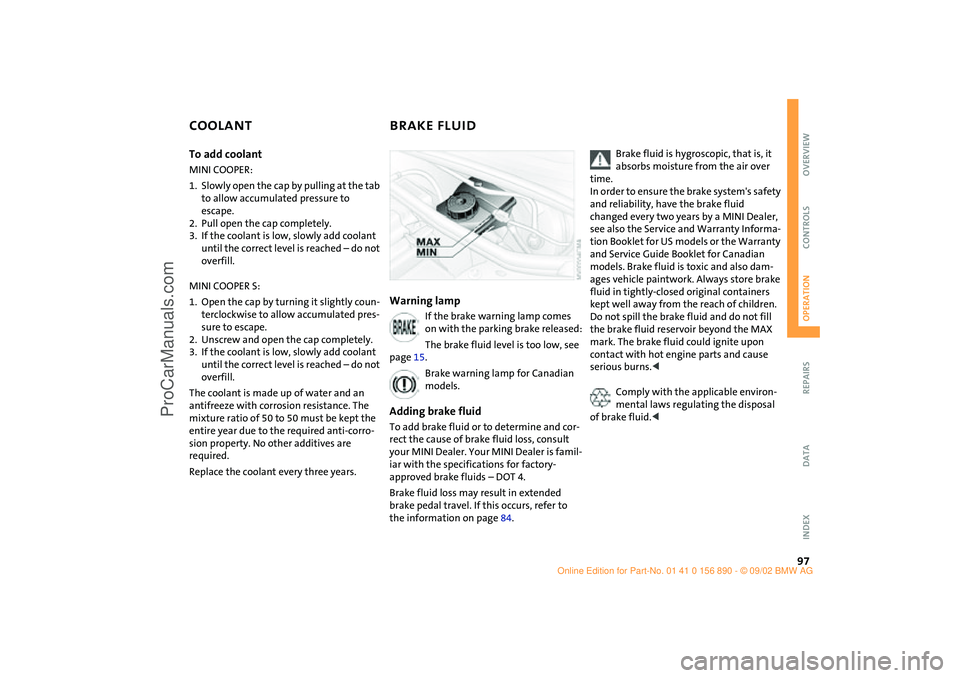
Warning lamp
If the brake warning lamp comes
on with the parking brake released:
The brake fluid level is too low, see
page 15.
Brake warning lamp for Canadian
models.
Adding brake fluidTo add brake fluid or to determine and cor-
rect the cause of brake fluid loss, consult
your MINI Dealer. Your MINI Dealer is famil-
iar with the specifications for factory-
approved brake fluids – DOT 4.
Brake fluid loss may result in extended
brake pedal travel. If this occurs, refer to
the information on page 84.
Brake fluid is hygroscopic, that is, it
absorbs moisture from the air over
time.
In order to ensure the brake system's safety
and reliability, have the brake fluid
changed every two years by a MINI Dealer,
see also the Service and Warranty Informa-
tion Booklet for US models or the Warranty
and Service Guide Booklet for Canadian
models. Brake fluid is toxic and also dam-
ages vehicle paintwork. Always store brake
fluid in tightly-closed original containers
kept well away from the reach of children.
Do not spill the brake fluid and do not fill
the brake fluid reservoir beyond the MAX
mark. The brake fluid could ignite upon
contact with hot engine parts and cause
serious burns.<
Comply with the applicable environ-
mental laws regulating the disposal
of brake fluid.<
ba.book Seite 97 Montag, 5. August 2002 8:09 20
ProCarManuals.com