tires MINI COOPER 2011 Owner's Manual
[x] Cancel search | Manufacturer: MINI, Model Year: 2011, Model line: COOPER, Model: MINI COOPER 2011Pages: 210, PDF Size: 3.19 MB
Page 145 of 210

Wheels and tiresMOBILITY
143
M+S
Winter and all-season tires.
These have better winter properties than
summer tires.
XL
Designation for specially reinforced tires.
Tire condition
Inspect your tires regula rly for tread wear, signs
of damage and for foreig n objects lodged in the
tread. Check the tread depth.
Tread depth
The tread depth should not drop below 1/8 in/
3 mm, although, for exam ple, European legisla-
tion only specifies a minimum tread depth of
1/16 in/1.6 mm. At tread depths below 1/8 in/
3 mm there is an increased risk of high-speed
hydroplaning, even when only small amounts of
water are present on the road surface.
Winter tires
When winter tires wear down past a tread depth
of 1/6 in/4 mm, they become perceptibly less
suitable for winter conditions. In the interest of
safety, new tires should be installed.
Minimum tread depth
Wear indicators in the base of the tread groove
are distributed around the tire's circumference;
the letters TWI, for Tread Wear Indicator, on the
tire's sidewalls identify tires that incorporate these wear indicators. When tire tread is worn
down to the level of the wear indicators, the
remaining tread depth is 1/16 in/1.6 mm.
Tire damage
Due to low-profile tires, please note that wheels,
tires and suspensions parts are more susceptible
to road hazards and consequential damages.
Unusual vibrations encountered during normal
vehicle operation can indicate tire failure or
some other vehicle defect
. This can, for exam-
ple, be caused by driving over curbs. The same
applies to any other ab normal road behavior,
such as pulling severely to the right or left.
In these cases, reduce speed immediately
and have wheels an d tires thoroughly
checked. To do so, drive carefully to the nearest
MINI dealer or tire shop that works according to
MINI repair procedures with correspondingly
trained personnel. If necessary, have the vehicle
towed there.
Otherwise, tire damage can be extremely
dangerous for vehicle occupants and other road
users. <
Tire age
The manufacturing date of tires is contained in
the tire coding:
DOT ... 0211 means that the tire was manufac-
tured in week 2 of 2011.
For various reasons, such as the development of
brittleness, the manufacturer of your MINI rec-
ommends tire replacemen t after no more than
6 years, regardless of th e actual wear of the
tires.
Page 146 of 210

MOBILITYWheels and tires
144
Run-flat tires*
The symbol identifying run-flat tires is a circle
with the letters RSC on the sidewall.
Run-flat tires comprise a conditionally self-sup-
porting tire and a special rim. The reinforcement
in the sidewalls ensures that the tire can con-
tinue to be used subject to certain restrictions,
even if depressurized.
For information on continui ng to drive with a flat
tire, refer to Indication of a flat tire, page 71.
New wheels and tires
Have new wheels and tires mounted only
by your MINI dealer or a specialized tire
shop that has specially trained personnel work-
ing in accordance with the specifications of the
MINI manufacturer. If this work is not carried out
properly, there is a danger of subsequent dam-
age and related safety haza rds. Make sure that
the new wheels are balanced. <
Retreaded tires
The manufacturer of your MINI recom-
mends that you avoid using retreaded
tires, as this could impair driving safety. The
causes for this include potentially different tire
casing structures and often wide variations in
tire age, which can resu lt in a limited service
life.<
Correct wheels and tires
The manufacturer of your MINI recom-
mends mounting only wheels and tires
that it has specifically approved for use on your
particular model. Although other wheels and
tires may theoretically have the same dimen-
sions, variations in factors such as manufactur-
ing tolerances can result in contact between tire
and bodywork, ultimately leading to serious
accidents. The manufacturer of your MINI can-
not evaluate non-approved wheels and tires to
determine if they are suited for use, and there-
fore cannot ensure the operating safety of the
vehicle if they are mounted. <
Your MINI dealer will be glad to inform you
about the correct wheel an d tire combination for
your vehicle.
The correct combin ation of wheels and tires is
also necessary to ensure reliable operation of
various vehicle systems such as ABS and DSC.
To maintain good handling and vehicle
response, use only tires of a single brand and
tread configuration. Afte r a tire has been dam-
aged, mount the previous wheel and tire combi-
nation again as soon as possible.
Wheels with Tire Pr essure Monitor TPM
electronics
When mounting new tires or changing over from
summer to winter tires, or vice versa, only use
wheels with TPM electronics; otherwise, the Tire
Pressure Monitor may not be able to detect a
puncture, refer to page 73. Your MINI dealer will
be glad to advise you.
Page 147 of 210
Wheels and tiresMOBILITY
145
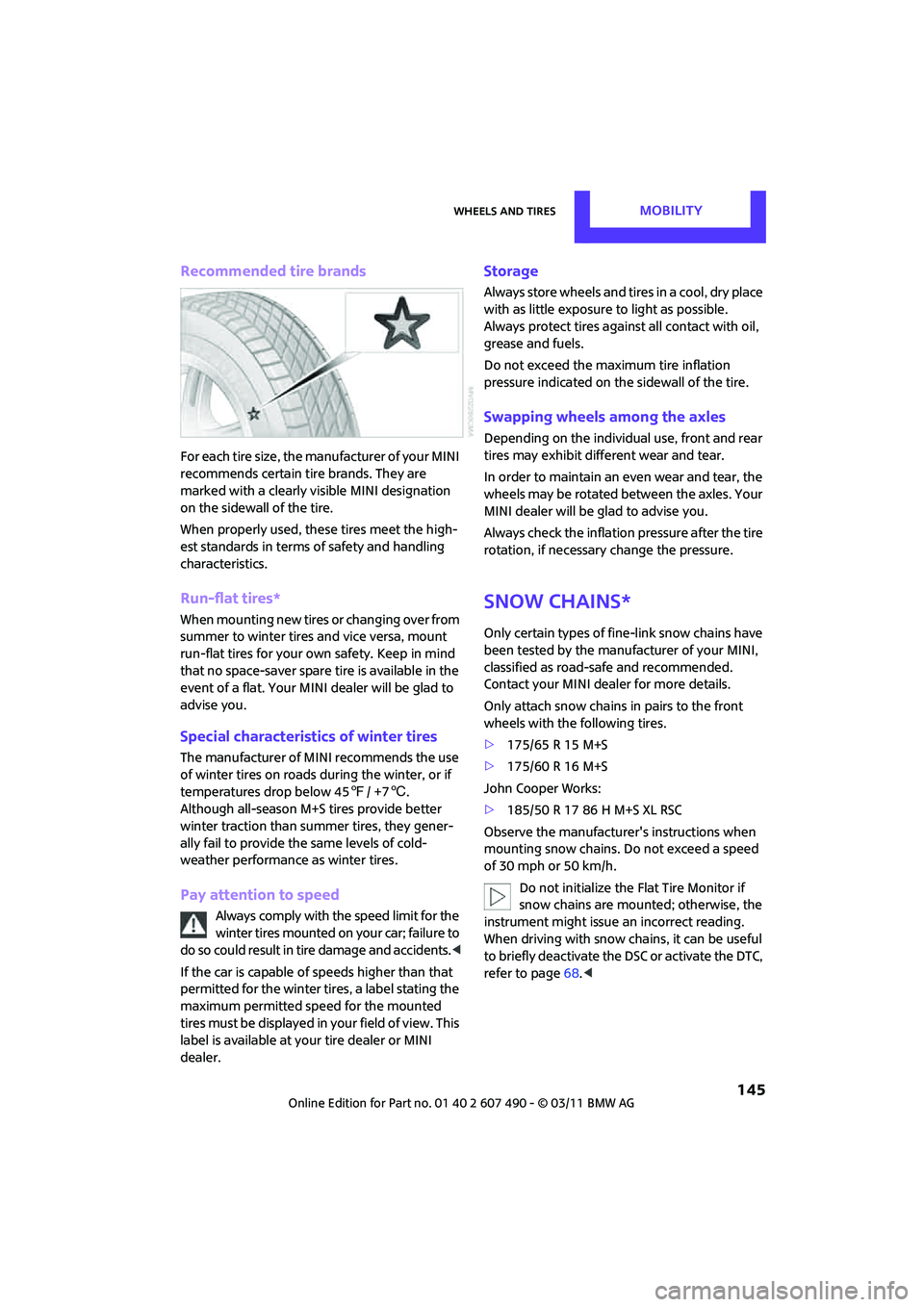
Recommended tire brands
For each tire size, the manufacturer of your MINI
recommends certain tire brands. They are
marked with a clearly visible MINI designation
on the sidewall of the tire.
When properly used, these tires meet the high-
est standards in terms of safety and handling
characteristics.
Run-flat tires*
When mounting new tires or changing over from
summer to winter tires and vice versa, mount
run-flat tires for your own safety. Keep in mind
that no space-saver spare tire is available in the
event of a flat. Your MINI dealer will be glad to
advise you.
Special characteristics of winter tires
The manufacturer of MINI recommends the use
of winter tires on roads during the winter, or if
temperatures drop below 45 7/ +7 6.
Although all-season M+S tires provide better
winter traction than summer tires, they gener-
ally fail to provide the same levels of cold-
weather performance as winter tires.
Pay attention to speed
Always comply with the speed limit for the
winter tires mounted on your car; failure to
do so could result in tire damage and accidents. <
If the car is capable of speeds higher than that
permitted for the winter ti res, a label stating the
maximum permitted speed for the mounted
tires must be displayed in your field of view. This
label is available at your tire dealer or MINI
dealer.
Storage
Always store wheels and tires in a cool, dry place
with as little exposure to light as possible.
Always protect tires agains t all contact with oil,
grease and fuels.
Do not exceed the maximum tire inflation
pressure indicated on the sidewall of the tire.
Swapping wheels among the axles
Depending on the individual use, front and rear
tires may exhibit diff erent wear and tear.
In order to maintain an even wear and tear, the
wheels may be rotated between the axles. Your
MINI dealer will be glad to advise you.
Always check the inflation pressure after the tire
rotation, if necessary change the pressure.
Snow chains*
Only certain types of fi ne-link snow chains have
been tested by the manufacturer of your MINI,
classified as road-s afe and recommended.
Contact your MINI dealer for more details.
Only attach snow chains in pairs to the front
wheels with the following tires.
> 175/65 R 15 M+S
> 175/60 R 16 M+S
John Cooper Works:
> 185/50 R 17 86 H M+S XL RSC
Observe the manufacturer's instructions when
mounting snow chains. Do not exceed a speed
of 30 mph or 50 km/h. Do not initialize the Flat Tire Monitor if
snow chains are mounted; otherwise, the
instrument might issue an incorrect reading.
When driving with snow chains, it can be useful
to briefly deactivate the DSC or activate the DTC,
refer to page 68.<
Page 159 of 210
Replacing componentsMOBILITY
157
Replacing components
Onboard vehicle toolkit
Your vehicle comes with an onboard vehicle
toolkit that varies with the equipment version; it
is stored underneath the flat load floor.
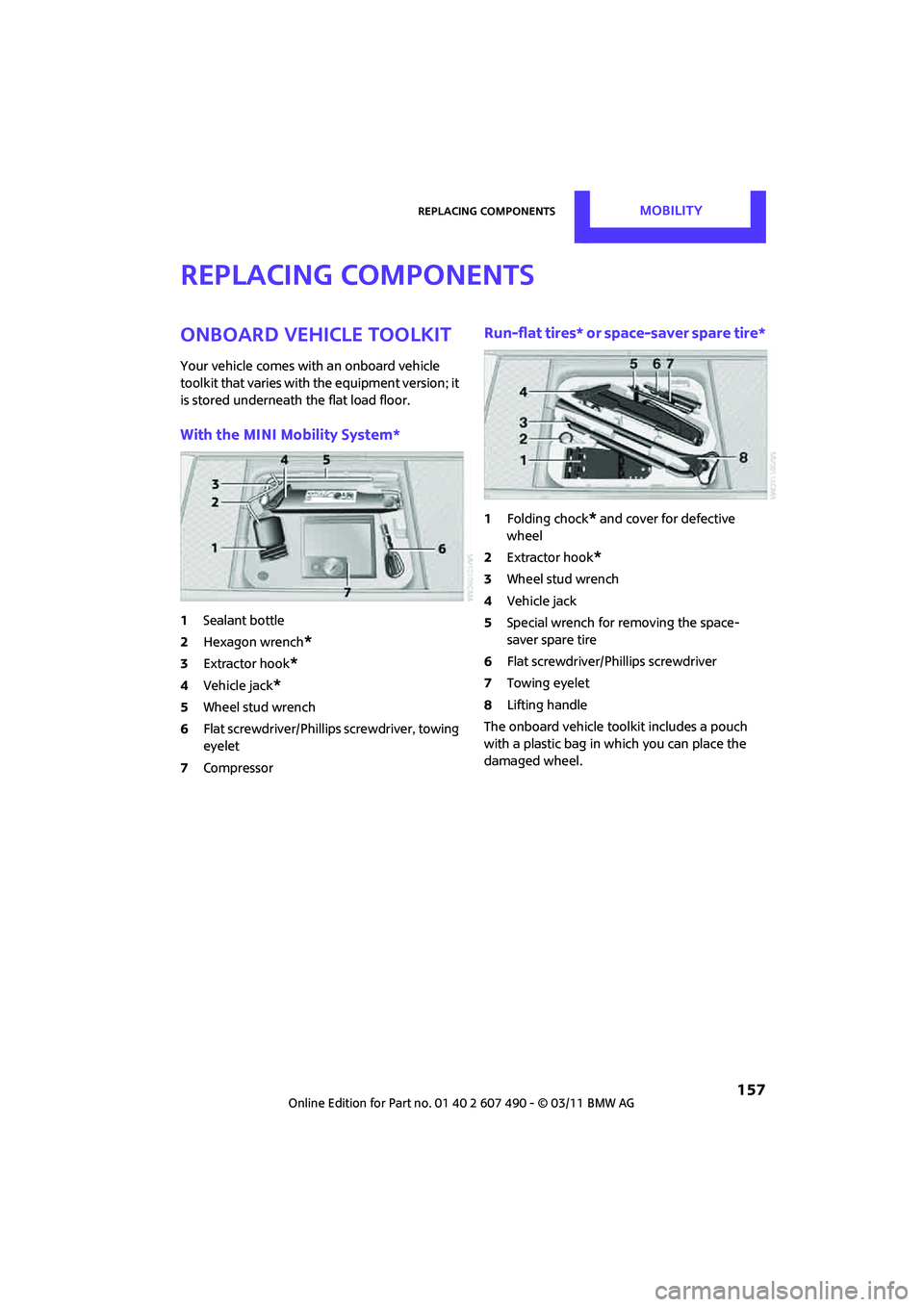
With the MINI Mobility System*
1Sealant bottle
2 Hexagon wrench
*
3Extractor hook*
4Vehicle jack*
5Wheel stud wrench
6 Flat screwdriver/Phillips screwdriver, towing
eyelet
7 Compressor
Run-flat tires* or space-saver spare tire*
1Folding chock* and cover for defective
wheel
2 Extractor hook
*
3Wheel stud wrench
4 Vehicle jack
5 Special wrench for removing the space-
saver spare tire
6 Flat screwdriver/Phillips screwdriver
7 Towing eyelet
8 Lifting handle
The onboard vehicle tool kit includes a pouch
with a plastic bag in which you can place the
damaged wheel.
Page 165 of 210
Replacing componentsMOBILITY
163
Center brake lamp
This lamp uses LED technology for operation. In
the event of a malfunction, contact your MINI
dealer or a workshop that has specially trained
personnel working in accordance with the
specifications of your MINI manufacturer.
Repairing a flat tire
Safety measures in the event of a break-
down:
Park the vehicle as far as possible from moving
traffic and switch on th e hazard warning flash-
ers.
Turn the steering wheel until the front wheels
are in the straight-ahead position and engage
the steering wheel lock. Engage the parking
brake and shift into 1st or reverse gear or place
the selector lever in position P.
All passengers should be outside the vehicle and
in a safe place, e.g. behind a guardrail.
Erect a warning triangle or warning flasher at the
appropriate distance if necessary. Comply with
all safety guidelines and regulations. <
In the event of a flat tire, different procedures
should be followed depending on the equip-
ment included in your vehicle:
> MINI Mobility System, refer to the following
section
> Run-flat tires, page 165
> Tire change with space-saver spare tire,
page 165
MINI Mobility System*
Preparations
Use of the MINI Mobility System may be ineffec-
tive if the tire puncture measures approx. 1/8 in/
4 mm or more. Contact the nearest MINI dealer
if the tire cannot be made drivable with the
Mobility System. Do not remove foreign bodies which have
penetrated the tire if possible.
Follow the instructions on using the Mobil-
ity System found on the compressor and
the sealant bottle. <
Remove the adhesive label for the speed limit
from the sealant bottle and affix it to the
steering wheel.
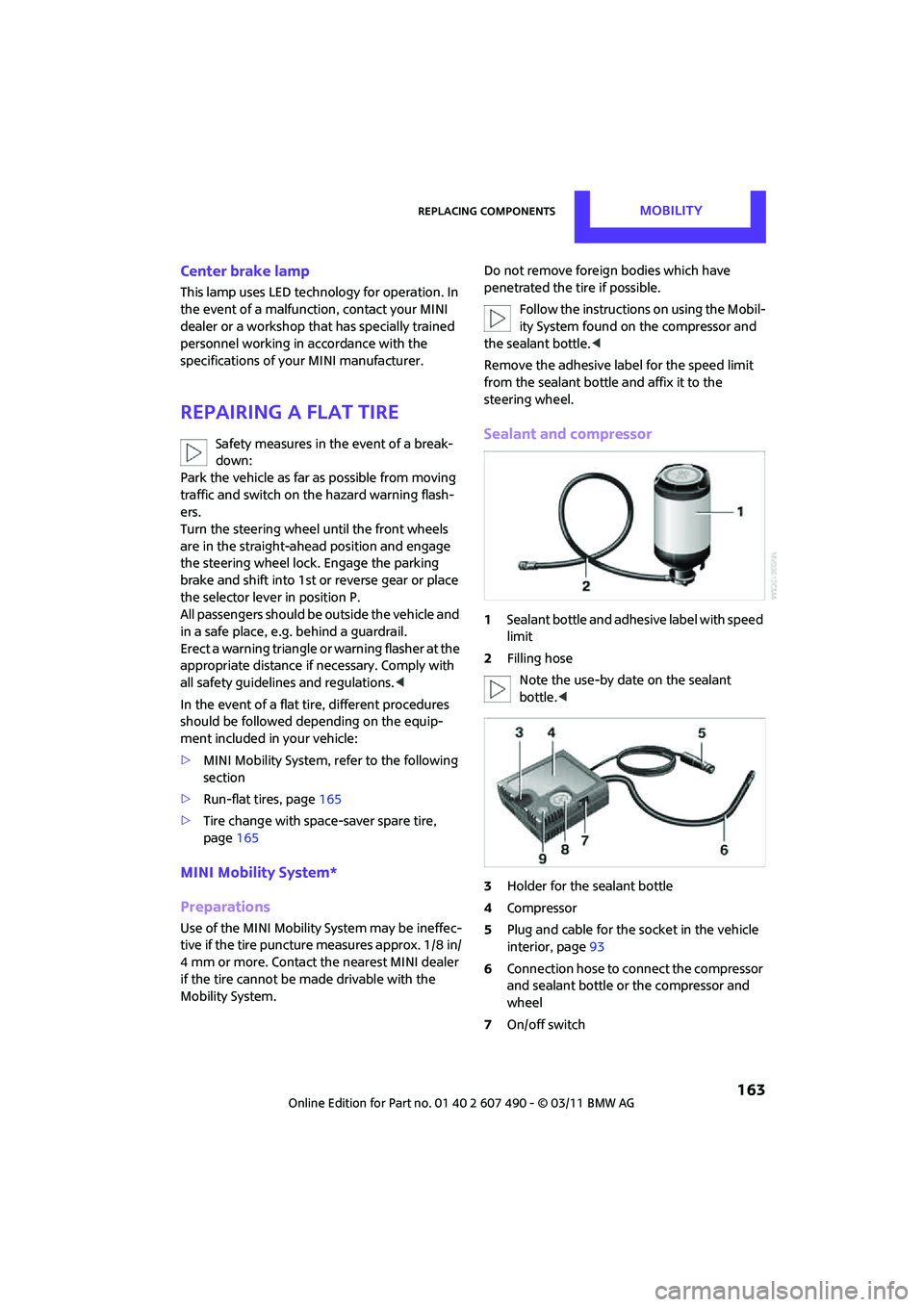
Sealant and compressor
1 Sealant bottle and adhesi ve label with speed
limit
2 Filling hose
Note the use-by date on the sealant
bottle. <
3 Holder for the sealant bottle
4 Compressor
5 Plug and cable for the socket in the vehicle
interior, page 93
6 Connection hose to connect the compressor
and sealant bottle or the compressor and
wheel
7 On/off switch
Page 167 of 210
Replacing componentsMOBILITY
165
Distributing the sealant
Immediate drive approx. 3.1 miles/5 km so that
the sealant evenly distributes itself.Do not exceed speeds of 50 mph/
80 km/h.
If possible, do not drop below 10 mph/
20 km/h.<
Adjusting the tire pressure
1. After driving approx. 3.1 miles/5 km or
10 minutes, stop at a suitable location.
2. Screw the connection hose 6 of the
compressor directly onto the tire valve.
3. Insert the plug 5 into the power socket in
the vehicle interior.
4. Correct inflation pressu re to 26 psi/180 kPa.
With the engine running:
> To increase the inflatio n pressure: switch on
the compressor. To check the current infla-
tion pressure, switch off the compressor.
Do not run the compressor for longer
than 10 minutes; otherwise, the
device will overheat and possibly be
damaged. <
> To decrease the inflation pressure: press the
release button 9.
If the tire cannot ma intain the inflation
pressure, drive the vehicle again, refer to
Distributing the sealan t. Then repeat steps
1to4.
If an inflation pressure of 26 psi/180 kPa still
cannot be reached, the tire is too heavily dam-
aged. Contact the nearest MINI dealer. <
Driving on
Do not exceed the permitted maximum
speed of 50 mph/80 km/h; doing so may
result in an accident. <
Replace the defective tire as soon as possible
and have the new wheel/tire assembly
balanced.
Have the Mobility System refilled.
Changing wheels
Run-flat tires*
Tire change for run-flat tires:
> Prepare for tire change, page 166
> Jack up vehicle, page 167
> Tighten lug bolts, page 167
Space-saver spare tire*
Tire change with space-saver spare tire:
>Remove the space-saver spare tire,
page 165
> Prepare for tire change, page 166
> Jack up vehicle, page 167
> Mount space-saver spare tire, page 167
> Tighten lug bolts, page 167
> Drive with space-saver spare tire, page 166
Removing the space-saver spare tire
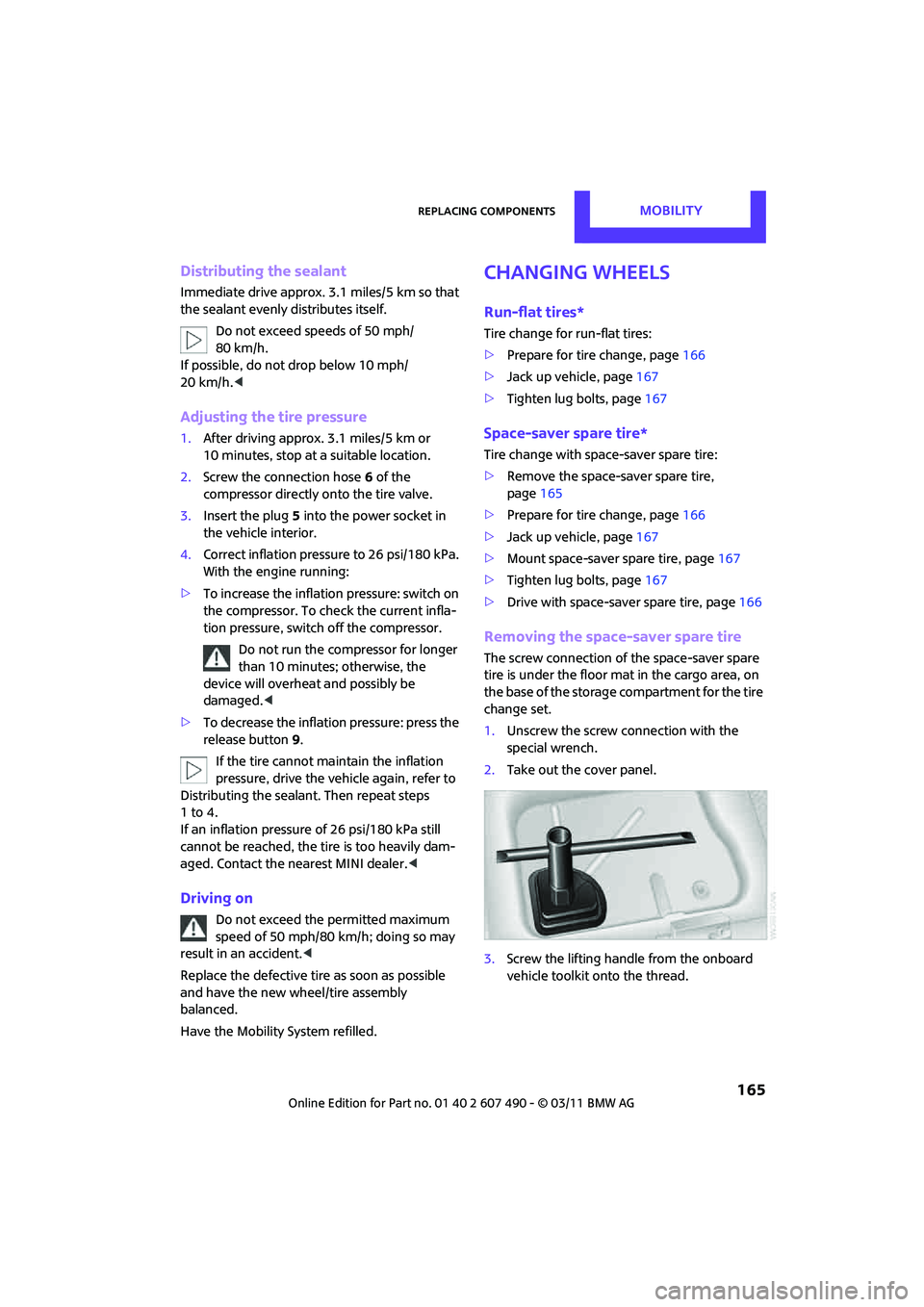
The screw connection of the space-saver spare
tire is under the floor mat in the cargo area, on
the base of the storage compartment for the tire
change set.
1. Unscrew the screw connection with the
special wrench.
2. Take out the cover panel.
3. Screw the lifting handle from the onboard
vehicle toolkit onto the thread.
Page 168 of 210

MOBILITYReplacing components
166
4.Raise the lifting handle slightly.
5. Squeeze the securing spring.
6. The space-saver spare tire is released and
must be held by the lifting handle.
7. Lower the space-saver spare tire with the
lifting handle.
8. Unscrew the lifting handle.
9. Pull the space-saver spare tire underneath
the vehicle out toward the rear.
10. Position the space-save r spare tire with the
valve facing upward.
11. Unscrew the valve extension from the valve
of the space-saver spare tire. 12.
Unscrew the dust cap from the extension
and place it on the valve of the space-saver
spare tire.
Due to its different dimensions, the
damaged wheel cannot be placed in the
recess for the space-saver spare tire. <
Driving with the space-saver spare tire
Drive cautiously and do not exceed a
speed of 50 mph/80 km/h. Changes may
occur in vehicle handling such as lower track
stability during braking, longer braking dis-
tances and changes in self-steering properties
when close to the handling limit. These proper-
ties are more noticeable with winter tires. <
Only one space-saver spare tire may be
mounted at one time. Mount a wheel and
tire of the original size as soon as possible, to
avoid any safety risks. <
Check the tire inflat ion pressure at the
earliest opportunity and correct it if
necessary. Replace the defe ctive tire as soon as
possible and have the ne w wheel/tire assembly
balanced. <
Preparing for a tire change
Observe the safety precautions regarding
flat tires on page 163.<
Additional safety measures when chang-
ing tires:
Only change the tire wh en parked on a surface
that is level, firm and not slippery.
The vehicle or the jack could slip sideways on
soft or slippery support surfaces, such as snow,
ice, flagstones, etc.
Do not use a wooden block or similar object as a
support base for the jack, as this would prevent
it from extending to its full support height and
reduce its load-carrying capacity.
Do not lie under the vehicle or start the engine
when the vehicle is supported by the jack; other-
wise, there is a risk of fatal injury. <
Page 196 of 210

194
REFERENCEEverything from A to Z
Everything from A to Z
INDEX
A
ABS Antilock Brake System67
Accessories, refer to Your individual vehicle 4
Acknowledgment signals for
locking/unlocking vehicle 23
Activated-charcoa l filter for
automatic climate control 88
Adaptive Light Control 80
Additives
– coolant 149
– engine oil 149
Adjusting temperature inside the car, refer to Air
conditioner 85
Adjusting temperature inside the car, refer to Automatic
climate control 86
Airbags 75
– sitting safely 37
– warning lamp 77
Air conditioner 84
Air conditioning mode
– air conditioner 85
– automatic cl imate control86
– ventilation 88
Air distribution
– automatic 87
– individual 86
– manual 86
Air flow rate 85,87
– air conditioning system 85
– automatic cl imate control87
– heating, ventilation 85
Airing, refer to Ventilation88
Air outlets, refer to Air vents 84
Air pressure, checking, refer to
Tire inflation pressure 134Air recirculation, refer to
Recirculated-air
mode 85,87
Air supply
– air conditioner 85
– automatic climate control 86
– ventilation 88
Air vents 84
AKI, refer to Fuel grade 133
Alarm system 27
All-season tires, refer to Winter tires 145
Always Open Timer 58
Ambient air, refer to Recirculated-air
mode 85,87
Ambient lighting 83
Antenna, care 153
Antifreeze
– coolant 14
9
– washer fluid 53
Antilock Brake System ABS 67
Anti-theft alarm system, refer
to Alarm system 27
Anti-theft system 21
Approved axle loads, refer to
Weights 191
Approved engine oils 149
Approved gross vehicle
weight, refer to Weights 191
Armrest, refer to Center armrest 92
Ashtray 93
Assistant systems, refer to
– Dynamic Stability Control
DSC 67
Audio device, external 91Automatic
– air distribution
87
– air flow rate 87
– cruise control 54
– headlamp control 78
Automatic climate control 84
– automatic air distribution 87
Automatic station search 107
Automatic station storage 108
Automatic transmission with Steptronic 48
– interlock 49
– overriding selector lever lock 50
– shiftlock 49
– sport program 49
AUTO program for automatic climate control 87
Auto radio, refer to Radio MINI Boost CD 106
AUX-IN, refer to External audio device 91
AUX In connection 106
Average fuel consumption 57
– setting the units 61
Average speed 57
Axle loads, refer to Weights 191
B
Background lighting, refer to
Ambient lighting 83
Backrests, refer to Seats 38
Backup lamps
– replacing bulb 161,162
Band-aids, refer to First aid pouch 169
Bar, refer to Tow-starting, towing away 172
Page 199 of 210

Everything from A to ZREFERENCE
197
Drinks holders, refer to Cupholders 93
Drive-off assistan t, refer to Hill
Assist 69
Driving dynamics control, refer to Sport button 69
Driving lamps, refer to Parking
lamps/low beams 78
Driving notes 96
Driving off on inclines, refer to
Hill Assist 69
Driving stability control systems 67
Driving through water 97
Driving tips, refer to Driving notes 96
Dry air, refer to Cooling function 88
DSC Dynamic Stability
Control 67
DTC Dynamic Traction Control 68
Dynamic Brake Control DBC, refer to Brake Assist 67
Dynamic Stability Control
DSC 67
Dynamic Traction Control DTC 68
E
Eject button 112
Electrical malfunction
– convertible top 34
– door lock 25
– fuel filler flap 132
– liftgate 26
Electric power windows
– initializing 31
Electronic brake-force distribution 67
Electronic Stability Program
ESP, refer to Dynamic
Stability Control DSC 67Emergency operation, refer to
Manual operation
– convertible top 34
– door lock 25
– fuel filler flap 132
– liftgate 26
– transmission lock, automatic
transmission 50
Emergency services, refer to Roadside Assistance 169
Engine
– breaking in 96
– data 188
– overheated, refer to Coolant temperature 149
– speed 188
– starting 47
– starting, Comfort Access 28
– switching off 47
Engine compartment 147
Engine coolant, refer to Coolant 149
Engine oil
– adding 148
– additives, refer to Approved
engine oils 149
– alternative oil types 149
– approved engine oils 149
– capacity 148
– checking level 147
– dipstick 147
– intervals between changes, refer to Service
requirements 62
– MINI Maintenance System 151
Engine oil level, checking 147
Engine output, refer to Engine data 188
Engine starting, refer to Starting the engine 47
ESP Electronic Stability
Program, refer to Dynamic
Stability Control DSC 67
Exhaust system, refer to Hot
exhaust system 96 Exterior mirrors
41
– adjusting 41
– automatic heating 41
– folding in and out 41
External audio
device91,106
External temperature display
– change units of measure 61
– in the on-board computer 61
Eyes
– for tow-starting and towing
away 171
– for tying down loads 101
F
Failure messages, refer to
Check Control 64
Failure of an electrical consumer 168
Fastening safety be lts, refer to
Safety belts 40
Fast forward
– CD 112
Fault messages, refer to Check
Control 64
Filter
– microfilter/activated- charcoal filter for automatic
climate control 88
– microfilter for air
conditioner 86
Fine wood, care 156
First aid pouch 169
Fixture for remote control, refer to Ignition lock 46
Flash when locking/
unlocking 23
Flat tire
– run-flat tires 144
– Tire Pressure Monitor TPM 72
Flat Tire Monitor FTM 69
– indicating a flat tire 71
– initializing the system 70
– snow chains 70
– system limits 70
Flat tires, refer to Tire condition 143
Page 202 of 210

REFERENCEEverything from A to Z
200
M
M+S tires, refer to Winter tires 145
Maintenance, refer to Service and Warranty Information
Booklet for US models and
Service Guide Booklet for
Canadian models
Maintenance system 151
Malfunction
– convertible top 34
– liftgate 26
Malfunction warn ings, refer to
Check Control 64
Manual air distribution 86
Manual mode
– automatic transmission with Steptronic 49
Manual operation
– door lock 25
– fuel filler flap 132
– liftgate 26
– power convertible top 34
– transmission lock, automatic
transmission 50
Manual station search 107
Manual transmission 48
Manual washing 154
Master key, refer to Integrated
key/remote control 20
Maximum cooling 87
Maximum speed
– with winter tires 145
Medical assistance, refer to First aid pouch 169
Microfilter
– for air conditioner 86
– for automatic climate
control 88
– MINI Maintenance System 151
Microfilter/activated-charcoal filter
– MINI Maintenance
System 151
Microphone for telephone 14MINI Internet page
4
MINI Maintenance System 151
Mirror dimming feature 42
Mirrors 41
– exterior mirrors 41
– heating 41
– interior rearview mirror 42
Mobile phone
– adjusting volume 124
– connecting, refer to Mobile
phone, pairing 120
– installation location, refer to Center armrest 92
– pairing 120
– refer to separate Owner's Manual
– What to do if… 123
Mobile phone, installation location, refer to Center
armrest 92
Mobil
e phone, refer to
separate Owner's Manual
Mobility System 163
Modifications, technical, refer to For your own safety 5
Monitoring syst em for tire
pressures, refer to Flat Tire
Monitor 69
MP3 111
Multifunctional steering
wheel, refer to Buttons on
the steering wheel 11
Multifunction switch
– refer to Turn signals/ headlamp flasher 51
– refer to Wiper system 52
Music tracks
– playing a track 112
– random order 112
N
Neck support, refer to Head
restraints 39
Nets, refer to Storage
compartments 92
New tires 144 Number of cylinders, refer to
Engine data 188
Number of safety belts 37
Nylon rope, refer to Tow
rope 172
O
OBD socket, refer to Socket for
On-Board Diagnosis 152
Octane ratings, refer to Fuel specifications 133
Odometer 56
Oil, refer to Engine oil 147
Oil consumption 147
Oil level 147
Oil types 148
Old batteries, refer to Disposal 168
Onboard vehicle toolkit 157
Opening and closing
– Comfort Access 28
– from inside 25
– from outside 21
– using the door lock 24
– using the remote control 21
Opening and unlocking
– from inside 25
Outlets
– refer to Ventilation 88
Outlets, refer to Air vents 84
Output, refer to Engine data 188
Outside-air mode
– automatic climate control 87
Overheated engine, refer to
Coolant temperature 149
P
Paintwork, care155
Park Distance Control PDC 66
Parking
– vehicle 47
Parking aid, refer to Park
Distance Control PDC 66
Parking brake 48