fuel MINI COOPER CONVERTIBLE 2008 User Guide
[x] Cancel search | Manufacturer: MINI, Model Year: 2008, Model line: COOPER CONVERTIBLE, Model: MINI COOPER CONVERTIBLE 2008Pages: 176, PDF Size: 2.4 MB
Page 70 of 176

68
FUEL GAUGE COOLANT TEMPERATURE GAUGE In the navigation system*
Please also comply with the instruc-
tions in the previous section.<
If the LED changes from orange to red,
there are approx. 2.1 gallons/8 liters of fuel
left in the tank.
Coolant temperature gaugeDepending on the equipment version, a
coolant temperature gauge is located in
the speedometer or the Cockpit Chrono
Pack.
Low temperature:
The engine is still cold. Drive at moderate
engine and vehicle speeds.
Center position:
Normal operating temperature of the
engine.
High temperature:
As soon as there is a deviation from the
center position upwards or to the left:
Drive with moderation and at low engine
speeds. If necessary, switch off the engine
and allow it to cool down.
Checking coolant level, refer to page122.Temperature warning LED 1 comes on while the vehicle is in
motion: engine is too hot. Switch off the
engine immediately and allow it to cool
down.
When you switch on the ignition, the LED 1
lights up briefly to confirm that the system
is operational.Equipment with navigation system* or
Cockpit Chrono Pack*
Coolant temperature warning
lamp 2 comes on while the vehicle
is in motion: engine is too hot.
Switch off the engine immediately and
allow it to cool down.
Page 72 of 176

70
ONBOARD COMPUTER
*
Mode selection
You can use the button in the turn signal
indicator lever to retrieve information from
the onboard computer for display in the
tachometer. By pressing the button briefly,
you can call up a new function for display.
The order of the displays:
Outside temperature, range, average con-
sumption and current consumption, aver-
age speed and current speed.
If the vehicle is equipped with a navi-
gation system, you will find more
information on the onboard computer in
the Owner's Manual for Navigation Sys-
tem.<
Outside temperature If the vehicle is not equipped with an
onboard computer, only the outside tem-
perature is displayed.
Press the button in the turn indicator lever
to switch the display from outside temper-
ature to current speed and vice versa.
You can have the unit of measure set
to7 or6.
cally switches to the outside temperature
display.
In addition, a signal sounds and the display
flashes.
Black ice can occur at temperatures
above +36/377 as well. You
should therefore drive carefully on bridges
and shaded roads, for example; otherwise
there is an increased risk of an accident.<
With navigation system:
The temperature is displayed in the status
line of the navigation system, refer to the
Owner's Manual for Navigation System.
Current vehicle speedIf the vehicle is not equipped with an
onboard computer, only the current speed
is displayed.
Press the button in the turn indicator lever
to switch the display from outside temper-
ature to current speed and vice versa.RangeThe display shows a range estimate based
on the available fuel. The amount of fuel
remaining in the tank is measured, and the
range is estimated from your driving style
over the last 20 miles/30 km.
If the range displayed is less than
35 miles/50 km, be sure to refuel;
otherwise engine functions are not guaran-
teed and damage could occur.<
Page 73 of 176

71
OVERVIEW REPAIRS OPERATIONCONTROLS DATA INDEX
ONBOARD COMPUTER
*
Average speed, average fuel
consumption
To reset average consumption, average
speed:
Press the button in the turn signal indicator
lever for a long time.
The average consumption is determined
for the time during which the engine is run-
ning.
If the vehicle is equipped with a navi-
gation system, the displays are
shown in the area of the navigation sys-
tem.<
You can have a different unit of mea-
sure set.
mentally friendly you are currently driving.
You can have a different unit of mea-
sure set.<
Page 80 of 176

78
TIRE PRESSURE MONITOR
*
>If TPM is temporarily malfunctioning due
to other systems or devices using the
same radio frequency.
Declaration according to NHTSA/
FMVSS 138 Tire Pressure Monitoring
SystemEach tire should be checked monthly when
cold and inflated to the inflation pressure
recommended by the vehicle manufacturer
on the vehicle placard or tire inflation pres-
sure label. If your vehicle has tires of a dif-
ferent size than the size indicated on the
vehicle placard or tire inflation pressure
label, you should determine the proper tire
inflation pressure for those tires. As an
added safety feature, your vehicle has been
equipped with a tire pressure monitoring
system, TPMS, that illuminates a low tire
pressure telltale when one or more of your
tires are significantly under-inflated.
Accordingly, when the low tire pressure
telltale illuminates, you should stop and
check your tires as soon as possible, and
inflate them to the proper pressure. Driving
on a significantly underinflated tire causes
the tire to overheat and can lead to tire fail-
ure. Underinflation also reduces fuel effi-
ciency and tire tread life, and may affect
the vehicle's handling and stopping ability.
Please note that the TPMS is not a substi-
tute for proper tire maintenance, and it is
the driver's responsibility to maintain cor-
rect tire pressure, even if underinflation has not reached the level at which the
TPMS low tire pressure telltale illuminates.
The TPMS malfunction indicator is com-
bined with the low tire pressure telltale.
When the system detects a malfunction,
the telltale will flash for approximately one
minute and then remain continuously lit.
This sequence will continue upon subse-
quent vehicle startups as long as the mal-
function exists. When the malfunction
indicator is illuminated, the system may
not be able to detect or signal low tire pres-
sure as intended. TPMS malfunctions may
occur for a variety of reasons, including the
installation of replacement or alternate
tires or wheels on the vehicle that prevent
the TPMS from functioning properly.
Always check the TPMS malfunction tell-
tale after replacing one or more tires or
wheels on your vehicle to ensure that the
replacement or alternate tires and wheels
allow the TPMS to continue to function
properly.
Page 107 of 176
105
OVERVIEW REPAIRSOPERATIONCONTROLS DATA INDEX
REFUELING
Always switch off the engine before
refueling; otherwise no fuel can be
added to the tank and the SERVICE ENGINE
SOON lamp may come on.<
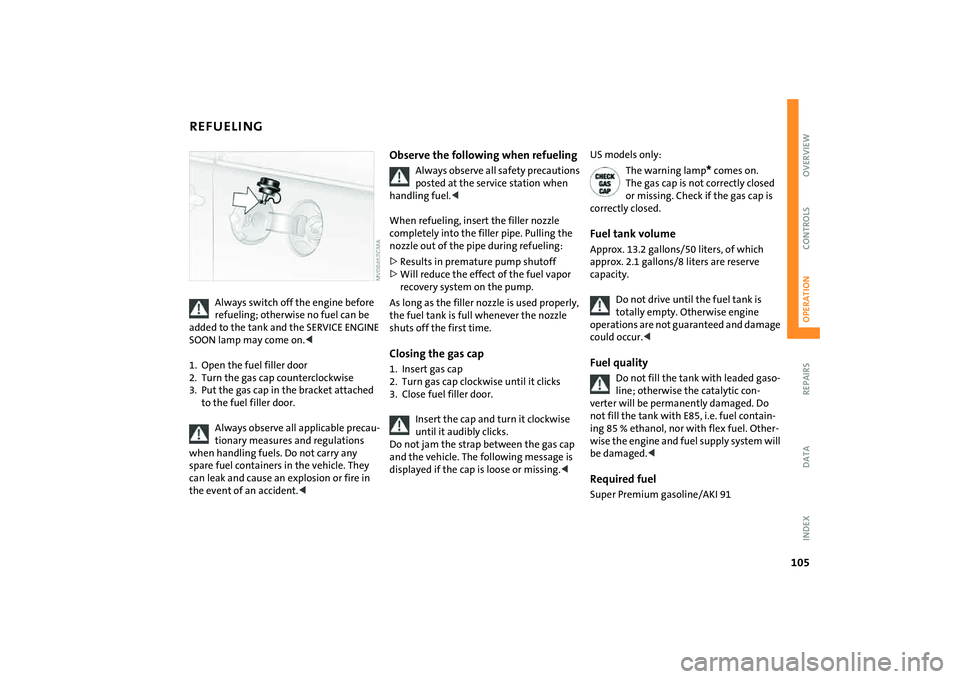
1. Open the fuel filler door
2. Turn the gas cap counterclockwise
3. Put the gas cap in the bracket attached
to the fuel filler door.
Always observe all applicable precau-
tionary measures and regulations
when handling fuels. Do not carry any
spare fuel containers in the vehicle. They
can leak and cause an explosion or fire in
the event of an accident.<
Observe the following when refueling
Always observe all safety precautions
posted at the service station when
handling fuel.<
When refueling, insert the filler nozzle
completely into the filler pipe. Pulling the
nozzle out of the pipe during refueling:
>Results in premature pump shutoff
>Will reduce the effect of the fuel vapor
recovery system on the pump.
As long as the filler nozzle is used properly,
the fuel tank is full whenever the nozzle
shuts off the first time.
Closing the gas cap1. Insert gas cap
2. Turn gas cap clockwise until it clicks
3. Close fuel filler door.
Insert the cap and turn it clockwise
until it audibly clicks.
Do not jam the strap between the gas cap
and the vehicle. The following message is
displayed if the cap is loose or missing.<
US models only:
The warning lamp
* comes on.
The gas cap is not correctly closed
or missing. Check if the gas cap is
correctly closed.
Fuel tank volumeApprox. 13.2 gallons/50 liters, of which
approx. 2.1 gallons/8 liters are reserve
capacity.
Do not drive until the fuel tank is
totally empty. Otherwise engine
operations are not guaranteed and damage
could occur.
line; otherwise the catalytic con-
verter will be permanently damaged. Do
not fill the tank with E85, i.e. fuel contain-
ing 85 % ethanol, nor with flex fuel. Other-
wise the engine and fuel supply system will
be damaged.<
Required fuelSuper Premium gasoline/AKI 91
Page 108 of 176
106
REFUELINGThis gasoline is highly recommended.
However, you may also use gasoline with
less AKI. The minimum AKI rating is 87.
If you use gasoline with this minimum AKI
rating, the engine may produce knocking
sounds when starting at high outside tem-
peratures. This has no effect on the engine
life.Use high-quality brandsField experience has indicated significant
differences in fuel quality: volatility, com-
position, additives, etc., among gasolines
offered for sale in the United States and
Canada. Fuels containing up to and includ-
ing 10 % ethanol or other oxygenates with
up to 2.8 % oxygen by weight, that is, 15 %
MTBE or 3 % methanol plus an equivalent
amount of co-solvent, will not void the
applicable warranties with respect to
defects in materials or workmanship.
The use of poor-quality fuels may
result in driveability, starting and
stalling problems especially under certain
environmental conditions such as high
ambient temperature and high altitude.
Should you encounter driveability prob-
lems which you suspect could be related to
the fuel you are using, we recommend that
you respond by switching to a recognized
high-quality brand such as gasoline that is
advertised as Top Tier Detergent Gasoline.
Failure to comply with these recommenda-
tions may result in unscheduled mainte-
nance.<
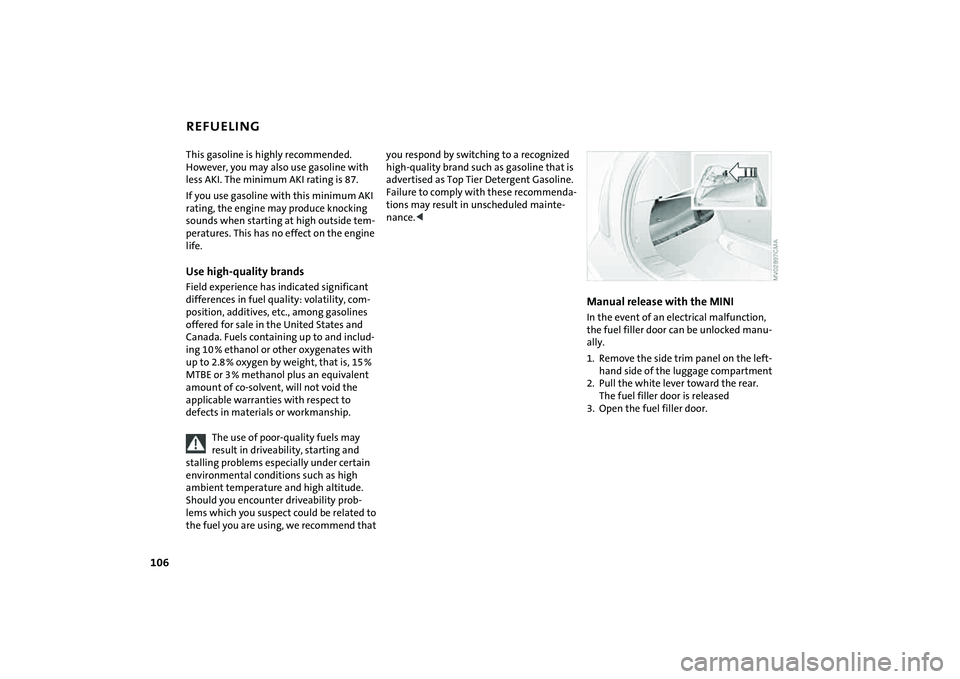
Manual release with the MINIIn the event of an electrical malfunction,
the fuel filler door can be unlocked manu-
ally.
1. Remove the side trim panel on the left-
hand side of the luggage compartment
2. Pull the white lever toward the rear.
The fuel filler door is released
3. Open the fuel filler door.
Page 109 of 176
107
OVERVIEW REPAIRSOPERATIONCONTROLS DATA INDEX
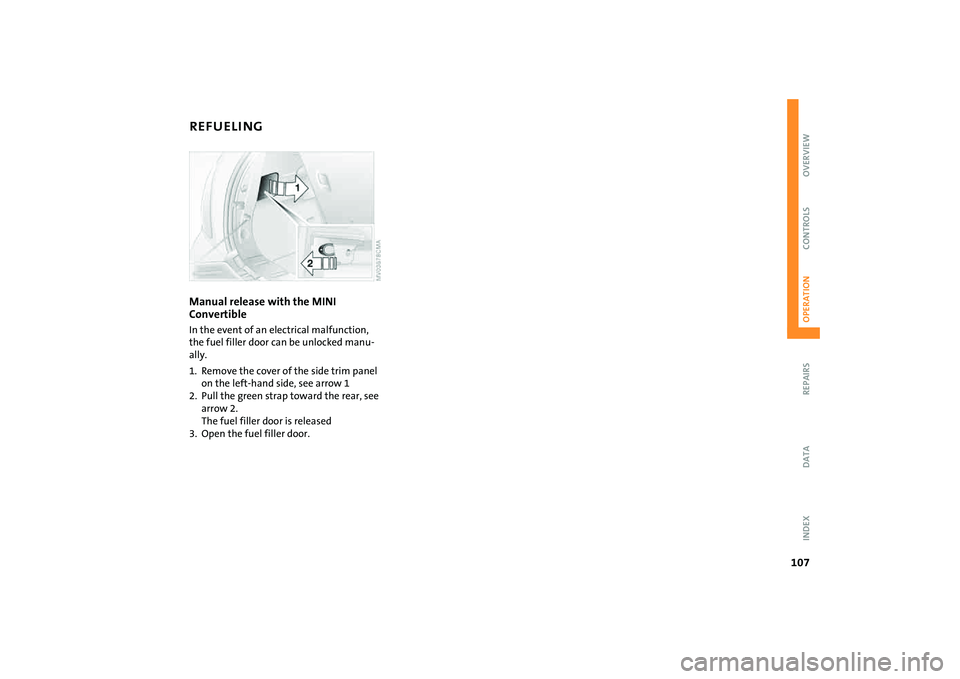
REFUELINGManual release with the MINI
ConvertibleIn the event of an electrical malfunction,
the fuel filler door can be unlocked manu-
ally.
1. Remove the cover of the side trim panel
on the left-hand side, see arrow 1
2. Pull the green strap toward the rear, see
arrow 2.
The fuel filler door is released
3. Open the fuel filler door.
Page 119 of 176
117
OVERVIEW REPAIRSOPERATIONCONTROLS DATA INDEX
NEW WHEELS AND TIRES SNOW CHAINS
*
Special characteristics of winter tires
The manufacturer of your MINI recom-
mends winter tires for driving in adverse
winter road conditions. While all-season
tires with the M+S designation provide bet-
ter winter traction than summer tires, they
generally do not achieve the full perfor-
mance of winter tires.
Observe speed ratings:
Never exceed the maximum speed
for which the winter tires are rated.
tect the tires against contact with oil,
grease and fuel. Do not exceed the tire
inflation pressure specified on the tire side-
wall.
Only certain types of snow chains have
been tested by the manufacturer of your
MINI, classified as road-safe and recom-
mended. Contact your MINI Dealer for
more details. Their use is only permitted in
pairs on the front wheels on winter tires of
the following types:
>175/65 R 15 M+S
>175/60 R 16 M+S.
When fitting, comply with the manufac-
turer's instructions. With chains, do not
exceed a speed of 30 mph / 50 km/h.
Do not initialize the Flat Tire Monitor
after attaching snow chains to the
tires.
When driving with snow chains, it can be
helpful to switch off the ASC or DSC for a
brief period, refer to page72.<
Page 123 of 176
121
OVERVIEW REPAIRSOPERATIONCONTROLS DATA INDEX
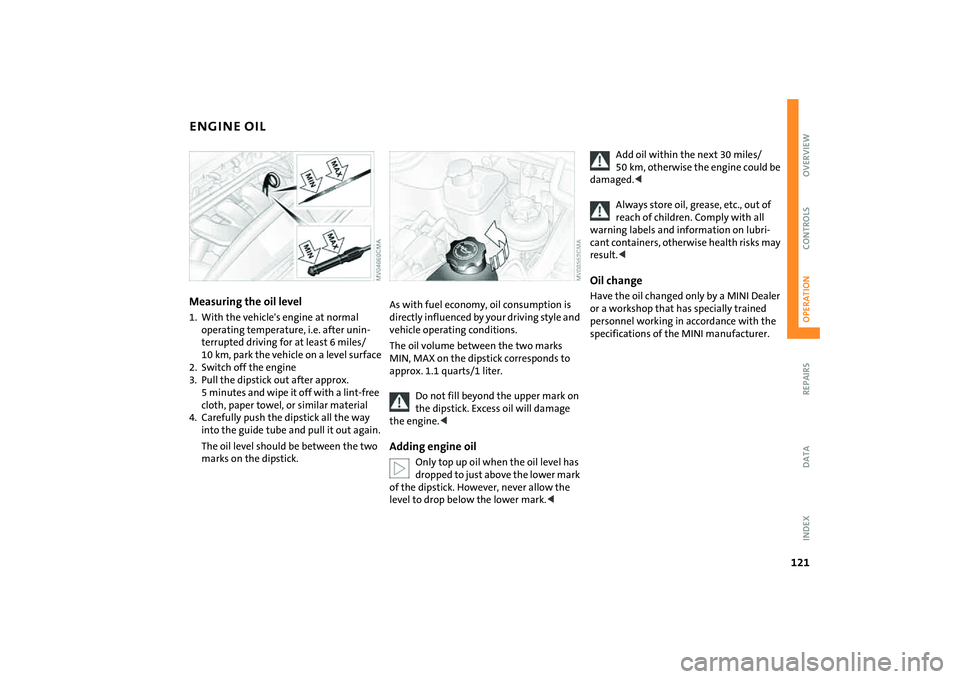
ENGINE OILMeasuring the oil level1. With the vehicle's engine at normal
operating temperature, i.e. after unin-
terrupted driving for at least 6 miles/
10 km, park the vehicle on a level surface
2. Switch off the engine
3. Pull the dipstick out after approx.
5 minutes and wipe it off with a lint-free
cloth, paper towel, or similar material
4. Carefully push the dipstick all the way
into the guide tube and pull it out again.
The oil level should be between the two
marks on the dipstick.
As with fuel economy, oil consumption is
directly influenced by your driving style and
vehicle operating conditions.
The oil volume between the two marks
MIN, MAX on the dipstick corresponds to
approx. 1.1 quarts/1 liter.
Do not fill beyond the upper mark on
the dipstick. Excess oil will damage
the engine.
dropped to just above the lower mark
of the dipstick. However, never allow the
level to drop below the lower mark.<
Add oil within the next 30 miles/
50 km, otherwise the engine could be
damaged.<
Always store oil, grease, etc., out of
reach of children. Comply with all
warning labels and information on lubri-
cant containers, otherwise health risks may
result.<
Oil changeHave the oil changed only by a MINI Dealer
or a workshop that has specially trained
personnel working in accordance with the
specifications of the MINI manufacturer.
Page 128 of 176

126
SOCKET FOR ONBOARD DIAGNOSTICS OBD CARING FOR YOUR VEHICLEPrimary components of exhaust emissions
can be checked by a device via the OBD
socket.
This socket is located to the left of the
driver's side, on the bottom of the instru-
ment panel underneath a cover.Exhaust emission values
The warning lamp comes on. The
exhaust emissions have deterio-
rated. Have the vehicle checked as
soon as possible.
Canadian models display this
warning lamp.
Under some circumstances, the lamp will
flash. This indicates severe engine misfir-
ing. In this case, you should reduce your
speed and visit your nearest MINI Dealer as
soon as possible. Severe engine misfiring
can quickly lead to serious damage of emis-
sions-related components, especially the
catalytic converter.
If the fuel filler cap is not properly
tightened, the OBD system may con-
clude that fuel vapors are escaping, causing
an indicator to light up. If the filler cap is
then tightened, the indicator should go out
within a few days.<
Suitable car-care products
Use the cleaning and car-care prod-
ucts available at your MINI Dealer.<
Washing your vehicleYou can wash your new MINI or MINI Con-
vertible in automatic car washes from the
beginning. Preference should be for cloth
car washes. If, due to lack of availability,
brush car washes must be used, modern
systems with soft brushes should be given
preference.
When using steam cleaners or high-
pressure cleaners, maintain sufficient
distance to the vehicle and do not exceed a
maximum temperature of 1407/606. If
the jet is too close or the pressure is too
high, this can lead to damage or initial
damage that can develop into more serious
damage. Water that enters vehicle compo-
nents can lead to damage over the long
term.
After washing the vehicle, apply the brakes
briefly to dry them, otherwise water can
reduce braking efficiency over the short
term and the brake rotors can corrode.
Switch the rain sensor off when passing
through an automatic car wash, refer to
page63. Failure to do so could result in