lock MINI Hardtop 2 Door 2006 Owner's Guide
[x] Cancel search | Manufacturer: MINI, Model Year: 2006, Model line: Hardtop 2 Door, Model: MINI Hardtop 2 Door 2006Pages: 168, PDF Size: 2.22 MB
Page 42 of 168

40
WIND DEFLECTOR*
With the convertible top open, the wind
deflector keeps air movement in the pas-
senger compartment to a minimum, thus
providing you with a pleasant drive, even at
higher speeds. The wind deflector comes
folded in a protective pouch and can be
stored in the luggage compartment.
Do not allow the wind deflector to
come into contact with sharp objects,
as the net could otherwise be damaged. Do
not place any objects on the installed wind
deflector. When storing the wind deflector
in the luggage compartment, make sure
that it cannot be damaged by other
objects.<
Before installing
1. Take the wind deflector out of the pouch
2. Fold out the wind deflector, arrow 1
3. Press the locking device together until it
engages, arrow 2.
Installing and folding up
1. Slide out securing pins 1 and 2 on one
side until they engage
2. Insert the wind deflector with the secur-
ing pins into the designated openings on
the corresponding side of the vehicle
3. Slide securing pins 1 and 2 on the other
side into the designated openings until
they engage
4. Fold up the upper part of the wind
deflector.
If a seat is in its rearmost position, do
not recline the backrest too far, oth-
erwise the wind deflector could be dam-
aged.<
Page 43 of 168

41
OVERVIEW REPAIRS OPERATIONCONTROLS DATA INDEX
WIND DEFLECTOR*
Removing
1. Fold down the upper part of the wind
deflector
2. Push back securing pin 1. To do so, turn
the handle forward, see arrow 1, and
push it back, see arrow 2
3. Push back securing pin 2 and remove the
wind deflector.
Collapsing
1. To unlock, push the handle of the secur-
ing pin on the side into its rearmost posi-
tion, see arrow 1
2. Collapse the wind deflector, see
arrows 2.
Adjusting screws
The gap between the wind deflector and
the side trim panel can be adjusted using
the adjusting screw.
Page 44 of 168

42
SAFE SEATING POSITION
The ideal seating position can make a vital
contribution to relaxed, relatively fatigue-
free driving. Together with the safety belts
and airbags, the seating position also plays
an important role in providing occupants
with maximum levels of passive safety in
an accident. To ensure that the safety sys-
tems operate with optimal efficiency, we
strongly urge you to observe the instruc-
tions contained in the following section.
For additional information about trans-
porting children safely, refer to page50.
Airbags
Always maintain an adequate dis-
tance between yourself and all of the
airbags. Always hold the steering wheel by
the rim with the hands at the 9 and
3 o'clock positions to keep any chance of
injury to hands or arms to an absolute min-
imum, should the airbag be deployed.
No one and nothing is to come between
the airbags and the seat occupant. Do not
use the front passenger airbag cover as a
storage surface for objects of any kind.
Ensure that the front passenger is correctly
seated, e.g. that no feet or legs are propped
against the dashboard. Otherwise, leg
injury could result if the front passenger
airbag suddenly deployed.
Make sure that passengers do not lean
their heads against the side or head airbag,
as injuries could result if the side airbags
were triggered.<
Even if all these instructions are followed, it
cannot entirely be ruled out that in some
circumstances injury may result from con-
tact with the airbags. In sensitive individu-
als, the ignition and inflation noise may
induce a mild hearing loss that is usually
temporary.
For airbag locations and additional infor-
mation on airbags, refer to page75.
Head restraint
A correctly adjusted head restraint reduces
the risk of injury to the cervical spine in the
event of an accident.
Adjust the head restraint in such a
way that it is centered roughly at ear
level. Otherwise, there is an increased risk
of injury in the event of an accident.<
Safety belt
Fasten your safety belt before each drive.
Airbags are an additional safety device and
work in conjunction with the safety belts,
but do not replace them. Your vehicle is
equipped with four seats, each of which is
provided with a safety belt.
Expectant mothers should always
wear their safety belts, taking care to
position the belt in the pelvic area against
the lower hips, where it will not exert pres-
sure against the abdomen.
Never allow more than one person to wear
a single safety belt. Never allow infants or
small children to ride in a passenger's lap.
Do not route the belt across your neck, or
run it across sharp edges. Be sure that the
belt does not become caught or jammed.
Avoid twisting the belt while routing it
firmly across the hips and shoulder; wear it
as snugly against your body as possible and
do not allow it to rest against hard or frag-
ile objects. Otherwise, the belt in the pelvic
area could slide over the hips in the event
of a frontal impact, leading to abdominal
injury. Avoid wearing bulky clothing and
pull the belt in the upper-body area upward
periodically to retension it. Otherwise, the
restraining effect of the safety belt could
be diminished.<
For information on using the safety belts,
refer to page46.
Page 46 of 168

44
SEAT ADJUSTMENT HEAD RESTRAINTS
Lumbar support*
You can adjust the contour of the backrest
for additional support in the curvature of
your spine's lumbar region. The upper hips
and spinal column receive supplementary
support to help you maintain a relaxed,
upright posture.
Turn the wheel.
The curvature is increased or decreased.
Backrest tilt
1. Pull up the lever at the inside of the seat
2. Apply weight to or remove weight from
the backrest as required
3. Release the lever so that the backrest
locks into place.
Adjusting
To raise: pull the head restraint upward.
To lower: press the button, see arrow 1,
and push the head restraint downward.
A correctly adjusted head restraint reduces
the risk of injury to the cervical spine in the
event of an accident.
Page 47 of 168

45
OVERVIEW REPAIRS OPERATIONCONTROLS DATA INDEX
HEAD RESTRAINTS ENTRY TO THE REAR
Adjust the head restraint in such a
way that it is centered roughly at ear
level. Otherwise, there is an increased risk
of injury in the event of an accident.
To avoid possible violation of traffic laws,
never retract the head restraints unless the
rear seats are empty. Always ensure that
the head restraints are raised before trans-
porting passengers in the rear seat.<
Removal
1. Pull up the head restraint as far as it will
go
2. Press the button, see arrow 1, while pull-
ing the head restraint all the way out.
Installation
1. Insert the head restraint into the guides
2. Adjust the head restraint.
Easy entry
The Easy entry function includes a memory
for the longitudinal seat and the backrest
positions.
1. Push down the lever at the outside of
the seat, see arrow 1.
The backrest folds forward automati-
cally
2. Push the seat forward, see arrow 2.
Original position
Slide the seat back to its home posi-
tion before folding back the backrest,
otherwise the seat is latched in at its cur-
rent position. In this case, adjust the longi-
tudinal position manually, refer to
page43.<
1. Push the seat back into its home posi-
tion
2. Fold the backrest back to the home posi-
tion to lock the seat.
When returning the seat to the rear
position, ensure that no one is
injured and that no objects are damaged.
Engage and lock both seats and backrests
into position prior to driving; otherwise
unexpected movement could increase the
risk of an accident.<
Page 48 of 168

46
SAFETY BELTS
Comply with the instructions on
page42, or the occupants' personal
safety will be diminished.<
Make sure every occupant fastens his or
her safety belt. Airbags are an additional
safety device and work in conjunction with
the safety belts, but do not replace them.
To close
Make sure you hear the lock engage in the
belt buckle.
Safety belt reminder for the front seats
The indicator lamp flashes or lights
up. A signal also sounds. Check if
the safety belts have been properly
fastened.
The safety belt reminder is operational
above a speed of approx. 5 mph / 8 km/h.
The reminder can also occur if objects are
on the front passenger seat.
To release
1. Press the red button in the belt buckle
2. Hold the belt
3. Guide the belt back into its reel.Safety belt height adjustment in the
MINI
Press the button and at the same time push
the entire unit upwards or downwards.
Also observe the instructions on adjusting
the seats on page42.
Safety belt height in the MINI
Convertible
The seat belt height is adapted to your
body size if you are sitting correctly.
Page 49 of 168

47
OVERVIEW REPAIRS OPERATIONCONTROLS DATA INDEX
SAFETY BELTS SEAT HEATING* STEERING WHEEL
Damaged safety belts
If the safety belts are damaged or
stretched in an accident: have the
safety belts including the seat-belt tension-
ers and the belt anchors checked. Have the
necessary work carried out only by a MINI
Dealer or a workshop that has specially
trained personnel working in accordance
with the specifications of the MINI manu-
facturer, otherwise correct operation of
these safety systems is not ensured.<
Press once for each temperature level.
The highest preselected temperature is set
when two LEDs are lit.
To switch off:
Press the button for a longer period.Do not adjust the steering wheel
while the vehicle is moving; other-
wise unexpected movement could increase
the accident risk.<
Settings
1. Push the locking lever downward
2. Adjust the desired steering wheel posi-
tion
3. Pull the lever back in.
Page 51 of 168

49
OVERVIEW REPAIRS OPERATIONCONTROLS DATA INDEX
VEHICLE MEMORY
How the system functions
No doubt you have often reflected on how
great it would be if you could configure
your vehicle's various adjustment settings
to meet your own personal requirements.
In developing this vehicle, the manufac-
turer of the MINI has incorporated a num-
ber of options which can be programmed
specifically for your vehicle.
What the system can do
Your MINI Dealer can provide you with
details on the capabilities of the Vehicle
Memory system.
Examples for Vehicle Memory:
>Automatic locking if none of the vehicle
doors are opened, refer to page26
>Automatic locking after starting to drive,
refer to page28
>Selective central locking system, refer to
pages26, 27
>Convenience operation, refer to
pages26, 27
>Pathway lighting, refer to page59
>Daytime driving lamps, refer to page60
>Speed-dependent windshield wipers,
refer to page62
>Setting units for outside temperature
and fuel consumption display, refer to
page69>Setting units for display of temperatures
specified for automatic climate control
system, refer to page83
>Volume control PDC, refer to page77
>Acoustic alarm for starting PDC activa-
tion, refer to page77.
This symbol alerts you to Vehicle
Memory functions in the Owner's
Manual.<
After memory functions have been
reconfigured, your vehicle may oper-
ate slightly differently from the descrip-
tions used in this Owner's Manual. If you
decide to sell your vehicle one day, please
remember to have the memory functions
reset to their default configuration.<
Page 53 of 168

51
OVERVIEW REPAIRS OPERATIONCONTROLS DATA INDEX
TRANSPORTING CHILDREN SAFELY
Child seat security
All rear safety belts and the safety belt for
the front passenger can be prevented from
being pulled out in order to secure child-
restraint systems.
To lock the safety belt
1. Secure the child-restraint system with
the belt
2. Pull the belt strap all the way out
3. Allow the belt strap to retract and pull it
taut against the child-restraint system.
The safety belt is locked.
To unlock the safety belt
1. Open the seat belt buckle
2. Remove the child-restraint system
3. Allow the belt strap to retract all the way.
Child-restraint systems with tether
strap
As an example, the illustration shows the
MINI COOPER and the MINI COOPER S.
There are two additional anchors for child-
restraint systems with tether straps.
Guiding the tether strap
1. Slide the head restraint up
2. Guide the tether strap through the
mounting for the head restraint
3. Push the head restraint into its lower-
most position.
Page 55 of 168
53
OVERVIEW REPAIRS OPERATIONCONTROLS DATA INDEX
IGNITION LOCK STARTING THE ENGINE
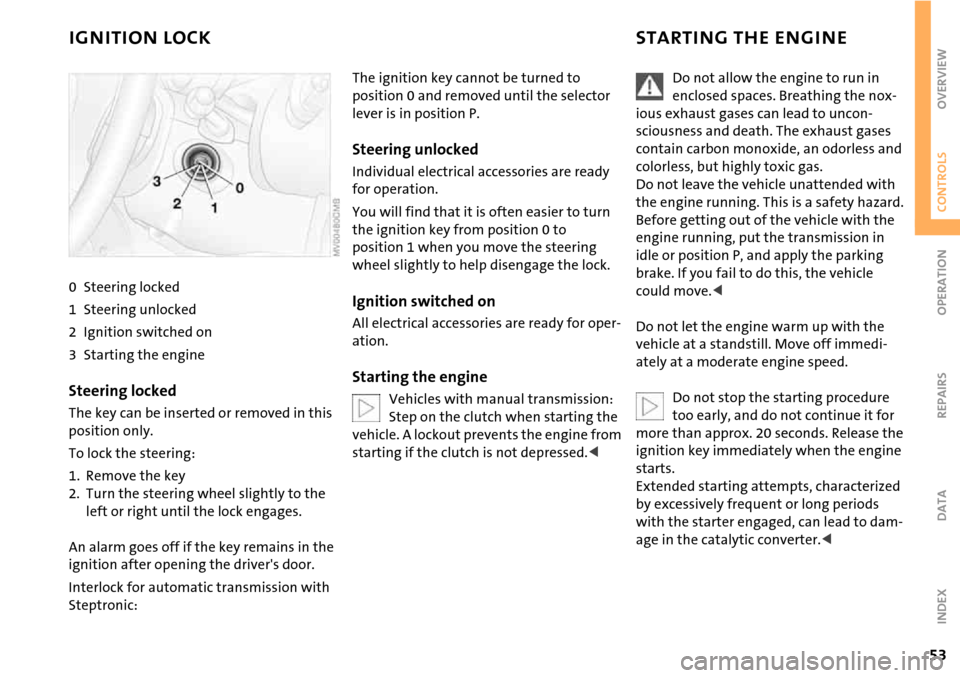
0 Steering locked
1 Steering unlocked
2 Ignition switched on
3 Starting the engine
Steering locked
The key can be inserted or removed in this
position only.
To lock the steering:
1. Remove the key
2. Turn the steering wheel slightly to the
left or right until the lock engages.
An alarm goes off if the key remains in the
ignition after opening the driver's door.
Interlock for automatic transmission with
Steptronic:
The ignition key cannot be turned to
position 0 and removed until the selector
lever is in position P.
Steering unlocked
Individual electrical accessories are ready
for operation.
You will find that it is often easier to turn
the ignition key from position 0 to
position 1 when you move the steering
wheel slightly to help disengage the lock.
Ignition switched on
All electrical accessories are ready for oper-
ation.
Starting the engine
Vehicles with manual transmission:
Step on the clutch when starting the
vehicle. A lockout prevents the engine from
starting if the clutch is not depressed.<
Do not allow the engine to run in
enclosed spaces. Breathing the nox-
ious exhaust gases can lead to uncon-
sciousness and death. The exhaust gases
contain carbon monoxide, an odorless and
colorless, but highly toxic gas.
Do not leave the vehicle unattended with
the engine running. This is a safety hazard.
Before getting out of the vehicle with the
engine running, put the transmission in
idle or position P, and apply the parking
brake. If you fail to do this, the vehicle
could move.<
Do not let the engine warm up with the
vehicle at a standstill. Move off immedi-
ately at a moderate engine speed.
Do not stop the starting procedure
too early, and do not continue it for
more than approx. 20 seconds. Release the
ignition key immediately when the engine
starts.
Extended starting attempts, characterized
by excessively frequent or long periods
with the starter engaged, can lead to dam-
age in the catalytic converter.<