ECU MINI Hardtop 2 Door 2015 (Mini Connected) Owner's Guide
[x] Cancel search | Manufacturer: MINI, Model Year: 2015, Model line: Hardtop 2 Door, Model: MINI Hardtop 2 Door 2015Pages: 244, PDF Size: 11.11 MB
Page 162 of 244

LoadOn 3-door modelsOn 5-door models
The maximum load is the sum of the weight of
the occupants and the cargo.
The greater the weight of the occupants, the
less cargo that can be transported.
Stowing cargo
▷Cover sharp edges and corners on the
cargo.▷Heavy cargo: stow as far forward as possi‐
ble, directly behind and at the bottom of
the rear passenger seat backrests.▷Very heavy cargo: when the rear seat is not
occupied, secure each of the outer safety
belts in the opposite buckle.▷If necessary, fold down the rear backrests
to stow cargo.▷Do not stack cargo above the top edge of
the backrests.Securing cargo
Lashing eyes in the cargo area
Without storage compartment package: to se‐
cure the cargo there are two lashing eyes, ar‐
row 1, in the cargo area.
With storage compartment package: to secure
the cargo there are six lashing eyes, arrows 1
and 2, in the cargo area.
Securing cargo Securing cargo
Stow and secure the cargo as described;
otherwise it may present a danger to the occu‐
pants, e.g., during braking and evasive maneu‐
vers. ◀
▷Smaller and lighter items: secure with re‐
taining straps or with draw straps.▷Larger and heavy objects: secure with
cargo straps.
Attach the cargo straps, retaining straps or
draw straps to the lashing eyes in the trunk.
Roof-mounted luggagerack
Note Installation only possible with roof rack.
Roof racks are available as special accessories.
Seite 158DRIVING TIPSLoading158
Online Edition for Part no. 01 40 2 961 168 - II/15
Page 163 of 244

Securing
Follow the installation instructions of the roof
rack.
Loading Be sure that adequate clearance is maintained
for tilting and opening the glass sunroof.
Because roof racks raise the vehicle's center of
gravity when loaded, they have a major effect
on vehicle handling and steering response.
Therefore, note the following when loading and
driving:▷Do not exceed the approved roof/axle
loads and the approved gross vehicle
weight.▷Distribute the roof load uniformly.▷The roof load should not extend past the
loading area.▷Always place the heaviest pieces on the
bottom.▷Secure the roof luggage firmly, e.g., tie with
ratchet straps.▷Do not let objects project into the opening
path of the tailgate.▷Drive cautiously and avoid sudden acceler‐
ation and braking maneuvers. Take corners
gently.
Rear luggage rack
General information Installation only possible with rear luggage rack
preparation.
Rear racks are available as special accessories.
Note Follow the installation instructions of the rear
luggage rack.
Drive cautiously and avoid sudden acceleration
and braking maneuvers. Take corners gently.
SecuringCOOPER/COOPER D/ONE/ONE DCOOPER S/COOPER SD
The anchorage points, arrow 1, and the socket,
arrow 2, are located below the covers in the
bumper.
Remove the covers before installing the rear
luggage rack.
Power consumption Function of tail lights
Before driving off, check that the tail
lights of the rear luggage rack are functioning
properly; otherwise, there is a risk of endanger‐
ing other traffic. ◀
The rear luggage rack lights must not consume
more than:
▷Turn signals: 42 watts per side.▷Rear lights: 50 watts per side.▷Brake lights: 84 watts in total.▷Rear fog lights: 42 watts in total.Seite 159LoadingDRIVING TIPS159
Online Edition for Part no. 01 40 2 961 168 - II/15
Page 187 of 244

Repairing a flat tireSafety measures in case of a breakdown
Park the vehicle as far away as possible
from passing traffic and on solid ground.
Switch on the hazard warning system.
Turn the steering wheel until the front wheels
are in the straight-ahead position and engage
the steering wheel lock.
Secure the vehicle against rolling away by set‐
ting the parking brake.
Have all vehicle occupants get out of the vehi‐
cle and ensure that they remain outside the im‐
mediate area in a safe place, such as behind a
guardrail.
If necessary, set up a warning triangle at an ap‐
propriate distance.
Comply with all safety guidelines and regula‐
tions. ◀
Mobility System
The concept
With the Mobility System, minor tire damage
can be sealed quickly to enable continued
travel. To accomplish this, sealant is pumped
into the tires, which seals the damage from the
inside.
The compressor can be used to check the tire
inflation pressure.
Hints▷Follow the instructions on using the Mobi‐
lity System found on the compressor and
sealant container.▷Use of the Mobility System may be ineffec‐
tive if the tire puncture measures approx.
1/8 in/4 mm or more.▷Contact the nearest service center if the tire
cannot be made drivable.▷If possible, do not remove foreign bodies
that have penetrated the tire.▷Pull the speed limit sticker off the sealant
container and apply it to the steering
wheel.▷The use of a sealant can damage the TPM
wheel electronics. In this case, have the
electronics checked at the next opportunity
and have them replaced if needed.
Enclosed areas
Do not let the engine run in enclosed
areas, since breathing in exhaust fumes may
lead to loss of consciousness and death. The
exhaust gases contain carbon monoxide, an
odorless and colorless but highly toxic gas. ◀
Storage The Mobility System is located under the cargo
floor panel.
Sealant container
▷Sealant container, arrow 1.▷Filling hose, arrow 2.
Observe use-by date on the sealant container.
Seite 183Wheels and tiresMOBILITY183
Online Edition for Part no. 01 40 2 961 168 - II/15
Page 193 of 244

Never reach into the engine compart‐
ment
Never reach into spaces or gaps in the engine
compartment; otherwise, there is a risk of in‐
jury, e.g., from rotating or hot parts. ◀
Fold down wiper arm
Before opening the hood, ensure that the
wiper arms are against the windshield, or this
may result in damage. ◀
Opening the hood1.Pull lever, arrow 1.
Hood is unlocked2.After the lever is released, pull the lever
again, arrow 2.
Hood can be opened.
Indicator/warning lights
When the hood is opened, a Check Control
message is displayed.
Closing the hood Hood open when driving
If you see any signs that the hood is not
completely closed while driving, pull over im‐
mediately and close it securely. ◀
Danger of jamming
Make sure that the closing path of the
hood is clear; otherwise, injuries may result. ◀
Let the hood fall from approx. 16 in/40 cm, ar‐
row.
The hood must audibly engage on both sides.
Seite 189Engine compartmentMOBILITY189
Online Edition for Part no. 01 40 2 961 168 - II/15
Page 210 of 244

4.Unlock the locking hexagon of the emer‐
gency wheel well using the hexagon at‐
tached to retaining plate.5.Lower the emergency wheel with the wheel
wrench.6.Unscrewing the wheel wrench7.Pull out the well with emergency wheel un‐
der the vehicle toward the rear.8.Remove the spacer and emergency wheel
from the well.9.Stow the well and spacer in the vehicle.
Prepare wheel change
1.Follow the Safety instructions, refer to
page 205.2.With the wheel chock from the wheel
change set, also secure the vehicle against
rolling away at the front wheel of the oppo‐
site side.3.Loosen the wheel lug bolts a half turn.
Jacking up the vehicle
1.Place the vehicle jack at the jacking point
closest to the wheel such that the vehicle
jack foot is vertically beneath the vehiclejacking point with the entire surface on the
ground.2.Insert the vehicle jack head in the rectan‐
gular recess of the jacking point for crank‐
ing it up.3.Crank it up until the wheel in question lifts
off of the ground.
Wheel mounting
1.Unscrew the wheel lug bolts and remove
the wheel.2.Put the new wheel or emergency wheel on
and screw in at least two bolts.
If original MINI light alloy wheels are not
mounted, any accompanying lug bolts also
have to be used.3.Screw in the remaining the lug bolts and
tighten all bolts well in a crosswise pattern.4.Lower the vehicle and remove the vehicle
jack.
After the wheel change
1.Tighten the lug bolts crosswise. The tight‐
ening torque is 101 lb ft/140 Nm.
Check for secure seating of the lug
bolts
For safety reasons, have the secure seating
of the lug bolts checked with a calibrated
torque wrench; otherwise, a safety hazard
results from incorrectly tightened lug
bolts. ◀2.Stow the defective wheel in the trunk.Seite 206MOBILITYReplacing components206
Online Edition for Part no. 01 40 2 961 168 - II/15
Page 212 of 244

▷Date: update.▷Navigation system: wait for the operability
of the navigation.
Disposing of old batteries
Have old batteries disposed of by your
service center or bring them to a recy‐
cling center.
Maintain the battery in an upright position for
transport and storage. Secure the battery so
that it does not tip over during transport.
Fuses Note Replacing fuses
Never attempt to repair a blown fuse and
do not replace a defective fuse with a substi‐
tute of another color or amperage rating; this
could lead to a circuit overload, ultimately re‐
sulting in a fire in the vehicle. ◀
Replacing fuse
The fuses are located in the passenger footwell
under the dashboard.
1.To open, loosen screws, arrow 1.2.Fold down the fuse holder, arrow 2.
Information on the fuse types and locations
is found on a separate sheet.3.Replace the fuse in question.4.The installation is done in reverse order
from the removal.Seite 208MOBILITYReplacing components208
Online Edition for Part no. 01 40 2 961 168 - II/15
Page 216 of 244

▷When the engine is stopped, there is no
power assist. Consequently, more force
needs to be applied when braking and
steering.▷Larger steering wheel movements are re‐
quired.▷The towing vehicle must not be lighter than
the vehicle being towed; otherwise, it will
not be possible to control the vehicle's re‐
sponse.
Tow truck
Have your vehicle transported with a tow truck
with a so-called lift bar or on a flat bed.
Do not lift the vehicle
Do not lift the vehicle by the tow fitting or
body and chassis parts; otherwise, damage
may result. ◀
Towing other vehicles
Hints Light towing vehicle
The towing vehicle must not be lighter
than the vehicle being towed; otherwise, it will
not be possible to control the vehicle's re‐ sponse. ◀
Attaching the tow bar/tow rope correctly
Attach the tow bar or tow rope to the tow
fitting; connecting it to other vehicle parts may
cause damage. ◀
▷Switch on the hazard warning system, de‐
pending on local regulations.▷If the electrical system has failed, clearly
identify the vehicle being towed by placing
a sign or a warning triangle in the rear win‐
dow.
Tow bar
The tow fittings used should be on the same
side on both vehicles.
Should it prove impossible to avoid mounting
the tow bar at an offset angle, please observe
the following:
▷Maneuvering capability is limited going
around corners.▷The tow bar will generate lateral forces if it
is secured with an offset.
Tow rope
When starting to tow the vehicle, make sure
that the tow rope is taut.
To avoid jerking and the associated stresses on
the vehicle components when towing, always
use nylon ropes or nylon straps.
Attaching the tow rope correctly
Only secure the tow rope on the tow fit‐
ting; otherwise, damage can occur when it is
secured on other parts of the vehicle. ◀
Tow fitting
The screw-in tow fitting should always be car‐
ried in the vehicle. It can be screwed in at the
front or rear of the MINI. It is located under the
Seite 212MOBILITYBreakdown assistance212
Online Edition for Part no. 01 40 2 961 168 - II/15
Page 221 of 244

Carpets and floor matsNo objects in the area around the pedals
Keep floor mats, carpets, and any other
objects out of the pedal area; otherwise, the
function of the pedals could be impeded while
driving and create the risk of an accident.
Do not place additional floor mats over existing
mats or other objects.
Only use floor mats that have been approved
for the vehicle and can be properly attached to
floor.
Ensure that the floor mats are securely fastened
again after they were removed for cleaning,
e.g. ◀
Floor mats can be removed from the car's inte‐
rior for cleaning.
If the floor carpets are very dirty, clean with a
microfiber cloth and water or a textile cleaner.
To prevent matting of the carpet, rub back and
forth in the direction of travel only.
Sensor/camera lenses To clean sensors and camera lenses, use a cloth
moistened with a small amount of glass deter‐
gent.
Displays/Screens/Projection lenses Cleaning displays and screens
Do not use any chemical or household
cleaning agents; otherwise, surfaces can be af‐
fected. ◀
Keeping out moisture
Keep all fluids and moisture away from
the unit; otherwise, electrical components can
be damaged. ◀
Avoid pressure
Avoid pressing too hard when cleaning
and do not use abrasive materials; otherwise,
damage can result. ◀
Clean with a clean, antistatic microfiber cloth.For stubborn soiling on the projection lens of
the Head-up Display, dampen the microfiber
cloth with alcohol. Extending projection lens,
refer to page 86.
Long-term
When the vehicle is shut down for longer than
three months, special measures must be taken.
Additional information is available from the
service center.Seite 217CareMOBILITY217
Online Edition for Part no. 01 40 2 961 168 - II/15
Page 235 of 244
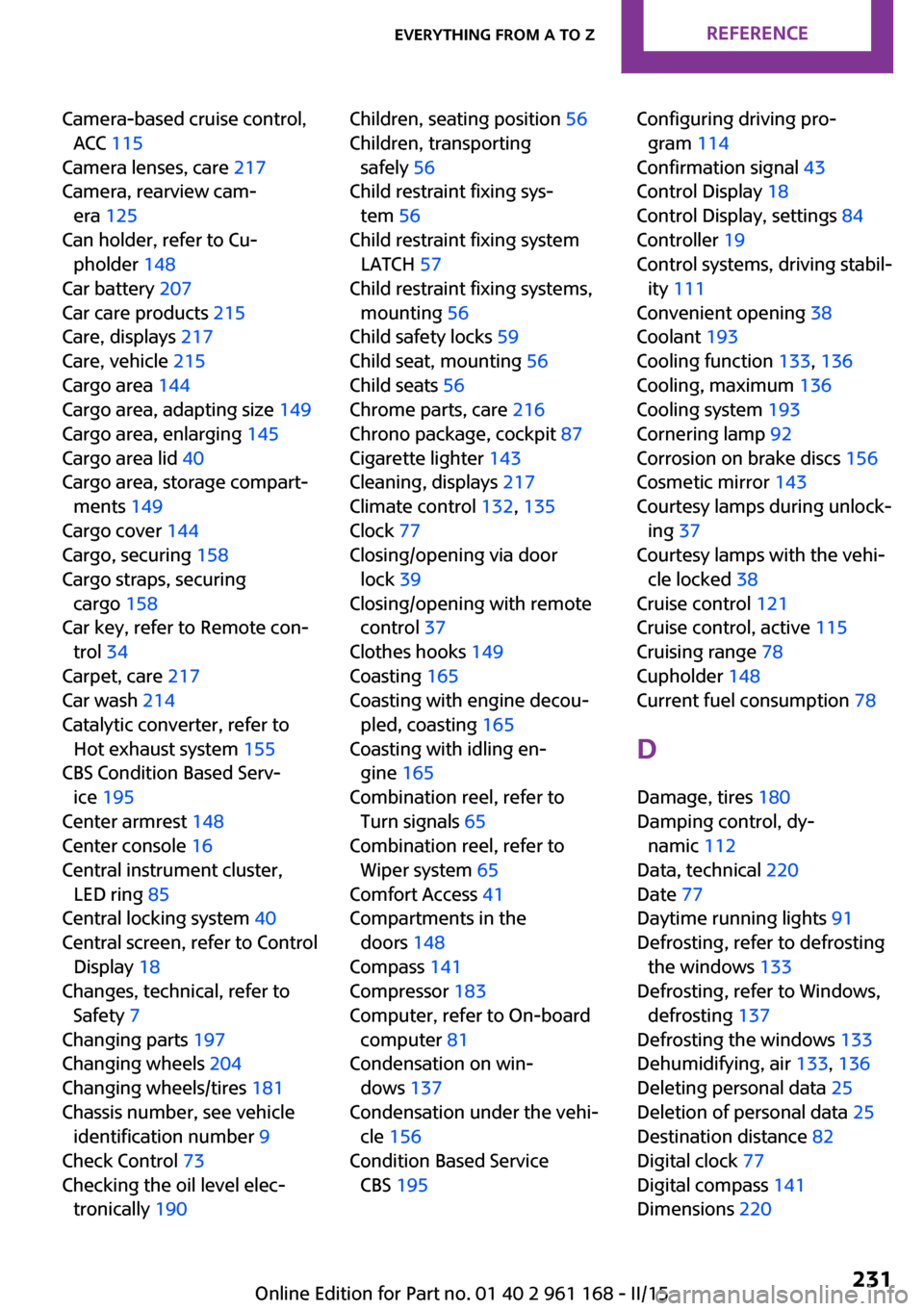
Camera-based cruise control,ACC 115
Camera lenses, care 217
Camera, rearview cam‐ era 125
Can holder, refer to Cu‐ pholder 148
Car battery 207
Car care products 215
Care, displays 217
Care, vehicle 215
Cargo area 144
Cargo area, adapting size 149
Cargo area, enlarging 145
Cargo area lid 40
Cargo area, storage compart‐ ments 149
Cargo cover 144
Cargo, securing 158
Cargo straps, securing cargo 158
Car key, refer to Remote con‐ trol 34
Carpet, care 217
Car wash 214
Catalytic converter, refer to Hot exhaust system 155
CBS Condition Based Serv‐ ice 195
Center armrest 148
Center console 16
Central instrument cluster, LED ring 85
Central locking system 40
Central screen, refer to Control Display 18
Changes, technical, refer to Safety 7
Changing parts 197
Changing wheels 204
Changing wheels/tires 181
Chassis number, see vehicle identification number 9
Check Control 73
Checking the oil level elec‐ tronically 190 Children, seating position 56
Children, transporting safely 56
Child restraint fixing sys‐ tem 56
Child restraint fixing system LATCH 57
Child restraint fixing systems, mounting 56
Child safety locks 59
Child seat, mounting 56
Child seats 56
Chrome parts, care 216
Chrono package, cockpit 87
Cigarette lighter 143
Cleaning, displays 217
Climate control 132, 135
Clock 77
Closing/opening via door lock 39
Closing/opening with remote control 37
Clothes hooks 149
Coasting 165
Coasting with engine decou‐ pled, coasting 165
Coasting with idling en‐ gine 165
Combination reel, refer to Turn signals 65
Combination reel, refer to Wiper system 65
Comfort Access 41
Compartments in the doors 148
Compass 141
Compressor 183
Computer, refer to On-board computer 81
Condensation on win‐ dows 137
Condensation under the vehi‐ cle 156
Condition Based Service CBS 195 Configuring driving pro‐
gram 114
Confirmation signal 43
Control Display 18
Control Display, settings 84
Controller 19
Control systems, driving stabil‐ ity 111
Convenient opening 38
Coolant 193
Cooling function 133, 136
Cooling, maximum 136
Cooling system 193
Cornering lamp 92
Corrosion on brake discs 156
Cosmetic mirror 143
Courtesy lamps during unlock‐ ing 37
Courtesy lamps with the vehi‐ cle locked 38
Cruise control 121
Cruise control, active 115
Cruising range 78
Cupholder 148
Current fuel consumption 78
D
Damage, tires 180
Damping control, dy‐ namic 112
Data, technical 220
Date 77
Daytime running lights 91
Defrosting, refer to defrosting the windows 133
Defrosting, refer to Windows, defrosting 137
Defrosting the windows 133
Dehumidifying, air 133, 136
Deleting personal data 25
Deletion of personal data 25
Destination distance 82
Digital clock 77
Digital compass 141
Dimensions 220 Seite 231Everything from A to ZREFERENCE231
Online Edition for Part no. 01 40 2 961 168 - II/15
Page 236 of 244

Dimmable exterior mirrors 54
Dimmable interior rearview mirror 55
Direction indicator, refer to Turn signals 65
Display, electronic, instrument cluster 73
Display, engine tempera‐ ture 82
Display lighting, refer to In‐ strument lighting 93
Displays 72
Displays, cleaning 217
Disposal, coolant 194
Disposal, vehicle battery 208
Distance control, refer to PDC 123
Distance to destination 82
Divided screen view, split screen 24
Door lock, refer to Remote control 34
Drive mode, GREEN mode 162
Drive-off assistant 114
Drive-off assistant, refer to DSC 111
Driving Dynamics Control 113
Driving Excitement, SPORT 83
Driving instruction, GREEN mode 164
Driving instructions, break- in 154
Driving mode 113
Driving notes, general 154
Driving stability control sys‐ tems 111
Driving style analysis 166
Driving tips 154
DSC Dynamic Stability Con‐ trol 111
DTC Dynamic Traction Con‐ trol 112
Dynamic Damping Con‐ trol 112 Dynamic Stability Control
DSC 111
Dynamic Traction Control DTC 112
E
Electronic displays, instrument cluster 73
Electronic oil measure‐ ment 190
Electronic Stability Program ESP, refer to DSC 111
Emergency detection, remote control 35
Emergency release, fuel filler flap 170
Emergency start function, en‐ gine start 35
Emergency wheel, compact wheel, refer to Emergency
wheel 205
Energy Control 78
Engine, automatic Start/Stop function 62
Engine, automatic switch- off 62
Engine compartment 188
Engine compartment, working in 188
Engine coolant 193
Engine idling when driving, coasting 165
Engine oil 190
Engine oil, adding 191
Engine oil additives 191
Engine oil change 192
Engine oil filler neck 191
Engine oil types, alterna‐ tive 192
Engine oil types, ap‐ proved 192
Engine start during malfunc‐ tion 35
Engine start, jump-start‐ ing 209 Engine start, refer to Starting
the engine 61
Engine stop 61
Engine temperature, dis‐ play 82
Entering a car wash 214
Equipment, interior 139
Error displays, see Check Con‐ trol 73
ESP Electronic Stability Pro‐ gram, refer to DSC 111
Exchanging wheels/tires 181
Exhaust system 155
Exterior mirror, automatic dimming feature 54
Exterior mirrors 53
External start 209
External temperature dis‐ play 77
External temperature warn‐ ing 77
Eyes for securing cargo 158
F
Failure message, see Check Control 73
False alarm, refer to Uninten‐ tional alarm 44
Fan, refer to Air flow 133, 136
Favorites buttons, onboard monitor 24
Filler neck for engine oil 191
Fine wood, care 216
First aid kit 209
Fitting for towing, see tow fit‐ ting 212
Flat tire, changing wheels 204
Flat Tire Monitor FTM 102
Flat tire, repairing 183
Flat tire, Tire Pressure Monitor TPM 98
Flat tire, warning lamp 99, 102
Flooding 155
Floor carpet, care 217 Seite 232REFERENCEEverything from A to Z232
Online Edition for Part no. 01 40 2 961 168 - II/15