inflation pressure MINI Paceman 2016 (Mini Connected) User Guide
[x] Cancel search | Manufacturer: MINI, Model Year: 2016, Model line: Paceman, Model: MINI Paceman 2016Pages: 223, PDF Size: 5.52 MB
Page 155 of 223
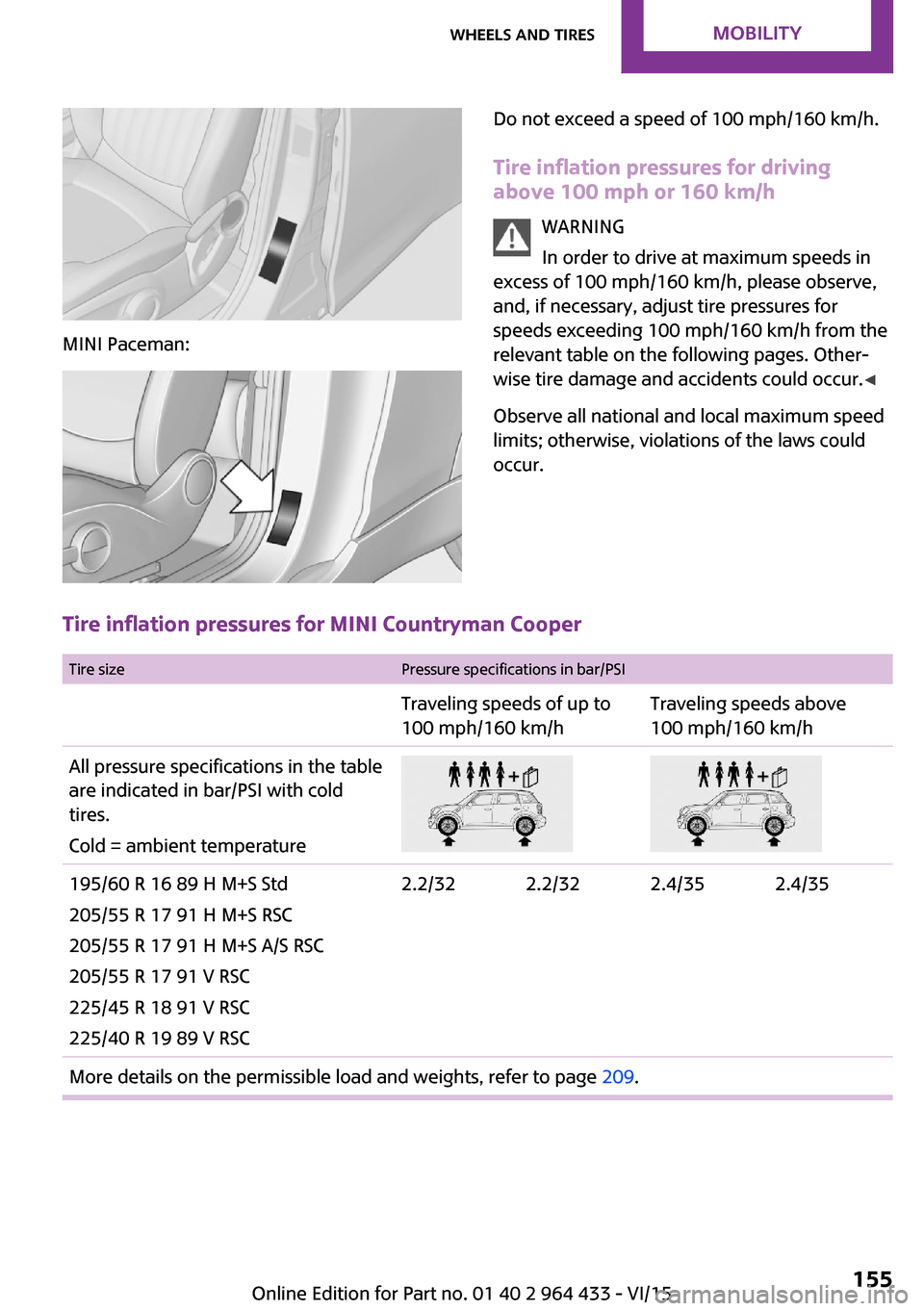
MINI Paceman:
Do not exceed a speed of 100 mph/160 km/h.
Tire inflation pressures for driving
above 100 mph or 160 km/h
WARNING
In order to drive at maximum speeds in
excess of 100 mph/160 km/h, please observe,
and, if necessary, adjust tire pressures for
speeds exceeding 100 mph/160 km/h from the
relevant table on the following pages. Other‐
wise tire damage and accidents could occur. ◀
Observe all national and local maximum speed
limits; otherwise, violations of the laws could
occur.
Tire inflation pressures for MINI Countryman Cooper
Tire sizePressure specifications in bar/PSITraveling speeds of up to
100 mph/160 km/hTraveling speeds above
100 mph/160 km/hAll pressure specifications in the table
are indicated in bar/PSI with cold
tires.
Cold = ambient temperature195/60 R 16 89 H M+S Std
205/55 R 17 91 H M+S RSC
205/55 R 17 91 H M+S A/S RSC
205/55 R 17 91 V RSC
225/45 R 18 91 V RSC
225/40 R 19 89 V RSC2.2/322.2/322.4/352.4/35More details on the permissible load and weights, refer to page 209.Seite 155Wheels and tiresMOBILITY155
Online Edition for Part no. 01 40 2 964 433 - VI/15
Page 156 of 223
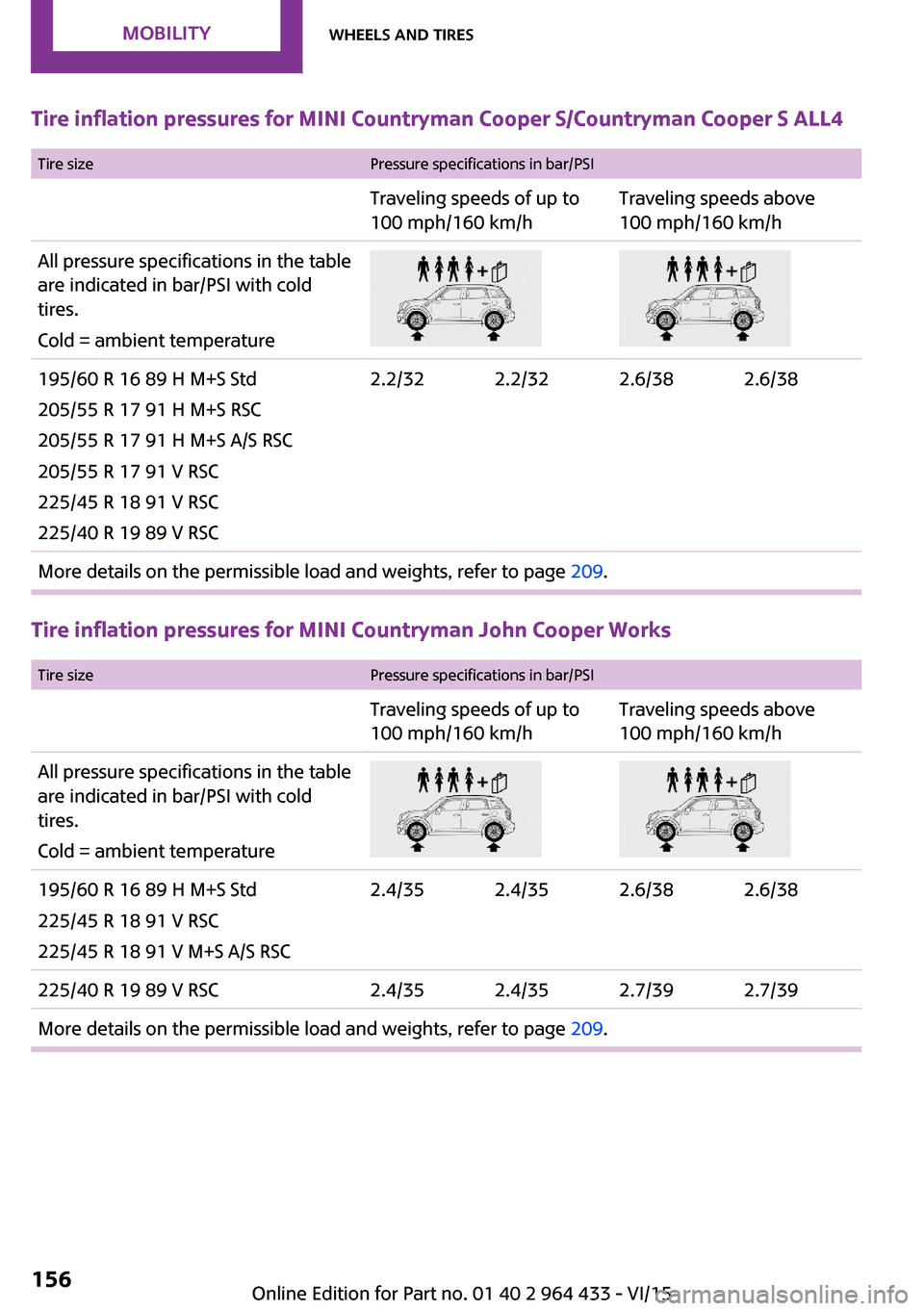
Tire inflation pressures for MINI Countryman Cooper S/Countryman Cooper S ALL4
Tire sizePressure specifications in bar/PSITraveling speeds of up to
100 mph/160 km/hTraveling speeds above
100 mph/160 km/hAll pressure specifications in the table
are indicated in bar/PSI with cold
tires.
Cold = ambient temperature195/60 R 16 89 H M+S Std
205/55 R 17 91 H M+S RSC
205/55 R 17 91 H M+S A/S RSC
205/55 R 17 91 V RSC
225/45 R 18 91 V RSC
225/40 R 19 89 V RSC2.2/322.2/322.6/382.6/38More details on the permissible load and weights, refer to page 209.
Tire inflation pressures for MINI Countryman John Cooper Works
Tire sizePressure specifications in bar/PSITraveling speeds of up to
100 mph/160 km/hTraveling speeds above
100 mph/160 km/hAll pressure specifications in the table
are indicated in bar/PSI with cold
tires.
Cold = ambient temperature195/60 R 16 89 H M+S Std
225/45 R 18 91 V RSC
225/45 R 18 91 V M+S A/S RSC2.4/352.4/352.6/382.6/38225/40 R 19 89 V RSC2.4/352.4/352.7/392.7/39More details on the permissible load and weights, refer to page 209.Seite 156MOBILITYWheels and tires156
Online Edition for Part no. 01 40 2 964 433 - VI/15
Page 157 of 223
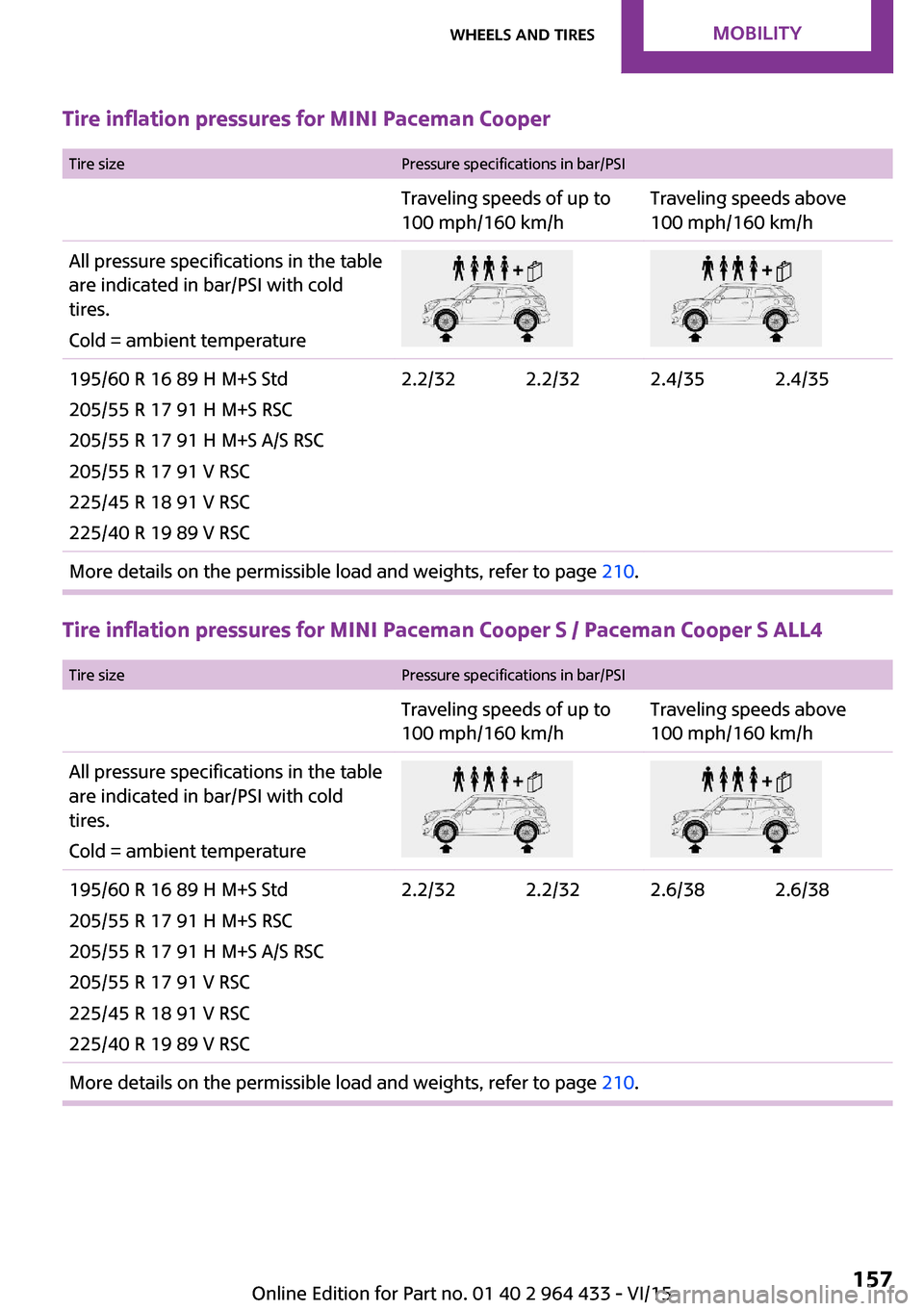
Tire inflation pressures for MINI Paceman Cooper
Tire sizePressure specifications in bar/PSITraveling speeds of up to
100 mph/160 km/hTraveling speeds above
100 mph/160 km/hAll pressure specifications in the table
are indicated in bar/PSI with cold
tires.
Cold = ambient temperature195/60 R 16 89 H M+S Std
205/55 R 17 91 H M+S RSC
205/55 R 17 91 H M+S A/S RSC
205/55 R 17 91 V RSC
225/45 R 18 91 V RSC
225/40 R 19 89 V RSC2.2/322.2/322.4/352.4/35More details on the permissible load and weights, refer to page 210.
Tire inflation pressures for MINI Paceman Cooper S / Paceman Cooper S ALL4
Tire sizePressure specifications in bar/PSITraveling speeds of up to
100 mph/160 km/hTraveling speeds above
100 mph/160 km/hAll pressure specifications in the table
are indicated in bar/PSI with cold
tires.
Cold = ambient temperature195/60 R 16 89 H M+S Std
205/55 R 17 91 H M+S RSC
205/55 R 17 91 H M+S A/S RSC
205/55 R 17 91 V RSC
225/45 R 18 91 V RSC
225/40 R 19 89 V RSC2.2/322.2/322.6/382.6/38More details on the permissible load and weights, refer to page 210.Seite 157Wheels and tiresMOBILITY157
Online Edition for Part no. 01 40 2 964 433 - VI/15
Page 158 of 223
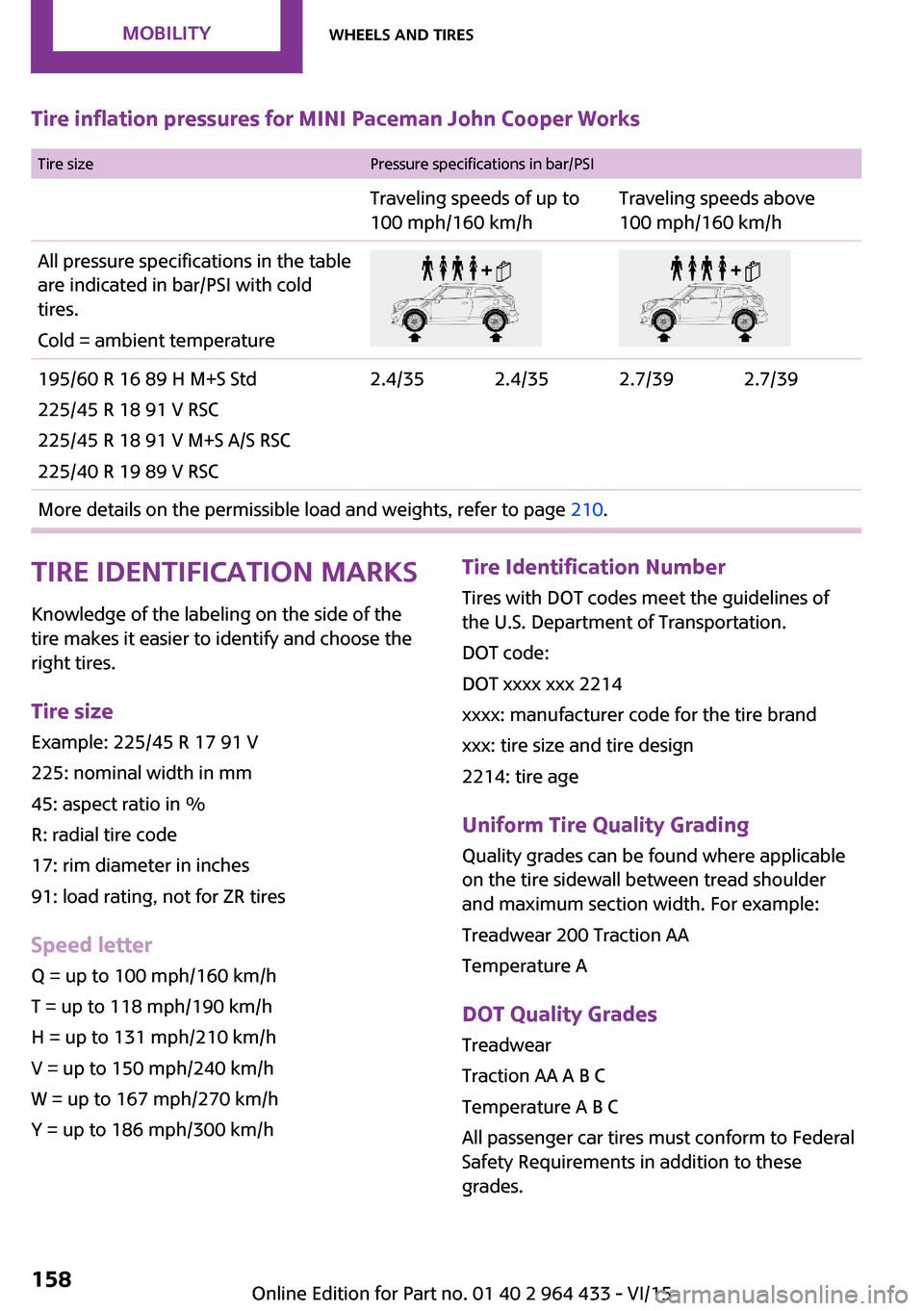
Tire inflation pressures for MINI Paceman John Cooper Works Tire sizePressure specifications in bar/PSITraveling speeds of up to
100 mph/160 km/hTraveling speeds above
100 mph/160 km/hAll pressure specifications in the table
are indicated in bar/PSI with cold
tires.
Cold = ambient temperature195/60 R 16 89 H M+S Std
225/45 R 18 91 V RSC
225/45 R 18 91 V M+S A/S RSC
225/40 R 19 89 V RSC2.4/352.4/352.7/392.7/39More details on the permissible load and weights, refer to page 210.Tire identification marks
Knowledge of the labeling on the side of the tire makes it easier to identify and choose the
right tires.
Tire size Example: 225/45 R 17 91 V
225: nominal width in mm
45: aspect ratio in %
R: radial tire code
17: rim diameter in inches
91: load rating, not for ZR tires
Speed letter Q = up to 100 mph/160 km/h
T = up to 118 mph/190 km/h
H = up to 131 mph/210 km/h
V = up to 150 mph/240 km/h
W = up to 167 mph/270 km/h
Y = up to 186 mph/300 km/hTire Identification Number Tires with DOT codes meet the guidelines of
the U.S. Department of Transportation.
DOT code:
DOT xxxx xxx 2214
xxxx: manufacturer code for the tire brand
xxx: tire size and tire design
2214: tire age
Uniform Tire Quality Grading Quality grades can be found where applicable
on the tire sidewall between tread shoulder
and maximum section width. For example:
Treadwear 200 Traction AA
Temperature A
DOT Quality Grades
Treadwear
Traction AA A B C
Temperature A B C
All passenger car tires must conform to Federal
Safety Requirements in addition to these
grades.Seite 158MOBILITYWheels and tires158
Online Edition for Part no. 01 40 2 964 433 - VI/15
Page 162 of 223

Run-flat tiresWhen mounting new tires or changing fromsummer to winter tires or vice versa, use run-
flat tires for your own safety. Also, a compact
wheel is not available in case of a flat tire. A
dealer’s service center will be glad to answer
any questions you may have.
Rotating wheels between axles
Different wear patterns occur on the front and
rear axles, depending on the individual condi‐
tions of use.
To ensure even wear on the tires, the wheels
can be rotated between the axles. A dealer’s
service center will be glad to answer any ques‐
tions you may have.
After changing the tires, check the tire inflation
pressure and correct it if necessary.
Storage
Store wheels and tires in a cool, dry place with
as little exposure to light as possible.
Always protect tires against all contact with oil,
grease and fuels.
Do not exceed the maximum tire inflation pres‐
sure indicated on the side wall of the tire.
Run-flat tires
Label
The symbol identifying run-flat tires is a circle
with the letters RSC on the sidewall.
Run-flat tires are tires that support themselves
for a limited period of time, and they may also
come with special rims. The sidewall reinforce‐
ment ensures that the tire can continue to be
used to a limited extent if it has lost pressure
and even if it has become completely depres‐
surized.
For continued driving in the event of a flat tire,
refer to page 78.
Correcting a flat tire
Safety measures▷Park the vehicle as far as possible from
passing traffic and on solid ground. Switch
on the hazard warning system.▷Let the steering wheel lock engage with the
wheels in the straight-ahead position, set
the parking brake, and engage first gear or
reverse, or engage selector lever position P.▷Have all vehicle occupants get out of the
vehicle and ensure that they remain out‐
side the immediate area in a safe place,
such as behind a guardrail.▷If a warning triangle or portable hazard
warning lamp is required, set it up on the
roadside at an appropriate distance from
the rear of the vehicle. Comply with all
safety guidelines and regulations.
The procedure to correct a flat tire depends on
the equipment in the vehicle:
▷Run-flat tires, refer to page 162.▷MINI Mobility System, refer to page 162.
MINI Mobility System
Information
▷Follow the instructions on using the Mobi‐
lity System found on the compressor and
sealant bottle.Seite 162MOBILITYWheels and tires162
Online Edition for Part no. 01 40 2 964 433 - VI/15
Page 163 of 223
▷Use of the Mobility System may be ineffec‐
tive if tire damage is greater than approx.
1/8 in/4 mm in size.▷Contact a dealer’s service center or another
qualified service center or repair shop if the
tire cannot be made drivable.▷If possible, do not remove foreign bodies
that have penetrated the tire.▷Pull the speed limit sticker off the sealant
bottle and apply it to the steering wheel.
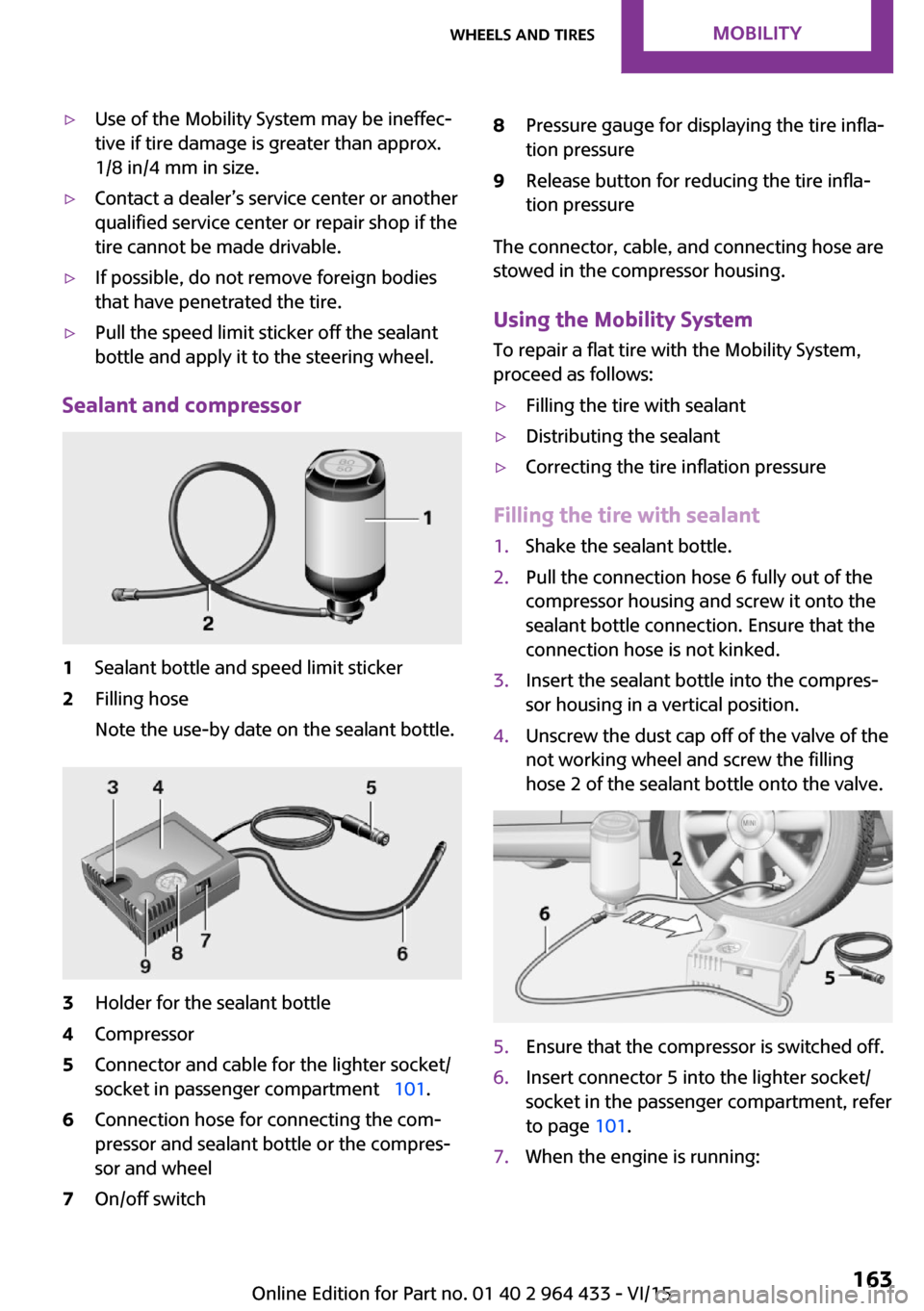
Sealant and compressor
1Sealant bottle and speed limit sticker2Filling hose
Note the use-by date on the sealant bottle.3Holder for the sealant bottle4Compressor5Connector and cable for the lighter socket/
socket in passenger compartment 101.6Connection hose for connecting the com‐
pressor and sealant bottle or the compres‐
sor and wheel7On/off switch8Pressure gauge for displaying the tire infla‐
tion pressure9Release button for reducing the tire infla‐
tion pressure
The connector, cable, and connecting hose are
stowed in the compressor housing.
Using the Mobility System
To repair a flat tire with the Mobility System,
proceed as follows:
▷Filling the tire with sealant▷Distributing the sealant▷Correcting the tire inflation pressure
Filling the tire with sealant
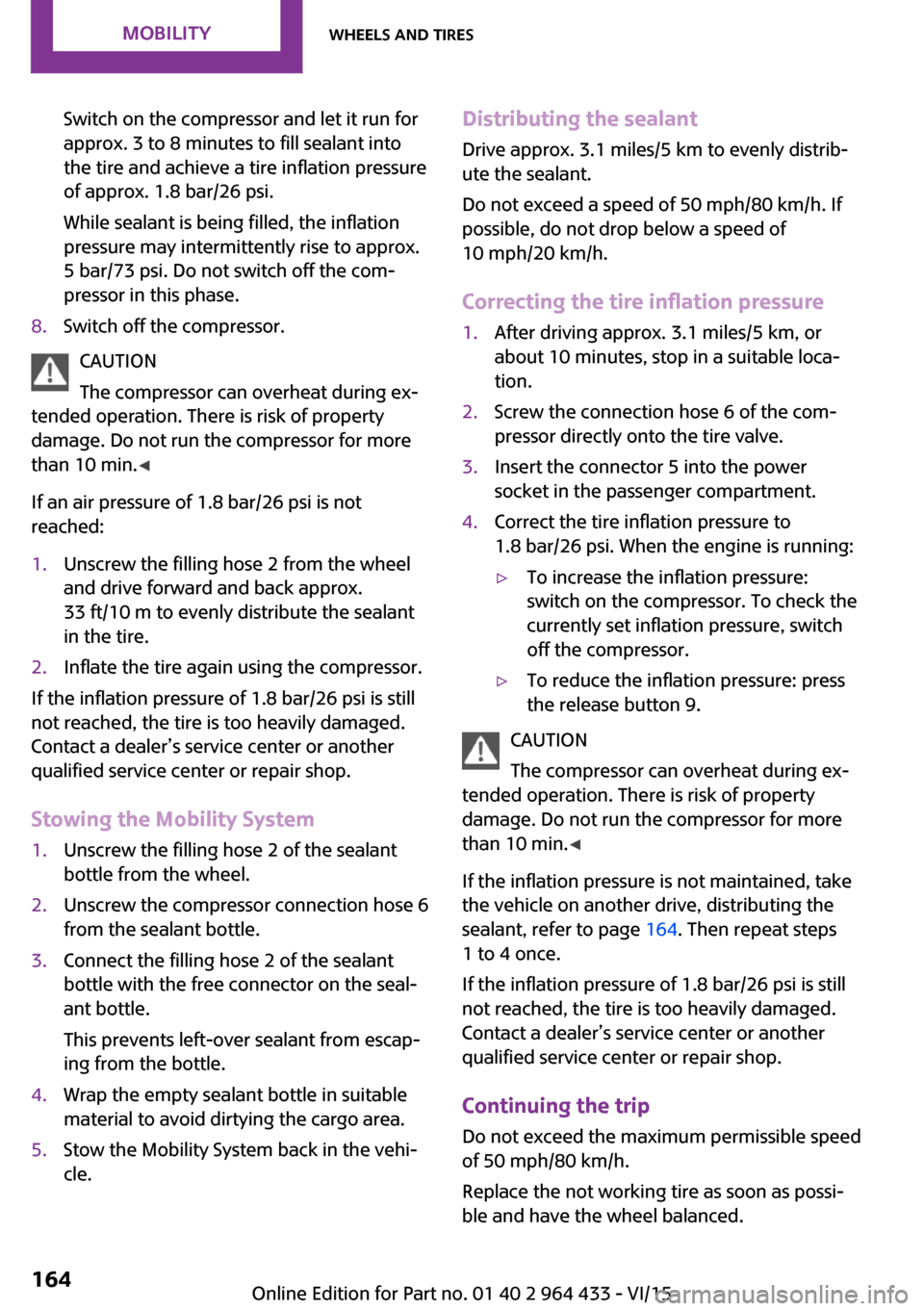
1.Shake the sealant bottle.2.Pull the connection hose 6 fully out of the
compressor housing and screw it onto the
sealant bottle connection. Ensure that the
connection hose is not kinked.3.Insert the sealant bottle into the compres‐
sor housing in a vertical position.4.Unscrew the dust cap off of the valve of the
not working wheel and screw the filling
hose 2 of the sealant bottle onto the valve.5.Ensure that the compressor is switched off.6.Insert connector 5 into the lighter socket/
socket in the passenger compartment, refer
to page 101.7.When the engine is running:Seite 163Wheels and tiresMOBILITY163
Online Edition for Part no. 01 40 2 964 433 - VI/15
Page 164 of 223
Switch on the compressor and let it run for
approx. 3 to 8 minutes to fill sealant into
the tire and achieve a tire inflation pressure
of approx. 1.8 bar/26 psi.
While sealant is being filled, the inflation
pressure may intermittently rise to approx.
5 bar/73 psi. Do not switch off the com‐
pressor in this phase.8.Switch off the compressor.
CAUTION
The compressor can overheat during ex‐
tended operation. There is risk of property
damage. Do not run the compressor for more
than 10 min. ◀
If an air pressure of 1.8 bar/26 psi is not
reached:
1.Unscrew the filling hose 2 from the wheel
and drive forward and back approx.
33 ft/10 m to evenly distribute the sealant
in the tire.2.Inflate the tire again using the compressor.
If the inflation pressure of 1.8 bar/26 psi is still
not reached, the tire is too heavily damaged.
Contact a dealer’s service center or another
qualified service center or repair shop.
Stowing the Mobility System
1.Unscrew the filling hose 2 of the sealant
bottle from the wheel.2.Unscrew the compressor connection hose 6
from the sealant bottle.3.Connect the filling hose 2 of the sealant
bottle with the free connector on the seal‐
ant bottle.
This prevents left-over sealant from escap‐
ing from the bottle.4.Wrap the empty sealant bottle in suitable
material to avoid dirtying the cargo area.5.Stow the Mobility System back in the vehi‐
cle.Distributing the sealant
Drive approx. 3.1 miles/5 km to evenly distrib‐
ute the sealant.
Do not exceed a speed of 50 mph/80 km/h. If
possible, do not drop below a speed of
10 mph/20 km/h.
Correcting the tire inflation pressure1.After driving approx. 3.1 miles/5 km, or
about 10 minutes, stop in a suitable loca‐
tion.2.Screw the connection hose 6 of the com‐
pressor directly onto the tire valve.3.Insert the connector 5 into the power
socket in the passenger compartment.4.Correct the tire inflation pressure to
1.8 bar/26 psi. When the engine is running:▷To increase the inflation pressure:
switch on the compressor. To check the
currently set inflation pressure, switch
off the compressor.▷To reduce the inflation pressure: press
the release button 9.
CAUTION
The compressor can overheat during ex‐
tended operation. There is risk of property
damage. Do not run the compressor for more
than 10 min. ◀
If the inflation pressure is not maintained, take
the vehicle on another drive, distributing the
sealant, refer to page 164. Then repeat steps
1 to 4 once.
If the inflation pressure of 1.8 bar/26 psi is still
not reached, the tire is too heavily damaged.
Contact a dealer’s service center or another
qualified service center or repair shop.
Continuing the trip Do not exceed the maximum permissible speed
of 50 mph/80 km/h.
Replace the not working tire as soon as possi‐
ble and have the wheel balanced.
Seite 164MOBILITYWheels and tires164
Online Edition for Part no. 01 40 2 964 433 - VI/15
Page 202 of 223

12CauseHow to respondLight up in yellow:Flat Tire Monitor failed. Punctures are not
indicated.Have the system checked.In vehicles with the Tire Pressure MonitorLight up in yellow and red:There is a flat tire or substantial loss of tire
pressure.Stop carefully. Additional informa‐
tion, refer to page 79.In vehicles with the Tire Pressure MonitorLight up in yellow:Tire Pressure Monitor not initialized.Check the inflation pressure and re‐
set the system, refer to page 79.The small light flashes yellow and then stays
on, the large light lights up in yellow:Tire Pressure Monitor failed. Punctures are
not indicated.Have the system checked.A wheel without TPM electronics is
mounted.Have the system checked.TPM is temporarily malfunctioning due to
other systems or devices using the same
radio frequency.In vehicles with the Tire Pressure MonitorThe small light flashes yellow and then stays
on, the large light lights up in yellow:Tire Pressure Monitor failed. Punctures are
not indicated.Have the system checked.A wheel without TPM electronics is
mounted.Have the system checked.Lights up in red:Seite 202MOBILITYIndicator/warning lamps202
Online Edition for Part no. 01 40 2 964 433 - VI/15
Page 216 of 223
Hazard warning system 15
Head airbags 74
Headlamp control, refer to Parking lamps/low
beams 69
Headlamps, care 191
Headlight control, auto‐ matic 69
Headlight courtesy delay fea‐ ture 71
Headlight flasher 53
Headlights 69
Headlights, cleaning, washer fluid 57
Head restraints 41
Head restraints, adjusting the height 41
Head restraints, removing 42
Heatable rear window, air conditioner 92
Heatable windshield 95
Heating, rear window with au‐ tomatic climate control 95
Heating, seats 38
Heating, windshield 95
Height adjustment, seats 36
High-beams 70
High beams, bulb replace‐ ment 176
Hill drive-off assistant 86
Hills 114
Holder for remote control, re‐ fer to Ignition lock 50
Homepage 6
Hood 167
Hood, closing 167
Hood, opening 167
Hood, unlocking 167
Horn 12
Hydraulic brake assistant 84
I
Ice warning, refer to External temperature warning 61 Icy roads, refer to External
temperature warning 61
Identification marks, run-flat tires 162
Identification marks, tires 158
Ignition 50
Ignition key position 1, refer to Radio ready state 50
Ignition key position 2, refer to Ignition on 50
Ignition key, refer to Remote control with integrated
key 20
Ignition lock 50
Ignition, switched off 51
Ignition, switched on 50
Indicator and warning lamps, overview 194
Indicator and warning lamps, Tire Pressure Monitor
TPM 80
Indicator and warning lights 15
Individual air distribution 92
Inflation pressure monitor, re‐ fer to Flat Tire Monitor 77
Inflation pressure monitor, re‐ fer to Tire Pressure Monitor
TPM 79
Inflation pressure, refer to Tire inflation pressure 154
Initializing, compass, refer to Calibrating 99
Initializing, Flat Tire Monitor FTM 78
Initializing, glass sunroof, electrical 33
Instrument cluster, refer to Displays 14
Instrument lighting 72
Instruments, refer to Cock‐ pit 12
Integrated key 20
Integrated universal remote control 96
Interior equipment 96 Interior lights 72
Interior lights, remote con‐ trol 24
Interior mirror 43
Interior motion sensor 32
Interior rearview mirror, com‐ pass 98
Interior temperature, setting, air conditioner 91
Interior temperature, setting, automatic climate con‐
trol 93
Internet page 6
J Jump-starting 184
K
Keyless Go, refer to Comfort Access 28
Keyless opening and closing, refer to Comfort Access 28
Key Memory, refer to Personal Profile 21
Key, refer to Remote control with integrated key 20
Kickdown, Steptronic trans‐ mission 58
Knee airbag 74
Knocking control 152
L Lamp and bulb replacement, bulb replacement 175
Lamp, replacing, refer to Lamp and bulb replace‐
ment 175
Lamps 69
Lamps, automatic headlight control 69
Lap-and-shoulder belt, refer to Safety belts 38 Seite 216REFERENCEEverything from A to Z216
Online Edition for Part no. 01 40 2 964 433 - VI/15
Page 219 of 223
Restraining systems, refer toSafety belts 38
Restraint systems for chil‐ dren 45
Retreaded tires 161
Reverse gear, manual trans‐ mission 57
Roadside Assistance 184
Roadside parking light, bulb replacement 177
Roadside parking lights 70
RON recommended fuel grade 152
RON, refer to Fuel quality 152
Rubber seals, care 192
Run-flat tires 162
Run-flat tires, flat tire 78
Run-flat tires, tire inflation pressure 154
S
Safe braking 113
Safety belts, care 193
Safety belts, damage 41
Safety belts, indicator/warning light 41
Safety belts, rear center safety belt 40
Safety belts, reminder 41
Safety systems, airbags 74
Safety systems, safety belts 38
Saving fuel 120
Seat adjustment 37
Seat adjustment, manual 36
Seat belts 38
Seat heating 38
Seats 36
Seats, adjusting 36
Seats, heating 38
Seats, sitting safely 36
Selector lever lock, overrid‐ ing 59 Selector lever lock, refer to Se‐
lector level positions, chang‐
ing, shiftlock 58
Selector lever positions, Step‐ tronic transmission 58
Selector lever, Steptronic transmission 58
Service and warranty 7
Service data in the remote control 172
Service interval display, refer to Condition Based Service
CBS 172
Service interval display, refer to Service requirements 66
Service requirements 66
Service requirements, CBS Condition Based Service 172
Settings and information 63
Settings, clock 64
Settings, configuring, refer to Personal Profile 21
Shifting, manual transmis‐ sion 57
Shifting, Steptronic transmis‐ sion 58
Shift lever, Steptronic trans‐ mission 58
Shift paddles on the steering wheel 59
Side airbags 74
Side windows, refer to Win‐ dows 33
Sitting safely 36
Sliding/tilting sunroof, refer to Glass sunroof, electrical 32
Slot for remote control 50
Snap-in adapter, mobile phone 145
Snow chains 165
Socket, OBD Onboard Diagno‐ sis 173
Special equipment, series equipment 6
Speed, average 63
Speedometer 14 Speed, with winter tires 161
Sport button 86
Sport program, Steptronic transmission 58
Stability control systems 84
Start/Stop button 50
Start/Stop button, starting the engine 51
Start/Stop button, switching off the engine 52
Starting the engine 51
Start problems, refer to Jump- starting 184
Steering wheel 44
Steering wheel, adjusting 44
Steering wheel lock 50
Steering wheel, shift pad‐ dles 59
Steptronic transmission 57
Steptronic transmission, kick‐ down 58
Steptronic transmission, over‐ riding the selector lever
lock 59
Stopping, engine 52
Storage, tires 162
Storing the vehicle 193
Summer tires, refer to Wheels and tires 154
Summer tires, tread 159
Sun visor 98
Switches, refer to Cockpit 12
Switching off, engine 52
Switching off, vehicle 52
Symbols 6
T Tachometer 62
Tailgate 27
Tailgate, Comfort Access 29
Tailgate, opening/closing 27
Tailgate, opening from the outside 27
Tail lights 179 Seite 219Everything from A to ZREFERENCE219
Online Edition for Part no. 01 40 2 964 433 - VI/15