wheel MITSUBISHI 3000GT 1991 Owners Manual
[x] Cancel search | Manufacturer: MITSUBISHI, Model Year: 1991, Model line: 3000GT, Model: MITSUBISHI 3000GT 1991Pages: 1146, PDF Size: 76.68 MB
Page 723 of 1146
L,
SERVICE
BRAKES
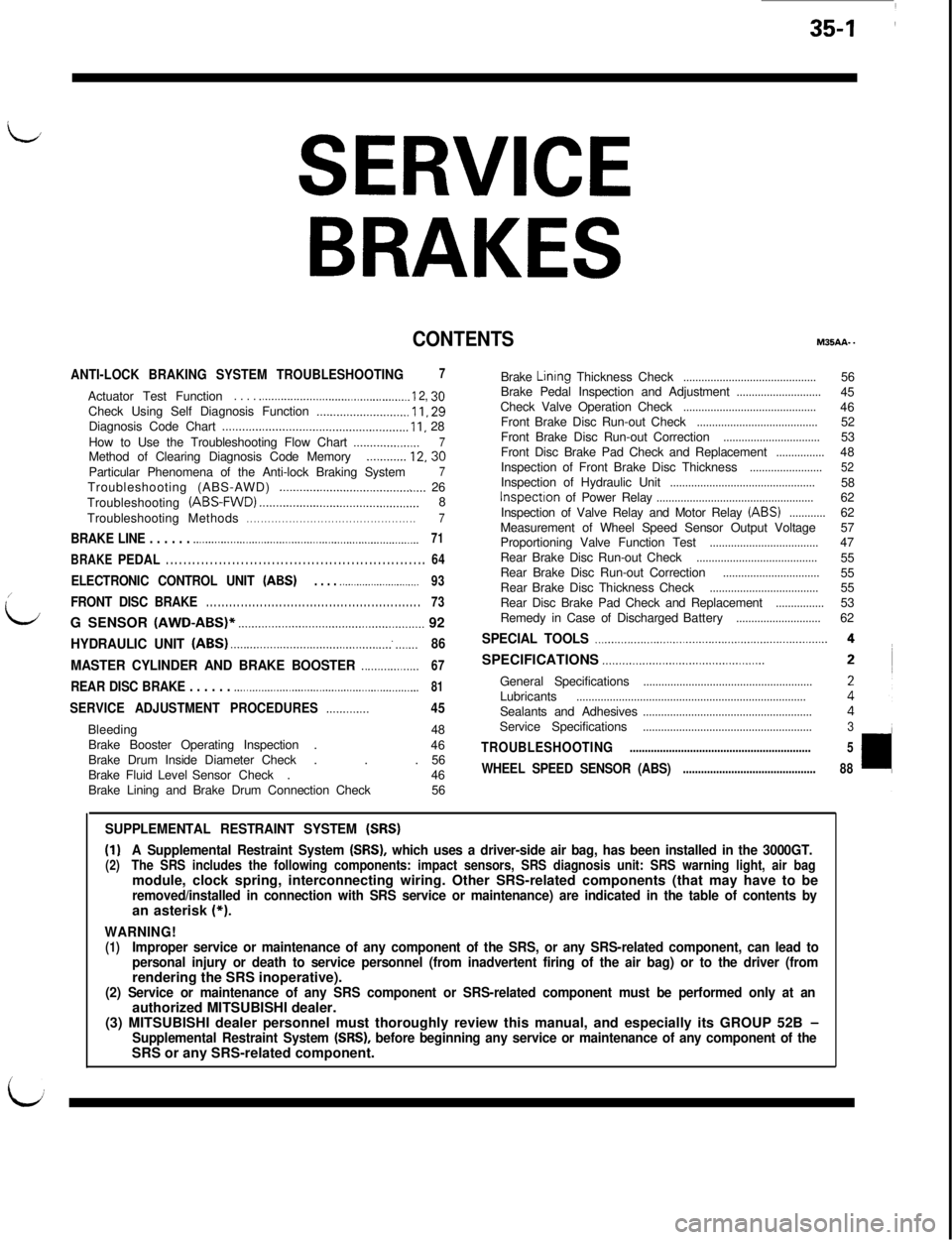
CONTENTSM35AA..
ANTI-LOCK BRAKING SYSTEM TROUBLESHOOTING7Actuator Test Function
. . . . ..___..._____.__................................ I 2, 36Check Using Self Diagnosis Function __._.....,_._.._____........ 11, 28
Diagnosis Code Chart ..,,........,......_..................................,. 1 I, 28
How to Use the Troubleshooting Flow Chart
_____.___......._._.7Method of Clearing Diagnosis Code Memory._.,._...... 12, 30
Particular Phenomena of the Anti-lock Braking System
7Troubleshooting (ABS-AWD) ._______._.._...........................,... 26
Troubleshooting (ABS-FWD) ______.._._........_...........,.....,.....,....8
TroubleshootingMethods. . . . . . . . . . . . . . . . . . . . . . . . . . . . . . . . . . . . . . . . . . . . . . . .7
BRAKE LINE . . . . . . .._.......................................................................71
BRAKEPEDAL. . . . . . . . . . . . . . . . . . . . . . . . . . . . . . . . . . . . . . . . . . . . . . . . . . . . . . . . . . .64
ELECTRONIC CONTROL UNIT (ABS). . . . .._._..___..__._............93/
L
FRONT DISC BRAKE. . . . . . . . . . . . . . . . . . . . . . . . . . . . . . . . . . . . . . . . . . . . . . . . . . . . . . . .73G SENSOR (AWD-ABS)’
____.____.___.__._._.................,,......,.....,.... 92
HYDRAULIC UNIT (ABS) .___.._._._._.______.............,...,,..........~ .,_____86
MASTER CYLINDER AND BRAKE BOOSTER ..__.._____.._____67SPECIFICATIONS ._....._.___.....................................
REAR DISC BRAKE . . . . . . .._..._._.___................................................81
SERVICE ADJUSTMENT PROCEDURES..___........45Bleeding48
Brake Booster Operating Inspection.
46
Brake Drum Inside Diameter Check. . .56
BrakeFluidLevelSensor Check.46
Brake Lining and Brake Drum Connection Check56Brake
Linrng Thickness Check............................................Brake Pedal Inspection and Adjustment............................Check Valve Operation Check............................................Front Brake Disc Run-out Check........................................Front Brake Disc Run-out Correction................................Front Disc Brake Pad Check and Replacement................Inspection of Front Brake Disc Thickness........................Inspection of Hydraulic Unit................................................Inspectton of Power Relay....................................................Inspection of Valve Relay and Motor Relay (ABS)............Measurement of Wheel Speed Sensor Output Voltage
Proportioning Valve Function Test
....................................Rear Brake Disc Run-out Check........................................Rear Brake Disc Run-out Correction................................Rear Brake Disc Thickness Check....................................Rear Disc Brake Pad Check and Replacement................Remedy in Case of DischargedBattery............................56
45
46
52
53
48
5258
62
62
57
47
55
55
55
53
62
SPECIAL TOOLS ..__.......___..........................................................General Specifications
........................................................Lubricants............................................................................Sealants and Adhesives........................................................Service Specifications........................................................3
TROUBLESHOOTING............................................................5
WHEEL SPEED SENSOR (ABS)............................................88
SUPPLEMENTAL RESTRAINT SYSTEM (SRS)
(1)A Supplemental Restraint System (SRS), which uses a driver-side air bag, has been installed in the 3000GT.(2)The SRS includes the following components: impact sensors, SRS diagnosis unit: SRS warning light, air bagmodule, clock spring, interconnecting wiring. Other SRS-related components (that may have to be
removed/installed in connection with SRS service or maintenance) are indicated in the table of contents byan asterisk (*).
WARNING!(1)Improper service or maintenance of any component of the SRS, or any SRS-related component, can lead to
personal injury or death to service personnel (from inadvertent firing of the air bag) or to the driver (fromrendering the SRS inoperative).
(2) Service or maintenance of any SRS component or SRS-related component must be performed only at anauthorized MITSUBISHI dealer.
(3) MITSUBISHI dealer personnel must thoroughly review this manual, and especially its GROUP 52B
-Supplemental Restraint System (SRS), before beginning any service or maintenance of any component of theSRS or any SRS-related component.
i
Page 724 of 1146
35-2SERVICE BRAKES - Specifications
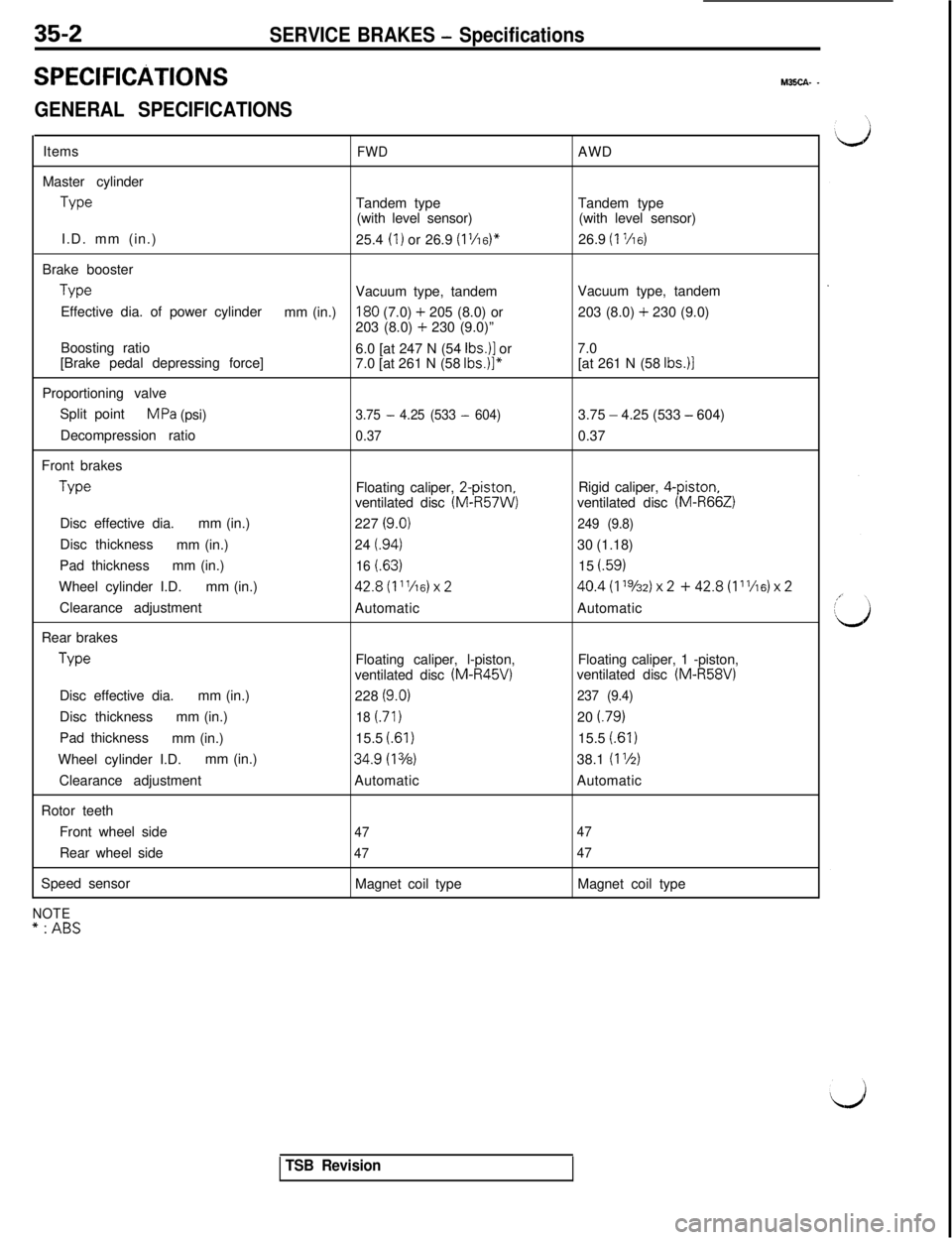
SPECIFICATIONSrvKwx.- -
GENERAL SPECIFICATIONSItems
FWDAWD
Master cylinderTypeTandem type
(with level sensor)Tandem type
(with level sensor)
I.D. mm (in.)
25.4
(1) or 26.9 (1 %s)*26.9 (1 '/l6)Brake boosterTypeVacuum type, tandemVacuum type, tandem
Effective dia. of power cylinder
mm (in.)
180 (7.0) + 205 (8.0) or203 (8.0) + 230 (9.0)
203 (8.0) + 230 (9.0)”
Boosting ratio
6.0 [at 247 N (54
Ibs.)] or7.0
[Brake pedal depressing force]
7.0 [at 261 N (58 Ibs.)]”[at 261 N (58 Ibs.)]Proportioning valve
Split point
MPa (psi)3.75 - 4.25 (533 - 604)3.75 - 4.25 (533 - 604)
Decompression ratio
0.370.37
Front brakesTypeFloating caliper, 2-piston,Rigid caliper, 4-piston,
ventilated disc (M-R57W)ventilated disc
(M-R66Z)Disc effective dia.mm (in.)
227
(9.0)249 (9.8)Disc thickness
mm (in.)24
(.94)30 (1.18)
Pad thicknessmm (in.)
16 (.63)15 l.59)
Wheel cylinder I.D.mm (in.)
42.8(1"/16)X240.4(1'g/32)x2 +42.8(1"/16)~2
Clearance adjustment
AutomaticAutomatic
Rear brakesTypeFloating caliper, l-piston,
ventilated disc
(M-R45V)Floating caliper, 1 -piston,
ventilated disc (M-R58V)Disc effective dia.mm (in.)
228
(9.0)237 (9.4)Disc thicknessmm (in.)
18 (.71)20 (.79)Pad thickness
mm (in.)15.5
(.61)15.5 (.61)Wheel cylinder I.D.mm (in.)
34.9 (13/8)38.1 (1%)
Clearance adjustmentAutomaticAutomatic
Rotor teeth
Front wheel side
4747Rear wheel side
4747Speed sensor
Magnet coil typeMagnet coil type
NOTE*:ABS
TSB Revision
Page 725 of 1146
L
i
SERVICE BRAKES - Specifications
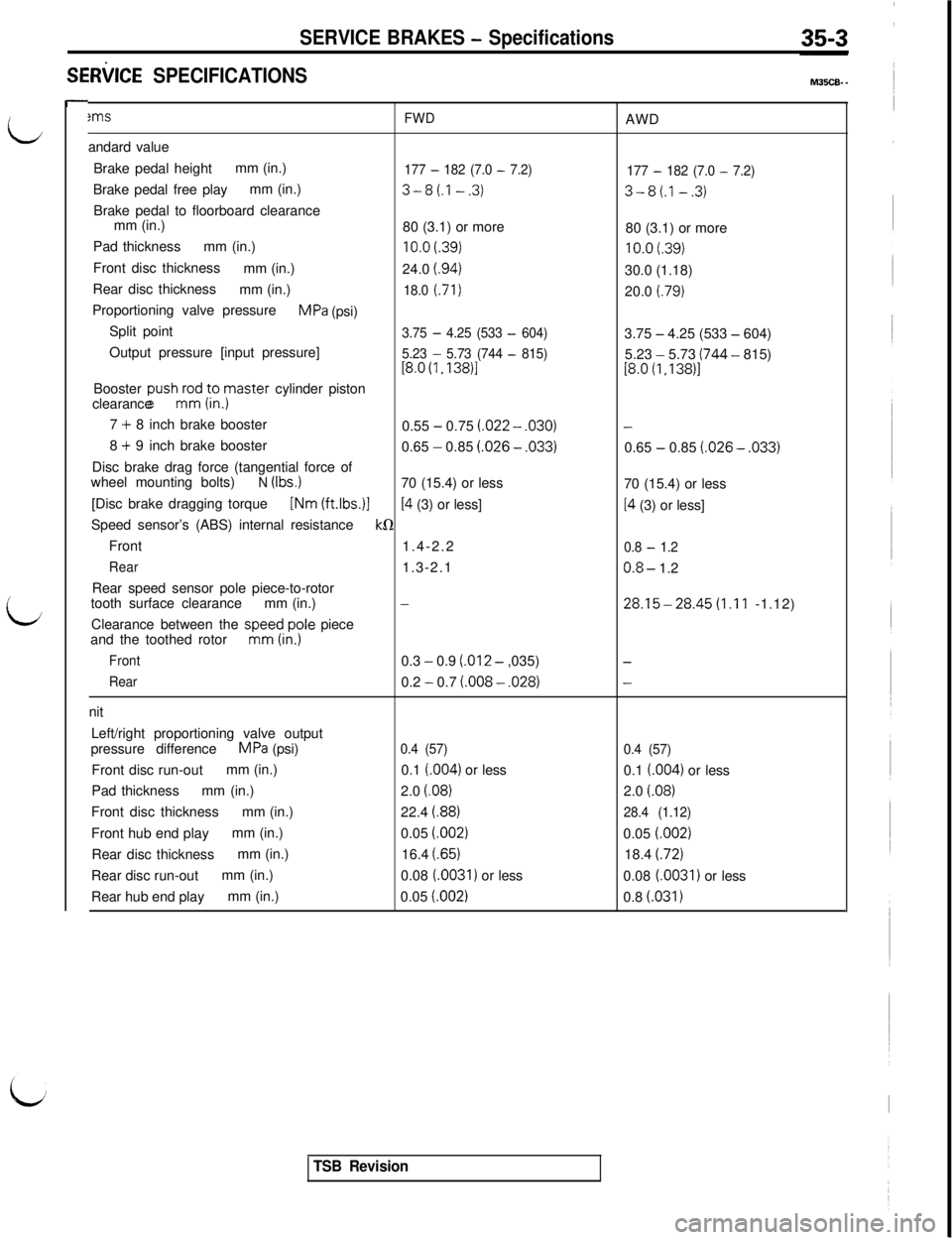
SERVICE SPECIFICATIONS
3msFWDAWD
andard value
Brake pedal heightmm (in.)
177 - 182 (7.0 - 7.2)
177 - 182 (7.0 - 7.2)Brake pedal free playmm (in.)
3-8(.1 -.3)3-8(.1 -.3)Brake pedal to floorboard clearance
mm (in.)
80 (3.1) or more
80 (3.1) or more
Pad thicknessmm (in.)
10.0 (.39)10.0 (.39)Front disc thickness
mm (in.)
24.0
t.94)30.0 (1.18)
Rear disc thickness
mm (in.)
18.0 (71)
20.0 (.79)Proportioning valve pressure
MPa (psi)
Split point
3.75 - 4.25 (533 - 604)3.75 - 4.25 (533 - 604)
Output pressure [input pressure]
5.23 - 5.73 (744 - 815)f8.0 (I, 138)]5.23 - 5.73 (744- 815)18.0 (1,138)]Booster
push;; (To,,;?aster cylinder piston
clearance
7
+ 8 inch brake booster
0.55 - 0.75 (.022 - ,030)-8 + 9 inch brake booster
0.65
- 0.85 (.026 - ,033)0.65 - 0.85 (026 - ,033)Disc brake drag force (tangential force of
wheel mounting bolts)
N (Ibs.)70 (15.4) or less
70 (15.4) or less
[Disc brake dragging torque[Nm (ft.lbs.)]
[4 (3) or less][4 (3) or less]
Speed sensor’s (ABS) internal resistance
kQFront
1.4-2.2
0.8 - 1.2
Rear1.3-2.1
0.8- 1.2
Rear speed sensor pole piece-to-rotor
tooth surface clearancemm (in.)
-28.15-28.45(1.11 -1.12)
Clearance between the
spmefm;l[yle piece
and the toothed rotor
Front0.3 - 0.9 (.012 - ,035)-
Rear0.2 - 0.7 (008 - .028)-nit
Left/right proportioning valve output
pressure difference
MPa (psi)0.4 (57)
0.4 (57)Front disc run-outmm (in.)
0.1
(.004) or less
0.1 (.004) or less
Pad thicknessmm (in.)
2.0
(08)2.0 (08)Front disc thicknessmm (in.)
22.4
(.88)28.4 (1.12)Front hub end playmm (in.)
0.05
(.002)0.05 (.002)Rear disc thicknessmm (in.)
16.4
(65)18.4 (.72)Rear disc run-outmm (in.)
0.08
(0031) or less
0.08 (.0031) or less
Rear hub end playmm (in.)
0.05
(002)0.8 (.031)
TSB Revision
Page 728 of 1146

35-6SERVICE BRAKES - TroubleshootingSymptomProbable cause
Remedy
Insufficient parking
Worn brake pad
brake functionReplace
Excessive parking brake lever stroke
Adjust the parking brake lever stroke
or check the parking brake cable
routing
Grease or oil on pad surface
Replace
Parking brake cable sticking
Replace
Stuck caliper piston
Replace
Scraping or grindingWorn brake pad
noise when brakes areReplace
appliedCaliper to wheel interferenceCorrect or replace
Cracked brake discCorrect or replace
Squealing, groaning or
chattering noise whenDisc brakes
- missing or damaged brake pad
anti-squeak shimReplace
brakes are applied
Brake discs and pads worn or scoredCorrect or replace
Improper lining partsCorrect or replace
Disc brakes-burred or rusted calipersClean or deburr
Dirty, greased, contaminated or glazed padClean or replace
Incorrect adjustment of brake pedal or booster
push-rodAdjust
Squealing noise whenDisc brakes
- rusted, stuck
brakes are not appliedLubricate or replace
Loose or extra parts in brakesRetighten
Improper positioning of pads in caliperCorrect
Improper installation of support mounting toCorrect
caliper body
Poor return of brake booster or master cylinderReplace
Incorrect adjustment of brake pedal or booster
push-rodAdjust
Groaning, clicking orStones or foreign material trapped inside wheelRemove stones, etc.
rattling noise whencovers
brakes are not applied
Loose wheel nutsRetighten
Disc brakes-failure of shimReplace
Disc brakes
- loose installation boltRetighten
Incorrect adjustment of brake pedal or booster
push-rodAdjust
TSB Revision
d
d
Page 729 of 1146
SERVICE BRAKES -Anti-lock Braking System Troubleshooting35-7
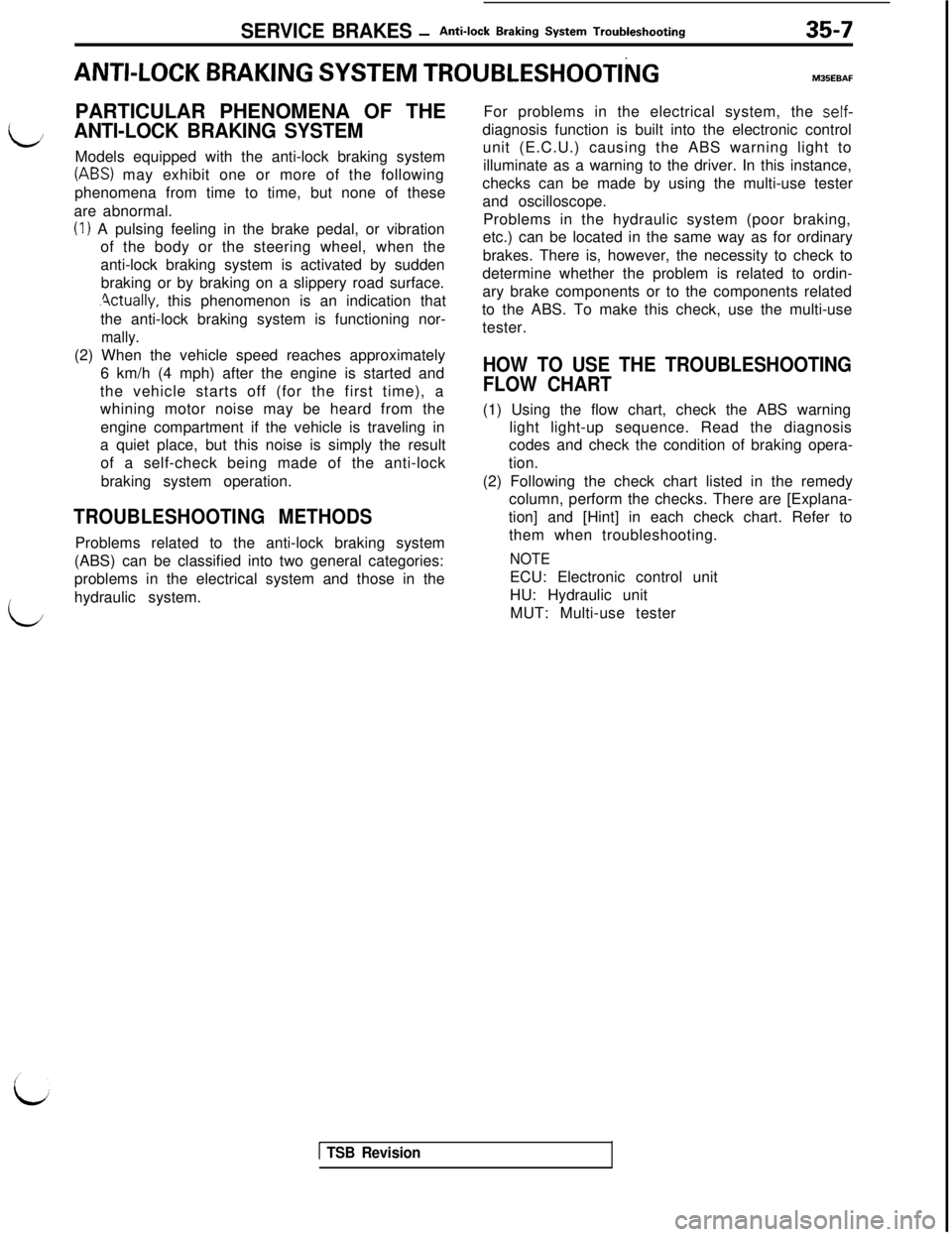
ANTI-LOCK BRAKING SYSTEM TROUBLESHOOTlilGPARTICULAR PHENOMENA OF THE
LANTI-LOCK BRAKING SYSTEMModels equipped with the anti-lock braking system
(ABS) may exhibit one or more of the following
phenomena from time to time, but none of these
are abnormal.
(1) A pulsing feeling in the brake pedal, or vibration
of the body or the steering wheel, when the
anti-lock braking system is activated by sudden
braking or by braking on a slippery road surface.
.9ctually, this phenomenon is an indication that
the anti-lock braking system is functioning nor-
mally.(2) When the vehicle speed reaches approximately
6 km/h (4 mph) after the engine is started and
the vehicle starts off (for the first time), a
whining motor noise may be heard from the
engine compartment if the vehicle is traveling in
a quiet place, but this noise is simply the result
of a self-check being made of the anti-lock
braking system operation.
TROUBLESHOOTING METHODSProblems related to the anti-lock braking system
(ABS) can be classified into two general categories:
problems in the electrical system and those in the
Lhydraulic system.For problems in the electrical system, the
self-diagnosis function is built into the electronic control
unit (E.C.U.) causing the ABS warning light to
illuminate as a warning to the driver. In this instance,
checks can be made by using the multi-use tester
and oscilloscope.
Problems in the hydraulic system (poor braking,
etc.) can be located in the same way as for ordinary
brakes. There is, however, the necessity to check to
determine whether the problem is related to ordin-
ary brake components or to the components related
to the ABS. To make this check, use the multi-use
tester.
HOW TO USE THE TROUBLESHOOTING
FLOW CHART(1) Using the flow chart, check the ABS warning
light light-up sequence. Read the diagnosis
codes and check the condition of braking opera-
tion.
(2) Following the check chart listed in the remedy
column, perform the checks. There are [Explana-
tion] and [Hint] in each check chart. Refer to
them when troubleshooting.
NOTEECU: Electronic control unit
HU: Hydraulic unit
MUT: Multi-use tester
1 TSB Revision
Page 731 of 1146
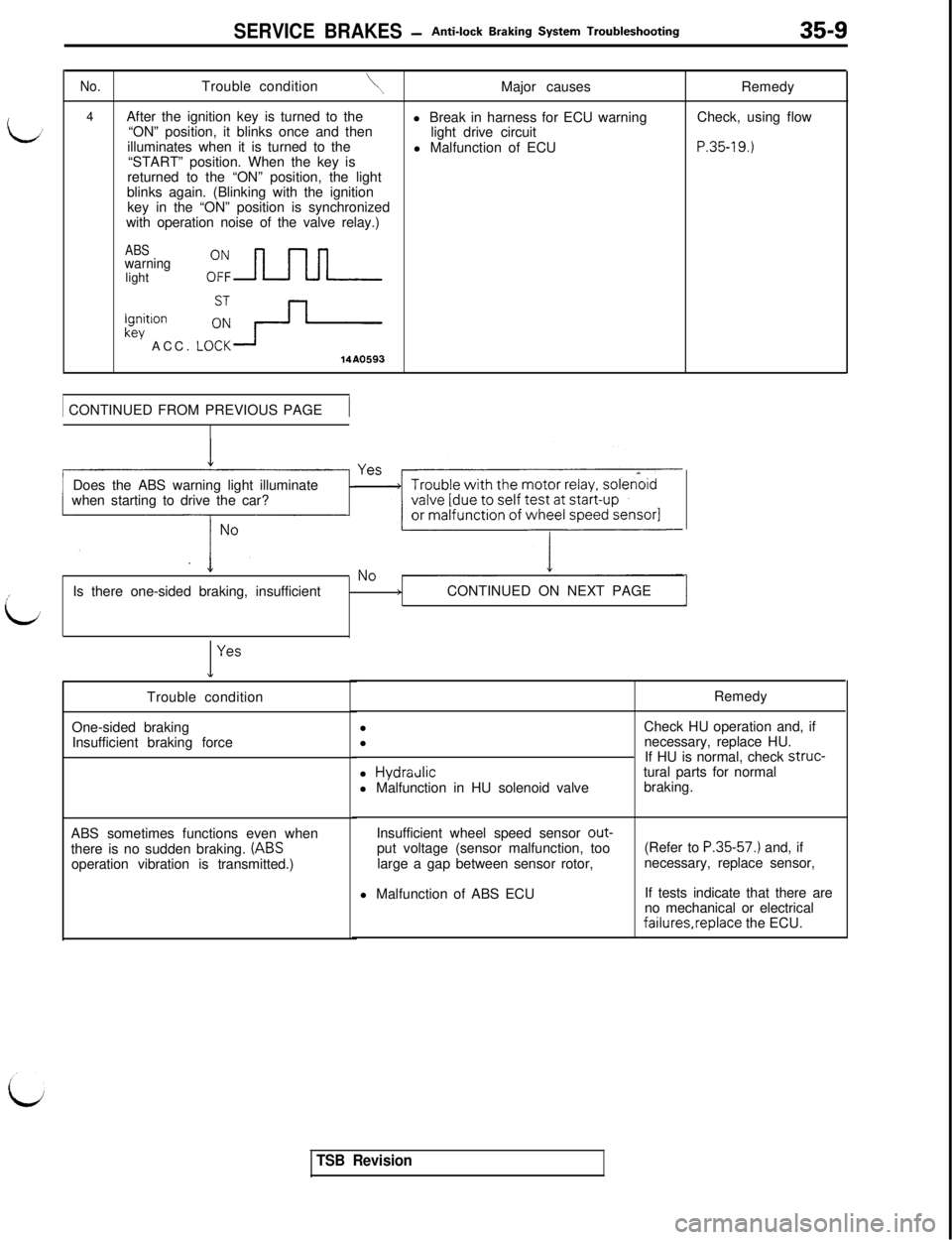
SERVICE BRAKES -Anti-lock Braking System Troubleshooting
L’
No.Trouble condition\4
After the ignition key is turned to the
“ON” position, it blinks once and then
illuminates when it is turned to the
“START” position. When the key is
returned to the “ON” position, the light
blinks again. (Blinking with the ignition
key in the “ON” position is synchronized
with operation noise of the valve relay.)
ABSwarninglight
key ACC. L::+
Ignition
14A05931 CONTINUED FROM PREVIOUS PAGE
1Major causes
l Break in harness for ECU warning
light drive circuit
l Malfunction of ECU
Does the ABS warning light illuminate
when starting to drive the car?
iIs there one-sided braking, insufficient
>CONTINUED ON NEXT PAGEI
I
YesTrouble condition
One-sided braking
Insufficient braking force
ABS sometimes functions even when
there is no sudden braking.
(ABSoperation vibration is transmitted.)Remedy
Check, using flow
P.35-19.)Remedy
l Check HU operation and, if
l necessary, replace HU.
If HU is normal, check struc-
l
HydraJicl Malfunction in HU solenoid valvetural parts for normal
braking.
Insufficient wheel speed sensor put voltage (sensor malfunction, too
large a gap between sensor rotor,
l Malfunction of ABS ECU(Refer to
P.35-57.) and, if
necessary, replace sensor,
If tests indicate that there are
no mechanical or electricalfaiIures,replace the ECU.
TSB Revision
Page 734 of 1146
35-12SERVICE BRAKES -Anti-lock Braking System Troubleshooting
METHOD OF CLEARING DIAGNOSIS
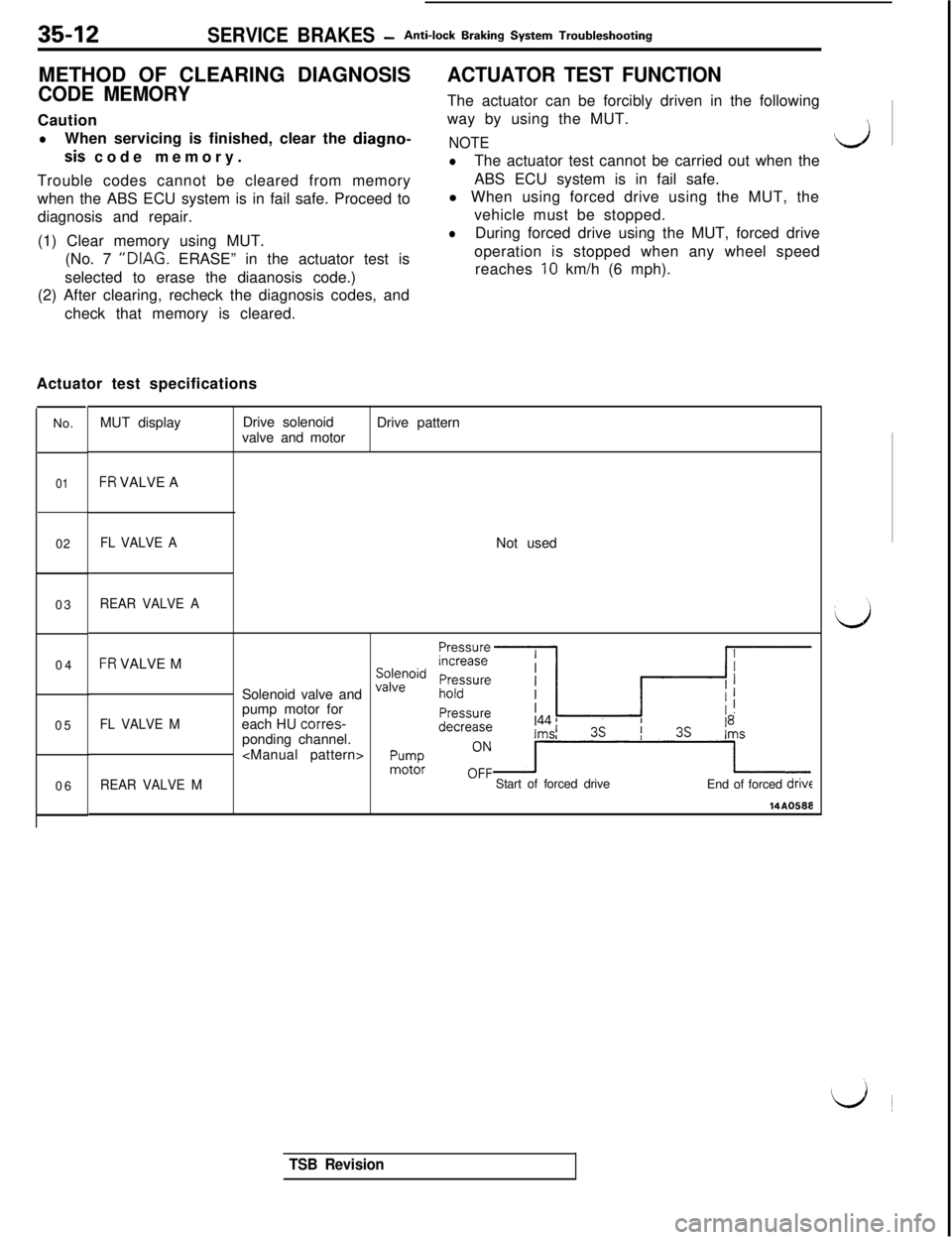
ACTUATOR TEST FUNCTION
CODE MEMORYThe actuator can be forcibly driven in the following
Cautionway by using the MUT.
lWhen servicing is finished, clear the diagno-
sis code memory.NOTEd
lThe actuator test cannot be carried out when the
Trouble codes cannot be cleared from memoryABS ECU system is in fail safe.
when the ABS ECU system is in fail safe. Proceed tol When using forced drive using the MUT, the
diagnosis and repair.vehicle must be stopped.
(1) Clear memory using MUT.
lDuring forced drive using the MUT, forced drive
(No. 7
“DIAG. ERASE” in the actuator test isoperation is stopped when any wheel speed
selected to erase the diaanosis code.)reaches 10 km/h (6 mph).
(2) After clearing, recheck the diagnosis codes, and
check that memory is cleared.
Actuator test specifications
No.MUT display
01FR VALVE A
02
FL VALVE A03
REAR VALVE A04
FR VALVE M
05
FL VALVE M06
REAR VALVE MDrive solenoid
valve and motorDrive pattern
Not used
Solenoid valve and
pump motor for
each HU corres-
ponding channel.
Start of forced drive
End of forced drive
1440588
TSB Revision
Page 742 of 1146
35-20SERVICE BRAKES -Anti-lock Braking System Troubleshooting
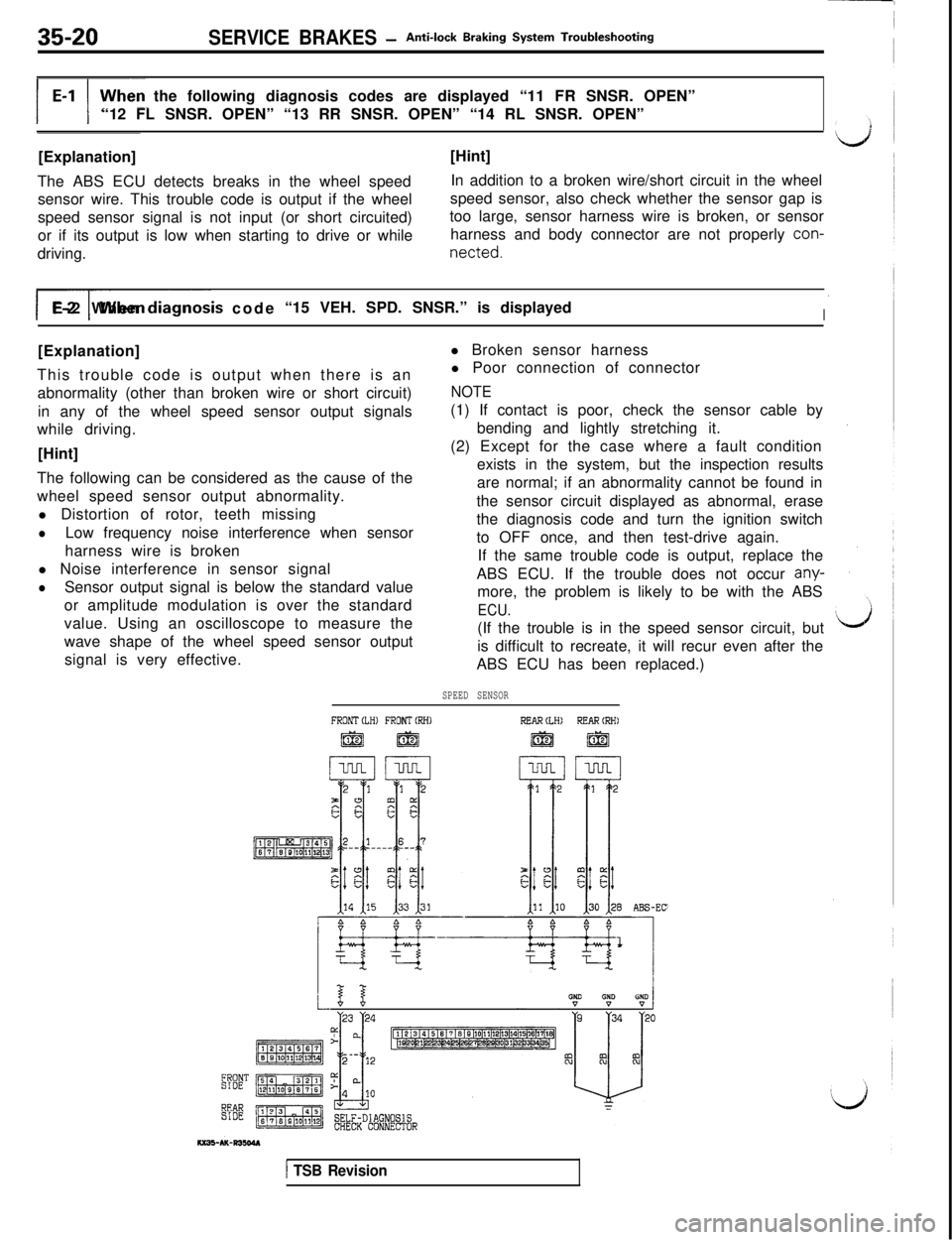
the following diagnosis codes are displayed “11 FR SNSR. OPEN”
“12 FL SNSR. OPEN” “13 RR SNSR. OPEN” “14 RL SNSR. OPEN”
[Explanation]
The ABS ECU detects breaks in the wheel speed
sensor wire. This trouble code is output if the wheel
speed sensor signal is not input (or short circuited)
or if its output is low when starting to drive or while
driving.[Hint]
In addition to a broken wire/short circuit in the wheel
speed sensor, also check whether the sensor gap is
too large, sensor harness wire is broken, or sensor
harness and body connector are not properly
con-
netted.
r--~- -E-2 When dlagnosls code“15 VEH. SPD. SNSR.” is displayedI[Explanation]
This trouble code is output when there is an
abnormality (other than broken wire or short circuit)
in any of the wheel speed sensor output signals
while driving.
[Hint]
The following can be considered as the cause of the
wheel speed sensor output abnormality.
l Distortion of rotor, teeth missing
lLow frequency noise interference when sensor
harness wire is broken
l Noise interference in sensor signal
lSensor output signal is below the standard value
or amplitude modulation is over the standard
value. Using an oscilloscope to measure the
wave shape of the wheel speed sensor output
signal is very effective.l Broken sensor harness
l Poor connection of connector
NOTE(1) If contact is poor, check the sensor cable by
bending and lightly stretching it.
(2) Except for the case where a fault condition
exists in the system, but the inspection results
are normal; if an abnormality cannot be found in
the sensor circuit displayed as abnormal, erase
the diagnosis code and turn the ignition switch
to OFF once, and then test-drive again.
If the same trouble code is output, replace the
ABS ECU. If the trouble does not occur
any-more, the problem is likely to be with the ABS
ECU.(If the trouble is in the speed sensor circuit, but
is difficult to recreate, it will recur even after the
ABS ECU has been replaced.)
SPEED SENSOR
FRONTCLH) FRONTFTRH)RF.AR(LH) REfIR(RH)
@cTJ @ij@ fi&
1 TSB Revision
Page 743 of 1146
SERVICE BRAKES -Anti-lock Braking System Troubleshooting35-21
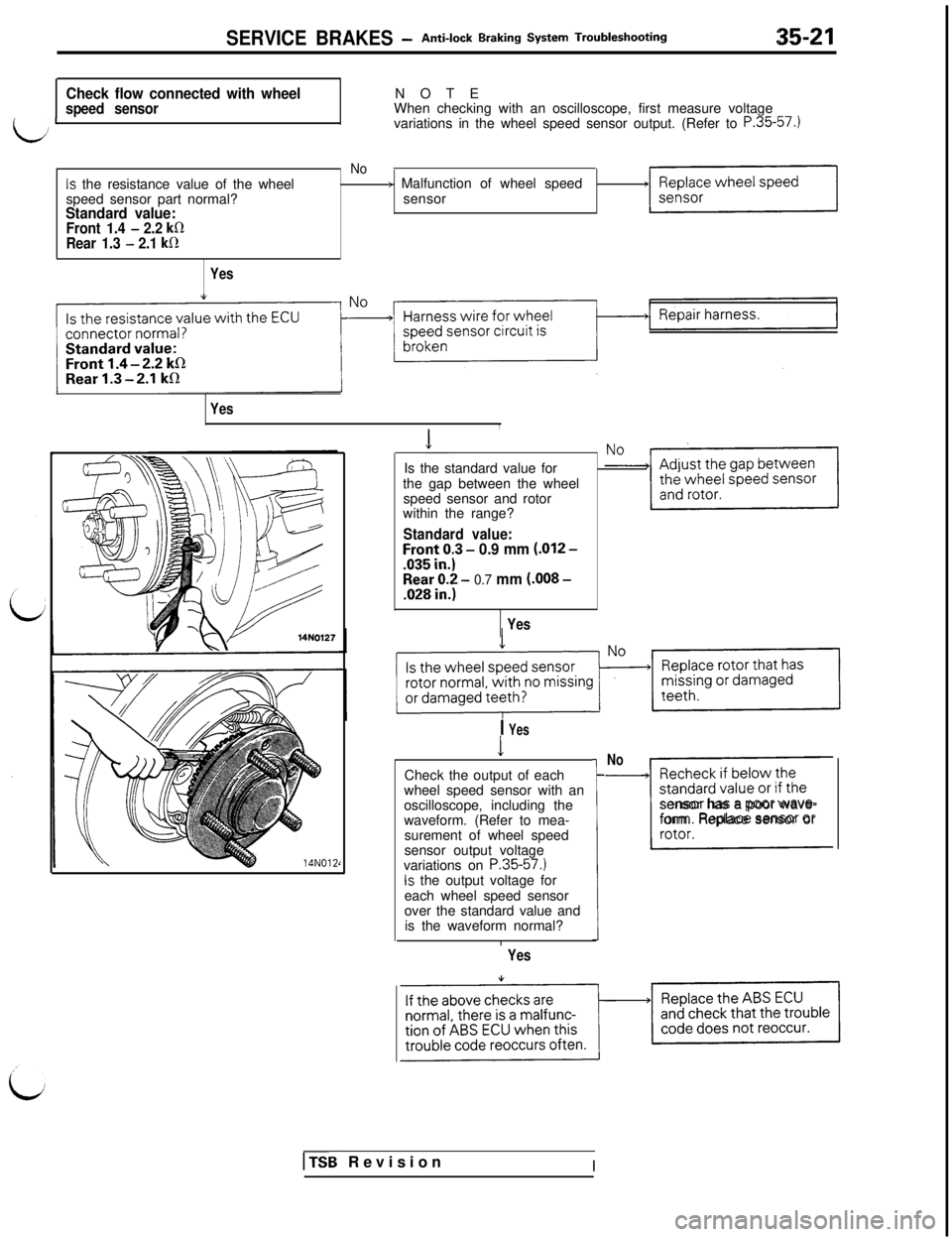
Check flow connected with wheelNOTEspeed sensorWhen checking with an oscilloscope, first measure voltage
iivariations in the wheel speed sensor output. (Refer to P.35-57.)
No
Is the resistance value of the wheel
speed sensor part normal?
Standard value:Front 1.4 - 2.2 kRRear 1.3 - 2.1 kSZ
> Malfunction of wheel speed
sensor
Yes
Yes
1
IIs the standard value for
the gap between the wheel
speed sensor and rotor
within the range?
Standard value:;+;;fi3 - 0.9 mm LO12 -
poe288r,$ - 0.7 mm LOO8 -
Yes
I Yes
ICheck the output of each
wheel speed sensor with an
oscilloscope, including the
waveform. (Refer to mea-
surement of wheel speed
sensor output voltage
variations on
P.35-57.)Is the output voltage for
each wheel speed sensor
over the standard value and
is the waveform normal?
:
No-
Lsensor has a poor wave-
form. Replace sensor or
Yes
RB RevisionI
Page 749 of 1146
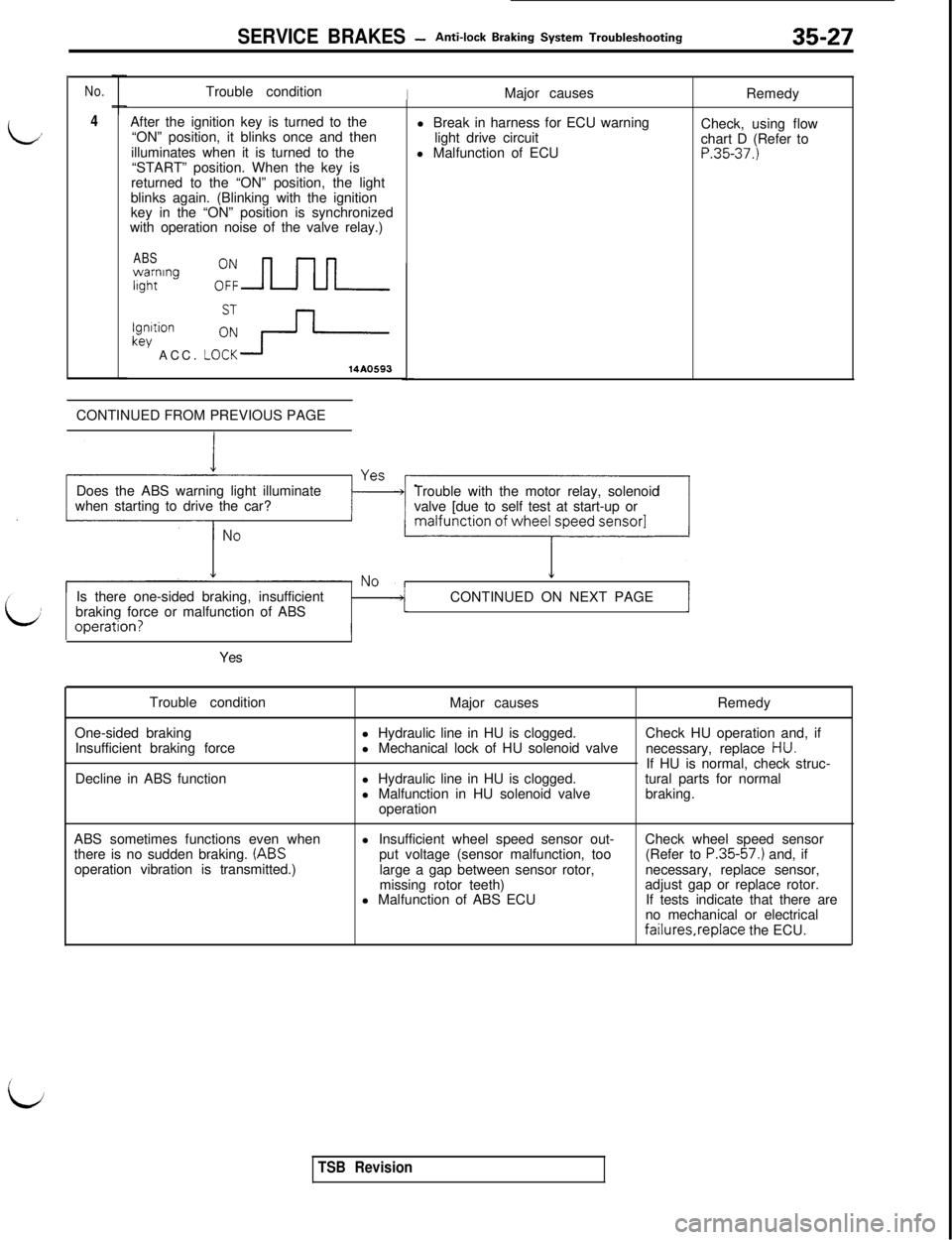
SERVICE BRAKES -Anti-lock Braking System Troubleshooting35-27
i-,’
No.
4Trouble condition
IMajor causes
After the ignition key is turned to the
“ON” position, it blinks once and then
illuminates when it is turned to the
“START” position. When the key is
returned to the “ON” position, the light
blinks again. (Blinking with the ignition
key in the “ON” position is synchronized
with operation noise of the valve relay.)
ABSwarrmglightkey ACC.
LOi;+lgmtion14A0593l Break in harness for ECU warning
light drive circuit
l Malfunction of ECU
CONTINUED FROM PREVIOUS PAGE
Yes
Trouble condition
One-sided braking
Insufficient braking force
Decline in ABS function
ABS sometimes functions even when
there is no sudden braking.
(ABSoperation vibration is transmitted.)Remedy
Check, using flow
chart D (Refer to
P.35-37.)Does the ABS warning light illuminate
when starting to drive the car?Trouble with the motor relay, solenoid
valve [due to self test at start-up or
Is there one-sided braking, insufficient
braking force or malfunction of ABSCONTINUED ON NEXT PAGE
Major causes
l Hydraulic line in HU is clogged.
l Mechanical lock of HU solenoid valve
l Hydraulic line in HU is clogged.
l Malfunction in HU solenoid valve
operation
l Insufficient wheel speed sensor out-
put voltage (sensor malfunction, too
large a gap between sensor rotor,
missing rotor teeth)
l Malfunction of ABS ECURemedy
Check HU operation and, if
necessary, replace
HU.If HU is normal, check struc-
tural parts for normal
braking.
Check wheel speed sensor
(Refer to
P.35-57.) and, if
necessary, replace sensor,
adjust gap or replace rotor.
If tests indicate that there are
no mechanical or electrical
failures,replace the ECU.
TSB Revision