warning MITSUBISHI 3000GT 1991 User Guide
[x] Cancel search | Manufacturer: MITSUBISHI, Model Year: 1991, Model line: 3000GT, Model: MITSUBISHI 3000GT 1991Pages: 1146, PDF Size: 76.68 MB
Page 663 of 1146
33B-1
ELECTRONIC
CONTROL
SUSPENSION
CONTENTSM33AA-B
CIRCUIT DIAGRAM
22SPECIAL TOOLS........................................................................3
................................................................
DAMPING FORCE CHANGEOVERSPECIFICATIONS....................................................................2
ACTUATOR................................................................................20General Specifications.......................................................2
ECS CONTROL UNIT................................................................21Service Specifications.......................................................3
ECS INDICATOR LIGHT............................................................20STEERING ANGULAR VELOCITYa .
ECS SWITCH............................................................................
19
G SENSOR................................................................................
19
POSITION DETECTION SWITCH............................................20
SERVICE ADJUSTMENT PROCEDURES
............................
12
On-Vehicle Inspection........................................................12
SENSOR*....................................................................................-IY
STOP LIGHT SWITCH............................................................20
THROTTLE POSITION SENSOR
............................................20
TROUBLESHOOTING............................................................4
VEHICLE SPEED SENSOR....................................................
SUPPLEMENTAL RESTRAINT SYSTEM (SRS)
(I)A Supplemental Restraint System (SRS), which uses a driver-side air bag, has been installed in the 3000GT.(2)The SRS includes the following components: impact sensors, SRS diagnosis unit: SRS warning light, aiir bagmodule, clock spring, interconnecting wiring.Other SRS-related components (that may have 1:o be
removed/installed in connection with SRS service or maintenance) are indicated in the table of contents byan asterisk (*).
WARNING!(1)Improper service or maintenance of any component of the SRS, or any SRS-related component, can lead to
personal injury or death to service personnel (from inadvertent firing of the air bag) or to the driver (from
rendering the SRS inoperative).
(2) Service or maintenance of any SRS component or SRS-related component must be performed only at an
authorized MITSUBISHI dealer.(3) MITSUBISHI dealer personnel must thoroughly review this manual, and especially its GROUP
Ei2B -Supplemental Restraint System (SRS), before beginning any service or maintenance of any component of theSRS or any SRS-related component.
Page 674 of 1146
33B-12ELECTRONIC CONTROL SUSPENSION (EC9 - i?:~~u:‘?s*men*
12FOOOESERVICE ADJUSTMENT PROCEDURES
I
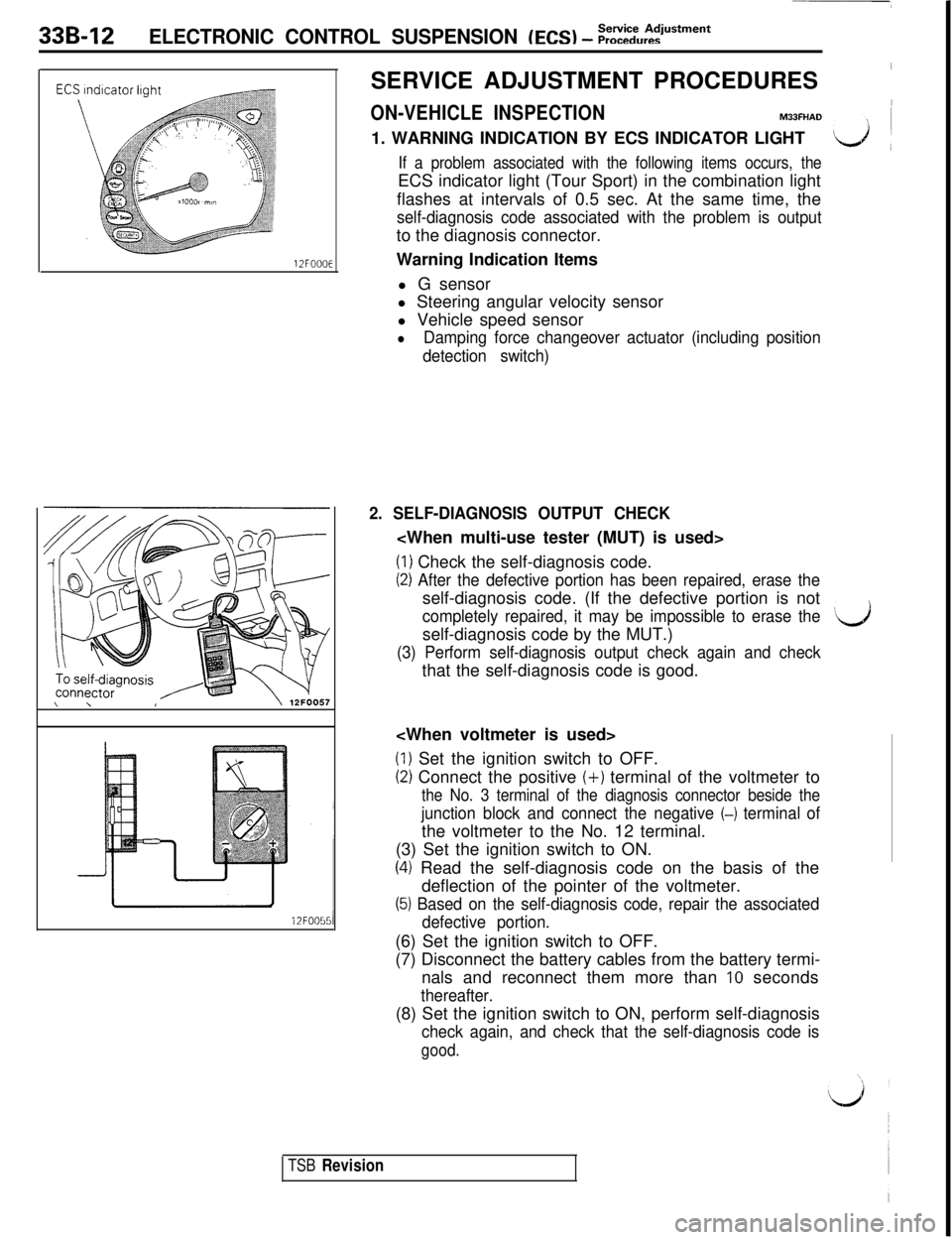
ON-VEHICLE INSPECTIONIM33FHAD1. WARNING INDICATION BY ECS INDICATOR LIGHT
If a problem associated with the following items occurs, theECS indicator light (Tour Sport) in the combination light
flashes at intervals of 0.5 sec. At the same time, the
self-diagnosis code associated with the problem is outputto the diagnosis connector.
Warning Indication Items
l G sensor
l Steering angular velocity sensor
l Vehicle speed sensor
lDamping force changeover actuator (including position
detection switch)
2. SELF-DIAGNOSIS OUTPUT CHECK
(I) Check the self-diagnosis code.
(2) After the defective portion has been repaired, erase theself-diagnosis code. (If the defective portion is not
completely repaired, it may be impossible to erase the’self-diagnosis code by the MUT.)d
(3) Perform self-diagnosis output check again and checkthat the self-diagnosis code is good.
(1) Set the ignition switch to OFF.
(2) Connect the positive (+) terminal of the voltmeter to
the No. 3 terminal of the diagnosis connector beside the
junction block and connect the negative (--) terminal ofthe voltmeter to the No. 12 terminal.
(3) Set the ignition switch to ON.
(4) Read the self-diagnosis code on the basis of the
deflection of the pointer of the voltmeter.
(5) Based on the self-diagnosis code, repair the associated
defective portion.(6) Set the ignition switch to OFF.
(7) Disconnect the battery cables from the battery termi-
nals and reconnect them more than
10 seconds
thereafter.(8) Set the ignition switch to ON, perform self-diagnosis
check again, and check that the self-diagnosis code is
good.
TSB Revision
Page 675 of 1146
![MITSUBISHI 3000GT 1991 User Guide Service AdjustmentELECTRONIC CONTROL SUSPENSION (ECS) - Procedures33B-13Fail Safe and Diagnosis List
Output Code
Diagnosis Item
Fail SafeCode No.Indication Pattern
0[Good]
[Good]
l-l
11G sensor defect](/img/19/57085/w960_57085-674.png "MITSUBISHI 3000GT 1991 User Guide Service AdjustmentELECTRONIC CONTROL SUSPENSION (ECS) - Procedures33B-13Fail Safe and Diagnosis List
Output Code
Diagnosis Item
Fail SafeCode No.Indication Pattern
0[Good]
[Good]
l-l
11G sensor defect")
Service AdjustmentELECTRONIC CONTROL SUSPENSION (ECS) - Procedures33B-13Fail Safe and Diagnosis List
Output Code
Diagnosis Item
Fail SafeCode No.Indication Pattern
0[Good]
[Good]
l-l
11G sensor defective*l Ride controls (pinching and bouncingcontrol, bad road detection control) sl:op.
21Steering angularvelocity sensor open-circuited*
l Anti-roll control stops.
24Vehicle speed sensor*nn open-crrcurtedl Steering stability controls (anti-roll, high
speed sensitive controls) and attitude
controls (anti-dive, anti-squat) stop.l Shock absorber damping force fixed
F. L. damping forcefl-~-~-j 11c$i;z;;Fr actuator
R. R. damping force
I /
64 j-jMJ-~-~-~ ~t$ec~Z$rn&ftYrrZ& /
NOTE(1)Control stop, warning indication and fixed damping force return to normal when the ignition switch is set to OFF.
When any of the problems marked* occurs, if no subsequent problem occurs (for example, when the problem IStransient) normal operation will be restored even if the ignition switch is not set to OFF.(2)Even if control stop warning indication and fixed damping force return to normal as described above, the
self-diagnosis code’is stored in the memory in the ECS control unrt.
(3)The self-diagnosis code can be force-cleared by use of the MUT or by stopping the power supply to the ECS controlunit. In addition
it is automatically cleared if the ON/OFF control of the ignition swatch is repeated 60 times after the
self-diagnosis code has been output, provided that no new self-diagnosis code is output during the period.TSB Revision
Page 723 of 1146
L,
SERVICE
BRAKES
CONTENTSM35AA..
ANTI-LOCK BRAKING SYSTEM TROUBLESHOOTING7Actuator Test Function
. . . . ..___..._____.__................................ I 2, 36Check Using Self Diagnosis Function __._.....,_._.._____........ 11, 28
Diagnosis Code Chart ..,,........,......_..................................,. 1 I, 28
How to Use the Troubleshooting Flow Chart
_____.___......._._.7Method of Clearing Diagnosis Code Memory._.,._...... 12, 30
Particular Phenomena of the Anti-lock Braking System
7Troubleshooting (ABS-AWD) ._______._.._...........................,... 26
Troubleshooting (ABS-FWD) ______.._._........_...........,.....,.....,....8
TroubleshootingMethods. . . . . . . . . . . . . . . . . . . . . . . . . . . . . . . . . . . . . . . . . . . . . . . .7
BRAKE LINE . . . . . . .._.......................................................................71
BRAKEPEDAL. . . . . . . . . . . . . . . . . . . . . . . . . . . . . . . . . . . . . . . . . . . . . . . . . . . . . . . . . . .64
ELECTRONIC CONTROL UNIT (ABS). . . . .._._..___..__._............93/
L
FRONT DISC BRAKE. . . . . . . . . . . . . . . . . . . . . . . . . . . . . . . . . . . . . . . . . . . . . . . . . . . . . . . .73G SENSOR (AWD-ABS)’
____.____.___.__._._.................,,......,.....,.... 92
HYDRAULIC UNIT (ABS) .___.._._._._.______.............,...,,..........~ .,_____86
MASTER CYLINDER AND BRAKE BOOSTER ..__.._____.._____67SPECIFICATIONS ._....._.___.....................................
REAR DISC BRAKE . . . . . . .._..._._.___................................................81
SERVICE ADJUSTMENT PROCEDURES..___........45Bleeding48
Brake Booster Operating Inspection.
46
Brake Drum Inside Diameter Check. . .56
BrakeFluidLevelSensor Check.46
Brake Lining and Brake Drum Connection Check56Brake
Linrng Thickness Check............................................Brake Pedal Inspection and Adjustment............................Check Valve Operation Check............................................Front Brake Disc Run-out Check........................................Front Brake Disc Run-out Correction................................Front Disc Brake Pad Check and Replacement................Inspection of Front Brake Disc Thickness........................Inspection of Hydraulic Unit................................................Inspectton of Power Relay....................................................Inspection of Valve Relay and Motor Relay (ABS)............Measurement of Wheel Speed Sensor Output Voltage
Proportioning Valve Function Test
....................................Rear Brake Disc Run-out Check........................................Rear Brake Disc Run-out Correction................................Rear Brake Disc Thickness Check....................................Rear Disc Brake Pad Check and Replacement................Remedy in Case of DischargedBattery............................56
45
46
52
53
48
5258
62
62
57
47
55
55
55
53
62
SPECIAL TOOLS ..__.......___..........................................................General Specifications
........................................................Lubricants............................................................................Sealants and Adhesives........................................................Service Specifications........................................................3
TROUBLESHOOTING............................................................5
WHEEL SPEED SENSOR (ABS)............................................88
SUPPLEMENTAL RESTRAINT SYSTEM (SRS)
(1)A Supplemental Restraint System (SRS), which uses a driver-side air bag, has been installed in the 3000GT.(2)The SRS includes the following components: impact sensors, SRS diagnosis unit: SRS warning light, air bagmodule, clock spring, interconnecting wiring. Other SRS-related components (that may have to be
removed/installed in connection with SRS service or maintenance) are indicated in the table of contents byan asterisk (*).
WARNING!(1)Improper service or maintenance of any component of the SRS, or any SRS-related component, can lead to
personal injury or death to service personnel (from inadvertent firing of the air bag) or to the driver (fromrendering the SRS inoperative).
(2) Service or maintenance of any SRS component or SRS-related component must be performed only at anauthorized MITSUBISHI dealer.
(3) MITSUBISHI dealer personnel must thoroughly review this manual, and especially its GROUP 52B
-Supplemental Restraint System (SRS), before beginning any service or maintenance of any component of theSRS or any SRS-related component.
i
Page 729 of 1146
SERVICE BRAKES -Anti-lock Braking System Troubleshooting35-7
ANTI-LOCK BRAKING SYSTEM TROUBLESHOOTlilGPARTICULAR PHENOMENA OF THE
LANTI-LOCK BRAKING SYSTEMModels equipped with the anti-lock braking system
(ABS) may exhibit one or more of the following
phenomena from time to time, but none of these
are abnormal.
(1) A pulsing feeling in the brake pedal, or vibration
of the body or the steering wheel, when the
anti-lock braking system is activated by sudden
braking or by braking on a slippery road surface.
.9ctually, this phenomenon is an indication that
the anti-lock braking system is functioning nor-
mally.(2) When the vehicle speed reaches approximately
6 km/h (4 mph) after the engine is started and
the vehicle starts off (for the first time), a
whining motor noise may be heard from the
engine compartment if the vehicle is traveling in
a quiet place, but this noise is simply the result
of a self-check being made of the anti-lock
braking system operation.
TROUBLESHOOTING METHODSProblems related to the anti-lock braking system
(ABS) can be classified into two general categories:
problems in the electrical system and those in the
Lhydraulic system.For problems in the electrical system, the
self-diagnosis function is built into the electronic control
unit (E.C.U.) causing the ABS warning light to
illuminate as a warning to the driver. In this instance,
checks can be made by using the multi-use tester
and oscilloscope.
Problems in the hydraulic system (poor braking,
etc.) can be located in the same way as for ordinary
brakes. There is, however, the necessity to check to
determine whether the problem is related to ordin-
ary brake components or to the components related
to the ABS. To make this check, use the multi-use
tester.
HOW TO USE THE TROUBLESHOOTING
FLOW CHART(1) Using the flow chart, check the ABS warning
light light-up sequence. Read the diagnosis
codes and check the condition of braking opera-
tion.
(2) Following the check chart listed in the remedy
column, perform the checks. There are [Explana-
tion] and [Hint] in each check chart. Refer to
them when troubleshooting.
NOTEECU: Electronic control unit
HU: Hydraulic unit
MUT: Multi-use tester
1 TSB Revision
Page 730 of 1146
35-8SERVICE BRAKES -Anti-lock Braking System Troubleshooting
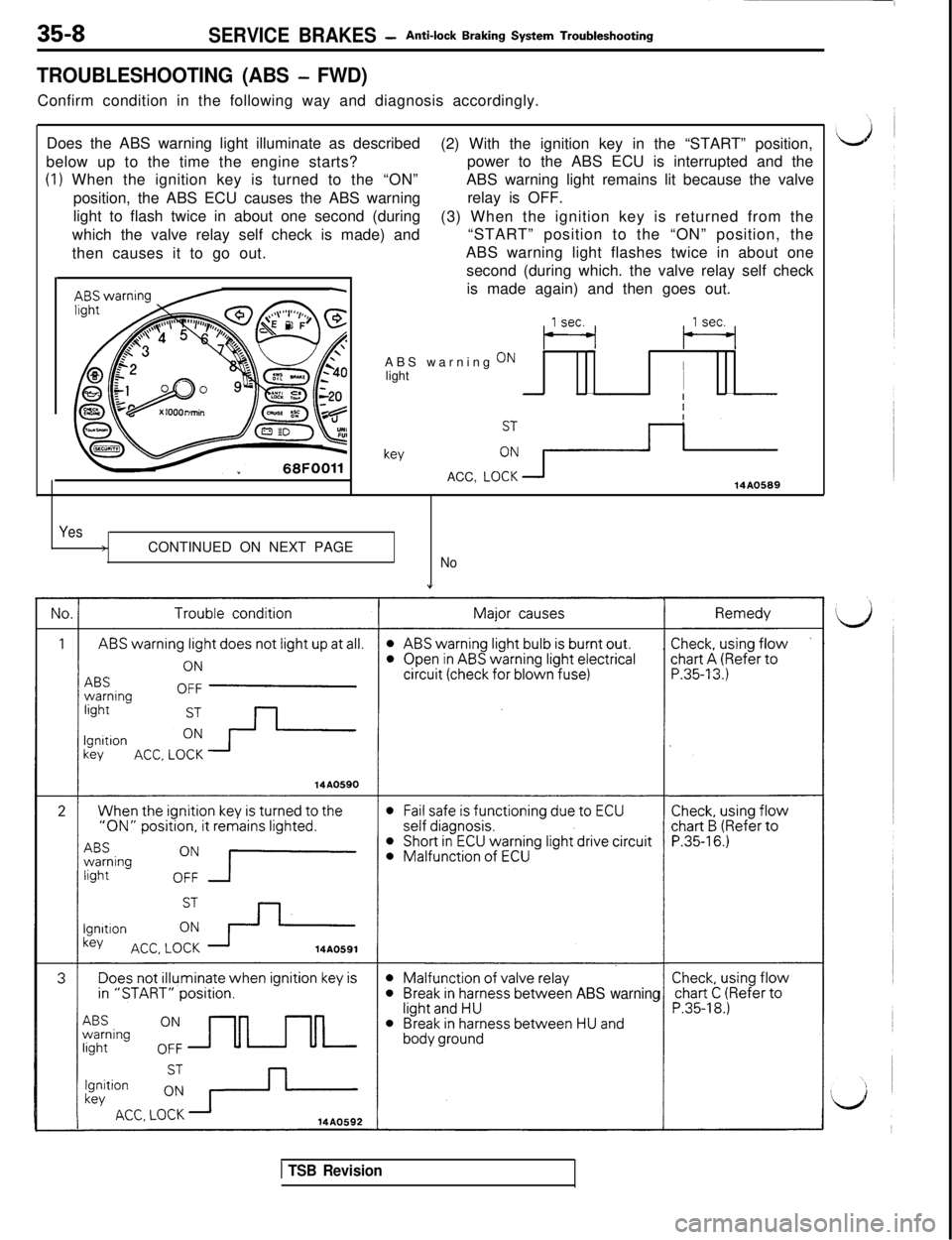
TROUBLESHOOTING (ABS - FWD)Confirm condition in the following way and diagnosis accordingly.
Does the ABS warning light illuminate as described
(2) With the ignition key in the “START” position,
below up to the time the engine starts?power to the ABS ECU is interrupted and the
(1) When the ignition key is turned to the “ON”ABS warning light remains lit because the valve
position, the ABS ECU causes the ABS warningrelay is OFF.
light to flash twice in about one second (during
(3) When the ignition key is returned from the
which the valve relay self check is made) and“START” position to the “ON” position, the
then causes it to go out.ABS warning light flashes twice in about one
second (during which. the valve relay self check
-is made again) and then goes out.
ABS warning
ONlightII
-I
keyACC,
LO!: +--14A0589
Yes>CONTINUED ON NEXT PAGE
No
”
weenABS warning
1 TSB Revision
Page 731 of 1146
SERVICE BRAKES -Anti-lock Braking System Troubleshooting
L’
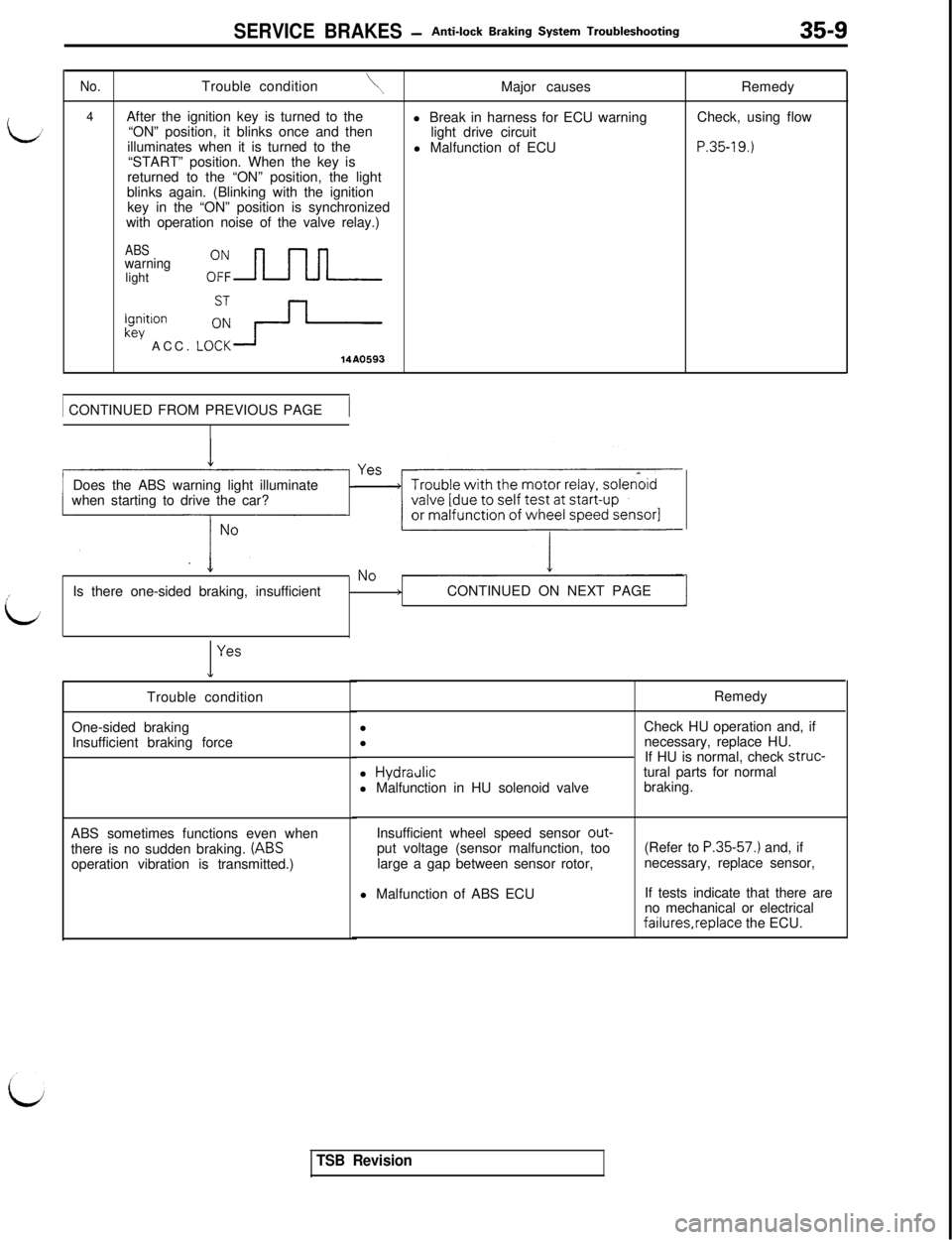
No.Trouble condition\4
After the ignition key is turned to the
“ON” position, it blinks once and then
illuminates when it is turned to the
“START” position. When the key is
returned to the “ON” position, the light
blinks again. (Blinking with the ignition
key in the “ON” position is synchronized
with operation noise of the valve relay.)
ABSwarninglight
key ACC. L::+
Ignition
14A05931 CONTINUED FROM PREVIOUS PAGE
1Major causes
l Break in harness for ECU warning
light drive circuit
l Malfunction of ECU
Does the ABS warning light illuminate
when starting to drive the car?
iIs there one-sided braking, insufficient
>CONTINUED ON NEXT PAGEI
I
YesTrouble condition
One-sided braking
Insufficient braking force
ABS sometimes functions even when
there is no sudden braking.
(ABSoperation vibration is transmitted.)Remedy
Check, using flow
P.35-19.)Remedy
l Check HU operation and, if
l necessary, replace HU.
If HU is normal, check struc-
l
HydraJicl Malfunction in HU solenoid valvetural parts for normal
braking.
Insufficient wheel speed sensor put voltage (sensor malfunction, too
large a gap between sensor rotor,
l Malfunction of ABS ECU(Refer to
P.35-57.) and, if
necessary, replace sensor,
If tests indicate that there are
no mechanical or electricalfaiIures,replace the ECU.
TSB Revision
Page 733 of 1146
SERVICE BRAKES -Anti-lock Braking System Troubleshooting
35-11
Adapter
iarness%f&(MB9913771(Mi3991341)\12FOO57
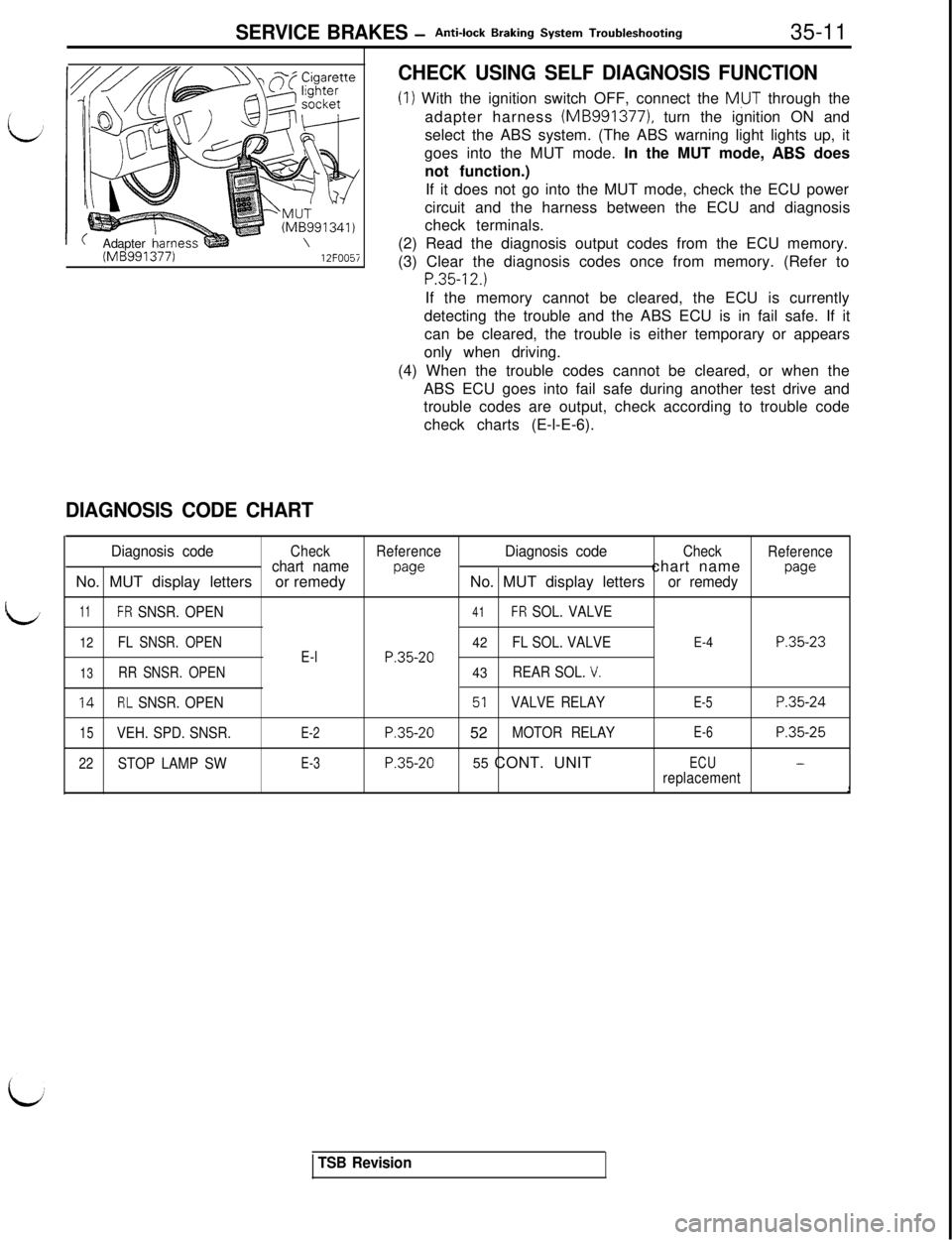
CHECK USING SELF DIAGNOSIS FUNCTION
(1) With the ignition switch OFF, connect the MUT through the
adapter harness
(MB9913771, turn the ignition ON and
select the ABS system. (The ABS warning light lights up, it
goes into the MUT mode. In the MUT mode, ABS does
not function.)
If it does not go into the MUT mode, check the ECU power
circuit and the harness between the ECU and diagnosis
check terminals.
(2) Read the diagnosis output codes from the ECU memory.
(3) Clear the diagnosis codes once from memory. (Refer to
P.35-12.)If the memory cannot be cleared, the ECU is currently
detecting the trouble and the ABS ECU is in fail safe. If it
can be cleared, the trouble is either temporary or appears
only when driving.
(4) When the trouble codes cannot be cleared, or when the
ABS ECU goes into fail safe during another test drive and
trouble codes are output, check according to trouble code
check charts (E-l-E-6).
DIAGNOSIS CODE CHART
Diagnosis codeCheckReferenceDiagnosis codeCheck
Referencechart namepagechart namepawNo. MUT display lettersor remedyNo. MUT display lettersor remedy
L11FR SNSR. OPEN41FR SOL. VALVE
12FL SNSR. OPEN42FL SOL. VALVEE-4P.35-23E-lP.35-2013RR SNSR. OPEN43REAR SOL. V.
14RL SNSR. OPEN51VALVE RELAYE-5P.35-24
15VEH. SPD. SNSR.E-2P.35-20 52MOTOR RELAYE-6P.35-25
22STOP LAMP SWE-3P.35-2055 CONT. UNITECU-
replacementI
TSB Revision
Page 735 of 1146
![MITSUBISHI 3000GT 1991 User Guide .SERVICE BRAKES -Anti-lock Braking System Troubleshooting35-13 A ABS warning light does not light at all.
iJ[Explanation][Hint]
When it does not light up at all, there is a strongIf other warning lig](/img/19/57085/w960_57085-734.png "MITSUBISHI 3000GT 1991 User Guide .SERVICE BRAKES -Anti-lock Braking System Troubleshooting35-13 A ABS warning light does not light at all.
iJ[Explanation][Hint]
When it does not light up at all, there is a strongIf other warning lig")
.SERVICE BRAKES -Anti-lock Braking System Troubleshooting35-13 'A ABS warning light does not light at all.
iJ[Explanation][Hint]
When it does not light up at all, there is a strongIf other warning lights do not light up either, fuse is
possibility that there is trouble with ABS warningprobably blown.
light or with power to the light.
id
r
f%ER RELAY
110
* ::h=g
6
::5
d
.-2=
?Et0
~
2____--..-
?EI
5fir 4
I
4 -
IGNITIONSWITCH(IG2)m!--
mj:
JSIBLE LINK0tiB
2
L__---------___
0
Lp1%
%2
j:(L-R)dg
6-k
&h+&"..L"Ei SOLENOID1:
G-R
G-R
^ -tl- - D
HH H?bb
IN:IGl)-
59
1
ki@iNATION
iB
ABS-ECU
Kxss-AK-RSGOIA
1 TSB RevisionI
Page 737 of 1146
SERVICE BRAKES -Anti-lock Braking System Troubleshooting35-15
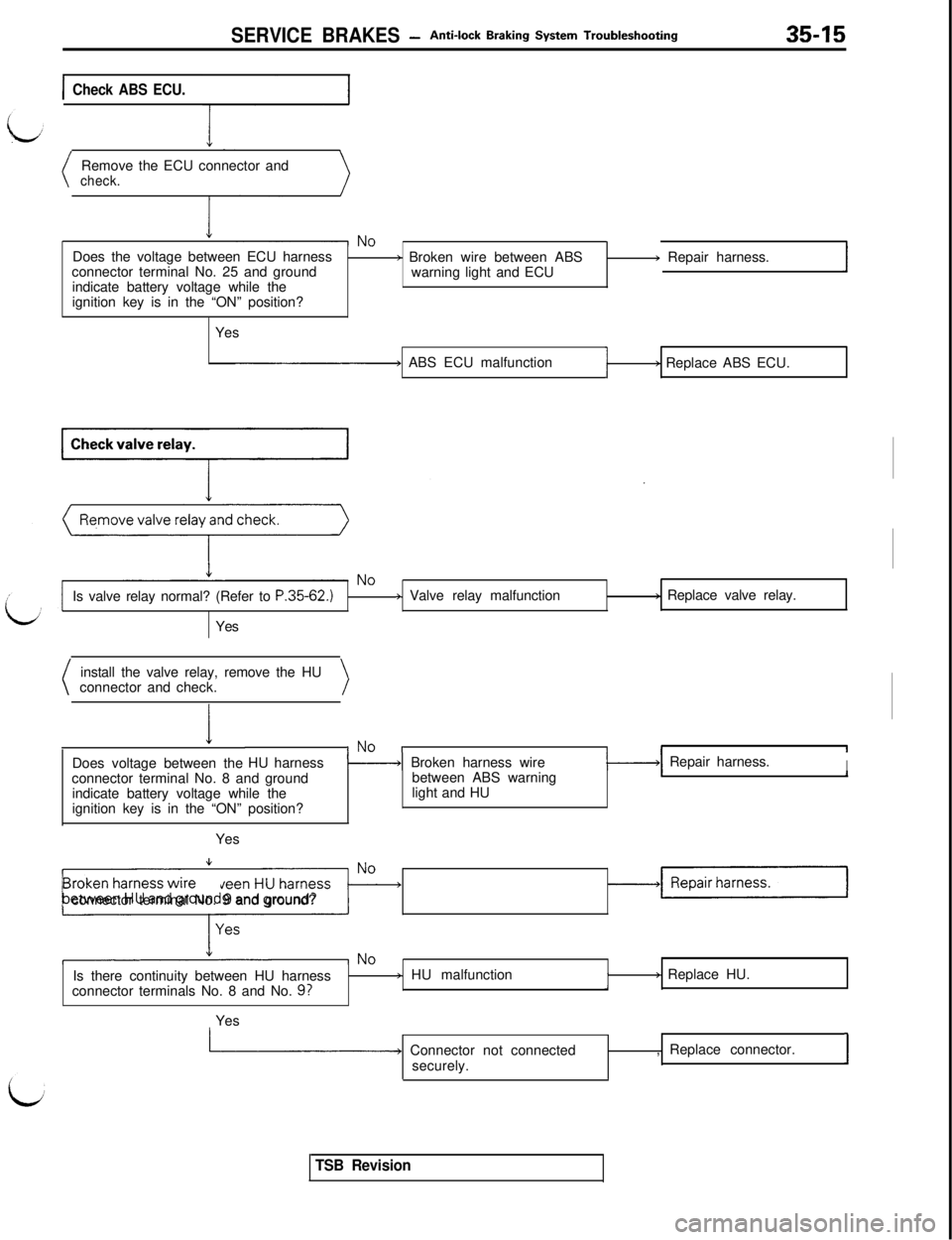
ICheck ABS ECU.Remove the ECU connector and
check.Does the voltage between ECU harness
connector terminal No. 25 and ground
indicate battery voltage while the
ignition key is in the “ON” position?
Yes
b Broken wire between ABS
warning light and ECU) Repair harness.
I ABS ECU malfunctionI) Replace ABS ECU.
Is valve relay normal? (Refer to
P.35-62.)Yes+ Valve relay malfunctionb Replace valve relay.
install the valve relay, remove the HU
connector and check.
IDoes voltage between theINO IHU harness\----+I Broken harness wireII1-1 Repair harness.I
Iconnector terminal No. 8 and ground
indicate battery voltage while the
ignition key is in the “ON” position?between ABS warning
light and HU1IYes
Is there continuity between HU harness
4:~~&?$?%$&ndconnector terminal No. 9 and ground?
Is there continuity between HU harness
connector terminals No. 8 and No.
9?
j HU malfunctionI> Replace HU.
Yes
L Connector not connected
securely., Replace connector.I
TSB Revision